Archive
09/26/11 – Ephemeris – The sun is getting very active again
Monday, September 26th. The sun will rise at 7:34. It’ll be up for 11 hours and 58 minutes, setting at 7:32. The moon, 1 day before new, will rise at 7:53 tomorrow morning.
There is a large sunspot group rotating onto the earth facing side of the sun. It has already produced two large solar flares. Flares are explosions caused by the snapping of the magnetic field lines that cause the sunspots in the first place. The most energetic of these throw off a huge cloud of charged particles, protons, electrons, and alpha particles called a coronal mass ejection or CME at a couple of million miles an hour. It takes 36 to 48 hours for the cloud to reach the earth. Then it tangles with the earth’s magnetic field causing a geomagnetic storm. This is not good news for satellite operators and power and phone companies in the north. However for the rest of us, we get a chance to see the northern lights or Aurora Borealis. Saturday’s two flares from that sunspot group sent out a CME that we may catch the tail of later today.
* Times are for the Traverse City/Interlochen area of Michigan. They may be different for your location.
08/16/11 – Ephemeris – Solar conjunctions today of Mercury and Venus
Tuesday, August 16th. The sun rises at 6:45. It’ll be up for 14 hours and 0 minutes, setting at 8:46. The moon, 3 days past full, will rise at 9:38 this evening.
Today we have an interesting coincidence. Both Venus and Mercury will be in conjunction with the sun. Astrologers may make a big deal out of it but this time astronomers won’t. A conjunction means that two solar system bodies are just north and south of each other. At 8:07 this morning Venus will be just north of the sun in superior conjunction. That is it is beyond the sun. And at 9:03 this evening Mercury will be somewhat south of the sun in inferior conjunction. Thai is it is between the earth and the sun. Mercury will be going into our morning sky, while Venus will begin to appear in the evening sky later this fall. But the coolest thing of all will be Venus’ next inferior conjunction June 6th, 2012. It will cross the face of the sun in a rare transit.
* Times are for the Traverse City/Interlochen area of Michigan. They may be different for your location.
05/10/11 – Ephemeris – The Ancient Greeks and measuring the distance to the sun
Tuesday, May 10th. The sun rises at 6:20. It’ll be up for 14 hours and 36 minutes, setting at 8:57. The moon, at first quarter today, will set at 2:46 tomorrow morning.
The ancient Greek astronomers had great success in actually calculating the distance to the moon. They came up with 60 earth radii. Yes, they knew the earth was round and even measured its circumference to great accuracy. The distance they got for the moon lies within the range of the actual moon’s distance. They next tried to measure the distance from the sun. To do this, they tried to observe the moon and the sun at the exact time the moon was at first quarter. At this time the earth, sun and moon make a right triangle. Theoretically the actual angle between the sun and the moon would give the distance to the sun. The answer they got was that the sun was 20 times the moon’s distance. That’s way short, the sun is 400 times the moon’s distance away.
* Times are for the Traverse City/Interlochen area of Michigan. They may be different for your location.
Addendum
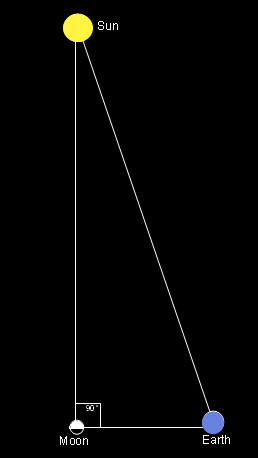
How the ancient Greeks tried to calculate the distance to the sun.
To the right is my take on the Greek sun measuring experiment. Using their guy Euclid and his geometry they knew that the sum of the angles of a triangle equal 180 degrees.
Having an exactly quarter moon, first or last, they knew the Sun-Moon-Earth angle was 90 degrees, so if they could measure the Sun-Earth-Moon angle from observation, they knew the other angle at the sun.
They had already calculated the moon’s distance, so they could calculate the other leg, the Sun-Moon distance using trigonometry. The first trig tables were invented by Greek astronomer Hipparchus.
Ah yes, Trig tables. I don’t suppose you kids use them anymore, with your electronic calculators. Back in my high school days my calculator was a slide rule. Sorry, old guy grousing.
What’s wrong with this picture?
I received this in an email. The picture’s pretty but is it real? If not, what’s wrong? Answer in the comments.
Sunset at the North Pole. This is one of the rarest picture that you mayever see in your life when the moon was closest to the earth. The date: Jan 13, 2011.This is the sunset at the North Pole with the moon at its closest point last week. a scene you will probably never get to see in person, so take a moment and enjoy God at work at the North Pole. And, you also see the sun below the moon, an amazing photo and not one easily duplicated. You may want to pass it on to others so they can enjoy it. The Chinese have a saying that goes something like this: 'When someone shares with you something of value, you have an obligation to share it with others!'

02/17/11 – Ephemeris – The whole sun is visible now
Thursday, February 17th. The sun will rise at 7:39. It’ll be up for 10 hours and 33 minutes, setting at 6:13. The moon, 1 day before full, will set at 7:24 tomorrow morning.
Four and a half years ago NASA launched a two spacecraft on a single rocket. One was sent ahead of the earth, and the other to trail behind the earth in its orbit. They are called Stereo, and give us a stereo view of the sun. Earlier this month they reached points 90 degrees ahead and behind the earth. They now cover the complete sun, front and back. For the next 9 years we should get coverage of the far side of the sun, so we’ll see what’s brewing in the way of sunspots and other solar phenomena before they rotate around to the side that faces the earth. The sun rotates slowly, and as a fluid body. At the equator the sun rotates in 25 days, at the poles it drops to 36 days. This differential rotation causes the sun’s magnetic field to tangle and break.
* Times are for the Traverse City/Interlochen area of Michigan. They may be different for your location.
 Bob Moler's Ephemeris Blog