Archive
07/05/11 – Ephemeris – The ancient’s perfect moon
Tuesday, July 5th. Today the sun will be up for 15 hours and 26 minutes, setting at 9:30. The moon, 3 days before first quarter, will set at 11:49 this evening. Tomorrow the sun will rise at 6:04.
As we look at the moon tonight we can see dark areas and bright areas. To western philosophers and astronomers from Aristotle to Copernicus objects in the heavens were thought to be perfect and changeless and moved in uniform circular motion around the earth. However the moon doesn’t appear perfect and spotless. It has light and dark areas on it. The supposed explanation for that was that it was a perfect mirror and reflected the earth. It might make sense if you didn’t think about it too much. For a very long time nobody did, at least nobody that made a difference until Copernicus came along. With Copernicus, Galileo and his telescope, Tycho Brahe’s observations, Kepler and Newton, the heavens were changed forever.
* Times are for the Traverse City/Interlochen area of Michigan. They may be different for your location.
06/14/11 – Ephemeris – Fate of the Apollo lunar flags
Flag Day, Tuesday, June 14th. Today the sun will be up for 15 hours and 32 minutes, setting at 9:28. The moon, 1 day before full, will set at 5:35 tomorrow morning. Tomorrow the sun will rise at 5:56
Whatever happened to the flags left on the moon by the Apollo astronauts? Forty or so years after the landings the sun’s harsh unfiltered light, especially in the ultraviolet has bleached and degraded the nylon fabric of the flags. Also the lunar soil, called regolith contains small jagged particles that are very compact and hard to pound a flag pole in. Apparently the flags of all but Apollo 11 and 15 are still standing, while the rocket blast of the lunar module ascent stage blew down the other two. The flag of the United States is carried on two spacecraft that are about to leave the magnetic bubble around the sun that is the heliosphere. The farthest, Voyager 1 is 117 times the earth’s distance from the sun, nearly 11 billion miles away.
* Times are for the Traverse City/Interlochen area of Michigan. They may be different for your location.
06/13/11 – Ephemeris – The lunar crater Aristarchus
Monday, June 13th. Today the sun will be up for 15 hours and 31 minutes, setting at 9:28. The moon, 2 days before full, will set at 4:39 tomorrow morning. Tomorrow the sun will rise at 5:56.
The moon tonight is bright. The sunrise line or terminator on the moon is crossing the large gray plain called Oceanus Procellarum, the largest of the moon’s seas. These seas were figments of the first telescopic observers imagination. They are really huge impact basins into which interior lava flowed. On the upper left edge of the moon near the terminator is a bright spot on the moon visible in binoculars. In a telescope it is a crater called Aristarchus. It is a fairly new crater, probably less than a billion years old. As a rule the brighter the crater the newer it is. Aristarchus is the brightest spot on the moon. Over the years visual astronomers have seen hazes and bright spots from time to time in and near Aristarchus.
* Times are for the Traverse City/Interlochen area of Michigan. They may be different for your location.
Addendum
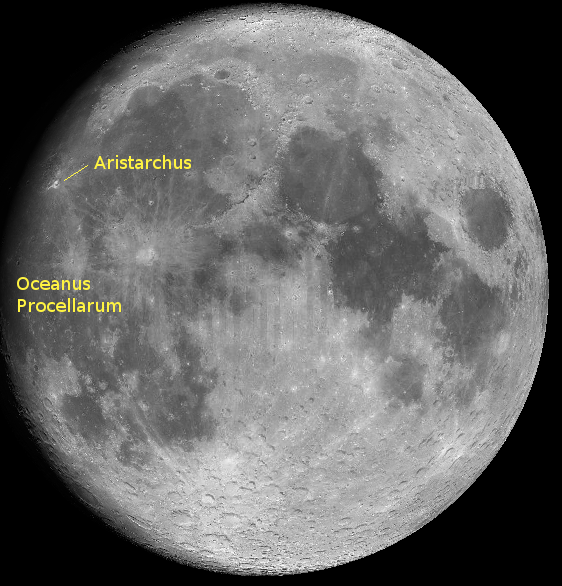
The moon with Aristarchus. Created with Virtual Moon Atlas.
06/10/11 – Ephemeris – The moon tonight
Friday, June 10th. Today the sun will be up for 15 hours and 29 minutes, setting at 9:26. The moon, 2 days past first quarter, will set at 2:40 tomorrow morning. Tomorrow the sun will rise at 5:57.
Tonight the moon is in its gibbous phase. Gibbous means hump backed. One crater that came into light in the last 24 hours is the crater Copernicus, named for the Polish astronomer and cleric who removed the earth from the center of the universe. The crater Copernicus is on the center left on the moon. Its halo of rays will show up better when the moon is full, but now the crater itself can be appreciated. In a telescope its is quite a sight. It has a complex triple central peak, and terraced walls. The small asteroid that hit it less than a billion years ago, struck the moon, gouging out the 56 mile diameter crater we see today. Rebound created the central peaks. An oblique image of it by a Lunar Orbiter in the late 60s was a famous picture of the time.
* Times are for the Traverse City/Interlochen area of Michigan. They may be different for your location.
06/09/11 – Ephemeris – The moon tonight
Thursday, June 9th. Today the sun will be up for 15 hours and 28 minutes, setting at 9:26. The moon, 1 day past first quarter, will set at 2:10 tomorrow morning. Tomorrow the sun will rise at 5:57.
Lets take a look at the moon tonight. It’ll be a day past first quarter and we see features at the terminator, the sunrise line which gives the moon a slightly gibbous shape. In small telescopes, at the north or top end of the moon, the wide flat crater Plato has just entered sunlight. Long shadows from its crater walls will retreat across its flat floor. If you look closely you’ll notice that the floor of Plato is slightly convex to conform with the curvature of the moon itself. South of Plato is a distinctive triangle of three craters on the flat floor of the Sea of Showers The largest is Archimedes, the northern of the other two is Aristellus, while the other is Autolycus. They are near the Apollo 15 landing site.
* Times are for the Traverse City/Interlochen area of Michigan. They may be different for your location.
06/06/11 – Ephemeris – The moon tonight
Monday, June 6th. Today the sun will be up for 15 hours and 25 minutes, setting at 9:24. The moon, 2 days before first quarter, will set at 12:50 tomorrow morning. Tomorrow the sun will rise at 5:58.
The moon tonight is a fat crescent. In binoculars the small Sea of Crises is prominently located as a gray patch at the edge of the moon. The Sea of Fertility is below it, while the sea of Tranquility is between them and near the terminator, the sunrise line on the moon. In telescopes there are three craters south of Tranquility, most prominent of which is Theophilus. With its prominent central peak. Farther to the north of Crises and near the terminator is the crater Posidonus, larger than Theophilus, but has a double crater wall on one side. Larger telescopes can see cracks in its floor . It has no central peak, and shows its age of maybe three and a half billion years.
* Times are for the Traverse City/Interlochen area of Michigan. They may be different for your location.
Addendum
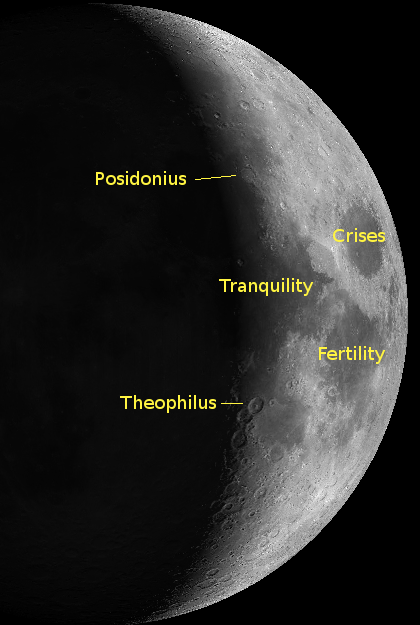
The moon on June 6, 2011 - Virtual Moon Atlas
05/12/11 – Ephemeris – Lunar telescopic wonders: Bay of Rainbows and the crater Copernicus
Thursday, May 12th. Today the sun will be up for 14 hours and 41 minutes, setting at 8:59. The moon, 2 days past first quarter, will set at 3:40 tomorrow morning. Tomorrow the sun will rise at 6:17.
Tonight the moon will again show a hook out into the darkness at the upper left edge of the moon for observers using binoculars or a telescope. That’s the Jura mountains cupping the Bay of Rainbows, a rather gray lava expanse on the edge of the Sea of Showers. At the other edge of the that sea is the great crater Copernicus, center left on the moon. Its halo of rays will show up better when the moon is full, but now the crater itself can be appreciated. In a telescope its is quite a sight. It has a complex triple central peak, and terraced walls. The small asteroid that hit it less than a billion years ago, struck the moon, gouging out the 56 mile diameter crater we see today. Rebound created the central peaks.
* Times are for the Traverse City/Interlochen area of Michigan. They may be different for your location.
Addendum
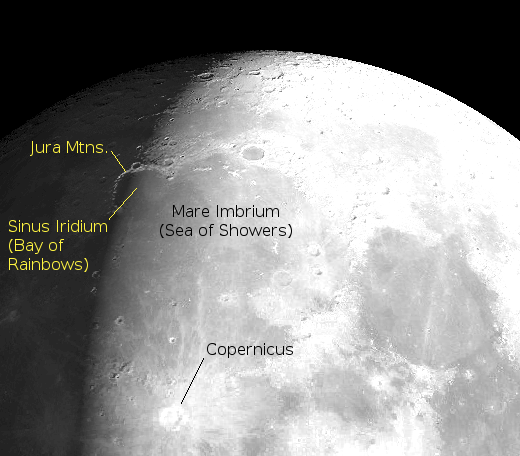
Bay of Rainbows and the crater Copernicus. Created using Virtual Moon Atlas.
I have more on Sinus Iridium and the Jura Mountains back in March.
05/10/11 – Ephemeris – The Ancient Greeks and measuring the distance to the sun
Tuesday, May 10th. The sun rises at 6:20. It’ll be up for 14 hours and 36 minutes, setting at 8:57. The moon, at first quarter today, will set at 2:46 tomorrow morning.
The ancient Greek astronomers had great success in actually calculating the distance to the moon. They came up with 60 earth radii. Yes, they knew the earth was round and even measured its circumference to great accuracy. The distance they got for the moon lies within the range of the actual moon’s distance. They next tried to measure the distance from the sun. To do this, they tried to observe the moon and the sun at the exact time the moon was at first quarter. At this time the earth, sun and moon make a right triangle. Theoretically the actual angle between the sun and the moon would give the distance to the sun. The answer they got was that the sun was 20 times the moon’s distance. That’s way short, the sun is 400 times the moon’s distance away.
* Times are for the Traverse City/Interlochen area of Michigan. They may be different for your location.
Addendum
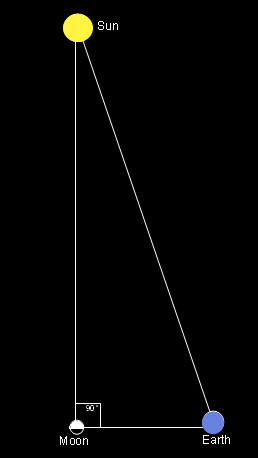
How the ancient Greeks tried to calculate the distance to the sun.
To the right is my take on the Greek sun measuring experiment. Using their guy Euclid and his geometry they knew that the sum of the angles of a triangle equal 180 degrees.
Having an exactly quarter moon, first or last, they knew the Sun-Moon-Earth angle was 90 degrees, so if they could measure the Sun-Earth-Moon angle from observation, they knew the other angle at the sun.
They had already calculated the moon’s distance, so they could calculate the other leg, the Sun-Moon distance using trigonometry. The first trig tables were invented by Greek astronomer Hipparchus.
Ah yes, Trig tables. I don’t suppose you kids use them anymore, with your electronic calculators. Back in my high school days my calculator was a slide rule. Sorry, old guy grousing.
05/09/11 – Ephemeris – The Rabbit in the Moon
Monday, May 9th. The sun rises at 6:22. It’ll be up for 14 hours and 34 minutes, setting at 8:56. The moon, 1 day before first quarter, will set at 2:18 tomorrow morning.
Lets look at the moon for this evening. There’s several ways one can see a rabbit in the moon. The head and ears can be seen in the dark seas on the moon upside down. The Sea of Serenity has just emerged into light and is the shoulders of this rabbit. In binoculars or a telescope The Sea of Serenity or Mare Serenitatis looks to me a bit like a scallop shell in shape. Below that is the Sea of Tranquility, the rabbit’s head. Finishing the rabbit off are its ears, the Sea of Fertility, the fat ear and the Sea of Nectar the skinny ear. Cultures over the earth see different things in the dark seas of the moon. Most familiar to us in the Man in the Moon. In Australia, it is the rabbit. The rest of him is on the night side of the moon now.
* Times are for the Traverse City/Interlochen area of Michigan. They may be different for your location.
Addendum
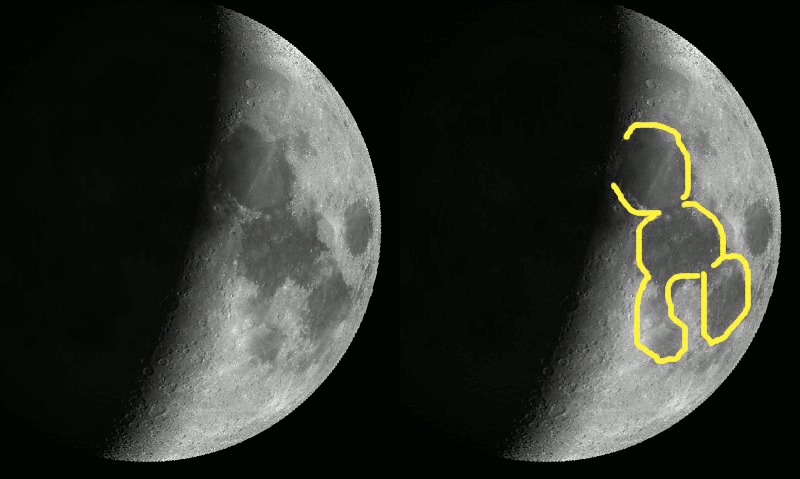
Rabbit in the Moon animation - Lunar image from Virtual Moon Atlas.
04/18/11 – Ephemeris – Paschal Full Moon
Monday, April 18th. The sun rises at 6:53. It’ll be up for 13 hours and 37 minutes, setting at 8:30. The moon, 1 day past full, will rise at 9:49 this evening.
Last night our time the moon was full. It was the Paschal full moon, the first full moon of spring, or officially after March 21st. Western Christian churches celebrate Easter at the Sunday following. That would be the 24th, just one day short of the latest possible date of Easter. Eastern churches use a slightly different calendar and a different calculation method, but this year they celebrate Easter the same date. The calculation methods were chosen to make Easter roughly coincide with Jewish Passover. Christian churches use a calendar based on the earth’s orbit of the sun, or actually the seasons, while the Jewish calendar is based on the lunar cycle. That’s also pretty close this year because Passover begins tonight at sundown.
* Times are for the Traverse City/Interlochen area of Michigan. They may be different for your location.
 Bob Moler's Ephemeris Blog