Archive
02/10/11 – Ephemeris – The moon near first quarter
Thursday, February 10th. The sun will rise at 7:50. It’ll be up for 10 hours and 13 minutes, setting at 6:03. The moon, 1 day before first quarter, will set at 2:04 tomorrow morning.
The moon is just about first quarter. When it’s out tonight it will be less than 6 hours from the actual moment of first quarter, that is when the moon is at a 90 degree angle from the sun. In a small telescope a neat straight feature will be visible. It is near the northern part of the moon, which is up to the unaided eye or binoculars and usually on the lower part of the moon when viewed in an astronomical telescope. The straight feature is the Alpine Valley which cuts through the lunar Alps. Mountain ranges on the moon are named for earthly mountains, though lunar mountains are usually the rims of lunar seas, which are really large craters. The Alpine valley is 79 miles long and 7 miles wide. It appears to be a fault line.
* Times are for the Traverse City/Interlochen area of Michigan. They may be different for your location.
Extra
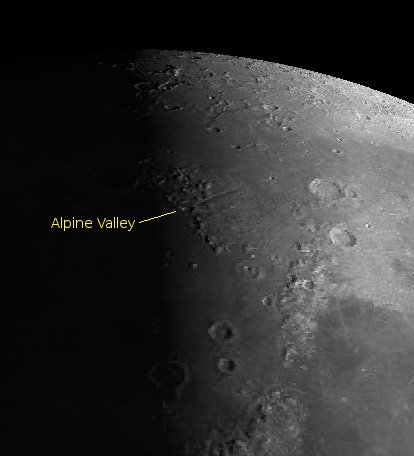
Alpine Valley on the moon
This is not a photograph! Image created using Virtual Moon Atlas by Christian Legrand and Patrick Chevalley. A free program. http://www.ap-i.net/avl/en/start.
02/08/11 – Ephemeris – The lunar crater Theophilus
Tuesday, February 8th. The sun will rise at 7:52. It’ll be up for 10 hours and 8 minutes, setting at 6:00. The moon, 3 days before first quarter, will set at 11:58 this evening.
The 5 day old crescent moon reveals to a small telescope, a trio of large craters on the edge of the moon’s terminator or sunrise line. The best of these is on top Theophilus, a perfectly circular 61 mile diameter crater with a prominent central peak. It’s a little late for it tonight but sometimes when the terminator is crossing the crater, the floor is dark and the central peak catches the morning sunlight. Theophilus is a couple of hundred miles south of the Apollo 11 landing site in the Sea of Tranquility, That sea will be completely in sunlight tomorrow night. The moon is a great celestial object to view with that new telescope. It’d big and bright, and relatively easy to find in the telescope. When trying to find an object in the sky always use the lowest power.
* Times are for the Traverse City/Interlochen area of Michigan. They may be different for your location.
02/07/11 – Ephemeris – The moon appears near Jupiter
Monday, February 7th. The sun will rise at 7:54. It’ll be up for 10 hours and 5 minutes, setting at 5:59. The moon, 4 days before first quarter, will set at 10:56 this evening.
The waxing crescent moon will appear near Jupiter in the evening with Jupiter below the moon. Jupiter is slowly leaving the evening sky, setting earlier by about a half an hour a week, while the sun is setting later by 10 minutes a week. These are the last few weeks to get a good view of Jupiter in a telescope before it sinks too close to the horizon for good views. The more of the earth’s atmosphere we have to look through near the horizon the fuzzier Jupiter looks. The moon is coming on and will brighten over the next week and a half. In binoculars the dark spot on the right edge of the moon is the Sea of Crises. In telescopes usually, about this time, a lone mountain peak at one of the moon’s poles catches the sunlight off the cusp of the crescent.
* Times are for the Traverse City/Interlochen area of Michigan. They may be different for your location.
12/20/10 – Ephemeris – Total lunar eclipse tomorrow morning
Monday, December 20th. The sun will rise at 8:15. It’ll be up for 8 hours and 48 minutes, setting at 5:04. The moon, 1 day before full, will set at 8:33 tomorrow morning.
The winter solstice occurs tomorrow, coincidentally there will be a total lunar eclipse after midnight tonight. The eclipse will start at 1:32 a.m. when the moon will begin to slip into the earth’s inner shadow. The moon will be completely inside the shadow at 2:40 a.m. beginning totality. The moon should still be visible but be a dim red color. The color and brightness of the eclipsed moon depends on the transparency of the earth’s atmosphere because it is illuminated by light being bent into the earth’s shadow by the earth’s atmosphere. Mid eclipse occurs at 3:17 a.m.. Totality will end at 3:53 a.m. when the moon peeks into sunlight again. The partial phase will end at 5:01 a.m. Our next lunar eclipse won’t be until December next year.
* Times are for the Traverse City/Interlochen area of Michigan. They may be different for your location.
11/11/10 – Ephemeris – The Greeks measured the moon and the earth
Veteran’s Day, Thursday, November 11th. The sun will rise at 7:33. It’ll be up for 9 hours and 45 minutes, setting at 5:18. The moon, 2 days before first quarter, will set at 10:22 this evening.
Check out the moon tonight. The Greeks were able to use it to make two great discoveries. First they knew that lunar eclipses were caused by the moon entering the earth’s shadow. That wasn’t the discovery, the discovery was that the edge of the earth’s shadow was always circular. The only object that casts a circular shadow no matter what its orientation is a sphere. So the Greeks knew the earth was round long before the birth of Christ. They were also able to determine the distance of the moon via eclipses as 60 earth radii, which is within the moon’s actual distance range. It was in the 3rd century B.C. that Eratosthenes determined the circumference of the earth to provide an actual distance scale to the moon.
* Times, as always are for the Traverse City/Interlochen area of Michigan.
10/26/10 – Ephemeris – New LCROSS results
Tuesday, October 26th. The sun will rise at 8:12. It’ll be up for 10 hours and 28 minutes, setting at 6:40. The moon, half way from full to last quarter, will rise at 8:51 this evening. | There are now more results from the LCROSS spacecraft collision in an eternally shadowed crater on the moon a bit more than a year ago. These came from the Wall Street Journal. I’ll assume that these results are preliminary too. Despite the disappointing show for TV viewers of this event including yours truly, there was a measurable plume that resulted in the discovery of the hoped for water plus hydrogen, ammonia, methane, plus the metals mercury, sodium and silver. The percentage of the soil kicked up was nearly 6 percent water or rather ice. If the astronauts can get to the rugged south pole of the moon to process the soil into water they will save the approximately $50,000 a pound to haul it up from the earth.
10/22/10 – Ephemeris – The Full Hunter’s Moon
Friday, October 22nd. The sun will rise at 8:06. It’ll be up for 10 hours and 39 minutes, setting at 6:46. The moon, is the full Hunter’s Moon, and will rise at 6:12 this evening.
The full moon is blinding in telescopes and binoculars. Well it is daylight there, and the moon is essentially the same distance from the sun as the earth. The face of the man in the moon is at its best visibility now. In binoculars or low power in telescopes the best feature to view is the ray system radiating out of the bright southern crater Tycho which is relatively fresh. Fresh on the moon is less than a billion years old, how much less is not known. Maybe the Lunar Reconnaissance Orbiter can help pinpoint the age or a visit by astronauts in the future. My general feeling is that the only good full moon is an eclipsed one. On the second full moon from now, on the morning of December 21st we will be able to witness total lunar eclipse, if it’s clear.
10/18/10 – Ephemeris – The moon’s orientation in a telescope
Monday, October 18th. The sun will rise at 8:01. It’ll be up for 10 hours and 51 minutes, setting at 6:52. The moon, half way from first quarter to full, will set at 4:41 tomorrow morning.
This evening the moon will be inviting to the telescope. Depending on your optical arrangement, you will see the moon in different orientations. When I describe the moon is describe it as seen in binoculars, right side up. The Feature that looks like an arc of mountains called the Jura mountains that contain the Bay of Rainbows or Sinus Iridium will appear to the upper left of the moon. In a Newtonian reflecting telescope the moon appears upside down so Sinus Iridium appears to the lower right. A printed moon map may only have to be turned upside down to match what you see. In a telescope with a diagonal mirror by the eyepiece gives a mirror image. Whether it is upside down or not depends on the orientation of the eyepiece.
9/16/10 – Ephemeris – the moon
September 16: This is Ephemeris for Thursday, September 16th.* The sun will rise at 7:22. It’ll be up for 12 hours and 28 minutes, setting at 7:51. The moon, 1 day past first quarter, will set at 1:38 tomorrow morning.
We’re looking at the moon this week leading up to International Observe the Moon Night Saturday night. We’ll have some telescopes at the Clinch Park Marina Saturday if it’s clear. The moon tonight is special for those with telescopes. With lots of features that will be revealed by the moon’s sunrise terminator, the sunrise line of the east edge of the visible part of the moon. Starting at the north or top of the moon is the strange square crater Barrow. Below that is the ringed plane, the crater Plato. It’s cool watching the shadows of the crater walls recede as the sun rises. There’s a gash in the mountains nearby called the Alpine Valley. On the southern half of the moon there’s a thin line of a shadow, the straight wall a 900 foot high and 67 mile long cliff.
*Times are for the Grand Traverse Area of Northern Michigan, USA.
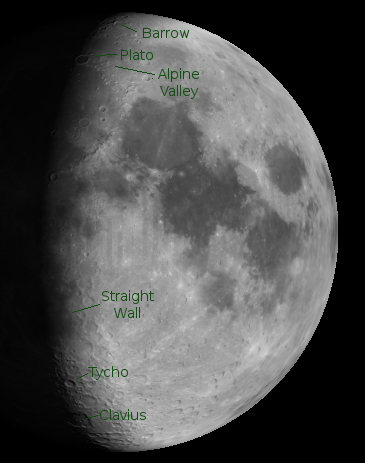
Moon 1 day past first quarter. Created using Virtual Moon Atlas.
Is crater Barrow really square? You be the judge.
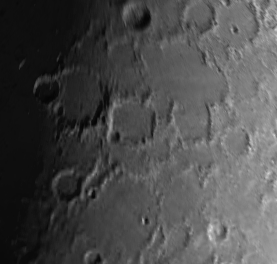
Overhead view of the crater Barrow. Created using Virtual Moon Atlas.
9/14/10 – Ephemeris – the moon
September 14: This is Ephemeris for Tuesday, September 14th.* The sun will rise at 7:20. It’ll be up for 12 hours and 34 minutes, setting at 7:55. The moon, 1 day before first quarter, will set at 11:38 this evening. | We’re looking at the moon this week leading up to International Observe the Moon Night Saturday night. We’ll have some telescopes at the Clinch Park Marina Saturday if it’s clear. The moon, even to the unaided eye shows bright and dark areas. The largest bright area to the bottom or south part of the moon is the highlands, a rugged area saturated with craters. The dark areas are generally nearly circular and flat with few craters. These are the maria which is Latin for seas. Which early telescopic viewers thought were really water filled. The seas are gigantic impact basins created by asteroids impacting the moon and their floors are filled with lava from the moon’s interior. They have relatively few craters that occurred later on.
*Times are for the Grand Traverse Area of Northern Michigan, USA.
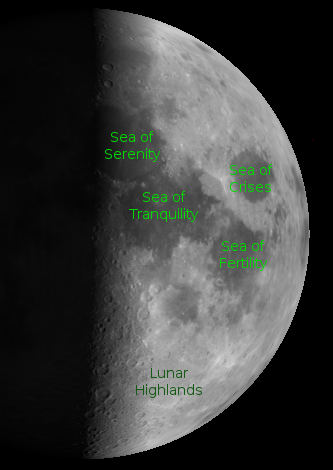
Moon 1 day before first quarter. Created using Virtual Moon Atlas.
 Bob Moler's Ephemeris Blog