Archive
12/01/2020 – Ephemeris – Previewing December skies
This is Ephemeris for Tuesday, December 1st. Today the Sun will be up for 9 hours and 2 minutes, setting at 5:03, and it will rise tomorrow at 8:01. The Moon, 1 day past full, will rise at 6:02 this evening.
Let’s look at December skies. We are now in the holiday season and about to celebrate the southernmost travel of the Sun in the sky and its return northward. So there is not much change in sunrise and sunset times. The Sun will stop its travel south, the winter solstice, on the 21st at 5:02 am. It will make that day the shortest day in terms of daylight hours. However, the earliest sunset will occur on the 9th. The Geminid meteor shower will reach its peak on the evening of the 13th, near new moon. Also in the evening on the 21st Jupiter and Saturn will be in conjunction and will be easily visible in the same binocular or low power telescope field. This month starts out with a surprisingly active Sun at the start of a new sunspot cycle.
The event times given are for the Traverse City/Interlochen area of Michigan. They may be different for your location.
Addendum
December Evening Star Chart
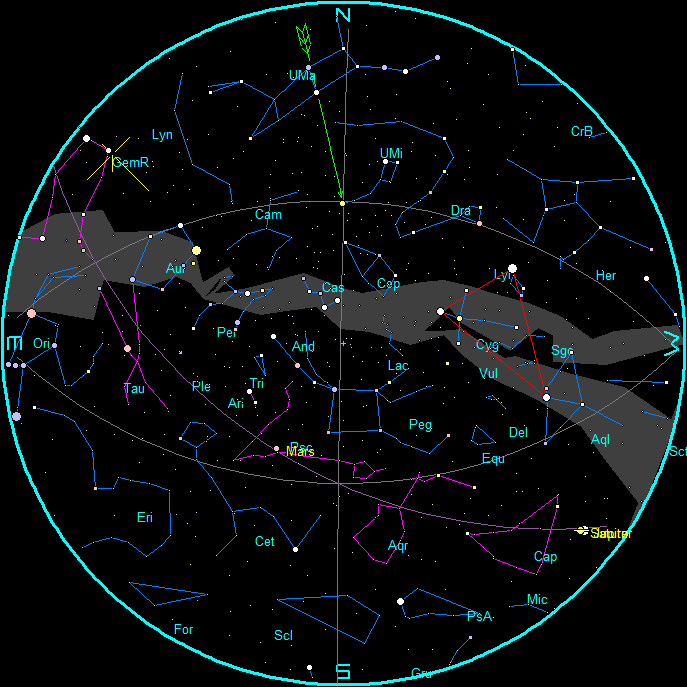
Star Chart for December 2020 (7 p.m. EST December 15, 2019). Click on image to enlarge. Created using my LookingUp program. Click on image to enlarge.
Credit my LookingUp program.
The planets and stars are plotted for the 15th at 7 pm EST (two hours earlier this year to include Jupiter and Saturn) in the evening and 6 a.m. for the morning chart. These are the chart times. Note that Traverse City is located approximately 45 minutes behind our time meridian, West 75° longitude. (An hour 45 minutes behind our daylight saving time meridian during EDT).
December Morning Star Chart
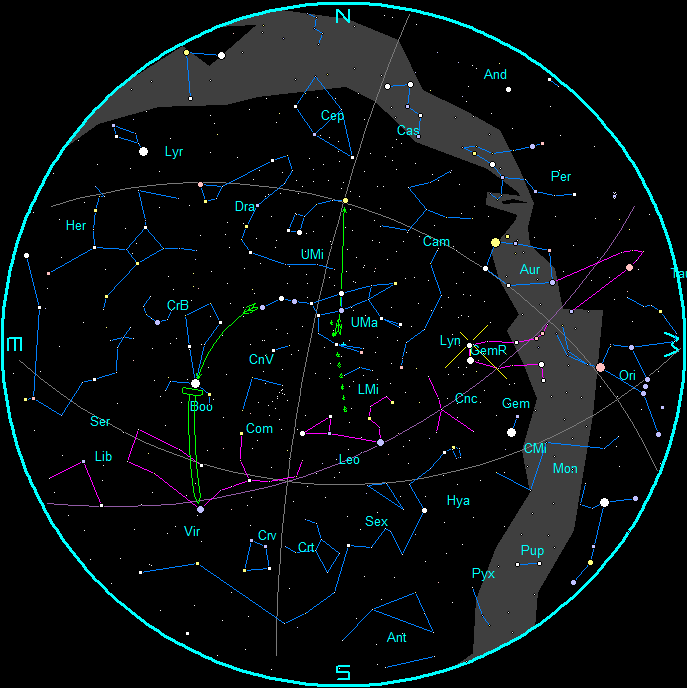
Star Chart for December mornings 2020 (6 a.m. EST December 15, 2020). Click on image to enlarge. Created using my LookingUp program. Credit my LookingUp program.
For a list of constellation names to go with the abbreviations click here.
- Pointer stars at the front of the bowl of the Big Dipper point to Polaris the North Star.
- The leaky bowl of the Big Dipper drips on Leo.
- Follow the arc of the handle of the Big Dipper to the star Arcturus, then
- Follow the spike to Spica.
- The Summer Triangle is in red.
- GemR on the star charts is the radiant of the Geminid meteor shower which peaks on the evening of the 13th.
Twilight Limits, Nautical and Astronomical
| EST | |||||||
| Morning twilight | Evening twilight | Dark night | Moon | ||||
| Date | Astro. | Nautical | Nautical | Astro. | Start | End | Illum. |
| 2020-12-01 | 6h21m | 6h56m | 18h15m | 18h51m | – | – | 0.99 |
| 2020-12-02 | 6h22m | 6h57m | 18h15m | 18h50m | 18h50m | 18h51m | 0.97 |
| 2020-12-03 | 6h23m | 6h58m | 18h15m | 18h50m | 18h50m | 19h48m | 0.92 |
| 2020-12-04 | 6h23m | 6h59m | 18h15m | 18h50m | 18h50m | 20h52m | 0.85 |
| 2020-12-05 | 6h24m | 7h00m | 18h15m | 18h50m | 18h50m | 22h00m | 0.77 |
| 2020-12-06 | 6h25m | 7h01m | 18h15m | 18h50m | 18h50m | 23h12m | 0.67 |
| 2020-12-07 | 6h26m | 7h01m | 18h15m | 18h50m | 18h50m | – | 0.56 |
| 2020-12-08 | 6h27m | 7h02m | 18h15m | 18h50m | 18h50m | 0h25m | 0.45 |
| 2020-12-09 | 6h28m | 7h03m | 18h15m | 18h50m | 18h50m | 1h39m | 0.33 |
| 2020-12-10 | 6h29m | 7h04m | 18h15m | 18h50m | 18h50m | 2h55m | 0.22 |
| 2020-12-11 | 6h29m | 7h05m | 18h15m | 18h50m | 18h50m | 4h13m | 0.13 |
| 2020-12-12 | 6h30m | 7h05m | 18h15m | 18h51m | 18h51m | 5h33m | 0.06 |
| 2020-12-13 | 6h31m | 7h06m | 18h15m | 18h51m | 18h51m | 6h31m | 0.01 |
| 2020-12-14 | 6h31m | 7h07m | 18h16m | 18h51m | 18h51m | 6h31m | 0 |
| 2020-12-15 | 6h32m | 7h08m | 18h16m | 18h51m | 18h51m | 6h32m | 0.02 |
| 2020-12-16 | 6h33m | 7h08m | 18h16m | 18h52m | 19h09m | 6h33m | 0.06 |
| 2020-12-17 | 6h29m | 7h05m | 18h13m | 18h48m | 20h19m | 6h29m | 0.13 |
| 2020-12-18 | 6h30m | 7h06m | 18h13m | 18h49m | 21h29m | 6h30m | 0.21 |
| 2020-12-19 | 6h31m | 7h06m | 18h14m | 18h49m | 22h37m | 6h31m | 0.3 |
| 2020-12-20 | 6h31m | 7h07m | 18h14m | 18h49m | 23h42m | 6h31m | 0.4 |
| 2020-12-21 | 6h32m | 7h07m | 18h14m | 18h50m | – | 6h32m | 0.5 |
| 2020-12-22 | 6h32m | 7h08m | 18h15m | 18h51m | 0h46m | 6h32m | 0.6 |
| 2020-12-23 | 6h33m | 7h08m | 18h16m | 18h51m | 1h47m | 6h33m | 0.69 |
| 2020-12-24 | 6h33m | 7h08m | 18h16m | 18h52m | 2h49m | 6h33m | 0.78 |
| 2020-12-25 | 6h33m | 7h09m | 18h17m | 18h52m | 3h51m | 6h33m | 0.85 |
| 2020-12-26 | 6h34m | 7h09m | 18h17m | 18h53m | 4h54m | 6h34m | 0.91 |
| 2020-12-27 | 6h34m | 7h09m | 18h18m | 18h54m | 5h57m | 6h34m | 0.96 |
| 2020-12-28 | 6h34m | 7h10m | 18h19m | 18h54m | – | – | 0.99 |
| 2020-12-29 | 6h35m | 7h10m | 18h20m | 18h55m | – | – | 0.99 |
| 2020-12-30 | 6h35m | 7h10m | 18h20m | 18h56m | – | – | 1 |
| 2020-12-31 | 6h35m | 7h10m | 18h21m | 18h56m | – | – | 0.99 |
Twilight calendar was generated using Cartes du Ciel (Sky Charts).
See my blog post: Twilight Zone for the definitions of the different periods of twilight here: https://bobmoler.wordpress.com/2018/09/27/.
NASA Calendar of Planetary Events
     Date     Time    Event
Dec 1  Tu            Venus: 27.5° W
    1  Tu  02:46 am  Moon Ascending Node
    2  We  08:22 pm  Moon North Dec.: 24.9° N
    4  Fr  08:10 pm  Moon-Beehive: 2.5° S
    7  Mo  07:37 pm  Last Quarter
   12  Sa  03:40 pm  Moon-Venus: 0.8° S
   12  Sa  03:42 pm  Moon Perigee: 361800 km
   13  Su  07:50 pm  Geminid Meteor Shower: ZHR = 120
   14  Mo  06:03 am  Moon Descending Node
   14  Mo  11:15 am  Total Solar Eclipse
                          (Pacific, S America, Atlantic)
   14  Mo  11:17 am  New Moon
   15  Tu  05:23 pm  Moon South Dec.: 24.9° S
   16  We  11:28 pm  Moon-Jupiter: 3° N
   17  Th  12:25 am  Moon-Saturn: 3.1° N
   19  Sa  09:56 pm  Mercury Superior Solar Conjunction
   21  Mo  05:02 am  Winter Solstice
   21  Mo  06:41 pm  First Quarter
   22  Tu  04:00 am  Ursid Meteor Shower: ZHR = 10
   22  Tu  04:35 am  Jupiter-Saturn: 0.1° N
   23  We  09:48 am  Venus-Antares: 5.6° N
   24  Th  11:32 am  Moon Apogee: 405000 km
   28  Mo  10:03 am  Moon Ascending Node
   29  Tu  10:28 pm  Full Moon
   30  We  02:53 am  Moon North Dec.: 24.9° N
All event times are given for UTC-5 Eastern Standard Time.
Sky Events Calendar by Fred Espenak and Sumit Dutta (NASA’s GSFC),
http://eclipse.gsfc.nasa.gov/SKYCAL/SKYCAL.html.
If you go to the above site you can print out a list like the above for the entire year or calendar pages for your time zone.
Sun and Moon Rising and Setting Events
LU                  Ephemeris of Sky Events for Interlochen/TC
December, 2020    Local time zone: EST
+-----------------------------------------------------------------------+
| DATE |  SUN     SUN  DAYLIGHT|   TWILIGHT*    |MOON  RISE OR    ILLUM |
|      |  RISE    SET    HOURS |  END    START  |PHASE SET** TIME FRACTN|
+=======================================================================+
|Tue  1| 08:00a  05:03p  09:02 | 06:12p  06:51a |      Rise 06:02p   98%|
|Wed  2| 08:01a  05:03p  09:01 | 06:12p  06:52a |      Rise 06:51p   94%|
|Thu  3| 08:02a  05:02p  09:00 | 06:12p  06:53a |      Rise 07:48p   88%|
|Fri  4| 08:03a  05:02p  08:58 | 06:12p  06:53a |      Rise 08:52p   80%|
|Sat  5| 08:04a  05:02p  08:57 | 06:12p  06:54a |      Rise 10:00p   71%|
+------+-----------------------+----------------+-----------------------+
|Sun  6| 08:05a  05:02p  08:56 | 06:12p  06:55a |      Rise 11:12p   61%|
|Mon  7| 08:06a  05:02p  08:55 | 06:12p  06:56a |L Qtr Rise 12:25a   50%|
|Tue  8| 08:07a  05:02p  08:54 | 06:12p  06:57a |      Rise 01:39a   39%|
|Wed  9| 08:08a  05:02p  08:53 | 06:12p  06:58a |      Rise 02:55a   28%|
|Thu 10| 08:09a  05:02p  08:52 | 06:12p  06:59a |      Rise 04:13a   18%|
|Fri 11| 08:10a  05:02p  08:51 | 06:12p  07:00a |      Rise 05:33a   10%|
|Sat 12| 08:11a  05:02p  08:51 | 06:12p  07:00a |      Rise 06:53a    4%|
+------+-----------------------+----------------+-----------------------+
|Sun 13| 08:12a  05:02p  08:50 | 06:13p  07:01a |      Rise 08:11a    1%|
|Mon 14| 08:12a  05:02p  08:49 | 06:13p  07:02a |New   Set  05:06p    0%|
|Tue 15| 08:13a  05:02p  08:49 | 06:13p  07:02a |      Set  06:03p    2%|
|Wed 16| 08:14a  05:03p  08:48 | 06:13p  07:03a |      Set  07:09p    7%|
|Thu 17| 08:14a  05:03p  08:48 | 06:14p  07:04a |      Set  08:18p   14%|
|Fri 18| 08:15a  05:03p  08:48 | 06:14p  07:04a |      Set  09:29p   22%|
|Sat 19| 08:16a  05:04p  08:48 | 06:15p  07:05a |      Set  10:37p   31%|
+------+-----------------------+----------------+-----------------------+
|Sun 20| 08:16a  05:04p  08:48 | 06:15p  07:05a |      Set  11:42p   40%|
|Mon 21| 08:17a  05:05p  08:48 | 06:16p  07:06a |F Qtr Set  12:45a   50%|
|Tue 22| 08:17a  05:05p  08:48 | 06:16p  07:06a |      Set  01:47a   60%|
|Wed 23| 08:18a  05:06p  08:48 | 06:17p  07:07a |      Set  02:49a   69%|
|Thu 24| 08:18a  05:07p  08:48 | 06:17p  07:07a |      Set  03:50a   77%|
|Fri 25| 08:18a  05:07p  08:48 | 06:18p  07:08a |      Set  04:53a   84%|
|Sat 26| 08:19a  05:08p  08:49 | 06:19p  07:08a |      Set  05:57a   91%|
+------+-----------------------+----------------+-----------------------+
|Sun 27| 08:19a  05:09p  08:49 | 06:19p  07:08a |      Set  07:00a   96%|
|Mon 28| 08:19a  05:09p  08:50 | 06:20p  07:09a |      Set  08:01a   99%|
|Tue 29| 08:19a  05:10p  08:50 | 06:21p  07:09a |Full  Rise 04:45p  100%|
|Wed 30| 08:19a  05:11p  08:51 | 06:21p  07:09a |      Rise 05:40p   99%|
|Thu 31| 08:20a  05:12p  08:52 | 06:22p  07:09a |      Rise 06:43p   96%|
+-----------------------------------------------------------------------+
* Nautical Twilight
** Moonrise or moonset, whichever occurs between sunrise and sunset
Generated using my LookingUp for DOS program.
10/05/2020 – Ephemeris – The Space Age is 63 years old
This is Bob Moler with Ephemeris for Monday, October 5th. Today the Sun will be up for 11 hours and 28 minutes, setting at 7:14, and it will rise tomorrow at 7:47. The Moon, half way from full to last quarter, will rise at 9:15 this evening.
Sixty three years ago yesterday the space age began with the Soviet Union’s launching of the first artificial Earth satellite Sputnik 1. the name Sputnik means fellow traveler or traveling companion. I was a junior in high school at the time and already into astronomy and was well aware of the United States own Vanguard satellite program and preparations for amateur astronomers to track it from the ground. I was watching TV that night when the news broke that the Russians launched a satellite and played the beep-beep-beep transmitted by Sputnik and a white dot moving across the screen, supposedly the satellite. It caused a great deal of soul searching by the public about our science and educational programs.
The event times given are for the Traverse City/Interlochen area of Michigan. They may be different for your location.
Addendum
07/16/2020 – Ephemeris – Comet NEOWISE’ orbit and path in our skies
This is Ephemeris for Thursday, July 16th. Today the Sun will be up for 15 hours and 11 minutes, setting at 9:24, and it will rise tomorrow at 6:13. The Moon, half way from last quarter to new, will rise at 3:20 tomorrow morning.
Comet NEOWISE is now visible in the northwest at about 11:00 pm. It doesn’t fare too well in twilight. The tail will be near vertical but tilted a bit to the right. The comet’s orbit is tilted about 40 degrees to the Earth’s orbital plane and it is traveling opposite the traffic flow of the planets and asteroids of the solar system. It came from the south and is reaching its northern most position before heading back to the south. It is actually circumpolar now, meaning it is far enough north in our sky so it doesn’t set for those of us in the Grand Traverse region for another 6 days. Its low point will be just scraping the northern horizon. It is still visible in the morning in the northeast, but the evening time is now the best time to view it.
The event times given are for the Traverse City/Interlochen area of Michigan. They may be different for your location.
Addendum
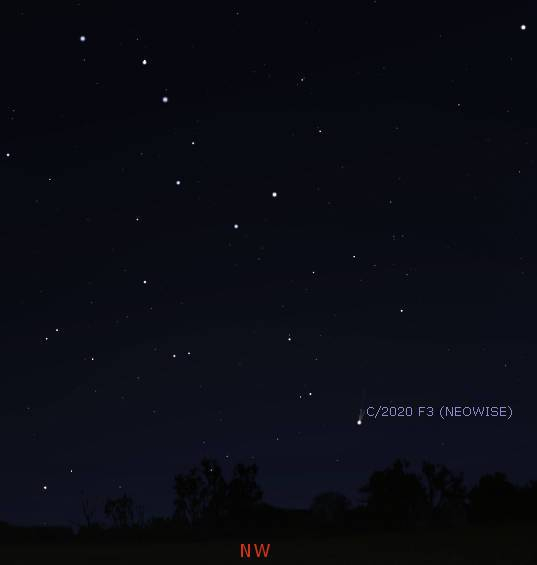
Comet 2020 F3 NEOWISE at 11 pm July 16, 2020, approximately an hour and a half after sunset. Created using Stellarium.
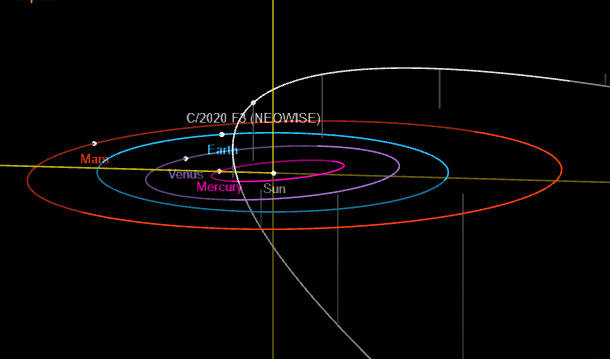
C/2020 F3 (NEOWISE) orbit. Comet position at July 16 at 8 pm EDT: Earth distance 0.765 au, Sun distance 0.479 au. Credit JPL Small-Body Browser
05/04/2020 – Ephemeris – NASA mission preparations this month
This is Bob Moler with Ephemeris for Monday, May 4th. Today the Sun will be up for 14 hours and 24 minutes, setting at 8:52, and it will rise tomorrow at 6:26. The Moon, 3 days before full, will set at 5:47 tomorrow morning.
May is a month of preparation for the space community. The Mars 2020 Rover, now named Endurance is getting packed up and balanced in preparation to be loaded into the sky crane and aeroshell, part of the cruise stage for its trip to Mars. It will employ the same landing technique as its predecessor, Curiosity which landed 9 years before in 2012. The launch is scheduled for July 17th to land on February 18th next year. It will deploy a small helicopter as a demonstration. It has many of the tools as Curiosity plus new ones and will cache rocks for future return to the Earth for further analysis. Hopefully by month’s end two NASA astronauts will launch on a Falcon 9 from US soil to the International Space Station.
The event times given are for the Traverse City/Interlochen area of Michigan. They may be different for your location.
Addendum

Mars 2020 Rover “Endurance” destined for the martian crater Jezero. Credit NASA.
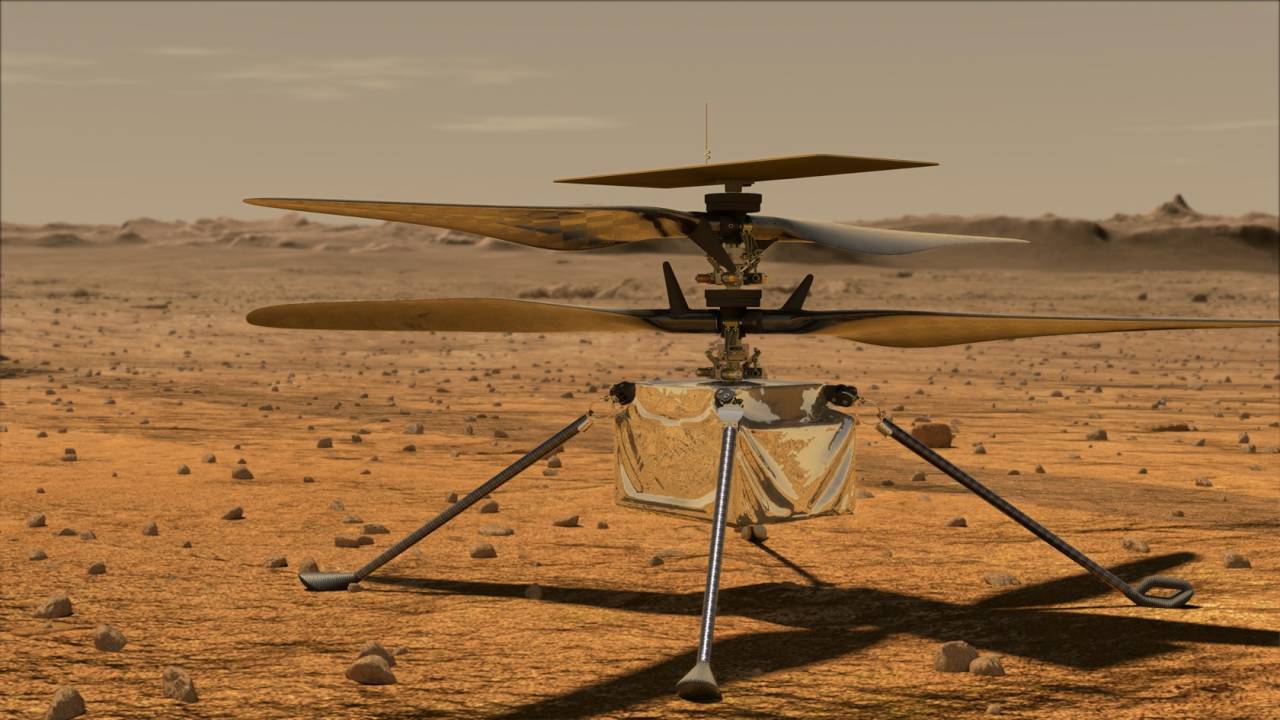
Mars Helicopter “Ingenuity” after deployment. Delta of ancient river that flowed into a lake in the Jezero crater. Credit NASA.
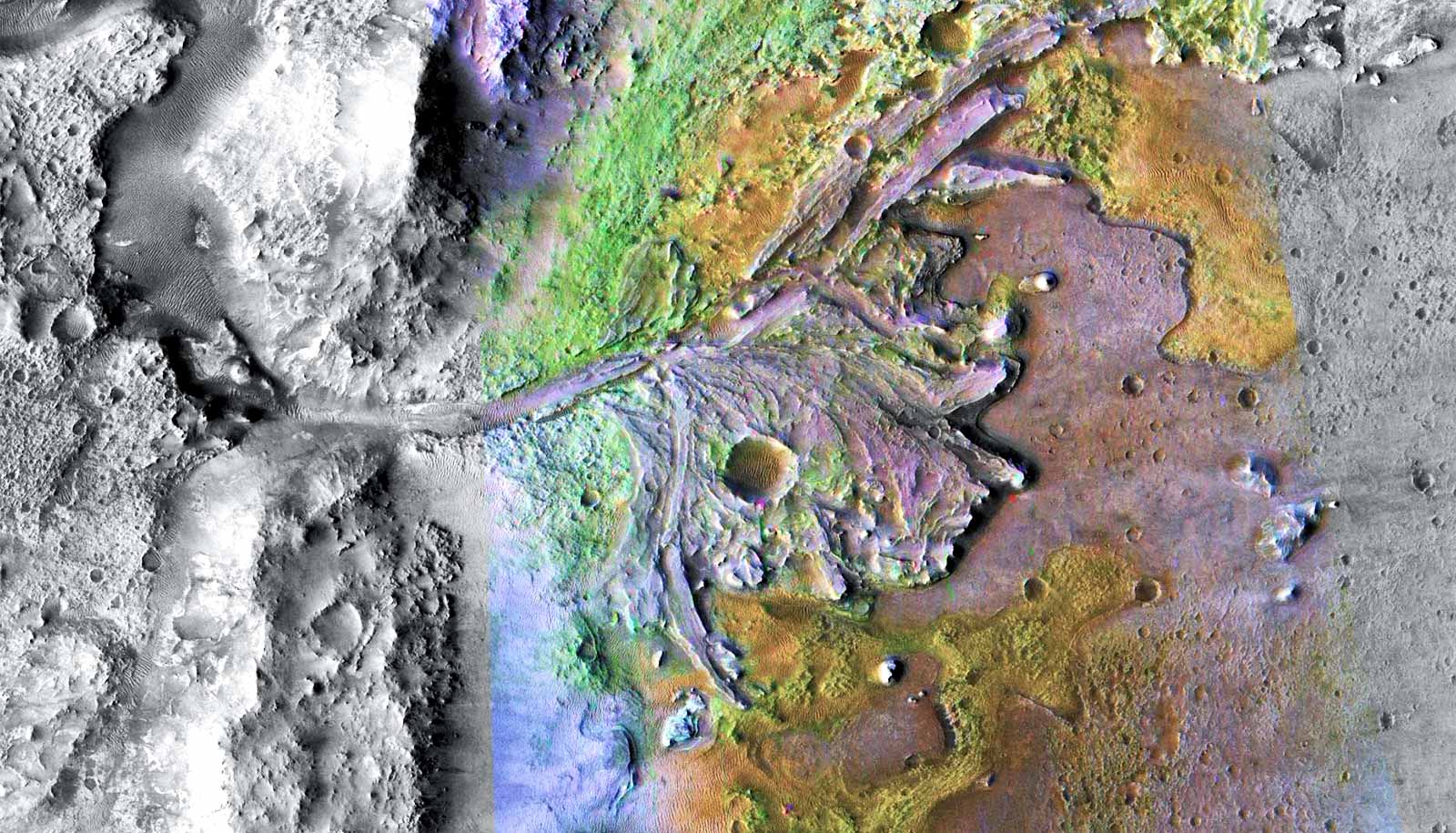
Delta of ancient river that flowed into a lake in the Jezero crater. Credit NASA.
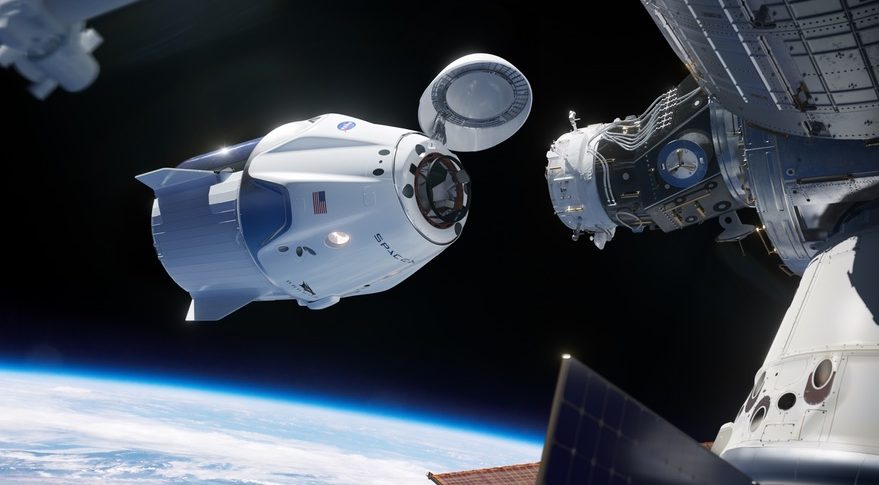
Crew Dragon docking to the International Space Station during the Demo 1 flight. Credit NASA.
10/04/2019 – Ephemeris – Astronomy events in Traverse City this weekend
Ephemeris for Friday, October 4th. Today the Sun will be up for 11 hours and 34 minutes, setting at 7:18, and it will rise tomorrow at 7:45. The Moon, 1 day before first quarter, will set at 11:33 this evening.
Tonight and tomorrow night there will be astronomy events at the Northwestern Michigan College’s Rogers Observatory and weather permitting tomorrow night on Front Street in Traverse City.
- Tonight there is the monthly meeting of the Grand Traverse Astronomical Society with a program at 8 p.m. and a star party starting at 9 p.m.
- Tomorrow night at the observatory from 7 to 8:30 p.m. NMC, the Rogers Observatory and the Traverse Area District Library will present Storyteller’s Night Sky with Mary Stewart Adams.
- At the same time, if it’s clear, members of the Grand Traverse Astronomical Society will set up telescopes on the East 200 block of Front Street in Traverse City for the International Observe the Moon Night.
The times given are for the Traverse City/Interlochen area of Michigan. They may be different for your location.
09/27/2019 – Ephemeris – Apollo 50th anniversary talk tonight in Thompsonville
Ephemeris for Friday, September 27th. Today the Sun will be up for 11 hours and 55 minutes, setting at 7:31, and it will rise tomorrow at 7:36. The Moon, 1 day before new, will rise at 7:09 tomorrow morning.
Tonight to commemorate the 50th anniversary the Apollo 11 landing on the Moon, I will present the illustrated talk Apollo and the Race to the Moon at 7 p.m. at the Betsie Valley District Library in Thompsonville. Afterwards, if it’s clear, members of the Grand Traverse Astronomical Society will host a star party featuring Saturn and Jupiter and some of the brighter deep sky objects. In the talk I’ll explore the Apollo 11 mission, the engineers, astronauts and all the crewed and robotic missions that paved the way for the successful lunar landings. I’ll also look at the Soviet space program their triumphs, plans, and ultimate failure to beat the Americans to the Moon.
The times given are for the Traverse City/Interlochen area of Michigan. They may be different for your location.
Addendum

Apollo and the Race to the Moon Title slide
08/16/2019 – Ephemeris – The Apollo missions provided clues as to the origin of the Moon
Ephemeris for Friday, August 16th. Today the Sun will be up for 14 hours and 1 minute, setting at 8:47, and it will rise tomorrow at 6:47. The Moon, 1 day past full, will rise at 9:44 this evening.
Members of the Grand Traverse Astronomical Society will be in Downtown Traverse City for Friday Night Line again this evening. We might get a glimpse of the Moon later tonight. Speaking of the Moon, the rocks brought back from the Moon by the Apollo astronauts turn out to be very similar to earthly rocks. This gave rise to the most popular theory of how the Moon formed. A second planet was born in the Earth’s orbit lazily orbiting at a point 60 degrees ahead or behind the Earth itself. Perturbations possibly by Venus caused it to crash into the Earth with a glancing blow sending debris into orbit of the Earth to become the Moon. It explains the similarity of the rocks of the Earth and and those brought back from the Moon.
The times given are for the Traverse City/Interlochen area of Michigan. They may be different for your location.
Addendum
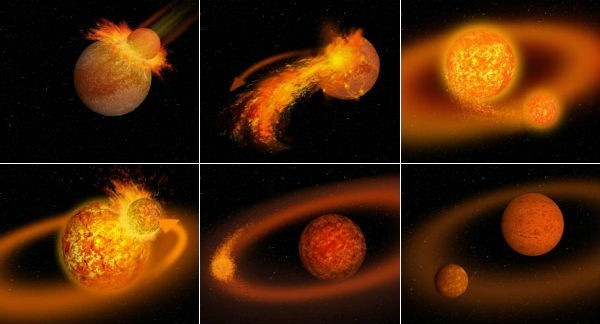
A progression of how the Moon may have fomed by a small protoplanet crashing into the Earth. Credit: Brian Koberlein
11/13/2018 – Ephemeris – The Summer Triangle in autumn
Ephemeris for Tuesday, November 13th. The Sun will rise at 7:37. It’ll be up for 9 hours and 39 minutes, setting at 5:16. The Moon, 2 days before first quarter, will set at 10:20 this evening.
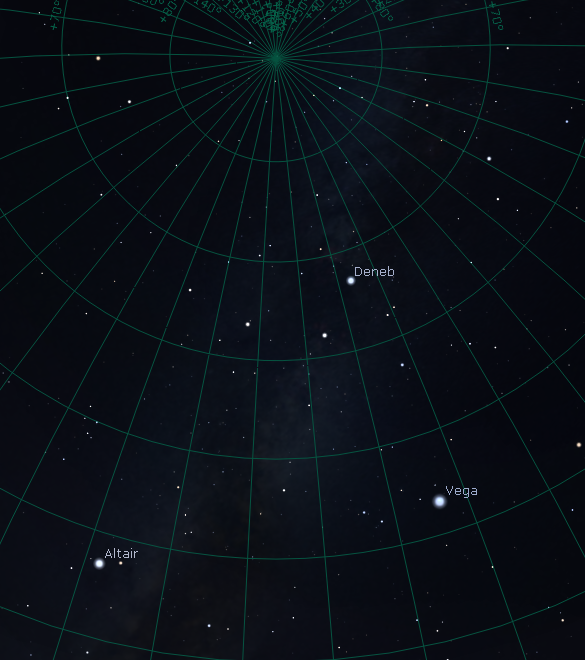
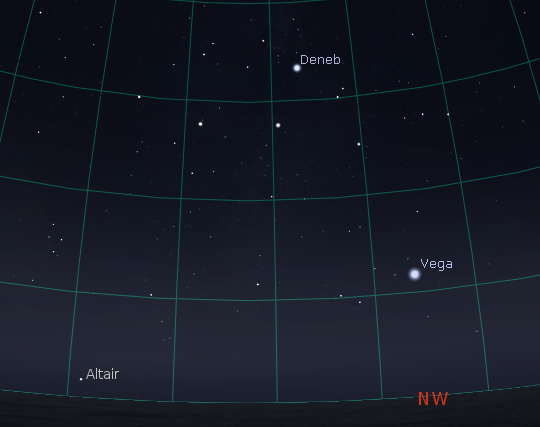
The Summer Triangle is still in the sky at 9 p.m., even though it’s November. These three bright stars that straddle the Milky Way are high in the east for most of the summer, move overhead and begin to slide to the west in autumn. We will lose Altair, the southernmost of the three stars at 9 p.m. on the winter solstice, December 21st. We’ll lose the brightest, Vega in January. For the northern half of the IPR listening area the northernmost of the triangle stars, Deneb won’t quite set below a north Lake Michigan horizon. Next spring we’ll be waiting and watching for these three stars to rise, reclaim the skies, and bring again the warm summer skies. The winter skies do however have more bright stars than the summer sky.
The times given are for the Traverse City/Interlochen area of Michigan. They may be different for your location.
Addendum
11/12/2018 – Ephemeris – Orion is rising
Ephemeris for Veterans Day Observed, Monday, November 12th. The Sun will rise at 7:35. It’ll be up for 9 hours and 41 minutes, setting at 5:17. The Moon, 3 days before first quarter, will set at 9:25 this evening.
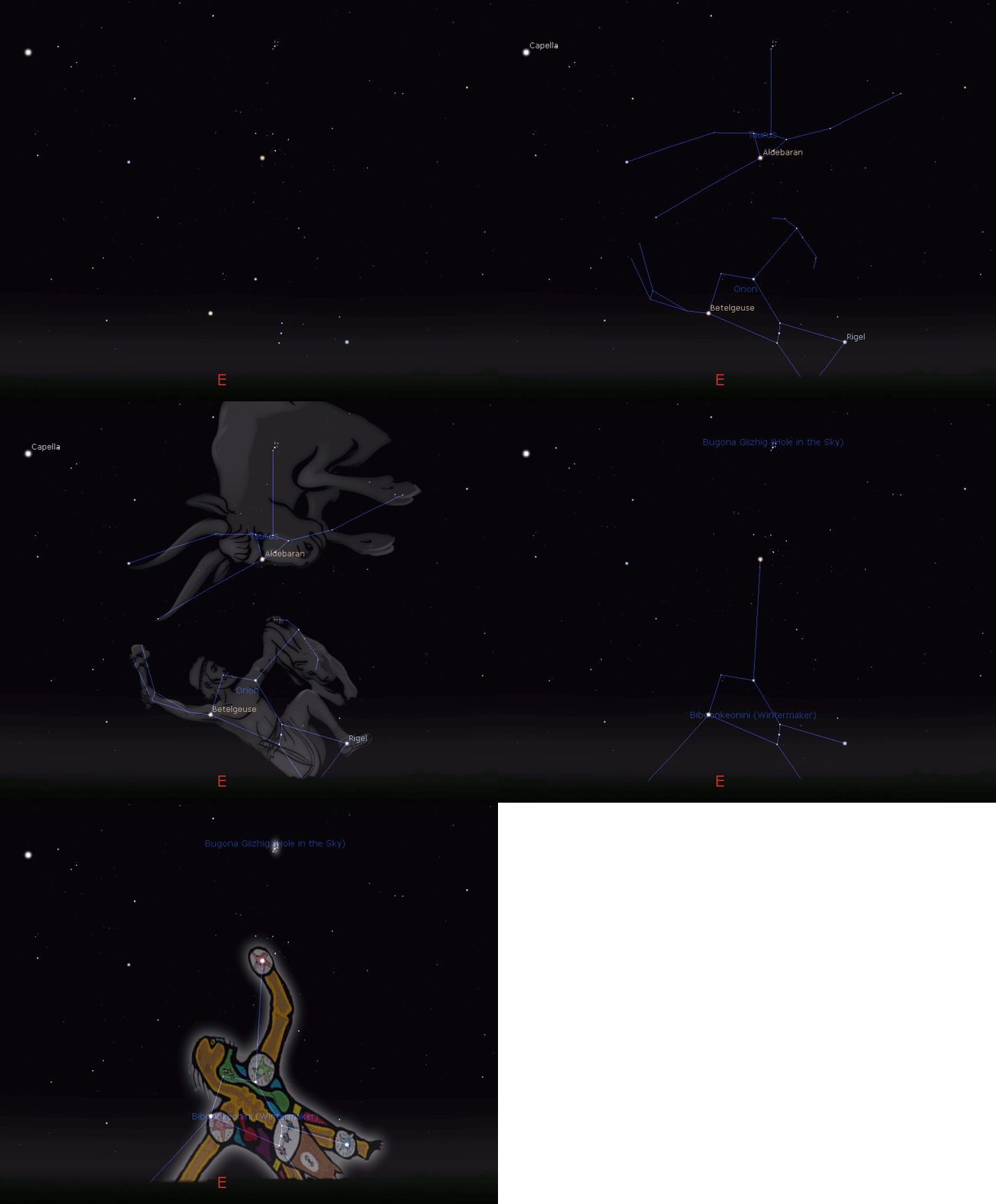
Just after the Moon sets tonight winter’s most dazzling constellation will be rising, Orion the hunter of Greek myth. The stars of his torso are in a rectangle leaning to the left. Orion’s belt of three stars in a straight line in the center of the rectangle is nearly vertical. The Anishinaabe peoples whose region we live in see the constellation of the Wintermaker rather than Orion. It uses Orion’s torso and belt stars, but his arms are spread wide from Aldebaran in the face of Taurus the bull to the west to Procyon in Canis Minor, which won’t rise until 11 p.m. to the east. The Wintermaker’s arms are wide enough to embrace the entire winter sky. Its name in Anishinaabemowin, which is Biboonikeonini, means “North Wind”.
The times given are for the Traverse City/Interlochen area of Michigan. They may be different for your location.
11/04/2018 – Ephemeris Extra – Wintermaker rising
A chill is in the air, The Fisher, Ojiig’s bloody tail has swooped low in the north at midnight to paint the trees with their fall colors, and the leaves have fallen to the ground. Haven’t heard of the Fisher? I mention it from time to time here on my Ephemeris program on Interlochen Public Radio. It’s a constellation of the Anishinaabe peoples indigenous to this area of Michigan, of which the Chippewa, Ottawa, and Ojibwe are a part.
The Fisher occupies the stars which we know as the Big Dipper and the Great Bear, Ursa Major. And unlike the bear, a fisher really does have a long tail. The fisher is a real weasel-like animal whose diet apparently does not include fish. It is found across southern Canada and in the American West. I’ve related the story of the Fisher, and how he brought summer to the Earth, in these pages in the August 2012 issue and on my blog bobmoler.wordpress.com. Search for fisher. Like most legends, there are different versions of that story and others about the Fisher.
Fisher or not, summer is gone and the world seems darker and colder. Over in the east these evenings great winter constellation of Orion is rising. It brings to mind the Robert Frost poem Star-Splitter, and our star chart this month from the November 1st post:
“You know Orion always comes up sideways.

Throwing a leg up over our fence of mountains,

And rising on his hands, he looks in on me

Busy outdoors by lantern-light with something

I should have done by daylight, and indeed,

After the ground is frozen, I should have done

Before it froze, and a gust flings a handful

Of waste leaves at my smoky lantern chimney

To make fun of my way of doing things,

Or else fun of Orion's having caught me.

Has a man, I should like to ask, no rights

These forces are obliged to pay respect to?"
The rest of the poem is available on the Poetry Foundation website: https://www.poetryfoundation.org/poems/44273/the-star-splitter. The poem is about one Brad McLaughlin and his telescope. While I don’t approve of how he financed his telescope, I do share his enthusiasm.
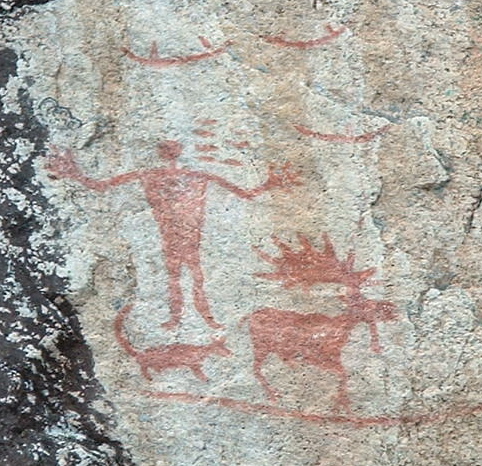
The Wintermaker, Biboonikeonini’s, name literally means North Wind. While his torso is the same as Orion’s his arms stretch from Aldebaran in Taurus to Procyon in Canis Minor, just about spanning the entire winter sky. The pictographs, seen above of the Wintermaker, Curly Tail and Moose can only be seen from a canoe in the cliff face on one side of the narrows between North Hegman and Trease lakes, 15 miles north of Ely, Minnesota
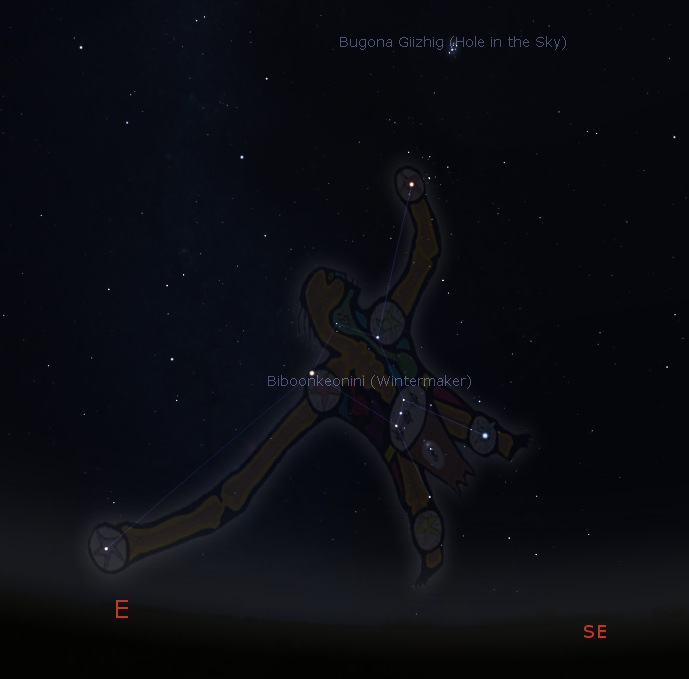
In late winter as Ojiig is rising in the northeast signaling the maple sugaring season, the Wintermaker is moving lower in the southwest. Some Ojibwe parents make bows for their children to shoot arrows at the Wintermaker to convince him to flee the skies so spring can begin as a way to teach them the old legends of their culture.
The Pleiades is an important group of stars for the Anishinaabe in several ways. It is the Hole-In-The-Sky, Bagone’giizhig, through which the Sky Woman fell and to give birth to the first humans on the Earth.
The Pleiades also represent the seven poles of the Shaking Tent Ceremony, and the seven sacred stones that are heated for the sweat lodge, which is also seen in the stars in the spring as Corona Borealis.

They are also the Seven Daughters of the Moon and Sun. They loved to dance and play, and when their father, the Moon was low in the sky, would descend to the Earth in a basket to do their thing. On one of their trips to the earth, one of them was captured by a human and she ended up falling in love with him, and married him. When father Moon found out he permanently dimmed her star, so now most people now only can spot 6 of the stars. This last bit seems to parallel the Greek story of the lost Pleiad.
Note: This is published as an article in the Grand Traverse Astronomical Society’s November 2018 newsletter Stellar Sentinel.
 Bob Moler's Ephemeris Blog