08/09/2018 – Ephemeris – How to observe the Perseid Meteor Shower
Ephemeris for Thursday, August 9th. The Sun rises at 6:38. It’ll be up for 14 hours and 19 minutes, setting at 8:57. The Moon, 2 days before new, will rise at 5:30 tomorrow morning.
Now through most of this month and reaching peak numbers Sunday evening and Monday morning the Perseid meteors will be shooting through our skies. Where to look? Up is the direction. All over the sky. They will seem to come from the northeast on parallel paths, like driving through a snow storm at night, the snowflakes will diverge from right in front of you. The numbers will generally increase as that radiant point rises higher in the sky. A diligent experienced, and undistracted, observer may see up to 100 or more an hour. Casual observers will see much less. The longest meteor streaks will be seen early in the evening when the meteoroids enter the atmosphere at 37 miles (59 km) per second at a very shallow angle, so last a bit longer. Bring a blanket, dress warmly and enjoy the show!
The times given are for the Traverse City/Interlochen area of Michigan. They may be different for your location.
Addendum
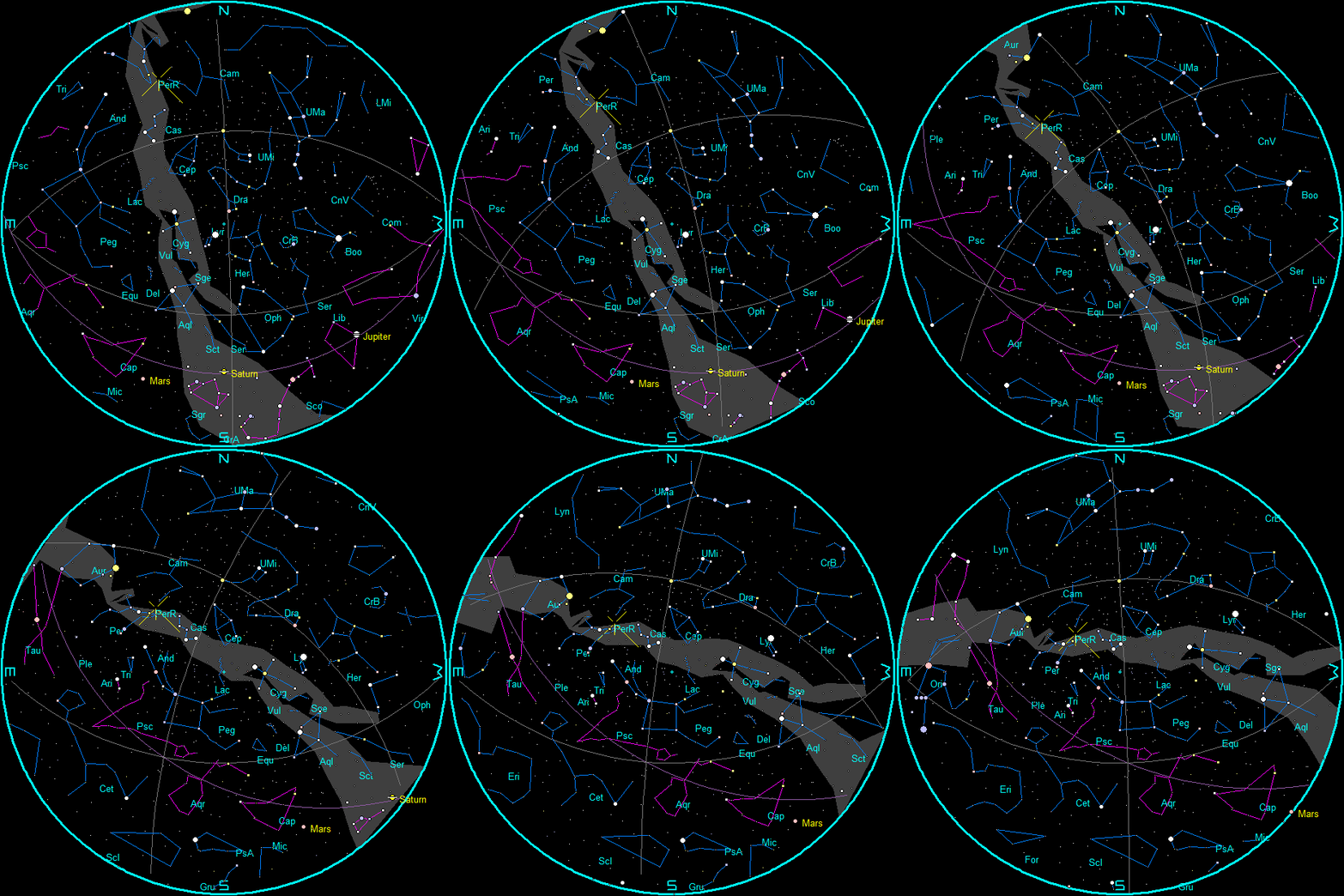
The sky dome for the night of the Perseid shower maximum at 1 hour intervals from 10:30 p.m. to 4:30 a.m. Click on image to enlarge. Created using my LookingUp program and GIMP.
For locations other than the Traverse City/Interlochen area the 10:30 step is approximately an hour and a half after sunset.
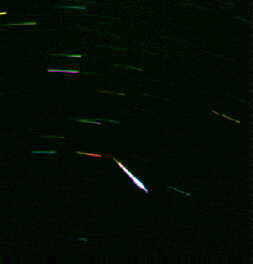
My best Perseid photo. From the 70’s.
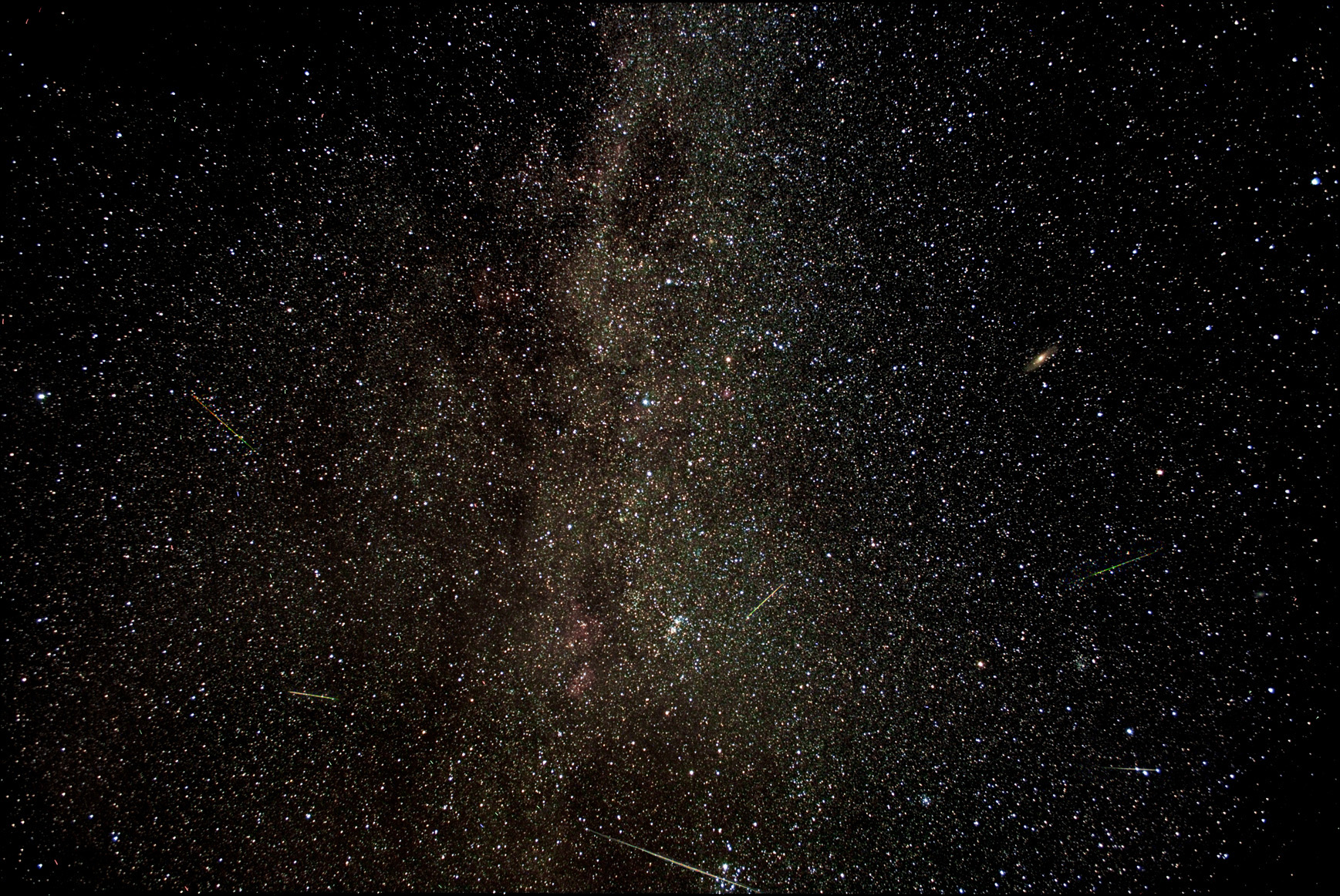
Here are some meteors seen in the 2007 Perseid meteor shower taken by Scott Anttila. The image is centered on Cassiopeia. The radiant is low and a bit left of center in the image. The Double Cluster is seen below center and the Great Andromeda Galaxy is seen on the right just above center.
The logic of taking meteor photos pointing near the radiant is the he meteors appear to travel slower there because they are coming mostly toward the camera and have a better chance of being picked up. My photograph was unguided, so the stars trailed. Scott’s was guided.
08/08/2018 – Ephemeris – Let’s check out the bright planets for the week
Ephemeris for Wednesday, August 8th. The Sun rises at 6:37. It’ll be up for 14 hours and 22 minutes, setting at 8:59. The Moon, 3 days before new, will rise at 4:20 tomorrow morning.
It’s Wednesday and time to look for and at the bright planets. Four of them are visible in the evening sky. The brilliant Venus will be visible in the western twilight from about 9:20 p.m. until it sets at 10:36 p.m. Jupiter will be in the southwest as it gets dark. It is only outshone by Venus, the Moon, and currently Mars. Jupiter will set at 12:26 a.m. Saturn will start the evening low in the southern sky and will stay relatively low, above the Teapot of Sagittarius. It will be due south at 10:46 p.m. and will set at 3:12 a.m.. Mars will be low in the southeast as the skies darken tonight. and is now 36.2 million miles (58.3 million km) away. It is being slowly left behind by the faster moving Earth.
The times given are for the Traverse City/Interlochen area of Michigan. They may be different for your location.
Addendum

The evening planets visible at 10 p.m., one hour after sunset. August 8th, 2018. Also shown are the constellations. Click on the image to enlarge. Created using Stellarium.
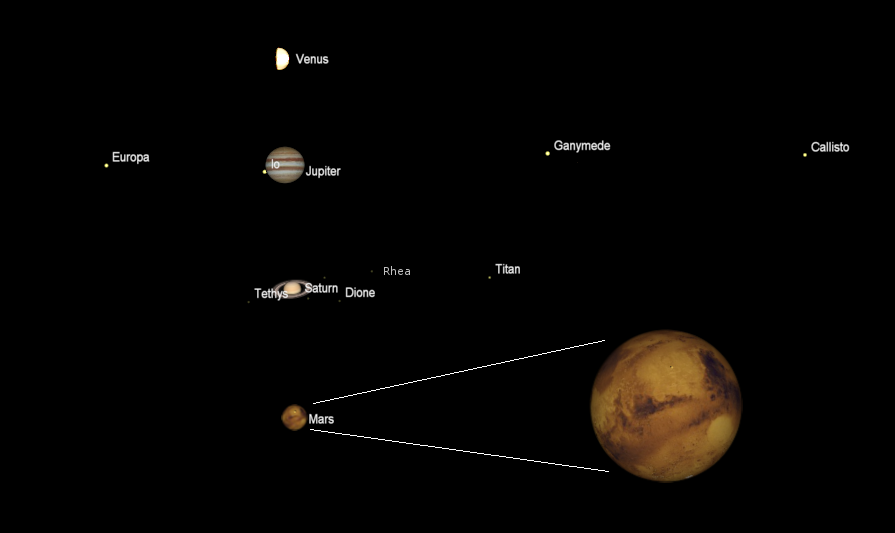
Venus, Jupiter, Saturn and Mars with the same magnification at 10 p.m. August 8, 2018. Jupiter’s satellite Io is shown. However at 10 p.m. Io is still is Jupiter’s shadow and will emerge at 11:07 p.m. Mars is also shown enlarged. It seems that the global dust storm is abating, so the albedo features are beginning to be seen. Created using Cartes du Ciel (Sky Charts) which does not properly show Jovian shadow events with the moons.
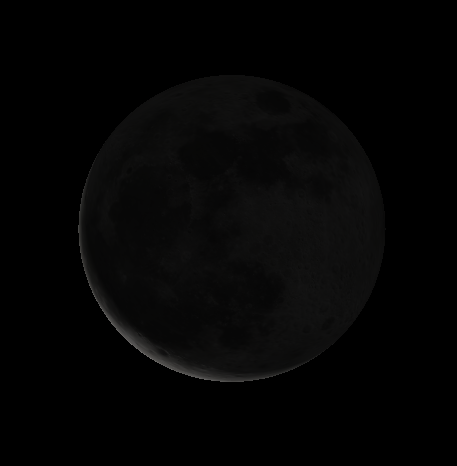
What the Moon might look like at 5:30 a.m., August 9th, 2018 with earthshine. Created using Stellarium.
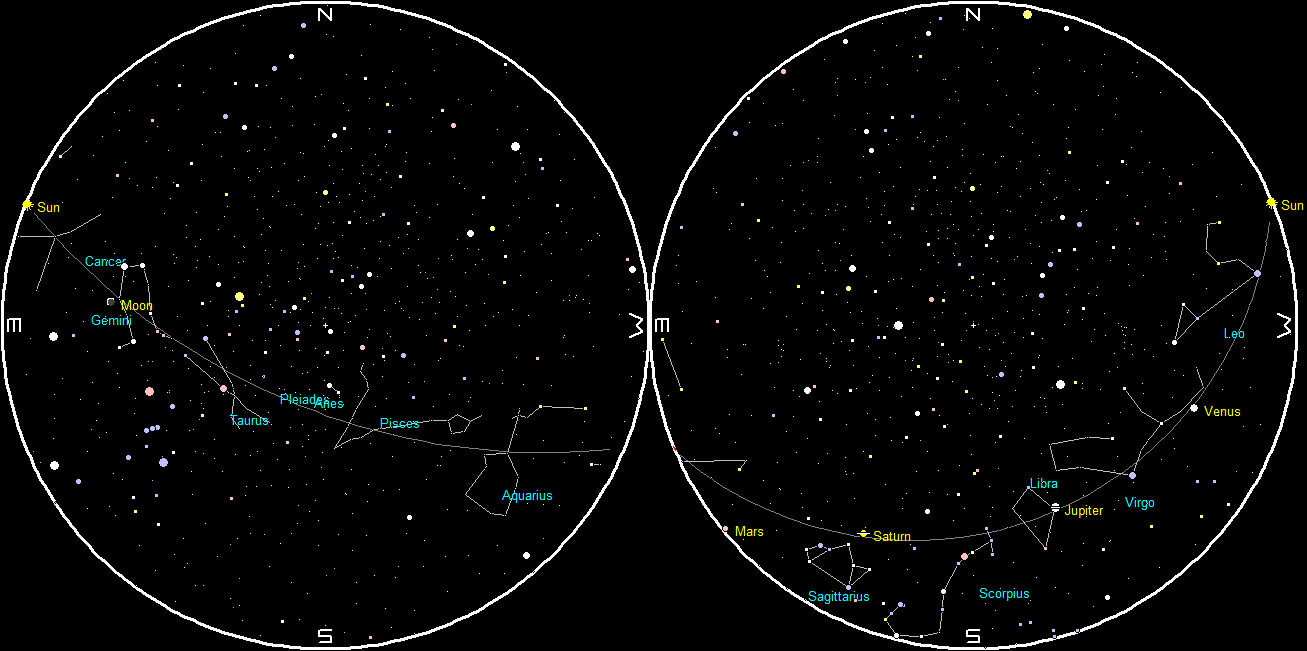
Planets and the Moon at sunset and sunrise of a single night starting with sunset on the right on August 8, 2018. The night ends on the left with sunrise on the 9th. Click on the image to enlarge. Created using my LookingUp program.
08/07/2018 – Ephemeris – The source of the Perseids
Ephemeris for Tuesday, August 7th. The Sun rises at 6:35. It’ll be up for 14 hours and 24 minutes, setting at 9:00. The Moon, 3 days past last quarter, will rise at 3:18 tomorrow morning.
The Perseid meteor shower will reach its peak Sunday night and Monday morning, less than a week from now. The meteor shower is caused by tiny particles shed by the comet 109P/Swift-Tuttle on past trips through the inner solar system. The 109P means it was recognized as the 109th comet to have seen to return to the vicinity of the Sun to be rediscovered in 1992. Lewis Swift and Horace Tuttle first discovered the comet independently in 1862. The orbit of the comet fit the orbits of the meteoroids that produce the Perseid meteor shower each year. The comet will return in 2126 after retreating to 51 times the Earth’s distance from the Sun, deep in the Kuiper belt, leaving behind a trail of meteoroids.
The times given are for the Traverse City/Interlochen area of Michigan. They may be different for your location.
Addendum
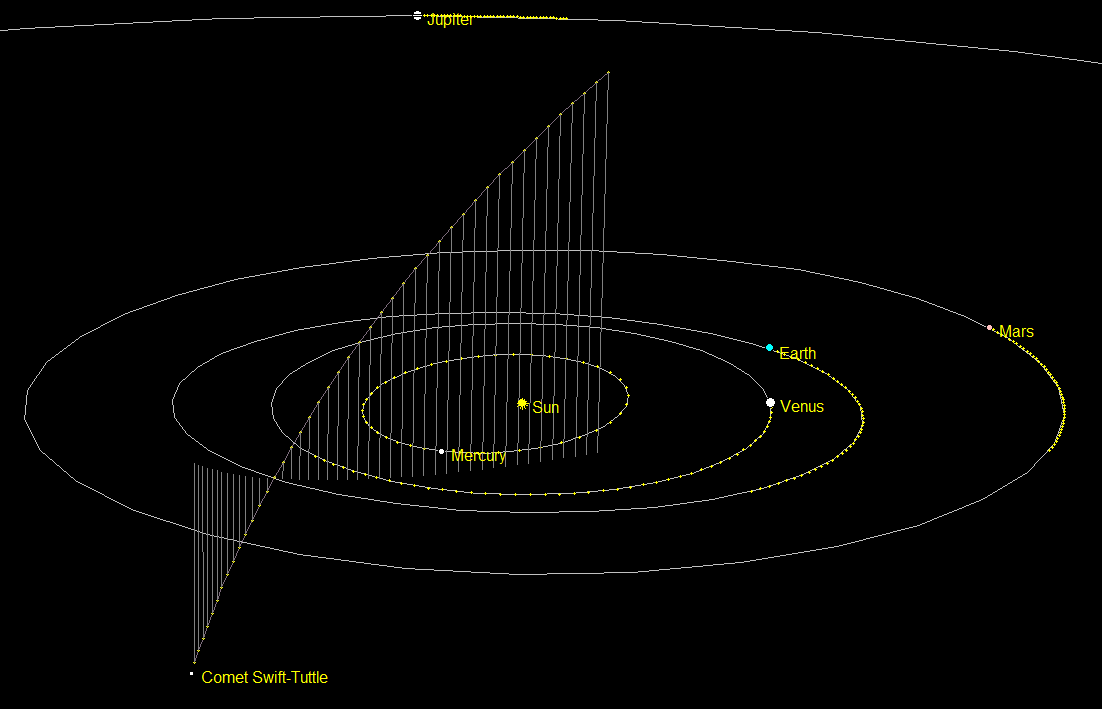
The passage of 109P/Comet Swift-Tuttle through the inner solar system November 1, 1992 to January 30, 1993. The meteoroids shed by the comet on its numerous trips close to the Sun lie close to that orbit. Note that its orbit intersects with the Earth’s orbit. That’s where the Earth will be around August 12-13 every year. Click on the image to enlarge. Created using my LookingUp program.
08/06/2018 – Ephemeris – The meteors of August, the Perseids are showing up now
Ephemeris for Monday, August 6th. The Sun rises at 6:34. It’ll be up for 14 hours and 27 minutes, setting at 9:01. The Moon, 2 days past last quarter, will rise at 2:27 tomorrow morning.
Over the past several weeks folks outdoors at night might have been seeing some shooting stars or meteors appearing to zip past in the sky. The ones I’m talking about seem to come from the northeast. These are the precursors of the Perseid meteor shower which will reach its peak on the night of August 12 and 13 this year. Over the millennia the meteoroid stream that feeds the meteors to our skies has spread out to last over a month from the latter half of July to three-quarters of August. We’ll meet the culprit for this show tomorrow. I try to use the proper terminology for all this. Meteoroid is the tiny body in space. In the Perseid’s case the size of a grain of sand to a pea. Meteor is the streak we see in the sky as it burns up. Meteorite is the body that makes it to the ground. To my knowledge no Perseid meteoroid has made it that far.
The times given are for the Traverse City/Interlochen area of Michigan. They may be different for your location.
Addendum
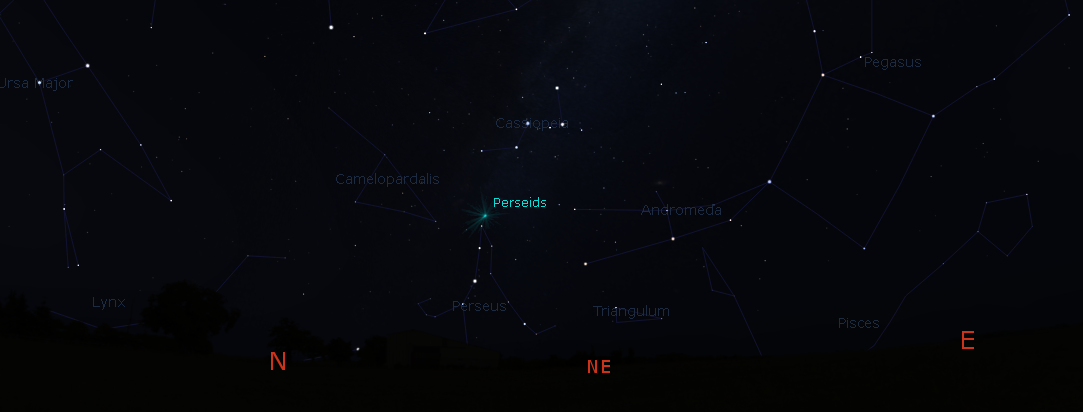
The Perseid radiant at 11 p.m. tonight, August 6, 2018. Note that the radiant position is different from what I show on my charts for the month. The radiant there is for the night of the Maximum, August 12th. The radiant point shifts with time due to Earth’s changing position with the meteoroid stream. Click on image to enlarge. Created using Stellarium.
Ephemeris Extra – The great meteor shower of August
This post from the Grand Traverse Astronomical Newsletter “Stellar Sentinel” was written for August of 2018. The dates and times of the peak may change a bit from year to year.
The Perseid meteor shower is the second most active annual meteor shower. The most active is the Geminids of December during a period that’s cold and generally very cloudy here in Northern Michigan. Consequently, I’ve never seen a Geminid meteor.
The Perseid meteor shower is the most famous as the August meteor shower, coming on the warm summer month. In Northern Michigan the radiant of the shower, the point in the sky from which they appear to come, is circumpolar, which means they are visible anytime in dark skies from dusk to dawn.
The Perseids are so named because they appear to come from near the constellation of Perseus the hero, an autumn constellation that starts the evening low in the northeast and rises and moves to high in the east near dawn. In earlier times these meteors were called the Tears of St. Lawrence, who was martyred in AD 255. His Feast day is August 10th, the day he died, which falls very close to the peak activity of the shower.
The Perseid meteors are visible for over a month from about July 17th to August 24th, with peak activity between August 12th at 4 p.m. to August 13th at 4 a.m. EDT. So the peak activity will partially be during our night hours, and the one day old Moon will not interfere at all. The peak hourly rate may reach 100 per hour at times. All things being equal, the higher the radiant is in the sky the greater the numbers of meteors seen. The Perseid radiant will be rising all night, being highest as the first light of dawn appears. Even though the numbers of meteors are fewer I like to start looking by 10:30 p.m. With the radiant low in the sky, the meteoroid particles we see are almost skimming the atmosphere, lasting longer. There’s is nothing so cool as to see a bright Perseid meteor seeming to fly along the Milky Way. The radiant point is in the Milky Way between Perseus below, and Cassiopeia above.
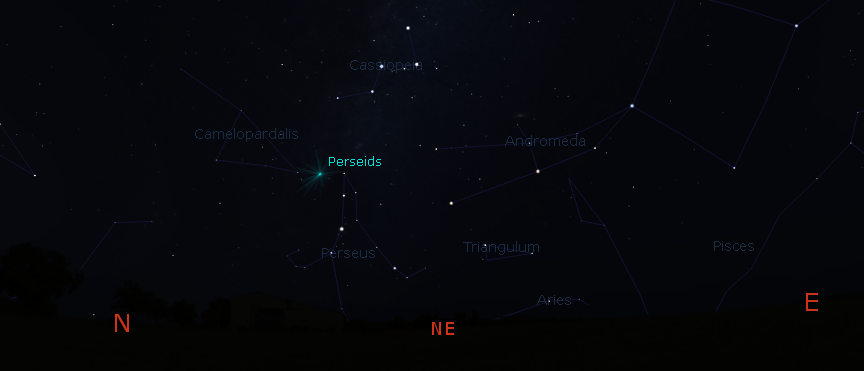
The Perseid radiant is located off the highest star is Perseus as it rises about 11 p.m. August 12, 2018. Click on the image to enlarge. Created using Stellarium.
Observing this meteor shower is very easy and one needs no special equipment. A blanket to lie on, mosquito repellent, warm clothes, some water and snacks, if staying the night, and a dark location. My preferred location is the Dune Climb at the Sleeping Bear Dunes National Lakeshore. It has no light, except the occasional car lights and has modern restroom facilities and a low horizon except in the west. I supposed one could climb up the dune to get rid of even the car lights. Even though the radiant is in the northeast, the meteors will appear all over the sky.
Binoculars are nice to take a break to explore the Milky Way and to observe the smoky train left by a particularly bright meteor. These can be viewed for a minute of more and deform and twist due to the different wind directions and speeds at different altitudes.
What causes the Perseid meteor shower and why does it occur at the same time every year?
The Perseid meteor shower, like all meteor showers are caused by the debris left along the orbits of comets. If the comet’s orbit crosses close to the Earth’s orbit we can get a meteor shower. Comets spend the majority of their time far from the Sun, where it’s very cold, and are in very elongated orbits.
Comets are made from rocky bits, dust and frozen gasses. As the comet comes into the inner solar system the Sun heats it up and the frozen gasses sublimate, are ionized by the Sun’s radiation and are caught into the thin ion tail. This liberates the comet’s fine dust which is blown away from the Sun by the pressure of sunlight into a broad dust tail. Larger particles end up traveling in the comet’s path, and are affected mainly by the Sun and the various gravitational tugs of the planets.
The comet responsible for the Perseids is 109P/Swift-Tuttle. It was independently discovered by L. Swift and P. Tuttle in 1862. It was recorded as being seen in 69 BC by, you guessed it, the Chinese. It’s a big comet, with a nucleus some 16 miles in diameter, and it crosses the Earth’s orbit, so it is a potentially hazardous object, and if it hit the Earth, would wreak more damage than the asteroid that killed the dinosaurs. From the 1862 appearance the comet was given a period of 120 years. It didn’t show in 1982. An observation of the previous appearance of the comet in 1737 allowed a recalculation of the orbit and a new return year of 1992. That was correct. The comet was recovered that year.
The comet will return in 2126. The calculations used to predict the 1992 return suggested that the comet could possible collide with the Earth. However observations of the 1992 appearance of the comet determined that the comet, though it would pass close to the Earth, is not a hazard. But it should be really bright. I can’t wait!
08/03/2018 – Ephemeris – Mars will be featured tonight at the NMC Rogers Observatory
Ephemeris for Friday, August 3rd. The Sun rises at 6:31. It’ll be up for 14 hours and 34 minutes, setting at 9:05. The Moon, 1 day before last quarter, will rise at 12:37 tomorrow morning.
Tonight the Grand Traverse Astronomical Society will host a star party at Northwestern Michigan College’s Rogers Observatory from 9 to 11 p.m. If it’s clear the planets Mars, Saturn, Jupiter and Venus will be the featured attractions. This is our nearest star party to the closest approach of Mars earlier this week, so Mars will be at its largest appearing in telescopes, however the position of Mars is quite far south in our sky, allowing our atmosphere to degrade the crispness of the view. Saturn is always magnificent with its rings, and Jupiter with it’s moons and cloud bands. Venus is getting nearer now and showing a gibbous phase. Later on the wonders of the Milky Way will be on display.
The times given are for the Traverse City/Interlochen area of Michigan. They may be different for your location.
08/02/2018 – Ephemeris – Has liquid water been found on Mars?
Ephemeris for Thursday, August 2nd. The Sun rises at 6:30. It’ll be up for 14 hours and 37 minutes, setting at 9:07. The Moon, 2 days before last quarter, will rise at 12:09 tomorrow morning.
The European Space Agency has announced the possible discovery of liquid water beneath Mars’ southern polar cap. Perhaps it’s like the lakes found under Earth’s Antarctic ice sheet. The discovery was made by the Mars Express orbiter’s ground penetrating radar. Mars south polar cap is primarily made of water ice up to 3.7 kilometers thick, covered in winter by a meter, give or take, thickness of carbon dioxide ice, what we call dry ice. Mars elliptical orbit happens to make southern hemisphere summers short and hot, and winters long and especially cold. Liquid water could exist several kilometers below the martian surface. Mars’ internal heat flow is what NASA’s InSight lander, now en route to Mars is going to tell us.
The times given are for the Traverse City/Interlochen area of Michigan. They may be different for your location.
Addendum

Mars Express detects water buried under the south pole of Mars. Click on the image to enlarge. Credit: European Space Agency (ESA)
08/01/2018 – Ephemeris – The bright planets for the first of August
Ephemeris for Wednesday, August 1st. The Sun rises at 6:29. It’ll be up for 14 hours and 39 minutes, setting at 9:08. The Moon, 3 days before last quarter, will rise at 11:43 this evening.
It’s Wednesday and time to look for and at the bright planets. Four of them are visible in the evening sky. The brilliant beacon of Venus will be visible in the western twilight from about 9:30 p.m. until it sets at 10:52 p.m. Jupiter will be in the southwest as it gets dark. It is only outshone by Venus, the Moon, and currently Mars. Jupiter will set at 12:48 a.m. Saturn will start the evening low in the south-southeast and will stay relatively low, above the Teapot of Sagittarius. It will be due south at 11:15 p.m. and will set at 3:41 a.m.. Mars will be low in the southeast as the skies darken tonight. and is now 35.8 million miles (57.6 million km) away. It is being slowly left behind by the faster moving Earth.
The times given are for the Traverse City/Interlochen area of Michigan. They may be different for your location.
Addendum
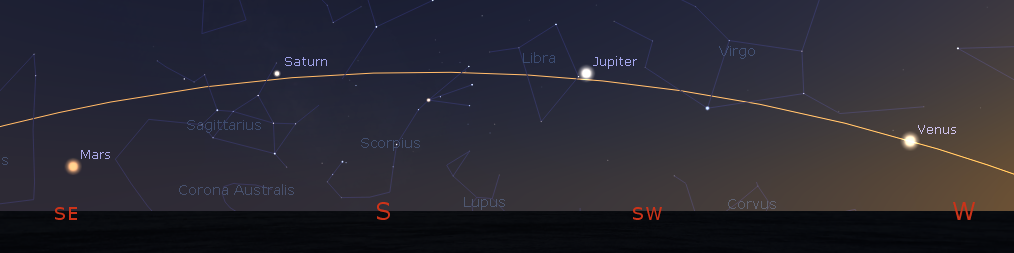
Evening planets visible at 10 p.m. August 1st, 2018. Also shown are the zodiacal constellations and the ecliptic. The ecliptic, which is the plane of the Earth’s orbit and near where than rest of the planets appear because the solar system is pretty flat. Also note that Venus, which will reach greatest eastern elongation from the Sun on the 17th, is not very high above the horizon. That’s because the ecliptic meets the horizon at a shallow angle. In spring Venus would be very high on the west. The projection shows Venus and Mars a bit higher in the sky than they actually are. Click on the image to enlarge. Created using Stellarium.
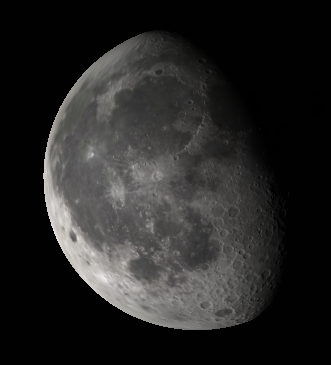
What the Moon might look like in binoculars at 2 a.m., August 2nd, 2018. Created using Stellarium.
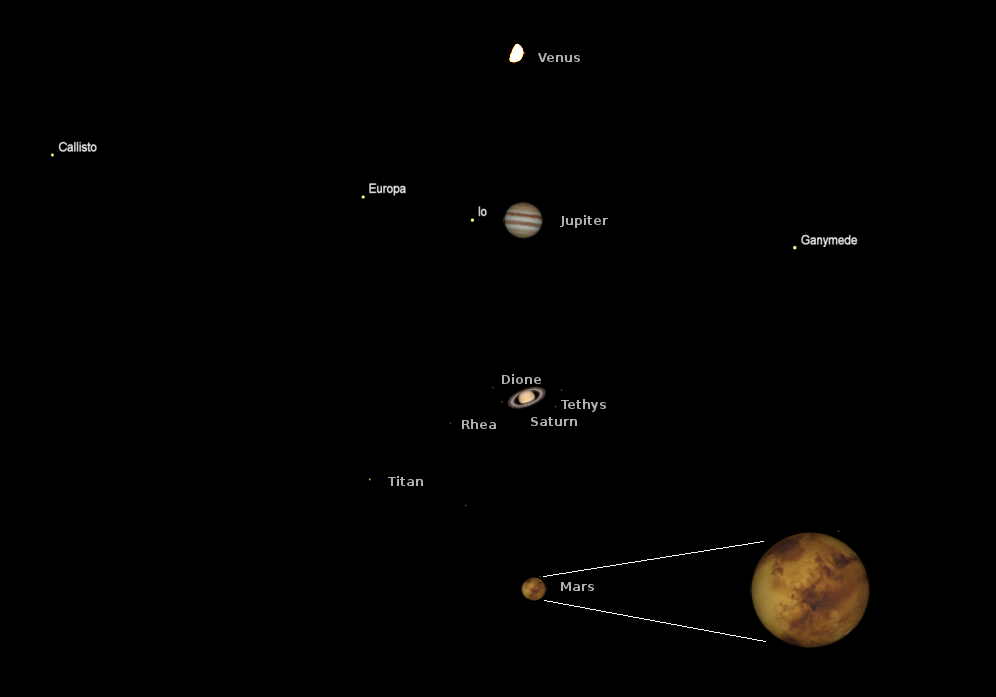
Venus, Jupiter, Saturn and Mars with the same magnification at 10 p.m. August 1, 2018.
Mars is also shown enlarged. It seems that the global dust storm is abating, so the albedo features are beginning to be seen. Created using Cartes du Ciel (Sky Charts).
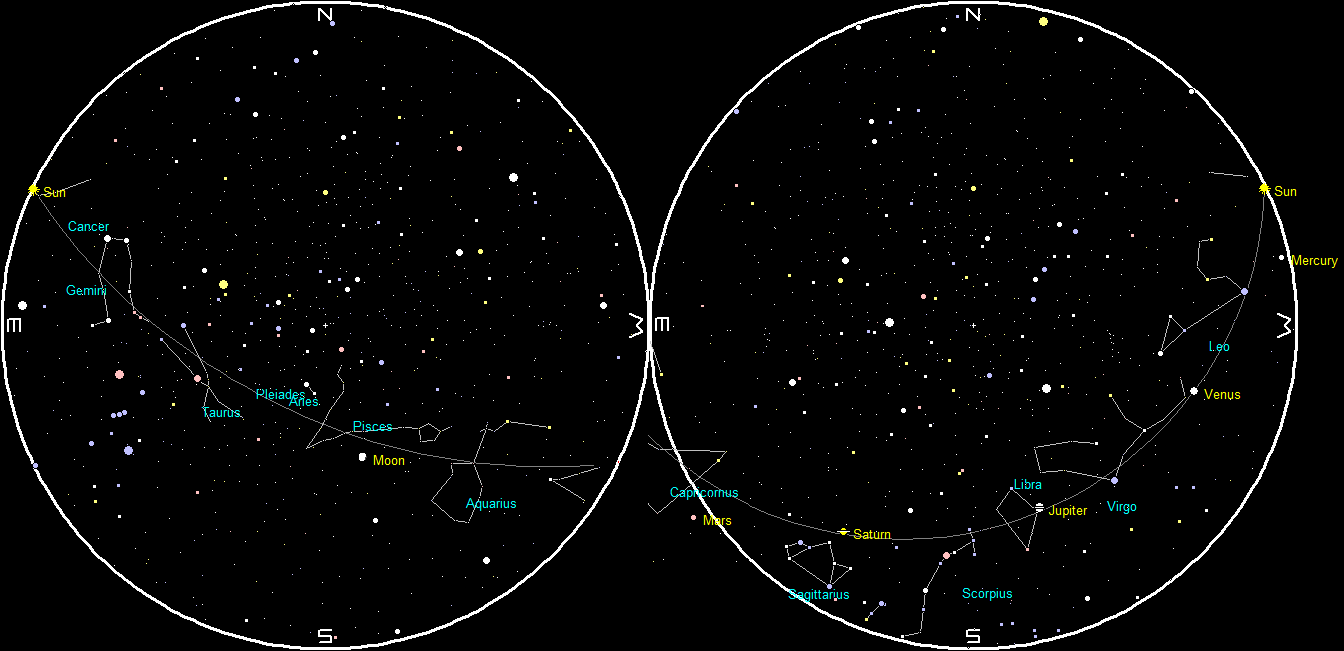
Planets and the Moon at sunset and sunrise of a single night starting with sunset on the right on August 1, 2018. The night ends on the left with sunrise on the 2nd. Mars, being close to opposition and very much south of the ecliptic is not in the sky at either sunrise or sunset, I showed a patch of sky with Mars in it in the at sunset still below the horizon. Click on the image to enlarge. Created using my LookingUp program.
07/31/2018 – Ephemeris – Previewing August skies
Ephemeris for Tuesday, July 31st. The Sun rises at 6:27. It’ll be up for 14 hours and 41 minutes, setting at 9:09. The Moon, half way from full to last quarter, will rise at 11:17 this evening.
Let’s look ahead at the month of August in the skies. Daylight hours will decrease from 14 hours and 39 minutes tomorrow to 13 hours 17 minutes on the 31st. The altitude of the sun at local noon, that is degrees of angle above the horizon will decrease from 63 degrees tomorrow to just over 53 degrees on the 31st. Straits area listeners can subtract one more degree from those angles. Local noon, when the Sun is due south, is about 1:43 p.m. The Perseid meteor shower will reach its peak all night on the 12th. It will be a dark night with the one day old moon setting at 10 p.m. The radiant point, where the meteors will seem to come from, will be rising higher in the northeastern sky all night. On the 17th Venus will reach ts greatest separation from the Sun in the evening sky.
The times given are for the Traverse City/Interlochen area of Michigan. They may be different for your location.
Addendum
August Evening Star Chart
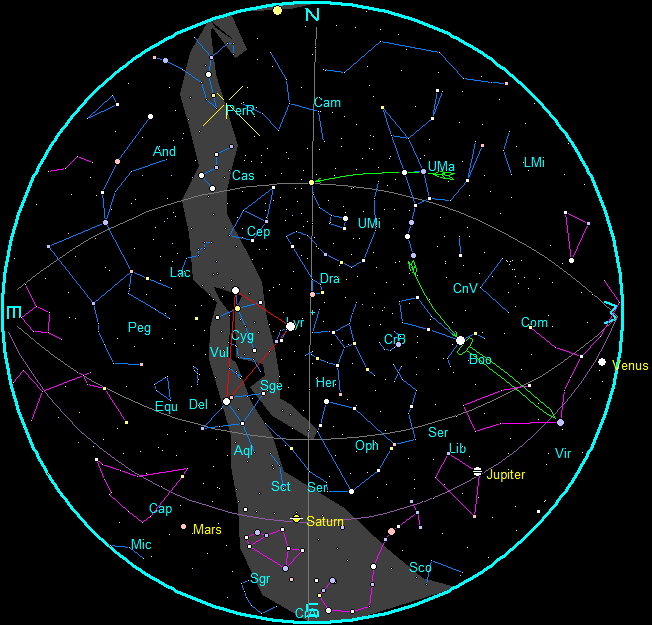
Star Chart for August 2018 (10 p.m. EDT August 15, 2018). Created using my LookingUp program. Click on image to enlarge.
The planets and stars are plotted for the 15th at 10 p.m. EDT in the evening and 4:30 a.m. for the morning chart. These are the chart times. Note that Traverse City is located approximately 45 minutes behind our time meridian. (An hour 45 minutes behind our daylight saving time meridian during EDT). To duplicate the star positions on a planisphere you may have to set it to 1 hour 45 minutes earlier than the current time.
Note the chart times of 10 p.m. and 4:30 a.m. are for the 15th. For each week before the 15th add ½ hour (28 minutes if you’re picky). For each week after the 15th subtract ½ hour. The planet positions are updated each Wednesday on this blog. For planet positions on dates other than the 15th, check the Wednesday planet posts on this blog.
August Morning Star Chart
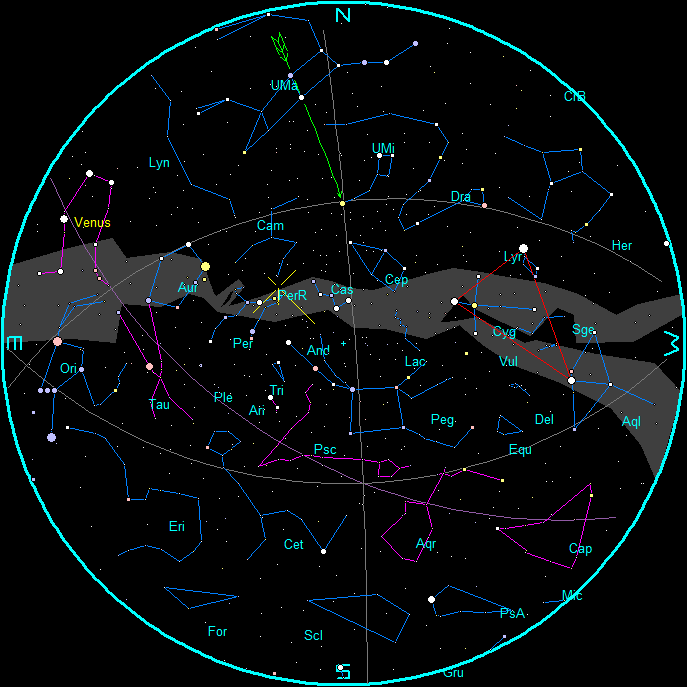
Star Chart for August 2018 mornings based on 4:30 a.m. August 15th. Created using my LookingUp program. Click on image to enlarge.
For a list of constellation names to go with the abbreviations click here.
- Pointer stars at the front of the bowl of the Big Dipper point to Polaris the North Star.
- Leaky Big Dipper drips on Leo.
- Follow the arc of the handle of the Big Dipper to the star Arcturus and
- Continue with a spike to Spica.
- The Summer Triangle is in red.
- PerR – Perseid meteor shower radiant
Twilight
| Morning | Twilight | Evening | Twilight | Dark | Night | Moon | |
| Date | Astronomical | Nautical | Nautical | Astronomical | Start | End | Illum. |
| 2018-07-31 | 4h28m | 5h17m | 22h28m | 23h17m | 23h17m | 23h17m | 0.89 |
| 2018-08-01 | 4h30m | 5h18m | 22h27m | 23h15m | 23h15m | 23h43m | 0.82 |
| 2018-08-02 | 4h32m | 5h20m | 22h25m | 23h13m | 23h13m | – | 0.74 |
| 2018-08-03 | 4h34m | 5h21m | 22h24m | 23h11m | 23h11m | 0h09m | 0.64 |
| 2018-08-04 | 4h36m | 5h23m | 22h22m | 23h09m | 23h09m | 0h37m | 0.53 |
| 2018-08-05 | 4h38m | 5h24m | 22h20m | 23h07m | 23h07m | 1h08m | 0.42 |
| 2018-08-06 | 4h40m | 5h26m | 22h18m | 23h05m | 23h05m | 1h44m | 0.31 |
| 2018-08-07 | 4h42m | 5h27m | 22h17m | 23h03m | 23h03m | 2h26m | 0.20 |
| 2018-08-08 | 4h43m | 5h29m | 22h15m | 23h00m | 23h00m | 3h18m | 0.11 |
| 2018-08-09 | 4h45m | 5h30m | 22h13m | 22h58m | 22h58m | 4h19m | 0.05 |
| 2018-08-10 | 4h47m | 5h32m | 22h11m | 22h56m | 22h56m | 4h47m | 0.01 |
| 2018-08-11 | 4h49m | 5h33m | 22h10m | 22h54m | 22h54m | 4h49m | 0.00 |
| 2018-08-12 | 4h51m | 5h35m | 22h08m | 22h52m | 22h52m | 4h51m | 0.03 |
| 2018-08-13 | 4h53m | 5h36m | 22h06m | 22h49m | 22h49m | 4h53m | 0.08 |
| 2018-08-14 | 4h55m | 5h38m | 22h04m | 22h47m | 23h01m | 4h55m | 0.16 |
| 2018-08-15 | 4h56m | 5h39m | 22h02m | 22h45m | 23h29m | 4h56m | 0.26 |
| 2018-08-16 | 4h58m | 5h41m | 22h00m | 22h43m | 23h59m | 4h58m | 0.36 |
| 2018-08-17 | 5h00m | 5h42m | 21h58m | 22h41m | – | 5h00m | 0.47 |
| 2018-08-18 | 5h02m | 5h44m | 21h56m | 22h38m | 0h30m | 5h02m | 0.57 |
| 2018-08-19 | 5h04m | 5h45m | 21h54m | 22h36m | 1h03m | 5h04m | 0.67 |
| 2018-08-20 | 5h05m | 5h47m | 21h53m | 22h34m | 1h40m | 5h05m | 0.76 |
| 2018-08-21 | 5h07m | 5h48m | 21h51m | 22h32m | 2h22m | 5h07m | 0.84 |
| 2018-08-22 | 5h09m | 5h50m | 21h49m | 22h29m | 3h09m | 5h09m | 0.90 |
| 2018-08-23 | 5h11m | 5h51m | 21h47m | 22h27m | 4h00m | 5h11m | 0.90 |
| 2018-08-24 | 5h12m | 5h53m | 21h45m | 22h25m | 4h56m | 5h12m | 0.95 |
| 2018-08-25 | 5h14m | 5h54m | 21h43m | 22h23m | – | – | 0.99 |
| 2018-08-26 | 5h16m | 5h55m | 21h41m | 22h20m | – | – | 1.00 |
| 2018-08-27 | 5h17m | 5h57m | 21h39m | 22h18m | – | – | 0.99 |
| 2018-08-28 | 5h19m | 5h58m | 21h37m | 22h16m | – | – | 0.97 |
| 2018-08-29 | 5h21m | 6h00m | 21h35m | 22h14m | – | – | 0.92 |
| 2018-08-30 | 5h22m | 6h01m | 21h33m | 22h11m | 22h11m | 22h40m | 0.86 |
| 2018-08-31 | 5h24m | 6h02m | 21h31m | 22h09m | 22h09m | 23h09m | 0.78 |
Twilight calendar was generated in Cartes du Ciel.
NASA Calendar of Planetary Events
Date        Time    Event
Aug 01  We          Venus: 45.1° E
    04  Sa  2:18 pm Last Quarter
    06  Mo  2:35 pm Moon-Aldebaran: 1.1° S
    08  We  6:33 pm Moon North Dec.: 20.8° N
    08  We  9:59 pm Mercury Inferior Conj.
    10  Fr  9:40 am Moon Ascending Node
    10  Fr  2:05 pm Moon Perigee: 358100 km
    11  Sa  5:47 am Partial Solar Eclipse (NE Canada to Asia)
    11  Sa  5:58 am New Moon
    12  Su  8:44 pm Perseid Meteor Shower: ZHR = 90
    14  Tu  9:35 am Moon-Venus: 6.4° S
    17  Fr  6:38 am Moon-Jupiter: 4.8° S
    17  Fr 11:59 am Venus Greatest Elongation: 45.9° E
    18  Sa  3:49 am First Quarter
    20  Mo 10:07 pm Mercury-Beehive: 5.9° S
    21  Tu  5:55 am Moon-Saturn: 2.4° S
    21  Tu 10:58 pm Moon South Dec.: 20.8° S
    23  Th  7:23 am Moon Apogee: 405700 km
    24  Fr 12:51 am Moon Descending Node
    26  Su  7:56 am Full Moon
    26  Su  3:59 pm Mercury Greatest Elongation: 18.3° W
Sep 01  Sa          Venus: 45° E
Sky Events Calendar by Fred Espenak and Sumit Dutta (NASA’s GSFC),
http://eclipse.gsfc.nasa.gov/SKYCAL/SKYCAL.html
If you go to the above site you can print out a list like the above for the entire year
or calendar pages for your time zone.
Sun and Moon Rising and Setting Events
     LU              Ephemeris of Sky Events for Interlochen/TC
     August, 2018    Local time zone: EDT
     +-----------------------------------------------------------------------+
     | DATE |  SUN     SUN  DAYLIGHT|   TWILIGHT*    |MOON  RISE OR    ILLUM |
     |      |  RISE    SET    HOURS |  END    START  |PHASE SET** TIME FRACTN|
     +=======================================================================+
     |Wed  1| 06:29a  09:08p  14:39 | 10:23p  05:13a |      Rise 11:43p   77%|
     |Thu  2| 06:30a  09:07p  14:37 | 10:22p  05:14a |      Rise 12:09a   68%|
     |Fri  3| 06:31a  09:05p  14:34 | 10:20p  05:16a |      Rise 12:37a   58%|
     |Sat  4| 06:32a  09:04p  14:32 | 10:18p  05:17a |L Qtr Rise 01:08a   47%|
     +------+-----------------------+----------------+-----------------------+
     |Sun  5| 06:33a  09:03p  14:29 | 10:17p  05:19a |      Rise 01:44a   37%|
     |Mon  6| 06:34a  09:01p  14:27 | 10:15p  05:20a |      Rise 02:27a   26%|
     |Tue  7| 06:35a  09:00p  14:24 | 10:13p  05:22a |      Rise 03:18a   17%|
     |Wed  8| 06:37a  08:59p  14:22 | 10:11p  05:23a |      Rise 04:20a    9%|
     |Thu  9| 06:38a  08:57p  14:19 | 10:10p  05:25a |      Rise 05:30a    3%|
     |Fri 10| 06:39a  08:56p  14:16 | 10:08p  05:26a |      Rise 06:45a    0%|
     |Sat 11| 06:40a  08:54p  14:14 | 10:06p  05:28a |New   Set  09:21p    1%|
     +------+-----------------------+----------------+-----------------------+
     |Sun 12| 06:41a  08:53p  14:11 | 10:04p  05:29a |      Set  09:58p    4%|
     |Mon 13| 06:42a  08:51p  14:08 | 10:02p  05:31a |      Set  10:30p   10%|
     |Tue 14| 06:44a  08:50p  14:06 | 10:00p  05:32a |      Set  11:00p   17%|
     |Wed 15| 06:45a  08:48p  14:03 | 09:59p  05:34a |      Set  11:29p   27%|
     |Thu 16| 06:46a  08:46p  14:00 | 09:57p  05:35a |      Set  11:59p   36%|
     |Fri 17| 06:47a  08:45p  13:57 | 09:55p  05:37a |      Set  12:29a   47%|
     |Sat 18| 06:48a  08:43p  13:54 | 09:53p  05:38a |F Qtr Set  01:03a   57%|
     +------+-----------------------+----------------+-----------------------+
     |Sun 19| 06:49a  08:42p  13:52 | 09:51p  05:40a |      Set  01:40a   66%|
     |Mon 20| 06:51a  08:40p  13:49 | 09:49p  05:41a |      Set  02:22a   75%|
     |Tue 21| 06:52a  08:38p  13:46 | 09:47p  05:43a |      Set  03:09a   83%|
     |Wed 22| 06:53a  08:37p  13:43 | 09:45p  05:44a |      Set  04:00a   89%|
     |Thu 23| 06:54a  08:35p  13:40 | 09:43p  05:46a |      Set  04:56a   94%|
     |Fri 24| 06:55a  08:33p  13:37 | 09:41p  05:47a |      Set  05:54a   98%|
     |Sat 25| 06:56a  08:31p  13:34 | 09:39p  05:48a |      Set  06:54a  100%|
     +------+-----------------------+----------------+-----------------------+
     |Sun 26| 06:58a  08:30p  13:31 | 09:37p  05:50a |Full  Rise 08:54p  100%|
     |Mon 27| 06:59a  08:28p  13:29 | 09:35p  05:51a |      Rise 09:21p   98%|
     |Tue 28| 07:00a  08:26p  13:26 | 09:33p  05:53a |      Rise 09:47p   94%|
     |Wed 29| 07:01a  08:24p  13:23 | 09:31p  05:54a |      Rise 10:13p   88%|
     |Thu 30| 07:02a  08:23p  13:20 | 09:29p  05:56a |      Rise 10:40p   81%|
     |Fri 31| 07:04a  08:21p  13:17 | 09:27p  05:57a |      Rise 11:09p   72%|
     +-----------------------------------------------------------------------+
     * Nautical Twilight
     ** Moon rise or moon set, whichever occurs between sunrise and sunset
Ephemeris of Sky Events is created with my DOS version LookingUp program.
07/30/2018 – Ephemeris – Early tomorrow morning Mars will be the closest to is in 15 years
Ephemeris for Monday, July 30th. The Sun rises at 6:26. It’ll be up for 14 hours and 44 minutes, setting at 9:10. The Moon, 3 days past full, will rise at 10:51 this evening.
Mars’ closest approach to the Earth since August 27, 2003 is tomorrow at about 3:51 a.m. at a distance of 35.8 million miles (57.6 million km). The last really close approach of Mars was on August 27, 2003 when it was about 600 thousand miles (a million km) closer. That close approach was probably the closest in 50 thousand years. Mars and the Earth get close in their orbits about every 26 months. But because Mars has a much more elliptical orbit than the Earth, the very best close encounters occur every 15 or 17 years. Despite the fact that we have satellites that orbit Mars and two rovers operating on its surface, amateur astronomers still challenge themselves to observe and photograph Mars at its very closest.
The times given are for the Traverse City/Interlochen area of Michigan. They may be different for your location.
Addendum
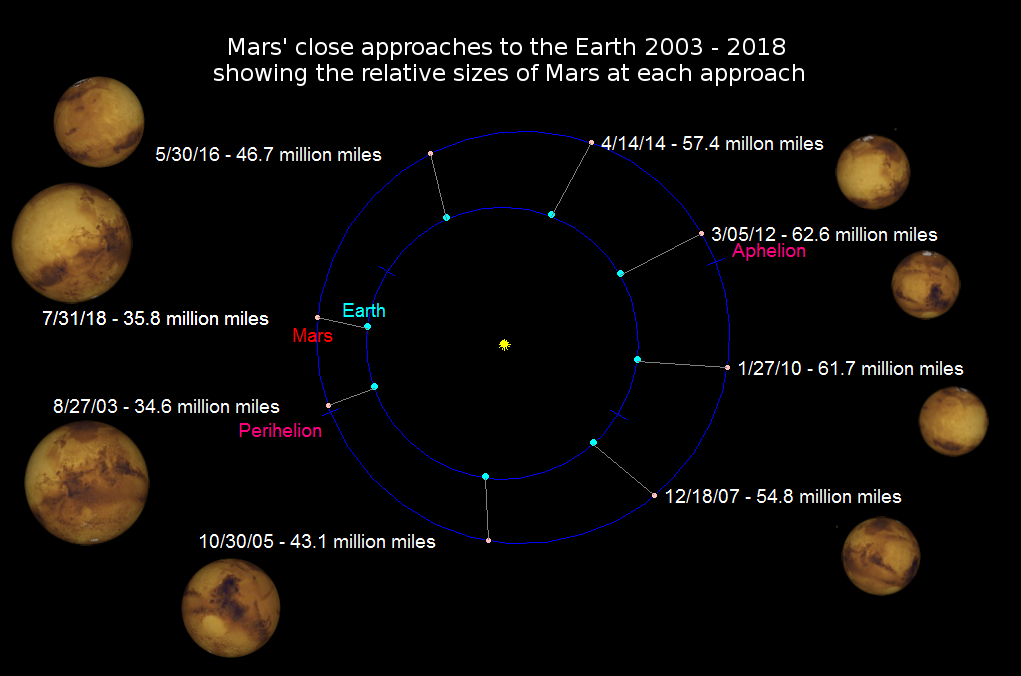
Mars’ closest approaches to the Earth in the period 2003 to 2018 also showing the apparent sizes of the planet at each approach. Click on image to enlarge. Created using my LookingUp program and Cartes du Ciel (Sky Charts).

