01/05/11 – Ephemeris – The bright planets this week
Wednesday, January 5th. The sun will rise at 8:19. It’ll be up for 8 hours and 57 minutes, setting at 5:16. The moon, 1 day past new, will set at 6:55 this evening.
Lets take a look at the bright planets for the first time in 2011. Mars is very low and lost in the evening twilight. The planet Jupiter is up in the south southwestern sky in the early evening. It is a spectacular sight in a telescope with its four satellites, shifting their positions from night to night, and the cloud bands running in the directions of the satellites. Jupiter is the brightest starlight object in the evening. It’s located below the Circlet in Pisces now and will set at 11:27 p.m. The ringed planet Saturn will rise at 1:01 a.m. in the east southeast. It’s located in the constellation Virgo this year. It’s rings are opening nicely for telescopic observers. Venus is brilliant in the morning sky and will rise at 4:34 a.m. in the east southeast.
* Times are for the Traverse City/Interlochen area of Michigan. They may be different for your location.
01/04/11 – Ephemeris – Solar eclipse for the Old World today
Tuesday, January 4th. The sun will rise at 8:19. It’ll be up for 8 hours and 56 minutes, setting at 5:15. The moon is new today, and won’t be visible.
There is a partial solar eclipse in progress for Europe, North Africa and as far a China. This is the companion to the lunar eclipse we had December 21st. Since the lunar eclipse was total, this solar eclipse is not centrally aligned. Eclipses occur in seasons with an interval of a bit less than 6 months[, making a complete eclipse year of 346 days]. Eclipses generally occur in pairs in each eclipse season, one lunar eclipse followed two weeks later by a solar eclipse or vice versa. On rare occasions three eclipse cam occur at two week intervals: A partial solar eclipse , a very central lunar eclipse and another partial solar eclipse. Such a triad will occur this year. A partial solar eclipse on June 1st., a total lunar eclipse June 15th and another partial solar eclipse July 1st. Non will be visible from here.
*Text in brackets was omitted due to time constraints
* Times are for the Traverse City/Interlochen area of Michigan. They may be different for your location.
Check out the NASA Eclipse web site for 2011.
01/03/11 – Ephemeris – The earth at perihelion and the Quadrantid meteor shower
Monday, January 3rd. The sun will rise at 8:19. It’ll be up for 8 hours and 55 minutes, setting at 5:14. The moon, 1 day before first quarter, will rise at 8:26 tomorrow morning.
We have two celestial events today. Around 2:30 this afternoon the earth with be at its closest point to the sun called perihelion, only 91.4 million miles. We’re a little too far north to need the extra sun screen. What really happens is the earth travels faster in its orbit making winter the shortest season. Tonight will see the peak of the Quadrantid meteor shower. These meteors seem to come from the defunct constellation of the Quadrangle near the tip of the handle of the Big Dipper. It can be as productive as the meteors of August. Up to 100 an hour may be seen toward dawn when the radiant point is high in the sky. Early in the evening the radiant will be low in the north giving us fewer but longer meteor trails in the sky.
* Times are for the Traverse City/Interlochen area of Michigan. They may be different for your location.
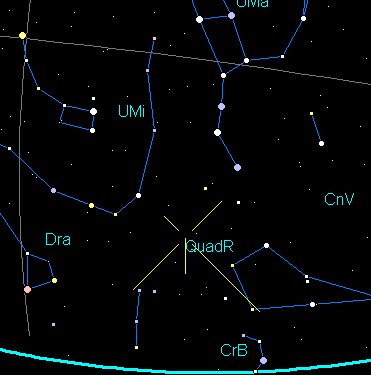
Quadrantid meteor shower radiant at 1:30 a.m. Looking northeast.
2010 in review
The stats helper monkeys at WordPress.com mulled over how this blog did in 2010, and here’s a high level summary of its overall blog health:

The Blog-Health-o-Meter™ reads This blog is on fire!.
Crunchy numbers
A Boeing 747-400 passenger jet can hold 416 passengers. This blog was viewed about 2,900 times in 2010. That’s about 7 full 747s.
In 2010, there were 95 new posts, not bad for the first year! There were 47 pictures uploaded, taking up a total of 3mb. That’s about 4 pictures per month.
The busiest day of the year was September 20th with 172 views. The most popular post that day was 9/20/10 – Ephemeris – Mercury and Jupiter.
Where did they come from?
The top referring sites in 2010 were en.wordpress.com, ephemeris.bjmoler.org, search.aol.com, obama-scandal-exposed.co.cc, and search.conduit.com.
Some visitors came searching, mostly for comet hartley 2 ephemeris, comet hartley ephemeris, hartley 2 ephemeris, jupiter 9/20/10, and biggest dog bone.
Attractions in 2010
These are the posts and pages that got the most views in 2010.
9/20/10 – Ephemeris – Mercury and Jupiter September 2010
1 comment
10/04/10 – Ephemeris – Comet Hartley 2 October 2010
12/20/10 – 12/21/10 Live eclipse blogging December 2010
1 comment
12/20/10 – Ephemeris – Total lunar eclipse tomorrow morning December 2010
The biggest dog bone I’ve ever seen. November 2010
12/31/10 – Ephemeris – Space exploration events in 2011
New Years Eve, Friday, December 31st. The sun will rise at 8:19. It’ll be up for 8 hours and 52 minutes, setting at 5:11. The moon, 1 day before new, will rise at 5:54 tomorrow morning.
The year 2011 will be a great one for exploration of the solar system. Three NASA spacecraft will reach their targets. On Valentine’s Day the Stardust spacecraft will pass close to Comet Tempel 1, to see the changes in that comet in the 5 and a half years since the Deep Impact spacecraft hit that comet with a 600 pound chunk of copper. On March 18th, the MESSENGER spacecraft will attempt to enter orbit around Mercury after a seven year long journey. On July 16th the ion powered Dawn spacecraft will gently assume orbit of the asteroid Vesta. Vesta is one of the bigger asteroids, being second most massive and the brightest. It will orbit Vesta for a year before leaving for the dwarf planet Ceres.
* Times are for the Traverse City/Interlochen area of Michigan. They may be different for your location.
12/30/10 – Ephemeris – The bright star Procyon
Thursday, December 30th. The sun will rise at 8:19. It’ll be up for 8 hours and 51 minutes, setting at 5:11. The moon, 2 days before new, will rise at 4:46 tomorrow morning.
Visible in the east southeast above and left of Sirius the brightest night time star which is low in the southeast at 9 p.m. tonight is the bright star Procyon in the constellation Canis Minor, or lesser dog. Only one other star can be found in Canis Minor. Perhaps it’s a hot dog. If Sirius is the Dog Star then Procyon should be the Little Dog Star. Procyon is an interesting name. It means “Before the dog”, which is an allusion to the fact that Procyon, though east of Sirius actually rises before it. This is due to Procyon’s more northerly position. This effect doesn’t work south of the equator, however. Procyon is a star much like Sirius but farther away. It’s 11.41 to Sirius’ 8.6 light years away. And like Sirius it even has a small white dwarf star in its system.
* Times are for the Traverse City/Interlochen area of Michigan. They may be different for your location.
12/29/10 – Ephemeris – The bright planets this week
Wednesday, December 29th. The sun will rise at 8:19. It’ll be up for 8 hours and 51 minutes, setting at 5:10. The moon, 2 days past last quarter, will rise at 3:34 tomorrow morning.
Lets take a look at the bright planets for the last time this year. Mars is very low and lost in the evening twilight. The planet Jupiter is up in the south southwestern sky in the early evening. It is a spectacular sight in a telescope with its four satellites, shifting their positions from night to night, and the cloud bands running in the directions of the satellites. Jupiter is the brightest starlight object in the evening. It’s located below the Circlet in Pisces now and will set at 11:49 p.m. The ringed planet Saturn will rise at 1:27 a.m. in the east southeast. It’s located in the constellation Virgo this year. It’s rings are opening nicely for telescopic observers. Venus is brilliant in the morning sky and will rise at 4:27 a.m. in the east southeast.
* Times are for the Traverse City/Interlochen area of Michigan. They may be different for your location.
12/28/10 – Ephemeris – Orion’s hunting dogs
Tuesday, December 28th. The sun will rise at 8:18. It’ll be up for 8 hours and 50 minutes, setting at 5:09. The moon, 1 day past last quarter, will rise at 2:20 tomorrow morning.
The great winter constellation or star group Orion the Hunter, is located in the southeastern sky at 9 p.m. His elongated rectangle of a torso is almost vertical. In the center of the rectangle are three stars in a line that make his belt. As a hunter, especially one of old, he has two hunting dogs. The larger, Canis Major can be found by following the three belt stars of Orion down and to the left. There lies the brilliant star called Sirius, also known as the Dog Star. It’s in the heart of a stick figure dog facing Orion that appears to be begging. The smaller dog can be found by extending a line through Orion’s shoulder stars to the left. We find a bright star called Procyon. It and one other star make up the hot-dog shaped constellation of Canis Minor, the little dog.
* Times are for the Traverse City/Interlochen area of Michigan. They may be different for your location.
12/27/10 – Ephemeris – Orion and the Great Orion Nebula
Monday, December 27th. The sun will rise at 8:18. It’ll be up for 8 hours and 50 minutes, setting at 5:08. The moon, at last quarter today, will rise at 1:06 tomorrow morning.
At 9 in the evening the constellation Orion will appear in the southeast with its seven brightest stars brighter than those of the Big Dipper. Orion’s upright rectangle of stars will lean to the left before midnight, when it will be upright. In the morning hours it will lean to the right. The rectangle is the torso of this mythical hunter. Inside the rectangle is a line of three stars, his belt, and an easy way for find him, because it is the only line of three bright stars in the sky. Below the belt appear another three stars, though fainter, in a line, his sword. Binoculars will reveal more than three stars and a bit of haze around the small group that appear as the middle star. Telescopes will reveal much more. This is the Great Orion Nebula where stars even now are bring born.
* Times are for the Traverse City/Interlochen area of Michigan. They may be different for your location.

