12/02/10 – Ephemeris – The constellation of Auriga the Charioteer2
Thursday, December 2nd. The sun will rise at 8:00. It’ll be up for 9 hours and 3 minutes, setting at 5:03. The moon, 3 days before new, will rise at 5:47 tomorrow morning.
The constellation Auriga the charioteer is half way up the sky in the east at 9 p.m. It is a pentagon of stars, with the brilliant star Capella at one of its corners. Capella represents a she goat he’s carrying. A narrow triangle of stars nearby Capella is her kids. The Kids is an informal constellation or asterism. Within and near that pentagon, binoculars and telescopes will find several star clusters, groups of hundreds of stars born in the clump we still see them in. These star clusters will appear as fuzzy spots in binoculars. One called M38 is near the center of the pentagon. Another, M36 is to the east of it. Still another star cluster, M37, is farther east, just outside the pentagon. The M designations come from Charles Messier who 2 centuries ago ran into them while looking for comets.
* Times are for the Traverse City/Interlochen area of Michigan. They may be different for your location.
How the Search for the Star of Bethlehem Began
For this December’s meeting of the GTAS I will present my biennial program In Search of the Star of Bethlehem. I’ve been alternating this program with Biblical Cosmology, as a change of pace.
This posting will supplement and illuminate the presentation, not replace it. Here we’ll look at the origins of the search for what became known as the Star of Bethlehem and of the search for what the star was. We’ll start at the beginning with the only reference to the star found in the Bible, in the second chapter of Matthew. The translation here is from the New American Bible.
The story
After Jesus’ birth in Bethlehem of Judea during the reign of King Herod, astrologers from the east arrived one day in Jerusalem inquiring, “Where is the newborn King of the Jews? We observed his star at its rising and have come to pay him homage.” At the news King Herod became greatly disturbed, and with him all Jerusalem. Summoning all of the chief priests and scribes of the people, he inquired of them where the Messiah was to be born. “In Bethlehem of Judea”, they informed him. “Here is what the prophet has written: And you, Bethlehem, land of Judah, are by no means least among the princes of Judah, since from you shall come a ruler who is to shepherd my people Israel”. Herod called the astrologers aside and found out the exact time of the star’s appearance. Then he sent them to Bethlehem after having instructed: “Go and get detailed information about the child. When you have found him, report it to me so that I may go and offer him homage too.” After their audience with the king, they set out. The star, which they had observed at its rising went ahead of them until it came to a standstill over the place where the child was. They were overjoyed at seeing the star, and on entering the house, found the child with Mary his mother.
The story teller
The story is told in the Gospel of Matthew. Who was Matthew? We don’t know. Scholars are quite sure that he wasn’t the apostle Matthew. Much of the material of the Gospel of Matthew is taken from the Gospel of Mark, written by John Mark, a young associate of St. Paul. A source for Mark, and possibly Matthew and Luke was a now lost source, called by Biblical scholars called Q, from the German word Quelle, which means simply Source. It could have been written or even an oral tradition of the sayings of Jesus.
Mark’s Gospel is dated to about AD 70. While Matthew’s is somewhat later. He seemed cognizant of the destruction of Jerusalem in AD 70. Matthew’s audience for his Gospel seems to be Jewish Christians, and he emphasizes that Jesus is the fulfillment of Biblical prophesy.
The only other nativity narrative in the Gospels is that of Luke. Though not contradictory, the nativity stories of Matthew and Luke are completely different with few points in common. One wonders how Luke could omit the visit of the magi or the flight to Egypt, had he known. Maybe he didn’t. Luke’s audience was more non Jewish and not as interested in Jesus as fulfillment of biblical prophesy.
Most Biblical scholars agree that the Gospels are not biographies in the modern sense of the word, and may not be, I hate saying this, the Gospel truth. Where did the writer of Matthew get the goings on in King Herod’s court some 70 years after the fact? I suppose there were leaks, just like there’s leaks in our President George III’s recent administration. Even so there’s bound to be some alteration and embellishment over time. This tendency to embellish stories more with time is seen with the apocryphal or “hidden” gospels written later on which relate, rather fanciful accounts of Jesus’ childhood.
The search begins
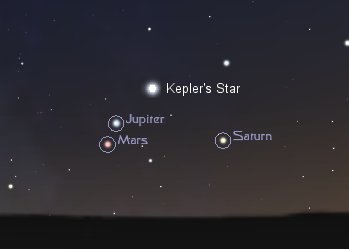
Kepler's Star and the planets
The search for the Star of Bethlehen began in 1604, with the appearance of a supernova in the constellation of Ophiuchus. At the bottom of this page is a representation of the sky near the end of twilight on the night Johannes Kepler discovered the supernova, October 9, 1604. It was near a close grouping of the three planets Jupiter Saturn and Mars. He calculated a similar grouping of the same three planets in 6 B.C. after Jupiter and Saturn pass three times in a triple conjunction the previous year.
He speculated that a nova appeared near that grouping too, and that the appearance of the planets and the “New” star prompted the magi to journey to Judea to pay homage to the newborn King of the Jews. The question is: was there a “new” star or a nova or supernova visible near the planets in 6 BC?
This is an excerpt of my December 2005 article in the GTAS publication the Stellar Sentinel
12/01/10 – Ephemeris – This Week’s Bright Planets
Wednesday, December 1st. The sun will rise at 7:59. It’ll be up for 9 hours and 4 minutes, setting at 5:03. The moon, 3 days past last quarter, will rise at 4:32 tomorrow morning.
Lets take a look at the bright planets for this week. Mars is very low and lost in the evening twilight as is Mercury. The planet Jupiter is up in the southern sky in the early evening. It is a spectacular sight in a telescope with its four satellites, shifting their positions, and the cloud bands running in the directions of the satellites. Jupiter will move due south at 7:39 p.m.. It is the brightest starlight object in the evening. It’s located below the Circlet in Pisces now and will set at 1:26 a.m. The ringed planet Saturn will rise at 3:08 a.m. in the east southeast. It’s located in the constellation Virgo this year. It’s rings are opening nicely for telescopic observers. Venus is in the morning sky and will rise at 4:36 a.m. in the east southeast.
* Times are for the Traverse City/Interlochen area of Michigan. They may be different for your location.
11/30/10 – Ephemeris – December Preview
Tuesday, November 30th. The sun will rise at 7:58. It’ll be up for 9 hours and 6 minutes, setting at 5:04. The moon, 2 days past last quarter, will rise at 3:16 tomorrow morning.
Let’s preview December’s skies. Winter will officially arrive on the 21st at 6:38 p.m., the winter solstice. The noontime sun will dip from 23 ½ degrees to a bit less than 22 degrees above the southern horizon on that day. There will be little movement in the sunset times: In the Traverse City/Interlochen area this will be from 5:03 tomorrow, down to 5:02 and then advancing to 5:11 at the end of the month. There is more movement in the sunrise times which will advance from 7:59 tomorrow morning to 8:19 on the 31st. The big events in December will be the Geminid meteor shower whose maximum is on the morning of the 14th, and a total lunar eclipse that will be visible on the morning of the 21st.
* Times are for the Traverse City/Interlochen area of Michigan. They may be different for your location.
11/29/10 – Ephemeris – The constellation Orion
Monday, November 29th. The sun will rise at 7:56. It’ll be up for 9 hours and 7 minutes, setting at 5:04. The moon, 1 day past last quarter, will rise at 2:01 tomorrow morning.
The central constellation of winter, Orion the hunter, is low in the east southeastern sky at 9 p.m. Look for the line of three stars that is his belt aligned nearly vertically. Orion’s rectangular frame is tilted to the left with his shoulder stars Betelgeuse, in the upper left and Bellatrix, and his knee stars Saif and Rigel to the lower right. Red Betelgeuse and blue-white Rigel vie for the brightest of Orion’s stars. It is a never ending contest, because Betelgeuse is a variable star, and is usually somewhat dimmer than Rigel. They make a nice color contrast. From Betelgeuse extend stars that portray an arm holding a club. From Bellatrix extend stars to the right that delineate an arm holding up a shield to ward off the charge of Taurus the Bull.
* Times are for the Traverse City/Interlochen area of Michigan. They may be different for your location.
11/26/10 – The constellation Taurus
Friday, November 26th. The sun will rise at 7:53. It’ll be up for 9 hours and 12 minutes, setting at 5:06. The moon, 2 days before last quarter, will rise at 10:18 this evening.
Low in the east southeast at 9 p.m. is the constellation of the giant hunter Orion. Above him is Taurus the bull. His face is a letter V shape of stars lying on its side, the star cluster Hyades, with the bright orange-red star Aldebaran at one tip of the V as its angry blood-shot eye, but actually about half way between us and the cluster. Orion is depicted in the sky facing, with club in one hand and a shield in the other, the approaching and in some depictions charging Taurus. The Pleiades star cluster is in his shoulder. Taurus in Greek mythology was the guise the god Zeus when he carried off the maiden Europa. Europa’s still with him as the intriguing satellite orbiting Zeus’ Roman equivalent the planet Jupiter.
* Times, as always are for the Traverse City/Interlochen area of Michigan.
11/25/10 – Ephemeris – The constellation Andromeda
Thanksgiving Day (US), Thursday, November 25th. The sun will rise at 7:52. It’ll be up for 9 hours and 14 minutes, setting at 5:06. The moon, 3 days before last quarter, will rise at 9:04 this evening.
In the south at 9 this evening can be found a large square of stars, the Great Square of Pegasus the flying horse, flying upside down to the right. What look like its hind legs stretching to the left from the upper left corner star is another constellation, Andromeda the chained maiden. She is seen in the sky as two diverging curved strings of stars that curve upward. She was rescued by the hero Perseus, a nearby constellation, riding his steed Pegasus. Andromeda’s claim to astronomical fame is the large galaxy seen with the unaided eye just above the upper line of stars. The Great Andromeda Galaxy is 2.5 million light years away. To the unaided eye the galaxy appears as a small smudge of light. In binoculars the galaxy is a delicate spindle of light.
* Times, as always are for the Traverse City/Interlochen area of Michigan.
11/24/10 – Ephemeris – This week’s bright planets
Wednesday, November 24th. The sun will rise at 7:50. It’ll be up for 9 hours and 16 minutes, setting at 5:07. The moon, 3 days past full, will rise at 7:52 this evening.
Lets take a look at the bright planets for this week. Mars is very low and lost in the evening twilight as is Mercury. The planet Jupiter is up in the southern sky in the early evening. It is a spectacular sight in a telescope with its four satellites, shifting their positions, and the cloud bands running in the directions of the satellites. Jupiter will move due south at 8:05 p.m.. It is the brightest starlight object in the sky. It’s located in Pisces this year and will set at 1:52 a.m. The ringed planet Saturn will rise at 3:32 a.m. in the east southeast. It’s located in the constellation Virgo this year. It’s rings are opening nicely for telescopic observers. Venus is in the morning sky and will rise at 4:51 a.m. in the east southeast.
* Times, as always are for the Traverse City/Interlochen area of Michigan.
11/23/10 – Ephemeris – Hyabusa returns bits of Itokawa
Tuesday, November 23rd. The sun will rise at 7:49. It’ll be up for 9 hours and 18 minutes, setting at 5:07. The moon, 2 days past full, will rise at 6:45 this evening.
The Japanese announced last week that the Hyabusa sample container that landed in June after visiting the asteroid Itokawa contained 1,500 minute asteroid particles in the empty looking container. The inside of the container was carefully scraped with a special spatula and came up with bits of the asteroid. The Itokawa asteroid had been studied from earth and had been determined to be a stony asteroid, what they call a type S. The two minerals found were olivine and pyroxene Olivine is common on the earth, moon, meteorites and two of the comets we’ve visited. Pyroxene is common to on the earth and meteorites. Samples of the area where the capsule landed were taken to rule out contamination.
* Times, as always are for the Traverse City/Interlochen area of Michigan.
11/22/10 – Ephemeris – Some Comet Hartley 2 results
Monday, November 22nd. The sun will rise at 7:48. It’ll be up for 9 hours and 20 minutes, setting at 5:08. The moon, 1 day past full, will rise at 5:46 this evening.
NASA held a news conference last Thursday, two weeks after the Deep Impact spacecraft’s encounter with Comet Hartley 2 on November 4th. The comet didn’t disappoint. It was the most active nucleus found by any spacecraft, and its most active jets were powered by dry ice, something not seen before. The jets also disgorged bits of ice that looked like a snow storm in the spacecraft’s high resolution imagers. This was another first. The chicken drumstick shape of the nucleus was expected by beforehand. But the difference in the surface between the lobes which was smooth and the lobes themselves which were rough and actively spewing jets of CO2 and snow was a surprise. Looks like astronomers will be chewing on this drumstick for years to come.
* Times, as always are for the Traverse City/Interlochen area of Michigan.

