My shakedown cruise
A week an a half ago my granddaughter and I went out on the schooner Manitou for as two hour cruise with over 50 folks on the west arm of the Grand Traverse Bay. It was my shakedown cruise, not the boat’s. I was asked to be the astronomer on the four day Astronomy Cruise. The regular physicist/astronomer was on sabbatical this year.
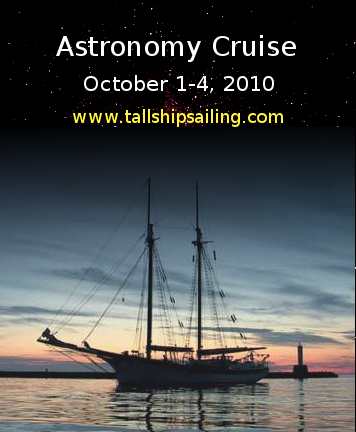
Astronomy Cruise image from the Ephemeris Web site
Here’s the image on the Ephemeris web site that I’ve been running since last autumn.
Anyway, back to the cruise. There was a steady wind and after the ship motored away from the dock and headed into the wind. 12 of us hauled on the line to raise the mainsail. Others raised the foresail and the crew raised two jibs. (If I got anything wrong, I’m working on the terminology, OK?). We stayed in the south end of the bay, sailing back and forth. I never knew our speed, but the boat seemed fast and responsive enough. I had a long chat with the captain with what the itinerary would be. She said their wasn’t one. That was determined by the wind Though they did expect to make it to one of the Manitou islands. I checked out below decks at the cabins and the galley. Snug but nice.
My companion and bunk mate for this cruise is a veteran of many cruises Norm Wheeler. He’s the instructor for Science and English at the Leelanau School and the head of the school’s Lanphier Observatory. He’s also a member of the Beach Bards, a story telling troupe that entertains at a bonfire on the beach at the school and on the Manitou.
I’m going to bring my 8 inch Celestron telescope for viewing at night from onshore, a couple of pair of binoculars I’ll also bring my laptop computer if worse comes to worst and it’s cloudy. I have a stock of my Grand Traverse Astronomical Society presentations to use.
Here’s some photos from the cruise.
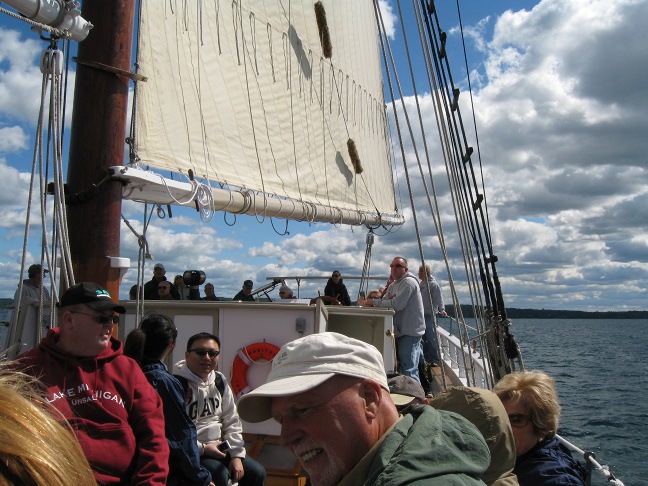
Looking Aft
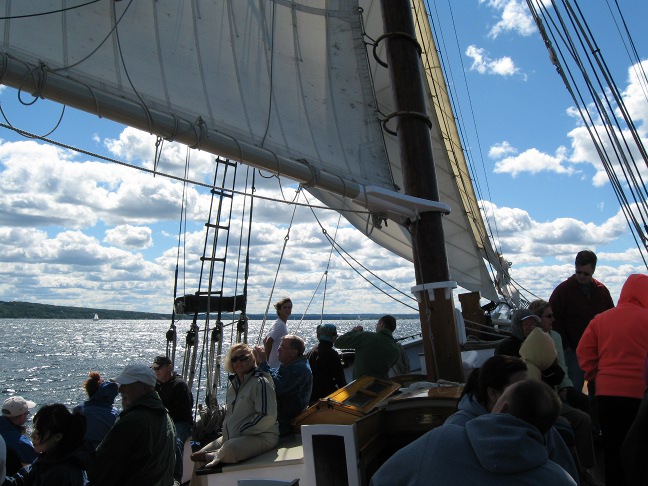
Looking Forward
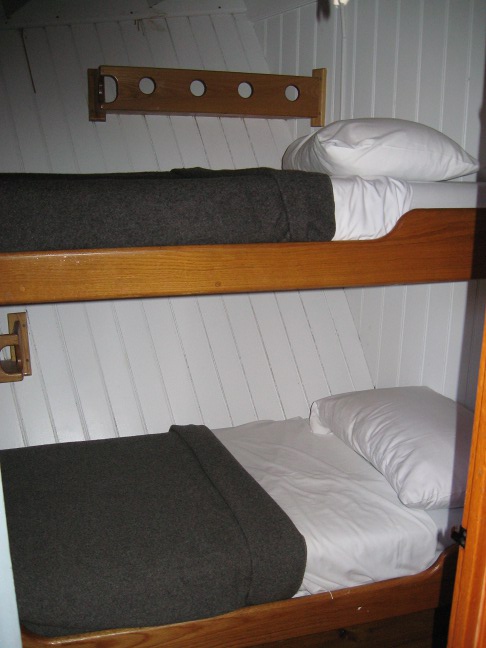
The bunks in one of the forward cabins
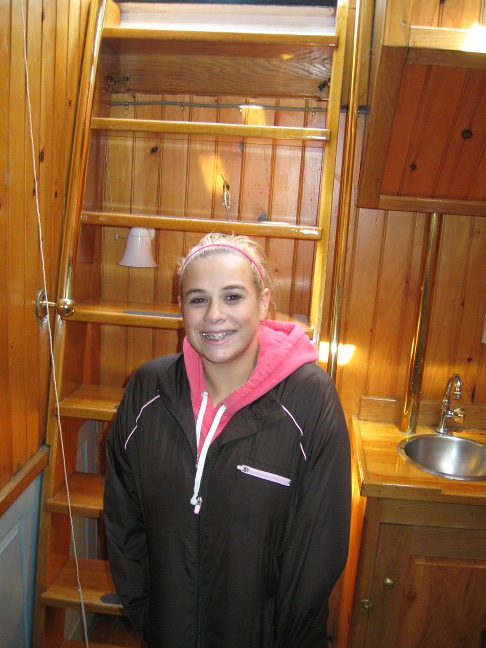
My granddaughter Coley near the ladder below deck

Coley on deck
9/16/10 – Ephemeris – the moon
September 16: This is Ephemeris for Thursday, September 16th.* The sun will rise at 7:22. It’ll be up for 12 hours and 28 minutes, setting at 7:51. The moon, 1 day past first quarter, will set at 1:38 tomorrow morning.
We’re looking at the moon this week leading up to International Observe the Moon Night Saturday night. We’ll have some telescopes at the Clinch Park Marina Saturday if it’s clear. The moon tonight is special for those with telescopes. With lots of features that will be revealed by the moon’s sunrise terminator, the sunrise line of the east edge of the visible part of the moon. Starting at the north or top of the moon is the strange square crater Barrow. Below that is the ringed plane, the crater Plato. It’s cool watching the shadows of the crater walls recede as the sun rises. There’s a gash in the mountains nearby called the Alpine Valley. On the southern half of the moon there’s a thin line of a shadow, the straight wall a 900 foot high and 67 mile long cliff.
*Times are for the Grand Traverse Area of Northern Michigan, USA.
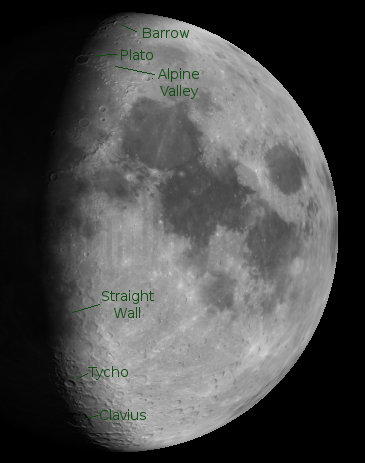
Moon 1 day past first quarter. Created using Virtual Moon Atlas.
Is crater Barrow really square? You be the judge.
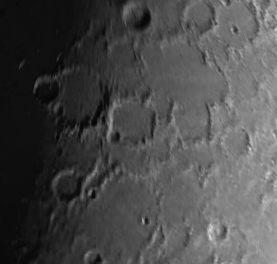
Overhead view of the crater Barrow. Created using Virtual Moon Atlas.
9/15/10 – Ephemeris – the planets this week
September 15: This is Ephemeris for Wednesday, September 15th.* The sun will rise at 7:21. It’ll be up for 12 hours and 31 minutes, setting at 7:53. The moon, at first quarter today, will set at 12:37 tomorrow morning. | Lets take a look at the bright planets for this week. Venus and Mars are very low in the twilight. Venus is the brightest. It’s 45 million miles away and slowly approaching, and appears as a tiny crescent. It will set at 8:57 p.m. Mars is right of Venus and a bit above, and much dimmer. I doubt if you could spot it. Mars will set at 9:13 p.m. The star Spica is just right of Venus and Mars. The planet Jupiter now rises just about due east at 8:06 p.m., moving due south at 2:01 a.m.. It’s located in Pisces this year. Mercury is becoming visible low in the east before sunrise It will rise tomorrow morning at 5:53 a.m. Mercury is becoming more and more visible in the morning twilight. 6:30 to 7 a.m. is the best time to spot it.
*Times are for the Grand Traverse Area of Northern Michigan, USA.
9/14/10 – Ephemeris – the moon
September 14: This is Ephemeris for Tuesday, September 14th.* The sun will rise at 7:20. It’ll be up for 12 hours and 34 minutes, setting at 7:55. The moon, 1 day before first quarter, will set at 11:38 this evening. | We’re looking at the moon this week leading up to International Observe the Moon Night Saturday night. We’ll have some telescopes at the Clinch Park Marina Saturday if it’s clear. The moon, even to the unaided eye shows bright and dark areas. The largest bright area to the bottom or south part of the moon is the highlands, a rugged area saturated with craters. The dark areas are generally nearly circular and flat with few craters. These are the maria which is Latin for seas. Which early telescopic viewers thought were really water filled. The seas are gigantic impact basins created by asteroids impacting the moon and their floors are filled with lava from the moon’s interior. They have relatively few craters that occurred later on.
*Times are for the Grand Traverse Area of Northern Michigan, USA.
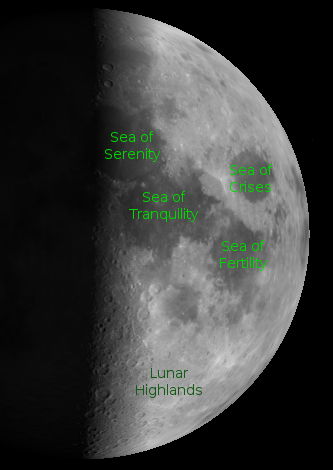
Moon 1 day before first quarter. Created using Virtual Moon Atlas.
9/13/10 – Ephemeris – the moon
September 13: This is Ephemeris for Monday, September 13th*. The sun will rise at 7:18. It’ll be up for 12 hours and 37 minutes, setting at 7:56. The moon, 2 days before first quarter, will set at 10:46 this evening. | We’re going to look at the moon this week leading up to International Observe the Moon Night Saturday night. We’ll have some telescopes at the Clinch Park Marina Saturday if it’s clear. Looking at the moon tonight in binoculars or a small telescope you can see gray areas of the Sea of Crises nearest the bright edge, the Sea of Fertility and toward the center the Sea of Tranquility, where the Apollo 11 astronauts landed. Looking south near the terminator, the line between light and dark on the moon are three prominent craters in a seeming chain. The most prominent is Theophilus with a nice central peak, If you’re interested in a computer based moon map google “Virtual Moon Atlas” for a free download. It allows you to move around the moon, has a wealth of facts and images too.
*Times are for the Grand Traverse Area of Northern Michigan, USA.
Update:

The moon 2 days before first quarter. Image produced using Virtual Moon Atlas
International Observe the Moon Night 9/18/10
The Sidewalk Astronomers of the Grand Traverse Astronomical Society will be observing the moon Saturday night September 18th starting at 8 p.m. near the Clinch Park Marina in Traverse City, MI. This is part of the International Observe The Moon Night.
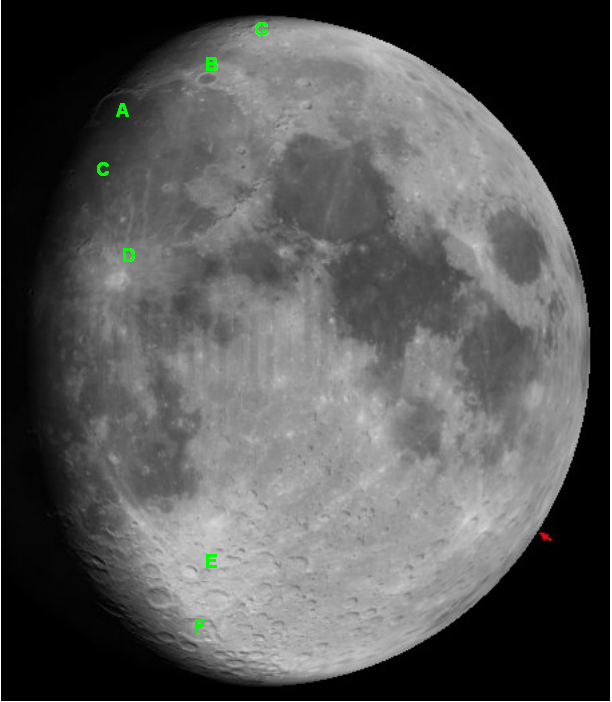
The moon on the evening of September 18, 2010
A Few Points of Interest
A – Sunrise at Sinus Iridium (Bay of Rainbows)
B – The ringed plain Plato
C – Watch for wrinkle ridges in Mare Imbrium (Sea of Showers)
D – The crater Copernicus
E – The crater Tycho and its moon girdling rays.
F – The crater Clavius. Notice the ring of craterlets inside
G – The crater Barrow, a nearly square crater.
Also occurring that night is a conjunction of Jupiter and Uranus. And on Jupiter the Great Red Spot will be centrally located.
We’ll be there if it’s clear or partly cloudy.
Fun under the shooting stars
Holey Cow! it was clear last night for the meteor watching event mentioned in my last post. We were hosted by Grass River Natural Area naturalist Anne Drake and her assistant. (Sorry I didn’t get his name.) On the GTAS side were Richard Kuschell who helped arranged the event, Gary and Eileen Carlisle, Ron and Jan Uthe, and little ole me.
Ron, with the most portable telescope, a Meade 5″ Maksutov went out where the whole sky was visible on the dock on Grass River a quarter of a mile from the small meadow where most of the rest of us were. The trail over there was mostly a boardwalk. Anne lead groups out there. His main problem out there was dewing of the corrector on the scope.
We also has Gary’s 8″ Celestron, my 11″ Dobsonian and the society’s 25″ big Dob all at the meadow. We were able to view objects rather high in the sky due to the trees surrounding the meadow.
About 27 or so folks came out. They saw the quite a few Perseid meteors and a number of the other wonders in the dark heavens. The last of them left just after 11 p.m. so we packed up and headed back. By the time I got home at about quarter to one a.m. some fleecy clouds could be seen overhead.
We’ll be hanging out at the Grass River Natural Area for the Perseids
On the evening of August 12th, 2010 and morning of the 13th the GTAS Sidewalk astronomers will be at Antrim County’s Grass River Nature Area to view the Perseid Meteor Shower and other wonders of the dark skies. Should it be cloudy we’ll do it on the evening of the 13th. Here’s the blurb I put on the GTAS web site:
Grass River Natural Area: at dusk. Perseid meteor shower. Cloud or rain date the 13th. Location North of Alden on Alden Road. Click here for a Mapquest map. Foe GPS devices use the address 6500 Alden Hwy, Bellaire, MI 49615. Park in the parking lot a ways in. Walk the authorized vehicles road or Cabin Trail to a small meadow. There’s also horizon to horizon viewing at the Dock Access Trail or the Sedge Meadow Trail. Keep on the board walk because the ground is spongy.. We’ll also have telescopes at the meadow. Bring your favorite mosquito repellent. The Grass River Natural Area web site is http://www.grassriver.org
GTAS Outreach memories for July 23 thru 30, 2010
What an 8 days. It began and ended with Friday Night Lives in Traverse City. We had reasonable weather for both. Some clouds to contend with. The sun was cooperating with sunspots both evenings. The setup for the Friday night Live events runs from 5 to 5:30 p.m, with the actual event running to 9 p.m. We always hang around later, moving the scopes to parking spaces.
On the 23rd we were there until after 11 p.m. with the gibbous moon rising above the buildings. On the 30th we had no moon and the sky hazed out, so we weren’t there as long, but we did get a lot of traffic from Traverse City Film Festival, with the State Theater a couple of doors down the street. Our troupe of Richard Kuschell, Gary Carlisle, Ron and Jan Uthe plus yours truly were there with telescopes, GTAS brochures and observatory schedules.
On the 29th we went to St. Francis High School for a morning with the Munson Day Camp kids. Richard Kuschell, Gary and Eileen Carlisle, Ron Uthe plus yours truly showed the kids sunspots with three of our telescopes. The Carlisles put up their display of astronomical photographs, while I gave the kids a tour of the solar system.
We then had the kids experiment with moon balls to demonstrate the moon’s phases. I had a ball that was scaled as the earth to the moon balls and had the kids put their moon balls on the floor, guessing how far from the earth the moon is. We got the usual number of short guesses, but in young man placed his moon ball at the proper distance.
The finale was cooking up a comet. Here’s a video of how it’s done. We had the kids help each of us. Gary made the best comet. The rest of us hada bunch of cometlets.
We took Gary’s comet as an example and made another for Friday Night Live the next night.
Worlds in Collusion
There’s is a planet grouping that will happen starting this weekend. Look west, young astronomer. Mars will pass Saturn on Sunday August 1st. Venus will in turn pass Saturn on the 9th. And finally Venus will catch up to speedy Mars on the 23rd. Through this, keep an eye on Venus. The first event will take place just left of Venus.
Of course these planets aren’t gathering at all. Venus is closer than the sun, Mars farther than the sun, and Saturn nearly a billion miles from us. They’re just kinda lining up with the earth at one end.

