Archive
Ephemeris: 09/18/2025 – A fine example of different star colors
This is Bob Moler with Ephemeris for Thursday, September 18th. Today the Sun will be up for 12 hours and 21 minutes, setting at 7:47, and it will rise tomorrow at 7:26. The Moon, 3 days before new, will rise at 4:56 tomorrow morning.
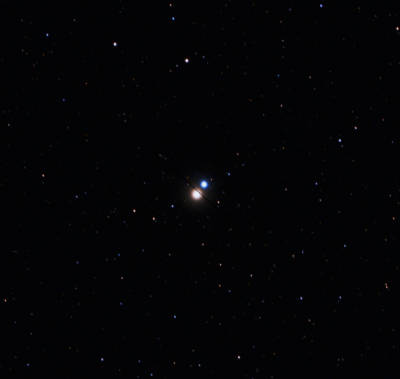
Alberio is the name of the star that is in the head of the constellation of Cygnus the swan, which is almost overhead these evenings. It is also at the foot of the asterism or informal constellation of the Northern Cross. To the naked eye Alberio looks like a single star, however even in small telescopes its true nature is revealed. It’s a double star whose individual star colors are strikingly different Its brightest star is yellow, and the dimmer star is blue. While star colors are subtle, these two, due to their apparent closeness, make an obvious color contrast. Unlike what your interior decorator says: In stars, blue is hot, yellow, orange and red are cool. The two stars are too far apart to be considered a binary star system, but appear to move together in space. It is what is called an optical double, though they’re both around 430 light years away.
The astronomical event times given in this blog are for the Traverse City/Interlochen area of Michigan (Lat 44.7° N, Long 85.7° W; EDT, UT – 4 hours) unless stated otherwise. Times will be different for other locations.
Addendum
07/15/2022 – Ephemeris – How to find the constellation of Cygnus the swan
This is Ephemeris for Friday, July 15th. Today the Sun will be up for 15 hours and 14 minutes, setting at 9:25, and it will rise tomorrow at 6:12. The Moon, 2 days past full, will rise at 11:23 this evening.
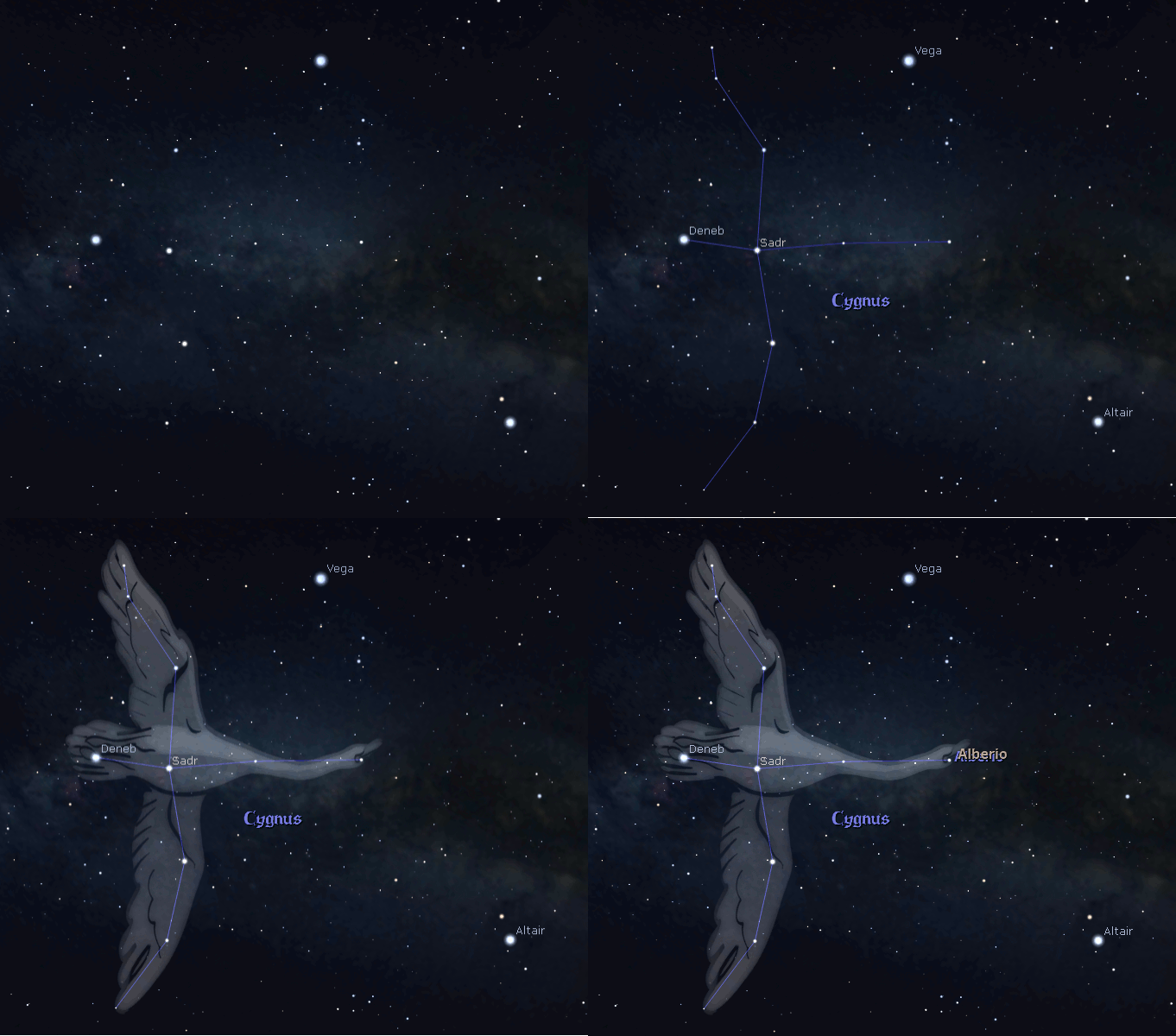
Located fairly high in the east at 11 p.m. is the constellation of Cygnus the swan, flying south through the Milky Way. It is also called the Northern Cross. At the left, the tail of the swan or the head of the cross is the bright star Deneb, one of the stars of the Summer Triangle. The next star right is Sadr the intersection of the body and the wings of the swan seen in flight, or the intersection of the two pieces of the cross. There are two or three stars farther to the right that delineate the swan’s long neck or upright of the cross, that ends with the star Alberio in the beak of the swan or foot of the cross. The crosspiece of the cross extends to the stars on either side of the intersection star Sadr, while the swan’s wings extend to a couple more stars each.
The astronomical event times given are for the Traverse City/Interlochen area of Michigan (EDT, UT – 4 hours). They may be different for your location.
Addendum
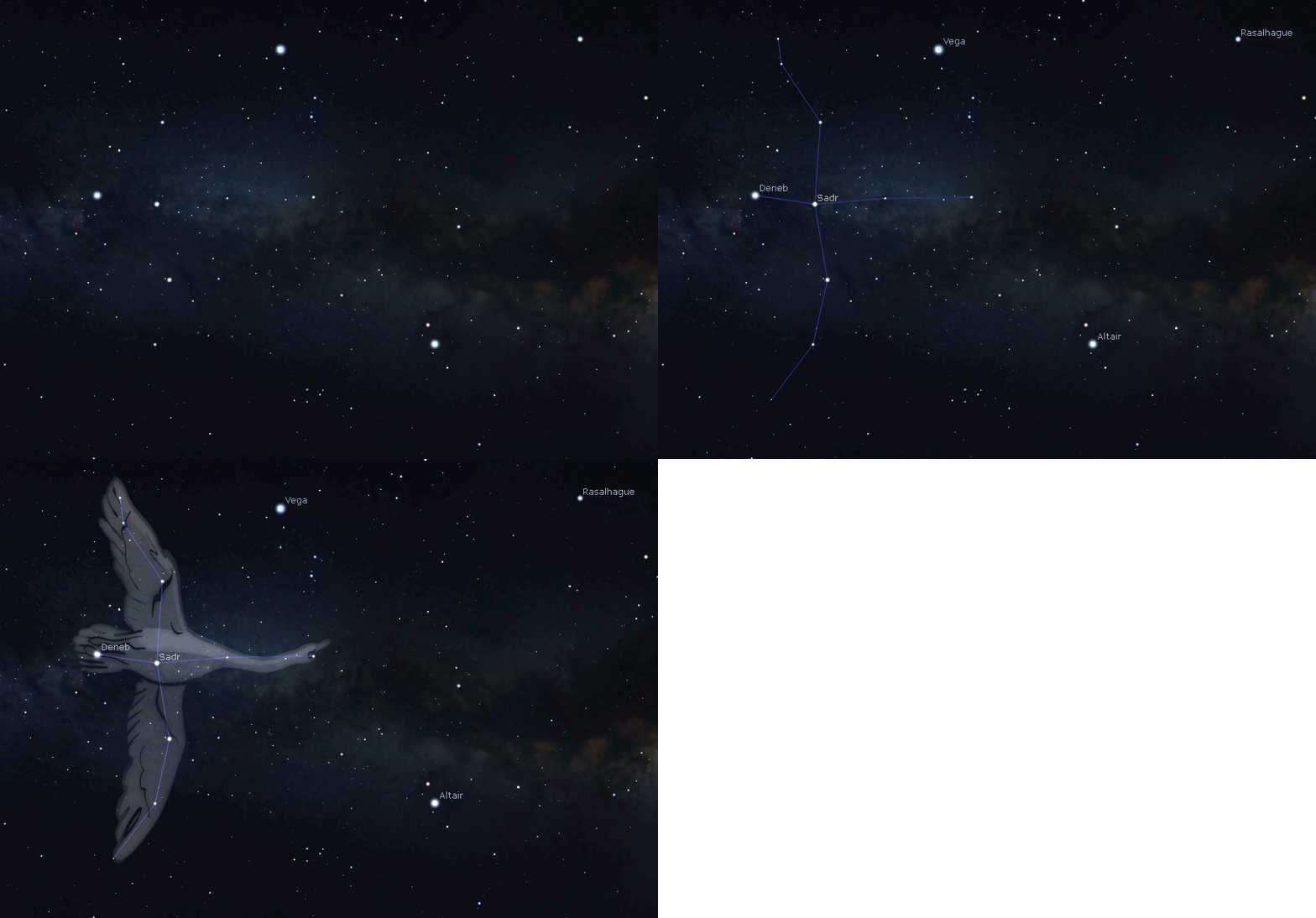
Animated Cygnus finder chart. Included also are, beside Deneb, the other stars of the Summer Triangle: Vega and Altair and their constellations Lyra the harp and Aquila. See if you can find them. Created using Stellarium.
07/10/2020 – Ephemeris – The constellation Cygnus the swan
This is Bob Moler with Ephemeris for Friday, July 10th. Today the Sun will be up for 15 hours and 20 minutes, setting at 9:28, and it will rise tomorrow at 6:08. The Moon, 2 days before last quarter, will rise at 12:52 tomorrow morning.
Fairly high in the east at 11 p.m. Is the constellation of Cygnus the swan, flying south through the Milky Way. It is also called the Northern Cross. At the left, the tail of the swan or the head of the cross is the bright star Deneb, one of the stars of the Summer Triangle. The next star right is Sadr the intersection of the body and the wings of the swan seen in flight, or the intersection of the two pieces of the cross. There are two or three stars farther to the right that delineate the swan’s long neck or upright of the cross, that ends with the star Alberio in the beak of the swan or foot of the cross. The crosspiece of the cross extends to the stars on either side of the intersection star Sadr, while the swan’s wings extend to a couple more stars each.
The event times given are for the Traverse City/Interlochen area of Michigan. They may be different for your location.
Addendum
Animated Cygnus finder chart. Included also are, beside Deneb, the other stars of the Summer Triangle: Vega and Altair and their constellations Lyra the harp and Aquila. See if you can find them. Click on the image to enlarge it. Created using Stellarium.
07/14/2017 – Ephemeris – Constellations of the Summer Triangle II: Cygnus the swan
Ephemeris for Friday, July 14th. Today the Sun will be up for 15 hours and 14 minutes, setting at 9:25, and it will rise tomorrow at 6:11. The Moon, 2 days before last quarter, will rise at 12:32 tomorrow morning.
Fairly high in the east at 11 p.m. Is the constellation of Cygnus the swan, flying south through the Milky Way. It is also called the Northern Cross. At the left, the tail of the swan or the head of the cross is the bright star Deneb, one of the stars of the Summer Triangle. The next star right is Sadr the intersection of the body and the wings of the swan seen in flight, or the intersection of the two pieces of the cross. There are two or three stars farther to the right that delineate the swan’s long neck or upright of the cross, that ends with the star Alberio in the beak of the swan or foot of the cross. The crosspiece of the cross extends to the stars on either side of the intersection star Sadr, while the swan’s wings extend to a couple more stars each.
The times given are for the Traverse City/Interlochen area of Michigan. They may be different for your location.
Addendum
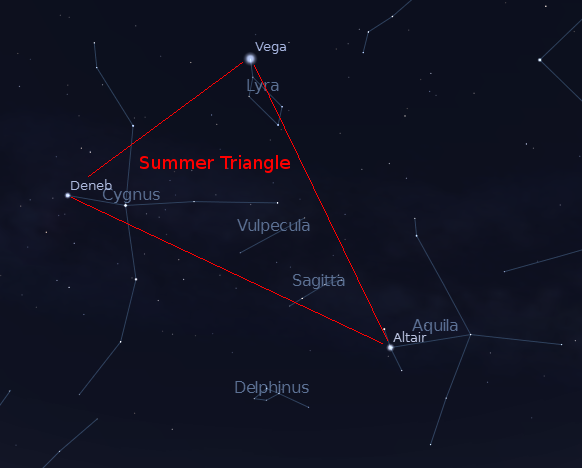
The Summer Triangle. Created using Stellarium and The Gimp.
Animated Cygnus finder chart. Created using Stellarium.
In mythology Cygnus was the form Zeus took in the Leda and the swan affair. Out of that union was born Pollux of Gemini fame. His half-brother and twin Castor was fathered by a mere mortal. Go here for their story.
Alberio is the star that shows in Cygnus’ eye. In telescopes of even low power Alberio shows as a binary star whose components are distinctly and beautiful blue and gold. Binoculars are not quite powerful enough to split these two.
074/26/2016 – Ephemeris – The flying swan and Northern Cross
Ephemeris for Tuesday, July 26th. The Sun rises at 6:22. It’ll be up for 14 hours and 52 minutes, setting at 9:15. The Moon, at last quarter today, will rise at 1:09 tomorrow morning.
Fairly high in the east at 11 p.m. Is the constellation of Cygnus the swan, flying south through the Milky Way. It is also called the Northern Cross. At the left, the tail of the swan or the head of the cross is the bright star Deneb, one of the stars of the Summer Triangle. The next star right is Sadr the intersection of the body and the wings of the swan seen in flight, or the intersection of the two pieces of the cross. There are two or three stars farther to the right that delineate the swan’s long neck or upright of the cross, that ends with the star Alberio in the beak of the swan or foot of the cross. It takes a telescope, but Alberio splits into a beautiful blue and gold binary star.
Times are for the Traverse City/Interlochen area of Michigan. They may be different for your location.
Addendum
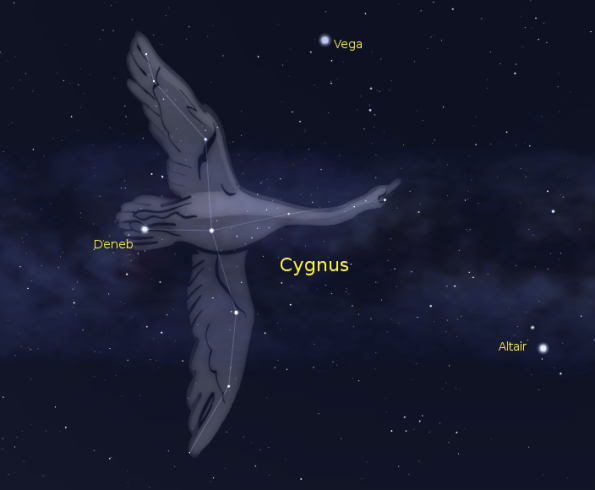
Cygnus the Swan Created using Stellarium.
08/04/2015 – Ephemeris – Is it a swan or a cross?
Ephemeris for Tuesday, August 4th. The Sun rises at 6:32. It’ll be up for 14 hours and 32 minutes, setting at 9:04. The Moon, 2 days before last quarter, will rise at 11:33 this evening.
High in the east northeast as it gets dark flies the constellation of Cygnus the swan. This constellation is also known as the Northern Cross. The cross is seen lying on its side with the bright star Deneb at the head of the cross to the left. The rest of the cross is delineated in the stars to the right. As a swan, Deneb is the tail, the stars of the crosspiece of the cross are part of the leading edges of the wings as Cygnus flies south through the Milky Way. There are faint stars that also define the tips and trailing edges of its wings. It is a very good portrayal of a flying swan, like the mute swans we see on the wing in our area. This is the form the Greek god Zeus took to seduce the maiden Leda in the Leda and the swan affair, out of whose union Pollux was born, who was the twin of Castor, both of whom are also in the stars as the constellation Gemini. In Cygnus we are looking toward the direction that the Sun and the Earth are traveling as we orbit the center of the Milky Way.
Times are for the Traverse City/Interlochen area of Michigan. They may be different for your location.
Addendum
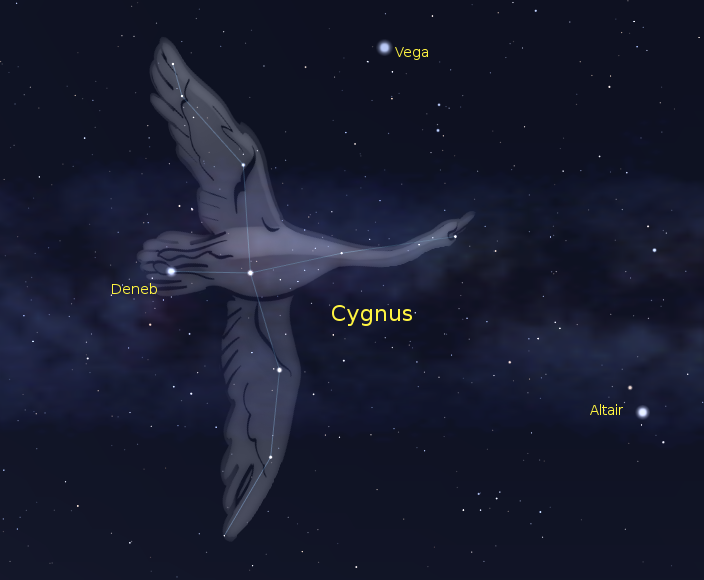
Cygnus The Swan Created using Stellarium.
Note for telescope owners: The star that appears in the eye of the swan image above is Alberio (β Cygni), which splits into a beautiful binary star, whose component stars are blue and gold. It takes a bit more magnification than a pair of binoculars provides.
Note also the mythological citation in the program was omitted from the broadcast version due to time constraints.
07/17/2014 – Ephemeris – The constellation Cygnus the swan
Ephemeris for Thursday, July 17th. Today the sun will be up for 15 hours and 10 minutes, setting at 9:23. The moon, 1 day before last quarter, will rise at 12:25 tomorrow morning. Tomorrow the sun will rise at 6:14. | Fairly high in the east at 11 p.m. Is the constellation of Cygnus the swan, flying south through the Milky Way. It is also called the Northern Cross. At the left, the tail of the swan or the head of the cross is the bright star Deneb, one of the stars of the Summer Triangle. The next star right is Sadr the intersection of the body and the wings of the swan seen in flight, or the intersection of the two pieces of the cross. There are two or three stars farther to the right that delineate the swan’s long neck or upright of the cross, that ends with the star Alberio in the beak of the swan or foot of the cross. The crosspiece of the cross extends to the stars on either side of the intersection star Sadr, while the swan’s wings extend to a couple more stars each.
Times are for the Traverse City/Interlochen area of Michigan. They may be different for your location.
Addendum
CygnusTheSwan Created using Stellarium.
 Bob Moler's Ephemeris Blog