Archive
06/12/2015 – Ephemeris – The first stars to appear at night
Ephemeris for Friday, June 12th. Today the Sun will be up for 15 hours and 31 minutes, setting at 9:28. The Moon, 3 days past last quarter, will rise at 4:03 tomorrow morning. Tomorrow the Sun will rise at 5:56.
Evening twilight lasts a very long time this time of year, so the stars will come out slowly. By about a half hour after sunset the planets Venus and Jupiter should be visible in the west. Probably the first actual star to appear is very high in the east, the orange star Arcturus in the constellation of Boötes, which is the 4th brightest night-time star. Next, lower in the northeast, is the 5th brightest star the white Vega in Lyra the harp. By this time Saturn should appear low in the southeast as a yellowish star. Soon many more stars will become visible with the Big Dipper overhead pointing to Polaris in the north, blue-white Spica in the south, Regulus, left of Jupiter and Capella low in the northwest.
Times are for the Traverse City/Interlochen area of Michigan. They may be different for your location.
Addendum
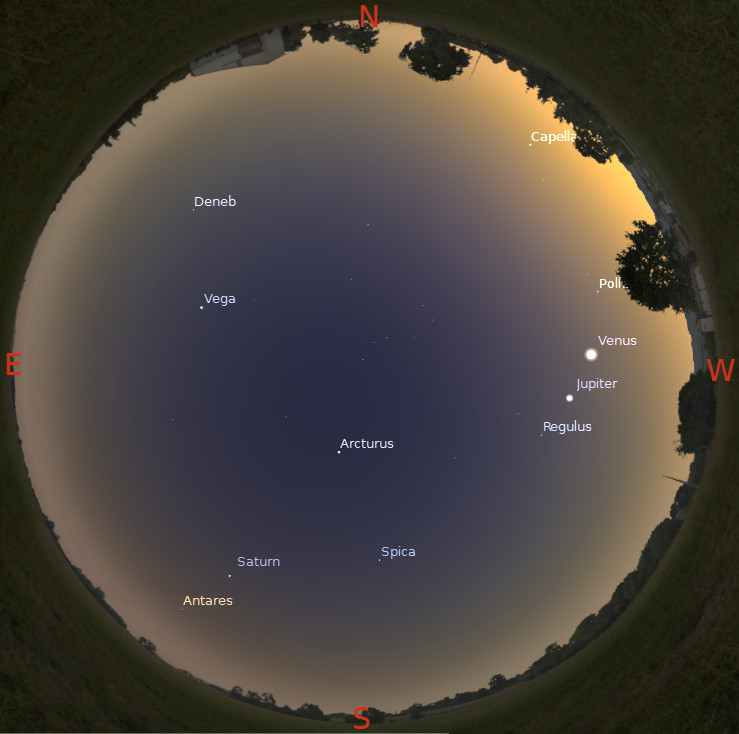
The first stars to appear after sunset. This is created from Stellarium for a half hour after sunset. It’s a bit optimistic, in my view, though my eyes aren’t the best. Try your eyes. Click on image to enlarge.
05/12/2015 – Ephemeris – Arcturus, a look at the Sun’s future
Ephemeris for Tuesday, May 12th. Today the Sun will be up for 14 hours and 42 minutes, setting at 9:00. The Moon, 1 day past last quarter, will rise at 3:43 tomorrow morning. Tomorrow the Sun will rise at 6:17.
Arcturus, a red giant star is about midway up the sky in the southeast at 10 p.m. It’s visible earlier, being the 4th brightest night-time star and the third brightest star-like object out at that time after Venus and Mars. A pointer to it is the handle of the Big Dipper, following the arc of the handle to Arcturus. Though only 37 light years away, it’s not from around here. It’s passing through the galactic disk from north to south. Arcturus is about 7 billion years old, and is about 8% more massive than our Sun. It appears to be starting its red giant phase, after running out of hydrogen to fuse to helium in its core and is beginning to fuse helium. It’s a preview of coming attractions for our Sun when it gets that old.
Times are for the Traverse City/Interlochen area of Michigan. They may be different for your location.
Addendum
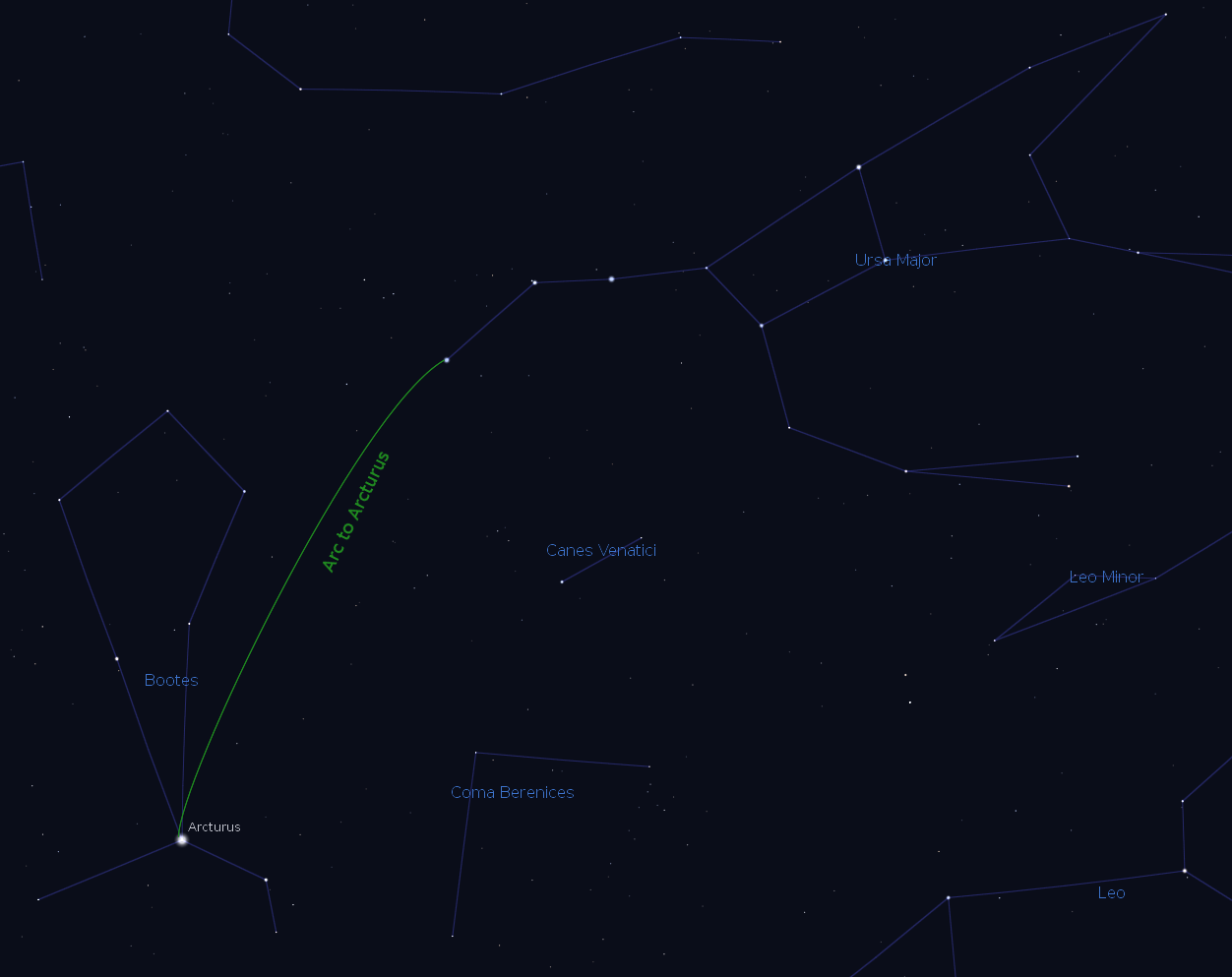
Finding Arcturus. Orientation for 11 p.m. on May 12, 2015. Created using Stellarium.

Evolution of a sun-like star. Note the sizes of the star at the various stages are compressed, also the time line. In the red giant stage the star is possibly a hundred times larger than at the main sequence stage. The white dwarf stage is a hundred times smaller than the main sequence stage. Click to enlarge. Credit: From a NASA/Chandra poster.
05/11/2015 – Ephemeris – How to find the constellation Virgo
Ephemeris for Monday, May 11th. Today the Sun will be up for 14 hours and 39 minutes, setting at 8:59. The Moon, at last quarter today, will rise at 3:08 tomorrow morning. Tomorrow the Sun will rise at 6:18.
Friday I talked about that in spring we are looking out the thin side of our Milky Way galaxy’s disk. One of the large constellations we see in the south at 11 p.m. can be found using the Big Dipper overhead, follow the arc of the handle to the bright star Arcturus, the straighten the arc to a spike to reach Spica, a bright blue-white star in the south. Spica is the brightest star in the constellation Virgo the virgin. She represents the goddess of the harvest, Virgo is holding a sheaf of wheat in depictions of her, and Spica is placed at the head of the sheaf. In the space between Spica and Leo the lion to her right is, a great cluster just below naked eye visibility. The Virgo cluster of galaxies.
Times are for the Traverse City/Interlochen area of Michigan. They may be different for your location.
Addendum
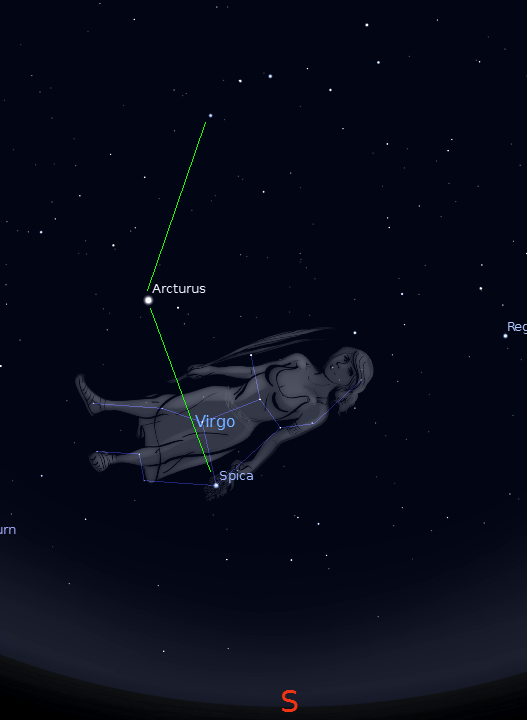
Star hop from the Big Dipper through Arcturus to Spica and Virgo. Orientation for 11 p.m. on May 11, 2015. Created using Stellarium.
04/06/2015 – Ephemeris – Arcturus the 4th brightest star
Ephemeris for Monday, April 6th. The Sun will rise at 7:14. It’ll be up for 13 hours and 1 minute, setting at 8:16. The Moon, 2 days past full, will rise at 10:37 this evening.
One of the stars that stays up most of the year, except late autumn and most of winter is Arcturus. Now in the evening Arcturus is low in the east. It’s a bright star, officially the 4th brightest star in the night sky, and the 4th brightest star-like object in our night sky after Venus, Jupiter, and Sirius. Arcturus can be found by following the arc of the handle of the Big Dipper to it. Remember, follow the arc to Arcturus. Arcturus belongs to the kite shaped constellation of Boötes, which we’ll visit in greater detail when it’s higher in the sky. Arcturus is an interesting star. It’s 37 light years away, and moving quite rapidly at 75 miles per second (122km/s), mostly across the sky. Some astronomers think that it
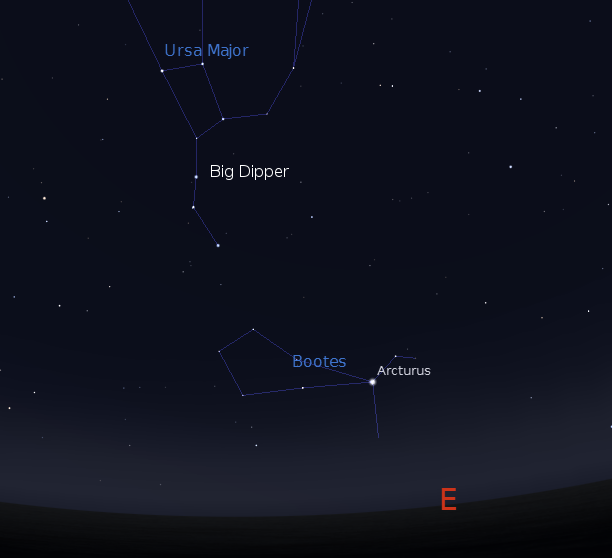
Arcturus off the handle of the Big Dipper at 9:30 p.m. April 6, 2015. Created using Stellarium.
may be part of a captured dwarf galaxy.
Times are for the Traverse City/Interlochen area of Michigan. They may be different for your location.
Addendum
06/02/2014 – Ephemeris – The Big Dipper points to other stars and constellations
Ephemeris for Monday, June 2nd. Today the sun will be up for 15 hours and 21 minutes, setting at 9:21. The moon, 3 days before first quarter, will set at 12:41 tomorrow morning. Tomorrow the sun will rise at 5:59.
The Big Dipper points to other stars and constellations. Right now the Big Dipper is nearly overhead. The front bowl stars point to Polaris, the North Star which never seems to move in the sky. The handle can be used to find two stars. First follow the arc of the handle away from the bowl to find the fourth brightest night time star Arcturus in the base of the kite shaped constellation of Boötes. Straighten the arc to a spike and continue to the south and you will come to the bright blue-white star Spica in Virgo the virgin. Don’t confuse it with reddish Mars to the right of it now. You can remember these stars with the phrase “Follow the arc of the handle to Arcturus and then spike to Spica”
Times are for the Traverse City/Interlochen area of Michigan. They may be different for your location.
Addendum
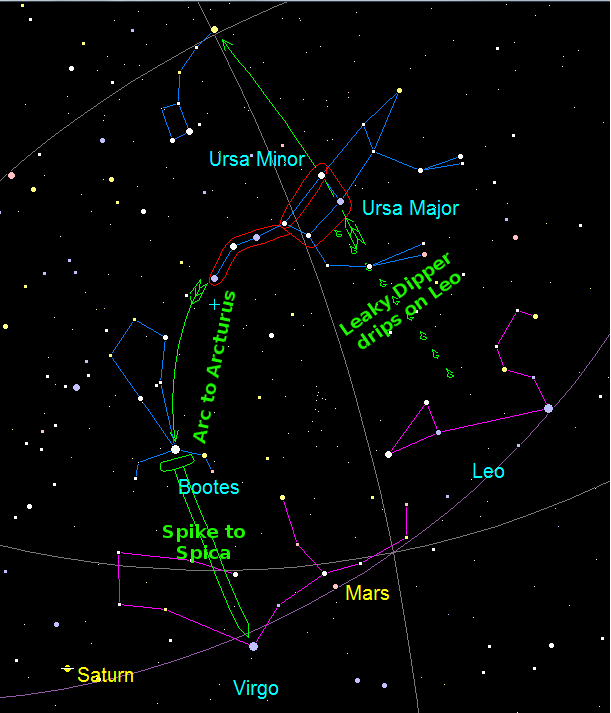
The Big Dipper can be used to point to other stars and constellations in the spring sky. Credit: My LookingUp program.
05/29/2014 – Ephemeris – Boötes the Herdsman
Ephemeris for Thursday, May 29th. Today the sun will be up for 15 hours and 15 minutes, setting at 9:18. The moon, 1 day past new, will set at 10:04 this evening. Tomorrow the sun will rise at 6:01.
High in the south southeastern sky at 10:30 tonight can be found the kite shaped constellation of Boötes the herdsman, chasing or herding the Great Bear Ursa Major of which the Big Dipper is the hind end, across the sky. The bright star at the base of the kite is the 4th brightest night-time star Arcturus. It can be found and name remembered by first locating the Big Dipper and by following the arc or curve of the handle to Arcturus. This star is an orange-colored giant star, 37 light years away. Its light was used open the 1933 Chicago Worlds Fair believing its light left the star in 1893 the year of the previous Chicago Worlds Fair. It turns out that Arcturus is 3 light years closer than what they thought.
Addendum
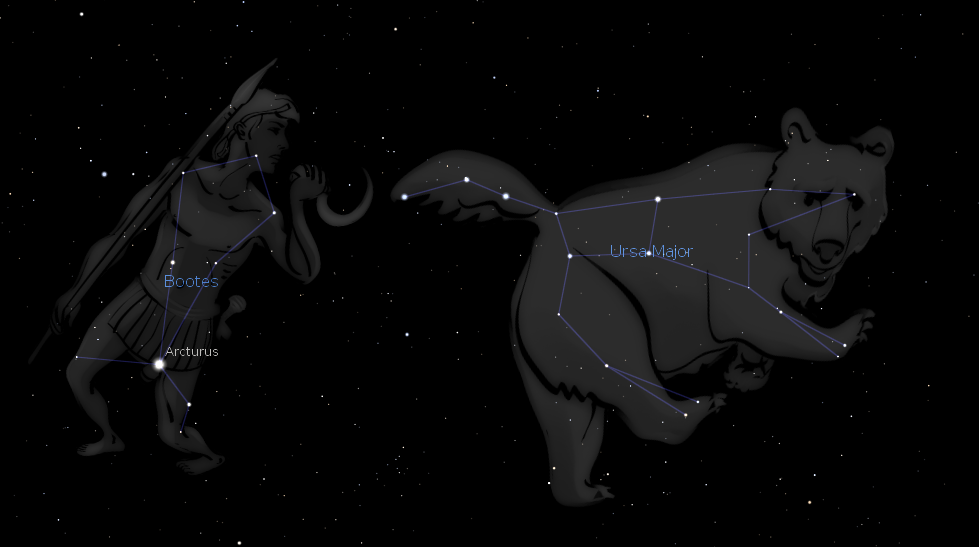
Bootes and Ursa Major high overhead on late spring evenings at 11 p.m. Created using Stellarium.
06/06/2013 – Ephemeris – Star colors
Ephemeris for Thursday, June 6th. Today the sun will be up for 15 hours and 26 minutes, setting at 9:24. The moon, 2 days before new, will rise at 5:22 tomorrow morning. Tomorrow the sun will rise at 5:57.
Star and planets colors are quite subtle. This is partly due to the fact that we are color blind at very low light levels. Only the brightest stars show color at all. Telescopes however aid our color perception because it makes the stars brighter. The planet Saturn, now in the south at night has a distinct yellowish hue, caused by the color of its atmosphere. The star Spica to its right is the bluest of the bright first magnitude stars, and shows as a bright arc light. Arcturus, above both Saturn and Spica has a yellow to orange hue. Antares low in the southeast has a definite reddish hue. In a telescope it also looks like a sparkler due to our turbulent atmosphere. Red stars are the coolest stars (temperature wise) while blue-white stars are the hottest.
Times are for the Traverse City/Interlochen area of Michigan. They may be different for your location.
Addendum
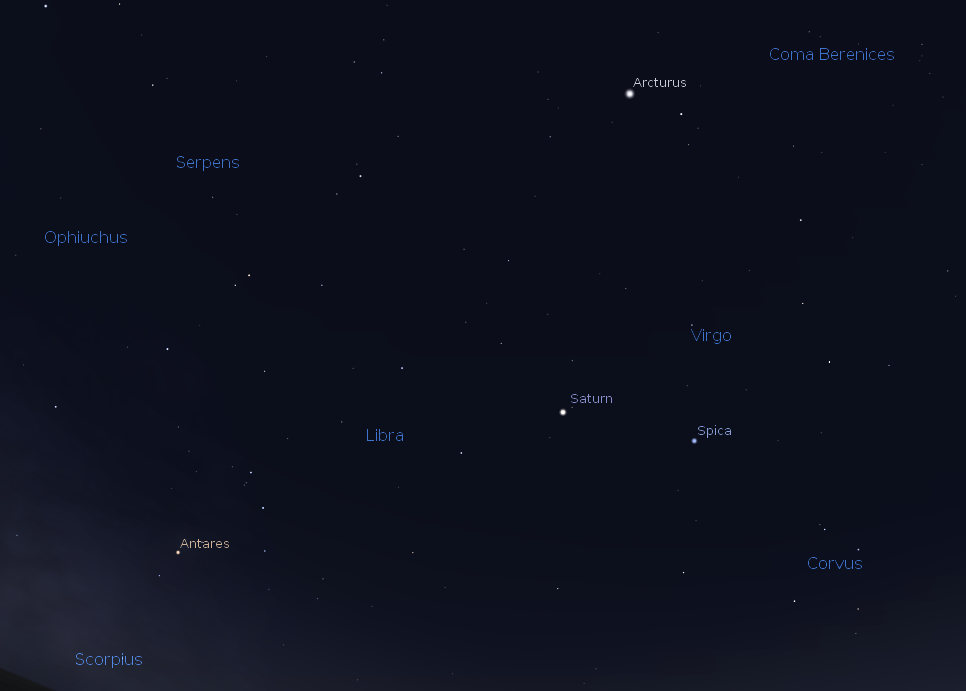
Stellarium does a pretty good job of showing the subtle colors of stars, which is also reflected in the color of the star labels. Click on the image to enlarge.
06/11/2012 – Ephemeris – The bright star Arcturus
Ephemeris for Monday, June 11th. Today the sun will be up for 15 hours and 30 minutes, setting at 9:27. The moon, at last quarter today, will rise at 1:55 tomorrow morning. Tomorrow the sun will rise at 5:56.
The bright star Arcturus appears high in the south at 10:30 in the evening. It’s at the base of a kite shaped constellation of Boötes the herdsman or bear chaser. Arcturus is remarkable for several reasons. It is only 10 percent more massive than the sun but is 110 times brighter and is orange in color. That’s because Arcturus has entered its red giant stage of life after depleting hydrogen in its core as its fuel source. Arcturus is much older than the sun to have evolved so far, being only a little more massive than the sun. Also Arcturus may be new to our galaxy, Its rapid motion of 76 miles per second with respect to the sun, along with 51 other stars known may have come from a small galaxy that collided with the Milky Way.
Times are for the Traverse City/Interlochen area of Michigan. They may be different for your location.
Addendum
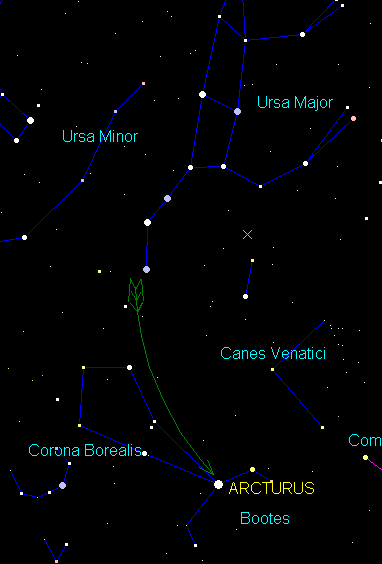
Arcturus, Boötes and the Big Dipper
07/19/11 – Ephemeris – The brightest stars visible now in the evening
Tuesday, July 19th. Today the sun will be up for 15 hours and 6 minutes, setting at 9:21. The moon, half way from full to last quarter, will rise at 11:11 this evening. Tomorrow the sun will rise at 6:15.
Let’s check out all the bright stars in the evening sky, as it gets dark tonight. High in the west is the bright yellow-orange star Arcturus. In the northwest is the Big Dipper, whose curved handle points to Arcturus. Straightening that curve to a spike will point to Spica a blue-white star low in the southwest. The bright star to its right isn’t. It’s the planet Saturn. In the south is the red star Antares which usually twinkles merrily. High in the east is the bright white star Vega. To its lower right is Altair, and to its lower left the star Deneb. Vega, Altair and Deneb make the Summer Triangle, whose rising in the east signals the coming of summer. Always present for us in northern Michigan is Capella very low in the north.
* Times are for the Traverse City/Interlochen area of Michigan. They may be different for your location.
Addendum
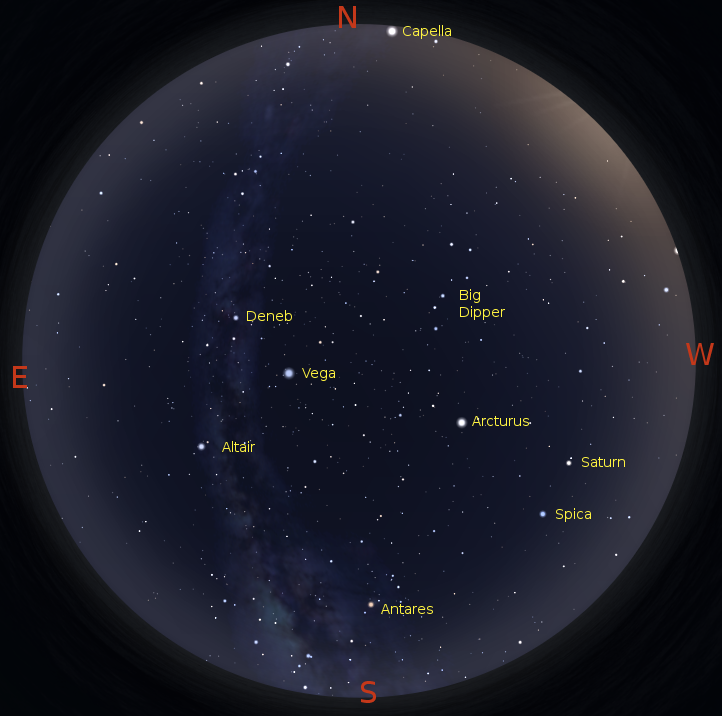
Bright Summer Stars. Created using Stellarium.
Click on the image to enlarge. This is a whole sky chart. The round edge is the horizon. BTW the star Capella, very low in the north, is a winter star, but it’s visible all year round for folks north of 44 degrees north latitude.
05/24/11 – Ephemeris – The bright star Arcturus
Tuesday, May 24th. Today the sun will be up for 15 hours and 6 minutes, setting at 9:13. The moon, at last quarter today, will rise at 2:21 tomorrow morning. Tomorrow the sun will rise at 6:05.
Very high in the southeastern sky at 10:30 is found the kite shaped constellation of Boötes the herdsman, chasing or herding the Great Bear Ursa Major of which the Big Dipper is the hind end, across the sky. The bright star at the base of the kite is the 4th brightest night time star Arcturus. It can be found and name remembered by first locating the Big Dipper and by following the arc or curve of the handle to Arcturus. This star is an orange colored giant star, 37 light years away. Its light was used open the 1933 Chicago Worlds Fair believing its light left the star in 1893 the year of the previous Chicago Worlds Fair. It turns out that Arcturus is 3 light years closer than what they thought.
* Times are for the Traverse City/Interlochen area of Michigan. They may be different for your location.
 Bob Moler's Ephemeris Blog