Archive
03/22/2012 – Ephemeris – Leo the lion and Mars
Ephemeris for Thursday, March 22nd. The sun will rise at 7:41. It’ll be up for 12 hours and 17 minutes, setting at 7:58. The moon is new today, and won’t be visible.
One of the great constellations of spring is up in the southeastern sky. This month Leo can be found by the bright planet Mars which adds a bright red star to the constellation. The head and mane of this beast is a backward question mark. It’s also known as the sickle. The bright star Regulus is at the bottom of this figure. It is now dimmer than Mars. To the east or left of Regulus and Mars is the triangle of stars that is his rump. The lion is special for several ancient cultures. Another way to find him when Mars isn’t around is to use the Bug Dipper, now soaring high in the northeast. Drill a hole in the bottom of the bowl of the dipper and imagine the water flowing out to the south and it will fall on the back of Leo the lion.
* Times are for the Traverse City/Interlochen area of Michigan. They may be different for your location.
Addendum

Mars and the constellation of Leo the lion March 22, 2012. Created using Stellarium.
03/31/11 – Ephemeris – The Big Dipper as seen by other cultures
Thursday, March 31st. The sun will rise at 7:25. It’ll be up for 12 hours and 42 minutes, setting at 8:08. The moon, 3 days before new, will rise at 6:13 tomorrow morning.
The Big Dipper is in the northeast nearing overhead at 10 in the evening, it’s seven stars shining brightly. The Big Dipper is not an actual constellation, recognized internationally. It’s part, the hind part, of Ursa Major, the great bear. The Big Dipper is an asterism or informal constellation. It is a distinctly North American constellation. For fugitive slaves, fleeing the southern states in the days before the Civil War, the Drinking Gourd, as they called it, showed the direction to freedom. In England the dipper stars become the Plough, or Charles’ Wain (Charlemagne’s Wagon), In France, known for culinary delights it was the saucepan, or the cleaver. So, other cultures saw what they wanted to see in these seven bright stars.
* Times are for the Traverse City/Interlochen area of Michigan. They may be different for your location.
Addendum

Big Dipper as seen from other cultures - animation
Big Dipper/Sauce Pan, Plough (plow), Charles’ Wain (Charlemagne’s wagon), and the Cleaver.
03/29/11 – Ephemeris – Ursa Major
Tuesday, March 29th. The sun will rise at 7:29. It’ll be up for 12 hours and 36 minutes, setting at 8:05. The moon, 3 days past last quarter, will rise at 5:29 tomorrow morning.
The Big Dipper is now nearly overhead in the northeast at 10 p.m. The seven bright stars are second to Orion in the southwest as the seven brightest stars in a constellation. If you looked up a list of constellations, you’d find that the Big Dipper isn’t there. Ursa Major or the Great Bear is the constellation of which the Big Dipper is a part. The seven bright stars of the dipper is the rump and long tail of this constellation. The rest of the bear, including his head and legs are delineated by dimmer stars. An anatomical problem is its long tail, which was drawn in by the ancients of the old world. The American Indians, also saw a bear in the stars here, but the handle of the dipper became three hunters following the bear.
* Times are for the Traverse City/Interlochen area of Michigan. They may be different for your location.
Addendum
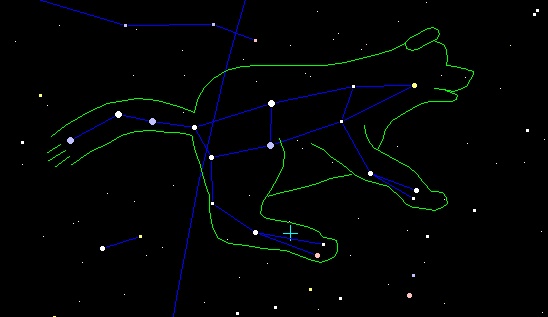
My rather crude drawing of Ursa Major, the Great Bear
03/22/11 – Ephemeris – The Big Dipper
Tuesday, March 22nd. The sun will rise at 7:42. It’ll be up for 12 hours and 14 minutes, setting at 7:57. The moon, 3 days past full, will rise at 12:17 tomorrow morning
We are a few days into spring. And while the winter constellation of Orion and its cohorts hold forth in the southwestern sky the Big Dipper is sneaking up in the northeast. At 9 p.m. the Big Dipper is standing on the tip of its handle in the northeastern sky. The stars at the front of the bowl are at the top of Big Dipper now. An imaginary line through them to the lower left will point to Polaris the North Star. The Big Dipper never sets for us, in the north country. It scrapes the northern horizon on autumn evenings, climbs the northeastern sky in the winter, is overhead, in spring, and descends in the northwest in summer. The Big Dipper points to, well it leaks on Leo the Lion. The bright star Arcturus, now rising in the east is found by following the curve of the handle.
* Times are for the Traverse City/Interlochen area of Michigan. They may be different for your location.
Addendum
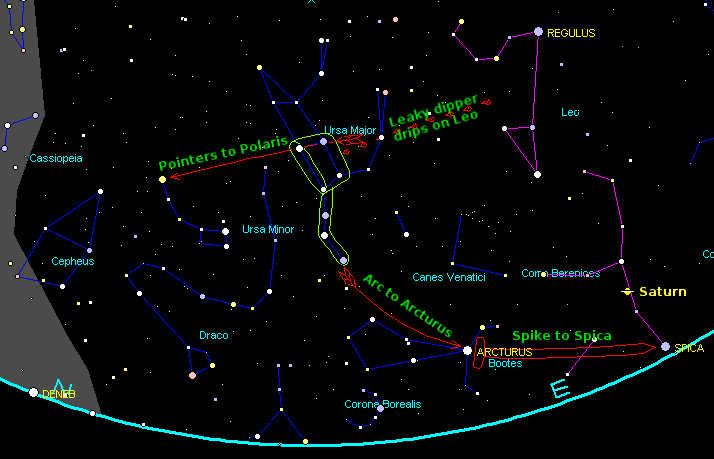
The Big Dipper points to other stars and constellations. Created using my own LookingUp program. Click on the image to enlarge.
 Bob Moler's Ephemeris Blog