Archive
02/20/2014 – Ephemeris – Winter Circle plus 1
Ephemeris for Thursday, February 20th. The sun will rise at 7:34. It’ll be up for 10 hours and 43 minutes, setting at 6:18. The moon, 2 days before last quarter, will rise at 12:27 tomorrow morning.
The winter skies are blessed with more first magnitude stars than any other season. Six of these stars lie in a large circle centered on the seventh. This circle is up at 9 p.m. Starting high overhead is Capella in Auriga the charioteer. Moving down clockwise is Aldebaran in the face of Taurus the Bull. Then down to Orion’s knee we find Rigel. Down and left is the brightest star of all Sirius the Dog Star in Canis Major, lowest of these stars in the south-southeast. Moving up and left is Procyon in Canis Minor, Above Procyon is Pollux in Gemini the twins. All these are centered on Betelgeuse the bright red star in Orion’s shoulder. The interloper this year is Jupiter which is situated in Gemini and outshines them all.
Times are for the Traverse City/Interlochen area of Michigan. They may be different for your location.
Addendum
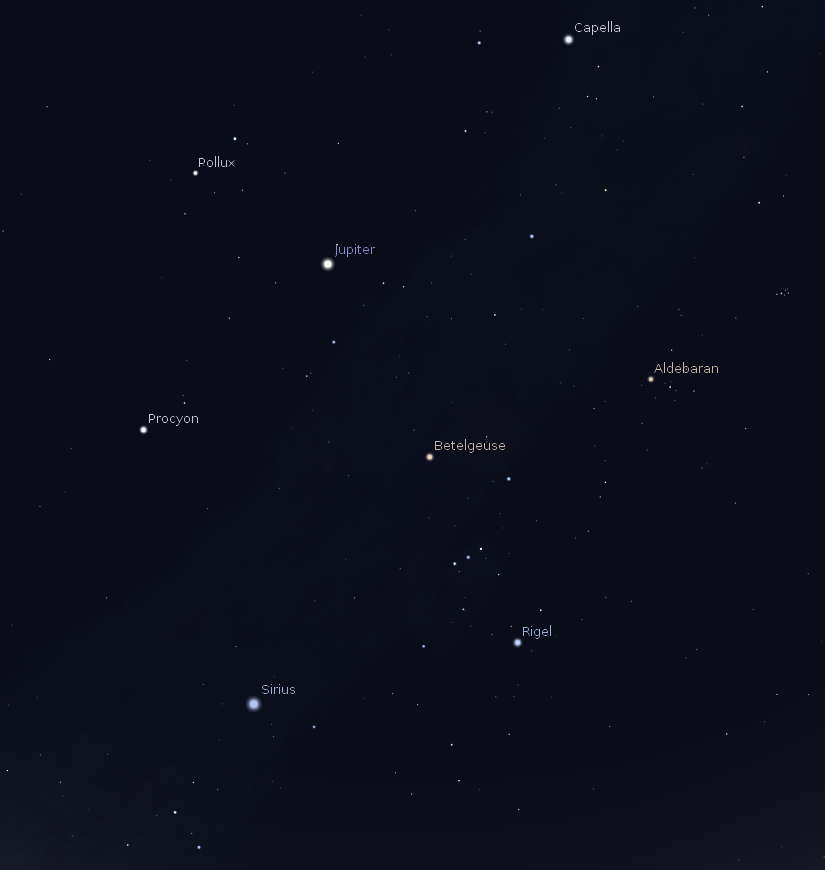
The Winter Circle plus Jupiter at 9 p.m. on February 20, 2014. Created using Stellarium.
01/24/2014 – Ephemeris – The constellation of Auriga the charioteer
Ephemeris for Friday, January 24th. The sun will rise at 8:09. It’ll be up for 9 hours and 30 minutes, setting at 5:40. The moon, at last quarter today, will rise at 2:37 tomorrow morning.
The constellation Auriga the charioteer is nearly overhead at 9 p.m. It is a pentagon of stars, with the brilliant star Capella at one of its corners. Capella represents a she goat he’s carrying. A narrow triangle of stars nearby Capella is her kids. The Kids is an informal constellation or asterism. Within and near that pentagon, binoculars and telescopes will find several star clusters, groups of hundreds of stars born in the clump we still see them in. These star clusters will appear as fuzzy spots in binoculars. One called M38 is near the center of the pentagon. Another, M36 is to the east of it. Still another star cluster, M37, is farther east, just outside the pentagon. The M designations come from Charles Messier who 2 centuries ago ran into them while looking for comets.
Times are for the Traverse City/Interlochen area of Michigan. They may be different for your location.
Addendum
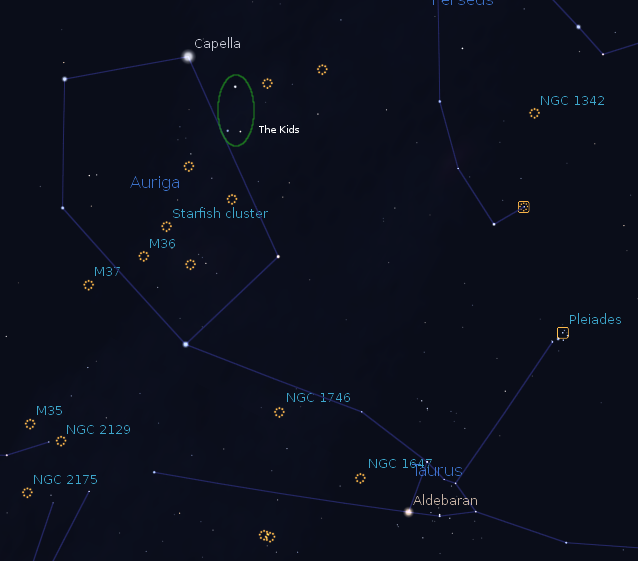
Auriga the charioteer with Taurus below. M38 here is called the Starfish Cluster, a name I am unfamiliar. Created using Stellarium.
12/09/2013 – Ephemeris – The bright star Capella, the she-goat
Ephemeris for Monday, December 9th. The sun will rise at 8:07. It’ll be up for 8 hours and 54 minutes, setting at 5:02, the earliest sunset of the year. The moon, at first quarter today, will set at 1:12 tomorrow morning.
A bright star called Capella is now high in the east. Capella is the farthest north of winter’s seven brilliant first magnitude stars. Capella never quite sets for anyone north of Ludington. Due to its brightness, and being the closest first magnitude star to the pole, Capella appears to move slowly as the earth rotates, and spends summer and autumn evenings close to the horizon and is a reminder that winter’s not far away. It has in years past elicited a few phone calls and other queries about that ‘bright object in the northeast’. Capella belongs to the pentagonal constellation of Auriga the Charioteer. Capella represents a mother goat he is holding. Three stars in a thin triangle nearby to the star’s right are her kids.
Times are for the Traverse City/Interlochen area of Michigan. They may be different for your location.
Addendum
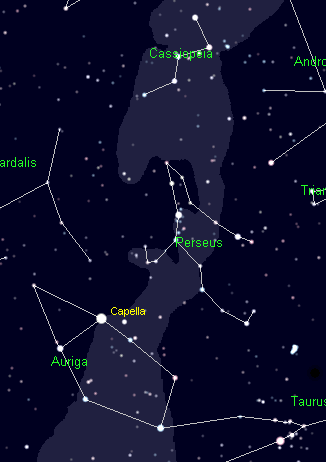
The Constellations Cassiopeia, Perseus and Auriga. Created using Cartes du Ciel
Note the small slender triangle of stars under the “p” in Capella. That’s the Kids, an asterism or informal constellation.
03/04/2013 – Ephemeris – The Winter Circle
Ephemeris for Monday, March 4th. The sun will rise at 7:14. It’ll be up for 11 hours and 20 minutes, setting at 6:34. The moon, at last quarter today, will rise at 2:34 tomorrow morning.
The winter skies are blessed with more first magnitude stars than any other season. Six of these stars lie in a large circle centered on the seventh. This circle is up all evening now that we are in the heart of winter. Starting high overhead is Capella in Auriga the charioteer. Moving clockwise and downward, we come to Aldebaran in the face of Taurus the Bull and brighter nearby Jupiter. Then down to Orion’s knee we find Rigel. Down and left is the brightest star of all Sirius the Dog Star in Canis Major Orion’s large hunting dog, lowest of these stars in the south. Moving up and left there is Procyon in Canis Minor Orion’s other hunting dog, Then above is Pollux in Gemini the twins. All are centered on Betelgeuse in Orion.
Times are for the Traverse City/Interlochen area of Michigan. They may be different for your location.
Addendum
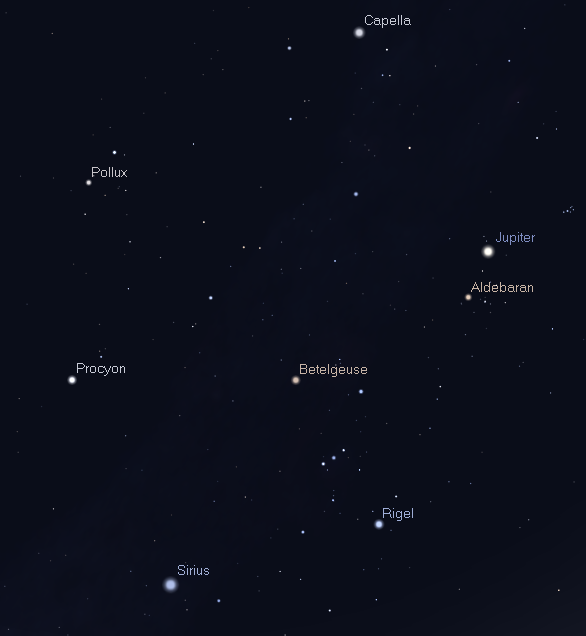
The Winter Circle and Jupiter for March. Created using Stellarium.
11/16/2012 – Ephemeris – Capella the winter that doesn’t set (around here)
Ephemeris for Friday, November 16th. The sun will rise at 7:41. It’ll be up for 9 hours and 32 minutes, setting at 5:13. The moon, 3 days past new, will set at 8:11 this evening.
Midway up the sky in the east northeast at 9 p.m. You will find the bright star Capella. It is above and left of the bright planet Jupiter. Capella is located at one corner of a pentagon of stars that is the constellation Auriga the Charioteer. Capella represents a little she goat, while a slim triangle of stars are her kids. That triangle is known as the Kids. Capella is circumpolar for locations north of Ludington, meaning that this winter star doesn’t set, even in summer. Capella is a close binary star of stars with the same color as the sun, but much brighter. They orbit each other in 104 days. It looks like a single star in most telescopes. Spotting it low on the northern horizon at midnight in July is a reminder that winter will come soon enough.
Times are for the Traverse City/Interlochen area of Michigan. They may be different for your location.
Addendum
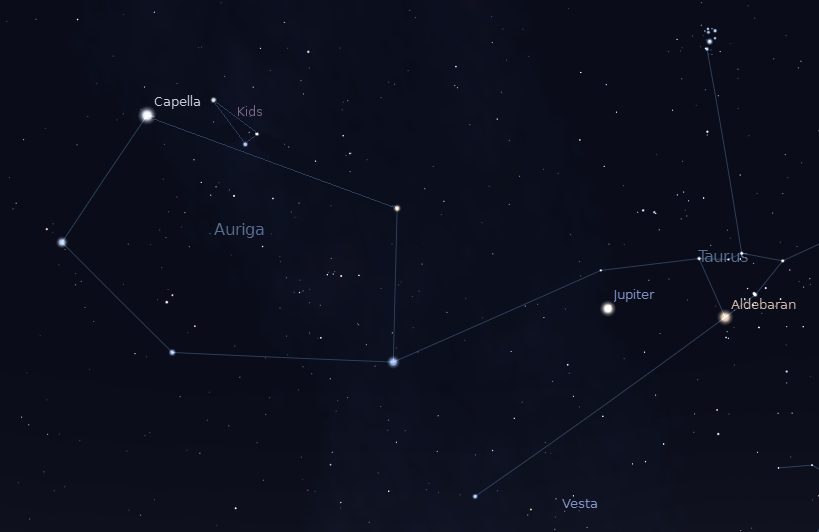
Capella in Auriga with the Kids at 9 p.m. on November 16, 2012. Created using Stellarium.
02/20/2012 – Ephemeris – The Winter Circle
Ephemeris for President’s Day, Monday, February 20th. The sun will rise at 7:35. It’ll be up for 10 hours and 41 minutes, setting at 6:17. The moon, 1 day before new, will rise at 7:01 tomorrow morning. | The winter skies are blessed with more first magnitude stars than any other season. Six of these stars lie in a large circle centered on the seventh. This circle is up at 9 p.m. Starting high overhead is Capella in Auriga the charioteer. Moving down clockwise is Aldebaran in the face of Taurus the Bull. Then down to Orion’s knee we find Rigel. Down and left is the brightest star of all Sirius the Dog Star in Canis Major, lowest of these stars in the south southeast. Moving up and left is Procyon in Canis Minor, Above Procyon is Pollux in Gemini the twins. All these are centered on Betelgeuse the bright red star in Orion’s shoulder.
* Times are for the Traverse City/Interlochen area of Michigan. They may be different for your location.
Addendum
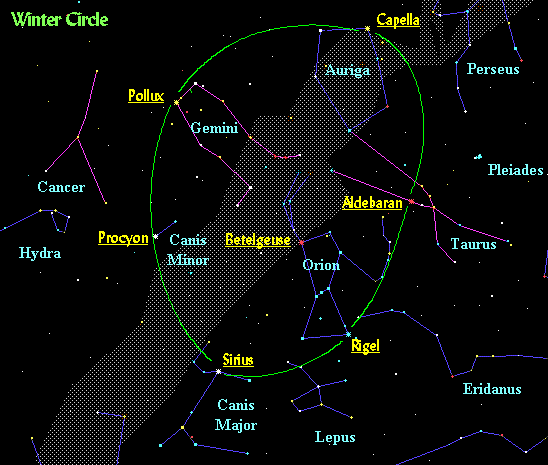
The Winter Circle of 1st magnitude stars
01/30/2012 – Ephemeris – Getting Sirius about color
Ephemeris for Monday, January 30th. The sun will rise at 8:04. It’ll be up for 9 hours and 43 minutes, setting at 5:47. The moon, at first quarter today, will set at 1:51 tomorrow morning.
The bright star shining so bright low in the south southeast at 9 p.m. is Sirius the Dog Star. I talked about it Friday in the context of its constellation Canis Major, Orion’s larger hunting dog. Sirius itself is a remarkable star. It’s name means dazzling one and a look at it in binoculars or a telescope will prove it.. The twinkling effects are due to the earth’s atmosphere, but the bright arc light color is all his. Sirius is a perfect white star. Compare it with the brightest star now overhead Capella which has the same color as our sun. Star colors tell us the temperature of the star surfaces, which run from cool red to hot blue. On our Fahrenheit temperature scale, the sun’s surface is about 10,000 degrees, Sirius is nearly twice that.
* Times, as always are for the Traverse City/Interlochen area of Michigan.
Addendum
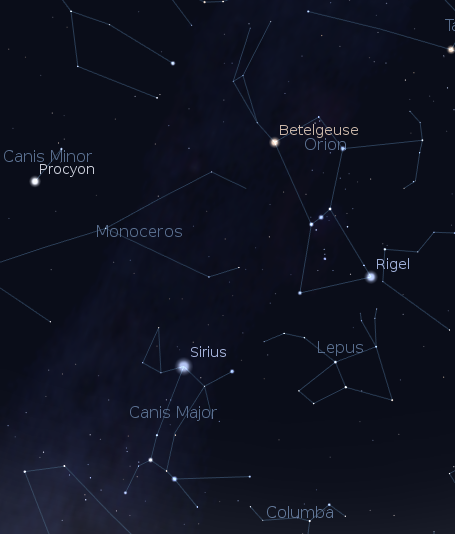
Orion and his Hunting Dogs. Created using Stellarium.
Sirius actually looks blue-white to me. Of course during the day our yellow sun looks white. I think it has to do with out night vision.
10/27/11 – The Harbinger of Winter – Capella
Thursday, October 27th. The sun will rise at 8:13. It’ll be up for 10 hours and 25 minutes, setting at 6:39. The moon, 1 day past new, will set at 7:02 this evening.
A bright star called Capella has slowly been rising in the northeastern sky in the evenings for the past few months. At 9 p.m. now it is low in the north northeast far below the letter “W” shaped constellation of Cassiopeia. This winter Capella will be overhead the highest of winter’s seven brilliant first magnitude stars. Capella never quite sets for anyone north of Ludington. Due to its brightness, and being the closest first magnitude star to the pole Capella appears to move slowly as the earth rotates, and spends summer and autumn evenings close to the horizon. In the sky Capella represents a mamma goat held on the shoulders of a charioteer. There’s a thin triangle of three stars to Capella’s lower right. It’s a group of stars called the Kids. Her kids.
* Times are for the Traverse City/Interlochen area of Michigan. They may be different for your location.
Addendum
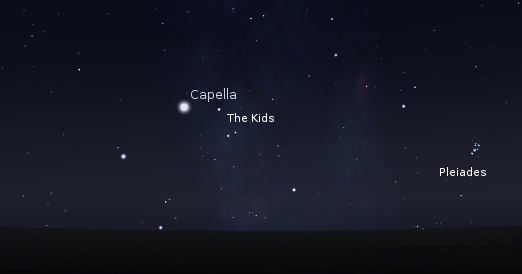
Capella and the Kids in the early evening. Created using Stellarium.
07/19/11 – Ephemeris – The brightest stars visible now in the evening
Tuesday, July 19th. Today the sun will be up for 15 hours and 6 minutes, setting at 9:21. The moon, half way from full to last quarter, will rise at 11:11 this evening. Tomorrow the sun will rise at 6:15.
Let’s check out all the bright stars in the evening sky, as it gets dark tonight. High in the west is the bright yellow-orange star Arcturus. In the northwest is the Big Dipper, whose curved handle points to Arcturus. Straightening that curve to a spike will point to Spica a blue-white star low in the southwest. The bright star to its right isn’t. It’s the planet Saturn. In the south is the red star Antares which usually twinkles merrily. High in the east is the bright white star Vega. To its lower right is Altair, and to its lower left the star Deneb. Vega, Altair and Deneb make the Summer Triangle, whose rising in the east signals the coming of summer. Always present for us in northern Michigan is Capella very low in the north.
* Times are for the Traverse City/Interlochen area of Michigan. They may be different for your location.
Addendum
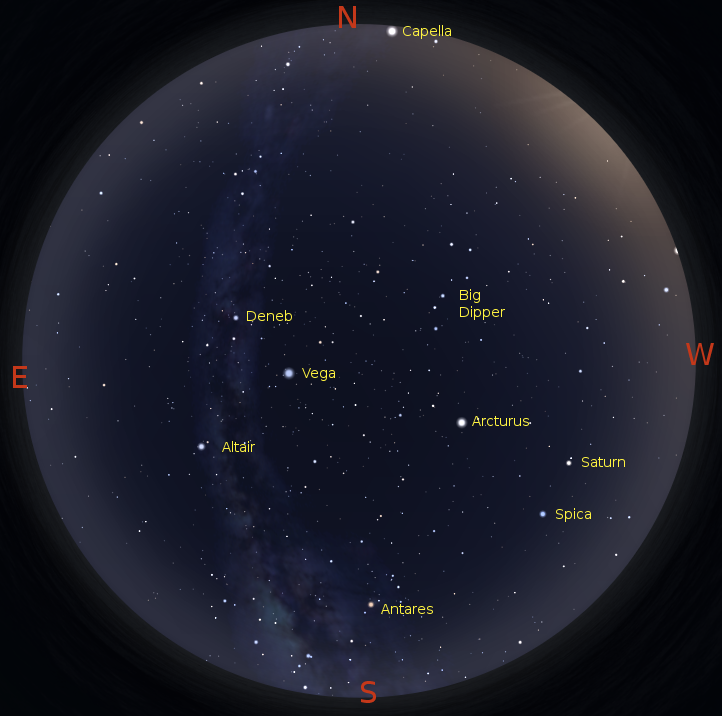
Bright Summer Stars. Created using Stellarium.
Click on the image to enlarge. This is a whole sky chart. The round edge is the horizon. BTW the star Capella, very low in the north, is a winter star, but it’s visible all year round for folks north of 44 degrees north latitude.
 Bob Moler's Ephemeris Blog