Archive
09/25/2014 – Ephemeris – Capella rising
Ephemeris for Thursday, September 25th. The sun will rise at 7:33. It’ll be up for 12 hours and 1 minute, setting at 7:34. The moon, 1 day past new, will set at 8:13 this evening.
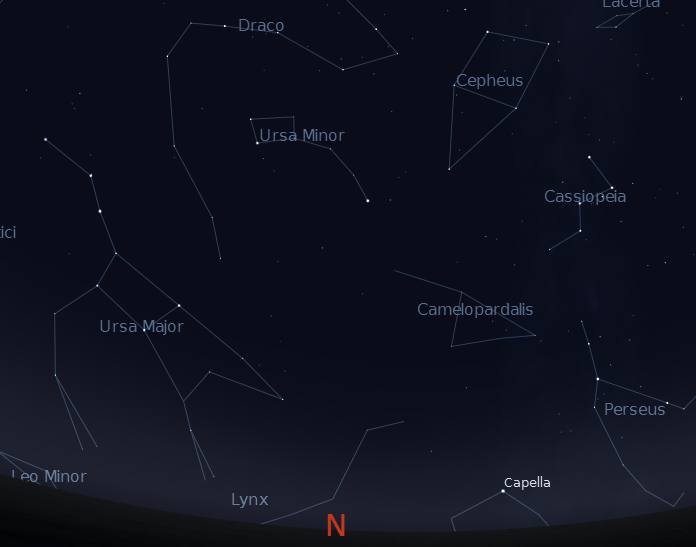
A bright star called Capella has slowly been rising in the northeastern sky in the evenings for the past few months. At 9 p.m. now it is low in the north-northeast far below the letter “W” shaped constellation of Cassiopeia. This winter Capella will be overhead the highest of winter’s seven brilliant first magnitude stars. Capella never quite sets for anyone north of Ludington. It is what is called a circumpolar star. Due to its brightness, and being the closest first magnitude star to the north pole, Capella appears to move slowly as the earth rotates, and spends summer and autumn evenings close to the horizon, and has in years past elicited a few phone calls and other queries about that ‘bright object in the northeast’. When it’s higher the rest of its constellation Auriga the Charioteer will be visible.
Times are for the Traverse City/Interlochen area of Michigan. They may be different for your location.
Addendum
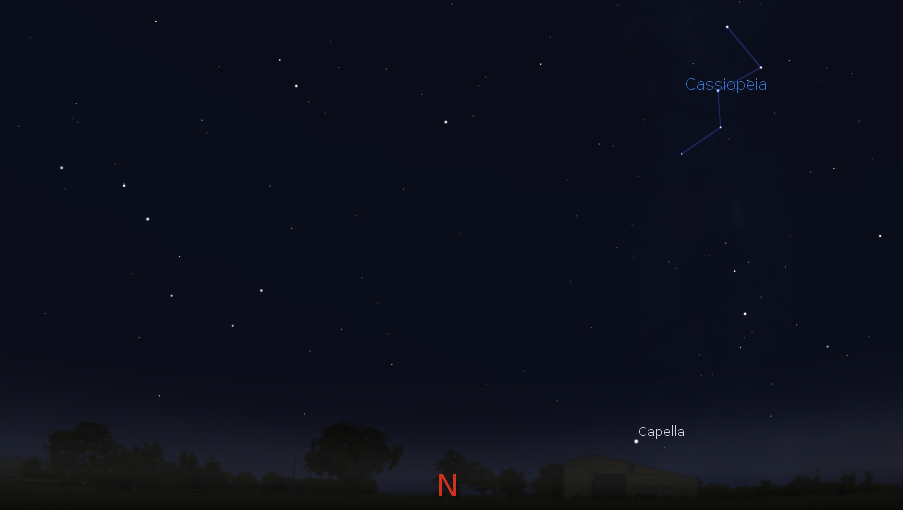
Capella cruising up from the north (thanks to the Earth’s rotation) on September 25 at 9 p.m. Created using Stellarium.
08/22/2014 – Ephemeris – Cassiopeia Rising
Ephemeris for Friday, August 22nd. The sun rises at 6:53. It’ll be up for 13 hours and 43 minutes, setting at 8:36. The moon, 3 days before new, will rise at 5:08 tomorrow morning.
Now in the northeastern sky at 10 p.m. or later is the constellation of Cassiopeia the queen, which looks like, in its current orientation like the letter W. The Milky Way runs through it, if you trace the Milky Way from the zenith back to the northeast. The milky band isn’t as bright here as it is in the teapot shaped Sagittarius to the south. That’s because in looking to the south we are looking toward the star clouds of the dense spiral arm toward the center of the galaxy. In Cassiopeia, and in the winter sky, we are looking out to the less populated galactic arms farther out from the center of the Milky Way. Cassiopeia can be found using the Big Dipper. A line from the star Mizar at the bend of the handle of the dipper through Polaris points to Cassiopeia. Cassiopeia doesn’t set for us in northern Michigan.
Times are for the Traverse City/Interlochen area of Michigan. They may be different for your location.
Addendum
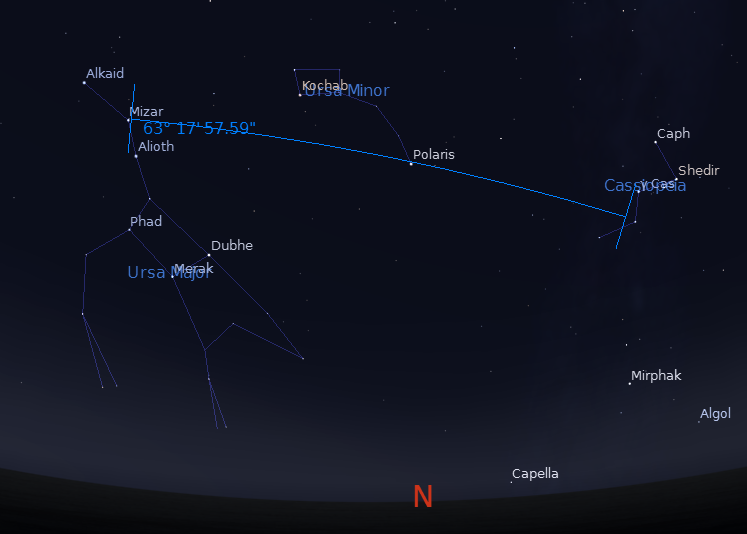
Finding Cassiopeia using the Big Dipper or Ursa Major at 10 p.m. August 22, 2014 using the angle measurement tool as a pointer. Created using Stellarium.
10/28/2013 – Ephemeris – The constellation Perseus the hero
Ephemeris for Monday, October 28th. The sun will rise at 8:15. It’ll be up for 10 hours and 21 minutes, setting at 6:36. The moon, 2 days past last quarter, will rise at 2:54 tomorrow morning.
About a third the way from the east northeastern horizon to the zenith at 9 p.m. and below the letter W shaped constellation of Cassiopeia the queen is Perseus the hero. It’s kind of a odd shape for a hero, To me it looks like a chicken running across the road. To those who’s imagination doesn’t run to poultry, its shape is also like the Greek letter pi. It’s two brightest stars are Mirfak and Algol the demon star. Look at the area around Mirfak with binoculars and you will see a large group of stars just below naked eye visibility. It’s called the Alpha Persei association. That because Mirfak is Alpha Persei. The group is about 560 light years away, which means, though close, are farther away than the Pleiades, below and right of them.
Times are for the Traverse City/Interlochen area of Michigan. They may be different for your location.
Addendum
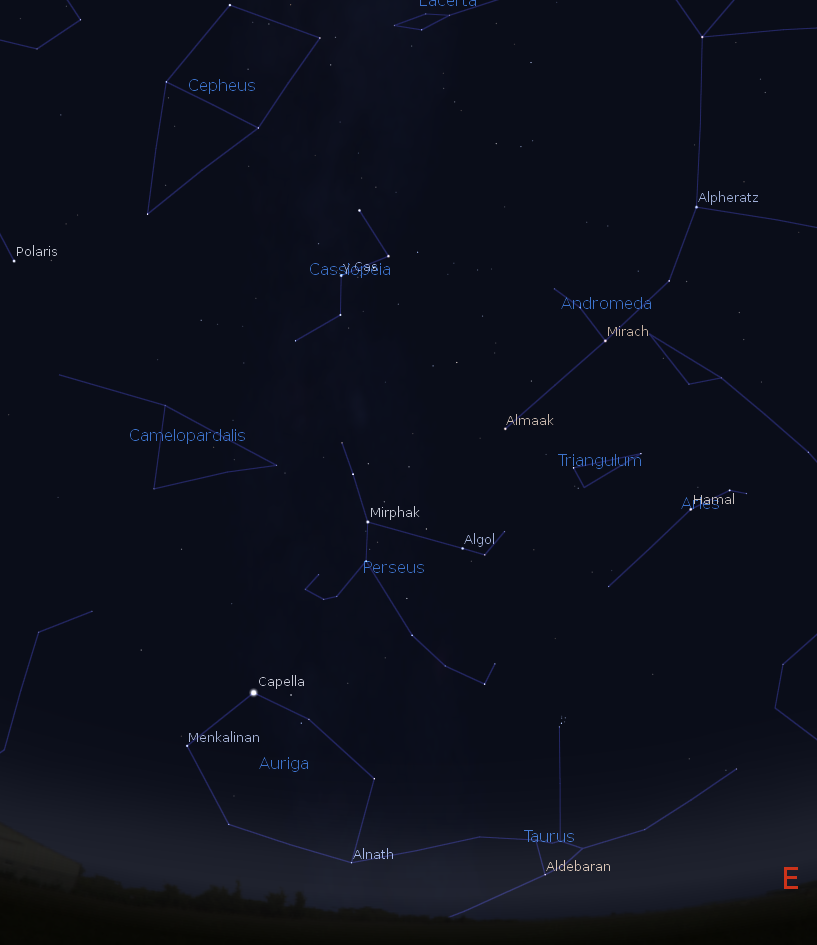
Perseus finder chart. Note the star Mirfak is spelled Mirphak on the chart. Created using Stellarium.
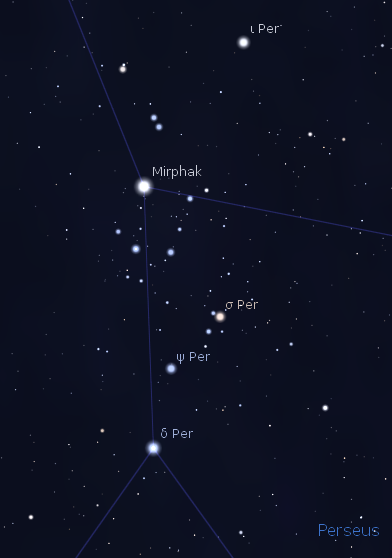
Alpha Persei Association. Created using Stellarium.
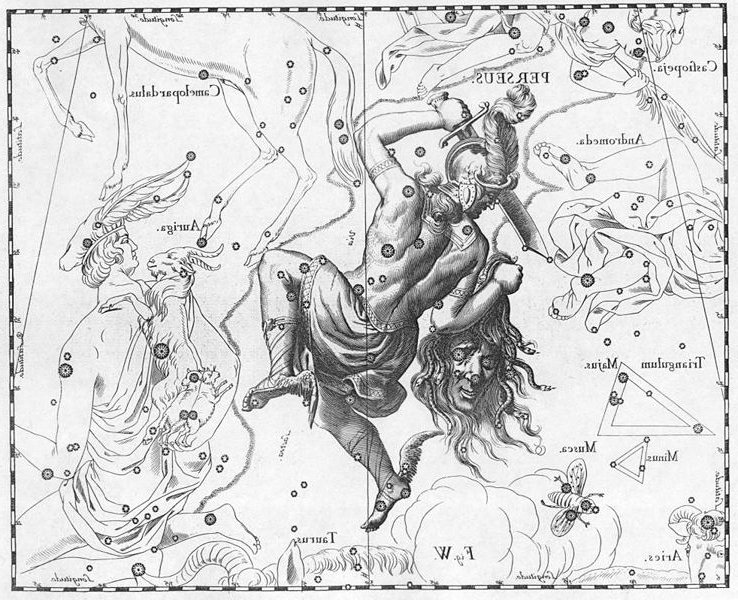
Perseus and the head of Medusa from the 1690 Uranographia by Johannes Hevelius. Image found with the article on Algol in Wikipedia.
09/30/2013 – Ephemeris – The constellation of Cassiopeia the queen
Ephemeris for Monday, September 30th. The sun will rise at 7:39. It’ll be up for 11 hours and 44 minutes, setting at 7:24. The moon, half way from last quarter to new, will rise at 4:07 tomorrow morning.
The stars of the autumn skies slowly are replacing the summer stars from the east. Look in the northeastern sky by 9 p.m. and you can find the W shaped constellation of Cassiopeia the queen. Cassiopeia is so far north that it never sets for us in Michigan. It is opposite the pole star Polaris from the Big Dipper. There’s a dim star that appears above the middle star of the W which turns the W into a very crooked backed chair. Cassiopeia, in Greek mythology, represents a queen of ancient Ethiopia, the W represents the profile of her throne. She enters in to the great autumn story whose other characters are also seen in the stars as the constellations Andromeda, Pegasus, Perseus, Cetus and her husband Cepheus.
Times are for the Traverse City/Interlochen area of Michigan. They may be different for your location.
Addendum
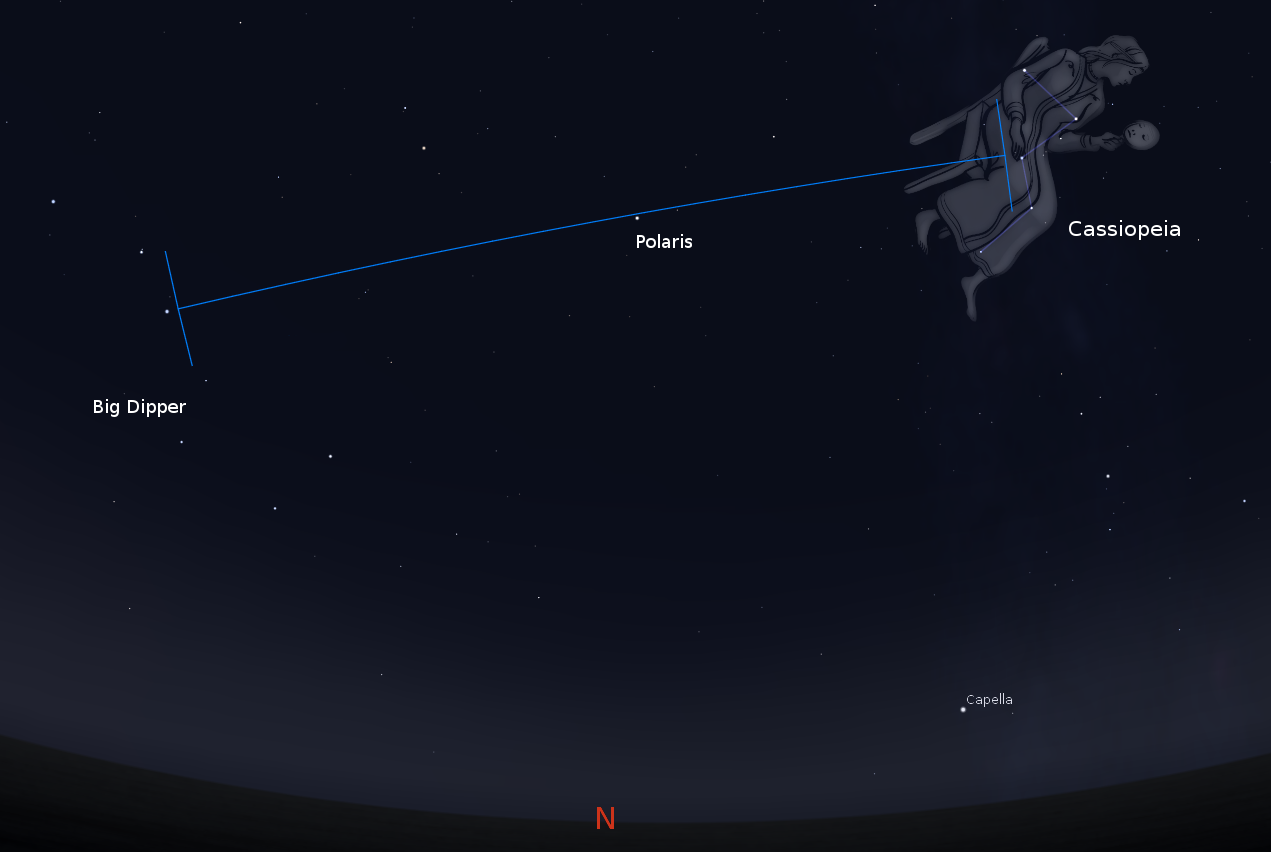
Cassiopeis, in the northeast is opposite Polaris from the Big Dipper. For 9 p.m. on September 30th. Created using Stellarium. Artistic credit: Johan Meuris. Click to enlarge.
10/15/2012 – Ephemeris – Autumn wonders for binoculars or small telescope: The Double Cluster
Ephemeris for Monday, October 15th. The sun will rise at 7:58. It’ll be up for 10 hours and 58 minutes, setting at 6:57. The moon is new today, and won’t be visible.
This week we’ll be looking at some of the wonders of the autumn sky that might better be seen in binoculars or a small telescope. Tonight we turn our attention to the Double Cluster, a fine pair of star clusters just below the W of the constellation of Cassiopeia the queen located in the northeast. Draw a vertical line down from the middle star of the W through the next star into the glow of the Milky Way. The Double Cluster appears to the unaided eye as a brighter glow of the Milky Way. This is confirmed with binoculars. But in a small telescope it becomes two piles of sparkling diamonds. The clusters are much younger than the sun so their brightest stars are blue-white to our eyes. The average distance of the two from earth is 7,200 light years and the are 1200 light years from each other.
Times are for the Traverse City/Interlochen area of Michigan. They may be different for your location.
Addendum
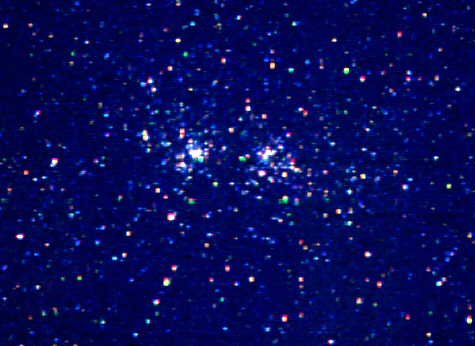
Double Cluster as it would be seen in a small telescope.
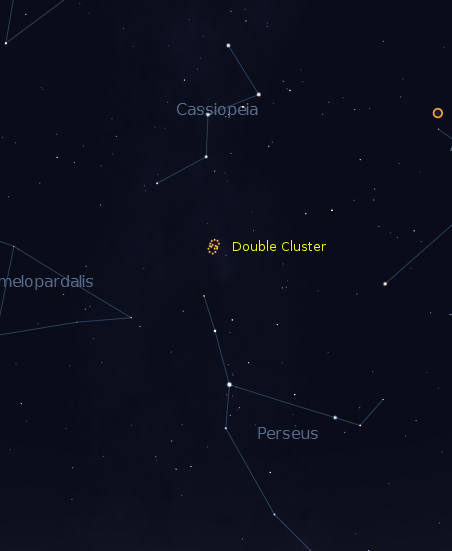
Chart for finding the Double cluster in October. Created using Stellarium.
09/06/2012 – Ephemeris – Cassiopeia the queen
Ephemeris for Thursday, September 6th. The sun will rise at 7:11. It’ll be up for 12 hours and 57 minutes, setting at 8:08. The moon, 2 days before last quarter, will rise at 11:01 this evening.
The constellation Cassiopeia looks like the letter W in the northeastern sky at 10 p.m. My mother taught it to me as my grandfather taught her as the Flying W. Cassiopeia represents a queen of Ethiopia in a grand story that has had at least a couple of movies made as the Clash of the Titans. A dim star above the middle star makes the constellation in to a crooked backed chair. Cassiopeia is circumpolar in Michigan since it is near the north pole of the sky. It revolves around and around the pole star Polaris. In late autumn it’s overhead, in the spring its low in the northwest and in early summer it’s scraping the northern horizon.
Times are for the Traverse City/Interlochen area of Michigan. They may be different for your location.
Addendum
Cassiopeia and the other circumpolar constellations. Created using Stellarium.
10/17/11 – Ephemeris – The constellation of Cassiopeia
Monday, October 17th. The sun will rise at 7:59. It’ll be up for 10 hours and 55 minutes, setting at 6:55. The moon, 2 days before last quarter, will rise at 10:25 this evening. | The stars of the autumn skies are replacing the summer stars from the east. Look in the northeastern sky by 9 p.m. and you can find the W shaped constellation of Cassiopeia the queen. Cassiopeia is so far north that it never sets for us in Michigan. It is opposite the pole star Polaris from the Big Dipper. There’s a dim star that appears above the middle star of the W which turns the W into a very crooked backed chair. Above and left of Cassiopeia is a dim upside down church steeple shaped constellation of Cepheus the king. The Milky Way flows through a corner of Cepheus and Cassiopeia toward the northeastern horizon and through the constellation of Perseus the hero, which kind of looks, to me, like a chicken, but that’s another story.
* Times are for the Traverse City/Interlochen area of Michigan. They may be different for your location.
Addendum
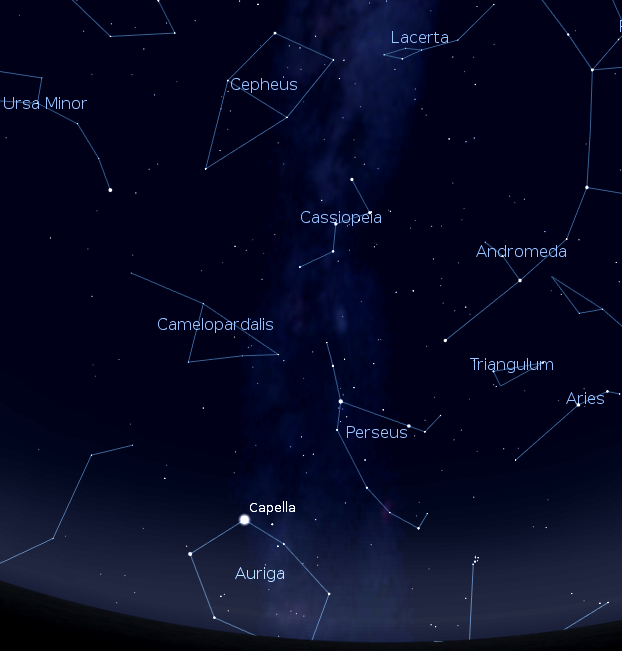
The constellation Cassiopeia and its neighbors. Created using Stellarium.
 Bob Moler's Ephemeris Blog