Archive
11/01/2013 – Ephemeris – Preview of Comet ISON plus a star party tonight in Traverse City
Ephemeris for Friday, November 1st. The sun will rise at 8:20. It’ll be up for 10 hours and 10 minutes, setting at 6:31. The moon, 2 days before new, will rise at 7:16 tomorrow morning.
This evening’s meeting of the Grand Traverse Astronomical Society starting at 8 p.m. at Northwestern Michigan College’s Rogers Observatory will be a special one. Yours truly will preview the viewing prospects for Comet ISON for this and next month. What will happen? Where do I look to see it? Will it be the comet of the century? On that last question, I can give an answer right now, we’ll know immediately if it isn’t. We probably won’t know for 87 years if it is. The century is still young. Due to the extreme interest in this subject, the visuals and other information from the talk will be released to the society’s gtastro.org web site. At 9 p.m. there will be a star party at the observatory, and another program if it’s cloudy.
Times are for the Traverse City/Interlochen area of Michigan. They may be different for your location.
Addendum
Click on image for slides from tonight’s talk:
10/31/2013 – Ephemeris – A look ahead at the skies of November
Ephemeris for Halloween, Thursday, October 31st. The sun will rise at 8:19. It’ll be up for 10 hours and 13 minutes, setting at 6:32. The moon, 3 days before new, will rise at 6:07 tomorrow morning.
Let’s look at the skies for the month of November. Comet ISON will continue to brighten this month, but will encounter bright twilit skies as it closes in with the sun the week of Thanksgiving. I’m hoping the comet will be visible to the naked eye by mid-month. The sun is still moving south rapidly. Daylight hours in the Interlochen/Traverse City area and will drop from 10 hours and 10 minutes tomorrow to 9 hours 5 minutes on the 30th. The altitude, or angle, of the sun above the southern horizon at local noon will be at 30 degrees tomorrow and will descend to 23 and a half degrees on the 30th. The altitude of the sun in the Straits area will be a degree lower. Local noon, this month, will be about 12:30 p.m. when standard time returns.
Times are for the Traverse City/Interlochen area of Michigan. They may be different for your location.
Addendum
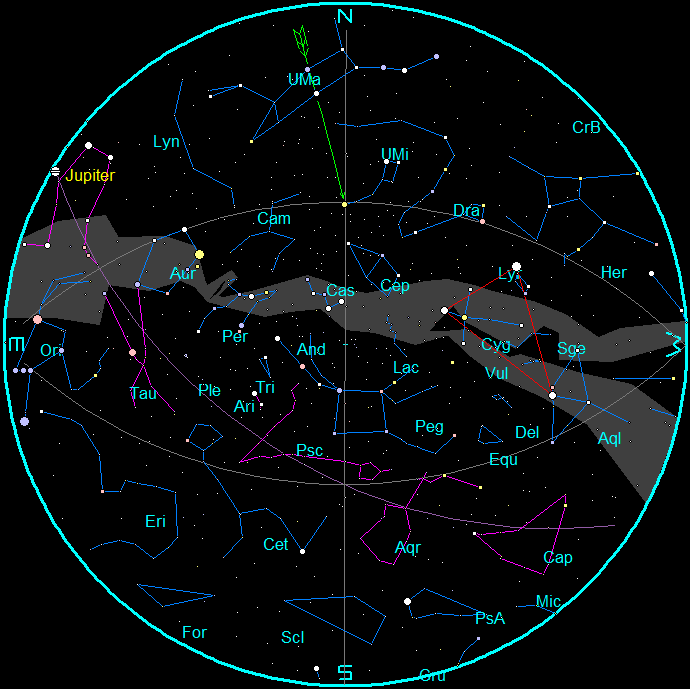
Star Chart based on 9 p.m. on November 15, 2013. Created using my program LookingUp.
The constellation abbreviations, names and bright star names are found here.
The red triangle is the Summer Triangle. The arrow through then front of the Big Dipper point to Polaris.
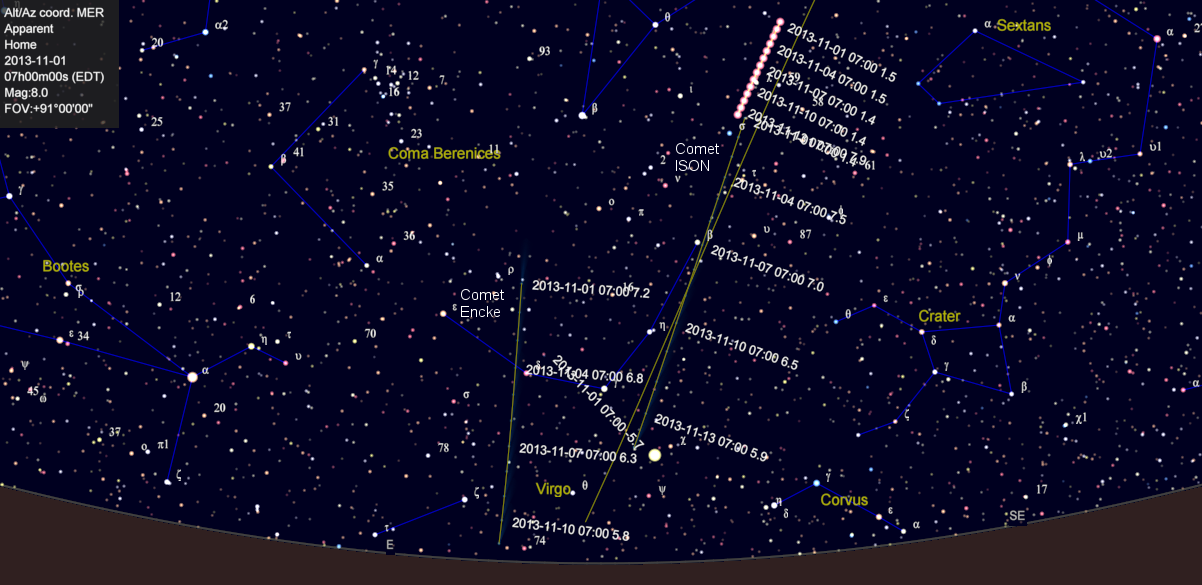
The path of Comet ISON and Comet Encke for November 1st through 14th, 2013. Created using Cartes du Ciel. Labels contain date and predicted magnitude. Click to enlarge.
Comet ISON will remain an early morning comet for November and most of December.
The oddball object with the skewed label is the moon.
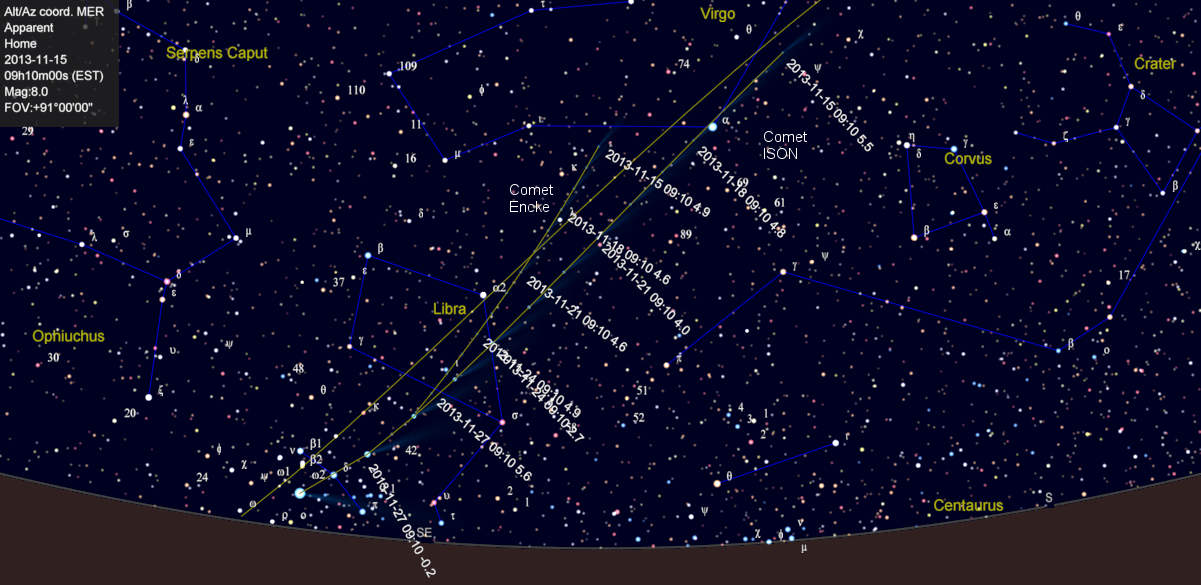
The path of Comet ISON and Comet Encke for November 15th through 28th, 2013. Created using Cartes du Ciel. The planets, Sun and Moon have been removed for clarity. Labels contain date and predicted magnitude. Click to enlarge.
The above two images are from my program Prospects for Viewing Comet ISON to be given tomorrow night at the regular meeting of the Grand Traverse Astronomical Society starting at 8 p.m. at Northwestern Michigan College’s Rogers Observatory south of Traverse City on Birmley Road.
Local school groups or clubs ca request the program by commenting to this post or emailing to info@gtastro.org.
10/30/2013 – Ephemeris – Where are the bright planets and Comet ISON now?
Ephemeris for Wednesday, October 30th. The sun will rise at 8:17. It’ll be up for 10 hours and 16 minutes, setting at 6:33. The moon, half way from last quarter to new, will rise at 5:01 tomorrow morning.
Let’s check out the bright planets. Venus is brilliant in the west southwest after sunset. Friday it will be at its greatest separation or elongation from the sun. Venus will set at 8:44 p.m. The giant planet Jupiter will rise at 10:55 p.m. in the east northeast. It’s cruising against the stars of Gemini now. It will pass due south at 6:31 a.m. Mars will rise at 3:08 a.m. also in the east northeast. Reddish Mars is below and left of the slightly brighter star Regulus in Leo now. It’s in the east at 6 a.m. Comet ISON is two-thirds the distance below Mars that Mars is below Regulus and nearly in line with the two. My guesstimate for magnitude is about 9, probably visible in telescopes. I haven’t seen it since earlier this month.
Times are for the Traverse City/Interlochen area of Michigan. They may be different for your location.
Addendum
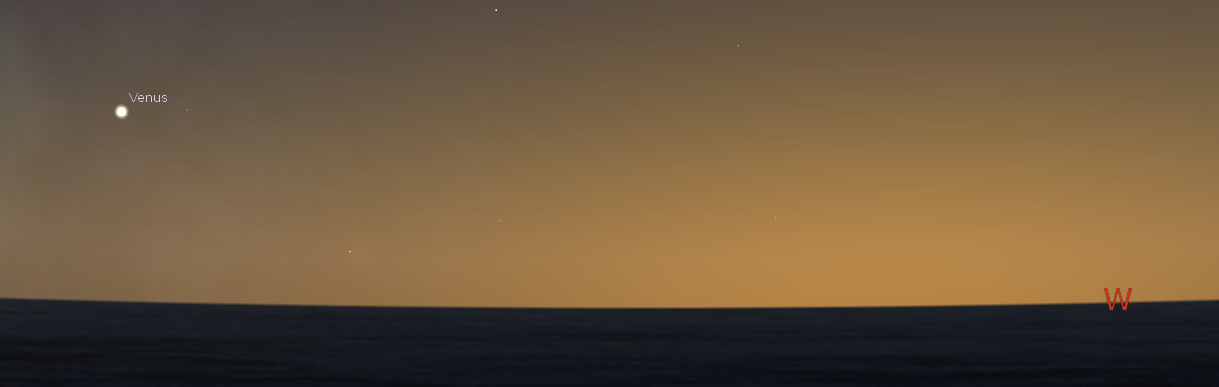
Venus in twilight at 7:15 p.m. on October 30, 2013. Created using Stellarium.
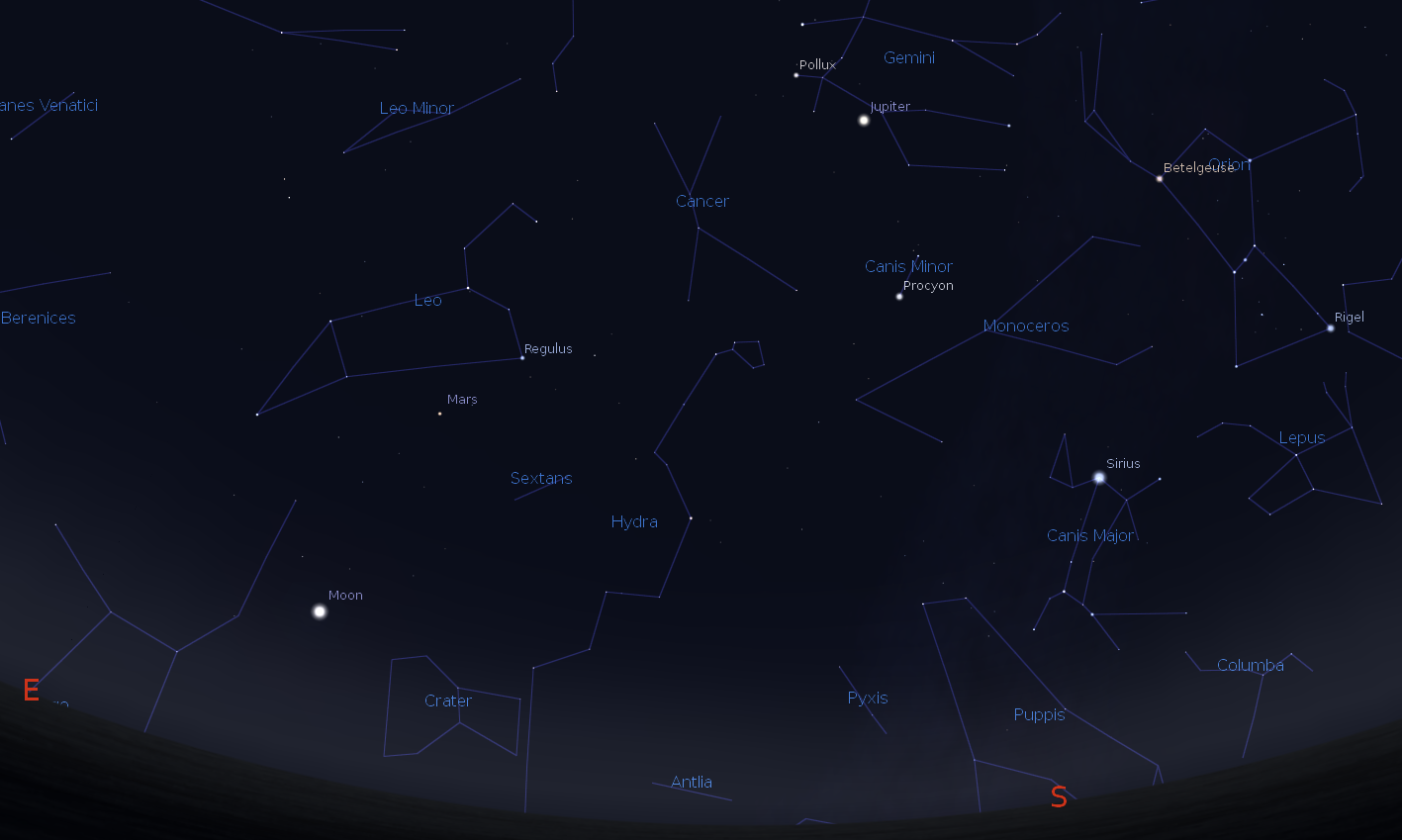
Jupiter and Mars at 6:30 a.m. October 31, 2013. Created using Stellarium.
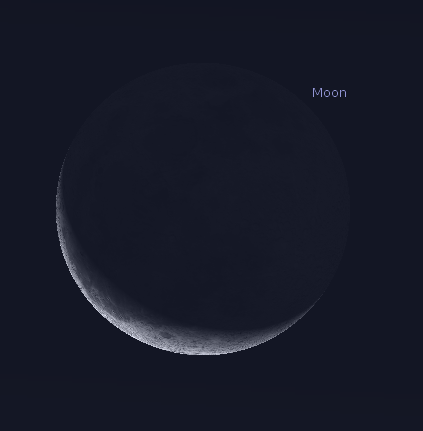
Closeup of the Moon at 6:30 a.m. on October 31, 2013. Created using Stellarium.
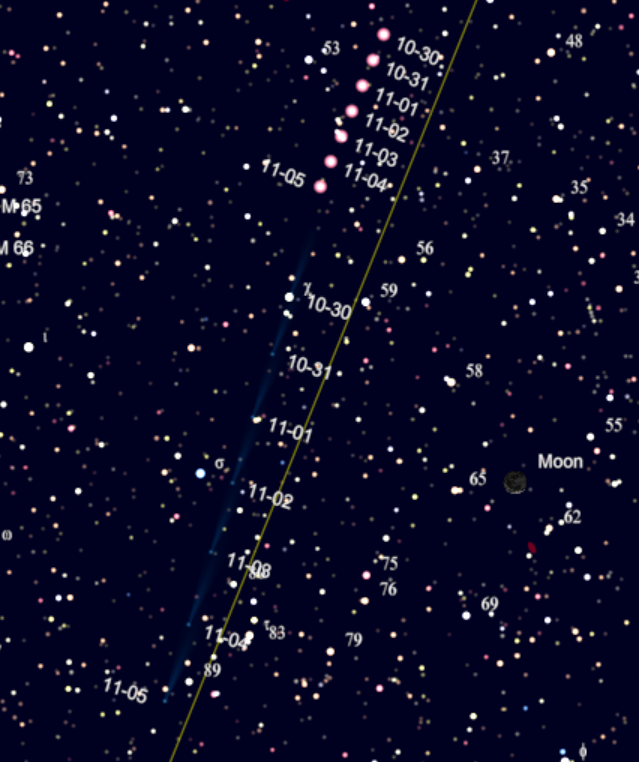
Comet ISON for October 30 to November 5, 2013. Created using Cartes du Ciel.
Click on the images to enlarge.
10/29/2013 – Ephemeris – Comet ISON 30 days before perihelion
Ephemeris for Tuesday, October 29th. The sun will rise at 8:16. It’ll be up for 10 hours and 18 minutes, setting at 6:35. The moon, 3 days past last quarter, will rise at 3:56 tomorrow morning.
In 30 days Comet ISON will meet its date with the sun. November 28th, Thanksgiving day Comet ISON will whip around the sun, and to us will seem to be sent at a near 90 degree angle from heading eastward to heading nearly due northward. That’s an illusion because we, on the earth will be moving, in effect under it. The closest Comet ISON will get to us is just under 40 million miles on December 26th and 27th. The morning waning crescent is no longer affecting the visibility of the comet, so barring clouds, it should be visible in dark skies in small telescopes. The website gtastro.org now has lots of information on the comet and where you can find more from good sources. I’ll tell you more on Friday.
Times are for the Traverse City/Interlochen area of Michigan. They may be different for your location.
Addendum
This is the major document from the Gtastro website cited above: The article from the GTAS Stellar Sentinel plus extra charts and information for viewing Comet ISON at perihelion (closest approach to the sun) safely online.
10/22/2013 – Ephemeris – Misinformation about Comet ISON: It ain’t Nibiru
Ephemeris for Tuesday, October 22nd. The sun will rise at 8:07. It’ll be up for 10 hours and 38 minutes, setting at 6:45. The moon, half way from full to last quarter, will rise at 9:19 this evening.
Don’t believe a lot of what you hear about Comet ISON from friends or the Internet. YouTube, for instance, has some good information, and some really nutty stuff. A couple of items to debunk right here. No, Comet ISON is not the rogue planet Nibiru. Nibiru was a Babylonian astronomical term, probably for the summer solstice point in the sky, not a planet. Ill-informed people want to frighten you by attaching the name to about any bright comet that comes along. I can tell because their knowledge of astronomical terms and planetary orbits is way off base. While the head of a comet can swell up to be greater than the size of the earth, it’s still a pretty good vacuum. We’ve sent spacecraft into cometary heads which have all survived.
Times are for the Traverse City/Interlochen area of Michigan. They may be different for your location.
10/23/2013 – Ephemeris – Where are the bright planets and Comet ISON for this week?
Ephemeris for Wednesday, October 23rd. The sun will rise at 8:08. It’ll be up for 10 hours and 35 minutes, setting at 6:44. The moon, 3 days before last quarter, will rise at 10:08 this evening.
Time again to check out the bright planets. Venus is brilliant in the west southwest after sunset. It will set at 8:44 p.m. The next planetary action will have to wait till after 11 p.m. The giant planet Jupiter will rise at 11:21 p.m. in the east northeast. It’s cruising against the stars of Gemini now. It will pass due south at 6:57 a.m. Mars will rise at 3:14 a.m. also in the east northeast. Reddish Mars is below and left of the slightly brighter star Regulus in Leo now. It’s in the east at 6 a.m. Comet ISON is a bit less than half the distance below Mars that Mars is below Regulus and in line with the two. The bright moon will interfere with spotting it. My guesstimate for magnitude is about 9.5, probably visible in telescopes if the moon wasn’t out.
Times are for the Traverse City/Interlochen area of Michigan. They may be different for your location.
Addendum:
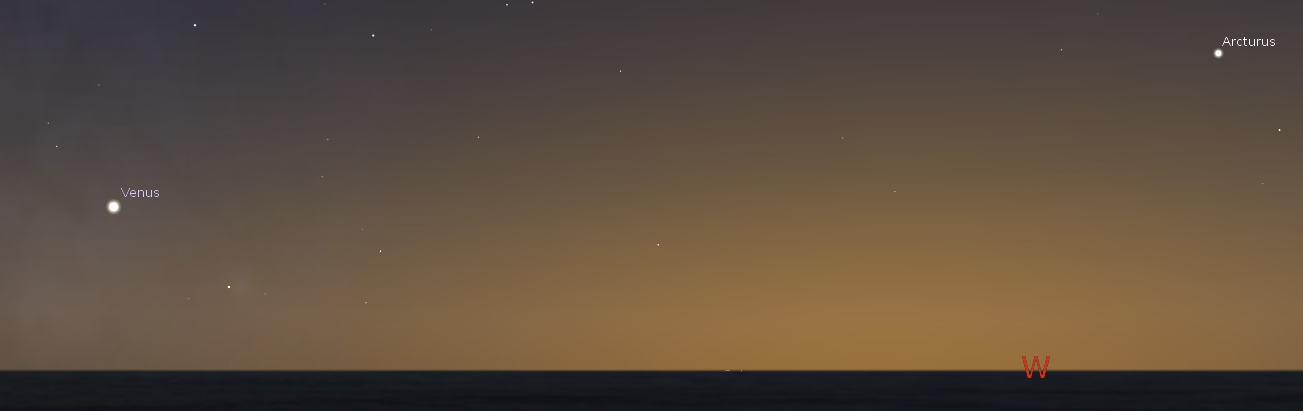
Venus low in the west southwest at 7:30 p.m. on October 23, 2013. Created using Stellarium
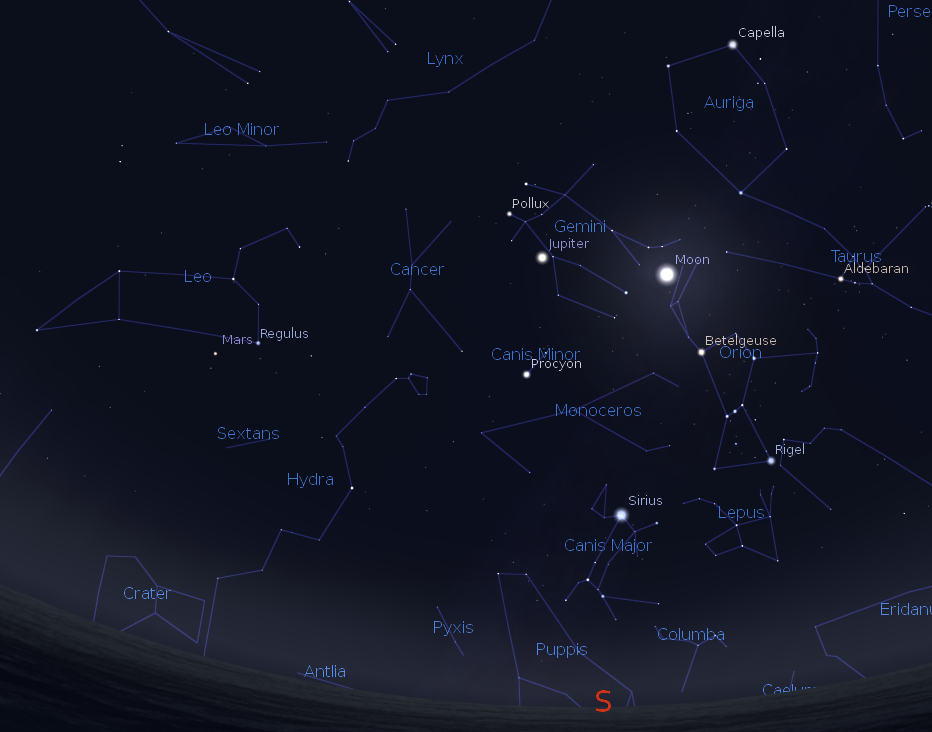
Jupiter, Mars and the Moon with the Winter and some spring constellations at 6:30 a.m. on October 24, 2013. Created using Stellarium.
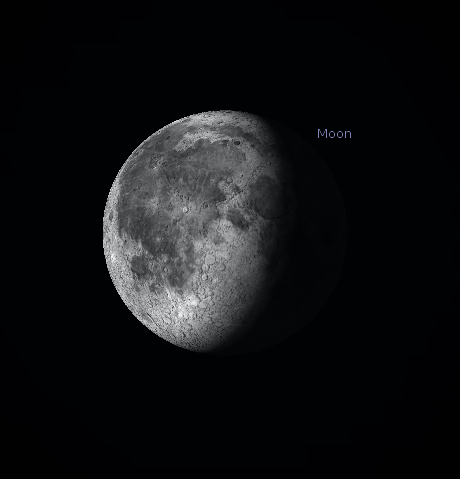
The moon’s phase the morning of October 24, 2013. Created using Stellarium.
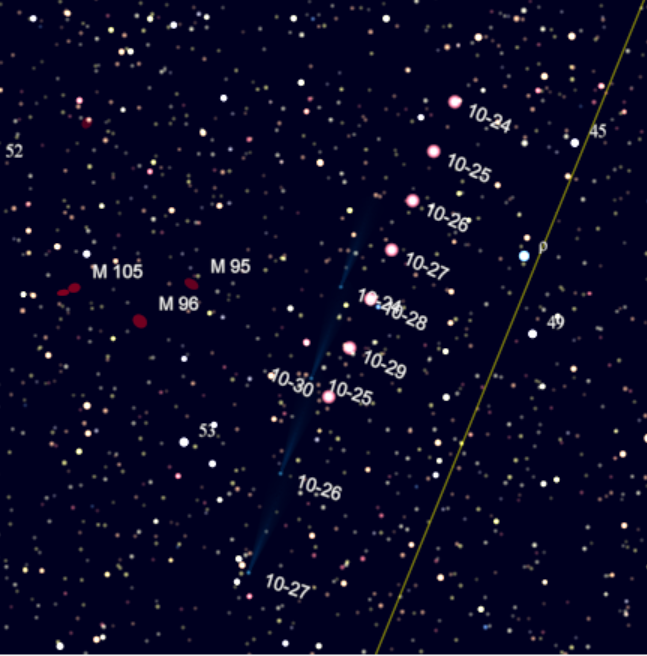
Mars and Comet ISON daily track from October 24th to the 30th, 2013. Be sure to match Mars dates with the comet dates. Created using Cartes du Ciel (Sky Charts).
10/16/2013 – Ephemeris – Where are the bright planets and Comet ISON this week
Ephemeris for Wednesday, October 16th. The sun will rise at 7:59. It’ll be up for 10 hours and 56 minutes, setting at 6:55. The moon, 2 days before full, will set at 6:30 tomorrow morning.
Time again to check out the bright planets. Venus is brilliant in the west southwest after sunset it will set at 8:46 p.m.. We are losing Saturn in the sun’s glare for a few months. The rest of the planetary action will be in the morning sky, though the giant planet Jupiter will rise before midnight at 11:47 a.m. in the east northeast. It’s cruising against the stars of Gemini now. By 6 a.m it will be high in the southeast, the brightest object in that direction. Mars will rise at 3:19 a.m. also in the east northeast. It’s near Leo’s brightest star Regulus at the bottom of the constellation’s backward question mark. It’s in the east at 6 a.m. Comet ISON is about two moon width’s to the upper left of Mars, but the bright moon will interfere with spotting it.
Times are for the Traverse City/Interlochen area of Michigan. They may be different for your location.
Addendum
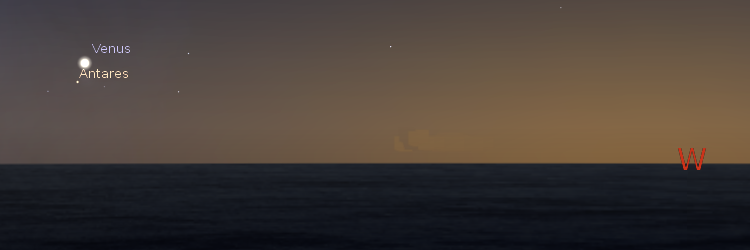
Venus low in the west southwest at 7:45 p.m. on October 16, 2013. Created using Stellarium.
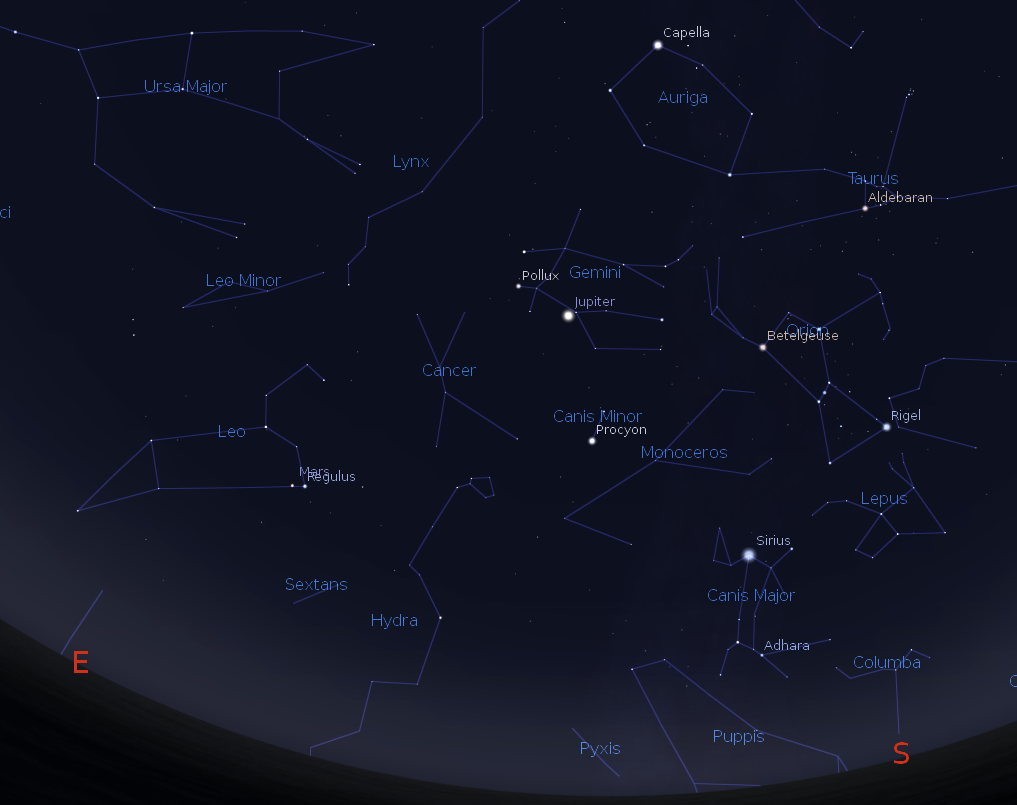
Jupiter and Mars with the winter stars and constellations at 6 a.m., October 17, 2013. Created using Stellarium.
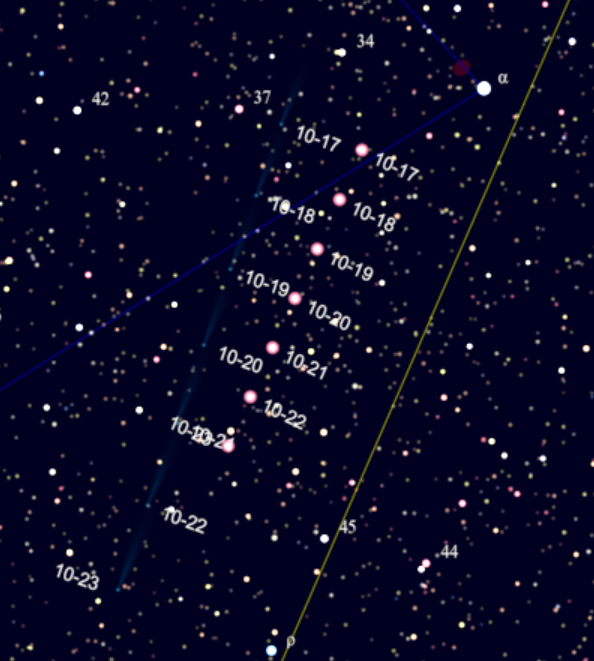
Mars and Comet ISON at 6 a.m. from October 17 to October 23, 2013. Star magnitude limit is 12. Created using Sky Charts (Cartes du Ciel)
10/15/2013 – Ephemeris – Correction to last Thursday’s Comet ISON program
Ephemeris for Tuesday, October 15th. The sun will rise at 7:58. It’ll be up for 10 hours and 59 minutes, setting at 6:57. The moon, 3 days before full, will set at 5:21 tomorrow morning.
Last week I went out to verify the statement that Comet ISON was visible in binoculars that I talked about last Thursday. That turned out to be incorrect. After two failed attempts last Tuesday and Wednesday mornings from my back yard. I had to find a darker location to out flank Traverse City and try to spot the comet with my 11 inch telescope. The comet turned out to be a faint smudge in the indicated spot. The sky wasn’t even dark in that direction, almost due east due to zodiacal light, visible on autumn mornings due to dust in the inner solar system. Zodiacal light is usually hard to spot until it becomes a nuisance. Advanced amateurs have indeed photographed it, tail and all, but visually the comet isn’t much at this stage.
Times are for the Traverse City/Interlochen area of Michigan. They may be different for your location.
Addendum
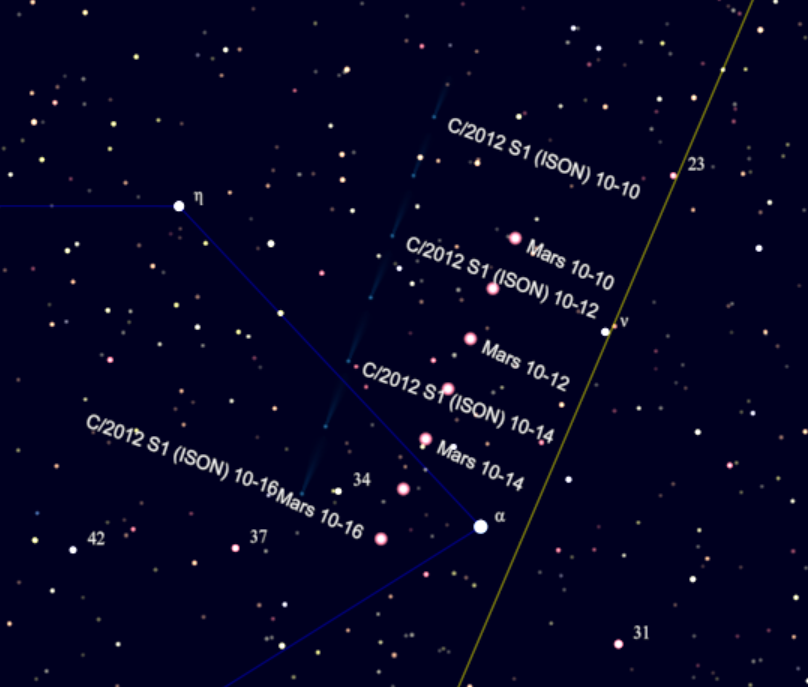
Comet ISON and Mars at 6 a.m. for 7 days starting October 10, 2013. Created using SkyCharts (Cartes du Ciel).
I’ll have a new weekly chart tomorrow. Mars and Comet ISON are sliding past Regulus now. See spaceweather.com for images of Comet ISON. By the end of this week the Moon’s light will interfere.
10/10/2013 – Ephemeris – Comet ISON is becoming visible in binoculars
Ephemeris for Thursday, October 10th. The sun will rise at 7:51. It’ll be up for 11 hours and 14 minutes, setting at 7:06. The moon, 1 day before first quarter, will set at 11:34 this evening.
Comet ISON is finally bright enough to possibly spot in binoculars. It seems to be between 10th and 11th magnitude, at the very limit of a pair of binoculars. Since it’s physically close to Mars, it’s close to Mars in our sky. Tomorrow morning it will be less than a binocular’s field of view to the upper left of Mars. Also don’t confuse Mars with the brighter star Regulus below Mars. In color photographs Comet ISON is showing a green coma or head a sign that the nucleus is spewing, among other things, cyanogen, a poison gas and/or diatomic carbon. Don’t worry, Comet ISON will not get anywhere close to the earth. The last comet I saw with a green head was Comet Hyakutake which came within 10 million miles of the earth in 1996. The comet’s head is pretty much a vacuum. We’ve flown spacecraft through them before. It’s the dust grains we worry about.
Times are for the Traverse City/Interlochen area of Michigan. They may be different for your location.
Addendum
Tuesday morning (Oct 8) I went out to try to spot Comet ISON with my 10X50 binoculars at 5:30 a.m. and was unsuccessful. I think I had two problems. First I am located 5 miles southwest of Traverse City, and though I had a good view to the east, I was hampered by the lights of the city. Also there may have been some zodiacal light. It’s the prime time for zodiacal light in the morning and the inbound comet is following close to the ecliptic line where the zodiac constellations reside. Wednesday morning I’m setting up my 11″ Dobsonian reflector. Let’s see what I can see.
Wednesday morning (Oct 9) I had my 11 inch Dobsonian trained on the comet’s location. But the light from Traverse City south was overpowering. Let’s see plan C is to go south to outflank Traverse City. We have a member of the Grand Traverse Astronomical Society who lives about 9 miles south of me. The only town he has to the east, in the direction of the comet is 9 1/2 miles, the little town of Kingsley. So that’s where I’m going tomorrow morning if it stays clear. It’s expected to be.
Comet ISON and Mars at 6 a.m. for 7 days starting October 10, 2013. Created using SkyCharts (Cartes du Ciel).
Don’t expect a tail. The head if Comet ISON will be hard enough to see. The yellow line is the ecliptic, the projection of the earth’s orbit on the sky. Most planet orbital planes lie close to the earth’s orbital plane, so are usually seen near it. The star marked α is Regulus the brightest star in the constellation of Leo, and about the brightness of Mars.
Spaceweather.com has images of the comet.
10/09/2013 – Ephemeris – The Bright planets and Comet ISON for this week
Ephemeris for Wednesday, October 9th. The sun will rise at 7:50. It’ll be up for 11 hours and 17 minutes, setting at 7:08. The moon, 2 days before first quarter, will set at 10:32 this evening.
Time again to check out the bright planets. Mercury has an unfavorable greatest elongation from the sun today. It’s too close to the horizon for all but the best observers to spot. Almost the same can be said of Saturn, right of and a bit below Venus tonight. Binoculars may be needed to it. Saturn will set at 8:15 while Venus will set at 8:50 p.m.. We are losing Saturn in the sun’s glare for a few months. The rest of the planetary action will be in the morning sky. The giant planet Jupiter will rise at 12:12 a.m. in the east northeast. It’s cruising against the stars of Gemini now. By 6 a.m it will be high in the southeast, the brightest object in that direction. Mars will rise at 3:25 a.m. also in the east northeast. It’s nearing Leo.
Times are for the Traverse City/Interlochen area of Michigan. They may be different for your location.
Addendum
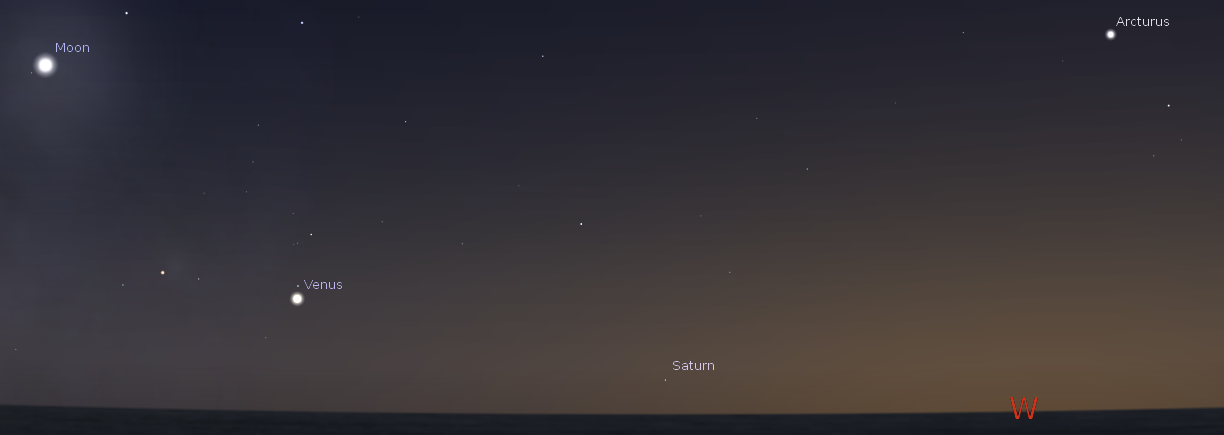
Venus, Saturn and the Moon in the west southwest at 8 p.m. October 9, 2013. Created using Stellarium.
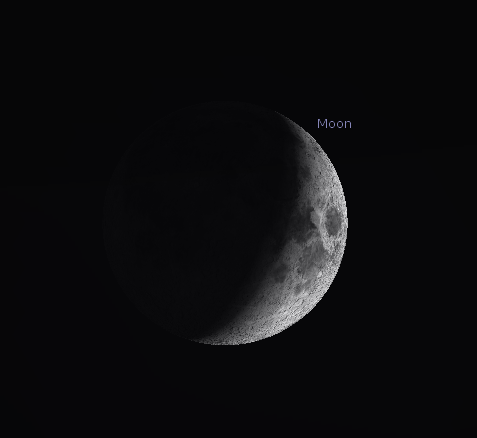
Closeup of the moon. Created using Stellarium.
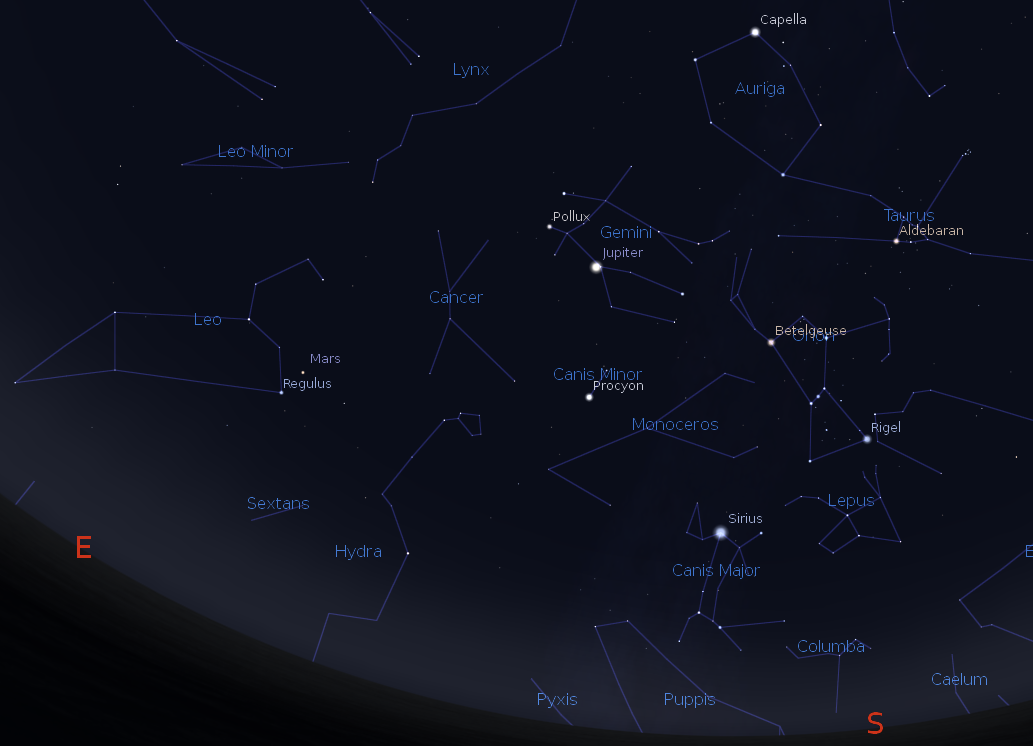
Jupiter and Mars with the winter stars and constellations at 6 a.m., October 10, 2013. Created using Stellarium.
Comet ISON and Mars at 6 a.m. for 7 days starting October 10, 2013. Created using SkyCharts (Cartes du Ciel).
Note that the comet is somewhat dimmer than predicted and barely visible in binoculars. The tail may not be visible except in photographs. I can’t really say since I haven’t seen it yet.
 Bob Moler's Ephemeris Blog