Archive
Ephemeris: 09/08/2023 – Comet Nishimura is getting brighter as it approaches the Sun, but also encountering brighter twilight
This is Ephemeris for Friday, September 8th. Today the Sun will be up for 12 hours and 53 minutes, setting at 8:06, and it will rise tomorrow at 7:14. The Moon, 2 days past last quarter, will rise at 1:20 tomorrow morning.
Our comet Nishimura is the third comet discovered by Japanese amateur astronomer Hideo Nishimura. Somehow the near earth asteroid detection programs missed it. I can understand why the Pan-STARRS and ATLAS search programs missed it, since they’re located on the Island of Maui, where those devastating wildfires are located. But they aren’t the only search programs. This weekend is the last chance to spot the comet. Nishimura will be rising before 5:30 am. The comet will be increasing its brightness to 4th magnitude this weekend. However, it will still be difficult to pick out without a pair of binoculars. The tail, if it has any, will be pointed just about straight up. After the 17th, its perihelion, it will be heading southward, and back out to the Oort Cloud, from where it came.
The astronomical event times given are for the Traverse City/Interlochen area of Michigan (EDT, UT –4 hours). They may be different for your location.
Addendum
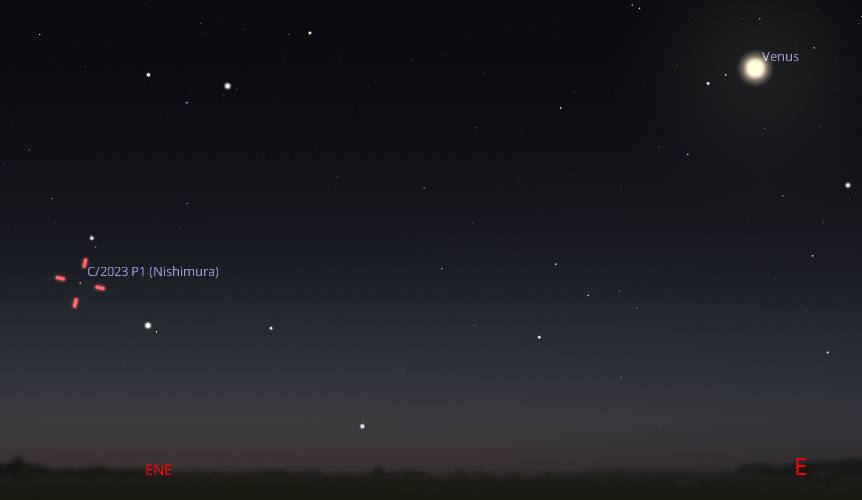
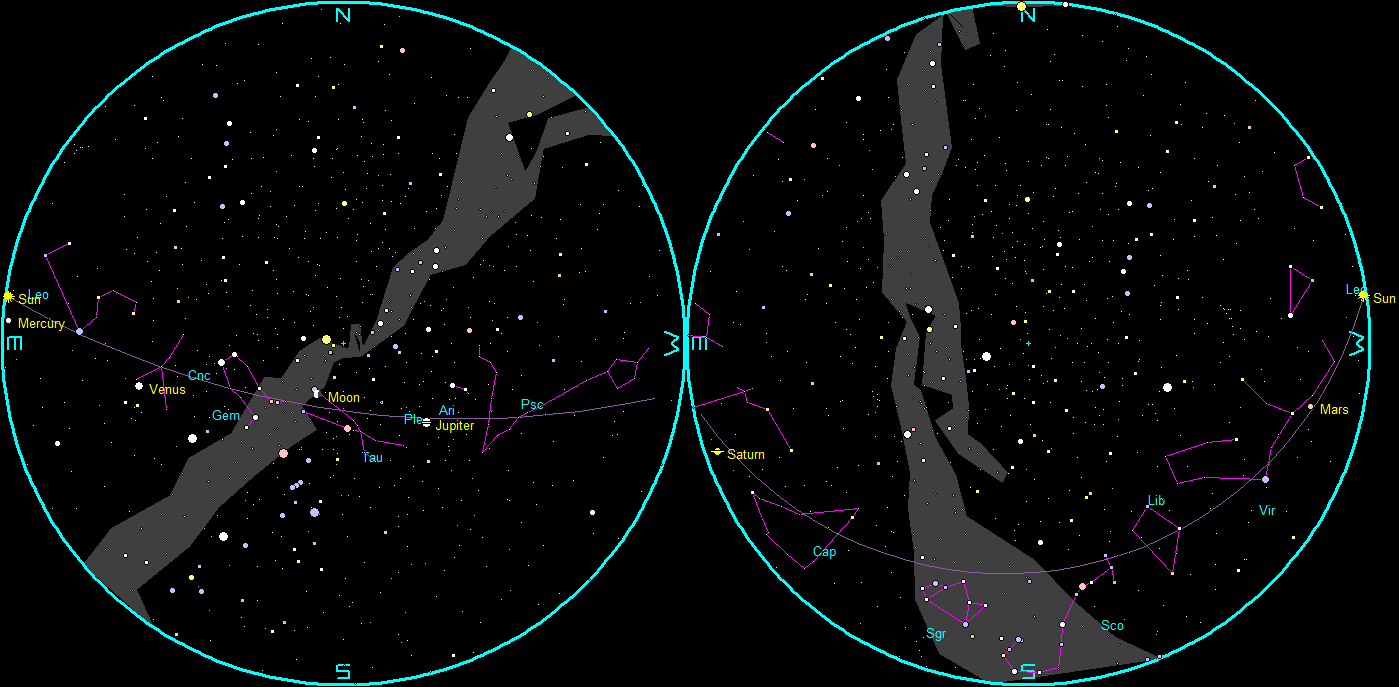
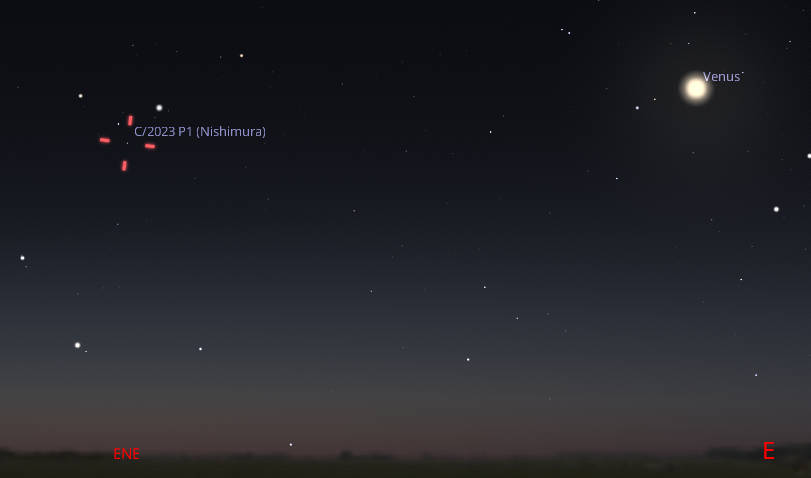
Comet Nishimura Saturday, September 9th, 6 am
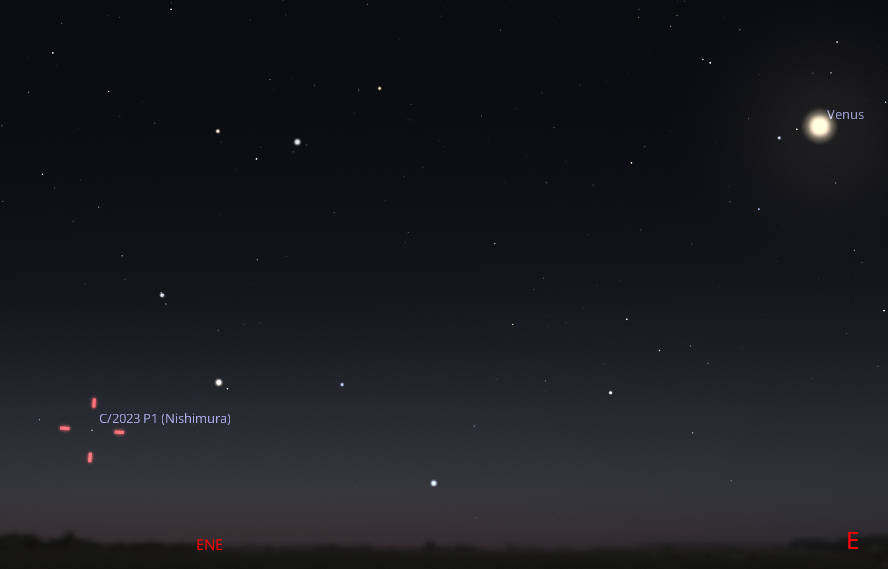
Comet Nishimura Sunday, September 10th, 6 am
Comet Nishimura Monday, September 11th, 6:15 am
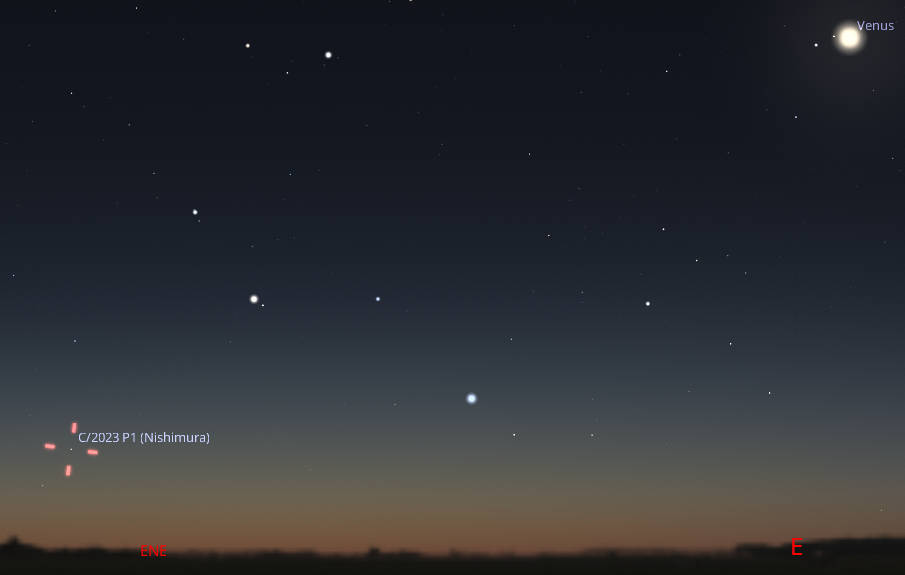
After Monday, September 11th I feel that the comet will be too close to the Sun, or in too bright a twilight to spot for our latitude. Observers farther south should have better luck after perihelion on the 17th.
Ephemeris: 09/07/2023 – Comet Nishimura is getting brighter as it approaches the Sun
This is Ephemeris for Thursday, September 7th. Today the Sun will be up for 12 hours and 56 minutes, setting at 8:08, and it will rise tomorrow at 7:13. The Moon, 1 day past last quarter, will rise at 12:26 tomorrow morning.
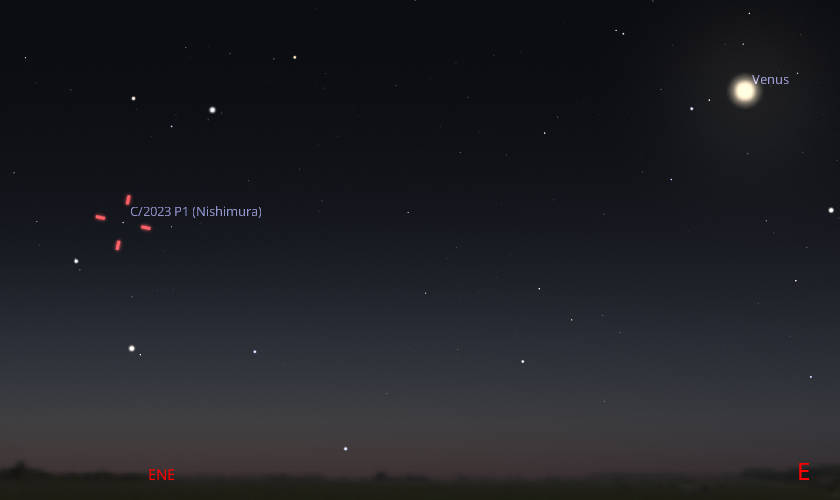
Comet Nishimura is brightening as it approaches the Sun. It will reach 22% of the Earth’s distance from the Sun at perihelion, its closest to the Sun on the 17th, but will be heading south of the Sun, and not be visible to us. Currently, it is in the morning sky, in the east-northeast. At 6 to 6:30 am it will appear in the east-northeast to the left of Venus. It will be probably 4.4 magnitude, which still isn’t easily spotted in a dark sky, much less in the morning twilight glow. If it does have a tail, it will be pointed vertically up from the head of the comet. A pair of binoculars will be needed to spot the comet. Nishimura appears to be a visitor from the Oort cloud of comets, a cloud that stretches about a quarter the way to the next star to the Sun.
The astronomical event times given are for the Traverse City/Interlochen area of Michigan (EDT, UT –4 hours). They may be different for your location.
Addendum
Ephemeris: 09/06/2023 – Let’s find out where the naked-eye planets and comet Nishimura have wandered off to
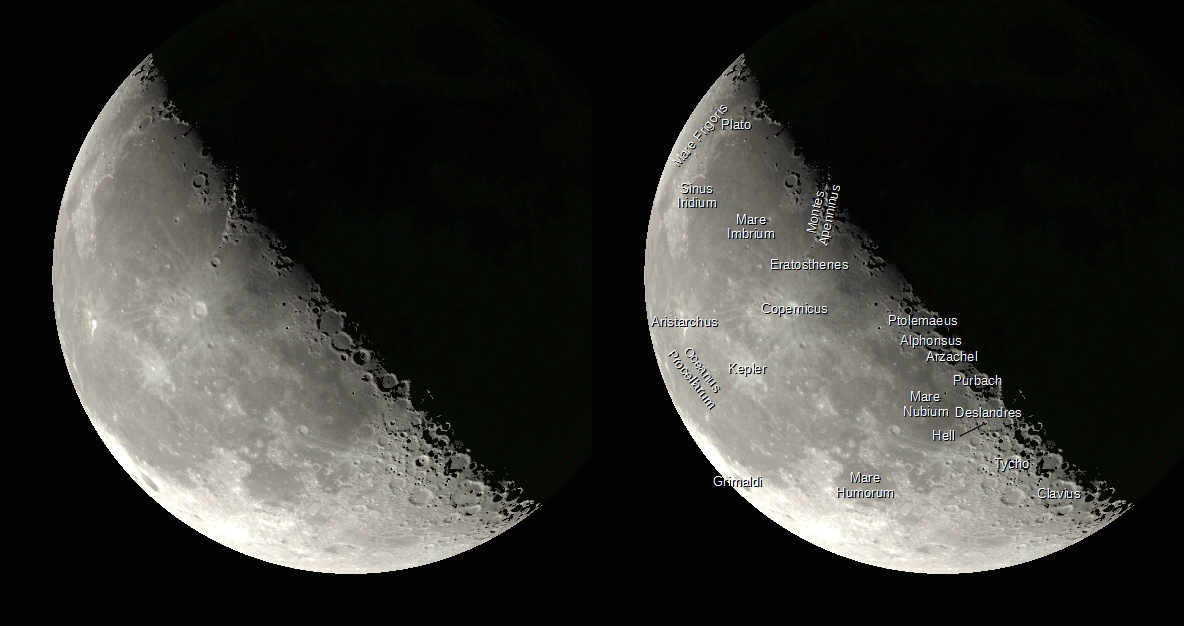
This is Ephemeris for Wednesday, September 6th. Today the Sun will be up for 12 hours and 59 minutes, setting at 8:10, and it will rise tomorrow at 7:12. The Moon, at last quarter today, will rise at 11:40 this evening.
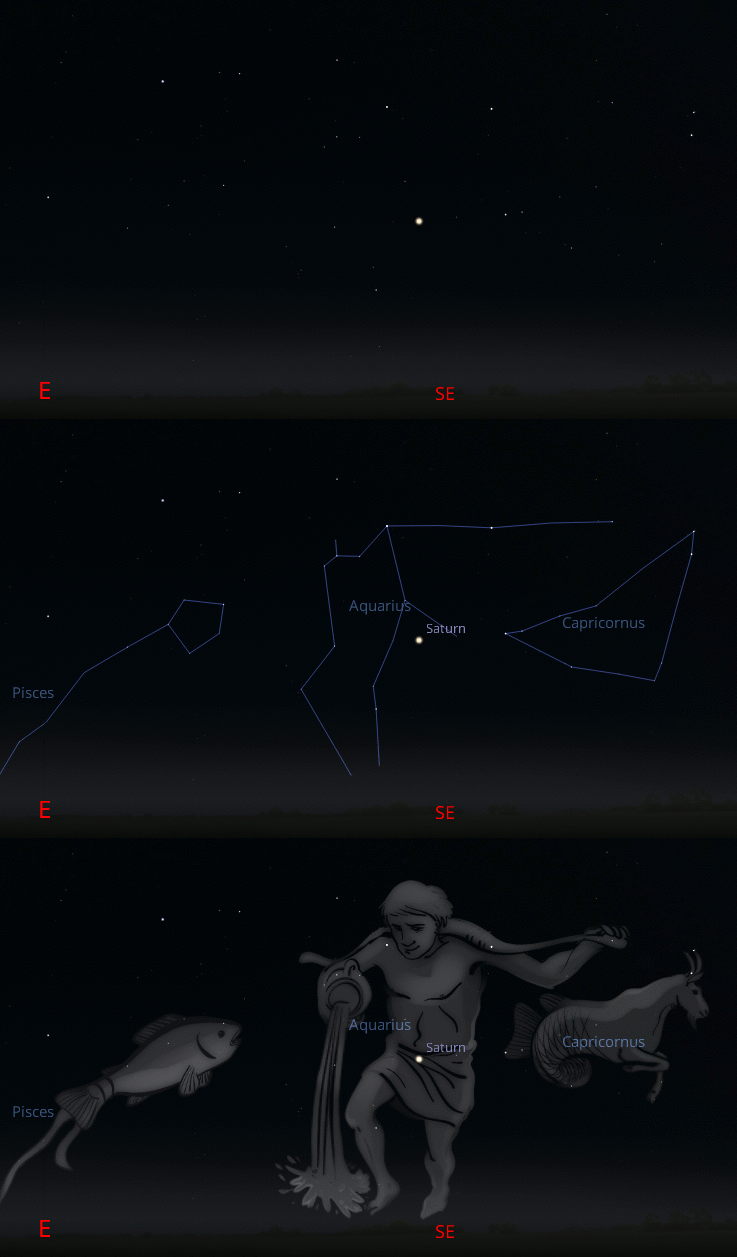
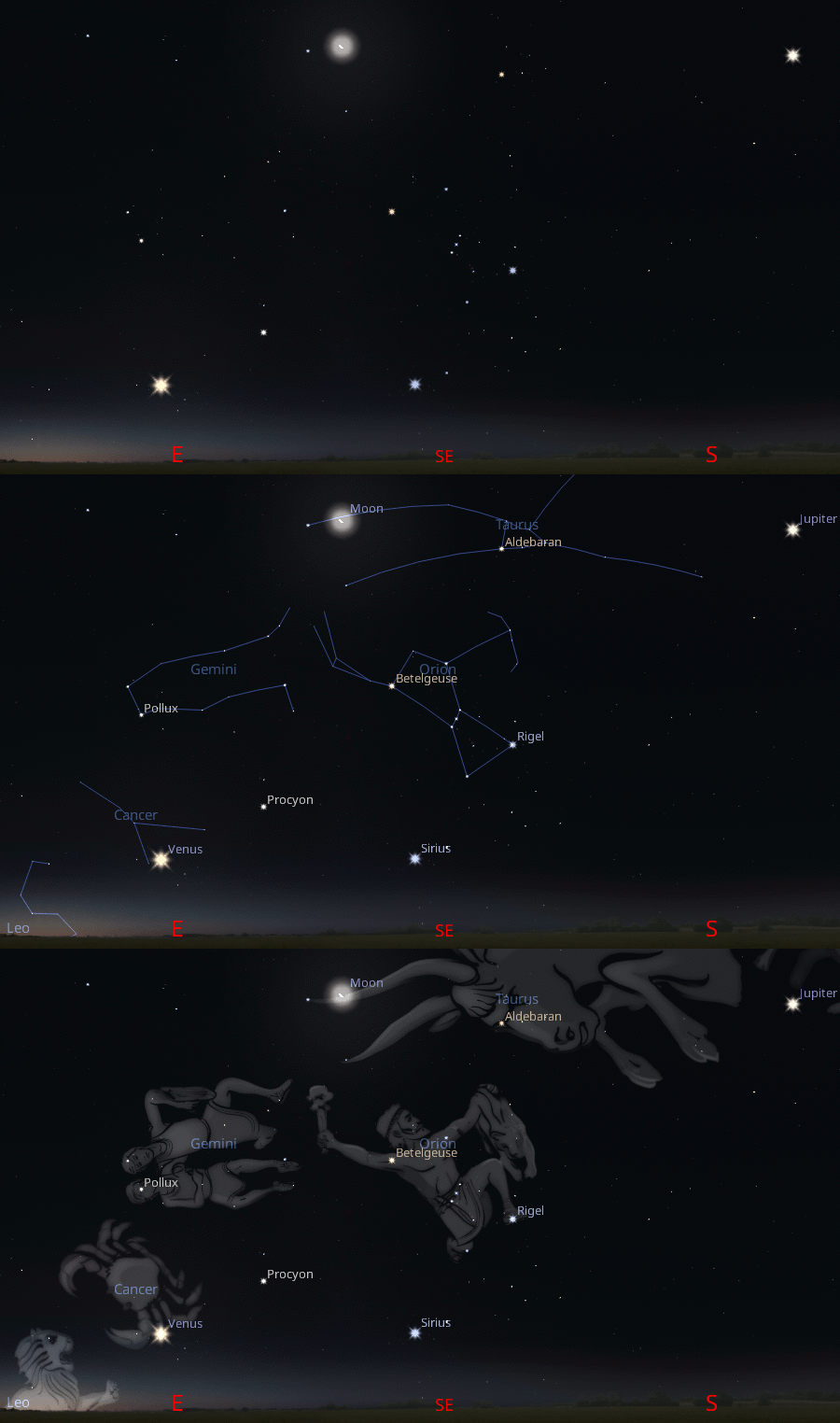
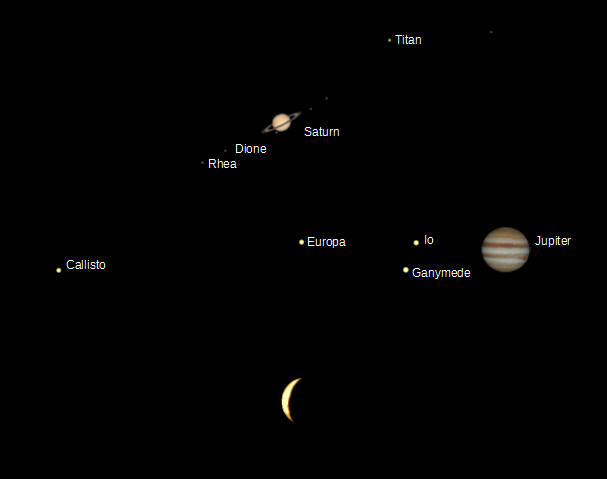
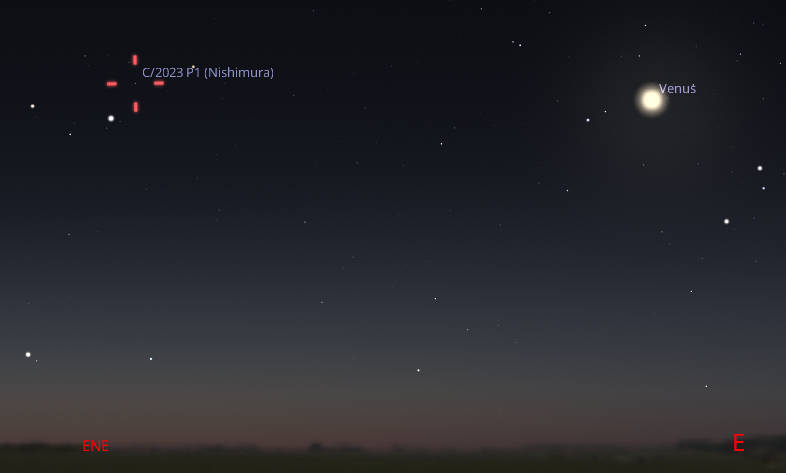
Let’s find out where the naked-eye planets have wandered off to. Three of those five planets are now visible but Mars and Mercury are too close to the Sun to be seen. Saturn is the sole evening planet visible. Jupiter and Venus are officially the only visible morning planets. Saturn can be spotted in the southeast in the evening. And it will still be visible throughout the morning hours morning until twilight starts. Saturn is in retrograde or westward motion against the stars of Aquarius. Jupiter will rise at 10:54pm. It is slowing its eastward motion and will become stationary tomorrow. Venus is our brilliant morning star. It will rise at 4:43 tomorrow morning. Comet Nishimura is left and a bit below Venus in the east-northeast.
The astronomical event times given are for the Traverse City/Interlochen area of Michigan (EDT, UT –4 hours). They may be different for your location.
Addendum
Ephemeris: 09/05/2023 – Where is Comet Nishimura tomorrow morning the 6th
This is Bob Moler with Ephemeris for Tuesday, September 5th. Today the Sun will be up for 13 hours and 2 minutes, setting at 8:12, and it will rise tomorrow at 7:10. The Moon, 1 day before last quarter, will rise at 11:03 this evening.
Comet Nishimura is supposedly a very dim naked-eye comet now, best found and seen in binoculars, though it will get brighter in the next few days. On Ephemeris, when I talk about things that one can observe, it must be bright enough to be spotted with the naked eye, even though it may be best appreciated with binoculars or telescope. This comet is a little dubious in that regard. Comets, to my eyes at least, appear dimmer than what their magnitudes suggest. More specific information is on my blog at bobmoler.wordpress.com, an Ephemeris Extra post for August 31st. Tomorrow morning the comet is to the left of Venus in the east northeast. Comet Nishimura will be visible for our location through next Monday.
The astronomical event times given are for the Traverse City/Interlochen area of Michigan (EDT, UT –4 hours). They may be different for your location.
Addendum
Ephemeris Extra: 08/31/2023 – Comet C/2023 P1 (Nishimura) may be visible to the naked eye in September
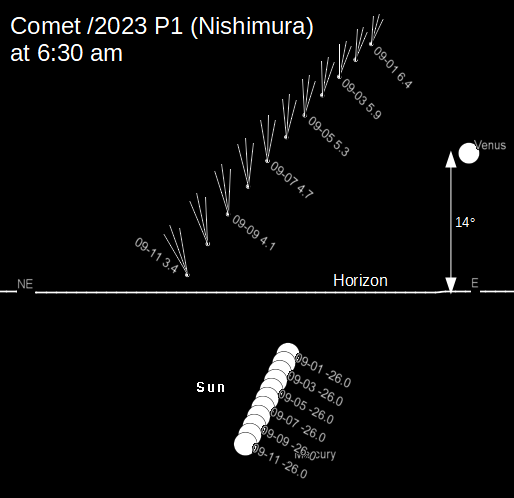
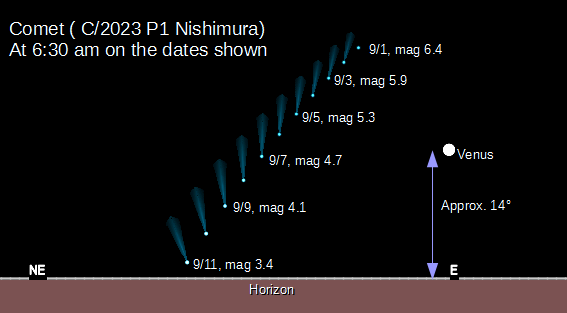
Comet Nishimura is shown at 6:30 AM in the east northeast for the mornings of September 1st through 11th. Venus stays pretty much at the same altitude of 14 degrees during this period. The Sun is shown here below the horizon. The comet and the Sun are labeled every other day with the month and day and estimated magnitude. Created using Cartes du Ciel (Sky Charts) by the author.
On August 12th this year Hideo Nishimura of Kakegawa, Japan discovered a comet that now bears his name. The comet has a chance of becoming a naked eye object this month, but for only a few days. It is a rapidly moving comet, and it is heading southward. We will only get a short period of time when it is possibly visible to the naked eye.
I’m sorry about all the weasel words about the brightness of the comet, but comets are notorious for being unpredictable with their brightness. They may brighten suddenly, they may dim suddenly, they may fall apart. We never know what happens to a comet until it happens.
Early brightness estimates were all over the place from 9th to 14th magnitude a range of 5 magnitudes or a brightness range of 100 from bright to dim. The comet was discovered only 12 days ago, as I write this, so there’s not very many brightness estimates to base future magnitudes on, even if the comet is well-behaved.
I’ve printed a chart, below, of the comet’s position in relation to the stars of Cancer and Leo for the period September 1 through 13th. The comet should be at least a binocular object during this period. I’ve also included a table of comet positions in altitude and azimuth for the start of astronomical and nautical twilight. The times of morning nautical twilight are listed on the Star Chart Page. Astronomical twilight starts about 36 minutes before nautical twilight this time of year.
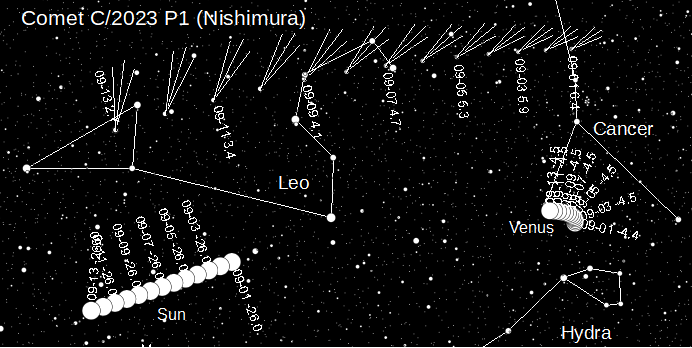
Comet Nishimura plotted against the stars of Cancer and Leo, along with the Sun and Venus. The comet, Venus and the Sun are labeled every other day with the month and day and estimated magnitude. Created using Cartes du Ciel (Sky Charts) by the author.
A pair of binoculars are the best way to view a comet that is just barely visible to the naked eye, or is competing with twilight. In both charts, the tail of the comet shows the direction that the tail would flow from and not its length.
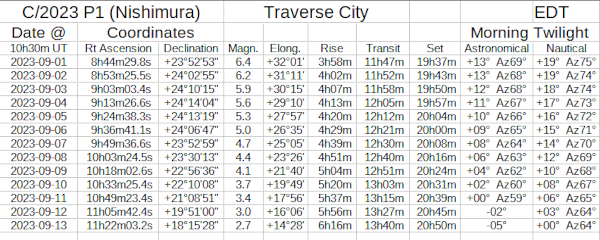
A table of positions of the comet at the beginning of astronomical and nautical twilight. Created using Cartes du Ciel.
At last report (August 26), it was half a magnitude dimmer than the predictions I have.
Ephemeris: 08/22/2023 – We might see a naked eye comet next month
Aug 22. This is Ephemeris for Tuesday, August 22nd. The Sun will be up for 13 hours and 44 minutes today, setting at 8:37, and it will rise at 6:54 tomorrow. The Moon, 2 days before first quarter, will set at 11:09 this evening.
A new comet has been discovered that might be visible to the naked eye in early September. It was discovered 10 days ago by Hideo Nishimura of Kakegawa, Japan. Somehow he was able to scoop all the automated asteroid seeking discovery programs. The comet will be visible in the morning before sunrise in the northeastern sky. It will be probably be naked eye from the 7th to the 10th. That’s only about four days in September. At that point it may get up to about fourth magnitude which is not very bright, especially for a comet, it’s barely visible, since comets appear dimmer than their magnitude suggests. However, it will be far enough from the Sun at the beginning of the four-day period to be able to be viewed before astronomical twilight.
The astronomical event times given are for the Traverse City/Interlochen area of Michigan (EDT, UT –4 hours). They may be different for your location.
Addendum
Most of the data for this posting comes from Seiichi Yoshida’s Weekly Information about Bright Comets webpage (www.aerith.net/comet/weekly/current.html).
 Bob Moler's Ephemeris Blog