Archive
Ephemeris: 11/06/2025 – An astronomer thinks a nova will appear soon
This is Ephemeris for Thursday, November 6th. Today the Sun will be up for 9 hours and 56 minutes, setting at 5:24, and it will rise tomorrow at 7:29. The Moon, 1 day past full, will rise at 5:50 this evening.
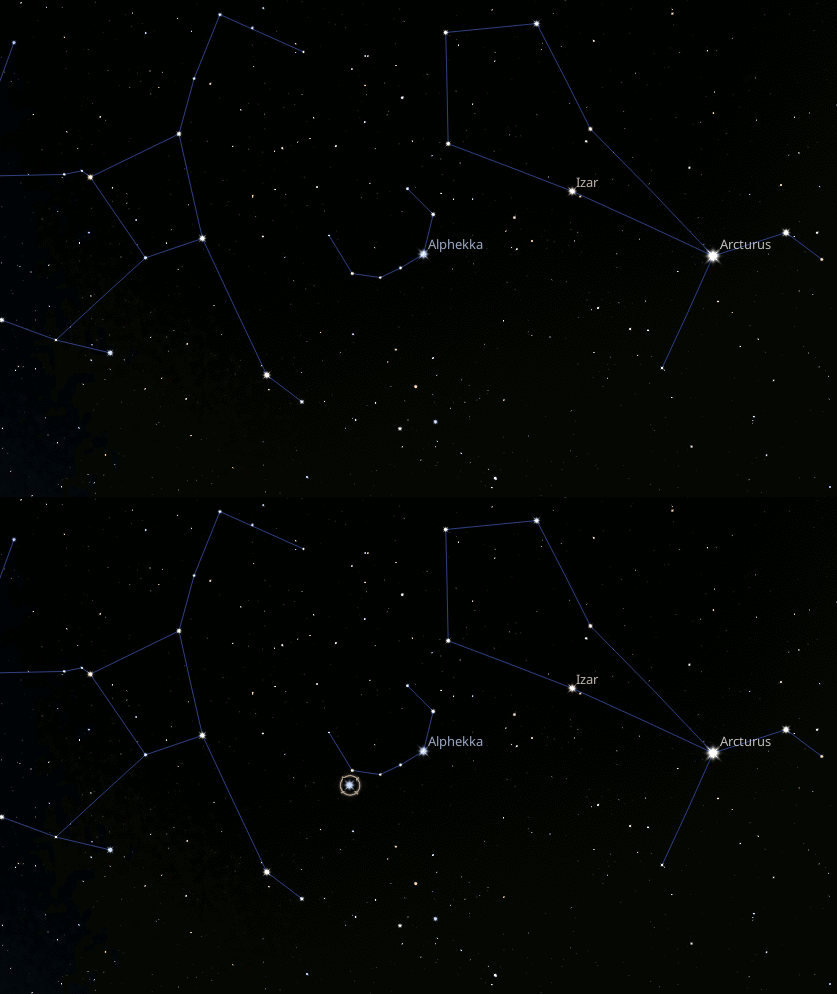
We’ve been waiting for the past year or so for the eruption of a nova in the constellation Corona Borealis the Northern Crown. It last erupted in 1946. Eruptions are about 80 years apart. Astronomer Jean Schneider of the Paris Observatory has made a study of this particular nova. It occurs in a binary star system with a white dwarf and a much larger star that orbit each other every 228 days. So it is possible that the Nova occurs at one point in that orbit. And based on the last eruption in 1946, November 10th, give or take, is one of the days we might look to see the eruption. If it doesn’t happen that day its next likely occurrence is around June 25th next year. It will appear just left of Corona Borealis low in the west northwest around 7 PM, and as bright as the normally brightest star in that constellation.
The astronomical event times given in this blog are for the Traverse City/Interlochen area of Michigan (Lat 44.7° N, Long 85.7° W; EDT, UT – 4 hours) unless stated otherwise. Times will be different for other locations.
Addendum
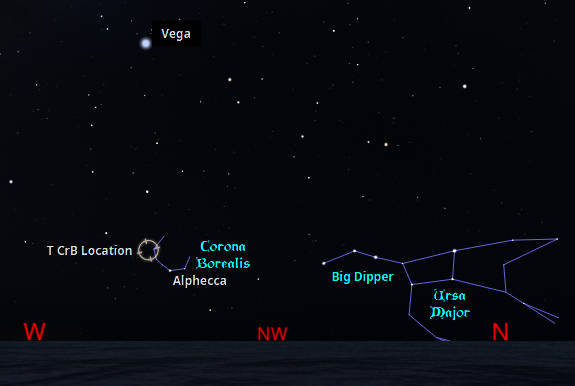
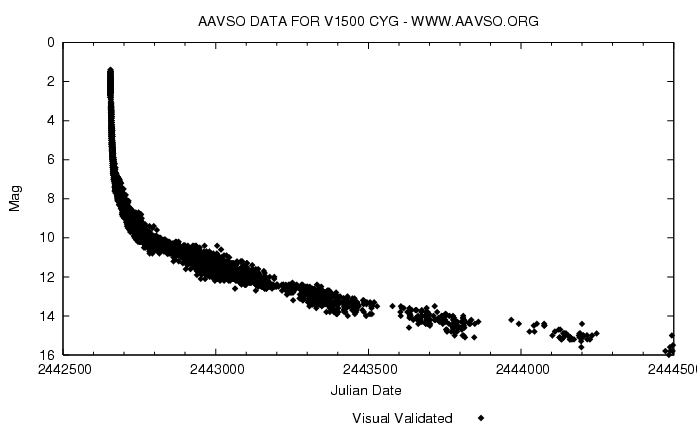
The website Spaceweather.com monitors reports of the brightness of the star on the right side of its page under the heading of T CrB NOVA WATCH. It is currently around 10th magnitude, invisible to the naked eye and barely visible in binoculars. It is expected to grow to 2nd magnitude or 1,600 times it’s normal brightness, about as bright as a Big Dipper star or Alphecca, near it, in Corona Borealis. The nova will fade rapidly, and will be visible to the naked eye for only about a week.
Ephemeris: 05/20/2025 – Corona Borealis, Ariadne’s Crown
This is Ephemeris for Tuesday, May 20th. Today the Sun will be up for 15 hours and 1 minute, setting at 9:10, and it will rise tomorrow at 6:08. The Moon, at last quarter today, will rise at 3:12 tomorrow morning.
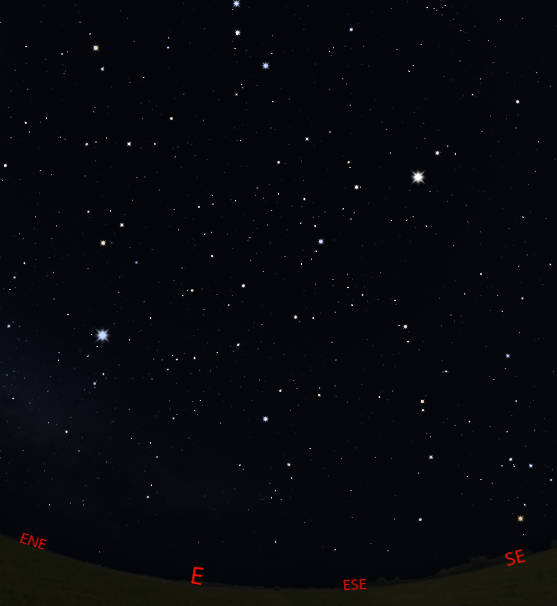
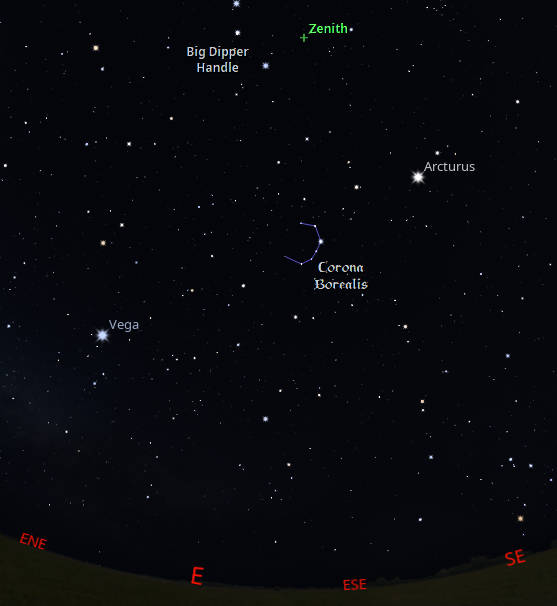
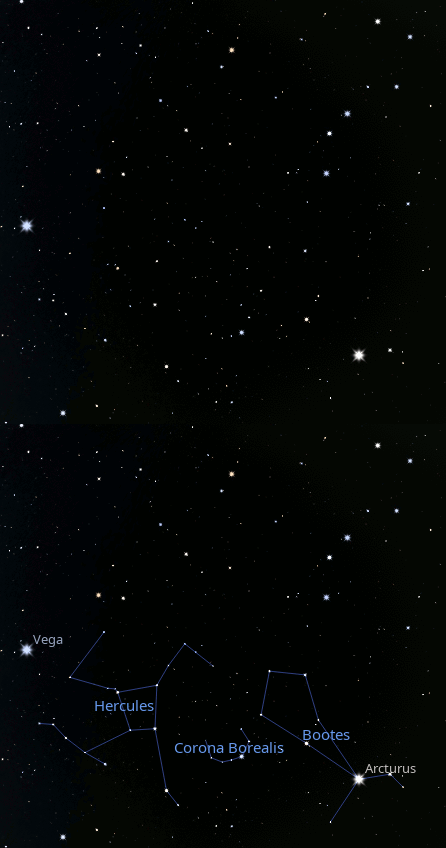
There are two bright stars in the eastern part of the sky. High in the southeast at 11 PM is Arcturus, and in the east northeast, lower down is the star Vega. A third of the way between Arcturus and Vega is a small arc of stars called Corona Borealis, the northern crown. It is a small constellation. The brightest star in it is called Alphecca. According to Greek mythology it is the crown given to Princess Ariadne, daughter of King Minos of Crete. Of interest in the next year or so is a possibility of a nova or bright star appearing just south of that arc of stars for about a week. It is a recurrent nova, which explodes about every 80 years. The last time was in 1946, so the next time would be within the next year or so. And astronomers are breathlessly waiting for that to happen.
The astronomical event times given in this blog are for the Traverse City/Interlochen area of Michigan (Lat 44.7° N, Long 85.7° W; EDT, UT – 4 hours) unless stated otherwise. Times will be different for other locations.
Addendum
Ephemeris: 06/27/2024 – Why do astronomers think a nova will appear this year?
This is Ephemeris for Thursday, June 27th. Today the Sun will be up for 15 hours and 33 minutes, setting at 9:32, and it will rise tomorrow at 5:59. The Moon, 1 day before last quarter, will rise at 1:18 tomorrow morning.
Our expected nova this year, T Coronae Borealis, is expected by some astronomers to erupt sometime in September give or take, but nobody knows for sure. The last eruption was seen in 1946. And if the average time between outbursts is 80 years, it seems to be two years early this time. In 1946 there were observations showing that there were some precursor effects going on before the eruption, and those have been noticed this time too, which is which why we assume that the nova will occur this year. Stars that vary in brightness are denoted in a constellation by a letter starting with R through Z, then RR, RS, etcetera through ZZ. After that it’s V and a number plus the constellation name or abbreviation.
The astronomical event times given are for the Traverse City/Interlochen area of Michigan (EDT, UT–4 hours). They may be different for your location.
Addendum
Ephemeris: 06/24/2024 – Waiting for a bright nova*
This is Ephemeris for Monday, June 24th. Today the Sun will be up for 15 hours and 34 minutes, setting at 9:32, and it will rise tomorrow at 5:58. The Moon, 3 days past full, will rise at 12:09 tomorrow morning.
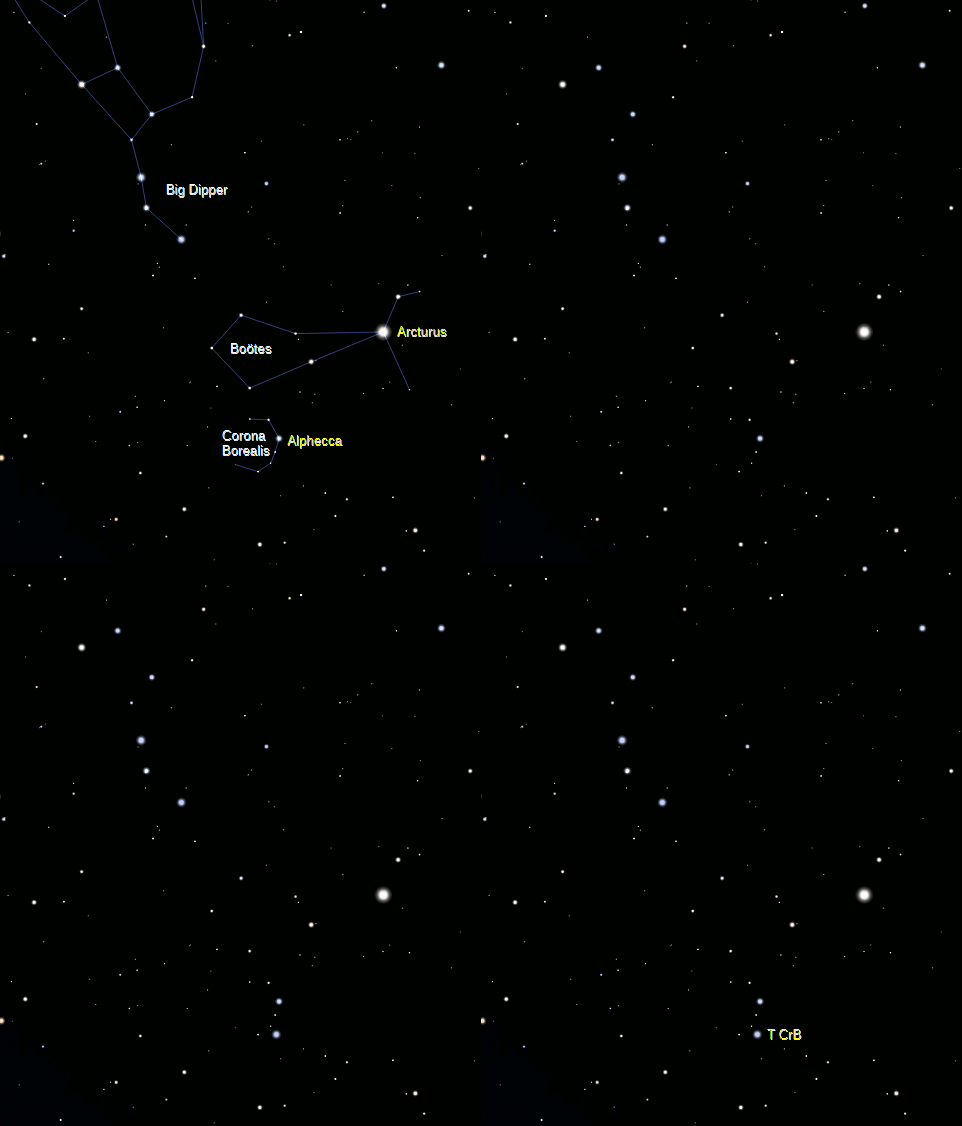
The small constellation of Corona Borealis, or Northern Crown appears about a third of the way between the bright star Arcturus, high in the south and the star Vega in the east. It is a small semicircle of stars with the brighter star called Alphecca near the center of the arc of stars. Sometime this year, we hope, another bright star will appear there. A nova of a dim star brightening about 1,600 times normal near that circle of stars. It has done it before. It has the designation of T Coronae Borealis (T CrB for short), and is a recurrent nova of a white dwarf star that suffers an explosion about once every 80 years. So this year we need to be looking out for that stellar explosion, which will be bright for only a few days, so one must be vigilant to spot it.
The astronomical event times given are for the Traverse City/Interlochen area of Michigan (EDT, UT–4 hours). They may be different for your location.
* The word ‘nova’ comes from the Latin Nova Stella, meaning New Star.
Addendum
NASA has post about T CrB here: https://www.nasa.gov/centers-and-facilities/marshall/nasa-global-astronomers-await-rare-nova-explosion/
Ephemeris: 04/29/2024 – Corona Borealis, the Northern Crown
This is Ephemeris for Monday, April 29th. Today the Sun will be up for 14 hours and 11 minutes, setting at 8:46, and it will rise tomorrow at 6:33. The Moon, 2 days before last quarter, will rise at 2:58 tomorrow morning.
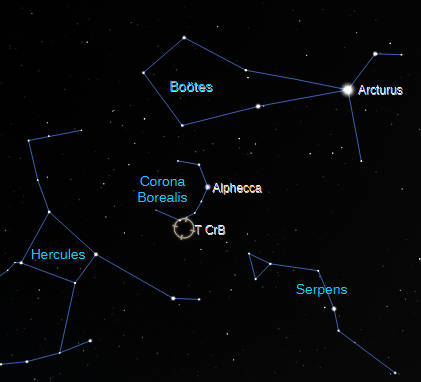
About a third of the way up the sky in the east at 10 p.m. can be found a small but easily spotted constellation of Corona Borealis, the Northern Crown. It is located just below the kite shaped constellation of Boötes, with its bright star Arcturus at the right. The Northern Crown is a three-quarter circle of stars, like a tiara, with a brighter star Alphecca at the bottom. Alphecca in Arabic means “The bright star of the broken ring of stars”, which is an accurate description of it. Check it out now for later this year we expect to have a bright star appear just below it. That star is T Coronae Borealis a recurrent Nova or exploding star. They occur when a white dwarf star is orbiting with a large red giant star and accumulating gas from that red giant star until it explodes.
The astronomical event times given are for the Traverse City/Interlochen area of Michigan (EDT, UT–4 hours). They may be different for your location.
Addendum
Ephemeris: 04/23/2024 – We are awaiting a bright nova
This is Bob Moler with Ephemeris for Tuesday, April 23rd. Today the Sun will be up for 13 hours and 54 minutes, setting at 8:38, and it will rise tomorrow at 6:42. The Moon, at full today, will rise at 8:40 this evening.
There is an event rarer than the appearance of Halley’s Comet. It’s an explosion of a star called T Coronae Borealis which means it’s in the constellation of the Northern Crown. Corona is a semicircle of stars located left of the bright star Arcturus, pointed to by the handle of the Big Dipper. The letter T means that it’s a variable star. It is something called a cataclysmic variable, or recurrent nova, and it blows up about every 80 years. The last time it did this was in 1946. Its brightness dips about 11 months before it goes kablooey. That dip has already happened. The star doesn’t destroy itself. It’s actually a white dwarf that’s siphoning off gases from a red giant star that it’s orbiting. When enough hydrogen gets accumulated, it ignites.
The astronomical event times given are for the Traverse City/Interlochen area of Michigan (EDT, UT–4 hours). They may be different for your location.
Addendum
06/09/2023 – Ephemeris – How to find Corona Borealis, the Northern Crown
This is Bob Moler with Ephemeris for Friday, June 9th. Today the Sun will be up for 15 hours and 29 minutes, setting at 9:27, and it will rise tomorrow at 5:57. The Moon, 1 day before last quarter, will rise at 2:13 tomorrow morning.
High in the southeast at 11 p.m. can be found a small but easily spotted constellation of Corona Borealis, the Northern Crown. It is located just east or left of the kite shaped constellation of Boötes, with its bright star Arcturus at the bottom. The Northern Crown is a three-quarters circle of stars, like a tiara, with a brighter star Alphecca at the bottom. Alphecca in Arabic means “Bright star of the broken ring of stars”. According to Greek mythology it belonged to Princess Ariadne, daughter of King Minos of Crete who helped Theseus escape from the Labyrinth of the Minotaur, only to be abandoned by him on an island. To the Native Chippewa and Ottawa of our area it is the Sweat Lodge.
The astronomical event times given are for the Traverse City/Interlochen area of Michigan (EDT, UT –4 hours). They may be different for your location.
Addendum
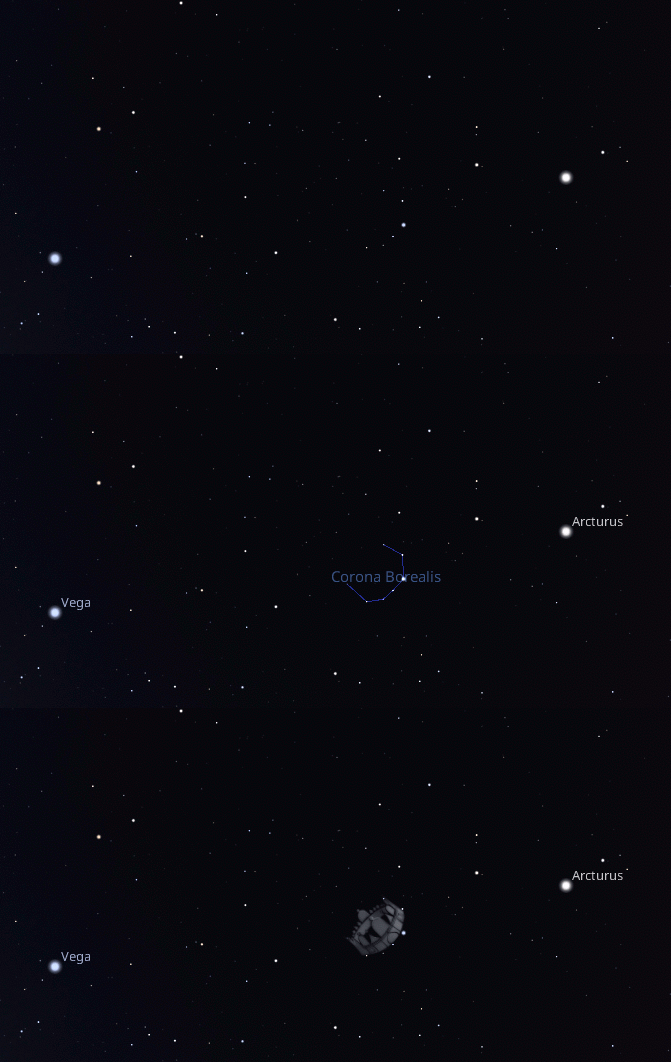
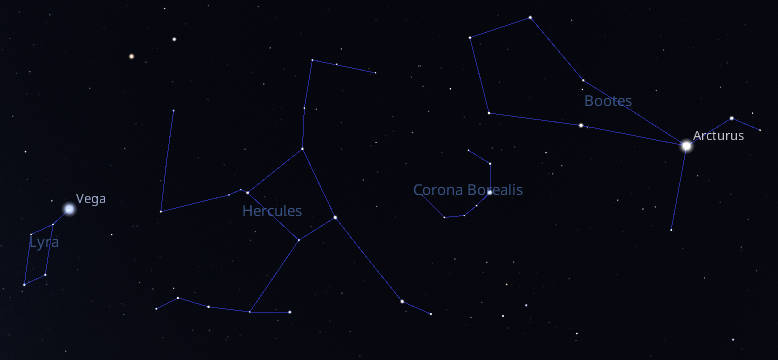
Next Monday I will post about Hercules.
06/23/2022 – Ephemeris – Corona Borealis, the Northern Crown
This is Ephemeris for Thursday, June 23rd. Today the Sun will be up for 15 hours and 34 minutes, setting at 9:32, and it will rise tomorrow at 5:58. The Moon, 3 days past last quarter, will rise at 3:08 tomorrow morning.
High in the south at 11 this evening can be seen a small nearly circular constellation of Corona Borealis, the Northern Crown. It is just left of Boötes, the kite shaped constellation off the handle of the Big Dipper. According to Greek myth, the crown was given by the gods to the princess Ariadne, daughter of King Minos of Crete. The crown is more like a tiara with the bright star Alphecca at the front. To the Anishinaabe people, who are native to our region, it is the Sweat Lodge. Part of what we call Hercules next to it is the Exhausted Bather, who is lying on the ground after the ceremony. The seven stones that are heated for the Sweat Lodge ceremony are the Pleiades, now close to Venus in the morning twilight.
The astronomical event times given are for the Traverse City/Interlochen area of Michigan (EDT, UT – 4 hours). They may be different for your location.
Addendum
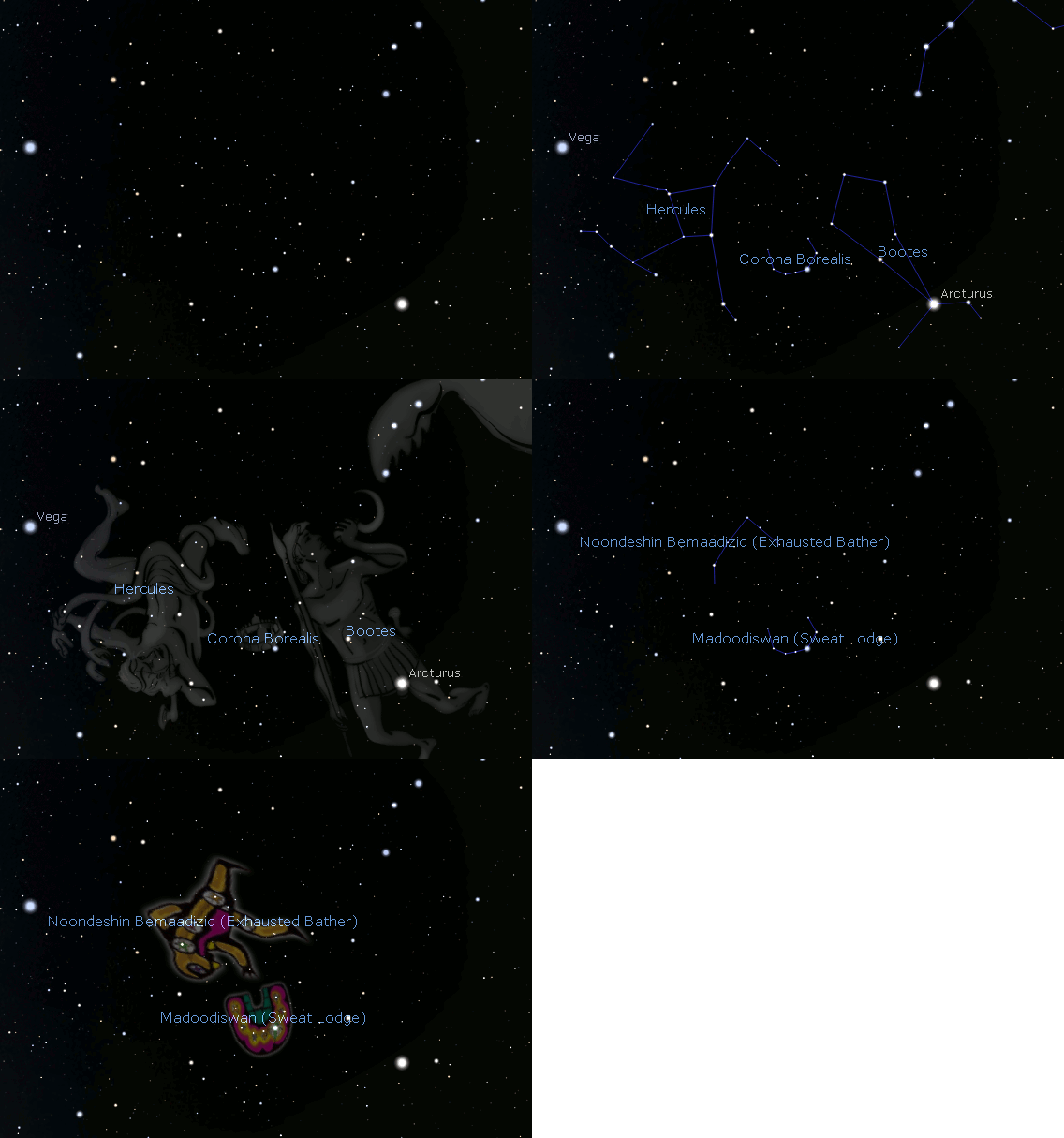
Corona Borealis and Sweat Lodge finder animation. Looking high in the south at 11 pm, June 23rd. The tail of Ursa Major or the handle of the Big Dipper is in the upper right. Created using Stellarium and GIMP. Both star lore images are embedded in Stellarium. The Anishinaabe images are embedded in Stellarium and is from Ojibwe Giizhig Anung Masinaaigan – Ojibiwe Sky Star Map created by A. Lee, W. Wilson, and C. Gawboy.
06/16/2020 – Ephemeris – One circlet of stars, two constellations: old world and new world
This is Ephemeris for Tuesday, June 16th. Today the Sun will be up for 15 hours and 34 minutes, setting at 9:30, and it will rise tomorrow at 5:56. The Moon, 3 days past last quarter, will rise at 3:52 tomorrow morning.
High in the south-southeast at 11 this evening can be seen a small nearly circular constellation of Corona Borealis, the Northern Crown. It is just below Boötes, the kite shaped constellation off the handle of the Big Dipper. According to Greek myth the crown was given by the gods to the princess Ariadne, daughter of King Minos of Crete. The crown is more like a tiara with the bright star Alphecca at the front. To the Anishinaabe people, who are natives of our region it is the Sweat Lodge. Part of what we call Hercules next to it is the Exhausted Bather, who is lying on the ground after the ceremony. The seven stones that are heated for the Sweat Lodge are the Pleiades, now too close to the Sun to be seen.
The event times given are for the Traverse City/Interlochen area of Michigan. They may be different for your location.
Addendum

Animated Corona Borealis/Sweat Lodge Finder Chart looking to the south-southeast at 11 p.m. June 16th. Click on the image to enlarge Created using Stellarium and GIMP.
05/23/2019 – Ephemeris – A look at the constellation of Corona Borealis
Ephemeris for Thursday, May 23rd. Today the Sun will be up for 15 hours and 5 minutes, setting at 9:12, and it will rise tomorrow at 6:06. The Moon, 3 days before last quarter, will rise at 1:37 tomorrow morning.
High in the east-southeast at 11 this evening can be seen a small nearly circular constellation of Corona Borealis, the Northern Crown. It is just below Boötes, the kite shaped constellation off the handle of the Big Dipper. According to Greek myth the crown was given by the gods to the princess Ariadne, daughter of King Minos of Crete. The crown is more like a tiara with the bright star Alphecca at the front. To the Anishinaabe people, who are natives of our region it is the Sweat Lodge. Part of what we call Hercules next to it is the Exhausted Bather, who is lying on the ground after the ceremony. The seven stones that are heated for the Sweat Lodge are the Pleiades, now too close to the Sun to be seen.
The times given are for the Traverse City/Interlochen area of Michigan. They may be different for your location.
Addendum
Animated Corona Borealis Finder Chart looking to the east-southeast at 11 p.m. May 23rd Click on the image to enlarge. Created using Stellarium and GIMP.
 Bob Moler's Ephemeris Blog