Archive
Ephemeris Extra – Some easy summertime deep sky objects
The finder charts were created using Cartes du Ciel (Sky Charts). This post is based on my article in the July 2017 Stellar Sentinel, the newsletter of the Grand Traverse Astronomical Society. It’s part of the Extras section for those receiving the emailed version.
What are Deep Sky Objects? These are objects, other than individual stars, beyond the solar system generally visible in binoculars or telescopes rather than the naked eye such as galaxies, nebulae and star clusters.
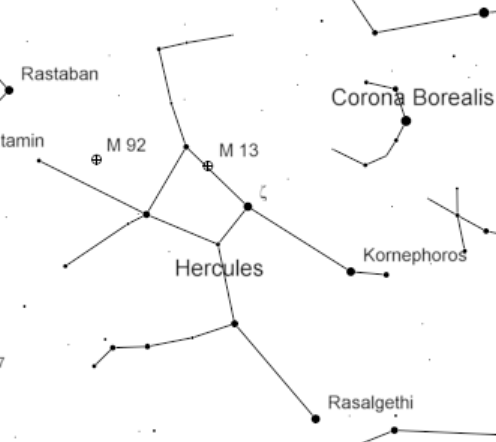 The Great Hercules Globular Star Cluster, M13 is the finest globular star cluster in the northern hemisphere of the sky. It is visible from late spring to early autumn. Globular star clusters have populations of hundreds of thousands of stars. They date back to the origin of the Milky Way of ten or a bit more billion of years old. There are only about 150 of these that belong to the Milky Way Galaxy. M13 is visible in binoculars on the western side of the Keystone pattern of stars, about one-third the distance from the north star on that side to the south side. It takes a much larger telescope to see individual stars. The star cluster will be a large circular glow. M92 is another star cluster which is dimmer and will be quite a challenge to find.
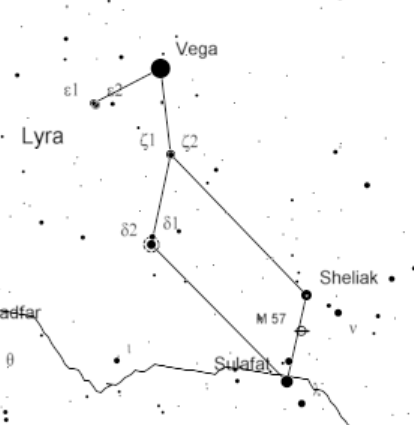 The Ring Nebula, M57 is small and cannot be seen with the naked eye or with binoculars, but it is still reasonably easy to find. A nebula is a cloud of gas and/or dust. M57 is in the constellation of Lyra the harp, a constellation visible in summer and early autumn. Point the telescope’s finder about half way between the two southern stars of the parallelogram of stars that’s the harp’s body, Sulafat and Sheliak. Move the telescope in a small spiral enlarging the search pattern by half the field of view at a time. The Ring Nebula will appear a ghostly small circular glow. Once centered, more magnification may be used. The center will be darker than the edge. Inside is a very faint invisible star that blew out its outer layers of gas into a smoke ring near the end of its life.
The Southern Milky Way contains lots of star clusters and nebulae. The chart below can be used to find the many Messier objects. Or just sweep through this gold mine of objects with binoculars or a low power telescope, most of which are in the next spiral arm in toward the center of the Milky Way. As far as the symbols go, open dotted circles are open or galactic star clusters. Crossed circles are globular star clusters. Squares are nebulae. M8, the Lagoon nebula, and M16 the Eagle nebula also contain star clusters. M8 and its associated star cluster appear as a horizontal spash of light in binoculars. As far as popular names go: M11 is the Wild Duck Cluster, M17 is the Omega or Swan Nebula, and M20 is the Trifid Nebula. An easy binocular star cluster is M7.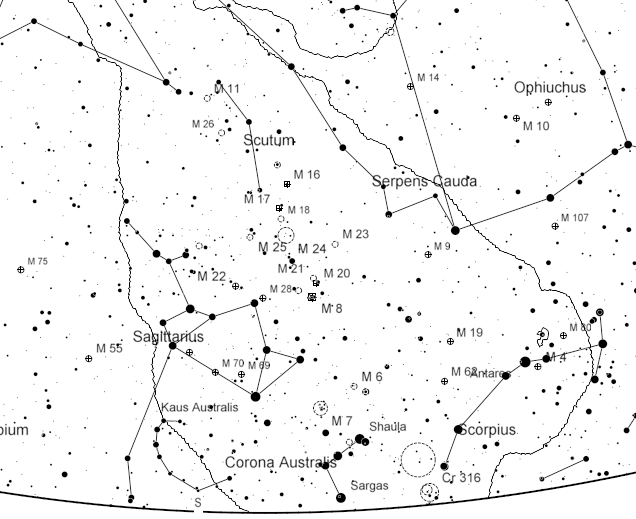
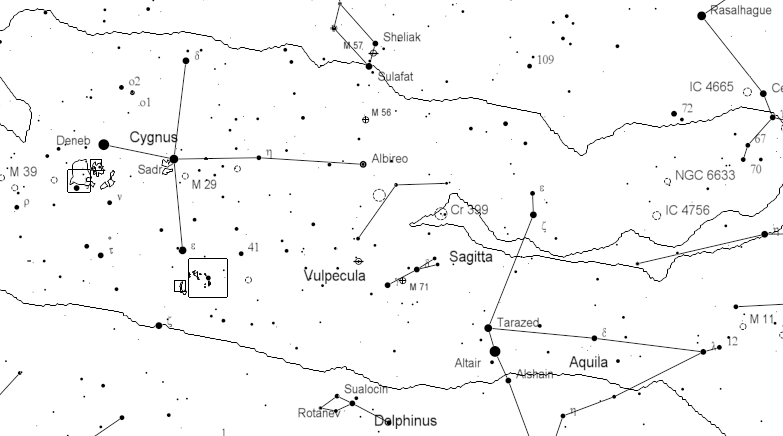
The Milky Way Overhead contains some notable deep sky objects. Note that the Milky Band splits here, though closer to the star Sadr in Cygnus than it shows here. The Dark expanse that runs through Aquila is called the Great Rift, and is caused by a cloud of dust and gas. Its edges can be probed with binoculars, especially in Aquila by watching star density drop off as one pans through the area. Don’t forget the blue and gold binary star Alberio. There’s another fainter blue and gold binary about a degree directly north of the Ring Nebula, M57. It’s 8th magnitude. The unmarked planetary nebula just above the second ‘l’ in Vulpecula is M27, the Dumbbell nebula. The other Messier (M) numbers are relatively easy to find. The large nebula below Deneb is the North American Nebula which can actually be seen with the naked eye or with binoculars on a moonless night away from city lights. The three-part nebula below Cygni is the Veil Nebula, a supernova remnant and very hard to spot but doable. The cluster Cr 399 (Collinder 399 or Brocchi’s Cluster) is better known as the Coathanger and is best seen in binoculars or a telescope finder, which inverts it, making it a properly oriented hanger.
Ephemeris Extra – Sightseeing around the Summer Triangle
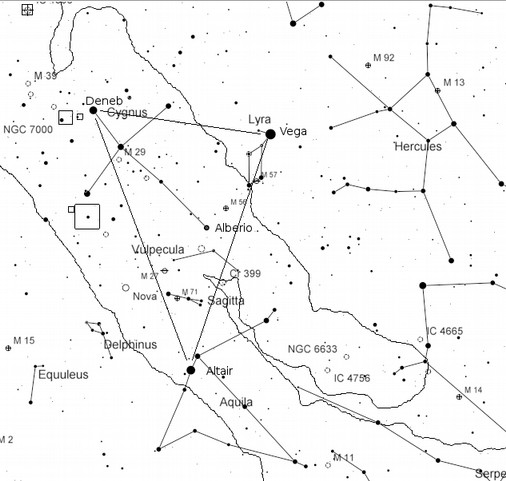
The Summer Triangle and some Deep-Sky treasures within and nearby. Created using Cartes du Ciel (Sky Charts).
Published in the Grand Traverse Astronomical Society’s August 2016 Stellar Sentinel Extras section, updated from an article first published in 1998
One of the signs that summer is here is the appearance of the Summer Triangle in the evening sky. Three of the brightest stars of summer are arranged in a large beautiful triangle. The Summer Triangle isn’t an official constellation. It is an informal one, which is called an asterism. The Big Dipper is another famous asterism.
Each of the triangle stars belongs to its own separate constellation. At the top of our chart is Deneb, the dimmest of the three in our sky at magnitude +1.25. However it is actually the brightest of the three. It suffers only due to its distance of 2,600 light years. Its absolute magnitude, its magnitude if it were 10 parsecs or 32.6 light years away, is -8.4, as bright as the quarter moon. Deneb is situated at the tail of the Cygnus the swan. The word Deneb means tail. It’s actually part of a longer Arabic phrase the means “Tail of the Hen”.
Brightest from our point of view is Vega in Lyra the harp. Vega means either “Falling Eagle” or “Falling Vulture”. Vega is close to the sun, at 25 light years. It’s apparent magnitude is +0.03, with an absolute magnitude of +0.5.
Closest of the three is Altair in Aquila the eagle which is only 16.7 light years away, at magnitude +0.77 with an absolute magnitude of +2.2. It spins rapidly, once in 8.9 hours, creating a decidedly oblate shape with an equatorial radius of 2 times the Suns radius and a polar radius of 1.6 times.
The area in and around the Summer Triangle is a wonderful hunting ground for a telescope. They include binary stars and deep sky objects.
Alberio, the star at the beak of Cygnus the swan is a beautiful maize and blue pair, which I have dubbed the “U of M Star” (University of Michigan’s Maize and Blue) at the public viewing nights. Sorry State fans, I don’t know of a green and white binary. It’s a wide pair, but requires more than a pair of binoculars.
Another neat binary star is Epsilon Lyrae, just to the left of Vega. It shows as a wide pair of equally bright stars in binoculars. A telescope reveals, upon close inspection, that each is again a bin ary. Epsilon Lyrae is the famous double-double star, And splitting them is a good test of telescope and atmospheric seeing.
Just about centered between the two stars at the south end o f the parallelogram of Lyra can be found one of the really special faint wonders of the sky. It is M57, 57th object of Charles Messier’s list of objects that look like comets but aren’t. It is better known as the Ring Nebula. It is one of a class of objects known as planetary nebulae. Planetary nebulae have nothing to with planets, but many of them look like Uranus or Neptune, being faint small greenish or bluish in color. Anyway, the ring, and all planetaries are the result of the SlimStar™ plan of rapid mass loss. It is something small stars like the Sun do when out of fuel and are in the final collapse to white dwarfhood. The outer layers of the star are pushed out to form many wonderful shapes. The Ring Nebula apparently is a torus about half a light year in diameter and about 2,300 light years away. Though small and bright in telescopes, it is invisible in finder telescopes. See the Hubble image of it on page E-4.
Another planetary is M27, also known as the Dumbbell Nebula is located just north of the tip star of Sagitta the arrow. This is a tough one to find, and like M57 is invisible in finders. The Dumbbell is large, but with a low surface brightness. The two glowing lobes of gas first visible give the object its name. Much finer detail is visible to the careful observer. It’s distance is thought to be about 1,360 light years, which makes its diameter nearly 3 light years.
The greatest globular star cluster in this area is M13 the Great Hercules Globular Star Cluster which is located along the western edge of the ‘Keystone’ part of Hercules. The fuzzy blob that is visible in binoculars and small telescopes begins to resolve itself into stars in telescopes of 6 inch diameter and larger. M13 contains upwards of a million stars packed in a diameter of 168 light years and is located some 22,200 light years away. Globulars are ancient clusters that trace there origins to the formation of the Milky Way. Other globulars in this area are M92, also in Hercules, M56 in Lyra, M14 in Ophiuchus, the serpent bearer, M15 in Pegasus, and perhaps M71 in Sagitta the arrow. M71 may be a sparse globular or very compact galactic cluster.
Galactic or open clusters here are M11, off the tail of Aquila the eagle, M39 and M29 in Cygnus. M11, which is actually in Scutum the shield is among the finest of its type. It takes a telescope of 6 inches diameter to completely resolve it. M11 is also called the Wild Duck Cluster, perhaps due to its vaguely triangular appearance.
The Summer Triangle provides a wealth of objects to view and study, Some are among the finest of all the heavens.
08/05/2016 – Ephemeris – Star party at NMC’s Rogers Observatory tonight
Ephemeris for Friday, August 5th. The Sun rises at 6:34. It’ll be up for 14 hours and 28 minutes, setting at 9:02. The Moon, 3 days past new, will set at 10:31 this evening.
There will be a star party this evening at Northwestern Michigan College’s Rogers Observatory hosted by the Grand Traverse Astronomical Society and the NMC Astronomy Club starting at 9 p.m. On tap, if it’s clear, will be Jupiter and the Moon early, then Mars and Saturn. Mars will appear quite small. As it gets darker the stars will appear. Some will show companion stars, while between the stars, what we call deep sky objects will be seen. Clusters of stars, and nebulae which can be either the birthplaces of stars or markers of dying stars. While other galaxies can be spotted our eyes are dazzled by our galaxy, the Milky Way spanning the sky from northeast to the south, in which these other objects dwell. The months of August and September are the months when the heart of the Milky Way is best seen.
Times are for the Traverse City/Interlochen area of Michigan. They may be different for your location.
Addendum
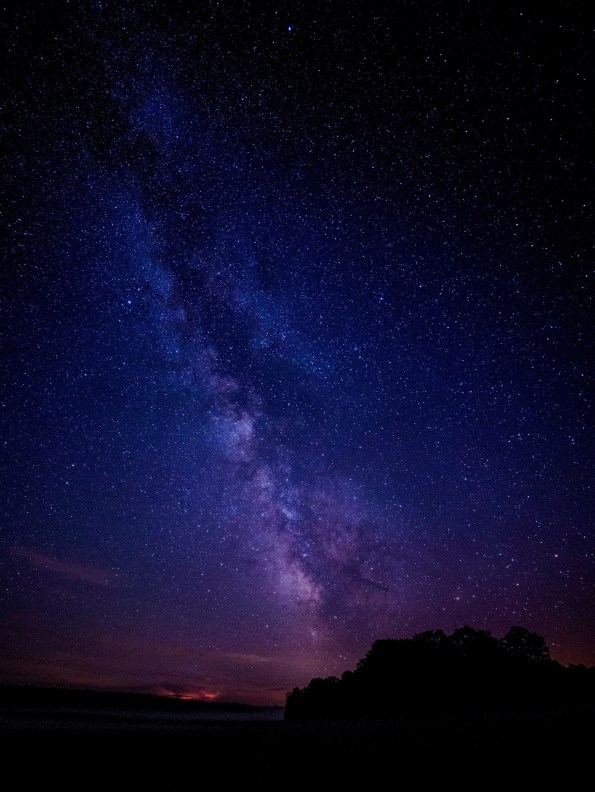
The Milky Way from the Sleeping Bear Dunes last August by Mark Stewart.
This year Saturn and Mars will be in the picture. In this picture Saturn is low and to the right.
08/02/2013 – Ephemeris – Star Party tonight!
Ephemeris for Friday, August 2nd. The sun rises at 6:30. It’ll be up for 14 hours and 35 minutes, setting at 9:06. The moon, half way from last quarter to new, will rise at 3:38 tomorrow morning.
Tonight the Grand Traverse Astronomical Society and the NMC Astronomy Club will host a star party at Northwestern Michigan College’s Rogers Observatory starting at 9 p.m. featuring, if it’s clear, the planets Venus and Saturn. Some of the wonders of the summer sky can be seen as it gets darker. There are sparkling binary stars and star clusters including the Great Globular Star Cluster in Hercules, the Wild Duck Cluster, the Ring Nebula, the expanding gasses of a dying star. There are also other wonders of the Milky Way to be seen. There will be a program if the skies are too cloudy to observe. The observatory is located south of Traverse City, on Birmley Road between Garfield and Keystone roads.
Times are for the Traverse City/Interlochen area of Michigan. They may be different for your location.
 Bob Moler's Ephemeris Blog