Archive
Ephemeris: 02/17/2026 – There’s an annular solar eclipse today… if you’re a penguin
This is Ephemeris for Fat Tuesday, February 17th. Today the Sun will be up for 10 hours and 34 minutes, setting at 6:14, and it will rise tomorrow at 7:38. The Moon is new today, and won’t be visible.
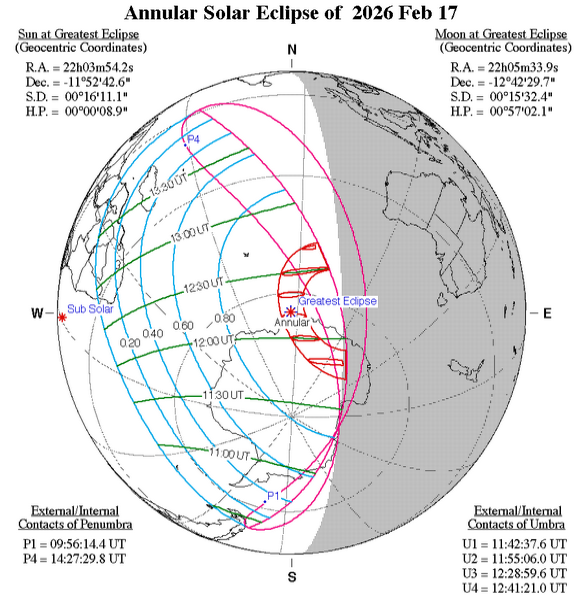
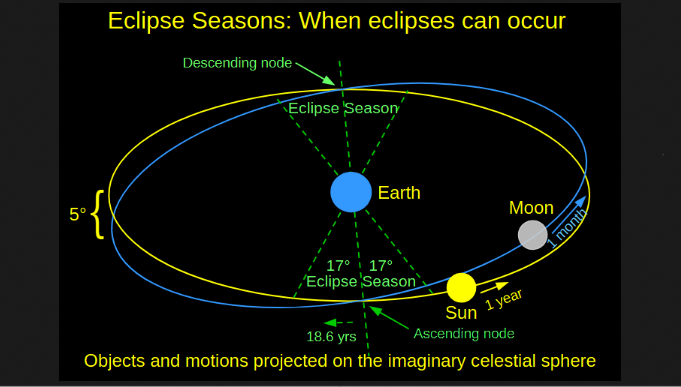
This morning there is an annular solar eclipse occurring. Don’t run outside to see it, especially if you’re here in northern Michigan. The eclipse is only visible in the Southern Ocean and Antarctica. However, this eclipse marks the beginning of an eclipse season, and we will have an eclipse that will be visible for our location in two weeks: a total lunar eclipse, which will be visible before sunrise on Tuesday morning, March 3rd. There are two periods were eclipses will occur in a year, with at least one of the sun and the moon. These periods are separated by a little less than six months, and last about 35 days. That’s about 5 1/2 days longer than a lunar month, so it is possible to squeeze in another eclipse, though not this time.
The astronomical event times given in this blog are for the Traverse City/Interlochen area of Michigan (Lat 44.7° N, Long 85.7° W; EST, UT – 5 hours) unless stated otherwise. Times will be different for other locations.
Addendum
10/25/2022 – Ephemeris – This eclipse season starts with a partial solar eclipse, but not for us
“But not for us” means not for Michigan in the United States. This is a script, as always, for a local radio program. Which also mentions the midterm election day, two weeks from now, which coincides with the total lunar eclipse that morning. I’ll have an Ephemeris Extra post before the lunar eclipse, which looks into the next few lunar and solar eclipses visible in Michigan and the United States.
This is Ephemeris for Tuesday, October 25th. Today the Sun will be up for 10 hours and 30 minutes, setting at 6:41, and it will rise tomorrow at 8:12. The Moon is new today, and won’t be visible.
The Moon will be visible in a negative way for some folks at this time. There is a partial solar eclipse in progress now for parts of Europe, Asia and Africa. So that thing blocking the northern part of the Sun for them will be the Moon. Being a partial eclipse means that an eclipse season has started, and we should have a lunar eclipse in about two weeks, when the Moon is full. There sure is, and it’s visible from here. In exactly two weeks, there will be. In the early morning hours of November 8th, Election Day, a total eclipse of the Moon. And if you’re standing outside the polling place waiting for the polls to open at 7 am, and it’s clear, and you have a view to the west, the partially eclipsed Moon will still be visible. That will be the ending partial phase of the eclipse.
The astronomical event times given are for the Traverse City/Interlochen area of Michigan (EDT, UT – 4 hours). They may be different for your location.
Addendum
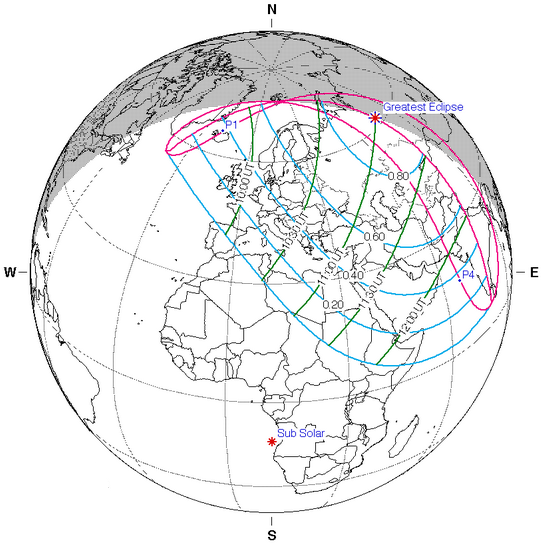
Map for the area on the Earth where the partial solar eclipse of October 25, 2022, will be visible. Credit: NASA/GSFC, Fred Espenak.
05/21/2021 – Ephemeris – For everything there is a season… even eclipses
This is Ephemeris for Friday, May 21st. Today the Sun will be up for 15 hours and 3 minutes, setting at 9:11, and it will rise tomorrow at 6:07. The Moon, 2 days past first quarter, will set at 4:14 tomorrow morning.
There are seasons for everything: baseball season, football season, spring, summer, what have you. There are also eclipse seasons. The Moon’s orbit is tilted by about 5 degrees to the ecliptic, the path of the Sun in the sky. The points where they cross are called nodes, 180 degrees apart. When the Sun is near one of those nodes we are in an eclipse season, where a solar eclipse can occur at new moon, and a lunar eclipse can occur at full moon. We are guaranteed one of each per eclipse season, and on rare occasions a third eclipse. Of course one has to be at the right place to see an eclipse. This eclipse season we will be at a marginal place to see both eclipses. Both are at sunrise, so we’ll see just a part of each of them.
The astronomical event times given are for the Traverse City/Interlochen area of Michigan. They may be different for your location.
Addendum
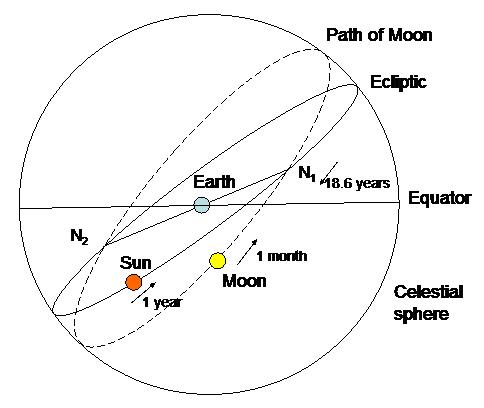
For a more extensive treatment of this subject check out: https://earthsky.org/astronomy-essentials/definition-what-is-an-eclipse-season
11/30/2020 – Ephemeris – We’ve entered an eclipse season
This is Bob Moler with Ephemeris for Monday, November 30th. Today the Sun will be up for 9 hours and 4 minutes, setting at 5:03, and it will rise tomorrow at 8:00. The Moon, at full today, will rise at 5:22 this evening.
This morning we had a slight eclipse of the Moon, where the Moon entered only the southern part of the Earth’s penumbral or partial shadow. On December 14th, at the next new moon there will be a total eclipse of the Sun that will be visible from South America. We are now in an eclipse season which lasts about 35 days. In that time two or rarely three eclipses can be fit in. The next eclipse season is 5 months and 18 days away in late May and early June 2021. Then there will be, for Michigan, the start of a lunar eclipse visible just before sunrise on May 26th and the end of a solar eclipse visible at sunrise on June 10th. Those two eclipses will just be teasing us. Our next nearby total solar eclipse is less than three and a half years away on April 8, 2024.
The event times given are for the Traverse City/Interlochen area of Michigan. They may be different for your location.
Addendum
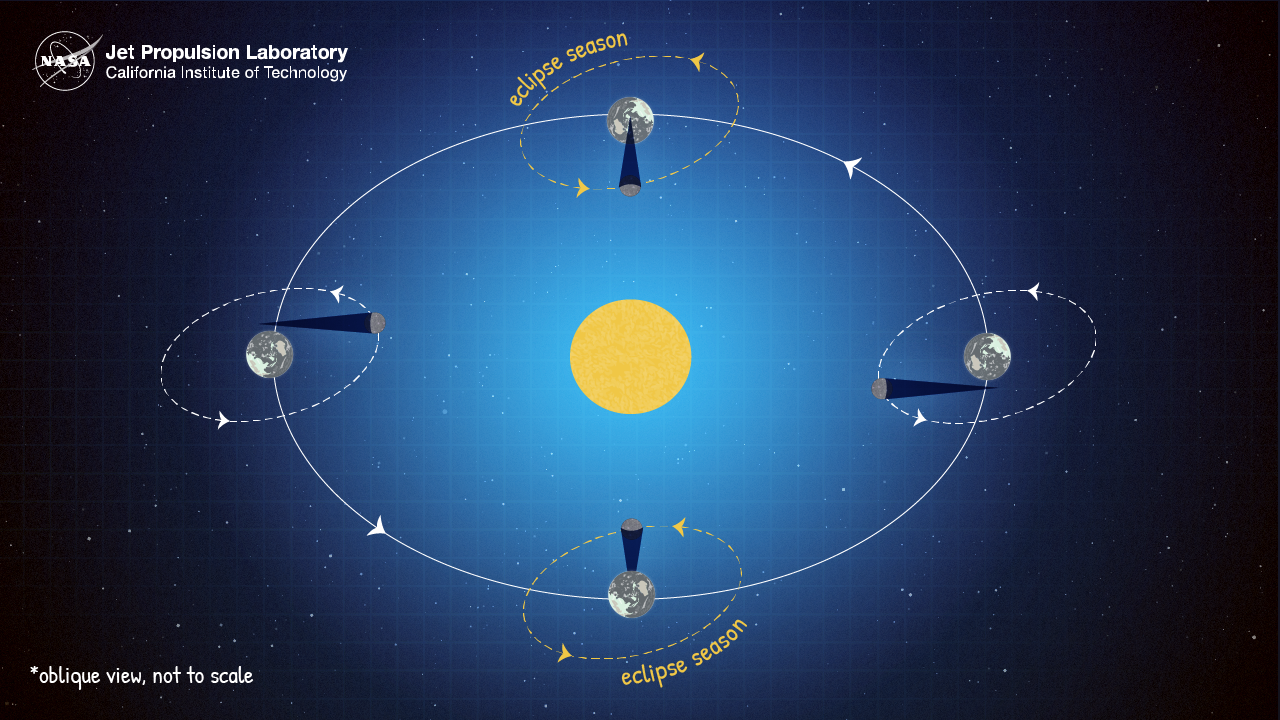
A diagram showing eclipse seasons. Though only solar eclipses are shown, it also includes lunar eclipses. Three months later (actually only a month later) the shadows of each are either too far north or south to fall on the other. Click on the image to enlarge. Credit: NASA/JPL
 Bob Moler's Ephemeris Blog