Archive
Ephemeris: 05/16/2025 – Two bright stars, alike but different
This is Bob Moler with Ephemeris for Friday, May 16th. Today the Sun will be up for 14 hours and 52 minutes, setting at 9:05, and it will rise tomorrow at 6:12. The Moon, halfway from full to last quarter, will rise at 1:21 tomorrow morning.
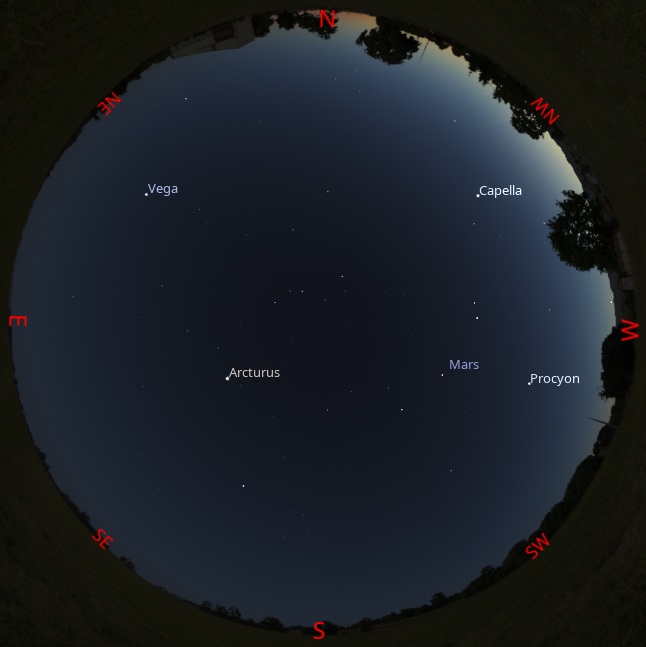
Two stars which I’ve been known to confuse in the twilit sky in late spring and late summer are Arcturus and Vega. These stars have about the same brightness and in some lists of stars swap places between the 4th and 5th brightest stars in the sky. Arcturus is an orangish star, now high in the southern sky in the evening, while Vega is a pure white star which to my eyes tends towards a little tinge of blue. Vega is high in the south, actually almost overhead, in the late summer. Now, in mid to late Spring Vega is rather low in the northeastern sky. Arcturus is a cool star on the outside which has depleted the hydrogen in its core and is a red giant star, while the younger and more massive Vega, still turning hydrogen into helium.
The astronomical event times given in this blog are for the Traverse City/Interlochen area of Michigan (Lat 44.7° N, Long 85.7° W; EDT, UT – 4 hours) unless stated otherwise. Times will be different for other locations.
Addendum
06/16/2023 – Ephemeris – Twilight is longer near the summer solstice
This is Ephemeris for Friday, June 16th. Today the Sun will be up for 15 hours and 33 minutes, setting at 9:30, and it will rise tomorrow at 5:56. The Moon, 2 days before new, will rise at 5:04 tomorrow morning.
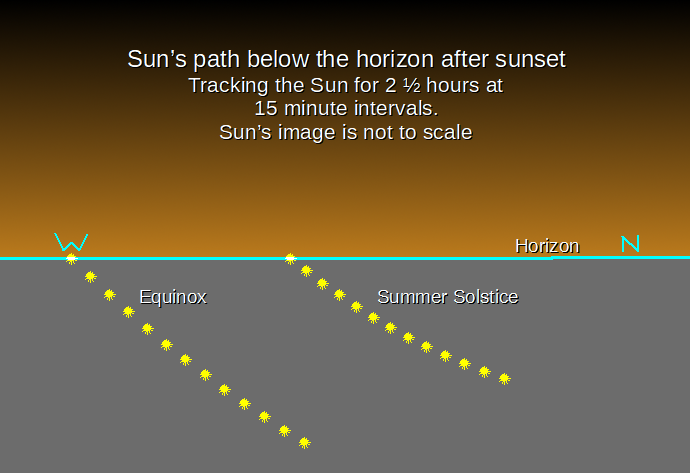
Not only does the Sun set later this time of year, but twilight lasts longer too. As of tonight the end of astronomical twilight, when the last vestiges of twilight are gone is, for the Traverse City/Interlochen area, 12:01 am, That’s two and a half hours of evening twilight. I feel that for most purposes that the end of nautical twilight, when navigators on ships could no longer see the horizon for their sextant readings, is dark enough to view most stars, and brighter objects beyond the solar system, what we call deep sky objects. That happens at 10:56 pm, or about an hour and a half after sunset. Twilight of both kinds are a third shorter around the equinoxes. These times are dependent on our latitude, and the Sun’s declination which is equivalent to latitude.
The astronomical event times given are for the Traverse City/Interlochen area of Michigan (EDT, UT –4 hours). They may be different for your location.
Addendum
Check out my September 27, 2018 post about the different twilight periods.
 Bob Moler's Ephemeris Blog