Archive
Ephemeris: 10/20/2025 – The Fisher paints the autumn colors
This is Ephemeris for Monday, October 20th. Today the Sun will be up for 10 hours and 44 minutes, setting at 6:49, and it will rise tomorrow at 8:06. The Moon, 1 day before new, will rise at 8:19 tomorrow morning.
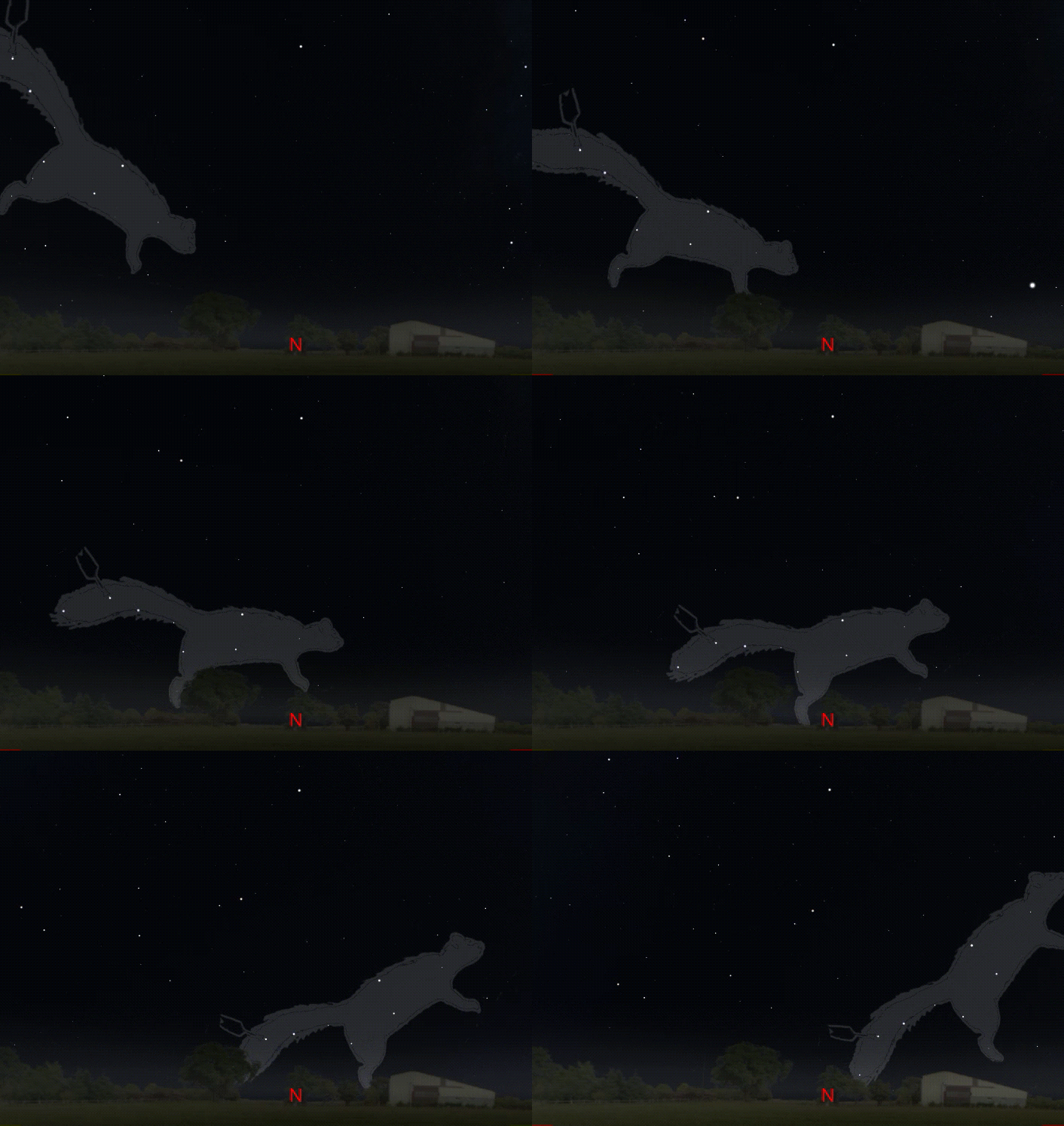
The leaves on the trees are beginning to turn to reds and yellows as we advance through autumn. The native Anishinaabe peoples, whose homeland we share, have a story about how that came to be. Of how a magical weasel-like creature called the Fisher or, in their native language, Ojiig Anung (Fisher Star), brought summer to the Earth from Skyland. For his trouble, he was shot with an arrow in his only vulnerable spot, the tip of his tail. As he fell to Earth Gichi Manitou, the Great Spirit, caught him and placed him in the sky where we see the Great Bear and the Big Dipper. Every late autumn night we see his tail, the handle of the dipper, slowly swooping down to the horizon in the north, where his bloody tail paints the trees with their autumn colors.
The astronomical event times given in this blog are for the Traverse City/Interlochen area of Michigan (Lat 44.7° N, Long 85.7° W; EDT, UT – 4 hours) unless stated otherwise. Times will be different for other locations.
Addendum
For my take on the story of how the Fisher brought summer to the Earth, click here.
Ephemeris: 03/04/2024 – The evening skies are a-changing
This is Ephemeris for Monday, March 4th. Today the Sun will be up for 11 hours and 21 minutes, setting at 6:35, and it will rise tomorrow at 7:12. The Moon, 1 day past last quarter, will rise at 4:30 tomorrow morning.
Tonight at 8 pm Orion is in the south. This will be the last month that we will be able to enjoy Orion in the evening sky, because by month’s end he will begin to dip low in the west in the evening twilight. Even though it’s not quite spring, the central constellation of that season, Leo the lion, is already rising in the east. It has cleared the horizon at 8 this evening. The backwards question mark of Leo’s head, mane and front part of his body is easily spotted in the east now with the bright star Regulus at the bottom. The Big Dipper is in the northeast, also rising higher, and signaling via the Anishinaabek constellation there of the Fisher Star, announcing the maple sugaring season.
The astronomical event times given are for the Traverse City/Interlochen area of Michigan (EST, UT –5 hours). They may be different for your location.
Addendum
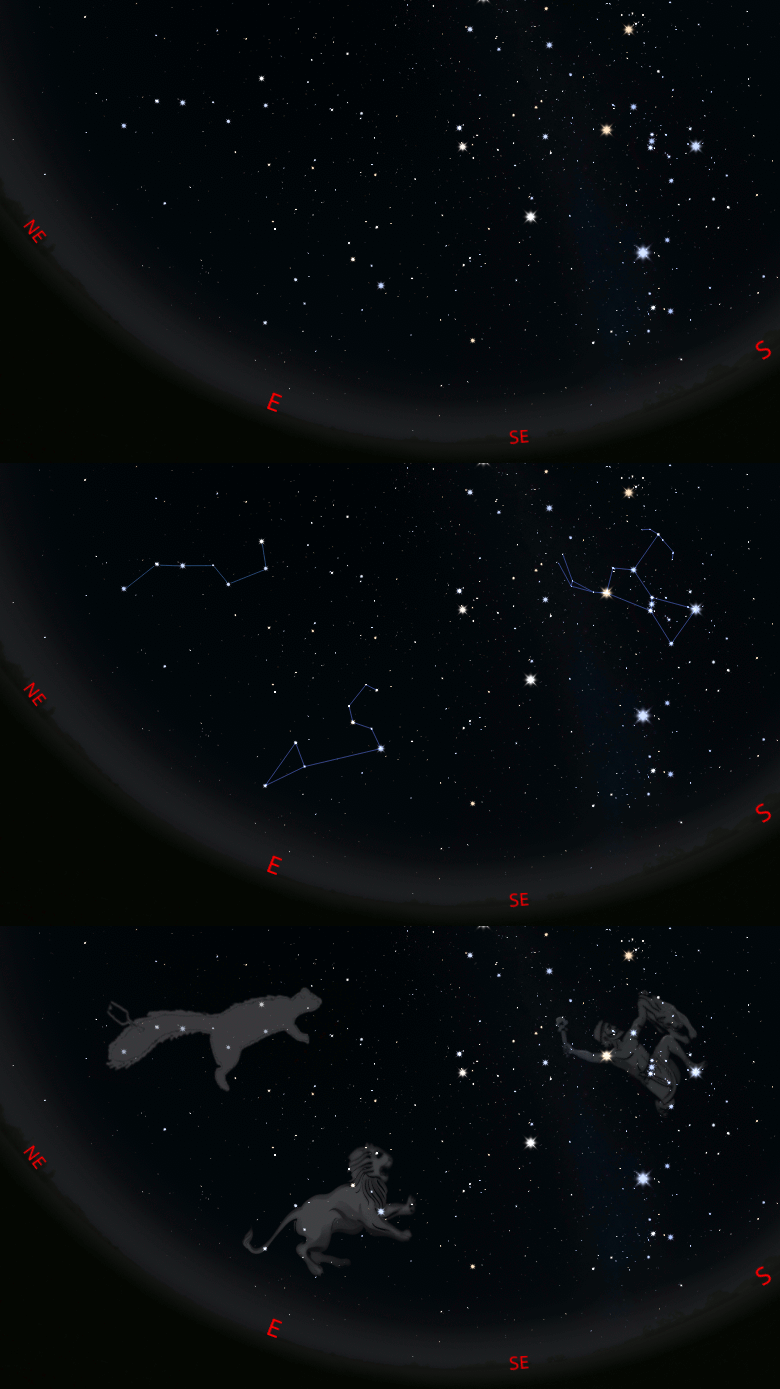
Looking to the east-southeast at 8 pm we look at three star groups or constellations. From left to right we have the Big Dipper and the Fisher Star in the northeast. Centered in the east we have Leo the lion. And on the right, just west of south, we have Orion the central winter constellation. Click or tap on the image to enlarge it. Credit: Stellarium, and using LibreOffice Draw, and GIMP.
10/17/2017 – Ephemeris – The Fisher paints the autumn leaves red
Ephemeris for Tuesday, October 17th. The Sun will rise at 8:00. It’ll be up for 10 hours and 53 minutes, setting at 6:54. The Moon, 2 days before new, will rise at 6:35 tomorrow morning.
This morning, if it’s clear the red planet Mars will appear just to the right of the thin crescent Moon. Mars isn’t the only thing that’s red now. So are the maple leaves as we advance into autumn. The native Anishinaabek peoples have a story about how that came to be. Of how a magical weasel-like creature called the Fisher or Ojiig brought summer to the Earth from Skyland. For his trouble he was shot with an arrow in his only vulnerable spot, the tip of his tail. As he fell to Earth the Great Spirit, Manitou caught him and placed him in the sky where we see the Great Bear (Ursa Major) and the Big Dipper. Every autumn we see his tail swoop down to the ground where his tail paints the leaves red with his blood.
The times given are for the Traverse City/Interlochen area of Michigan. They may be different for your location.
Addenda
The Moon and the morning planets this morning
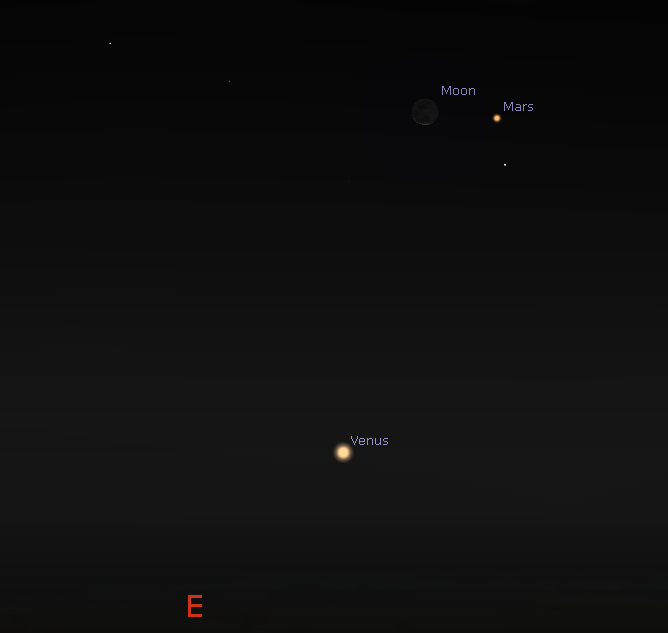
The Moon and Mars at 6:30 this morning October 17, 2017. Click on image to enlarge. Created using Stellarium.
At 00:21 UTC on the 18th Venus will be south of the Moon. It will be visible from Asia.
The Fisher (Ojiig) paints the trees with the autumn colors
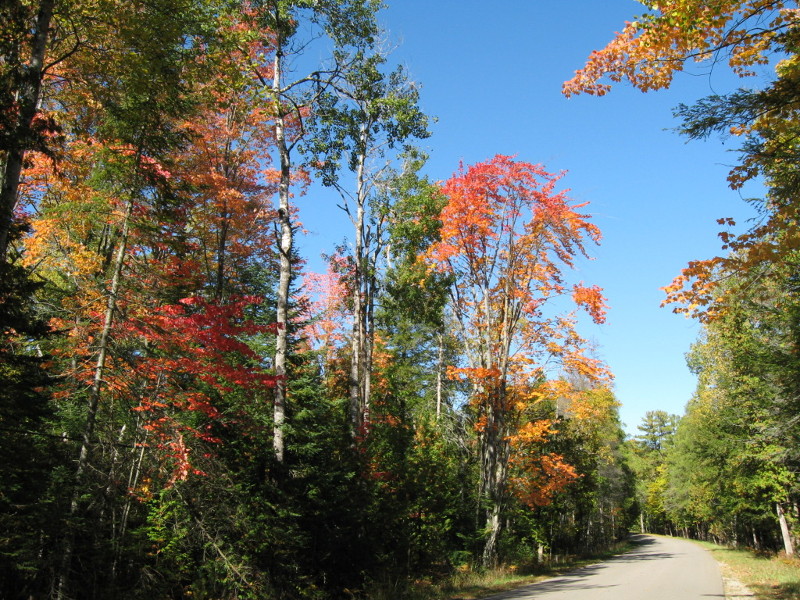
Autumn colors. My image.
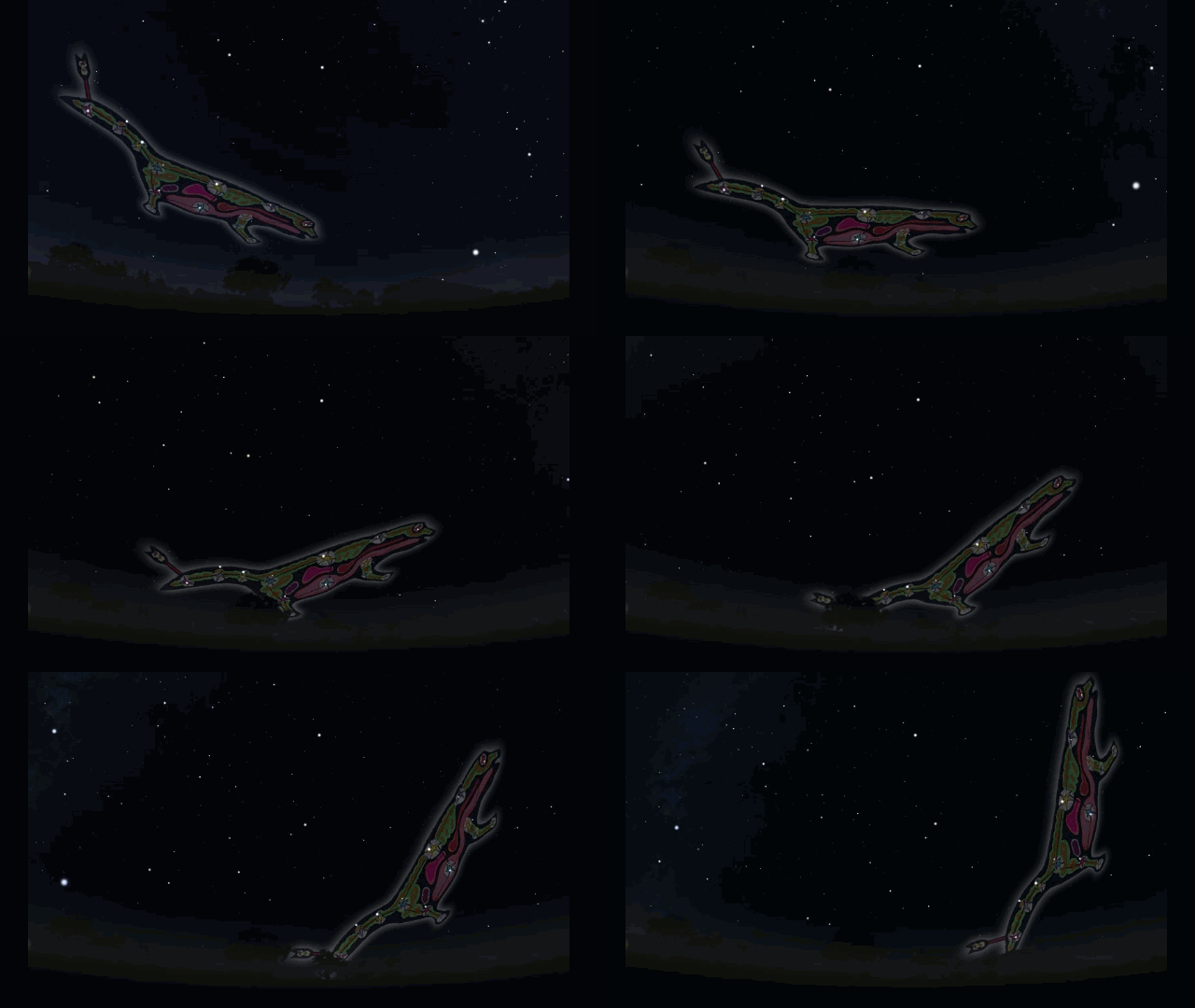
An animation of Fisher brushing his tail along the horizon on autumn nights. Click on image to enlarge. Created using Stellarium.
The constellation art is part of the latest versions of Stellarium. Ojibwe (Anishinaabek) constellation art by Annette S Lee and William Wilson from Ojibwe Sky Star Map Constellation Guide, ISBN 978-0-615-98678-4.
See the version of the story I learned: The story of the Fisher Star.
There are other variations of the story, and other adventures of the Fisher. Perform an Internet search for: Fisher or Fisher Star or Ojiig.
04/07/2016 – Ephemeris – The Big Dipper, the Great Bear and the Fisher Star
Ephemeris for Thursday, April 7th. The Sun will rise at 7:11. It’ll be up for 13 hours and 6 minutes, setting at 8:18. The Moon is new today, and won’t be visible.
The constellation of Ursa Major, or great bear was well-known to the ancient Greeks and Native Americans. Today, however, many of us can recognize only part of it as the Big Dipper. The bear can be easily seen only in a dark sky, at 10 p.m. it’s high just north of the zenith with feet to the south. The stars in front of the bowl are the front part of his body and head. The bowl of the Big Dipper is his rump, and the handle his long tail. The Native Americans, saw those three stars as three hunters following the bear. The tribes of the Great Lakes region saw it as the Fisher Star, who brought summer to the Earth. These stars here do make a convincing bear, except for the tail, when seen on a dark night. The weasel-like Fisher Star fits the stars completely.
Times are for the Traverse City/Interlochen area of Michigan. They may be different for your location.
Addendum
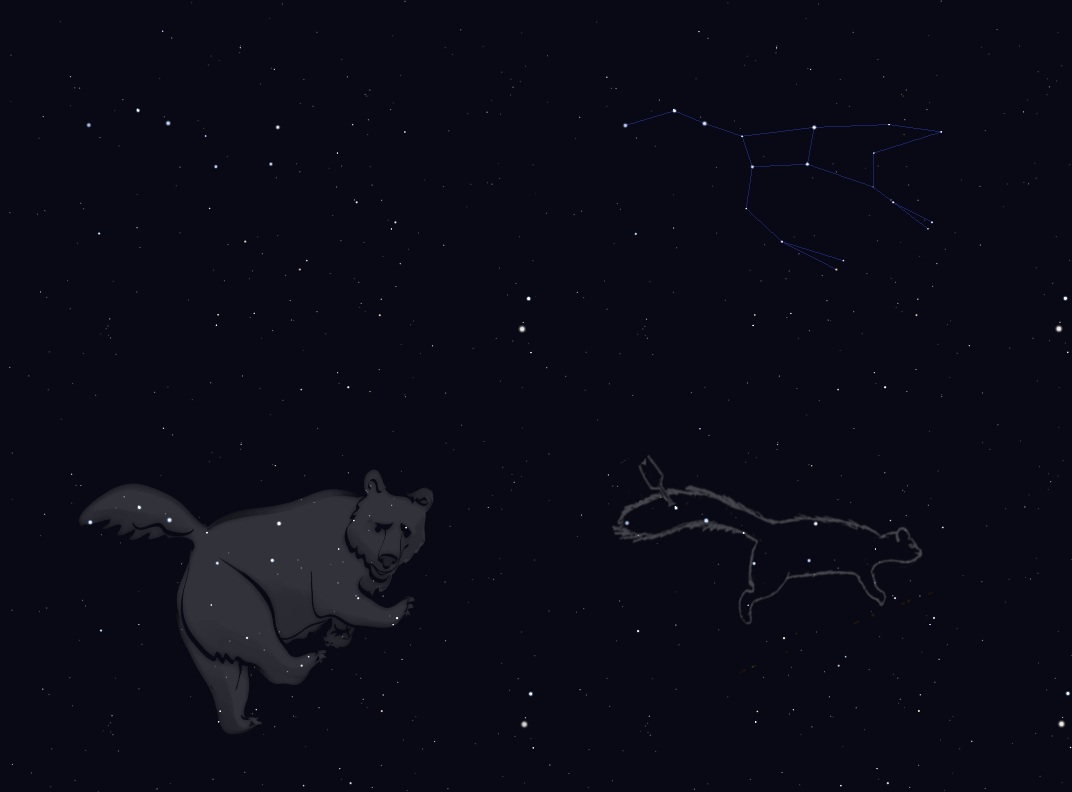
Animation of 4 views of Ursa Major. 1. with no added imagery, emphasizing the Big Dipper, 2. added lines for Ursa Major, 3. image of the bear, 4. image of Fisher Star. Created using Stellarium and GIMP.
Note: The Fisher Star illustration is an unattributed drawing from the Internet with a minor change.
03/10/2016 – Ephemeris – The many faces of the Big Dipper and Ursa Major
Ephemeris for Thursday, March 10th. The Sun will rise at 7:03. It’ll be up for 11 hours and 39 minutes, setting at 6:43. The Moon, 2 days past new, will set at 8:59 this evening.
The Big Dipper has many names to many peoples and countries around the world, from the plough, Charles’ Wain, and many others. Officially to the International Astronomical Union, it’s part of Ursa Major, the Great Bear, also recognized by Native Americans, Europeans, it’s even in the Bible. In the Book of Job the star Arcturus is a miss-translation. Arcturus means Guardian of the Bear. It should be Bear itself, and most modern translations catch that mistake. Anyway, the Anishinaabe people around the Great Lakes say the stars of the bear are that of another creature, that of Fisher Star one small weasel-like mammal that brought summer to the Earth, and now heralds the seasons of spring and autumn by his position in the sky.
Times are for the Traverse City/Interlochen area of Michigan. They may be different for your location.
Addendum
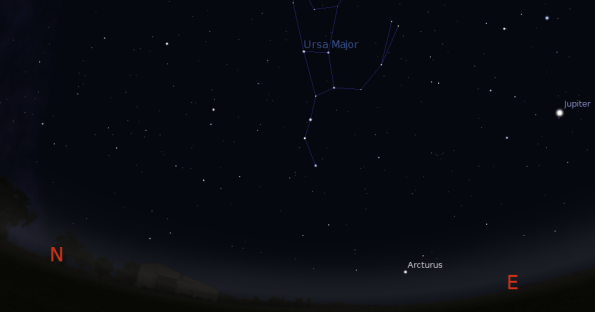
Ursa Major in the northeastern sky at 9 p.m., March 10, 2016. Created using Stellarium.
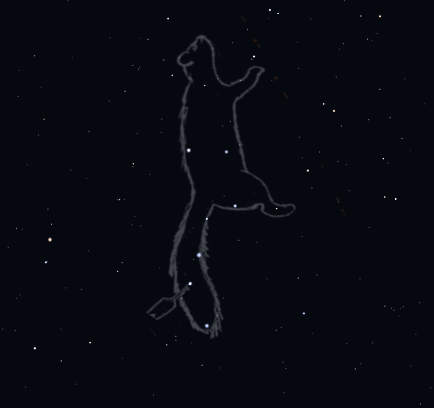
Fisher Star. Star field created by Stellarium.
03/09/2015 – Ephemeris – The Big Dipper, a sign of spring
Ephemeris for Monday, March 9th. The Sun will rise at 8:06. It’ll be up for 11 hours and 34 minutes, setting at 7:40. The Moon, 4 days before last quarter, will rise at 11:43 this evening.
There’s a sign of spring appearing in the sky, rising high in the northeast. It’s the Big Dipper standing on its handle. In the native story of the Fisher Star, it’s the sign that it’s time for the maple sugar season. The Big Dipper is part of Ursa Major the great bear or a weasel-like creature called Fisher or Fisher Star. Draw a line through the bottom of the bowl of the dipper as if it leaks, and it will drip on the back of Leo the lion in the southeast. The handle of the Big Dipper will arc to Arcturus after 10 p.m. when that star rises. The most important guide that the Big Dipper provides is to point to Polaris, the north star. The two stars at the front of the bowl of the dipper point to Polaris, that alone of all the stars appears fixed in the north.
Times are for the Traverse City/Interlochen area of Michigan. They may be different for your location.
Addendum
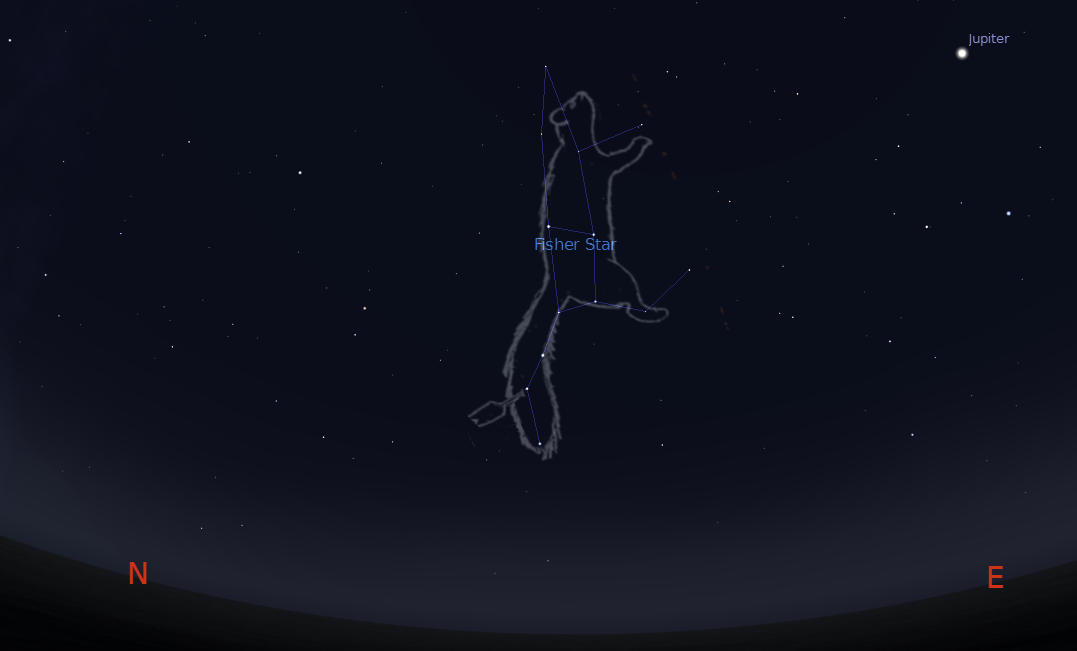
The Big Dipper, part of Ursa Major and also part of Fisher Star in the northeastern sky at 9 p.m. March 9, 2015
For the story of Fisher Star follow this link.
04/22/2014 – Ephemeris – The Great Bear and the Fisher Star
Ephemeris for Earth Day, Tuesday, April 22nd. The sun rises at 6:46. It’ll be up for 13 hours and 49 minutes, setting at 8:36. The moon, at last quarter today, will rise at 3:31 tomorrow morning.
This evening the Big Dipper is practically overhead. The Europeans and some Native Americans say it as the hind end of a bear with dimmer stars making up the rest of the bear. The official constellation of which the Big dipper is a part is Ursa Major, the Great Bear. The native Americans were smart enough to depict the handle stars of the dipper as three hunters following the bear, rather than the bear’s unnaturally long tail. The Anishinabek Indians who settled around here saw instead of a bear a weasel like creature, who did have a long tail called Fisher or Fisher Star, who through a great adventure, with his other animal friends, brought summer and the rest of the seasons to the frozen earth.
Times are for the Traverse City/Interlochen area of Michigan. They may be different for your location.
Addendum
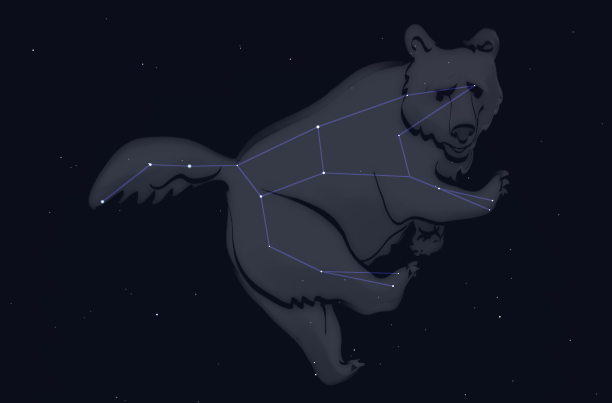
The Great Bear as the Europeans saw it. Created using Stellarium.
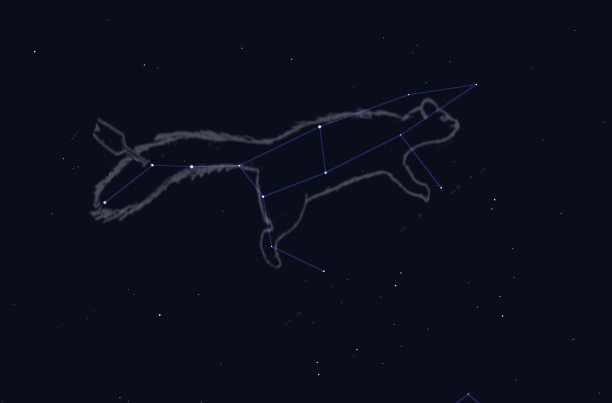
The Fisher Star. Created using Stellarium.
11/07/2013 – Ephemeris – The Big Dipper’s lowest appearance in the north
Ephemeris for Thursday, November 7th. The sun will rise at 7:28. It’ll be up for 9 hours and 54 minutes, setting at 5:23. The moon, 3 days before first quarter, will set at 9:32 this evening.
The entire Big Dipper is at its lowest in the sky at 9 p.m. with the Dipper’s bowl centered due north under the pole star Polaris. The southernmost star of the Big Dipper is the star at the tip of the handle, named Alkaid. Alkaid will be at its lowest at 11:20 this evening, 4 degrees above the horizon for Traverse City, so is circumpolar, meaning it doesn’t set in the IPR (Interlochen Public Radio) listening area. The star name is Arabic and means something like the Chief of the daughters mourning at the Bier. The bier is the bowl of the dipper supporting, I suppose, the body of their father or mother. To the Anishinabek native peoples around here the Big Dipper was the Fisher or Fisher Star, a weasel like creature, whose bloody tail swept over the maple trees, turning their leaves red.
Times are for the Traverse City/Interlochen area of Michigan. They may be different for your location.
Addendum
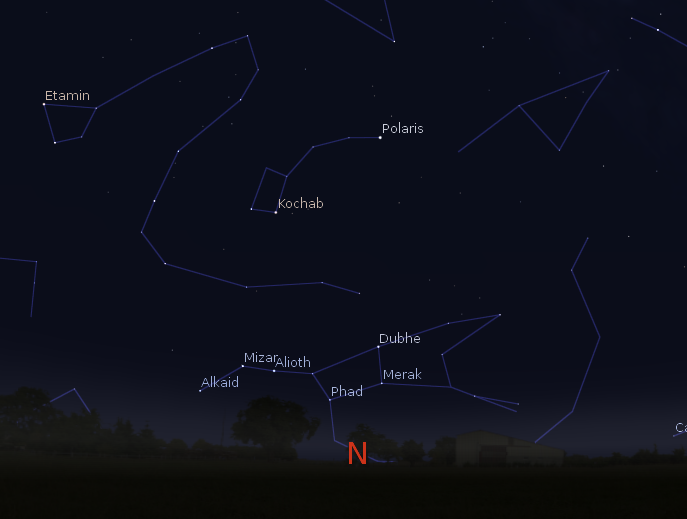
The Big Dipper low in the north at 9 p.m. November 7, 2013. Created using Stellarium.
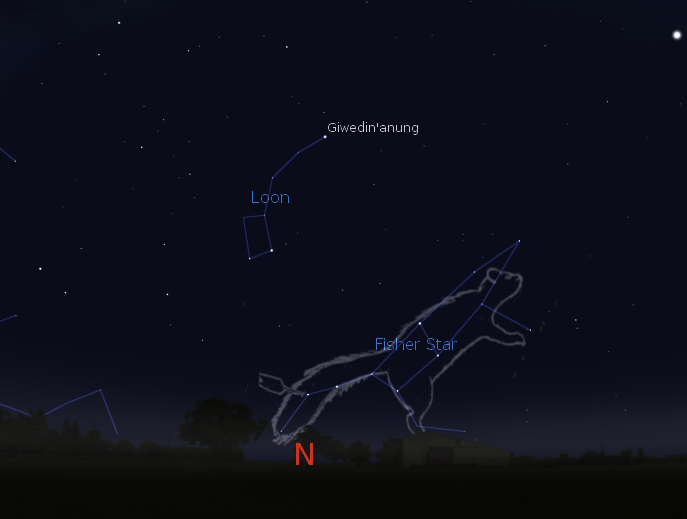
Fisher Star paints the autumn trees red at 11:20 p.m. November 7, 2013. Created using Stellarium.
For the story of the Fisher Star click here.
The story of the Fisher Star
The Anishinaabe peoples have lived in the Great Lakes area since way before the coming of the Europeans. They are comprised of the Ojibwe, Ottawa, Chippewa and even Algonquin tribes. While some did see a bear in the stars and around the Big Dipper sans tail. Most of the stories concern the Fisher or Fisher Star.
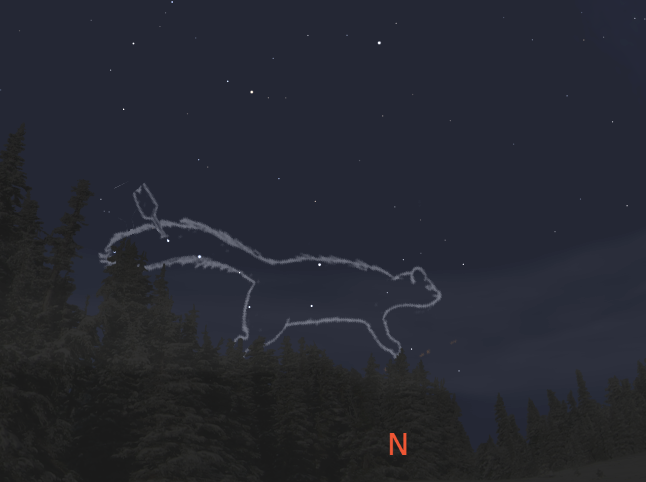
The Fisher Star in Autumn painting the leaves with his tail. Created using Stellarium and other sources.
By the way, the thee stars of the handle of the Big Dipper were hunters that were following the bear. The hunter denoted by the star Mizar at the bend in the handle of the dipper had a dog with him, the star we call Alcor, that make it an intriguing double for folks with good eyesight.
Fisher is supposed to be a weasel-like animal, intelligent, and a great hunter. He lived in a world that was snow covered and cold year round, where food was scarce. Perhaps this story is a cultural remembrance of the last glaciation period. Contrary to his name Fisher didn’t fish.
One day his son came to him with a request to bring summer, for he was cold and hungry. Fisher decided to somehow get to Skyland and tap into its warmth. He brought together his three bravest friends for the journey: Otter, Lynx, and Wolverine. They set out to seek the tallest mountains so they could reach Skyland.
When they had climbed the tallest mountain they found that Skyland was just out of reach. If they could only crack through. Otter tried first. He jumped first and bounced off. He fell back and slid completely down the mountain on his belly. It was so much fun that this is what otters do to this day. The lynx tried. He jumped up and hit his head and was knocked unconscious.
The wolverine was persistent. He jumped time after time and was finally able to chew a hole in the base of Skyland. When it was large enough he scampered through. Fisher was sure the hole wasn’t large enough, and that the inhabitants of Skyland would soon cover it up. So he chewed and chewed, enlarging the hole so the Skyland people couldn’t cover it for more than half the year.
As he was finishing up the hole the Skyland people discovered him. He boasted to them; “I am Fisher, the great hunter, you cannot catch me.” he jumped to the nearest tree and climbed to the top. The sky people shot arrows at him, but he had a special power making him impervious to arrows except for a particular spot on his tail. Kind of an Achilles tail, to mix my legends. Well, after some time the sky people got wise to Fisher’s protections and an arrow found the vulnerable spot in his tail and he fell out of the tree. Before Fisher’s body could fall to the ground the Great Spirit, Gitchee Manitou, caught him and placed him in the night sky to herald the seasons Fisher had created for the earth. In the sky Fisher’s tail is the handle of the Big Dipper. Tiny Alcor signifies the spot where the arrow hit. Every fall as Fisher’s tail passes over the northern horizon the blood in his wound paints the autumn leaves red. In late winter as he rises again in the northeast it is time to begin tapping the maple trees.
Sources: Keepers of the Earth, by Michael Caduto and Joseph Bruchac, and Anishinaabe Star Knowledge by Michael Wassegijig Price. Thanks also to Nodwese Red Bear.
09/27/2012 – Ephemeris – The Fisher in the stars
Ephemeris for Thursday, September 27th. The sun will rise at 7:36. It’ll be up for 11 hours and 53 minutes, setting at 7:29. The moon, 2 days before full, will set at 6:06 tomorrow morning.
The Big Dipper is swooping low in the northwestern sky in the evening now. The Big Dipper is not a constellation but part of the Great Bear for most peoples, and is enshrined by the International Astronomical Union as Ursa Major. To some of the Anishinabek peoples native to our region the stars of the Big Dipper belonged to a small weasel like animal call the Fisher. In a story I can’t relate here Fisher brought summer to the earth, and for his trouble was killed by an arrow to his only vulnerable spot, his tail. The Great Spirit would not let Fisher fall to earth, but placed him in the sky. His rising in the northeast signals the coming of spring, and when his bloody tail brushes the horizon in autumn his blood paints the maple trees red.
Times are for the Traverse City/Interlochen area of Michigan. They may be different for your location.
Addendum
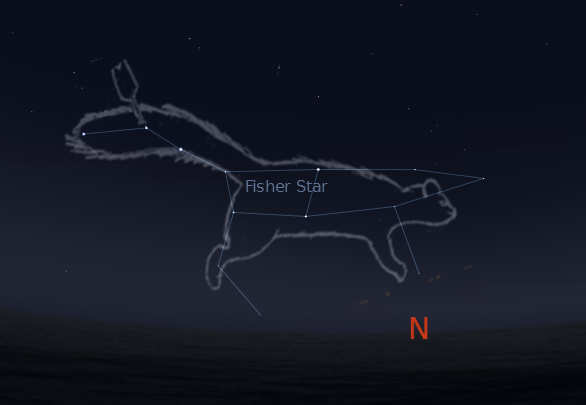
The Fisher heads towards the northern horizon. Created using Stellarium and an unknown artist which I took liberties with.
The Fisher is also known as the Fisher Star (Ojiig’anung). I’ll have my version of the story posted soon.
The Fisher heads towards the northern horizon. Created using Stellarium and an unknown artist which I took liberties with.
 Bob Moler's Ephemeris Blog