Archive
11/20/2015 – Ephemeris – Finding the bright stars of November
Ephemeris for Friday, November 20th. The Sun will rise at 7:46. It’ll be up for 9 hours and 24 minutes, setting at 5:10. The Moon, 1 day past first quarter, will set at 2:17 tomorrow morning.
The Moon is beginning to brighten up the sky making constellation spotting somewhat difficult, so I thought we’d look for the brightest stars. High in the west are the three stars of the Summer Triangle. At the bottom in the southwest is Altair, the first of these to set. A bit north of west the brightest, Vega. Highest in the west is Deneb, which won’t officially set for those Interlochen northward. Low in the south is the loneliest star Fomalhaut. In the northeast is the winter star Capella, which also doesn’t set for the IPR listener area, but spends summer nights hiding behind hills and trees in the north. Low in the east is the last of our bright stars, Aldebaran in Taurus the bull, which will be playing hide and seek with the Moon next week.
Times are for the Traverse City/Interlochen area of Michigan. They may be different for your location.
Addendum
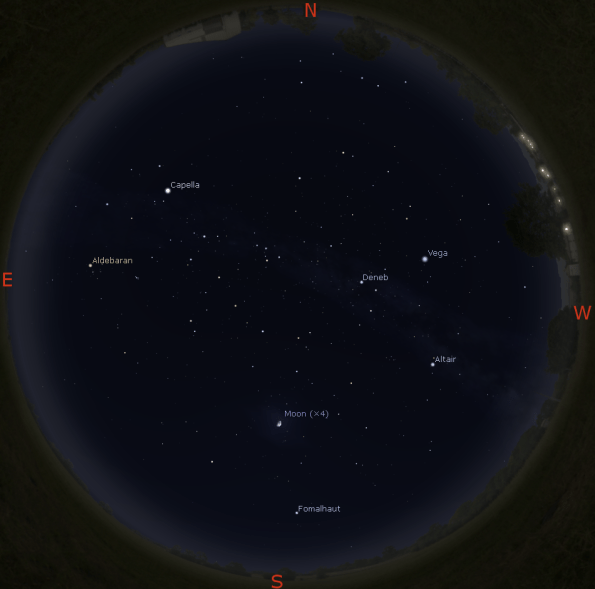
The bright first magnitude stars of autumn shown for 8 p.m. November 20, 2015. If you are closer to your time meridian, we’re 43 minutes behind ours, you will see two more bright stars in the east: Red Betelgeuse and blue-white Rigel. Created using Stellarium.
10/05/2015 – Ephemeris – The loneliest star
Ephemeris for Monday, October 5th. The Sun will rise at 7:45. It’ll be up for 11 hours and 31 minutes, setting at 7:16. The Moon, 1 day past last quarter, will rise at 1:38 tomorrow morning.
There’s a bright and lonely star that appears low in the south for only seven and a half hours a night on autumn evenings. It’s appearance is a sign as sure as the falling leaves that autumn is here At 10 p.m. tonight it’s low in the south-southeast. The star’s name is Fomalhaut, which means fish’s mouth. This is appropriate because it’s in the constellation of Piscis Austrinus, the southern fish. At our latitude it’s the fish that got away, because Fomalhaut appears to be quite alone. The dimness of the constellation’s other stars and location close to the horizon make the fainter stars hard to spot. The earth’s thick atmosphere near the horizon reduces the stars brightness by a factor of two or more, so Fomalhaut appears to keep a lonely vigil in the south.
Times are for the Traverse City/Interlochen area of Michigan. They may be different for your location.
Addendum
Fomalhaut appears quite alone in the south-southeast at about 10 p.m. Created using Stellarium.
Actually Fomalhaut isn’t all that alone, It apparently has a companion planet.
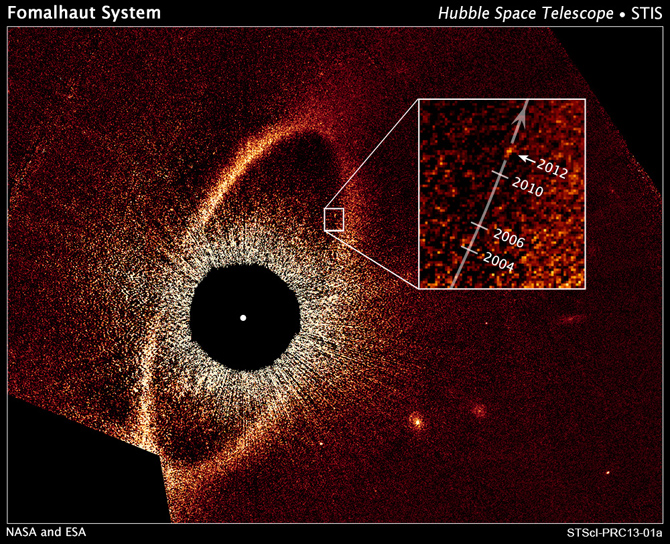
Fomalhaut b and it’s path around its star. Credit: NASA, ESA, and P. Kalas (University of California, Berkeley and SETI Institute)
10/14/2014 – Ephemeris – The loneliest star
Ephemeris for Tuesday, October 14th. The sun will rise at 7:56. It’ll be up for 11 hours and 3 minutes, setting at 6:59. The moon, 1 day before last quarter, will rise at 11:57 this evening.
There’s a bright star that appears for only seven and a half hours a night on autumn evenings. It’s appearance, low in the south, is a clear indication of the autumn season. At 9 p.m. tonight it’s low in the southeast. The star’s name is Fomalhaut, which means fish’s mouth. That fits because it’s in the constellation of Piscis Austrinus, the southern fish. At our latitude it’s the fish that got away, because Fomalhaut appears to be the loneliest star in the sky. The dimness of the constellation’s other stars and location close to the horizon make the fainter stars hard to spot. They would be overhead in Australia. The earth’s thick atmosphere near the horizon reduces the stars brightness by a factor of two or more.
Times are for the Traverse City/Interlochen area of Michigan. They may be different for your location.
Addendum
Fomalhaut appears quite alone in the south-southeast at 10 p.m. October 14, 2014. Created using Stellarium. Click on the image to enlarge.
10/25/2013 – Ephemeris – Fomalhaut the lonely star actually has companions
Ephemeris for Friday, October 25th. The sun will rise at 8:11. It’ll be up for 10 hours and 30 minutes, setting at 6:41. The moon, 1 day before last quarter, will rise at 11:56 this evening.
The lonely bright star low in the south at 9 p.m. these evenings is Fomalhaut the harbinger of autumn in my book. Fomalhaut has a recently discovered planet orbiting it Fomalhaut lower case b. However astronomers just announced the discovery of a third star in the system. I didn’t know it had two. The second star, Fomalhaut (capital) B is a binocular object 2 degrees of 4 moon widths south or below Fomalhaut. The just reported third star (now Fomalhaut big C) is a red dwarf star nearly 6 degrees or 11 moon diameters to the north of Fomalhaut or should I say Fomalhaut A. This star is 3 light years from the primary star which is itself only 25 light years from us. I think the more we study this star the more alphabet soup we’ll find.
Times are for the Traverse City/Interlochen area of Michigan. They may be different for your location.
Addendum
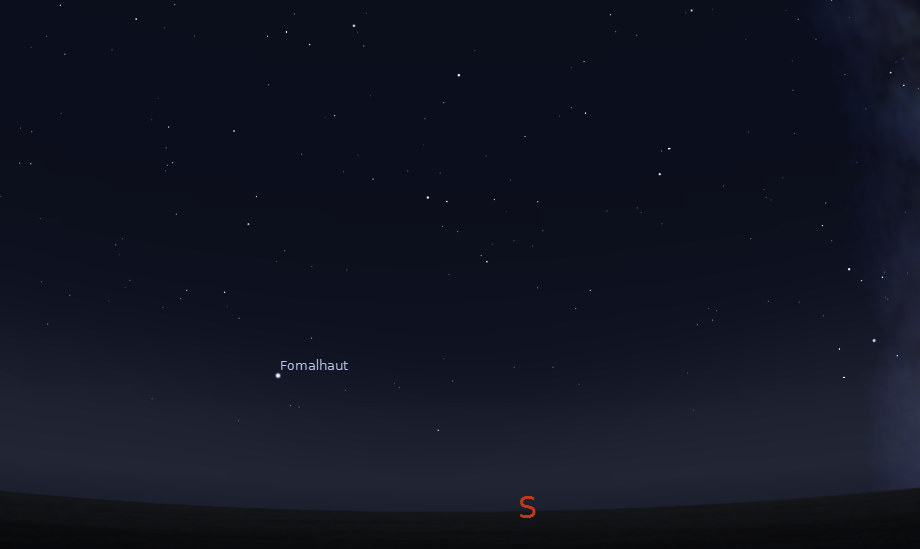
The bright star Fomalhaut all alone at 8:30 p.m. Created using Stellarium.
10/17/2013 – Ephemeris – The lonely star
Ephemeris for Thursday, October 17th. The sun will rise at 8:00. It’ll be up for 10 hours and 53 minutes, setting at 6:54. The moon, 1 day before full, will set at 7:37 tomorrow morning.
There’s a bright star that appears for only seven and a half hours on autumn evenings. It’s appearance, low in the southeast at 10 p.m., is a clear indication of the autumn season. The star’s name is Fomalhaut, which means fish’s mouth. That’s fitting because it’s in the constellation of Piscis Austrinus, the southern fish. At our latitude it’s kind of the fish that got away, because Fomalhaut appears to be quite alone low in the sky. The dimness of the constellation’s other stars and location close to the horizon make the faint stars hard to spot. The earth’s thick atmosphere near the horizon reduces their brightness by a factor of two or more, so Fomalhaut, one of the brightest stars in the sky, keeps a lonely vigil in the south.
Times are for the Traverse City/Interlochen area of Michigan. They may be different for your location.
Addendum
The bright star Fomalhaut all alone at 9 p.m. Created using Stellarium.
10/04/2012 – Ephemeris – The lonely autumn star Fomalhaut
Ephemeris for Thursday, October 4th. The sun will rise at 7:44. It’ll be up for 11 hours and 32 minutes, setting at 7:16. The moon, 4 days before last quarter, will rise at 9:40 this evening.
There’s a bright star that appears for only seven and a half hours on autumn evenings. It’s appearance, low in the southeast at 10 p.m., is a clear indication of the autumn season. The star’s name is Fomalhaut, which means fish’s mouth. That’s fitting because it’s in the constellation of Piscis Austrinus, the southern fish. At our latitude it’s kind of the fish that got away, because Fomalhaut appears to be quite alone low in the sky. The dimness of the constellation’s other stars and location close to the horizon make the faint stars hard to spot. The earth’s thick atmosphere near the horizon reduces their brightness by a factor of two or more, so Fomalhaut, one of the brightest stars in the sky, keeps a lonely vigil in the south.
Times are for the Traverse City/Interlochen area of Michigan. They may be different for your location.
Addendum
The bright star Fomalhaut all alone at 10 p.m. on October 4, 2012. Created using Stellarium.
Click image to enlarge.
10/25/11 – Ephemeris – The lonely star Fomalhaut
Tuesday, October 25th. The sun will rise at 8:10. It’ll be up for 10 hours and 31 minutes, setting at 6:42. The moon, 1 day before new, will rise at 8:02 tomorrow morning
There’s a bright and lonely star that appears low in the south for only seven and a half hours a night on autumn evenings. It’s appearance is a sign as sure as the falling leaves that autumn is here At 9 p.m. tonight it’s low in the south southeast. The star’s name is Fomalhaut, which means fish’s mouth. This is appropriate because it’s in the constellation of Piscis Austrinus, the southern fish. At our latitude it’s the fish that got away, because Fomalhaut appears to be quite alone. The dimness of the constellation’s other stars and location close to the horizon make the fainter stars hard to spot. They would be overhead in Australia. The earth’s thick atmosphere near the horizon reduces the stars brightness by a factor of two or more, so Fomalhaut appears to keep a lonely vigil in the south.
* Times are for the Traverse City/Interlochen area of Michigan. They may be different for your location.
Addendum
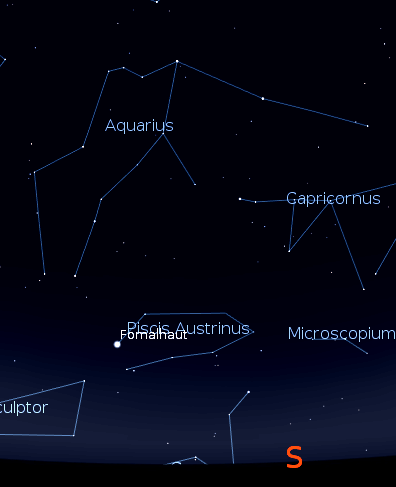
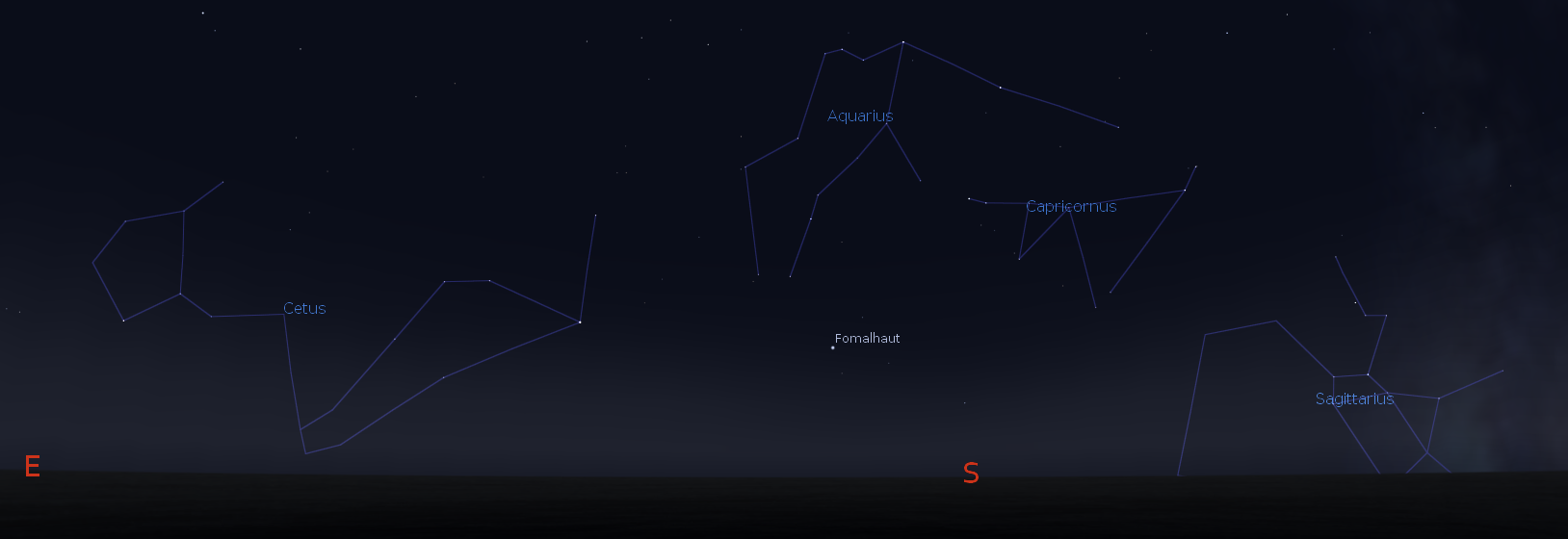
Aquarius and Fomalhaut as visualized by Stellarium
 Bob Moler's Ephemeris Blog