Archive
Ephemeris: 12/05/2024 – More about Jupiter: it’s very gassy
This is Bob Moler with Ephemeris for Thursday, December 5th. Today the Sun will be up for 8 hours and 57 minutes, setting at 5:02, and it will rise tomorrow at 8:05. The Moon, 3 days before first quarter, will set at 9:14 this evening.
The planet Jupiter rules over the night sky with the Moon after Venus sets. Jupiter, 11 times the diameter of the Earth, has the volume of 1300 earths, however it is only 318 times the mass of the Earth. It is made-up mostly of hydrogen and helium, so it is called a gas giant planet, rather than a terrestrial or rocky planet like the Earth. Jupiter is the best viewable of the planets in a small telescope. It has 2 dark bands across it called belts of darker appearing clouds. The famed Great Red Spot is an anticyclone embedded in the southern of those belts. The spot is not as red anymore. I remember it being brick-red back in the late 1950s and early 60s. Jupiter spins very rapidly, its day lasts only 10 hours.
The astronomical event times given are for the Traverse City/Interlochen area of Michigan (EST, UT – 5 hours). Times will be different for other locations.
Addendum
06/27/2018 – Ephemeris – Our Wednesday look at the bright planets
Wednesday, June 27th. Today the Sun will be up for 15 hours and 33 minutes, setting at 9:32, and it will rise tomorrow at 5:59. The Moon, 1 day before full, will set at 6:27 tomorrow morning.
It’s Wednesday again and time to look for and at the bright planets. Three of them are in the evening sky. The brilliant beacon of Venus will be visible in the western twilight from about 9:50 p.m. until it sets at 11:53 p.m. Mercury is far below and right of it, setting at 10:59 p.m. Jupiter will be in the south as it gets dark. Jupiter is only outshone by Venus and the Moon, though Mars will outshine it next month at its closest. Jupiter will set at 3:05 a.m. Binoculars will show it to be bigger than star-like in size. Saturn which is opposite the Sun in the sky today will rise as the Sun sets. It’s right below the Moon tonight. Mars will rise at 11:39 p.m. and is now outshining Saturn.
The times given are for the Traverse City/Interlochen area of Michigan. They may be different for your location.
Addendum
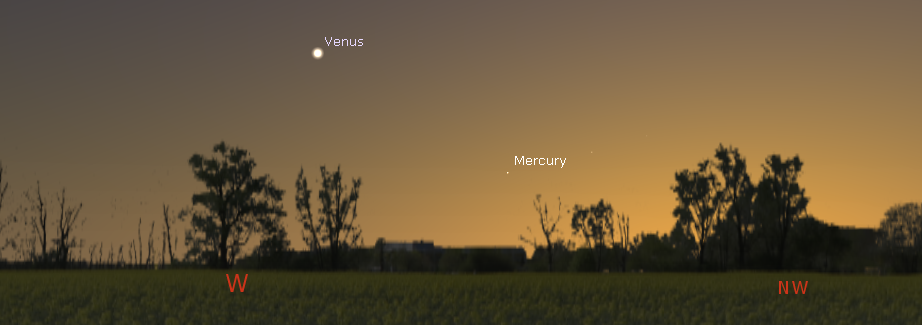
Venus and Mercury low in the western sky ay 10 p.m. June 27, 2018. Click on image to enlarge. Created using Stellarium.
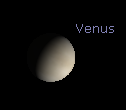
Telescopic appearance of Venus on June 27, 2018. A moon filter helps cut down the glare to be able to more easily see the phase. Created using Stellarium.
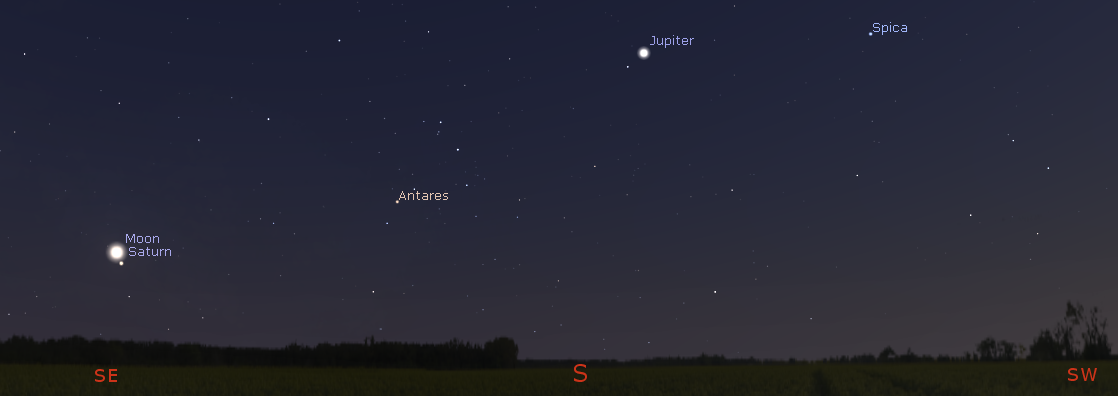
Jupiter, Saturn and the Moon tonight at 10:30 p.m. on June 27, 2018. Click on the image to enlarge. Created using Stellarium.
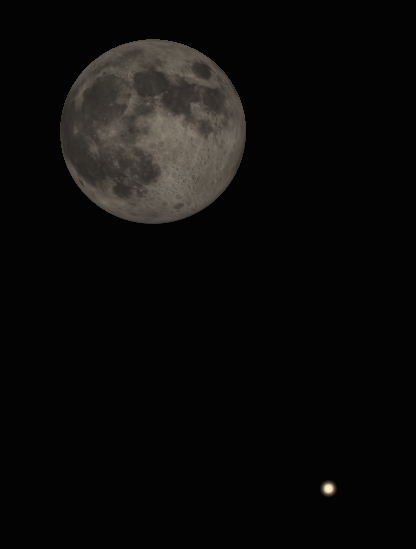
The Moon and Saturn as they might appear in binoculars at 10:30 p.m. June 27, 2018. Created using Stellarium.
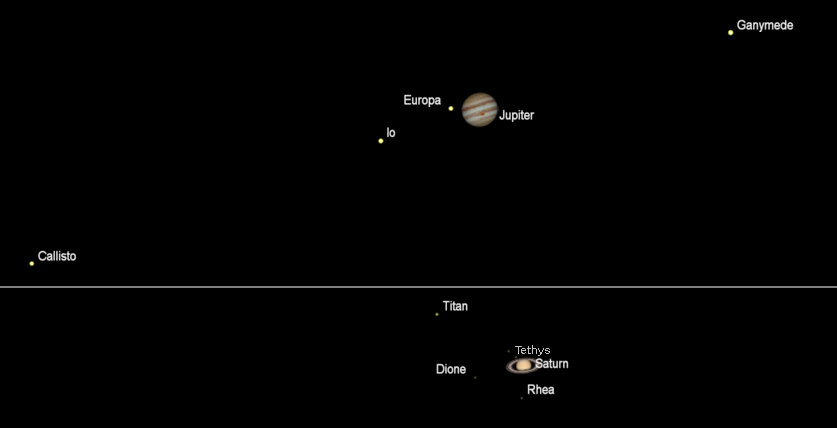
Jupiter and Saturn with the same magnification at 10:30 p.m. June 27, 2018. Information on Europa events and the Great Red Spot is below. Created using Cartes du Ciel (Sky Charts).
Moon   Event            Universal Time    Local Time
Europa Transit start    28 Jun 2018 3:30  27 Jun 2018 11:30 p.m.
Europa Shadow start     28 Jun 2018 5:34  28 Jun 2018  1:34 a.m.
Europa Transit end      28 Jun 2018 5:44  28 Jun 2018  1:44 a.m.
Europa Shadow end       28 Jun 2018 7:49  28 Jun 2018  3:49 a.m.
Great Red Spot Transit  28 Jun 2018 2:32  27 Jun 2018 10:32 p.m.
Source of Jovian events: https://www.projectpluto.com/jevent.htm
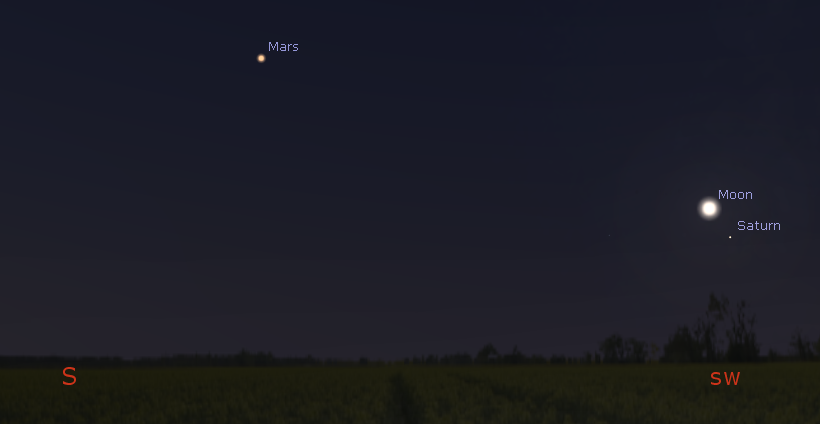
Mars, Saturn and the Moon at 5 a.m. June 28, 2018. Click on the image to enlarge. Created using Stellarium.
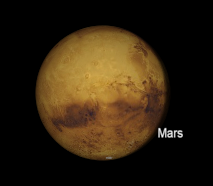
Greatly enlarged telescopic Mars at 5 a.m. June 28, 2018. Note that the dark albedo features may be covered by a global dust storm currently raging on the Red Planet. Created using Cartes du Ciel (Sky Charts).
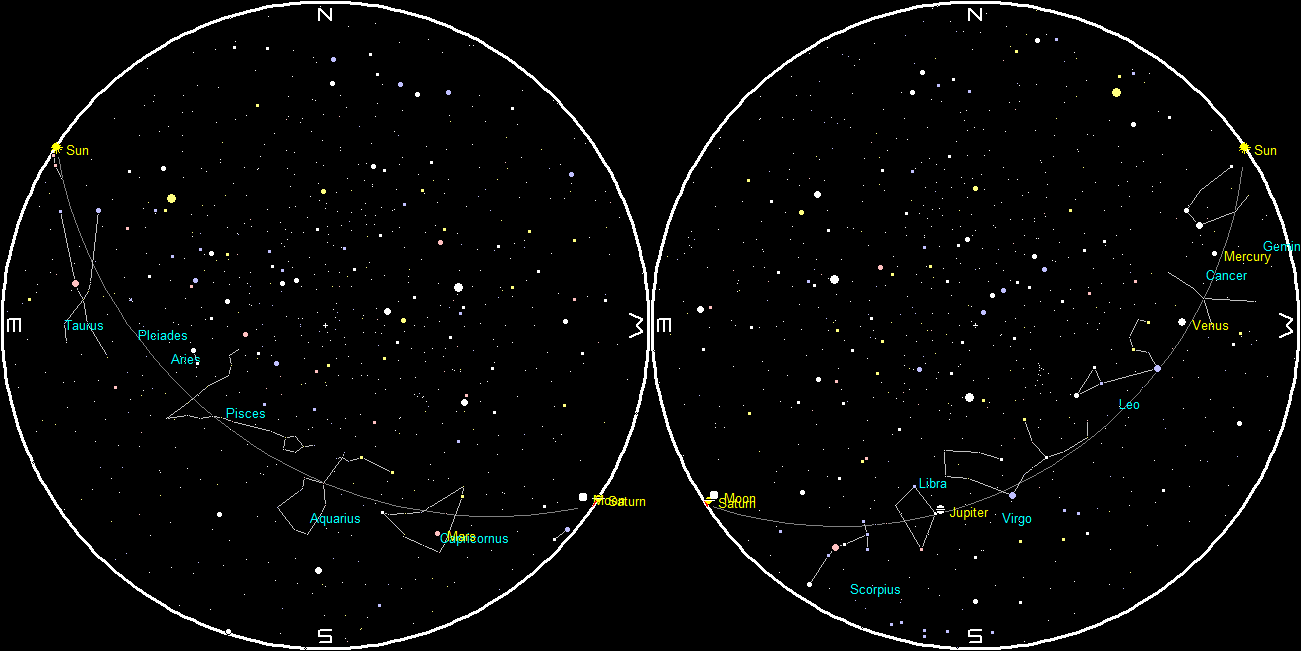
Planets and the Moon at sunset and sunrise of a single night starting with sunset on the right on June 27, 2018. The night ends on the left with sunrise on the 28th. Click on the image to enlarge. Created using my LookingUp program.
05/09/2017 – Ephemeris – Looking at Jupiter through a telescope
Ephemeris for Tuesday, May 9th. The Sun rises at 6:21. It’ll be up for 14 hours and 35 minutes, setting at 8:57. The Moon, 1 day before full, will set at 6:36 tomorrow morning.
The first thing one sees by turning a telescope to the planet Jupiter are it’s moons, that change position night to night. A closer look at the planet itself will reveal that it is not exactly circular, but a bit squashed, making Jupiter fatter in the direction of the line of moons. Jupiter has only a 3 degree axial tilt, and its four large moons orbit over Jupiter’s equator, so even though they have nearly circular orbits, appear to move back and forth in a straight line. On the face of the planet itself appear parallel cloud bands of cream and reddish-brown. The parallel cloud bands and the squashed appearance of the planet have the same cause. Jupiter, though over a thousand times the Earth’s volume rotates, that is has a day, of a bit less than 10 hours.
The times given are for the Traverse City/Interlochen area of Michigan. They may be different for your location.
Addendum
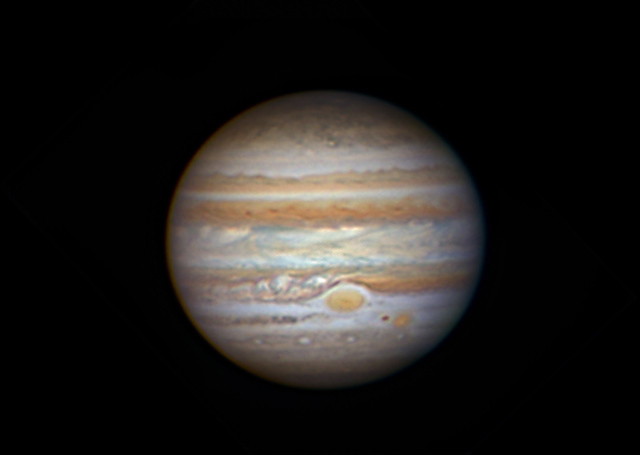
A slightly squished Jupiter with its Great Red Spot November 18, 2012 by Scott Anttila.
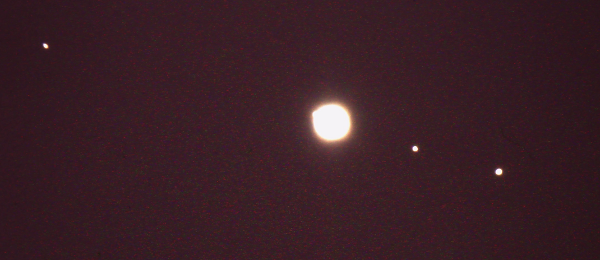
Overexposed Jupiter and its moons. Note the moon that looks like a bump on the left edge of the planet. My archival image.
04/07/2017 – Ephemeris – Learn about light pollution tonight
Ephemeris for Friday, April 7th. The Sun will rise at 7:12. It’ll be up for 13 hours and 5 minutes, setting at 8:17. The Moon, half way from first quarter to full, will set at 6:11 tomorrow morning.
This evening at 8 p.m. the Grand Traverse Astronomical Society will hold its monthly meeting at Northwestern Michigan College’s Rogers Observatory featuring a talk by observatory director Jerry Dobek about light pollution and what can be done about it to help preserve our dark night skies. I expect he will give us a progress report on the effort to make the Sleeping Bear Dunes National Lakeshore a Dark Sky Park. Special emphasis will be LEDs, now that they are proliferating, the good the bad and the ugly. At 9 p.m. there will be a star party with the gibbous Moon and Jupiter at opposition from the Sun and about at its closest to us at 414 million miles (666 million km) away.
Times are for the Traverse City/Interlochen area of Michigan. They may be different for your location.
Addendum
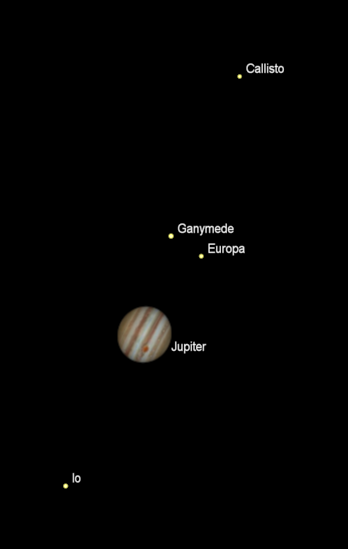
Jupiter and its moons as it should appear tonight at 10 p.m. April 7, 2017 (2 hr UT April 8). Note also the Great Red Spot, which may be paler than it appears here. I double checked the transit time of the red spot across Jupiter’s central meridian, which is predicted for 10:42 p.m. (2:42 UT, April 8) across Jupiter’s central meridian. The position of the Red Spot is correct for 10 p.m.
Times are from Project Pluto: https://www.projectpluto.com/jeve_grs.htm
04/06/2017 – Ephemeris – Jupiter will be opposite the Sun in the sky tomorrow
Ephemeris for Thursday, April 6th. The Sun will rise at 7:13. It’ll be up for 13 hours and 2 minutes, setting at 8:16. The Moon, 3 days past first quarter, will set at 5:39 tomorrow morning.
The planet Jupiter now rises around sunset. Tomorrow at 4:58 p.m. it will be officially in opposition from the Sun. This isn’t some conflict, but the simple fact that Jupiter will be opposite the Sun in our sky. It then will become an evening planet and in the next month or so will become a dazzling fixture in our evening sky, that it is now later in the evening. Jupiter is the second brightest planet after Venus, which is now emerging from the morning Sun’s twilight glare. Watch for it in next Wednesday’s planet report. Though the second brightest planet Jupiter by far is the largest planet. It’s mass exceeds the combines masses of all the other planets times two. Currently NASA’s Juno spacecraft is orbiting it.
Times are for the Traverse City/Interlochen area of Michigan. They may be different for your location.
Addendum
In a telescope the Jupiter system is quite dynamic. It’s four largest moons change position from night to night, and sometimes while you watch. The satellites sometimes duck behind Jupiter or through its shadow, or pass in front of the planet, casting their shadow on it. Close observation of Jupiter reveals details in its clouds. It rotates in less than 10 hours, over twice as fast as the Earth, which apparently whips the clouds into alternate light colored zones and darker brownish belts. There’s the Great Red Spot, which last I spotted it has faded to a pale pink, and located in the south edge of the south equatorial belt. The clouds rotate faster at the equator than at higher latitudes.
Jupiter with its Great Red Spot November 18, 2012 by Scott Anttila.
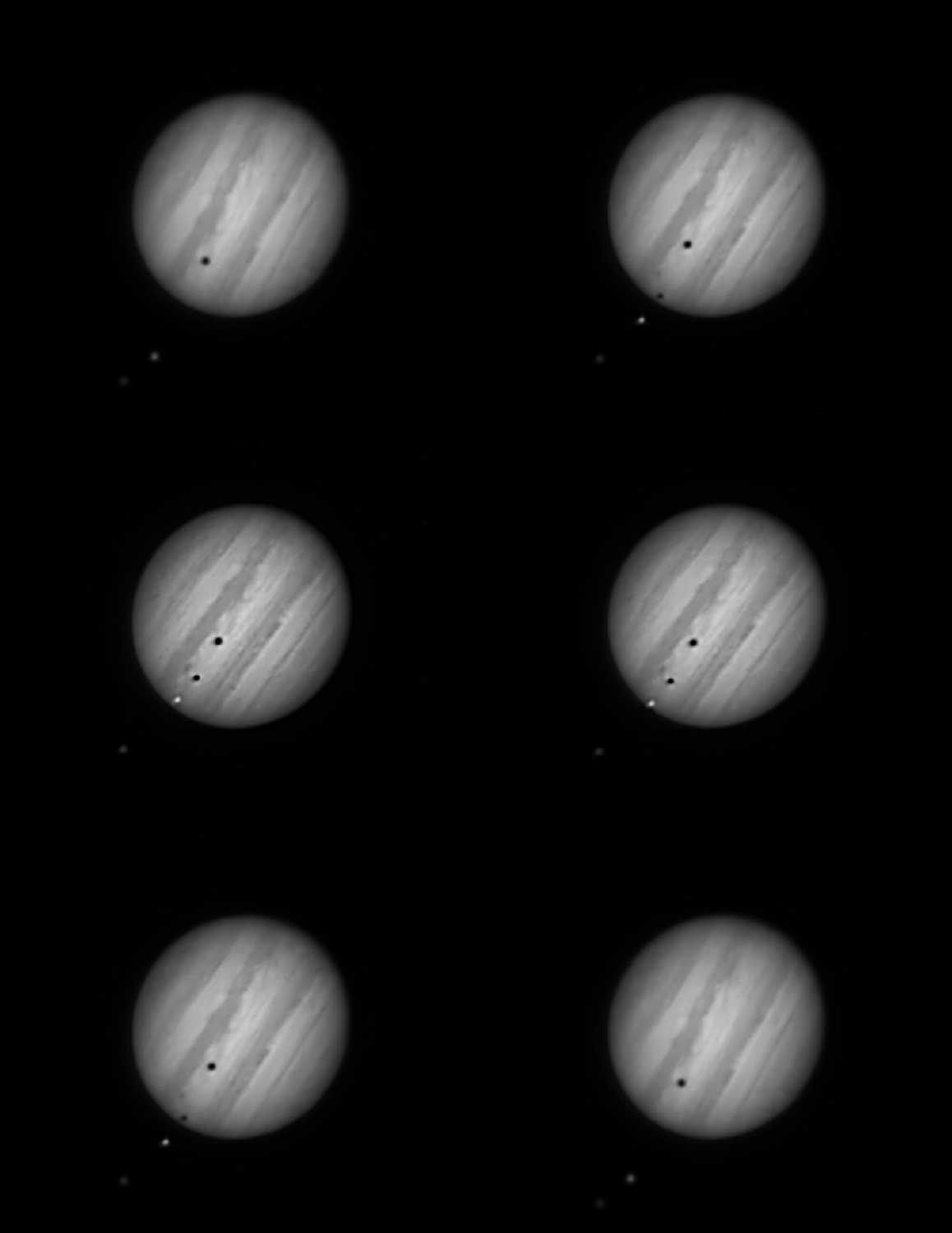
Rocking animation of the early stages of the shadow show on Jupiter. Callisto’s shadow already on the planet while Io’s shadow is just entering. Also Io’s transit is starting., following it’s shadow on the planet. Credit: Scott Anttila
04/14/2016 – Ephemeris – It’s always a cloudy day on Jupiter, worse than Traverse City in winter.
Ephemeris for Thursday, April 14th. The Sun will rise at 6:59. It’ll be up for 13 hours and 27 minutes, setting at 8:27. The Moon, 1 day past first quarter, will set at 3:50 tomorrow morning.
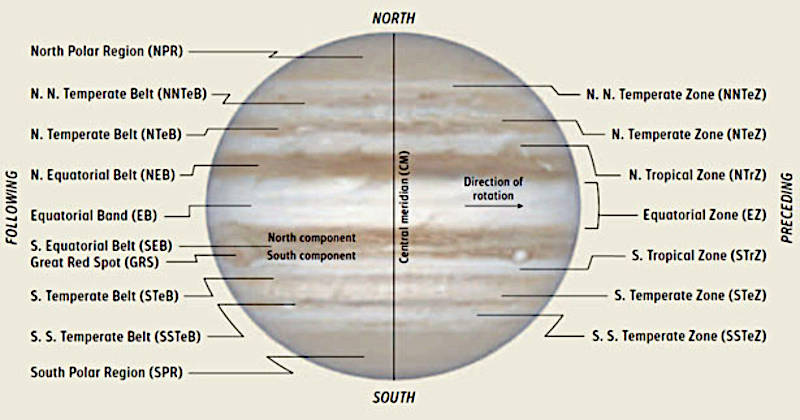
If one has a large enough telescope, possibly 100 millimeters diameter or larger Jupiter’s cloud detail can be studied. At first appearance the clouds appear simple light and dark stripes. They are caused by Jupiter’s rapid rotation of a bit less than 10 hours. The dark stripes are called belts. The darkest and broadest of these is the North Equatorial Belt. The next darkest belt is the South Equatorial Belt, which actually disappeared for a time in 2010. On the belt’s south side is found the Great Red Spot an anticyclone. The white stripes are called zones. There are more belts and zones at higher latitudes. The Great Red Spot is kinda pink now. In my youth in the 1950s it could be easily spotted in a small telescope and it was brick-red!
Times are for the Traverse City/Interlochen area of Michigan. They may be different for your location.
Addendum
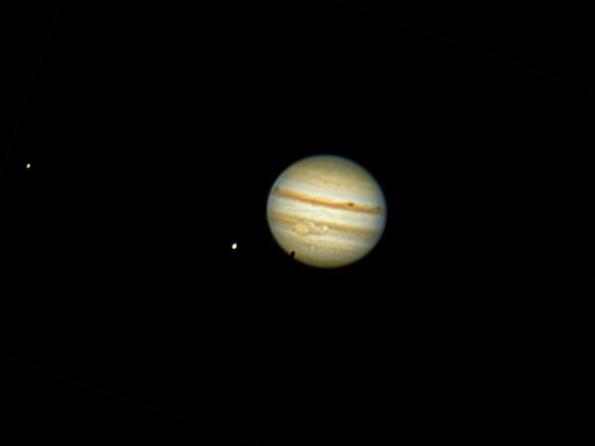
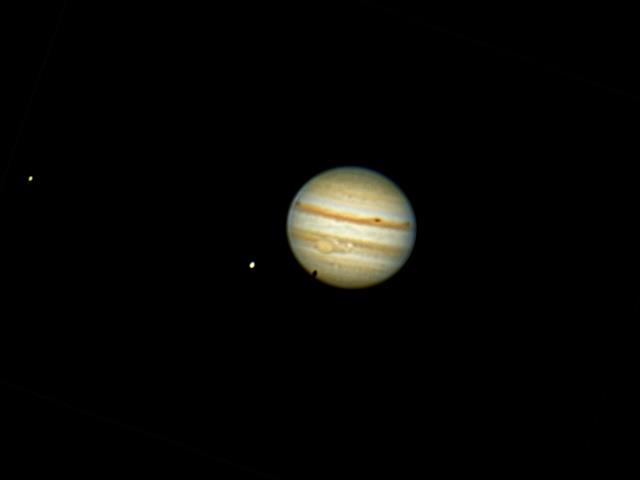
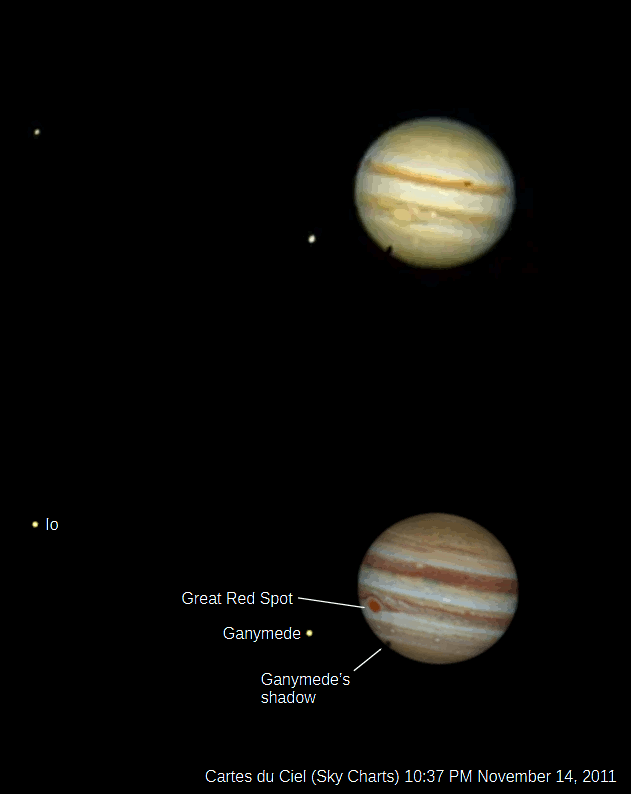
Scott Anttila image of Jupiter from November 14, 2011.
Note how faded the Great Red Spot was.
03/17/2015 – Ephemeris – Jupiter’s cloud stripes
Ephemeris for St. Patrick’s Day, Tuesday, March 17th. The Sun will rise at 7:51. It’ll be up for 11 hours and 59 minutes, setting at 7:51. The Moon, 3 days before new, will rise at 6:37 tomorrow morning.
Jupiter is the one planet that we can see detail on with telescopes in the evening sky. Venus is so bright that it is hard to even see its gibbous phase. Actually the best way to see Venus is during the day with the blue sky around it. Jupiter is a big planet, 11 times the Earth’s diameter and 1,300 times it volume. Despite this it is only 318 times the Earth’s mass, so much of its mass is the atmosphere. It’s rotation rate is just under 10 hours at its equator. This drops with latitude, so its atmosphere is twisted into alternate belts and zones. The belts are dark brown while the zones are lighter. They move around the planet at different speeds causing storms that their boundaries. The Great Red Spot is a anticyclone in the south.
Times are for the Traverse City/Interlochen area of Michigan. They may be different for your location.
Addendum
Jupiter by Scott Anttila November 14, 2011. With shadow on the planet and the Great Red Spot.
01/13/2014 – Ephemeris – Jupiter’s Great Red Spot
Ephemeris for Monday, January 13th. The sun will rise at 8:16. It’ll be up for 9 hours and 9 minutes, setting at 5:25. The moon, 2 days before full, will set at 6:49 tomorrow morning.
Jupiter is my youngest granddaughter’s favorite planet. She has books and pictures of Jupiter sporting its famous Great Red Spot. When I was a teenager in the 1950s, a bit older than she is now the Great Red Spot on Jupiter was indeed bright red. You couldn’t miss it in even the smallest telescopes. Since the early 1970s the spot has faded. At best it’s a pastel pink. The Great Red Spot appears to be a permanent feature of the Jovian atmosphere, an anti-cyclone that distorts the dark belts and bright zones of the planet. The dark belts are thought to be where air is sinking and the white zones are upwelling clouds. The Great Red Spot wanders east and west at about the same latitude within the atmosphere. I hope it gets really red soon.
Times are for the Traverse City/Interlochen area of Michigan. They may be different for your location.
Addendum
Jupiter with its Great Red Spot November 18, 2012 by Scott Anttila.
 Bob Moler's Ephemeris Blog