Archive
Ephemeris: 08/21/2025 – The Milky Way’s Great Rift
This is Ephemeris for Thursday, August 21st. Today the Sun will be up for 13 hours and 45 minutes, setting at 8:38, and it will rise tomorrow at 6:53. The Moon, 2 days before new, will rise at 5:57 tomorrow morning.
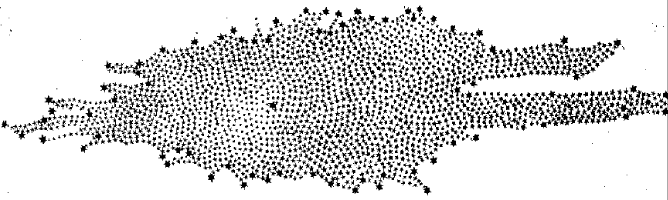
Once one finds the Milky Way which is pretty hard to miss this month, it becomes obvious that the Milky Way is split lengthwise starting near Deneb, the northernmost star of the Summer Triangle, almost all the way to the Teapot of Sagittarius low in the south. That dark split is called the Great Rift. Galileo first discovered that the hazy clouds of the Milky Way were actually made of faint stars, so it was thought the dark areas were due to a lack of stars. The great 18th century astronomer William Herschel did star counts all over the sky with his telescope. A map his sister drew of the flattened shape of his universe shows the lack of distant stars in one direction. It’s not really fewer stars, but interstellar clouds of dust blocking the light of the stars behind them.
The astronomical event times given in this blog are for the Traverse City/Interlochen area of Michigan (Lat 44.7° N, Long 85.7° W; EDT, UT – 4 hours) unless stated otherwise. Times will be different for other locations.
Addendum
Ephemeris: 08/05/2024 – Finding Aquila the Eagle
This is Ephemeris for Monday, August 5th. Today the Sun will be up for 14 hours and 28 minutes, setting at 9:02, and it will rise tomorrow at 6:35. The Moon, 1 day past new, will set at 9:58 this evening.
The bright star Altair is seen halfway up the sky in the southeast at 10:30 this evening. It is one of the stars of the Summer Triangle with Vega above it, and Deneb above and left of it. It is the brightest star in the constellation Aquila the eagle which is seen flying northward through the Milky Way, with Altair at its head. Altair is flanked by two stars one above one below. Its wing tips can be seen below, and to the upper right. His tail is almost lost in the Milky Way seen lower in the east southeast. Here in Aquila is where the great rift, the dark band that splits the Milky Way, is most prominent. The Greeks and Romans seemed to have trouble telling vultures and eagles apart. Another name of the constellation was Vultur Volans.
The astronomical event times given are for the Traverse City/Interlochen area of Michigan (EDT, UT–4 hours). They will be different for other locations.
Addendum
Ephemeris: 08/15/2023 – The Great Rift
This is Ephemeris for Tuesday, August 15th. Today the Sun will be up for 14 hours and 3 minutes, setting at 8:48, and it will rise tomorrow at 6:46. The Moon, 1 day before new, will rise at 6:41 tomorrow morning.
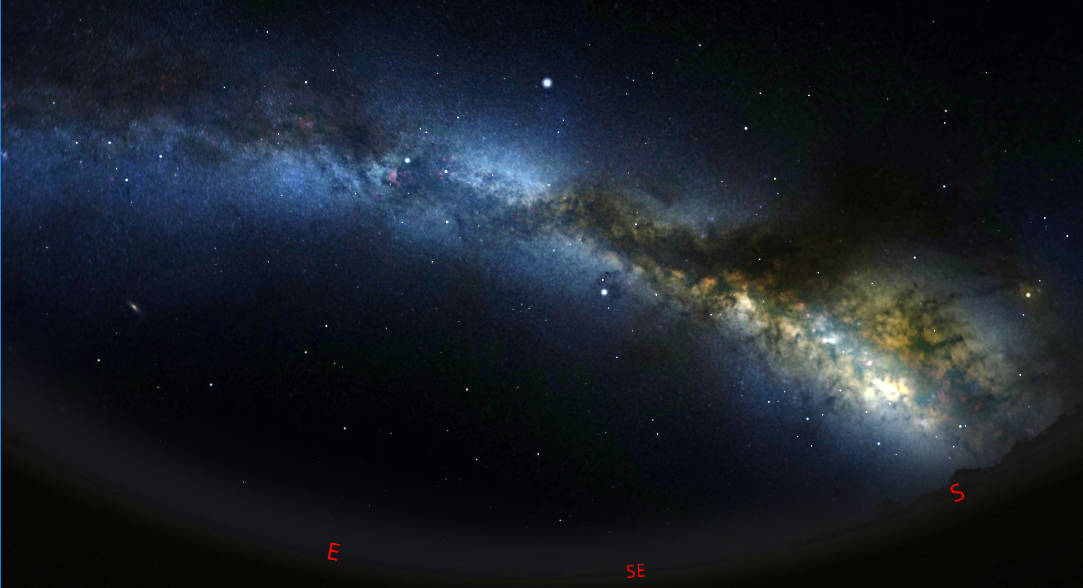
Once one finds the Milky Way which is pretty hard to miss this month, it becomes obvious that the Milky Way is split lengthwise starting near Deneb, the northernmost star of the Summer Triangle, almost all the way to the Teapot of Sagittarius low in the south. That dark split is called the Great Rift. Galileo first discovered that the hazy clouds of the Milky Way we’re actually made of faint stars, so it was thought the dark areas were due to a lack of stars. The great 18th century astronomer William Herschel did star counts all over the sky with his telescope. A map drawn of the shape of the Galaxy shows the lack of distant stars in the direction of the Great Rift. It’s not really fewer stars, but interstellar clouds of dust blocking the light of stars behind them.
The astronomical event times given are for the Traverse City/Interlochen area of Michigan (EDT, UT –4 hours). They may be different for your location.
The span of the Milky Way across the summer sky as seen in the free Stellarium app. Specifically August 15th at 10 pm from Northern Michigan. The Milky Way has been set to its maximum brightness to show as much detail as possible. It really isn’t that bright. The horizon is only delineated by the compass points. The dark clouds of the Great Rift are also visible. The Milky Way, in Stellarium, is photo-realistic. The triangle of three bright stars above center is the Summer Triangle, Specifically, clockwise from the top star: Vega, Altair and Deneb. Large images can be truncated on the right. Click or tap on the image to enlarge and display the complete image.
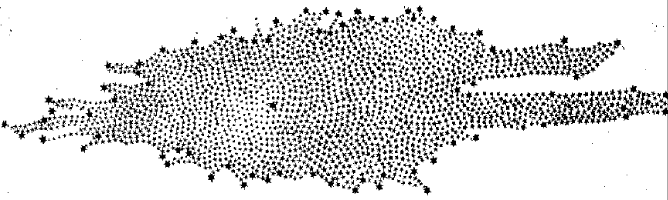
William Herschel’s vision of the cross-section of the Milky Way from 1785, drawn by his sister and collaborator, Caroline Herschel. The Great Rift is seen as the gap between the fingers of stars on the right. Herschel thought the rift was caused by a lack of stars. Other than that, he got the flattened shape right, for what he could see within ten thousand light years. The center of the Milky Way lies 27,000 light years to the right. The spiral structure of the Milky Way wasn’t determined until the advent of radio telescopes in the mid-twentieth century.
08/18/2022 – Ephemeris – The Great Rift
This is Ephemeris for Thursday, August 18th. Today the Sun will be up for 13 hours and 54 minutes, setting at 8:43, and it will rise tomorrow at 6:49. The Moon, 1 day before last quarter, will rise at 12:02 tomorrow morning.
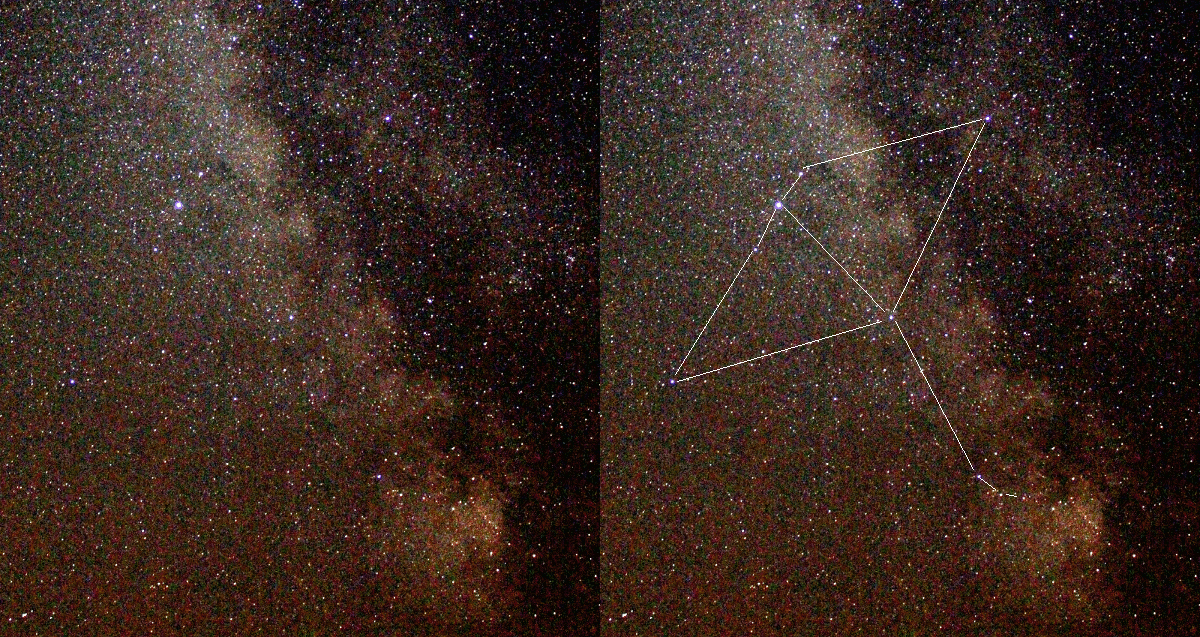
High overhead, the Milky Way is seen passing through the Summer Triangle of three bright stars. Here we find the Milky Way splits into two sections. The split starts in the constellation of Cygnus the Swan or Northern Cross very high in the east. The western part of the Milky Way ends southwest of Aquila the eagle. This dark dividing feature is called the Great Rift. Despite the lack of stars seen there, it doesn’t mean that there are fewer stars there than in the brighter patches of the Milky Way. The rift is a great dark cloud that obscures the light of the stars behind it. Sometimes binoculars can be used to find the edges of the clouds of the rift, as star numbers drop off suddenly. This is especially easily seen in Aquila.
The astronomical event times given are for the Traverse City/Interlochen area of Michigan (EDT, UT – 4 hours). They may be different for your location.
Addendum
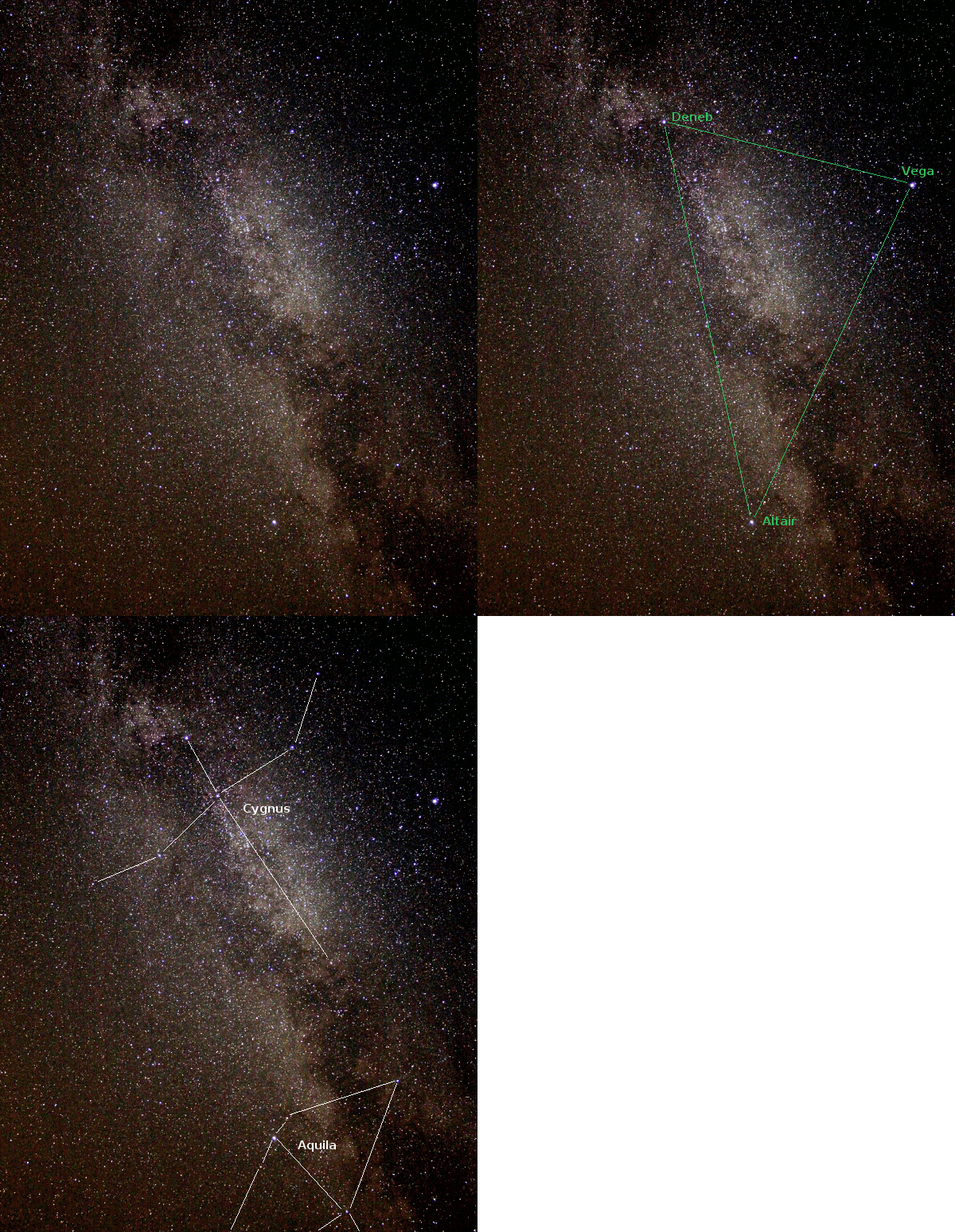
The Great Rift finder animation as seen in the Summer Triangle, also showing the constellations of Cygnus the swan and the northern part of Aquila the Eagle. This image a stack of 5 30 second exposures taken the morning of the Perseid meteor shower the is year in a vain attempt to capture some meteors.
07/18/2022 – Ephemeris – How to find the celestial eagle
This is Bob Moler with Ephemeris for Monday, July 18th. Today the Sun will be up for 15 hours and 8 minutes, setting at 9:23, and it will rise tomorrow at 6:15. The Moon, 2 days before last quarter, will rise at 12:33 tomorrow morning.
Aquila the eagle is a constellation that lies in the Milky Way. It’s in the southeastern sky as it gets dark. Its brightest star, Altair, is one of the stars of the Summer Triangle, a group of three bright stars that dominate the eastern sky in the evening now. Altair, in the head of the eagle, is flanked by two slightly dimmer stars, the shoulders of the eagle. The eagle is flying northeastward through the Milky Way. Its wings are seen in the wing tip stars. A curved group of stars to the lower right of Altair is its tail. Within Aquila, the Milky Way shows many dark clouds as part of the Great Rift that splits it here. The other summer bird is Cygnus the swan above and left of Aquila, flying toward the eagle.
The astronomical event times given are for the Traverse City/Interlochen area of Michigan (EDT, UT – 4 hours). They may be different for your location.
Addendum
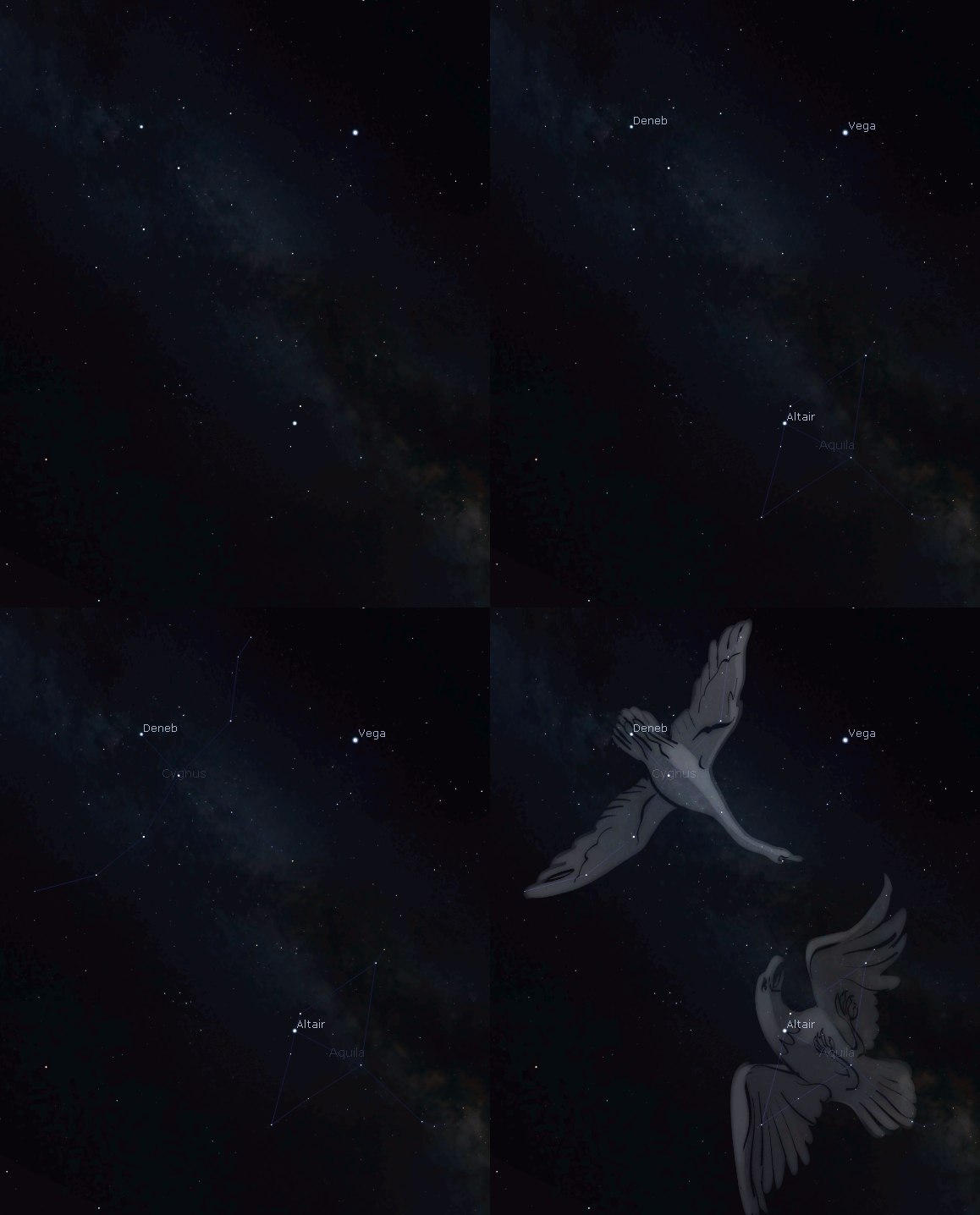
Animated Aquila finder chart, also showing Cygnus the swan. The named stars are the stars of the Summer Triangle. Created using Stellarium.
Annotated and animated photograph taken of Aquila August 13, 2018 during the Perseid meteor shower. Alas, no Perseids in this photograph. The clouds of the Great Rift are easily visible. The red tinge of the image was due to the smoke haze from the wildfires in the western states. Taken by me and processed using Registax and GIMP.
07/09/2021 – Ephemeris – Finding the constellation of Aquila the eagle
This is Ephemeris for Friday, July 9th. Today the Sun will be up for 15 hours and 22 minutes, setting at 9:29, and it will rise tomorrow at 6:07. The Moon is new today, and won’t be visible.
Aquila the eagle is a constellation that lies in the Milky Way. It’s in the southeastern sky as it gets dark. Its brightest star, Altair, is one of the stars of the Summer Triangle, a group of three bright stars dominating the eastern sky in the evening now. Altair, in the head of the eagle, is flanked by two slightly dimmer stars, the shoulders of the eagle. The eagle is flying northeastward through the Milky Way. Its wings are seen in the wing tip stars. A curved group of stars to the lower right of Altair is its tail. Within Aquila, the Milky Way shows many dark clouds as part of the Great Rift that splits it here. The other summer bird is Cygnus the swan above and left of Aquila, flying in the opposite direction. It was said this was the eagle that attended the god Jupiter.
The astronomical event times given are for the Traverse City/Interlochen area of Michigan (EDT, UT-4). They may be different for your location.
Addendum
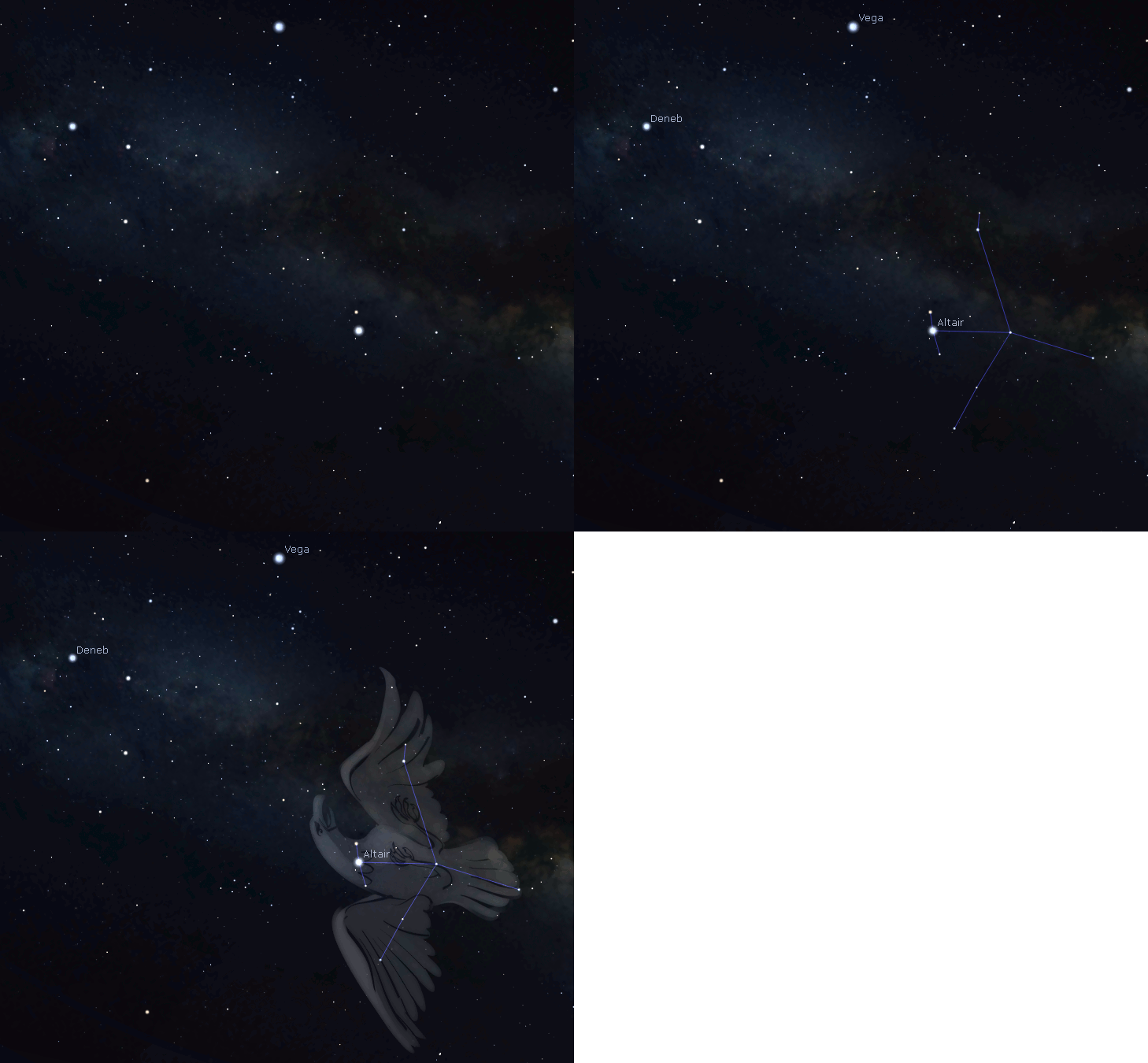
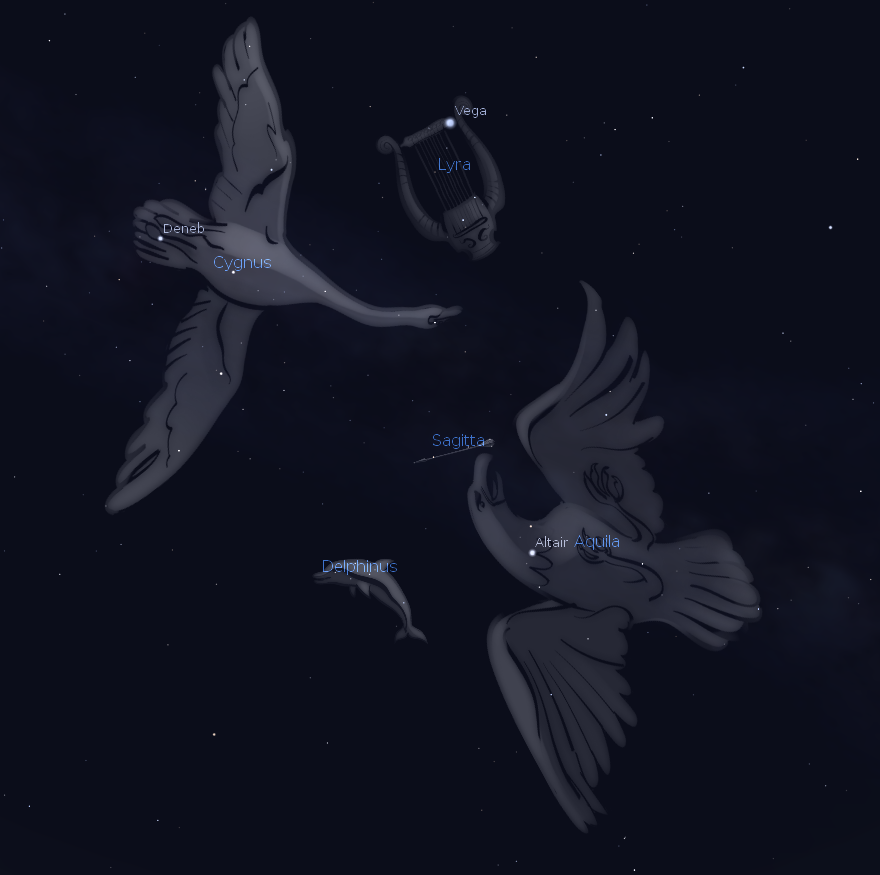
Animated Cygnus finder chart. Lyra the harp, Cygnus the swan, Delphinus the dolphin and Sagitta the arrow are also in the image. Can you find them? Click on the image to enlarge it. Created using Stellarium and GIMP.
08/17/2020 – Ephemeris – The Milky Way’s Great Rift.
This is Ephemeris for Monday, August 17th. Today the Sun will be up for 13 hours and 56 minutes, setting at 8:44, and it will rise tomorrow at 6:49. The Moon, 1 day before new, will rise at 5:53 tomorrow morning.
High overhead the Milky Way is seen passing through the Summer Triangle of three bright stars. Here we find the Milky Way splits into two sections. The split starts in the constellation of Cygnus the Swan or Northern Cross very high in the east. The western part of the Milky Way ends southwest of Aquila the eagle. This dark dividing feature is called the Great Rift. Despite the lack of stars seen there, it doesn’t mean that there are fewer stars there than in the brighter patches of the Milky Way. The rift is a great dark cloud that obscures the light of the stars behind it. Sometimes binoculars can be used to find the edges of the clouds of the rift, as stars numbers drop off suddenly. This is especially easily seen in Aquila.
The event times given are for the Traverse City/Interlochen area of Michigan. They may be different for your location.
Addendum
The Great Rift finder animation as seen in the Summer Triangle, also showing the constellations of Cygnus the swan and the the northern part of Aquila the Eagle. This image a stack of 5 30 second exposures taken the morning of the Perseid meteor shower in a vain attempt to capture some meteors.
Annotated and animated photograph taken of Aquila August 13, 2018 during the Perseid meteor shower, the same night the image above. Taken by me and processed using Registax and GIMP.
08/26/2018 – Ephemeris – The Great Rift
Ephemeris for Monday, August 26th. Today the Sun will be up for 13 hours and 32 minutes, setting at 8:30, and it will rise tomorrow at 6:59. The Moon, 3 days past last quarter, will rise at 3:13 tomorrow morning.
High overhead the Milky Way is seen passing through the Summer Triangle of three bright stars. Here we find the Milky Way split into two sections. The split starts in the constellation of Cygnus the Swan or Northern Cross very high in the east. The western part of the Milky Way ends southwest of the Aquila the eagle. This dark dividing feature is called the Great Rift. Despite the lack of stars seen there, it doesn’t mean that there are fewer stars there than in the brighter patches of the Milky Way. The rift is a great dark cloud that obscures the light of the stars behind it. Sometimes binoculars can be used to find the edges of the clouds of the rift, as stars numbers drop off suddenly. This is especially easy to spot in Aquila the eagle.
The times given are for the Traverse City/Interlochen area of Michigan. They may be different for your location.
Addendum
The Great Rift finder animation as seen in the Summer Triangle, also showing the constellations of Cygnus the swan and the the northern part of Aquila the Eagle. This image a stack of 5 30 second exposures taken the morning of the Perseid meteor shower the is year in a vain attempt to capture some meteors.
Annotated and animated photograph taken of Aquila August 13, 2018 during the Perseid meteor shower. Alas, no Perseids in this photograph. Taken by me and processed using Registax and GIMP.
07/25/2019 – Ephemeris – Finding the second bird in the summer sky: Aquila the eagle
Ephemeris for Thursday, July 25th. Today the Sun will be up for 14 hours and 55 minutes, setting at 9:16, and it will rise tomorrow at 6:22. The Moon, 1 day past last quarter, will rise at 1:40 tomorrow morning.
Aquila the eagle is a constellation that lies in the Milky Way. It’s in the southeastern sky as it gets dark. Its brightest star, Altair is one of the stars of the Summer Triangle, a group of three bright stars dominating the eastern sky in the evening now. Altair, in the head of the eagle, is flanked by two slightly dimmer stars, the shoulders of the eagle. The eagle is flying northeastward through the Milky Way. Its wings are seen in the wing tip stars. A curved group of stars to the lower right of Altair is its tail. Within Aquila the Milky Way shows many dark clouds as part of the Great Rift that splits it here. The other summer bird is Cygnus the swan above and left of Aquila, flying in the opposite direction.
The times given are for the Traverse City/Interlochen area of Michigan. They may be different for your location.
Addendum
Animated Cygnus finder chart. Created using Stellarium.
The Great Rift finder animation as seen in the Summer Triangle, also showing the constellations of Cygnus the swan and the the northern part of Aquila the Eagle. This image a stack of 5 30 second exposures taken the morning of the Perseid meteor shower last year in a vain attempt to capture some meteors.
09/04/2018 – Ephemeris – The Great Rift
Ephemeris for Tuesday, September 4th. The Sun will rise at 7:08. It’ll be up for 13 hours and 5 minutes, setting at 8:13. The Moon, 2 days past last quarter, will rise at 2:03 tomorrow morning.
High overhead the Milky Way is seen passing through the Summer Triangle of three bright stars. Here we find the Milky Way splits into two sections. The split starts in the constellation of Cygnus the Swan or Northern Cross very high in the east. The western part of the Milky Way ends southwest of the Aquila the eagle. This dark dividing feature is called the Great Rift. Despite the lack of stars seen there, it doesn’t mean that there are fewer stars there than in the brighter patches of the Milky Way. The rift is a great dark cloud that obscures the light of the stars behind it. Sometimes binoculars can be used to find the edges of the clouds of the rift, as stars numbers drop off suddenly. This is especially easily seen in Aquila.
The times given are for the Traverse City/Interlochen area of Michigan. They may be different for your location.
Addendum
The Great Rift finder animation as seen in the Summer Triangle, also showing the constellations of Cygnus the swan and the northern part of Aquila the eagle. This image a stack of 5 30 second exposures taken the morning of the Perseid meteor shower the is year in a vain attempt to capture some meteors.
Annotated and animated photograph taken of Aquila August 13, 2018 during the Perseid meteor shower. Alas, no Perseids in this photograph. Taken by me and processed using Registax and GIMP.
 Bob Moler's Ephemeris Blog