Archive
Ephemeris: 05/17/2024 – The famous Big Dipper stars Mizar and Alcor
This is Ephemeris for Friday, May 17th. Today the Sun will be up for 14 hours and 55 minutes, setting at 9:07, and it will rise tomorrow at 6:10. The Moon, 2 days past first quarter, will set at 4:01 tomorrow morning.
In tonight’s sky, the Big Dipper is nearly overhead. In its handle is a star or two that are interesting. It’s the star at the bend in the handle. It’s called Mizar. Next to it, for those with good eyesight, is a dimmer star, called Alcor. The name Mizar is from the Arabic, meaning apron or cover, while Alcor means the forgotten one. Before optometrists, the ability to actually see both stars was a test for good eyesight, especially for Arabic warriors. The pair is also known as the “Horse and the Rider”. I’ve been told that some Native American tribes saw the handle stars as hunters following the Great Bear, Ursa Major, of which the Big Dipper is a part, rather than its very unnatural tail. Dim Alcor became a hunting dog.
The astronomical event times given are for the Traverse City/Interlochen area of Michigan (EDT, UT–4 hours). They may be different for your location.
Addendum
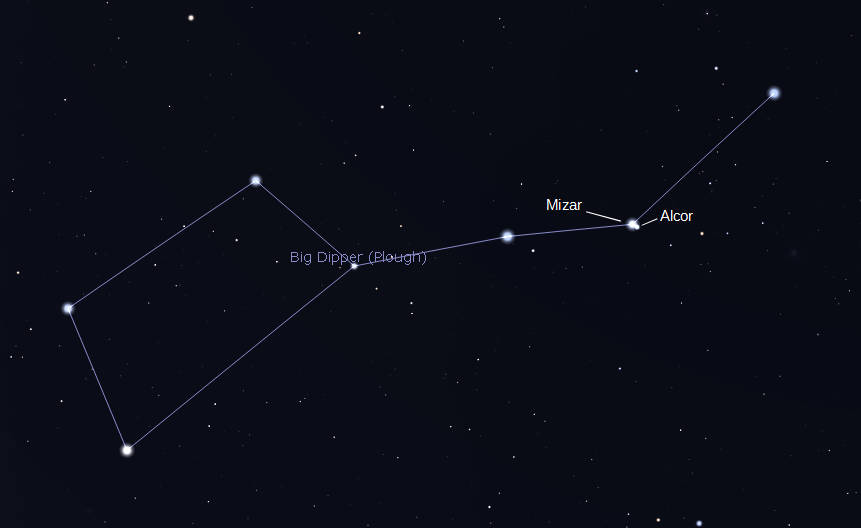
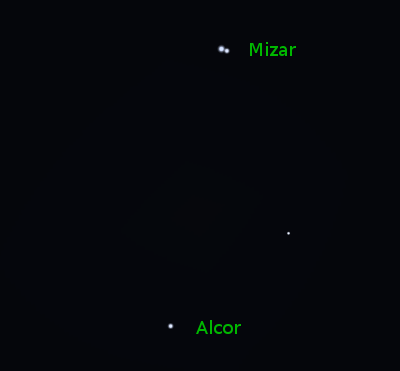
06/26/2020 – Ephemeris – The stars known as the Horse and Rider
Jun 26. This is Bob Moler with Ephemeris for Friday, June 26th. Today the Sun will be up for 15 hours and 33 minutes, setting at 9:32, and it will rise tomorrow at 5:59. The Moon, 2 days before first quarter, will set at 1:28 tomorrow morning.
The most interesting star in the Big Dipper is Mizar and its dim companion Alcor. It is the second star from the end of the handle, where the bend in the handle takes place. Folks with good vision can see the dimmer star right next to Mizar. In ancient times it was used as an eye test for visual acuity for warriors. As such it was known as the “Horse and the Rider”. Mizar is second magnitude, in the second rank of star brightness invented by the Greek astronomer Hipparchus in the 2nd century BC. He ranked stars in 6 classes, from first magnitude for the brightest to 6th for the dimmest visible to the naked eye. Alcor comes in at 4th magnitude. It does suffer a bit by being very close to Mizar which is 6 times brighter.
The event times given are for the Traverse City/Interlochen area of Michigan. They may be different for your location.
Addendum

Mizar finder animation for the Big Dipper’s orientation in late June at 11 pm where I live or an hour and a half after sunset. Created using Stellarium and GIMP.
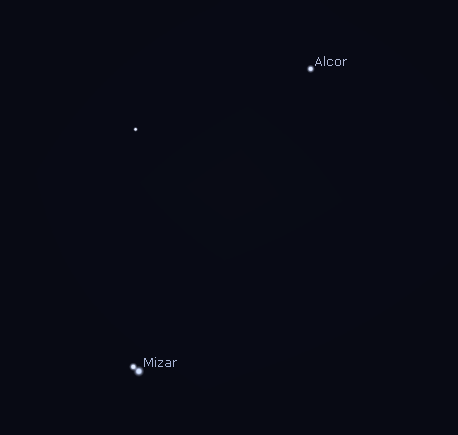
Mizar and Alcor as they might appear in a telescope. Mizar is a binary star in a telescope. The other star in the field is apparently a background star. The brighter star of Mizar is Mizar A, while the dimmer is Mizar B. It turns out that Mizar A and B plus Alcor are all spectroscopic binaries, meaning the companion stars are too close to resolve in telescopes, but whose motion shows up in the spectra of the stars. Mizar and Alcor are around 80 light years away. Created using Stellarium.
03/15/2016 – Ephemeris – Spotting the celestial Horse and Rider
Ephemeris for, the Ides of March, Tuesday, March 15th. The Sun will rise at 7:54. It’ll be up for 11 hours and 55 minutes, setting at 7:49. The Moon, at first quarter today, will set at 3:36 tomorrow morning.
In the handle of te Big Dipper rising high in the east northeast is an easily seen double star. It’s the star second from the end of the handle where it makes a bend. The bright star is Mizar. It has a dim companion star that folks with good eyesight can easily spot, named Alcor. The Arabs of old, before optometrists used the pair as an eye test. I would have failed. Even with my glasses on I can’t spot Alcor. I must resort to binoculars. The pair is known as the Horse and Rider, while the indigenous peoples of North America, see the stars of the handle of the Big Dipper not as the great Bear’s tail, but hunters following the bear. In this case Alcor is either a hunting dog, or a cooking pot to cook the bear in.
Times are for the Traverse City/Interlochen area of Michigan. They may be different for your location.
Addendum
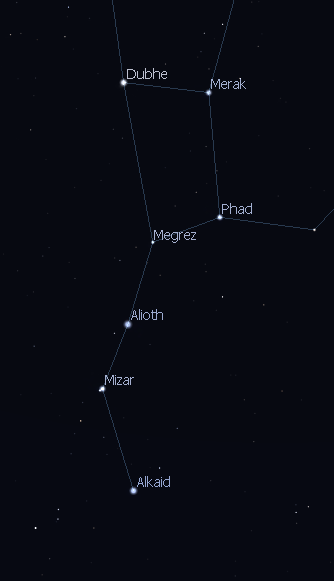
The Big Dipper, part of Ursa Major the Great Bear, is poised on its handle in the northeast. Can you spot Alcor? Created using Stellarium.
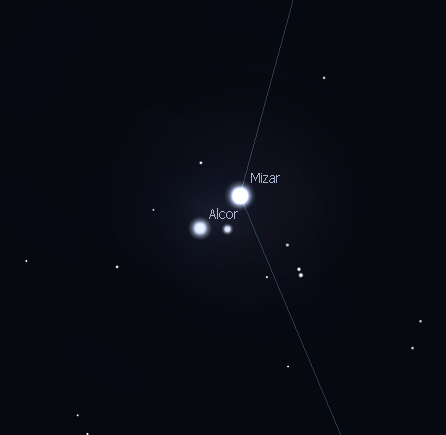
A closeup view of Mizar and Alcor and a dimmer star that lies in the background. Created using Stellarium.
A telescope with low power will also split Mizar intro a bright and dim companion named Mizar A and Mizar B. By observing Mizar A, B and Alcor have determined that all three are binary. There’s six stars there.
 Bob Moler's Ephemeris Blog