Archive
11/18/2015 – Ephemeris – The planet action is in the morning
Ephemeris for Wednesday, November 18th. The Sun will rise at 7:43. It’ll be up for 9 hours and 28 minutes, setting at 5:12. The Moon, 1 day before first quarter, will set at 11:57 this evening.
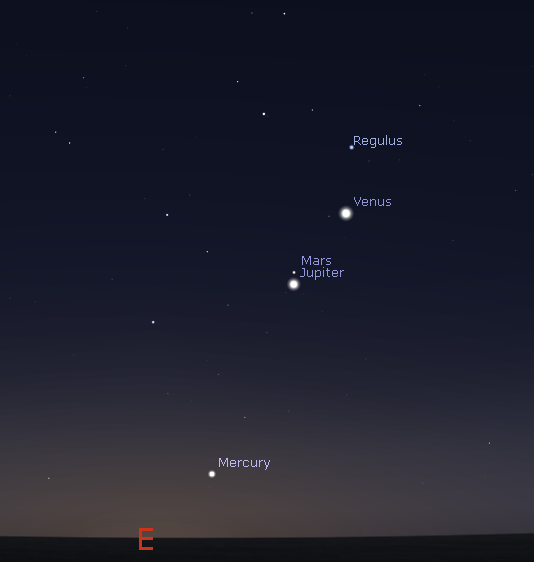
Let’s check out the whereabouts of the bright naked eye planets. Saturn is about to depart the evening sky. It’s too close to the direction of the Sun to spot. Mercury passed behind the Sun yesterday and is entering the evening sky. In the morning sky there are three bright planets. Jupiter will be the first to rise, at 1:50 a.m. in the east-northeast. Mars will rise next at 3:04 a.m. in the east, followed by Venus at 3:45 a.m. also in the east. Mars lies in line between Venus below and Jupiter above, a bit more than a third the way from Venus to Jupiter. These three planets will continue to pull apart. Nearly in line with the planets are the bright stars Regulus to the upper right and Spica to the lower left.
Times are for the Traverse City/Interlochen area of Michigan. They may be different for your location.
Addendum
Mercury passed behind the Sun in a superior conjunction yesterday the 17th. The Sun actually occulted Mercury, though that couldn’t be seen. Below is a SOHO LASCO C2 coronagraph GIF animation from the 14th to the 17th showing Mercury entering on the right and disappearing behind the disk that hides the Sun’s photosphere. The white circle in the center shows the position and size of the Sun. The plane of Mercury’s orbit crosses the plane of the Earth’s orbit where the Earth is in early November and again 6 months later in early May. It happens that next May 9th Mercury will pass in front of the Sun, an event called a transit, that will be visible here. It will start at 7:13 a.m. (11:13 UT) and end at 2:44 p.m. (18:44 UT). Transits of Mercury are not as spectacular or as rare as those of Venus. I’ll have more on the transit when the date draws close.
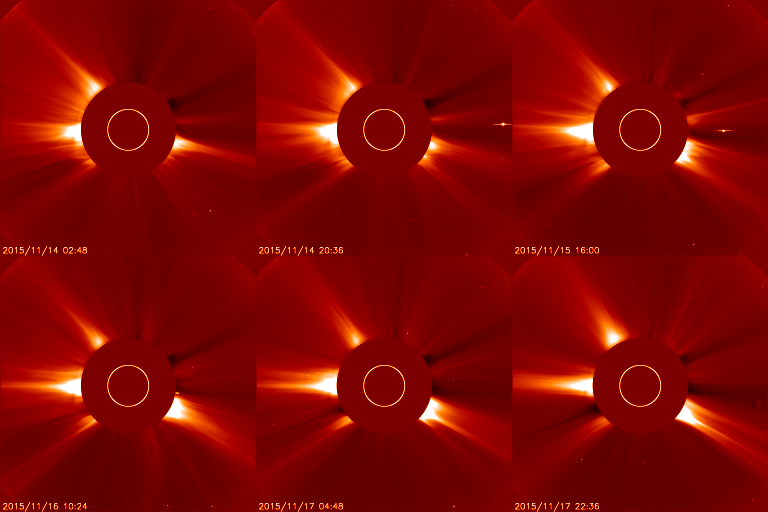
A GIF animation from the Solar and Heliospheric Observatory LASCO C2 coronagraph for November 14th to the 17th. Mercury will enter from the right. Credit ESA/NASA – LASCO/NRL SOHO team.
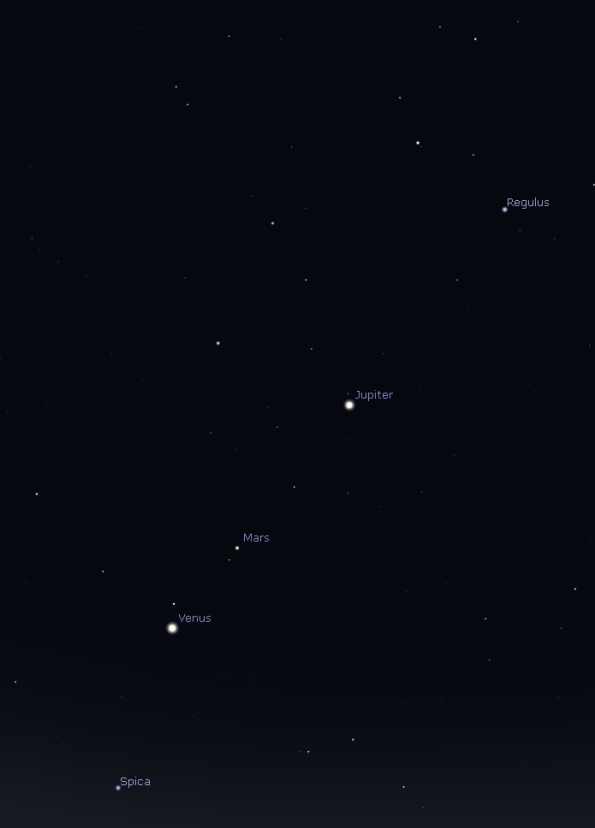
Jupiter, Mars and Venus appear in the southeast at 6 a.m., November 19, 2015. Created using Stellarium.
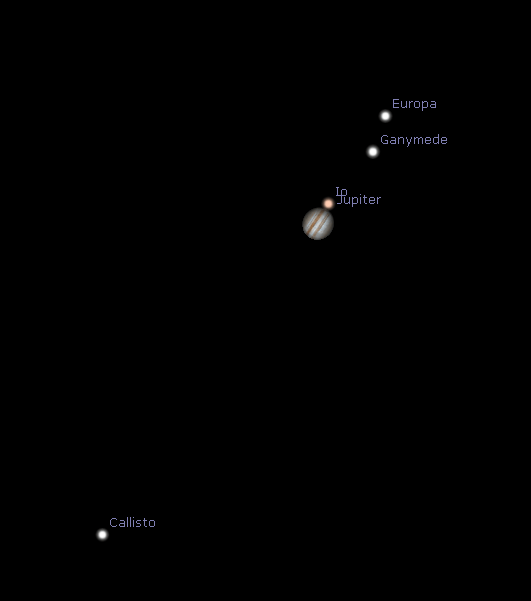
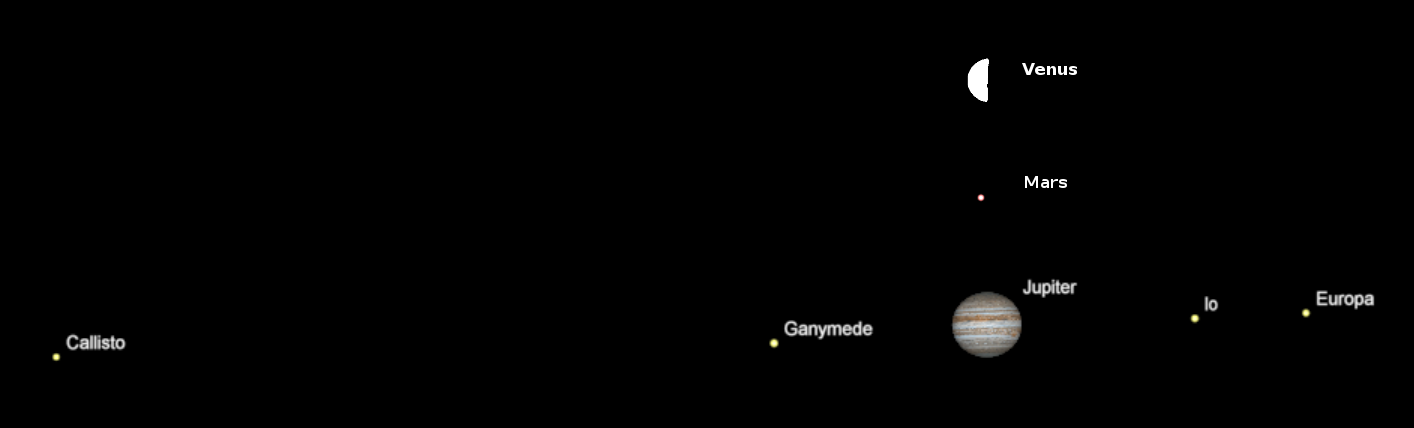
Jupiter and its moons in a telescope at 6 a.m., November 19, 2015. Created using Stellarium.
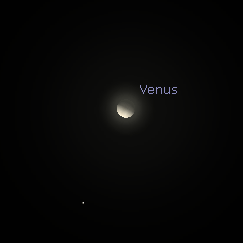
Venus as seen in a telescope at 6 a.m. November 19, 2015. This is at the same scale as the Jupiter image above. Created using Stellarium.
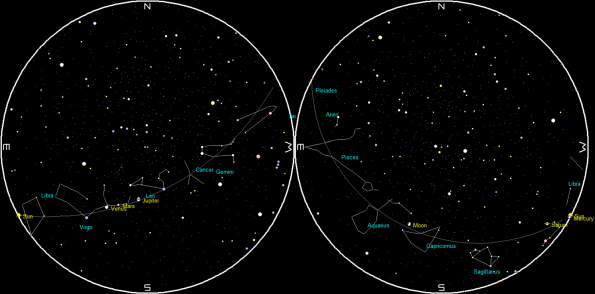
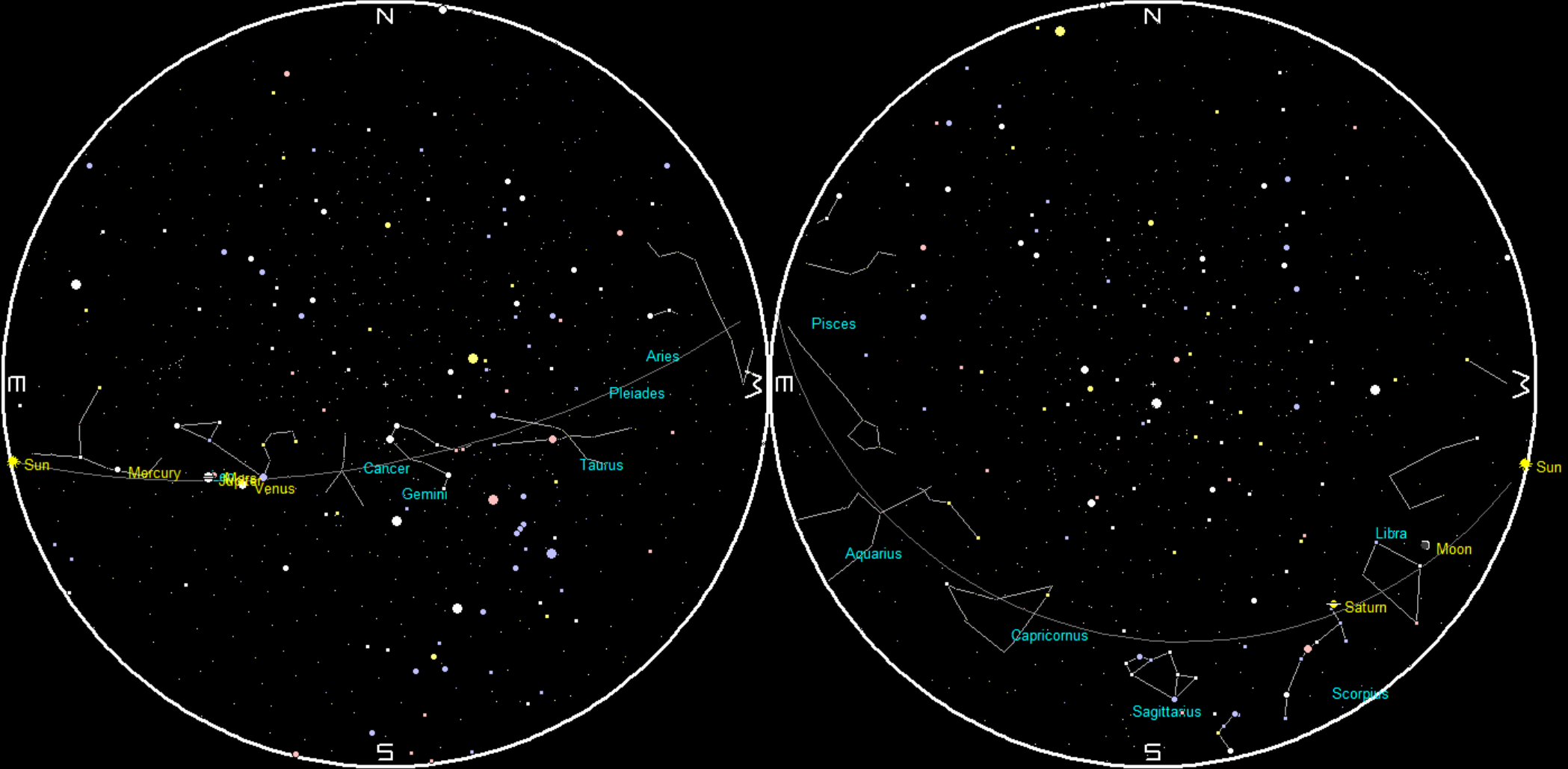
This is a chart showing the sunrise and sunset skies for November 18, 2015 showing the location of the planets and the Moon at that time. Created using my LookingUp program. Click on the image to enlarge.
11/11/2015 – Ephemeris – The bright planets separate in the morning sky
Ephemeris for Veteran’s Day, Wednesday, November 11th. The Sun will rise at 7:34. It’ll be up for 9 hours and 45 minutes, setting at 5:19. The Moon is new today, and won’t be visible.
Let’s check out the whereabouts of the bright naked eye planets. The numbers of visible planets is getting a bit thin. The planet Saturn will be low in the west-southwest after sunset and will set at 6:16 p.m., less than an hour after sunset. It would be as harder to find than Mercury would be at its best in the evening sky. And Mercury itself is too close to the direction of the Sun to be spotted. However in the morning sky there are three bright planets. Jupiter will be the first to rise, at 2:12 a.m. in the east-northeast. Mars will rise at 3:20 a.m., followed by Venus at 3:31 a.m. Mars lies in line between Venus below and Jupiter above, a bit less than a third the way from Venus to Jupiter. These three planets will continue to separate.
Times are for the Traverse City/Interlochen area of Michigan. They may be different for your location.
Addendum
Saturn can no longer be shown at a reasonable altitude with Stellarium.
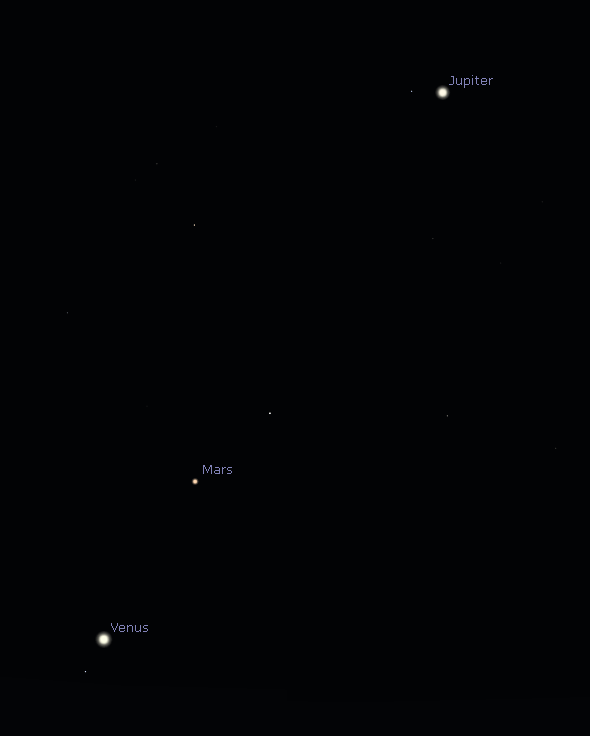
Jupiter, Mars and Venus appear in the southeast at 6 a.m., November 11, 2015. Created using Stellarium.
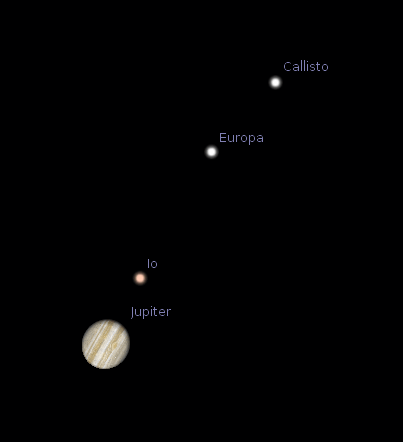
Jupiter and its moons in a telescope at 6 a.m., November 12, 2015. Ganymede enters into Jupiter’s shadow at 5:30 a.m. Created using Stellarium.
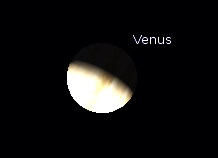
Venus as seen in a telescope at 6 a.m. November 12, 2015. This is not to the same scale as the Jupiter image above. Created using Stellarium.
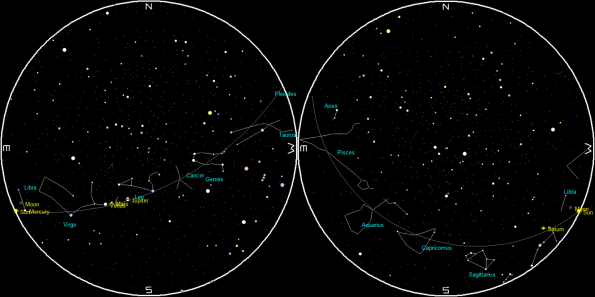
This is a chart showing the sunrise and sunset skies for November 11, 2015 showing the location of the planets and the Moon at that time. Created using my LookingUp program. Click on the image to enlarge.
11/05/2015 – Ephemeris – The Moon will be among the morning planets in the next two days
Ephemeris for Thursday, November 5th. The Sun will rise at 7:25. It’ll be up for 10 hours and 0 minutes, setting at 5:26. The Moon, 2 days past last quarter, will rise at 2:23 tomorrow morning.
Over the next two mornings the Moon will pass, first, the planet Jupiter and then on Saturday Mars and Venus. These will be readily visible at 6 a.m. and less so at 7 a.m. when twilight is brighter. This month and next we will have two times the Moon will actually pass in front of another bright celestial object. Both will occur in the morning. These events are called occultations. The first will be an occultation of the bright star Aldebaran, the bright star in Taurus the bull, which I sometimes call the bull’s angry bloodshot eye. That will occur on the morning of November 26th. The next will be really spectacular. On December 7th the crescent Moon will occult the planet Venus. I’ll keep you updated on both these events.
Times are for the Traverse City/Interlochen area of Michigan. They may be different for your location.
Addendum
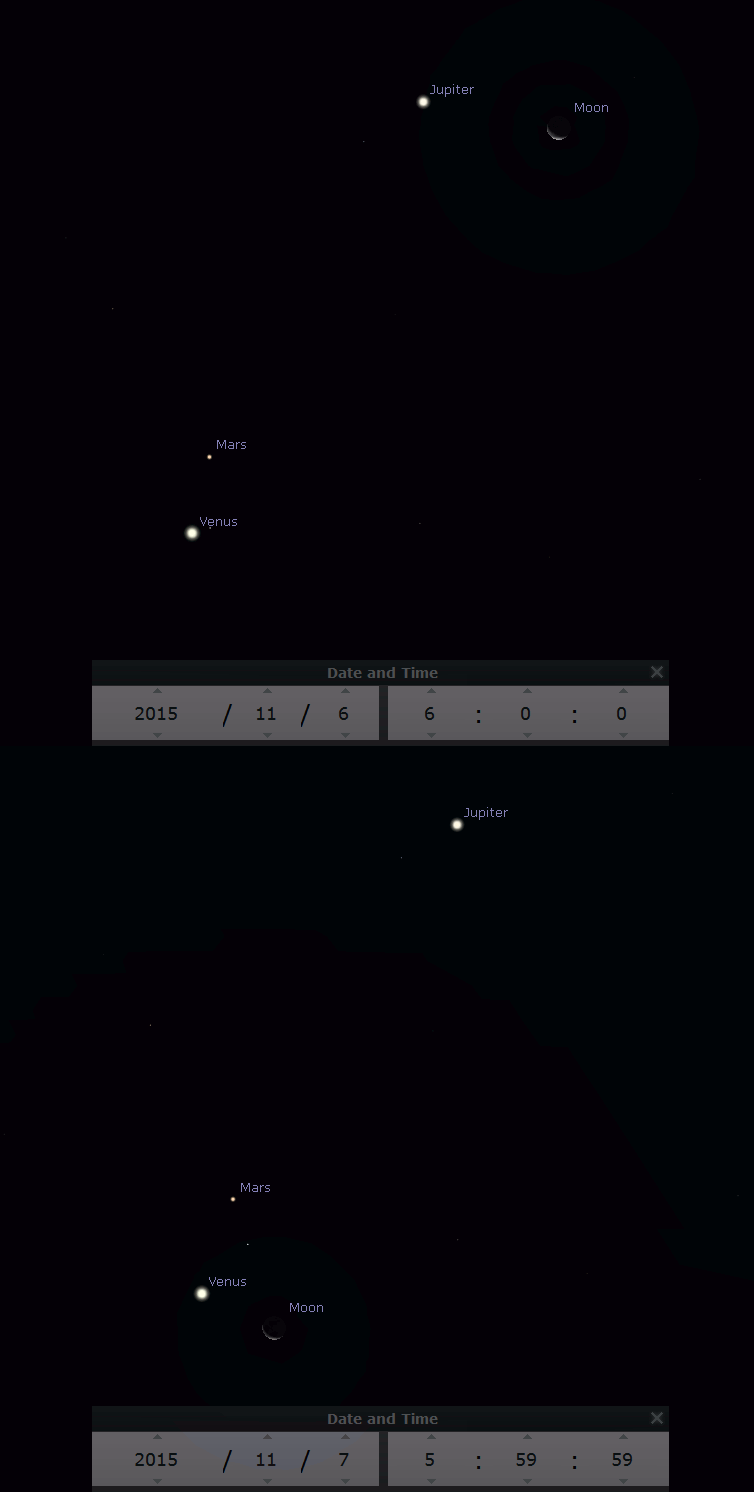
Animation of the Moon passing Jupiter tomorrow morning and Mars and Venus Saturday morning. Created using Stellarium and GIMP.
11/04/2015 – Ephemeris – Most of the bright planet action is in the morning
Ephemeris for Wednesday, November 4th. The Sun will rise at 7:24. It’ll be up for 10 hours and 3 minutes, setting at 5:27. The Moon, 1 day past last quarter, will rise at 1:25 tomorrow morning.
Let’s check out the whereabouts of the bright naked eye planets. The numbers of visible planets is getting a bit thin. The planet Saturn will be low in the west-southwest after sunset and will set at 6:41 p.m. It would be as hard to find as Mercury would be at its best in the evening sky. And Mercury itself is too close to the direction of the Sun to be spotted. However in the morning sky there are three bright planets. Jupiter will be the first to rise, at 2:34 a.m. in the east-northeast. Mars and Venus will rise within 5 minutes of each outer by 3:20 a.m. Mars will be almost directly above Venus by a degree or two Moon diameters. Friday and Saturday mornings the Moon will appear near these planets.
Times are for the Traverse City/Interlochen area of Michigan. They may be different for your location.
Addendum
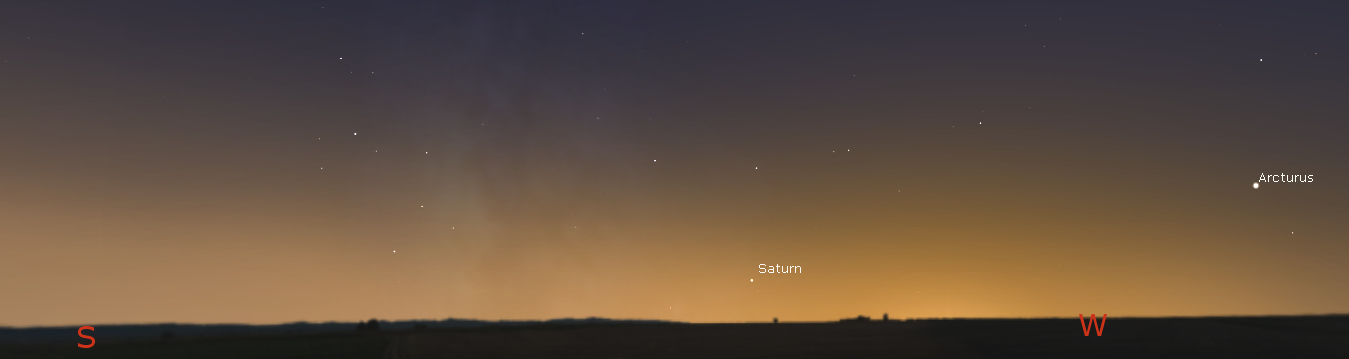
Saturn’s pretty low to the horizon at 6:15 p.m. November 4, 2015. Created using Stellarium. Click on image to enlarge.
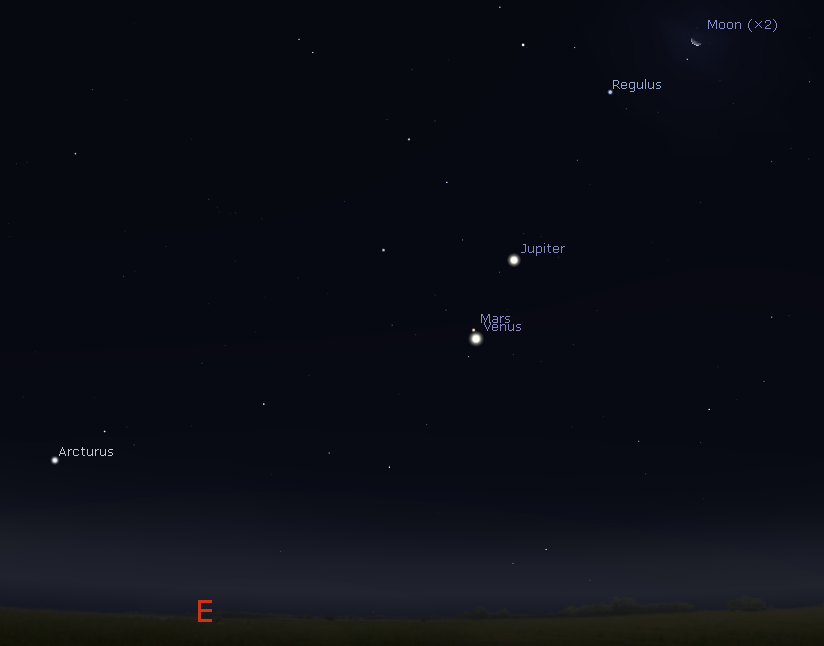
Mars is still close to Venus with Jupiter nearby in the southeast at 6 a.m. November 5, 2015. Created using Stellarium.
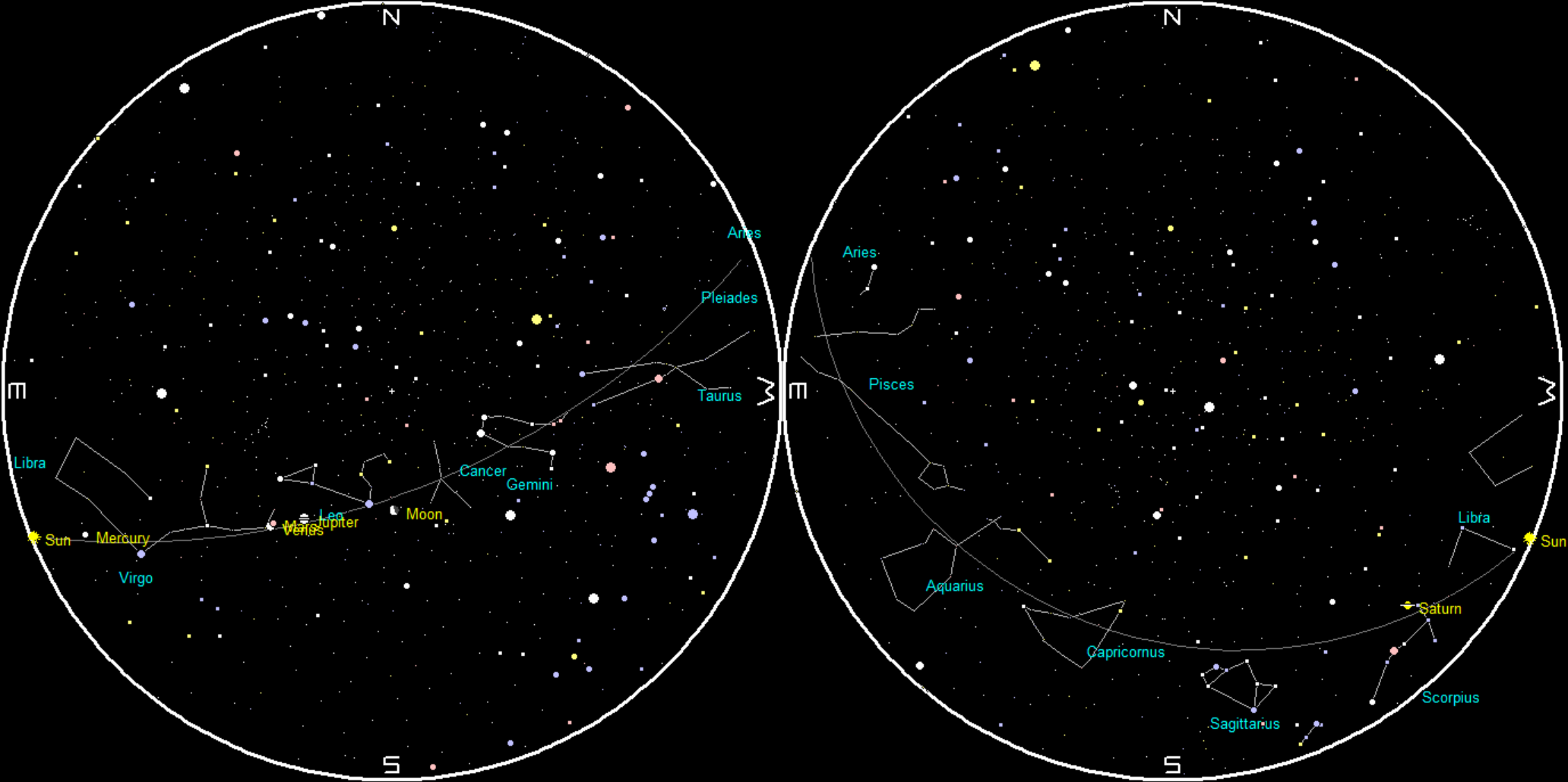
This is a chart showing the sunrise and sunset skies for November 4, 2015 showing the location of the planets and the Moon at that time. Created using my LookingUp program. Click on the image to enlarge.
10/03/2015 – Ephemeris – Venus and Mars pass each other this morning
Ephemeris for Tuesday, November 3rd, election day for some localities. The Sun will rise at 7:23. It’ll be up for 10 hours and 5 minutes, setting at 5:29. The Moon, at last quarter today, will rise at 12:26 tomorrow morning.
This morning the planets Mars and Venus will cross paths. Mars, which is much dimmer, will appear about 2 Moon diameters above and left of Venus. In fact if you view them at 7 a.m., binoculars may be your only hope to spot the red planet. Mars is a small planet, half the size of the Earth or Venus. It also farther from the Sun than either Venus or the Earth. When Mars is at its closest to the Earth it is actually brighter than Jupiter, but Mars varies its distance from the Earth by a great range, from 240 million miles (386 million km) at its greatest distance to about 35 million miles (56 million km) at its nearest. At its farthest, Mars is only as bright as a Big Dipper star. Venus and Jupiter also vary their brightness but to a smaller degree than Mars.
Times are for the Traverse City/Interlochen area of Michigan. They may be different for your location.
Addendum
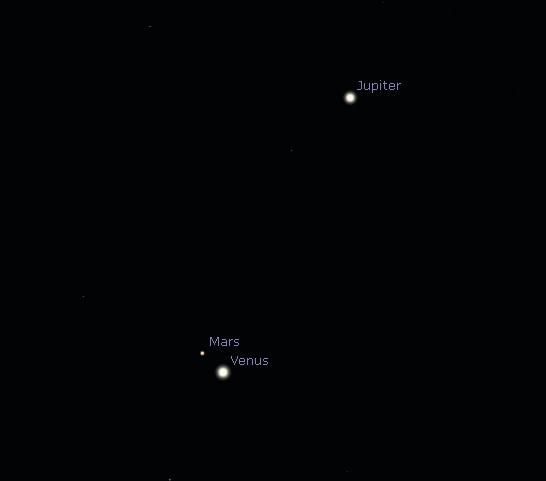
Venus in conjunction with Mars with Jupiter nearby in the southeast at 6 a.m. November 3, 2015. Created using Stellarium.
Venus is magnitude -3.95, distance is 113 million km, or 72 million miles away.
Mars is magnitude 1.88, distance is 326 million km or 203 million miles away.
Jupiter is magnitude -1.40, distance is 886 million km or 550 million miles away.
10/28/2015 – Ephemeris – The bright planets are gathered near the Sun in the evening and morning sky
Ephemeris for Wednesday, October 28th. The Sun will rise at 8:15. It’ll be up for 10 hours and 22 minutes, setting at 6:37. The Moon, 1 day past full, will rise at 7:52 this evening.
Let’s check out the whereabouts of the bright naked eye planets. The numbers of visible planets is getting a bit thin. The planet Saturn will be low in the west-southwest after sunset and will set at 8:06 p.m. It will be hard to find in evening twilight. In the morning sky the brilliant planet Venus will rise at 4:11 tomorrow morning. Jupiter will beat it above the horizon, rising at 3:33. Both will be quite high in the southeast by this program’s air time today. Jupiter will be just above Venus today and tomorrow morning. Mars will be below and to the left of these two. Mars will pass north of Venus next Tuesday. That will be a real contrast in brightness with Mars much fainter than Venus. Mercury has retreated back toward the Sun.
Times are for the Traverse City/Interlochen area of Michigan. They may be different for your location.
Addendum
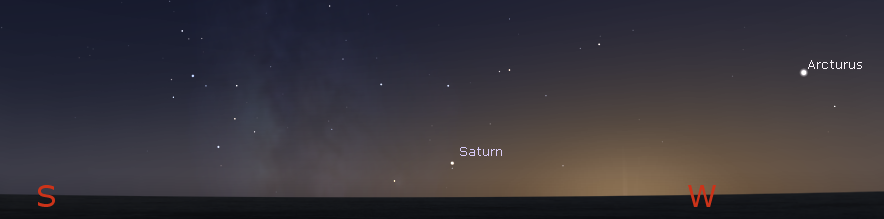
Saturn’s’ getting low in the twilight at 7:30 p.m. October 28, 2015. Created using Stellarium.
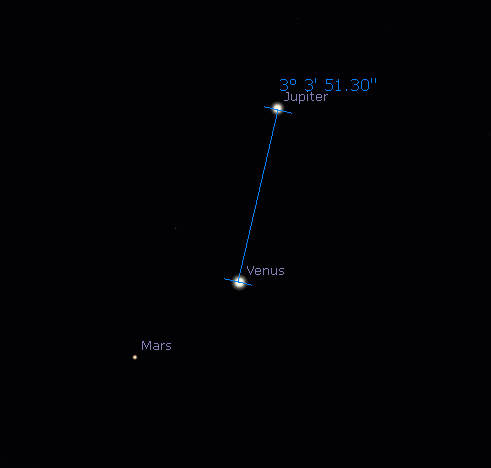
Venus with Jupiter 3 degrees above, with Mars below in the east-southeast at 7 a.m. October 29, 2015. Created using Stellarium.
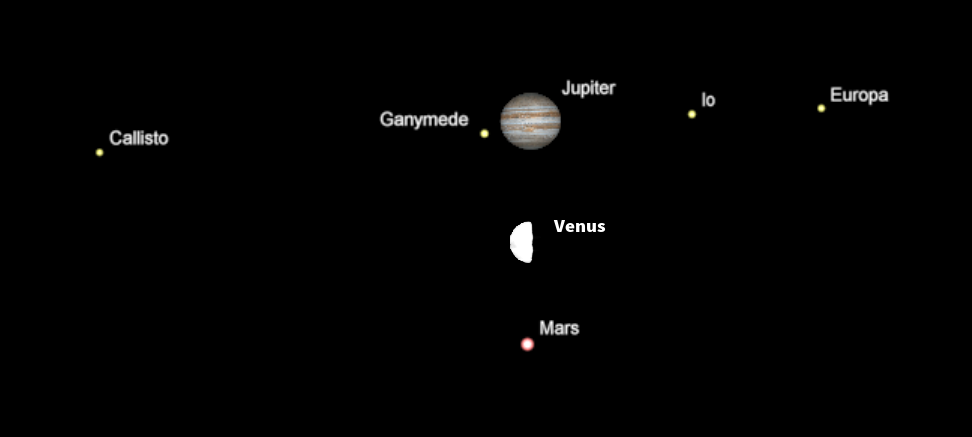
Apparent sizes of the morning planets Venus, Mars and Jupiter as seen through a telescope on October 29, 2015. Created using Cartes du Ciel (Sky Charts).
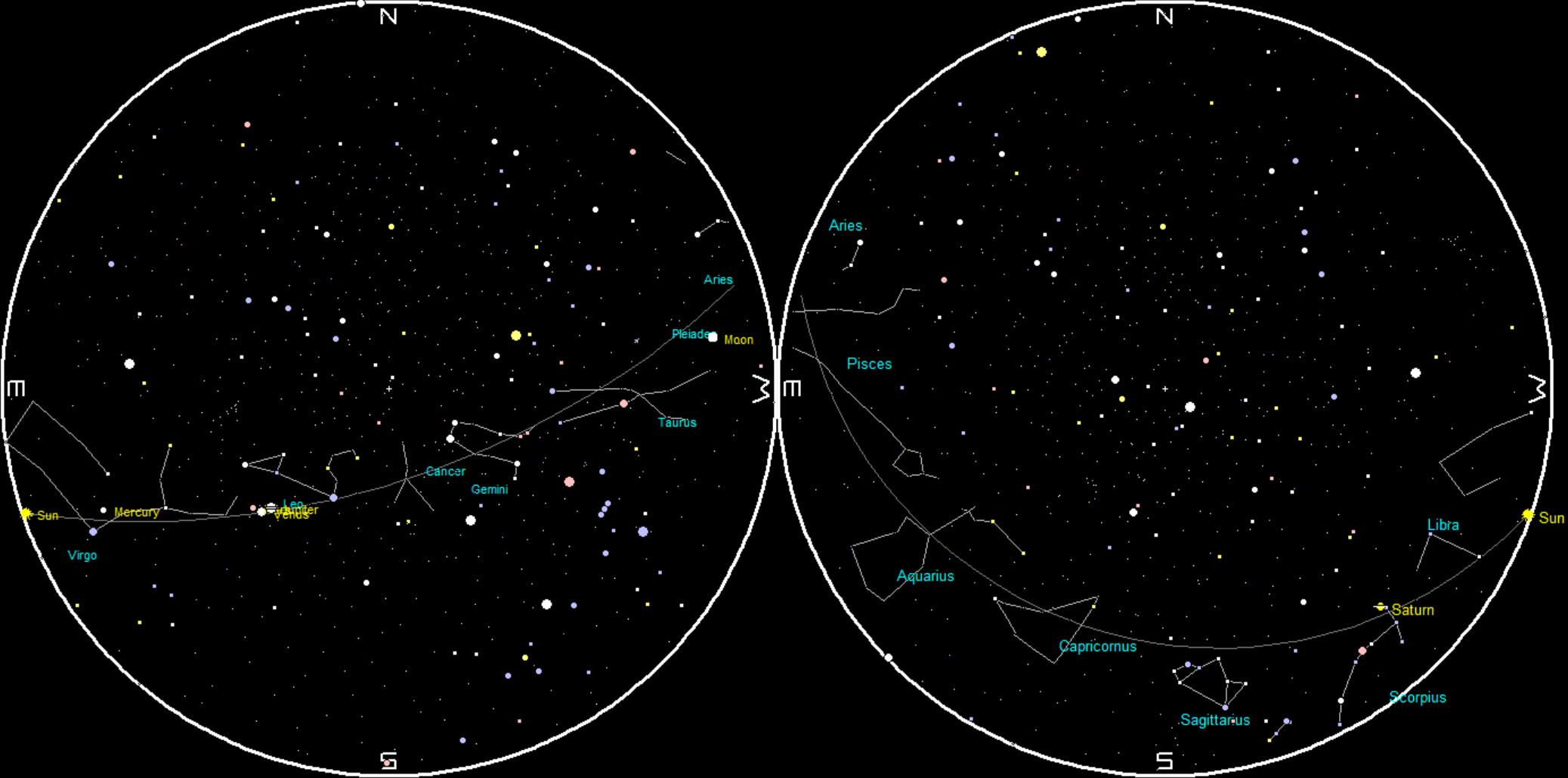
This is a chart showing the sunrise and sunset skies for October 28, 2015 showing the location of the planets and the Moon at that time. Created using my LookingUp program. Click on the image to enlarge.
10/23/2015 – Ephemeris – Jupiter approaches Venus this weekend
Ephemeris for Friday, October 23rd. The Sun will rise at 8:08. It’ll be up for 10 hours and 36 minutes, setting at 6:45. The Moon, 3 days past first quarter, will set at 4:23 tomorrow morning.
Over the weekend the planets Venus and Jupiter will approach each other, until on Monday morning they will be a bit more than a degree apart, or twice the diameter of the Moon apart. Of course in reality Jupiter is far more distant than Venus. Jupiter is 563 million miles (906 million km) away, while Venus is only 63 million miles (101 million km) away, about a ninth of Jupiter’s distance. Also, on Monday Venus will be at its greatest western elongation from the Sun, that is its greatest angular separation from the Sun of 46 degrees. Venus, like Mercury, which went through its greatest western elongation last week have orbits of the Sun inside that of the Earth, so never stray far from it. Venus never rises or sets more than 3 hours from the Sun.
Times are for the Traverse City/Interlochen area of Michigan. They may be different for your location.
Addendum
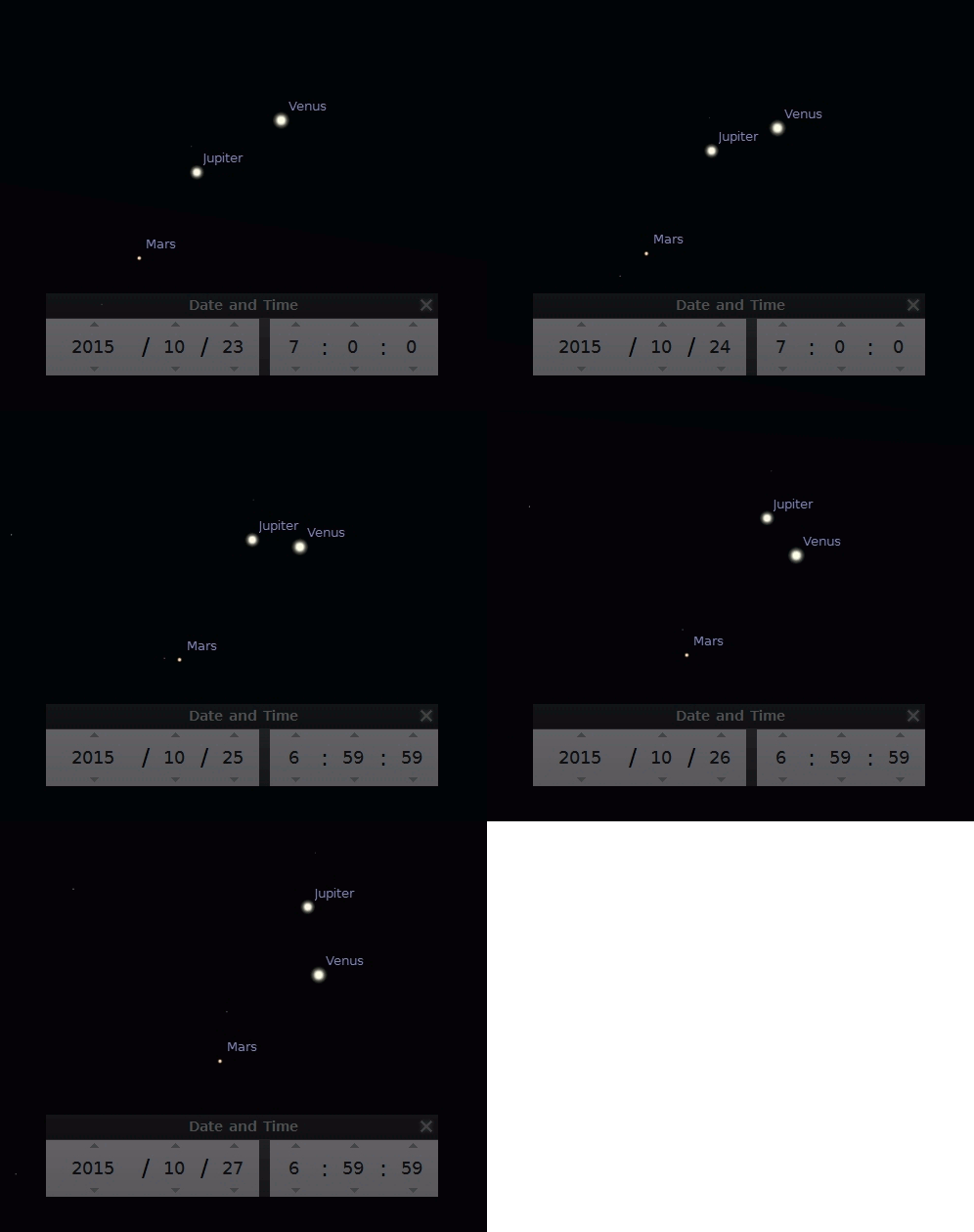
Jupiter passing Venus with Mars nearby in the east on the mornings of October 23, 24, 25, 26 and 27, 2015. Created using Stellarium and GIMP.
Check out my posts on the last two conjunctions of Jupiter and Venus in this series on August 18, 2014, and June 30, 2015. I discuss the possible connection to the Star of Bethlehem on my June 29th post.
10/21/2015 – Ephemeris – The bright planets and an anniversary star party
Update 5:05 p.m.:
The star party at the Sleeping Bear Dunes has been canceled due to clouds.
Ephemeris for Wednesday, October 21st. The Sun will rise at 8:05. It’ll be up for 10 hours and 42 minutes, setting at 6:48. The Moon, 1 day past first quarter, will set at 2:00 tomorrow morning.
We’ve got a busy day. The planet Saturn will be low in the west-southwest after sunset and will set at 8:31 p.m. In the morning sky the brilliant planet Venus will rise at 4:05 and be quite high at this program’s air time. Jupiter will be just below and left of it. Mars will be below and left of Jupiter by a similar amount. Both rise within 20 minutes of Venus. Far below and left will be Mercury which will rise at 6:38. Tonight is the last star party of the year at the Sleeping Bear Dunes National Lakeshore. This is the lakeshore’s 45th anniversary. It will held starting at 8 p.m. at Pierce Stocking Drive Stop #3 the Dunes Overlook if it’s clear, Park at Picnic Mountain. The Moon will be the big attraction tonight. The Grand Traverse Astronomical Society has been holding star parties at the Sleeping Bear Dunes since the park’s 40th anniversary in 2010.
Times are for the Traverse City/Interlochen area of Michigan. They may be different for your location.
Addendum
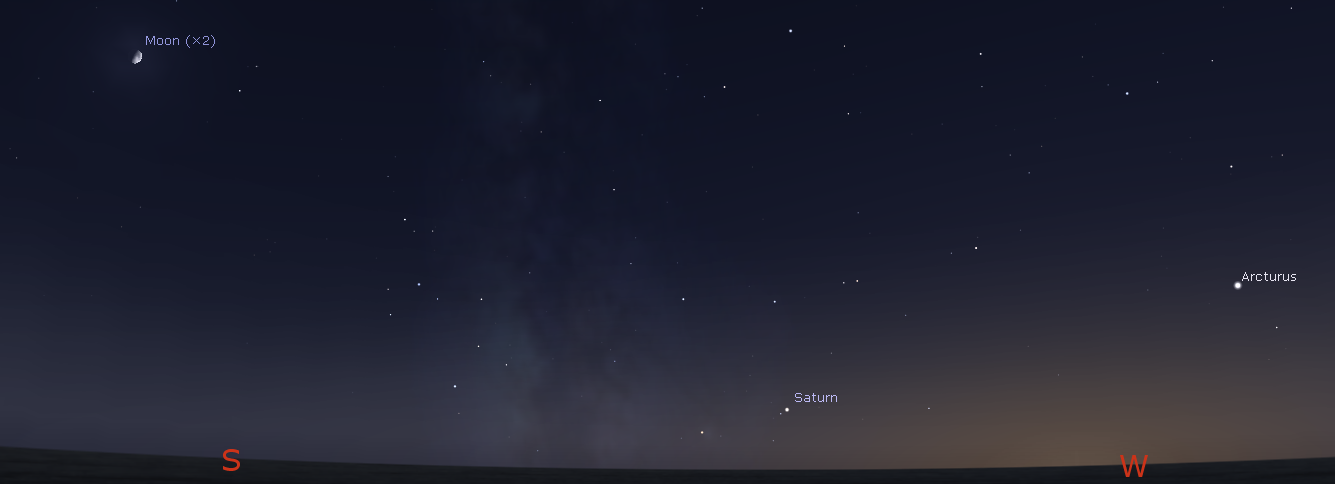
Saturn and the Moon (at twice normal size) at 7:30 p.m. October 21, 2015. Created using Stellarium.
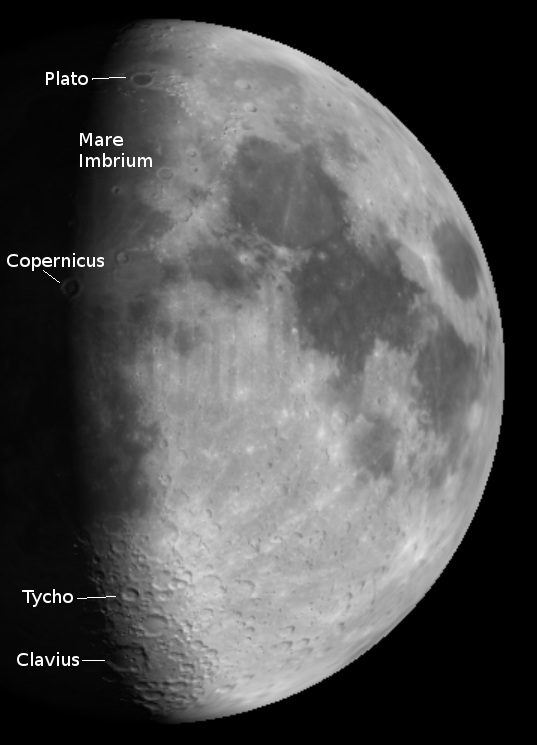
The telescopic Moon tonight, October 21, 2015, for the star party at Sleeping Bear Dunes. Created using Virtual Moon Atlas.
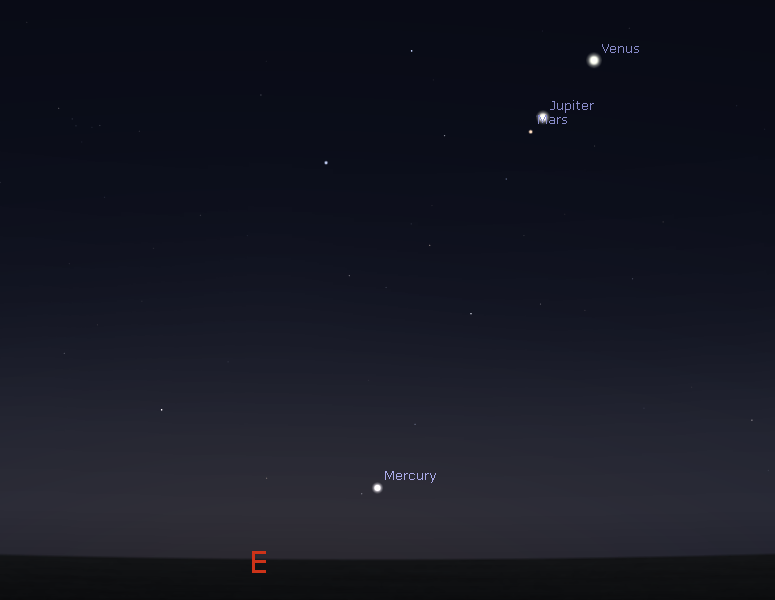
The morning planets at 7 a.m., October 22, 2015. Created using Stellarium.
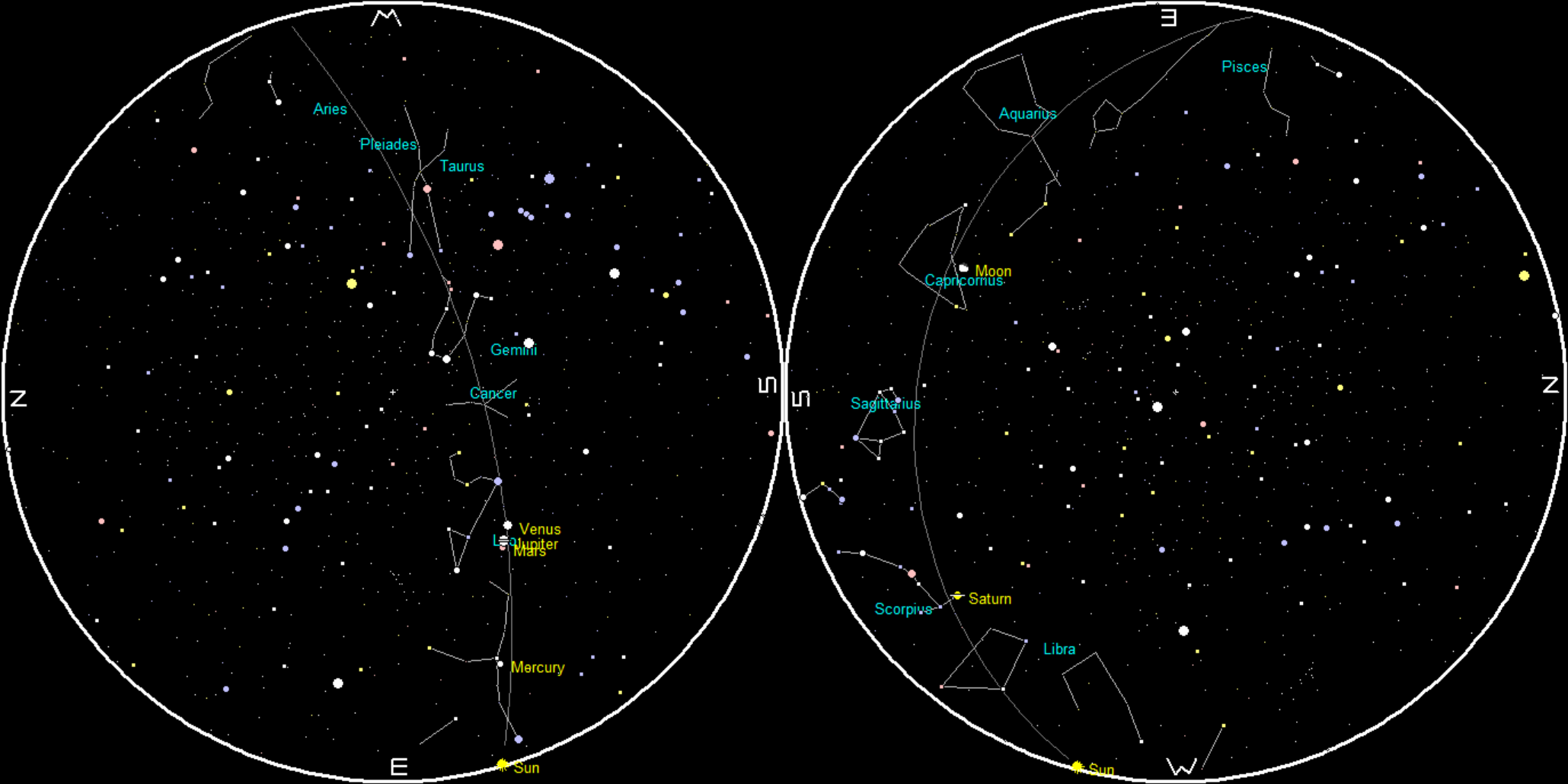
This is a chart showing the sunrise and sunset skies for October 21, 2015 showing the location of the planets and the Moon at that time. The charts are rotated 90 degrees to more clearly show the traffic jam of the morning planets. Created using my LookingUp program. Click on the image to enlarge.
10/14/2015 – Ephemeris – The planet get together in the morning
Ephemeris for Wednesday, October 14th. The Sun will rise at 7:56. It’ll be up for 11 hours and 3 minutes, setting at 7:00. The Moon, 2 days past new, will set at 8:06 this evening.
Lets see what’s happening with the bright planets. Saturn is alone in the evening sky spotted by 8 p.m. low in the west-southwestern sky near the bright star Antares to its left. Antares has a reddish hue, while Saturn is brighter and yellowish. Both these colors are enhanced by being low to the horizon. Saturn will set at 8:56 p.m. The rest of the planets are in the morning sky and seeing more action. Brilliant Venus, the morning star, will rise at 4 a.m. a bit north of east. Below and left of Venus is bright Jupiter, though not as bright as Venus. Above it tomorrow is dim Mars. They will pass each other on Saturday. Jupiter will rise at 4:37 preceded by 7 minutes by Mars. Mercury is way below these, but brightening. It will rise at 6:20.
Times are for the Traverse City/Interlochen area of Michigan. They may be different for your location.
Addendum
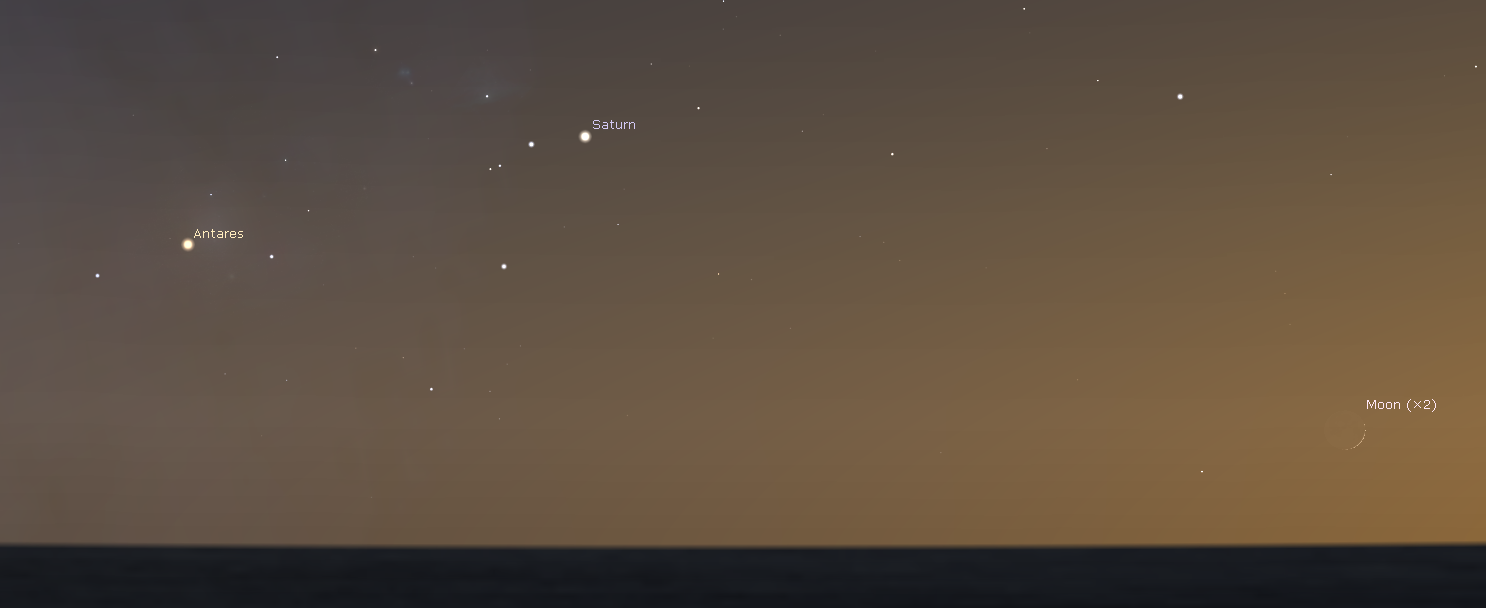
Saturn and Antares appear in west-southwestern twilight with the thin crescent Moon, shown twice its actual size to show up at all, at 7:45 p.m., October 14, 2015. Created using Stellarium.
The morning planets getting together at 7 a.m. Mercury will be falling back toward the Sun after tomorrow. Created using Stellarium.
Apparent sizes of the morning planets Venus, Mars and Jupiter as seen through a telescope. Created using Cartes du Ciel (Sky Charts).
This is a chart showing the sunrise and sunset skies for October 14, 2015 showing the location of the planets and the Moon at that time. Created using my LookingUp program. Click on the image to enlarge.
10/08/2015 – Ephemeris – The Draconid meteors will reach peak overnight tonight
Ephemeris for Thursday, October 8th. The Sun will rise at 7:49. It’ll be up for 11 hours and 21 minutes, setting at 7:10. The Moon, half way from last quarter to new, will rise at 4:33 tomorrow morning.
For this and the next few morning the Moon will pass the morning planets. This morning it’s Venus, tomorrow it will be near Mars and Jupiter, and Sunday morning it will be near Mercury.
This evening is the expected peak of the Draconid meteor shower. We can expect anything between zero and hundreds of meteors an hour. The calculated time of the peak number will be around 1:40 a.m. (5:40 UT, October 9). The point in space they will appear to come from is the head of the constellation Draco the dragon, a bit north of the bright star Vega, high in the west in the evening. Meteor experts don’t expect much from the shower this year, but the Draconids are capricious, you never know what to expect. However we do expect them to be slow-moving.
Times are for the Traverse City/Interlochen area of Michigan. They may be different for your location.
Addendum
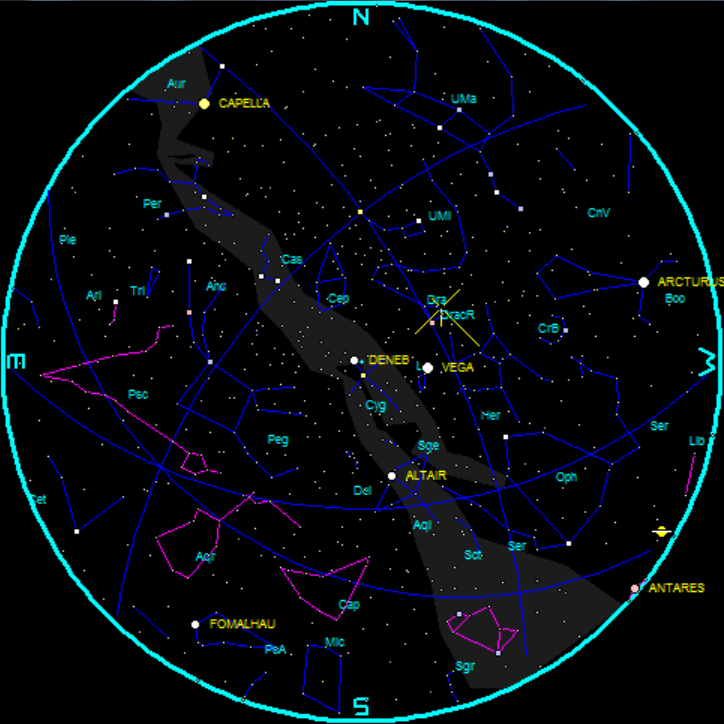
The entire sky dome including the Draconid Radiant (DraR) for 9 p.m. October 8, 2015 (1:00 UT 10/9). Created with my LookingUp program.
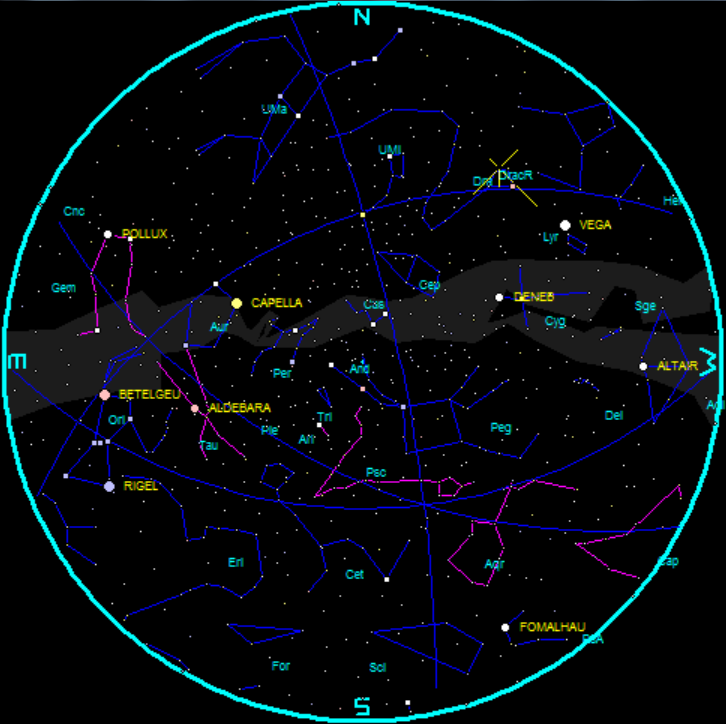
The entire sky dome including the Draconid Radiant (DraR) for 1:40 a.m. October 9, 2015 (05:40 UT). Created with my LookingUp program.
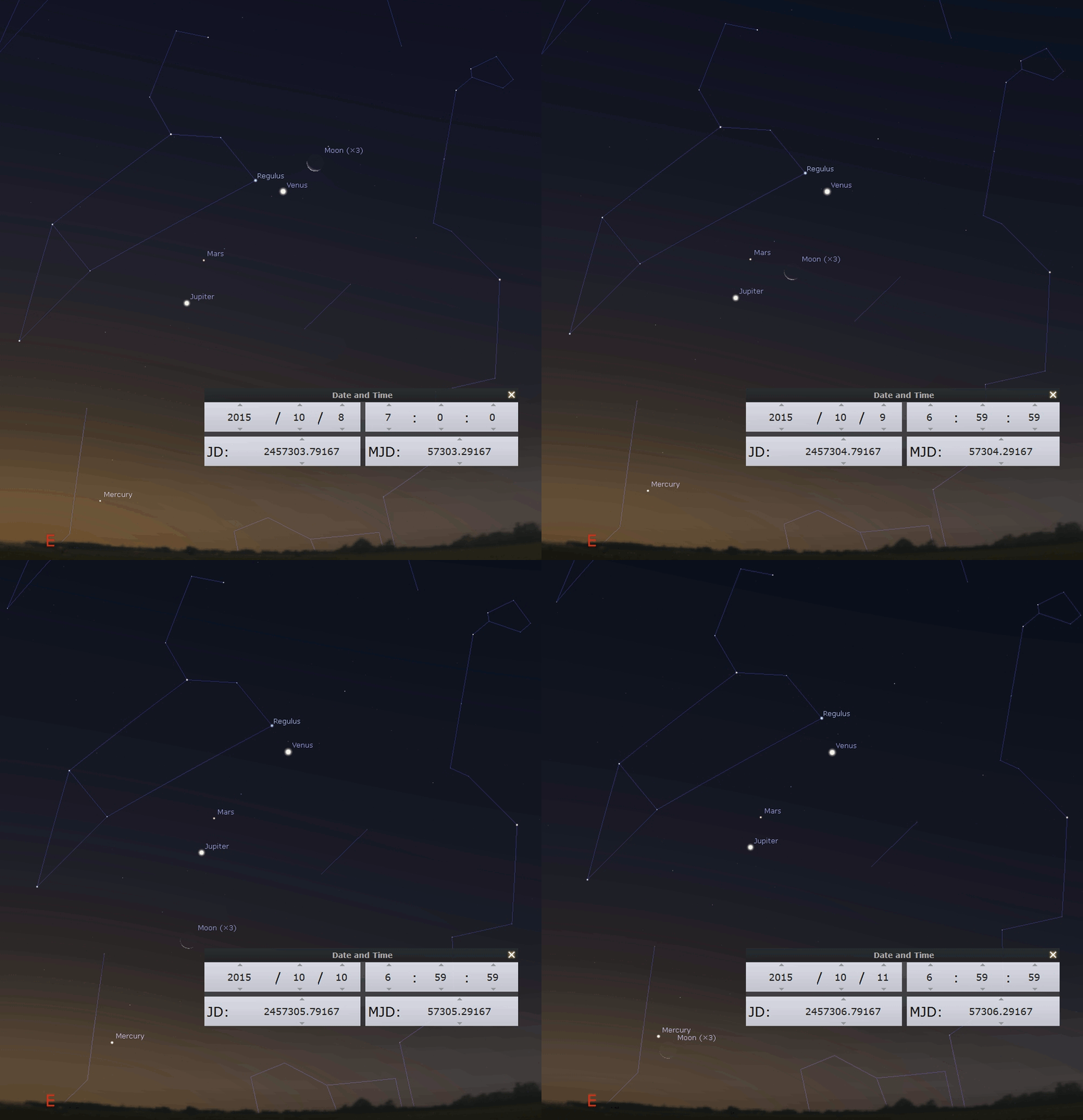
Morning planet animation for 7 a.m. October 8 to 11, 2015. Click on image to enlarge. Note the Moon’s size is tripled for visibility. Created using Stellarium 0.13 and GIMP.
 Bob Moler's Ephemeris Blog