Archive
07/09/2015 – Ephemeris – The first stars to appear at night
Ephemeris for Thursday, July 9th. Today the Sun will be up for 15 hours and 23 minutes, setting at 9:29. The Moon, 1 day past last quarter, will rise at 2:05 tomorrow morning, and tomorrow the Sun will rise at 6:07.
Let’s check out all the bright stars in the evening sky, as it gets dark tonight. Low in the west are the planets Venus and Jupiter. High in the west is the bright yellow-orange star Arcturus. In the northwest is the Big Dipper, whose curved handle points to Arcturus. Straightening that curve to a spike will point to Spica a blue-white star low in the southwest. The planet Saturn is located in the south. Below and left of it is the red star Antares which usually twinkles merrily. High in the east is the bright white star Vega. To its lower right is Altair, and to its lower left the star Deneb. Vega, Altair and Deneb make the Summer Triangle, whose rising in the east signals the coming of summer.
Times are for the Traverse City/Interlochen area of Michigan. They may be different for your location.
Addendum
I talked about seeing the first stars a month ago. It seems that in holding star parties this time of year we spend a lot of time watching the first stars appear. I wanted to discuss the Summer Triangle, but it wandered off to what you see above. I’ll get there next week, I promise.
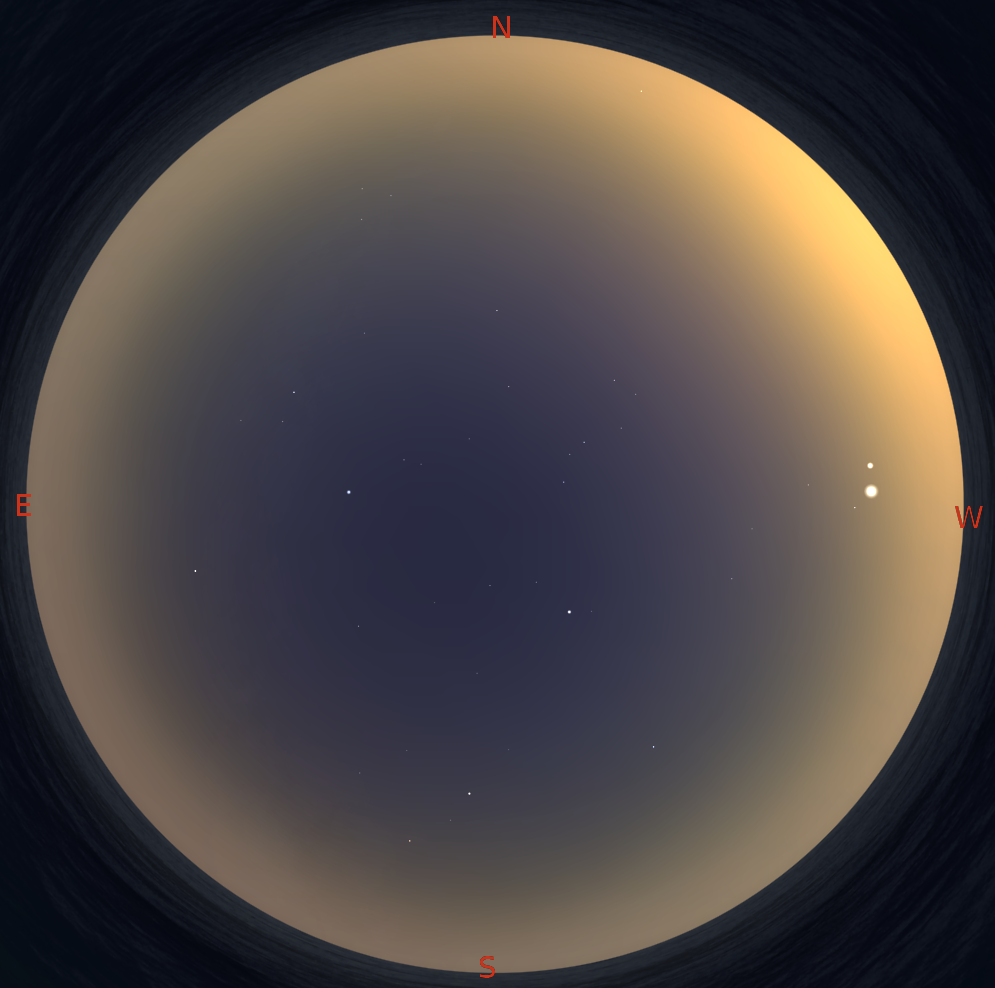
The first stars and planets to appear. See if you can located them from the text. Created using Stellarium for about 10 p.m., July 9, 2015.
07/08/2015 – Ephemeris – The bright planets are hanging around in the evening.
Ephemeris for Wednesday, July 8th. Today the Sun will be up for 15 hours and 24 minutes, setting at 9:29. The Moon, at last quarter today, will rise at 1:30 tomorrow morning, and tomorrow the Sun will rise at 6:06.
Lets take a look at the bright planets for this week. Our evening stars Venus and Jupiter are side by side in the west by 9:45 p.m. They both will set at 11:21 p.m.. Venus’ will slide down to the Sun faster and faster in the coming weeks leaving Jupiter behind for a while. Venus will take 5 weeks to slide past the Sun. Jupiter though will take 7 weeks, so Venus will pass it again around August 4th when both are too close to the horizon and Sun to spot. There’s a third conjunction of these two in October in the morning sky with Mars nearby. Saturn is in the south in the evening twilight. It will pass due south at 10:24 p.m. and will set at 3:16 a.m. Even small telescopes can see Saturn’s rings.
Times are for the Traverse City/Interlochen area of Michigan. They may be different for your location.
Addendum
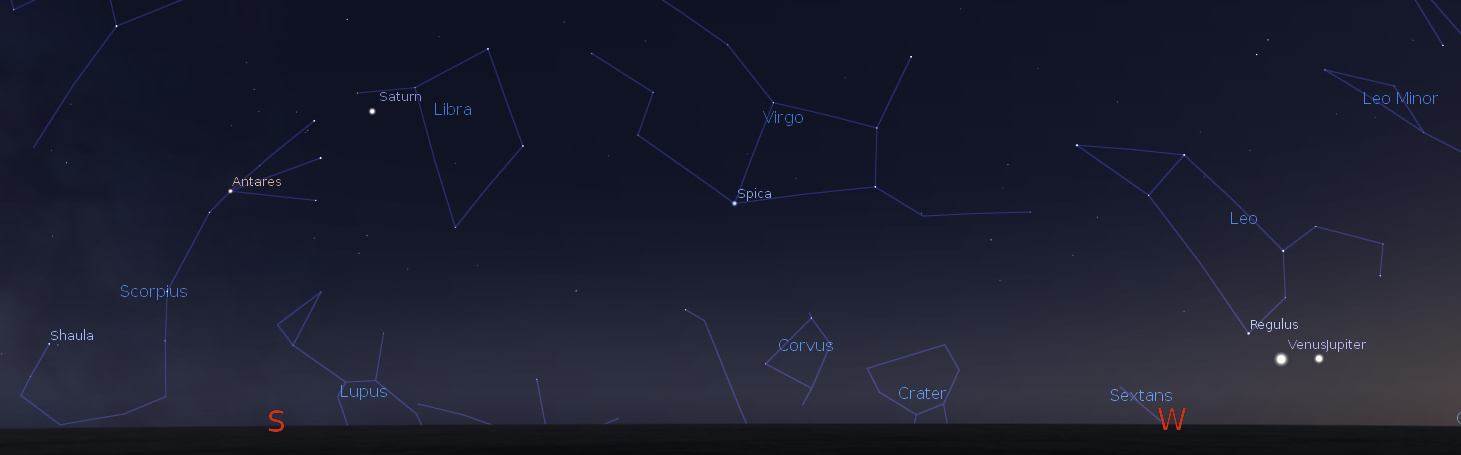
The evening planets at 10:30 p.m. July 8, 2015. Created using Stellarium.
Venus’ greatest brilliancy will be on Sunday the 12th. This is the point where Venus’ increasing size is countered by its decreasing phase. The brightness of Venus doesn’t change much over its orbit, and will be stay brilliant. However it will surrender to the brightening twilight as it sets closer and closer to sunset.
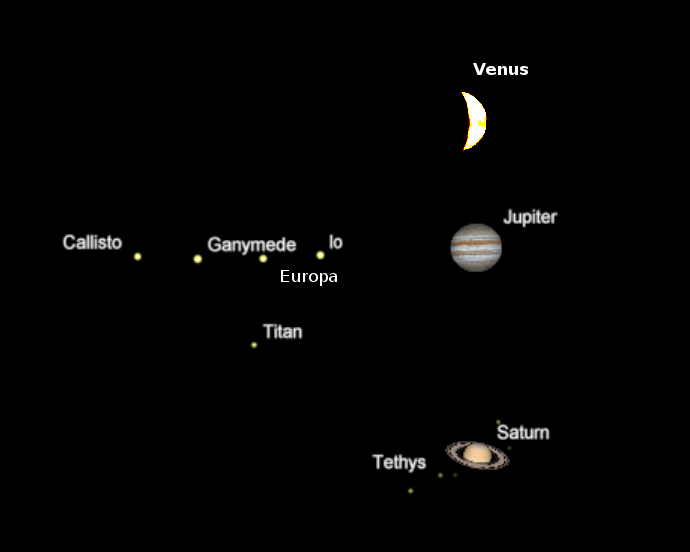
The evening planets as seen with the same magnification. Note that Venus is noticeably larger appearing than Jupiter. This is probably the time Venus’ crescent is visible in binoculars. Created using Cartes du Ciel (Sky Charts).
07/01/2015 – Ephemeris – Jupiter, Venus and Saturn grace our evening sky
Ephemeris for Wednesday, July 1st. Today the Sun will be up for 15 hours and 31 minutes, setting at 9:32. The Moon, at full today, will rise at 8:58 this evening and tomorrow the Sun will rise at 6:01.
Lets take a look at the bright planets for this week. Our brilliant evening star Venus and Jupiter are close together in the west by 9:45 p.m. They will set around 11:45 p.m.. Venus’ will slide down to the Sun faster and faster in the coming weeks leaving Jupiter behind for a while. Venus will take a month and a half to slide past the Sun. Jupiter though will take 2 months, so Venus will pass it again around August 4th when both are too close to the horizon and Sun to spot. There’s a third conjunction of these two in October in the morning sky with Mars nearby. Saturn is in the southeast in evening twilight. It will pass due south at 10:53 p.m. and will set at 3:41 a.m. Even small telescopes can see Saturn’s rings.
Times are for the Traverse City/Interlochen area of Michigan. They may be different for your location.
Addendum
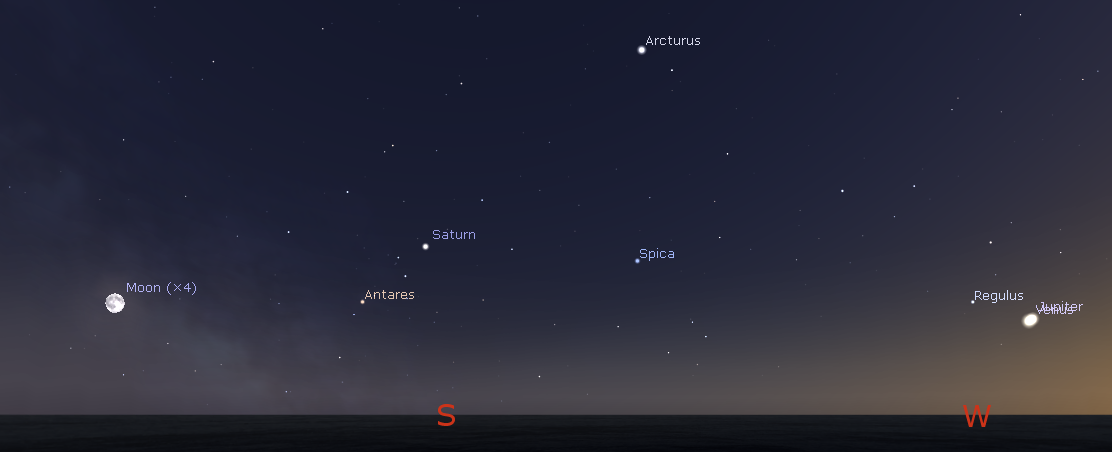
The evening planets and the Moon at 10:30 p.m. July 1, 2015. Though their images overlap Jupiter is above right of Venus. Click on the image to enlarge. Created using Stellarium.
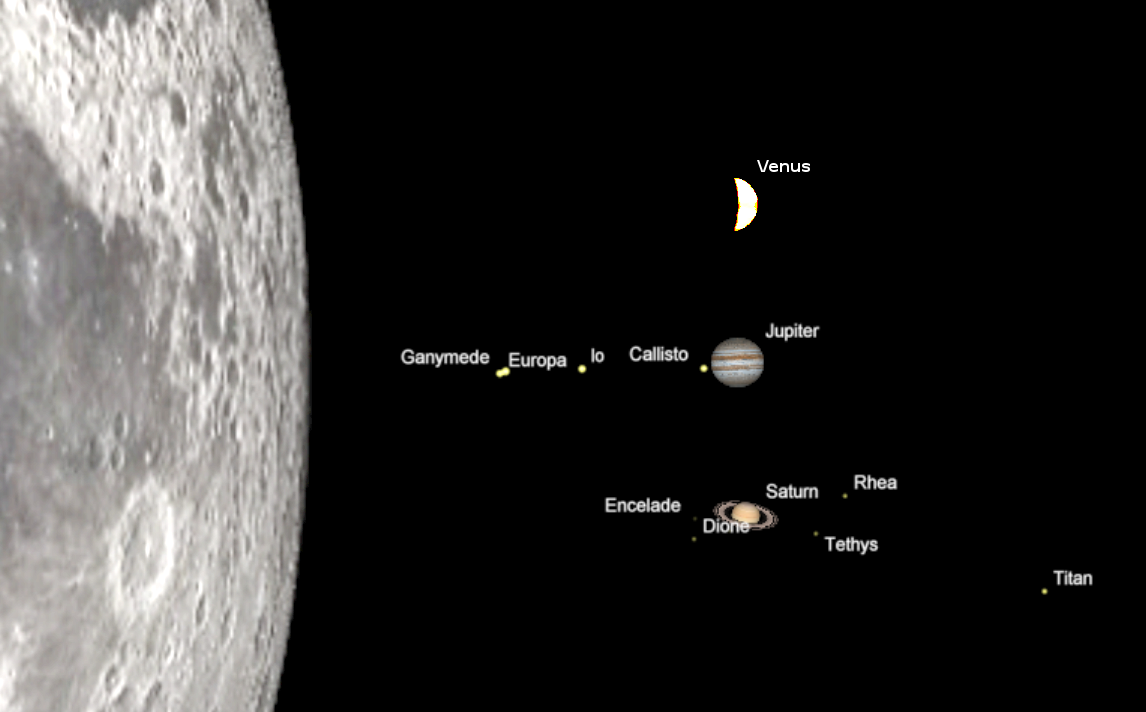
The evening planets and the Moon with their satellites to scale at 10:30 p.m. July 1, 2015. Created using Stellarium.
Mercury is officially in the morning sky now, but it is not a favorable appearance for northern hemisphere observers.
06/30/2015 – Ephemeris – Tonight’s close conjunction of Jupiter and Venus will be visible in the west after sunset
Ephemeris for Tuesday, June 30th. Today the Sun will be up for 15 hours and 31 minutes, setting at 9:32. The Moon, 1 day before full, will set at 5:49 tomorrow morning and tomorrow the Sun will rise at 6:00.
Tonight the planets Venus and Jupiter will appear at their closest in the western sky after sunset. Dimmer Jupiter will appear just above Venus by 20 minutes of arc or two-thirds of the width of the Moon. They can both be seen in the same telescope field using low power. It’s interesting that Jupiter, is over 11 times the diameter of Venus, but because Venus is so much closer to us, it now appears to be the same size as Jupiter, and it will continue to grow. It’s 48 million miles away and closing to 27 million on August 15th when it passes between the Earth and the Sun. Astrologers think a conjunction like this means something, while astronomers like me see two bright planets which happen to be beautifully aligned along our line of sight.
Times are for the Traverse City/Interlochen area of Michigan. They may be different for your location.
Addendum
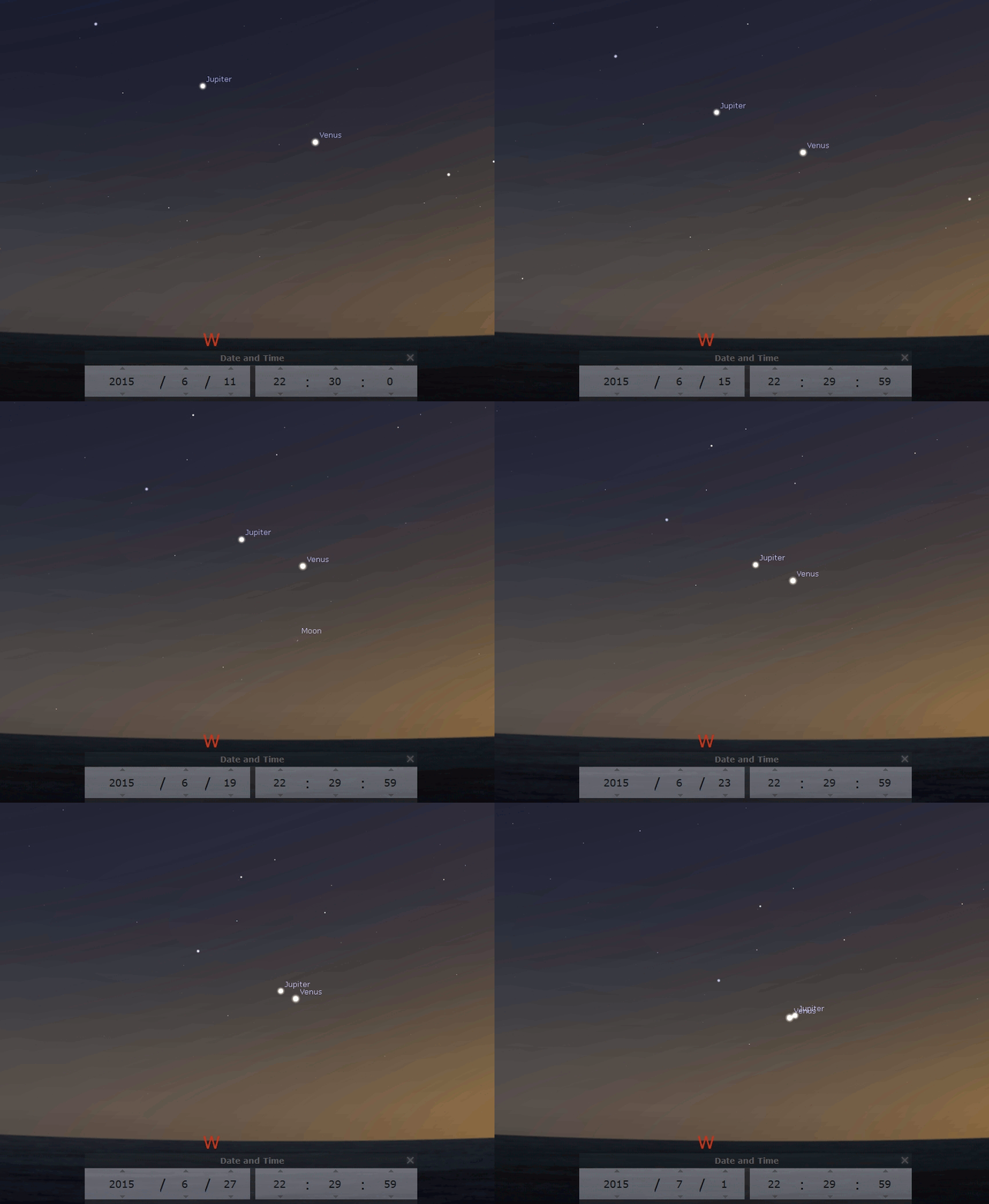
Jupiter-Venus approach animation June 11 to July 1, 2015 at 10:30 p.m. Created using Stellarium and GIMP. Click on image to enlarge.
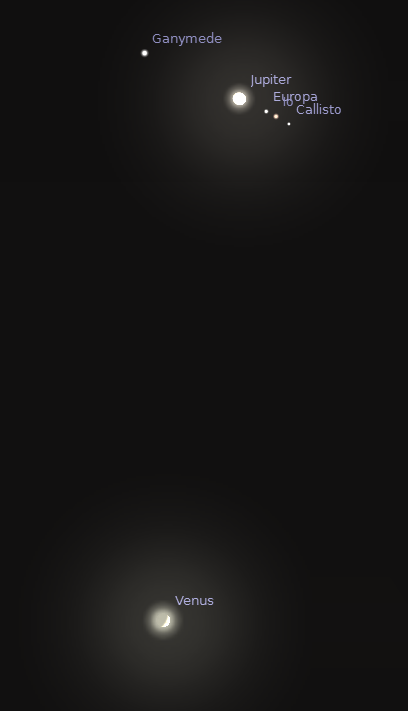
A telescopic view of what we expect the positions of Jupiter and Venus at 10:30 p.m. EDT June 30, 2015 (2:20 UT July 1, 2015). Created using Stellarium.
06/29/2015 – Ephemeris – Did tomorrow’s conjunction between Venus and Jupiter happen before?
Ephemeris for Monday, June 29th. Today the Sun will be up for 15 hours and 32 minutes, setting at 9:32. The Moon, 2 days before full, will set at 4:56 tomorrow morning and tomorrow the Sun will rise at 6:00.
Tonight the planet Jupiter will be a bit more than the width of the Moon away from Venus. Tomorrow that distance will be cut in half as Jupiter will pass directly above Venus. This is a second of two conjunctions that are a near repeat of two conjunctions that some, including myself have speculated as being what the Magi reported as the Star of Bethlehem in 3 and 2 BC. On August 12th 3 BC in the predawn sky Jupiter and Venus were a third of a moon width apart, Then on June 17th 2 BC they were in conjunction again but even closer . Last year we had a close conjunction of the two on August, 18th and the two will be in conjunction, and again tomorrow. Neither are as close as they were in 3 and 2 BC.
Times are for the Traverse City/Interlochen area of Michigan. They may be different for your location.
Addendum
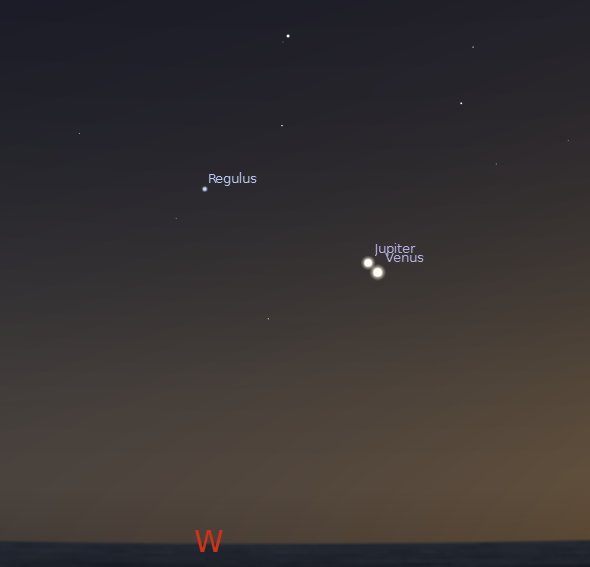
Jupiter and Venus at 10:30 tonight June 29, 2015, one day before their conjunction. Created using Stellarium.
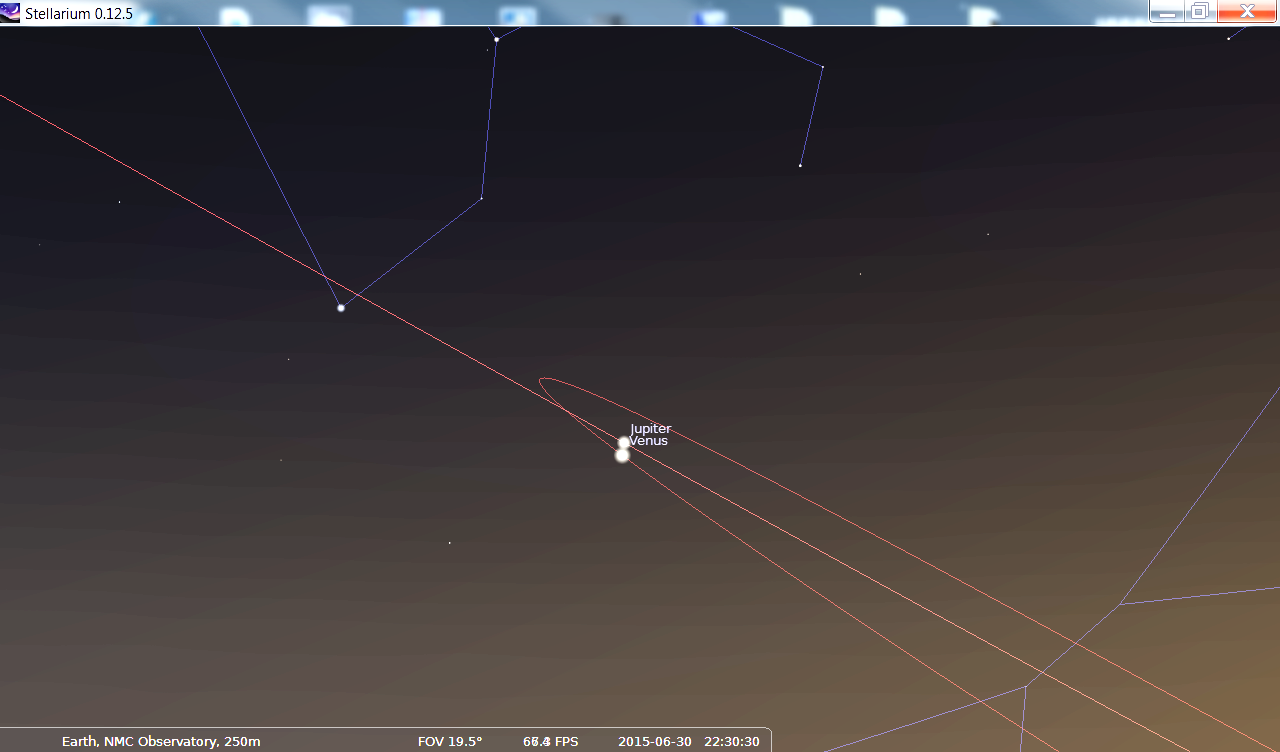
The orbits of Venus and Jupiter for the conjunction of June 30, 2015. The bright star to the upper left is Regulus. Created using Stellarium.
A telescopic view of what we expect the positions of Jupiter and Venus at 10:30 p.m. EDT June 30, 2015 (2:20 UT July 1, 2015). Created using Stellarium.
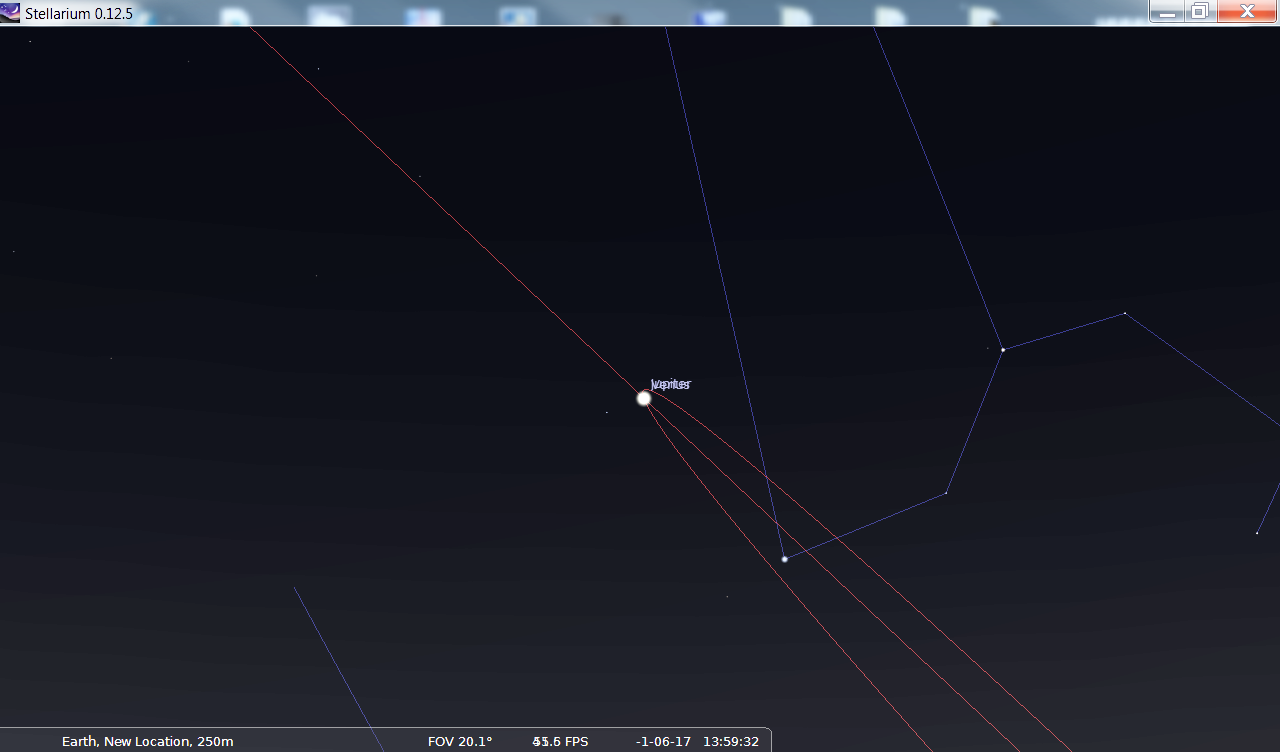
The orbits of Venus and Jupiter for the conjunction of June 17, 2 BC. The bright star to the lower right is Regulus. Created using Stellarium.
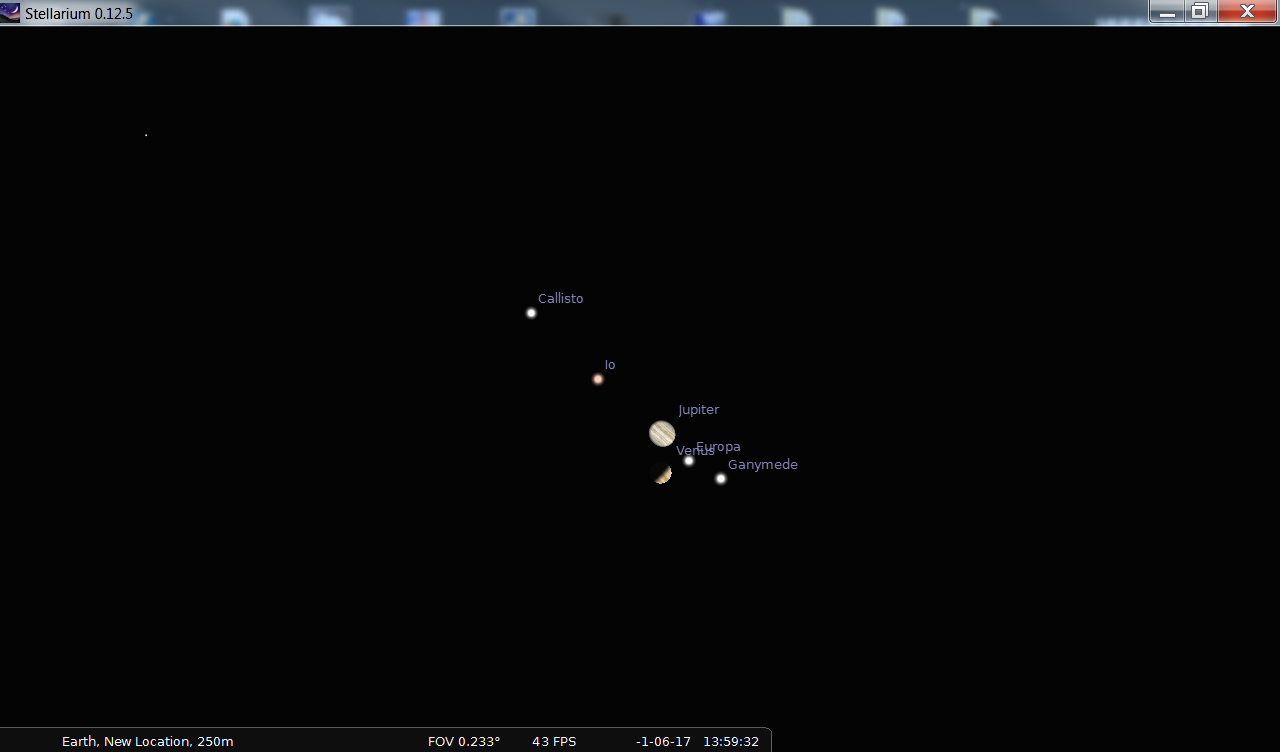
Venus appeared among Jupiter’s moons on August 12, 3 BC. Of course no one had a telescope back then. Created using Stellarium.
I’ve written about the Jupiter-Venus conjunctions of 3 and 2 BC. You can see it here from my Ephemeris website..
06/24/2015 – Ephemeris – Jupiter and Venus inch closer while Saturn keeps its distance
Ephemeris for Wednesday, June 24th. Today the Sun will be up for 15 hours and 34 minutes, setting at 9:32. The Moon, at first quarter today, will set at 1:58 tomorrow morning and tomorrow the Sun will rise at 5:58.
Lets take a look at the bright planets for this week. Our brilliant evening star Venus is in the west by 9:45 p.m. It will set around midnight. Venus’ will slide down to the Sun faster and faster in the coming weeks. It will take a bit less than 2 months. Jupiter will appear western sky to the left of and slightly above Venus at about 10 p.m. It will set at 12:09 a.m. It seems to approach Venus, and now appears about 3 and a half degrees away. That’s about three finger widths held at arm’s length. They will cross paths in 6 days, on the 30th. Saturn is in the southeast in evening twilight. It will pass due south at 11:22 p.m. and will set at 4:10 a.m. Even small telescopes can see Saturn’s rings.
Times are for the Traverse City/Interlochen area of Michigan. They may be different for your location.
Addendum
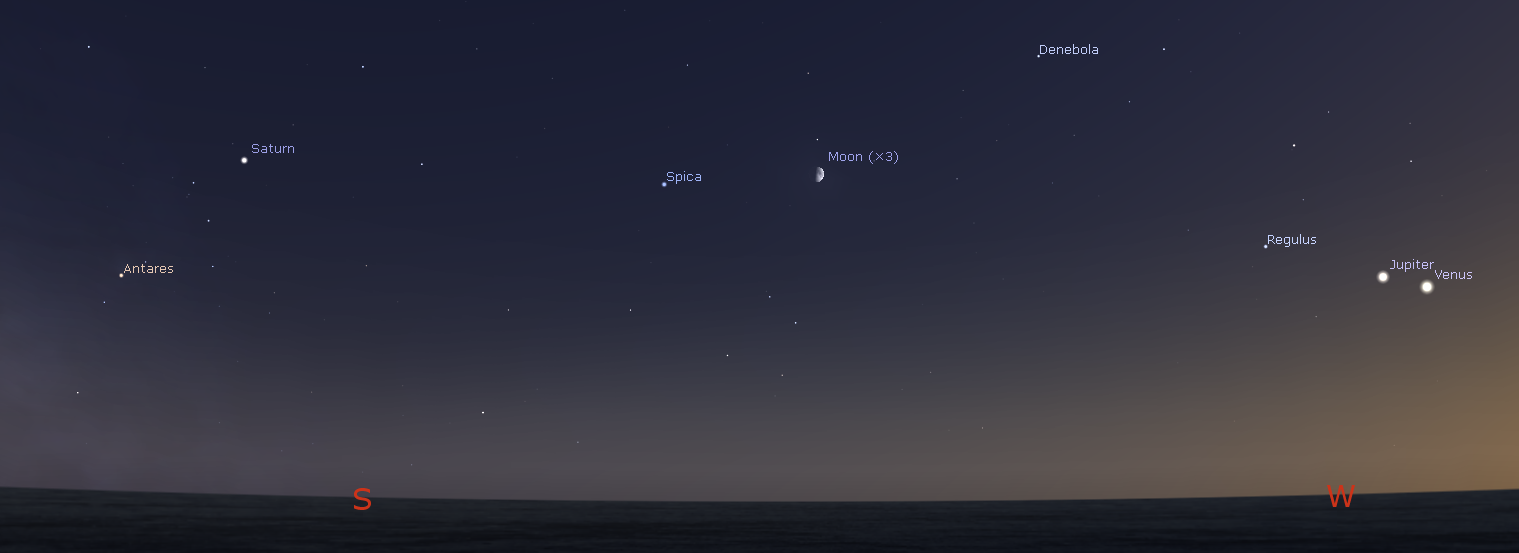
Jupiter and Venus converge in the west while the Moon and Saturn look on. 10:30 p.m., June 24, 2015. Created using Stellarium. Click to enlarge.
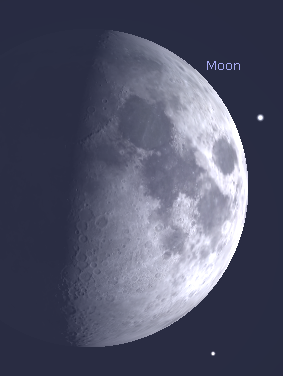
Closeup of the Moon at 10:30 p.m. June 24, 2015. Created using Stellarium.
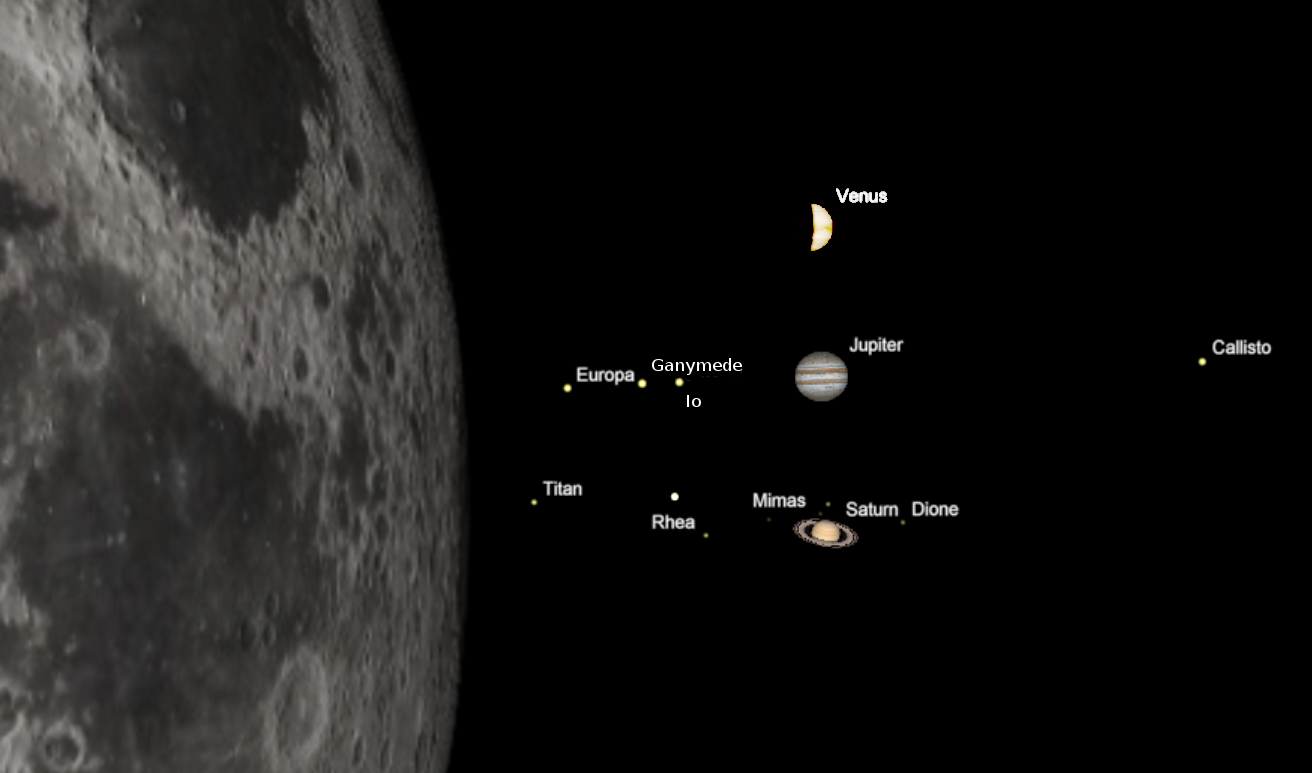
The evening planets and the Moon using the same magnification at 10:30 p.m., June 24, 2015. Created using Cartes du Ciel (Sky Charts). Click on image to enlarge.
Note that over the last few Wednesdays that I’ve portrayed the planets at the same scale that Venus has been getting larger with respect to Jupiter as it approaches the Earth and Jupiter moves away.
Jupiter-Venus approach animation June 11 to July 1, 2015 at 10:30 p.m. Created using Stellarium and GIMP. Click on image to enlarge.
06/17/2015 – Ephemeris – Jupiter and Venus approach each other while Saturn looks on
Ephemeris for Wednesday, June 17th. Today the Sun will be up for 15 hours and 34 minutes, setting at 9:30. The Moon, 1 day past new, will set at 10:14 this evening. Tomorrow the Sun will rise at 5:56.
Lets take a look at the bright planets for this week. Our brilliant evening star Venus is in the west by 9:45 p.m. It will set at 12:19 a.m. Venus’ will slide down to the Sun faster and faster in the coming weeks. It will take a bit less than 2 months. Jupiter will appear western sky to the left of and slightly above Venus at about 10 p.m. It will set at 12:34 a.m. It seems to approach Venus, and now appears about 8 degrees away. That’s somewhat less than the width of your fist held at arm’s length. They will cross paths in 13 days, on the 30th. Saturn is in the southeast in evening twilight. It will pass due south at 11:51 p.m. and will set at 4:39 a.m. Check out Saturn’s rings in any small telescope.
Times are for the Traverse City/Interlochen area of Michigan. They may be different for your location.
Addendum
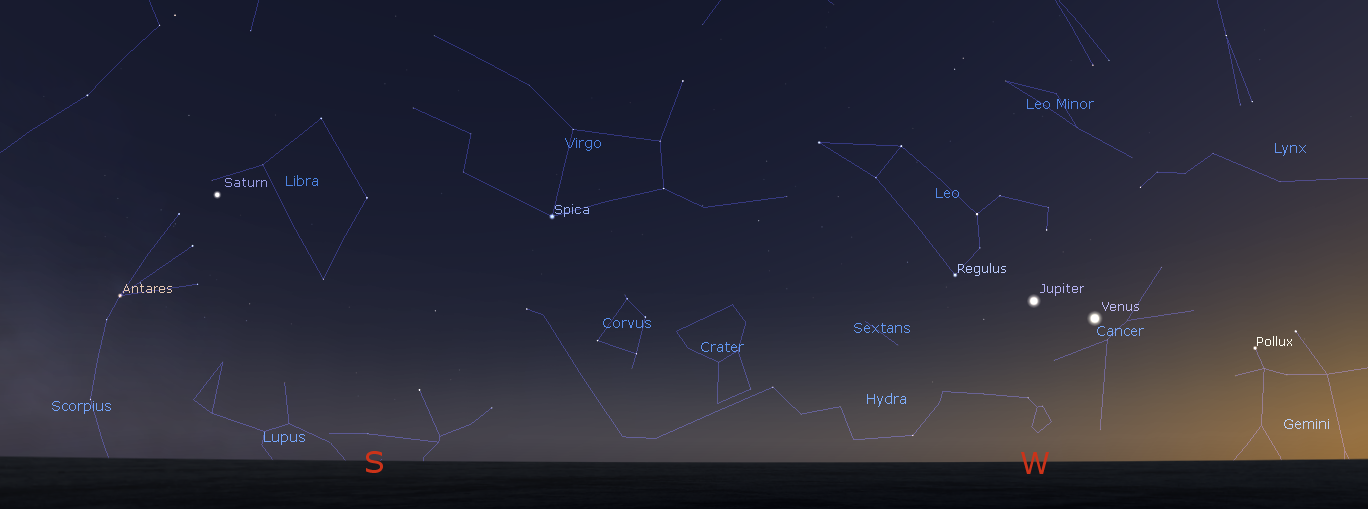
Venus, Jupiter and Saturn with the late spring southern constellations at 10:30 p.m., June 17, 2015. Created using Stellarium. Click on image to enlarge.
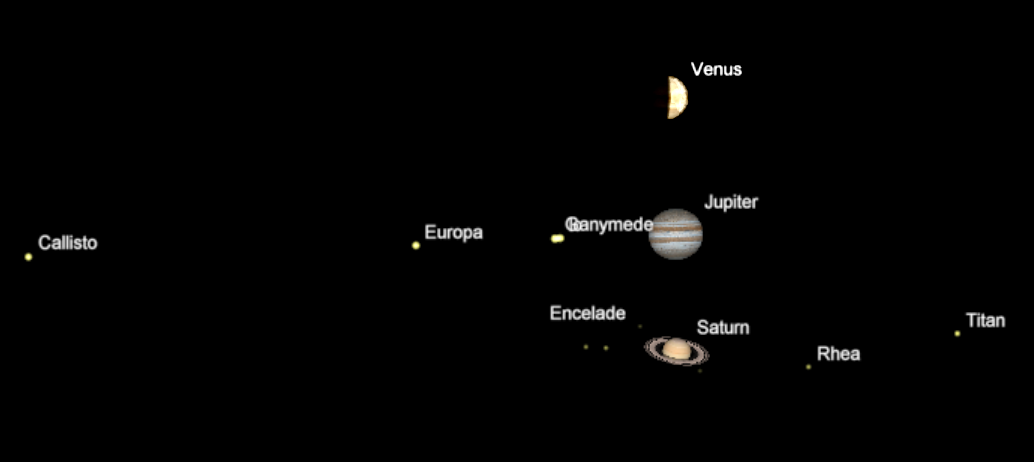
The evening planets using the same magnification at 10:30 p.m., June 17, 2015. Created using Cartes du Ciel (Sky Charts). Click on image to enlarge. Note that Jupiter’s moons Ganymede and Io are so close their labels overlap.
06/12/2015 – Ephemeris – The first stars to appear at night
Ephemeris for Friday, June 12th. Today the Sun will be up for 15 hours and 31 minutes, setting at 9:28. The Moon, 3 days past last quarter, will rise at 4:03 tomorrow morning. Tomorrow the Sun will rise at 5:56.
Evening twilight lasts a very long time this time of year, so the stars will come out slowly. By about a half hour after sunset the planets Venus and Jupiter should be visible in the west. Probably the first actual star to appear is very high in the east, the orange star Arcturus in the constellation of Boötes, which is the 4th brightest night-time star. Next, lower in the northeast, is the 5th brightest star the white Vega in Lyra the harp. By this time Saturn should appear low in the southeast as a yellowish star. Soon many more stars will become visible with the Big Dipper overhead pointing to Polaris in the north, blue-white Spica in the south, Regulus, left of Jupiter and Capella low in the northwest.
Times are for the Traverse City/Interlochen area of Michigan. They may be different for your location.
Addendum
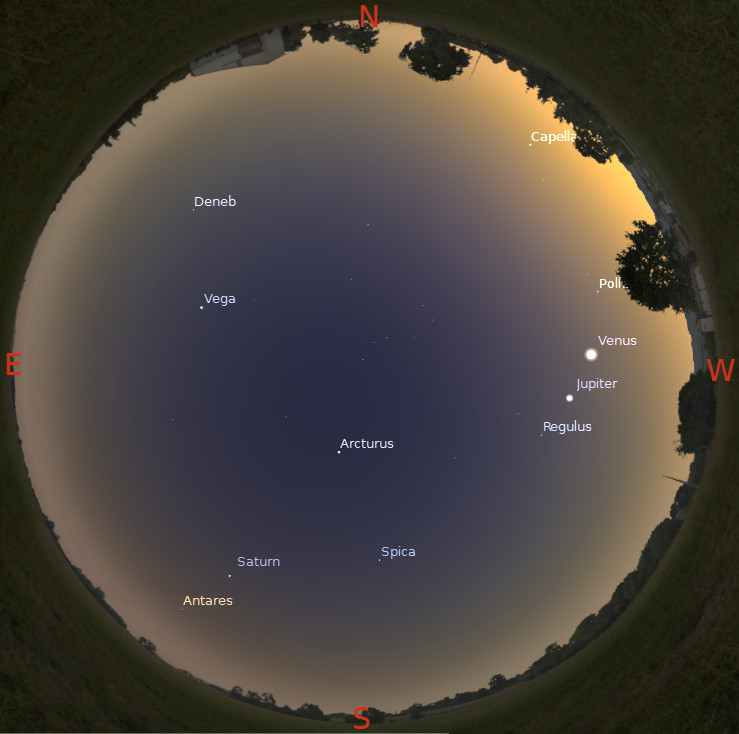
The first stars to appear after sunset. This is created from Stellarium for a half hour after sunset. It’s a bit optimistic, in my view, though my eyes aren’t the best. Try your eyes. Click on image to enlarge.
06/11/2015 – Ephemeris – Jupiter and Venus continue to appear to approach each other during this month
Thursday, June 11th. Today the Sun will be up for 15 hours and 31 minutes, setting at 9:28. The Moon, 2 days past last quarter, will rise at 3:27 tomorrow morning. Tomorrow the Sun will rise at 5:56.
In the western sky at sunset can be seen the brilliant evening star Venus and the bright but dimmer Jupiter. Jupiter is slowly moving eastward against the stars of the constellation Leo, but is losing the battle with the Earth’s own motion around the Sun. and is setting about 4 minutes earlier each night. Venus is moving faster eastward against the stars, setting only 2 minutes earlier each night. On June 30th it will only be two thirds of the Moon’s diameter south of Jupiter. However Venus will finally surrender to the Sun and will pass Jupiter again on August 3rd, being 7 degrees or 14 moon widths south of Jupiter. Venus will pass the Sun first on August 15th, followed by Jupiter on the 26th, both entering the morning sky.
Times are for the Traverse City/Interlochen area of Michigan. They may be different for your location.
Addendum
Jupiter-Venus approach animation June 11 to July 1, 2015 at 10:30 p.m. Created using Stellarium and GIMP. Click on image to enlarge.
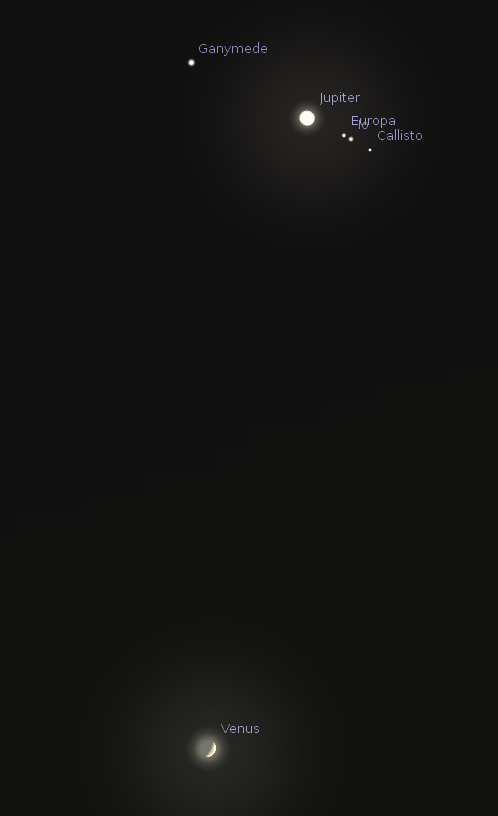
Conjunction of Jupiter and Venus at low power. They will be 20′ apart at 10:30 p.m. EDT June 30, 2015 (2:30 UT July 1, 2015). Created using Stellarium.
Later this month I will have a post showing that this conjunction and a similar conjunction of August last year are a near repeat of two Jupiter-Venus Conjunctions of 3 and 2 BC. which are candidates for the Star of Bethlehem.
06/10/2015 – Ephemeris – Three bright planets in the evening
Ephemeris for Wednesday, June 10th. Today the Sun will be up for 15 hours and 30 minutes, setting at 9:27. The Moon, 1 day past last quarter, will rise at 2:52 tomorrow morning. Tomorrow the Sun will rise at 5:56.
Lets take a look at the bright planets for this week. Our brilliant evening star Venus is in the west by 9:45 p.m. It will set at 12:31 a.m. Venus reached its greatest eastern elongation or separation from the Sun last Saturday it is now setting earlier. Venus’ slide down to the Sun will be much faster than its climb to greatest elongation. It will take a bit more than 2 months. Jupiter will appear western sky to the left of and slightly above Venus at about 10 p.m. It will set at 12:59 a.m. It seems to approach Venus. Now it appears about 13 degrees away. That’s somewhat more than the width of your fist held at arm’s length. They will cross paths on the 30th. Saturn is in the southeast as evening twilight fades.
Times are for the Traverse City/Interlochen area of Michigan. They may be different for your location.
Addendum
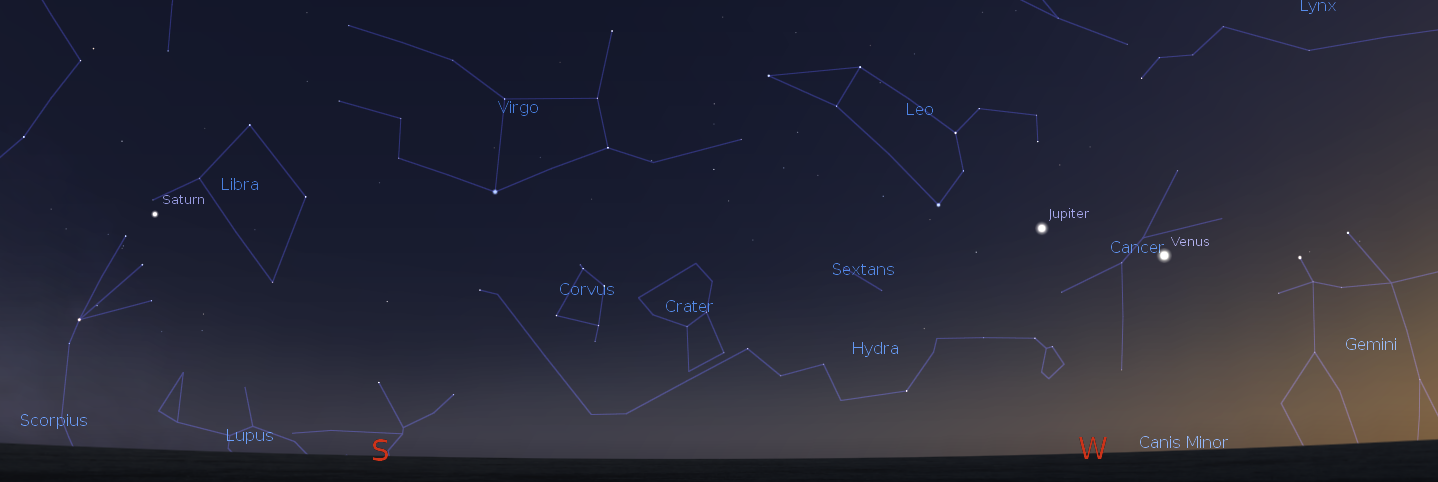
Venus, Jupiter and Saturn with the late spring southern constellations at 10:30 p.m., June 10, 2015. Created using Stellarium. Click on image to enlarge.
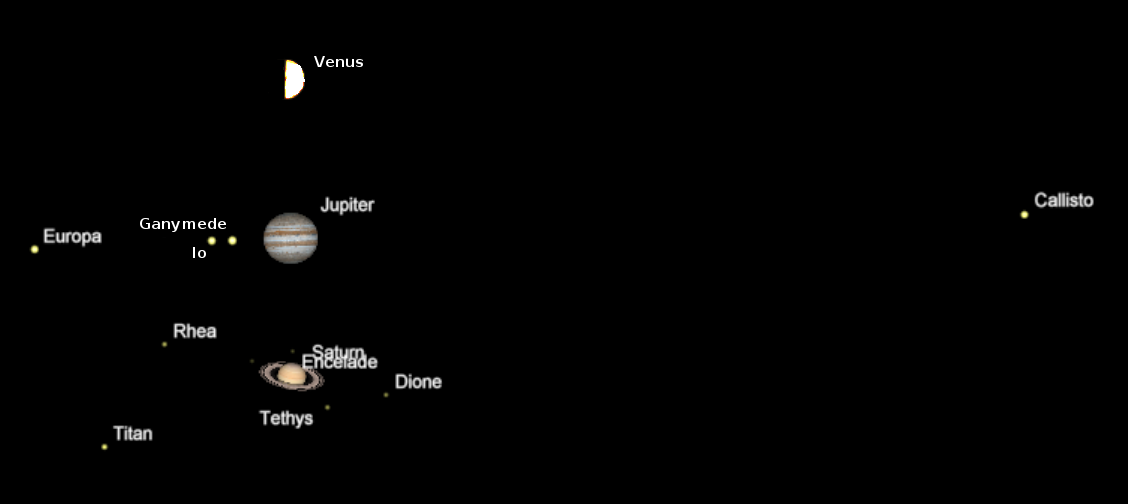
The evening planets using the same magnification at 10:30 p.m., June 10, 2015. Created using Cartes du Ciel (Sky Charts). Click on image to enlarge.
 Bob Moler's Ephemeris Blog