Archive
01/08/2014 – Ephemeris – Where are the bright planets this week?
Ephemeris for Wednesday, January 8th. The sun will rise at 8:18. It’ll be up for 9 hours and 2 minutes, setting at 5:20. The moon, 1 day past first quarter, will set at 2:18 tomorrow morning.
This is our weekly look at the planets. Venus is only three days from passing between the Earth and the Sun in what astronomers call inferior conjunction. Sharp eyed observers may be able to spot it in the bright twilight glow before it sets at 5:57 p.m. tonight. It will then pass into the morning sky. The giant planet Jupiter will be in the eastern sky as darkness falls tonight. It’s cruising against the stars of Gemini now. It will pass due south at 12:32 a.m., and will set at 8:13 a.m. Mars will rise at 12:39 a.m. in the east. Reddish Mars is in Virgo now and to the upper right of the bright star Spica by the width of your fist held at arm’s length. Saturn will rise at 3:47 a.m. in the east southeast. It’s seen against Libra the scales this year.
Times are for the Traverse City/Interlochen area of Michigan. They may be different for your location.
Addendum
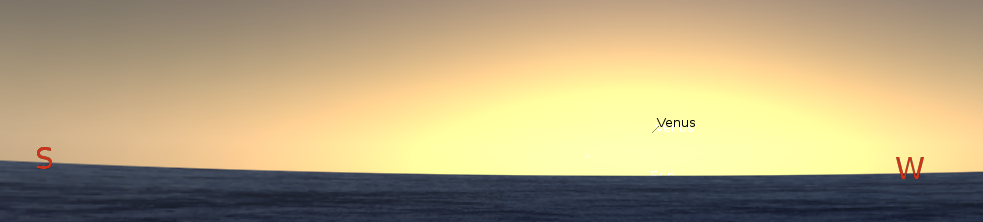
For diehards, Venus 15 minutes before it will set tonight January 8, 2014.
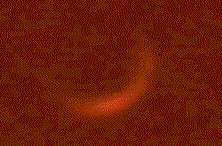
Venus at 3 days before inferior conjunction back in the late 1960’s. My photograph.
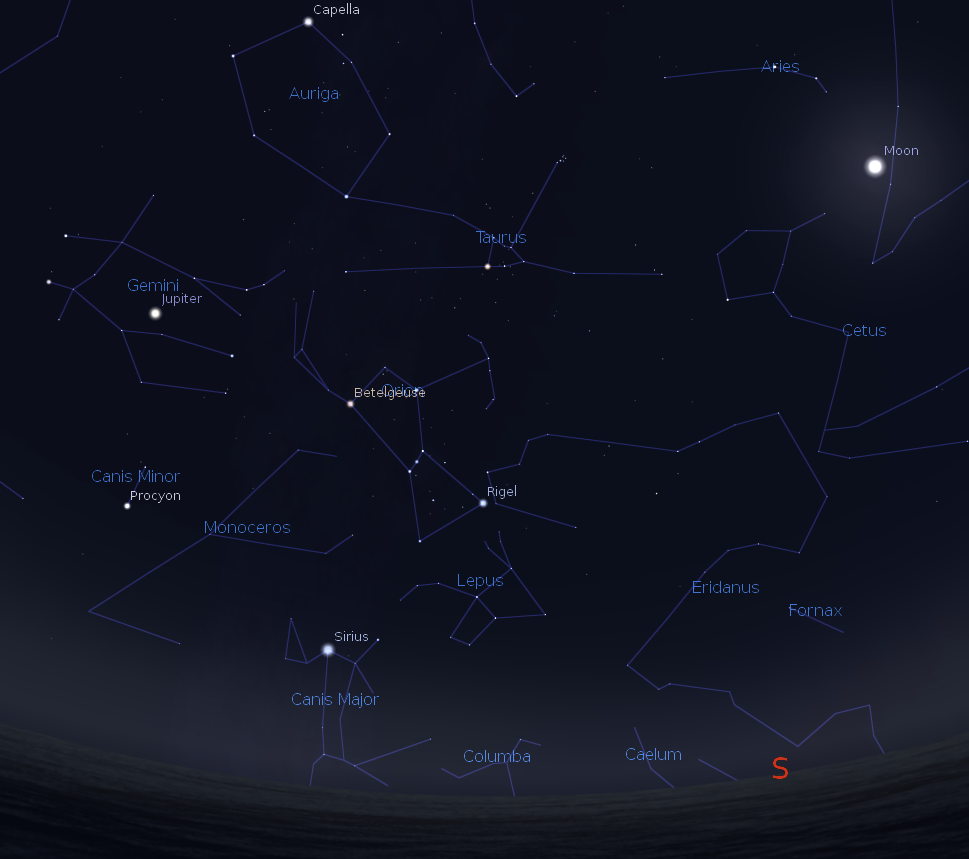
Jupiter, the Moon with the winter constellations at 9 p.m. on January 8, 2014. Created using Stellarium.
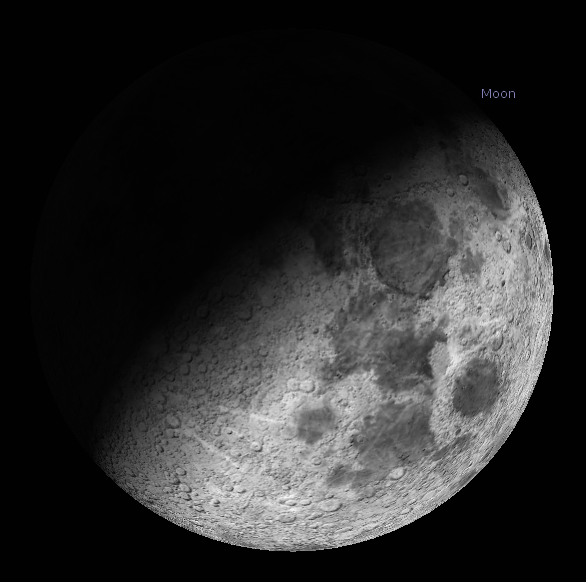
The telescopic moon at 9 p.m. January 8, 2014. Created using Stellarium.
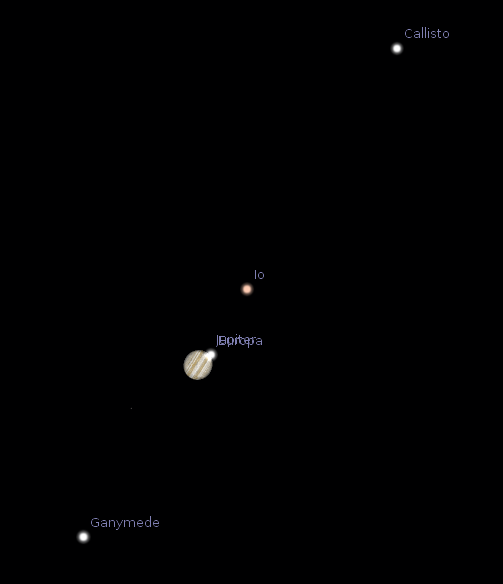
The telescopic Jupiter at 9 p.m. and January 8, 2014. The label for the moon Europa overlaps that of Jupiter. Created using Stellarium.
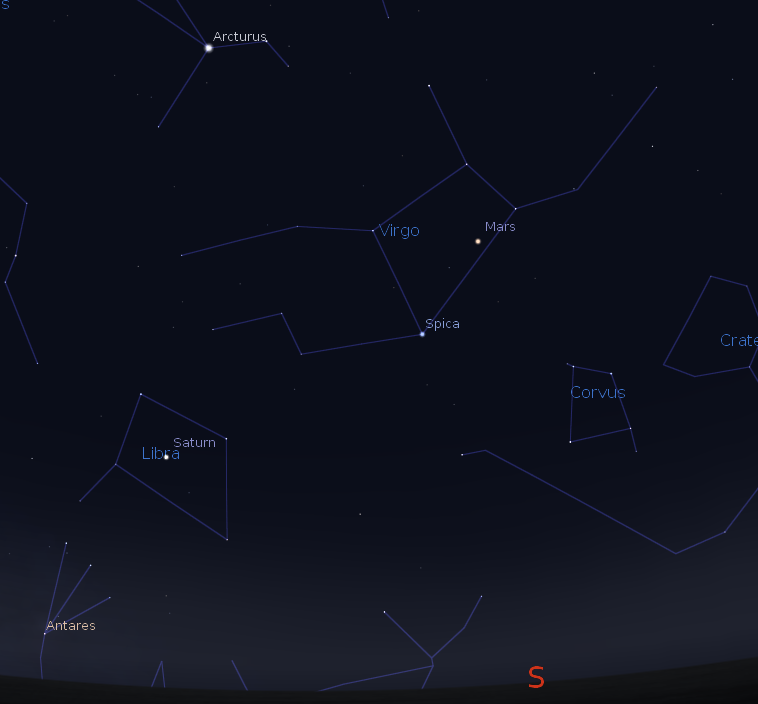
Mars and Saturn with the spring constellations at 6:30 a.m. on January 9, 2014. Created using Stellarium.
01/07/2014 – Ephemeris – Jupiter just after opposition
Ephemeris for Tuesday, January 7th. The sun will rise at 8:18. It’ll be up for 9 hours and 1 minute, setting at 5:19. The moon, at first quarter today, will set at 1:14 tomorrow morning.
The giant planet Jupiter was in opposition from the Sun two days ago, meaning that the Sun, Earth and Jupiter were pretty much in a line. It was a time the Jupiter was closest to us. The situation hasn’t changed much, However you will notice that tomorrow I will not give the time that Jupiter rises because it will rise before sunset, but I will give its setting time. Now Jupiter is about 391 million miles (630 million km) away and slowly dropping behind the faster moving Earth. Jupiter is so large that there is never bad time to view it with a small telescope, but Jupiter appears largest right now. Visible in telescopes are its four moons that change position from night to night. The face of the planet shows atmospheric cloud bands that bear closer scrutiny with larger telescopes.
Times are for the Traverse City/Interlochen area of Michigan. They may be different for your location.
Addendum
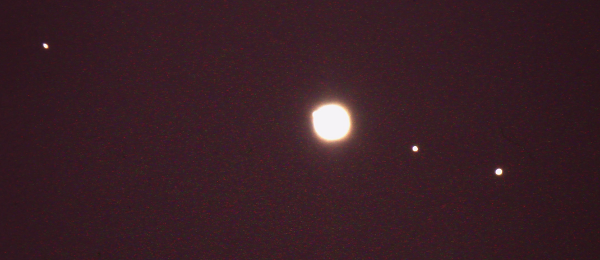
Jupiter and its four Galilean moons. The planet has to be over exposed to pick up the moons. The bump on the upper left of Jupiter’s image is another moon. But the eye can handle the brightness difference with no problem. This is one of my old pictures I do believe.
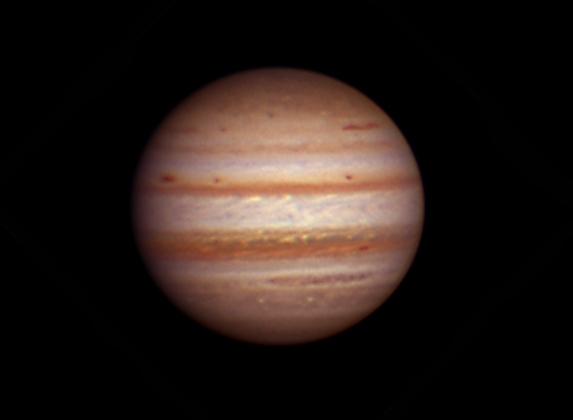
Jupiter by Scott Anttila. Taken February 6, 2012
12/30/2013 – Ephemeris – The tale of Gemini the twins
Ephemeris for Monday, December 30th. The sun will rise at 8:19. It’ll be up for 8 hours and 52 minutes, setting at 5:11. The moon, 2 days before new, will rise at 7:09 tomorrow morning.
The constellation Gemini, the Twins is visible in the east at 9 p.m. with the bright planet Jupiter interloping against its stars. The namesake stars of the two lads, will be on the left end of the constellation, nearly vertically aligned. Castor is on top, while Pollux, a slightly brighter star is on the bottom. Lines of stars from Castor and Pollux to the right delineate the lads. In Greek mythology Castor and Pollux were twins, and half brothers, Castor was fathered by a mere mortal, while Pollux was fathered by Zeus in the famous Leda and the swan affair. The brothers, however were inseparable, and when Castor was killed during the quest for the Golden Fleece, Pollux pleaded with Zeus to let him die also. Zeus placed them together in the sky forever.
Times are for the Traverse City/Interlochen area of Michigan. They may be different for your location.
Addendum
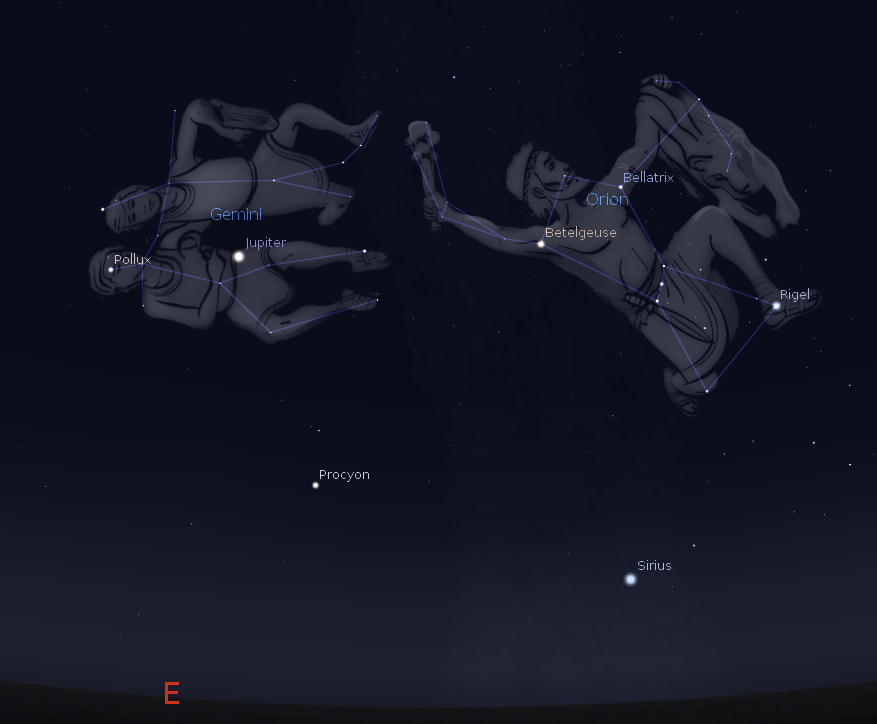
Gemini with Jupiter and Orion near by at 9 p.m. on December 30, 2013. Created using Stellarium.
12/25/2015 – Ephemeris – Where are the bright planets and Comet Lovejoy this week?
Ephemeris for Christmas Day, Wednesday, December 25th. The sun will rise at 8:18. It’ll be up for 8 hours and 49 minutes, setting at 5:07. The moon, at last quarter today, will rise at 1:34 tomorrow morning.
This is our weekly look at the planets. Venus is brilliant in the southwest after sunset. It will set at 7:08 p.m. Venus is noticeably closing with the sun. It will be lost in the glare of the sun in less than 2 weeks. Venus is a thin crescent, and we’re at the point where the crescent can be visible in binoculars. The giant planet Jupiter will rise at 5:56 p.m. in the east northeast. It’s cruising against the stars of Gemini now. It will pass due south at 1:35 a.m. Mars will rise at 1:02 a.m. in the east. Reddish Mars is to the upper right of the bright star Spica. It will be above the moon tomorrow morning. Saturn will rise at 4:36 a.m. in the east southeast. The ringed planet will best be seen in the evening next summer. There is a comet visible in binoculars in the morning sky. It’s Comet Lovejoy.
Times are for the Traverse City/Interlochen area of Michigan. They may be different for your location.
Addendum

Venus in the southwest at 6 p.m. on December 25, 2013. Created using Stellarium.
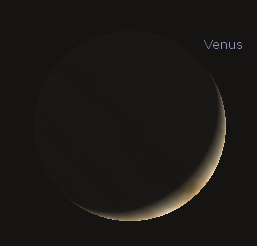
The thin crescent of Venus seen in a telescope. December 25, 2013. Created using Stellarium.
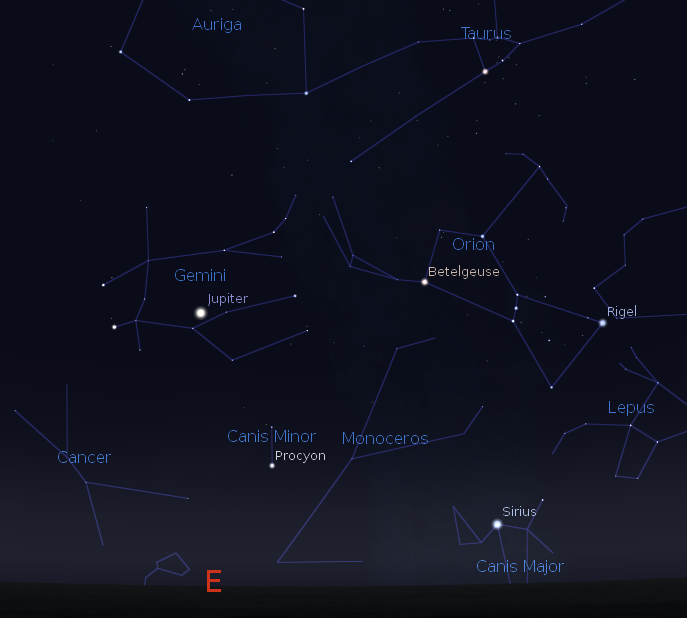
Jupiter and the constellations of winter at 9 p.m. on December 25, 2013. Created using Stellarium.
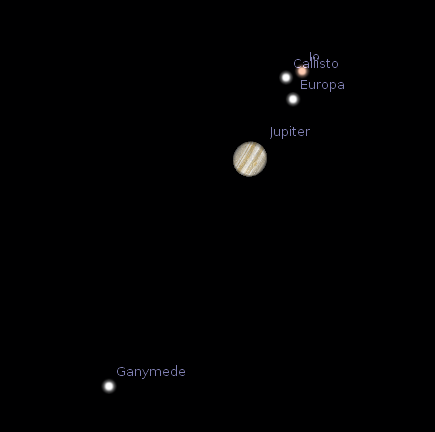
Apparent traffic jam of Jovian satellites as seen in a telescope at 9 p.m. on December 25, 2013. That actual rotation of the image depends on the telescope. Created using Stellarium.
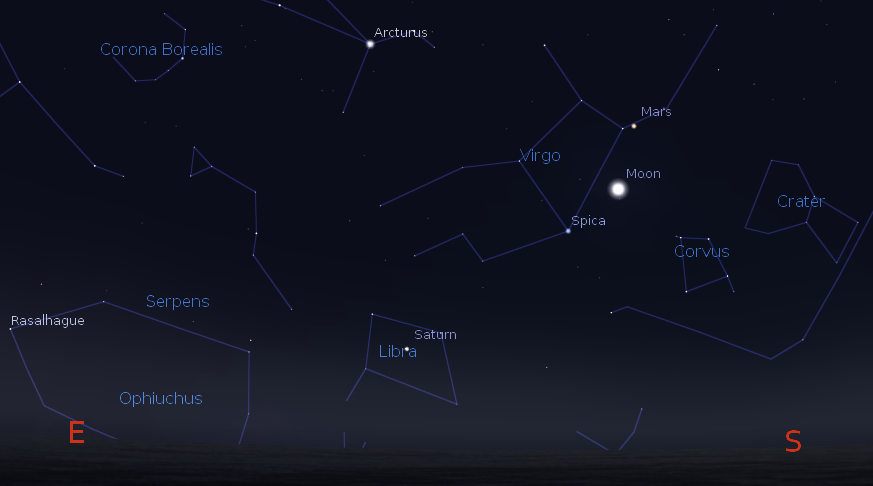
Mars and Saturn among the spring constellations at 6 a.m. December 26, 2013. Created using Stellarium.
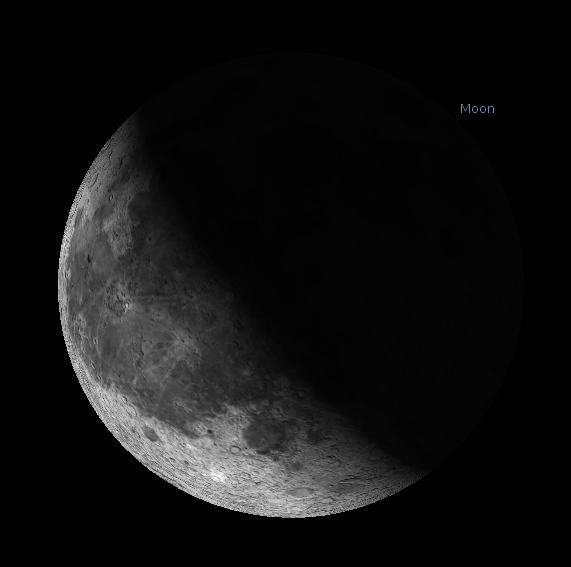
The Moon as seen in binoculars or telescope at 6 a.m. December 26, 2013. Created using Stellarium.
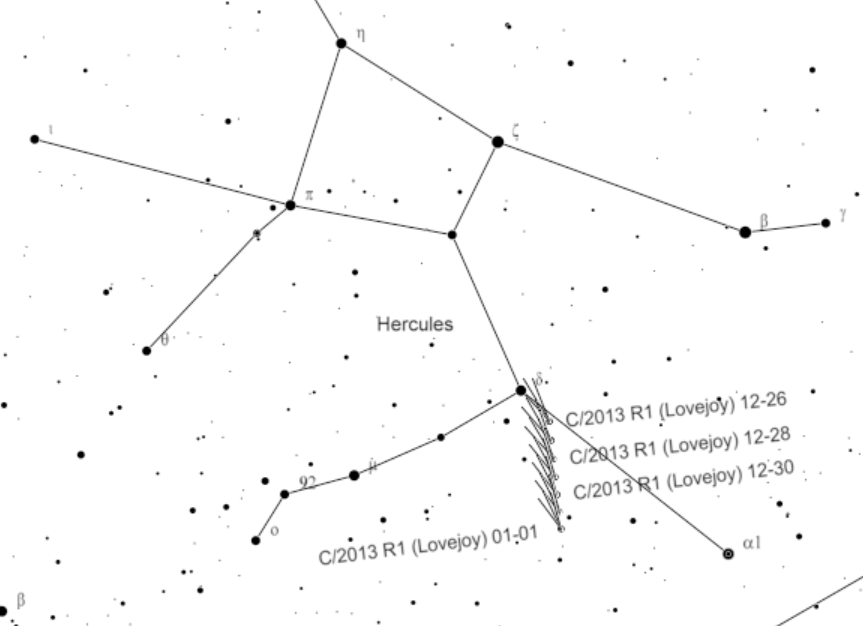
The track of Comet Lovejoy, which still should be visible in binoculars from 12/26/2013 to 01/01/2014 at 6 a.m. Created using Cartes du Ciel (Sky Charts).
Note that Stellarium and Cartes du Ciel as free programs. Links to them can be found at the right under Free Astronomical Programs.
12/24/2013 – Ephemeris – Two Christmas stars are visible this year
Ephemeris for Christmas Eve, Tuesday, December 24th. The sun will rise at 8:17. It’ll be up for 8 hours and 49 minutes, setting at 5:06. The moon, 1 day before last quarter, will rise at 12:31 tomorrow morning.
We are to be visited by not one but two Christmas Stars this year. And like what the original Star of Bethlehem may have been, these aren’t stars either but planets. Between Venus and Jupiter we will have full coverage until dawn. Venus will dazzle in the southwest after sunset. After it sets Jupiter will hold forth as the second brightest planet after Venus, rising in the east northeast in twilight, then moving very high in the sky near midnight, and will be near the west northwestern horizon and dawn breaks Christmas Day. These were the two planets whose very close conjunctions in 3 and again in 2 BC may have been interpreted by the Magi as the Star that announced the new King of Israel.
Times are for the Traverse City/Interlochen area of Michigan. They may be different for your location.
Addendum

Venus setting and Jupiter rising. The two Christmas stars this year. Christmas Eve 2013 at 6:45 p.m. Created using Stellarium.
12/19/2013 – Ephemeris – The mystery of the Star of Bethlehem
Ephemeris for Thursday, December 19th. The sun will rise at 8:15. It’ll be up for 8 hours and 49 minutes, setting at 5:04. The moon, 2 days past full, will rise at 7:34 this evening.
The Star of Bethlehem is one of the great mysteries of Christmas. The Chinese of that time were the only ones that recorded the happenings in the heavens. There were no bright stars that appeared near the time of Christ’s birth. That leads us to the Magi themselves, if that’s who they were. Magi were astrologer priests of the Zoroastrian religion in Persia. They saw signs in the positions of the planets that would go unnoticed to the Jews to which astrology was forbidden. Conjunctions where two or more planets gathered together were the most powerful of these configurations. There was a triple conjunction of Jupiter and Saturn in seven BC, and two extremely close conjunctions between Jupiter and Venus in 3 and 2 BC. Could one of those be it?
Times are for the Traverse City/Interlochen area of Michigan. They may be different for your location.
Addendum
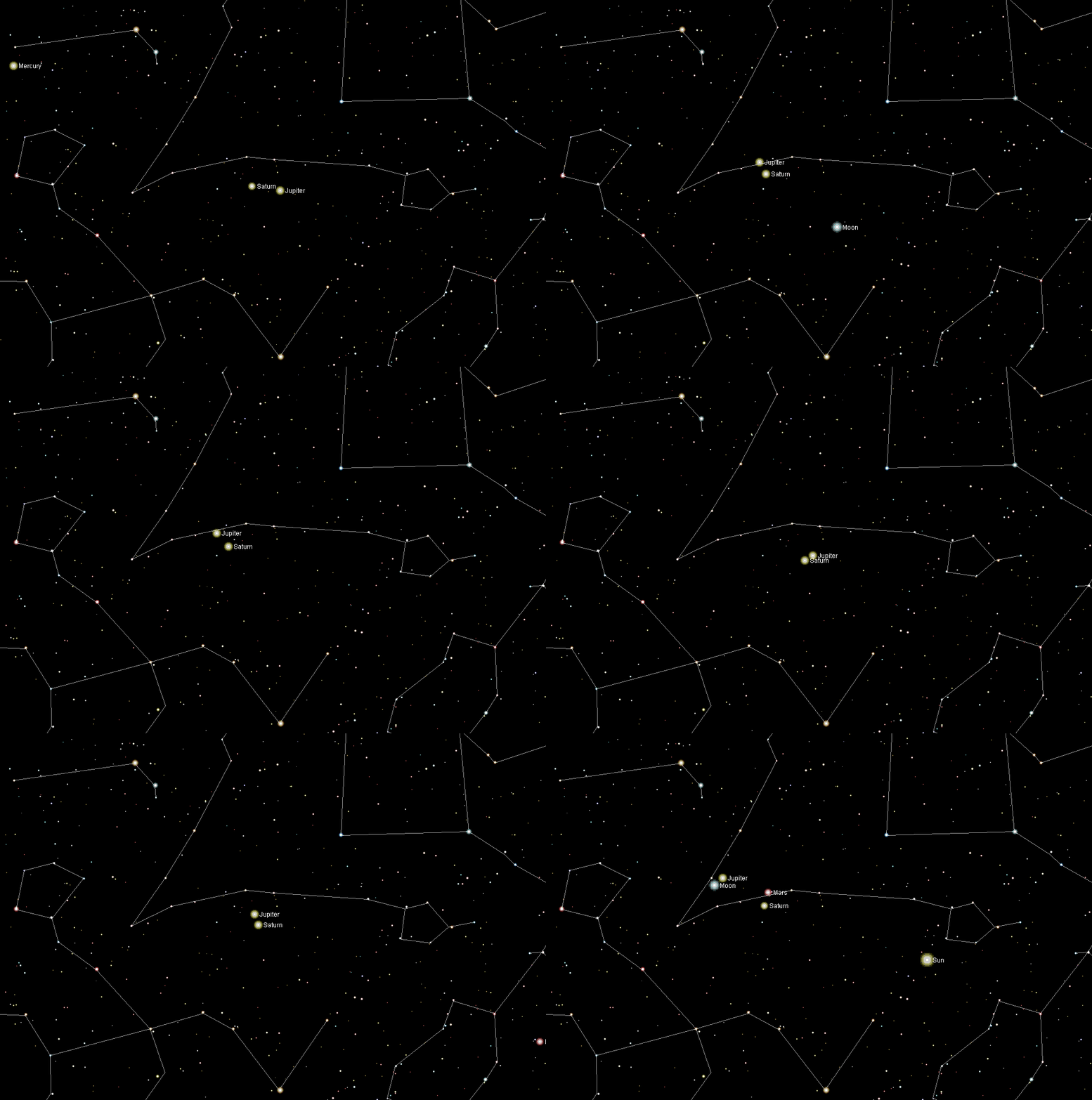
The Jupiter-Saturn triple conjunction of 7 BC. Click on the image to enlarge and animate. Created using Cartes du Ciel.
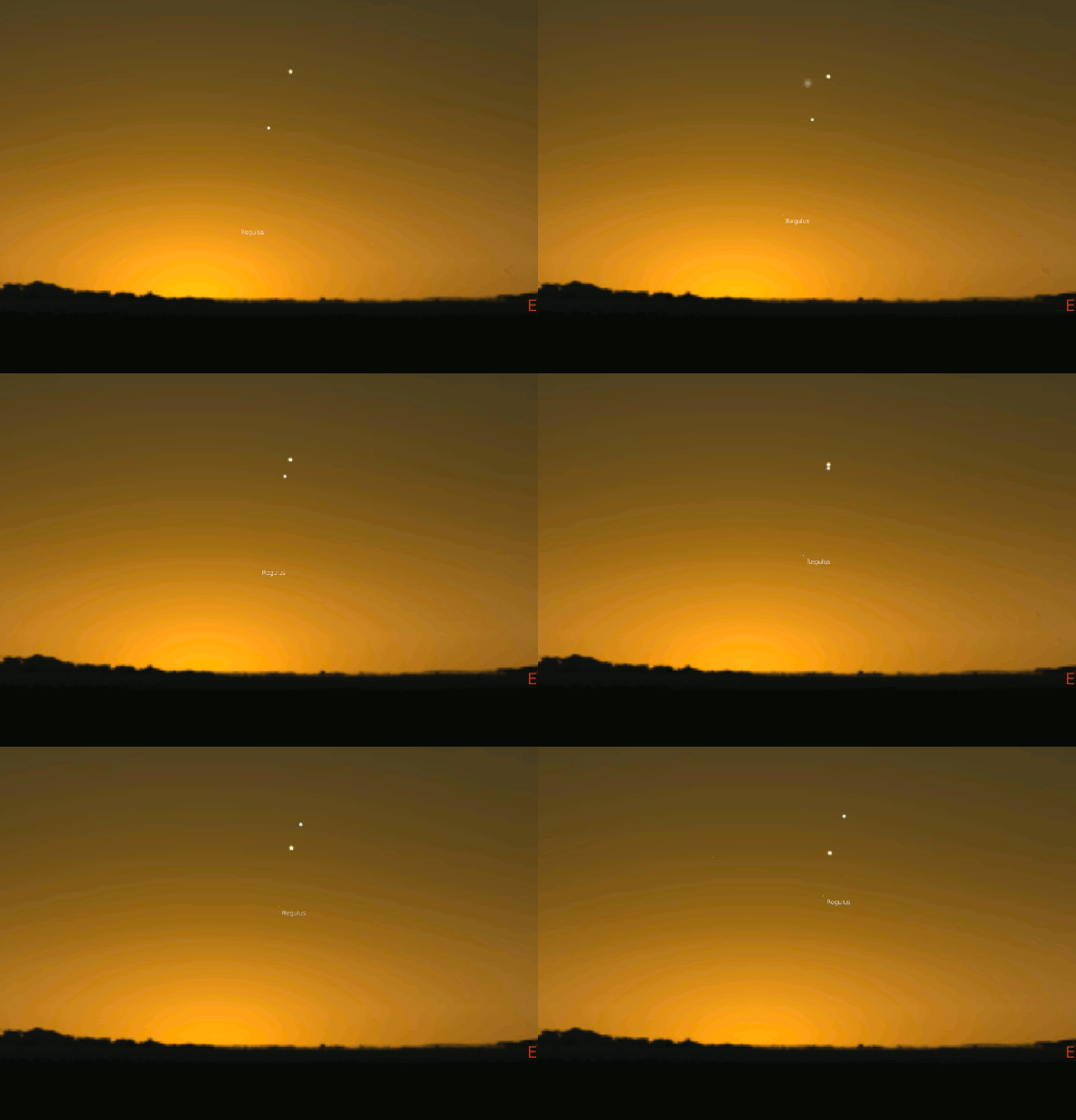
Animation of the Jupiter-Venus conjunction of August 3, 3 BC. in the morning twilight. Created using Stellarium.
Click on the image to enlarge and show the animation. Jupiter is rising while Venus, the brighter one, is heading back to the sun. Jupiter will seem to mate with Venus. 9 months later, the human gestation period their paths seem to cross again.
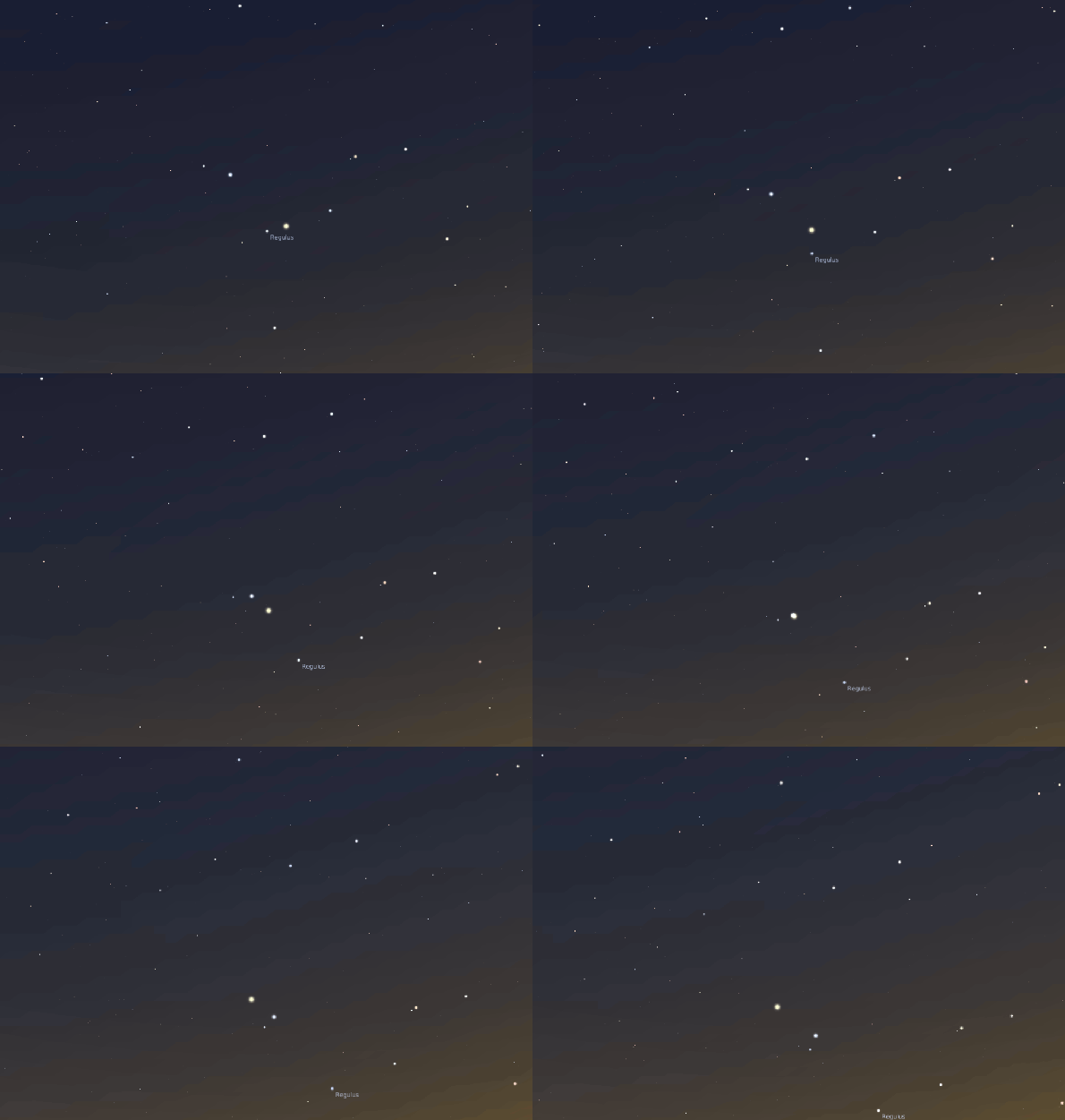
June of 2 BC just after sunset Jupiter and Venus again cross paths. Created using Stellarium.
Click on the image to enlarge and show the animation.
12/18/2013 – Ephemeris – Where are the bright planets and Comet Lovejoy?
Ephemeris for Wednesday, December 18th. The sun will rise at 8:14. It’ll be up for 8 hours and 49 minutes, setting at 5:03. The moon, 1 day past full, will rise at 6:38 this evening.
This is our weekly look at the planets. Venus is brilliant in the southwest after sunset. It will set at 7:30 p.m. Venus us beginning to noticeably close with the sun. It will be gone from our evening sky in a month. Venus is a crescent, and we’re coming to the point where the crescent can be visible in binoculars. The giant planet Jupiter will rise at 6:28 p.m. in the east northeast. It’s cruising against the stars of Gemini now. It will pass due south at 2:07 a.m. Mars will rise at 1:13 a.m. in the east. Reddish Mars is closer to Spica in Virgo than to Regulus in Leo. Saturn will rise at 5 a.m. in the east southeast. There is a comet visible in binoculars in the morning sky. It’s Comet Lovejoy. A finder chart for the next week will be at bobmoler.wordpress.com with today’s transcript.
Times are for the Traverse City/Interlochen area of Michigan. They may be different for your location.
Addendum
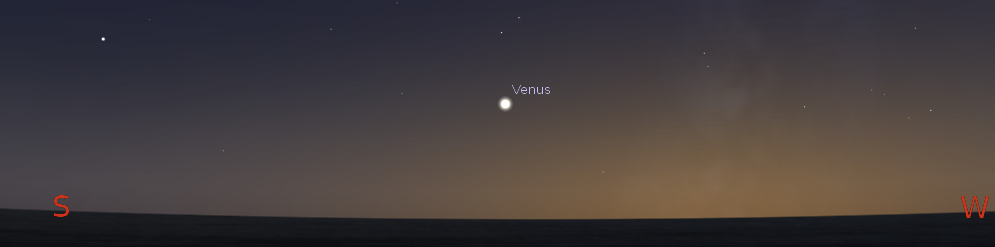
Venus in the southwest at 6 p.m. on December 18, 2013. Created using Stellarium.
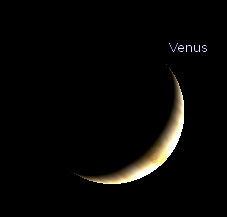
Venus as seen in a telescope at 6 p.m. December 18, 2013. The disk will be blindingly bright with no detail. Created using Stellarium.
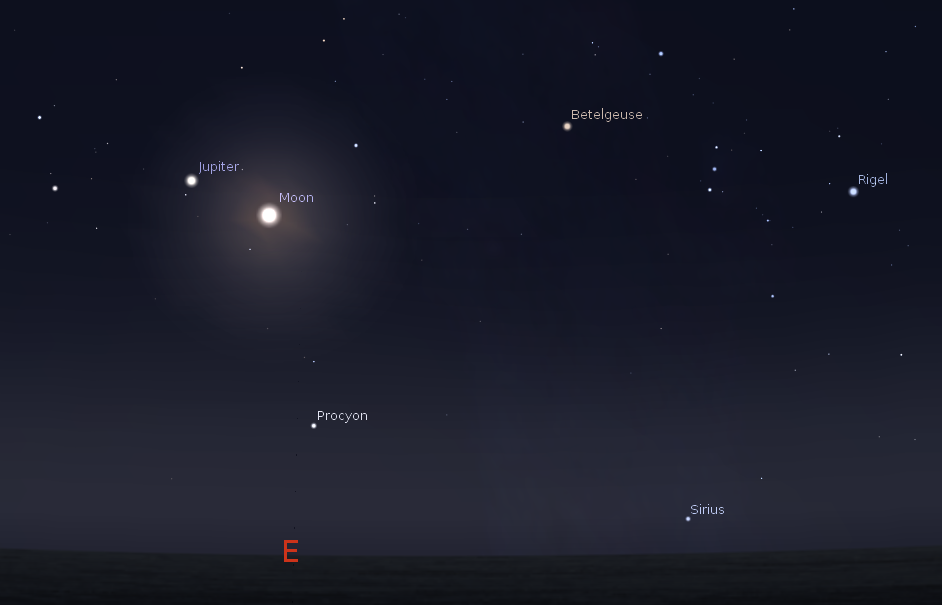
Jupiter and the Moon at 9 p.m. on December 18, 2013. Created using Stellarium.
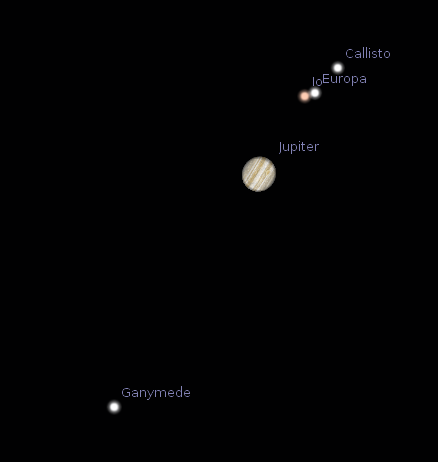
Jupiter and its moons as seen in a telescope at 9 p.m. December 18, 2013. The orientation may be rotated or even mirror image. Created using Stellarium.
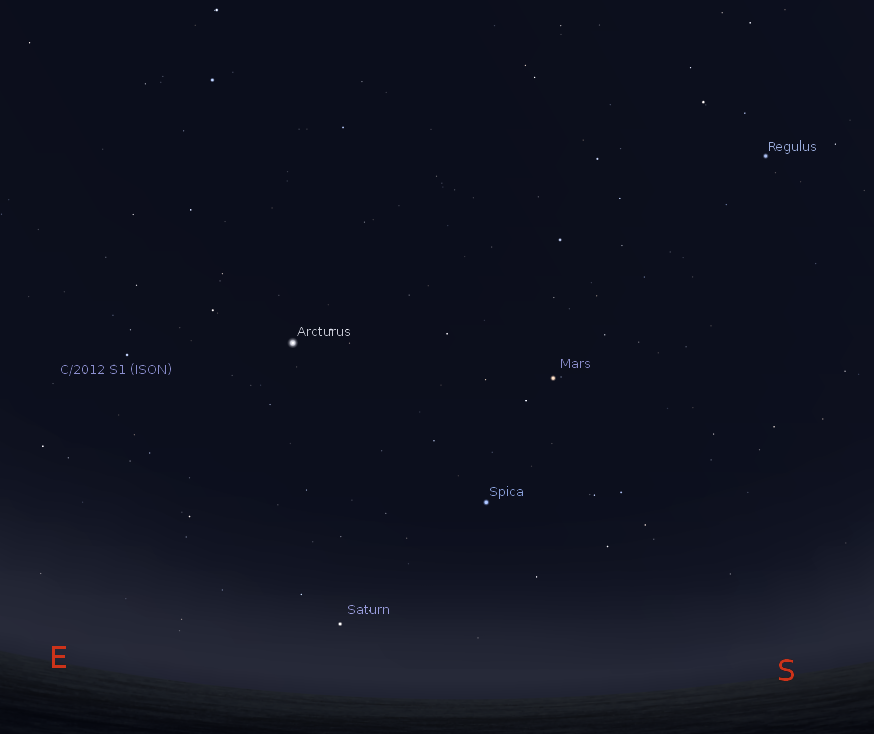
Mars, Saturn and the ghost of Comet ISON at 6 a.m. on December 19, 2013. Created using Stellarium.
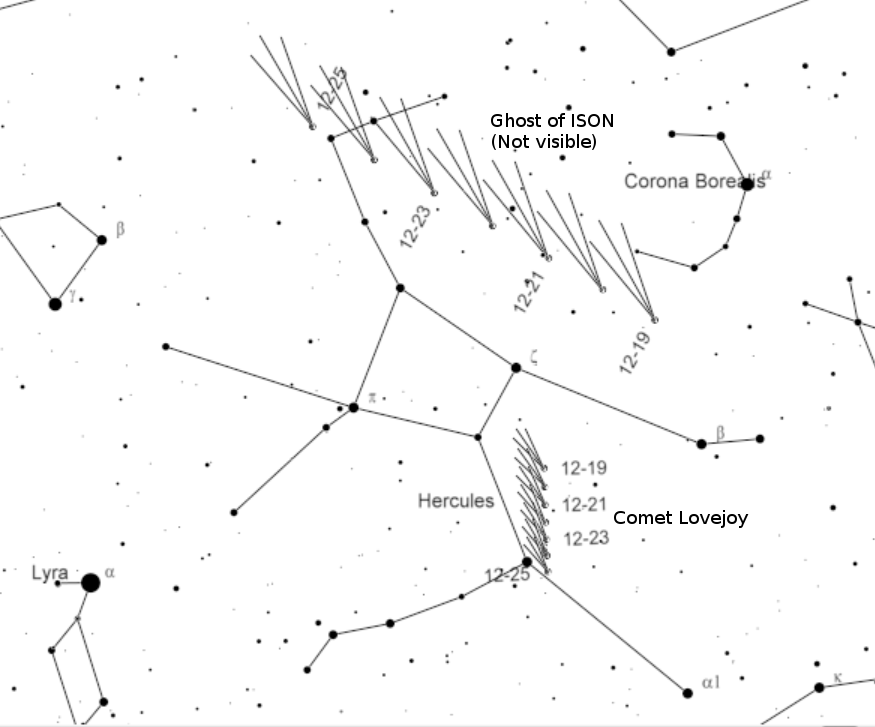
Comet Lovejoy finder chart for the next week at 6 a.m. We’re stuck also with the ghost of Comet ISON. Look in the northeast at the constellation Hercules. Created using Cartes du Ciel.
12/11/2013 – Ephemeris – Where are the bright planets this week, plus a consolation comet
Ephemeris for Wednesday, December 11th. The sun will rise at 8:09. It’ll be up for 8 hours and 52 minutes, setting at 5:02. The moon, 2 days past first quarter, will set at 3:23 tomorrow morning.
Let’s see where the bright planets are this week. Venus is brilliant in the southwest after sunset. It will set at 7:44 p.m. Venus has a crescent appearance because it is between the Earth and Sun which is easily seen in telescopes and can be detected in binoculars now. Venus is 57 million kilometers away from us now or 35.4 million miles. The giant planet Jupiter will rise at 7 p.m.. in the east northeast. It’s cruising against the stars of Gemini now. It will pass due south at 2:37 a.m. Mars will rise at 1:22 a.m. in the east. Mars is a bit closer to Spica in Virgo than Regulus in Leo, and can be distinguished by its yellow-orange color. Saturn will rise at 5:24 a.m. and should be visible low in the east south east by 6 a.m.
Times are for the Traverse City/Interlochen area of Michigan. They may be different for your location.
Addendum
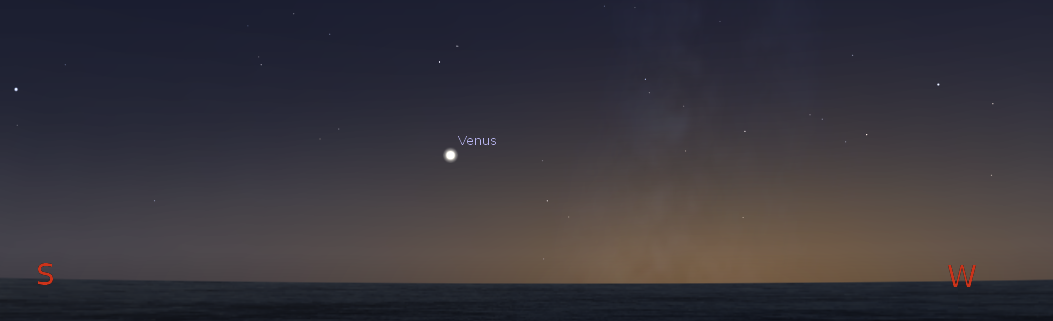
Venus in the southwest at 6 p.m. on December 11, 2013. Created using Stellarium.
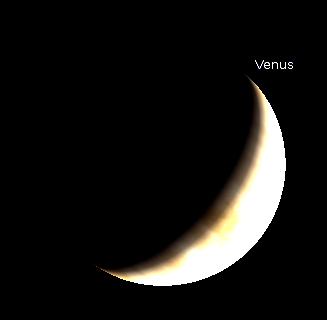
Venus as seen in a telescope at 6 p.m. December 11, 2013. The disk will be blindingly bright with no detail. Created using Stellarium.
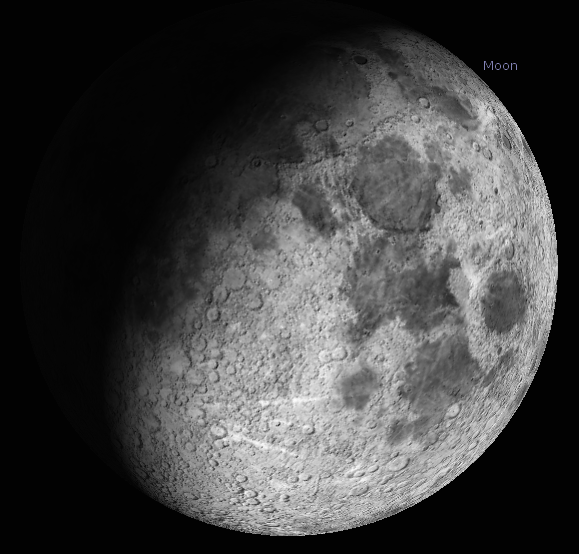
The gibbous Moon magnified at 9 p.m. on December 11, 2013. Created using Stellarium.
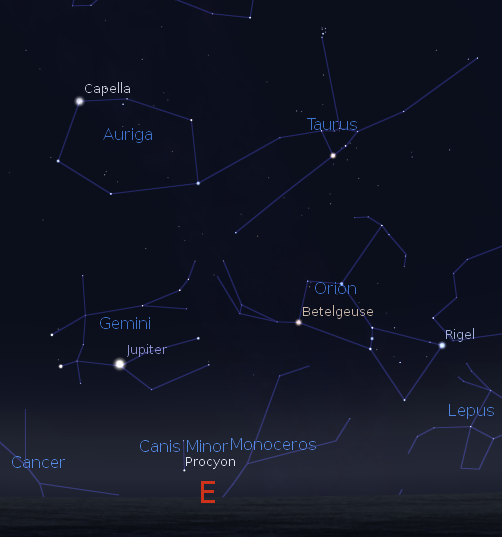
Jupiter and some winter constellations at 9 p.m. on December 11, 2013. Created using Stellarium.
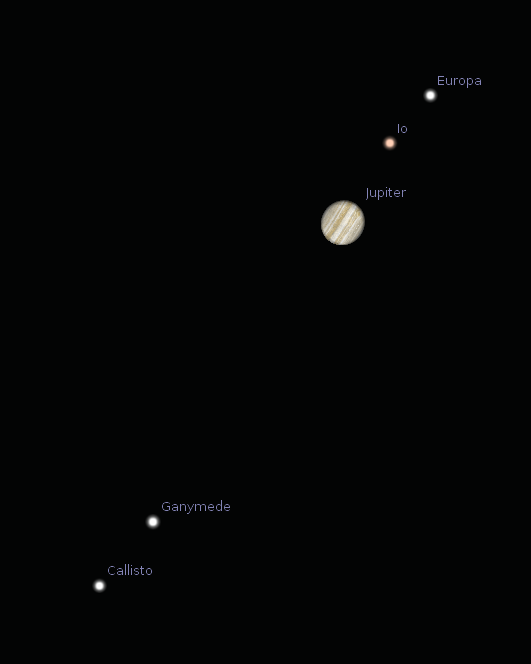
Jupiter and its moons as seen in a telescope at 9 p.m. December 11, 2013. The orientation may be rotated or even mirror image. Created using Stellarium.
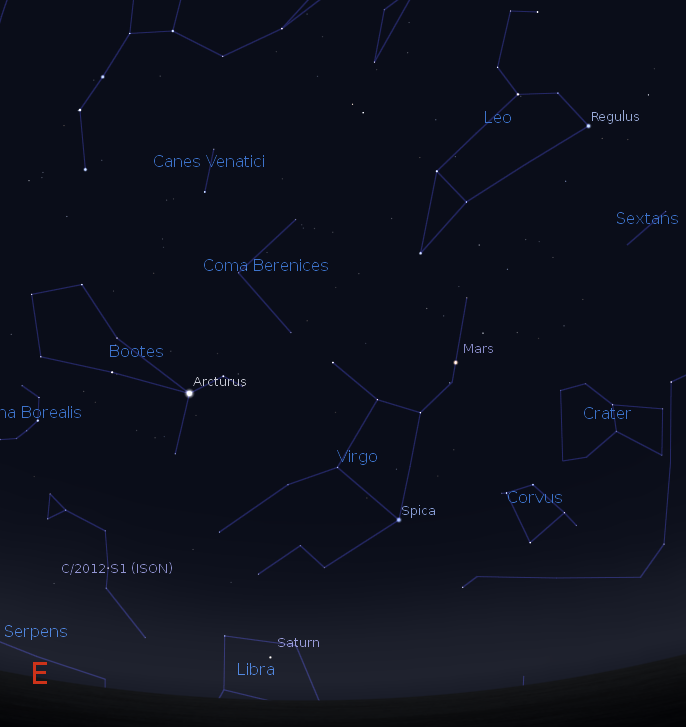
Mars, Saturn and the ghost of Comet ISON at 6 a.m. on December 12, 2013. Created using Stellarium.
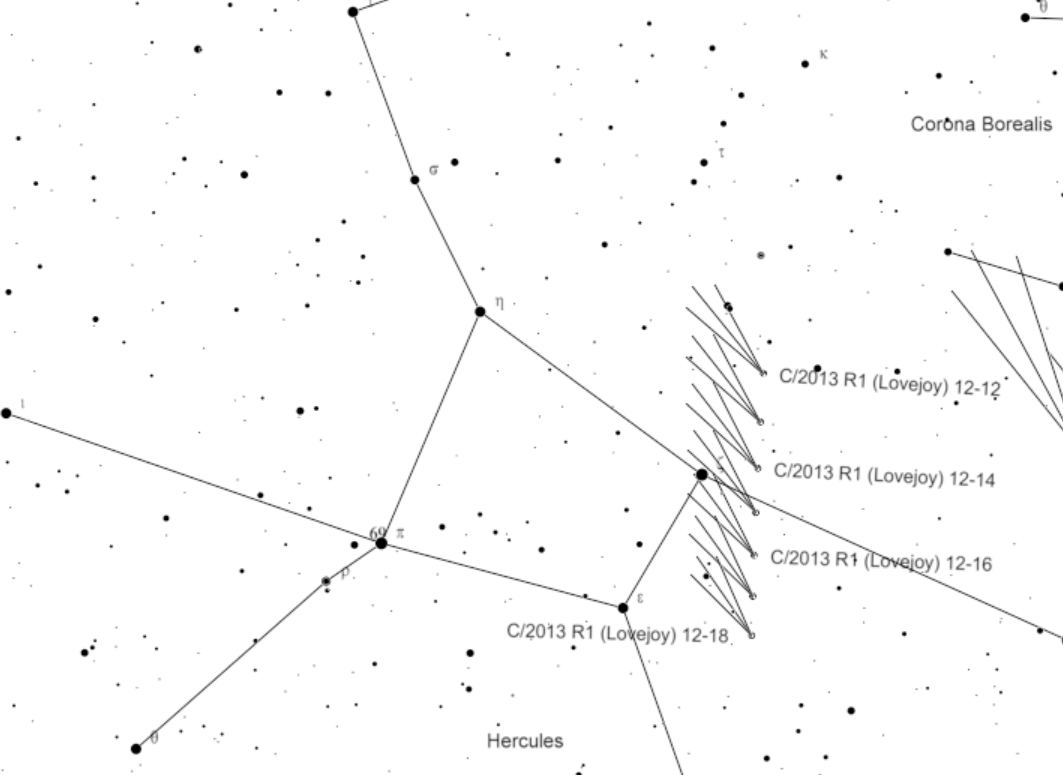
Comet Lovejoy finder chart for the next week at 6 a.m. There a bit of a tail at the right edge from the ghost of ISON (It’s not visible). Look in the northeast at the constellation Hercules with binoculars. Created using Cartes du Ciel.
Comet Lovejoy is an easy binocular object. It’s brighter than Comet ISON was in dark skies.
12/05/2013 – Ephemeris – The constellation Taurus the bull
Ephemeris for Thursday, December 5th. The sun will rise at 8:03. It’ll be up for 8 hours and 58 minutes, setting at 5:02. The moon, 3 days past new, will set at 8:27 this evening.
Early in the evening the moon will appear above the bright planet Venus in the southwest. Low in the east at 9 p.m. is the constellation of Orion the giant hunter. Above him is Taurus the bull. His face is a letter V shape of stars lying on its side with the bright orange-red star Aldebaran at the bottom tip of the V as its angry blood-shot eye. Orion is depicted in the sky facing with club in one hand and a shield in the other the approaching and in some depictions charging Taurus. The V of stars is a star cluster called the Hyades. The Pleiades are in his shoulder above. Taurus in Greek mythology was the guise the god Zeus when he carried off the maiden Europa. Europa’s still with him, sort of, as the intriguing satellite orbiting Zeus’ Roman equivalent Jupiter.
Times are for the Traverse City/Interlochen area of Michigan. They may be different for your location.
Addendum
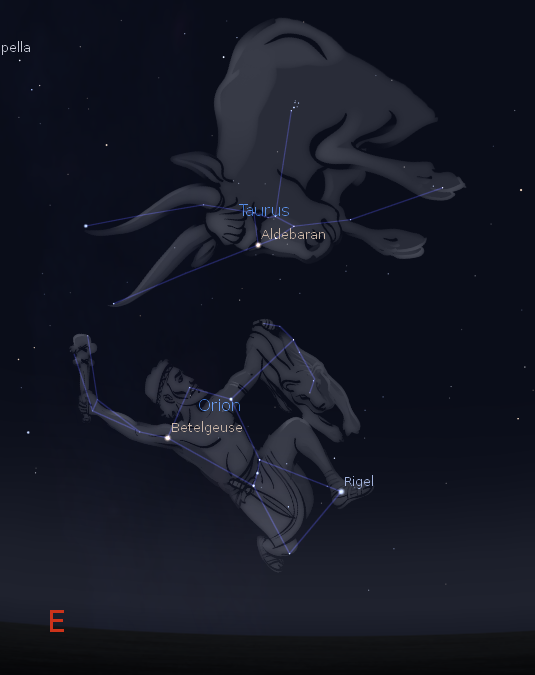
Taurus and Orion in the east at 9 p.m, December 5, 2013. Created using Stellarium.
12/04/2013 – Ephemeris – Where are the bright planets this week?
Ephemeris for Wednesday, December 4th. The sun will rise at 8:02. It’ll be up for 9 hours even, setting at 5:02. The moon, 2 days past new, will set at 7:15 this evening.
Let’s see where the bright planets are this week. Venus is brilliant in the southwest after sunset. It will set at 7:51 p.m. The thin crescent moon will be to the right and a bit below Venus tonight. Venus is itself a crescent, and we’re coming to the point where the crescent can be visible in binoculars. Venus is as close to us now as the debris from Comet ISON will ever get to us. The giant planet Jupiter will rise at 7:31 p.m. in the east northeast. It’s cruising against the stars of Gemini now. It will pass due south at 3:08 a.m. Mars will rise at 1:31 a.m. in the east. Reddish Mars is midway between Regulus in Leo and Spica in Virgo. Saturn will rise at 5:47 a.m. and should be visible low in the east south east by 6:30.
Times are for the Traverse City/Interlochen area of Michigan. They may be different for your location.
Addendum
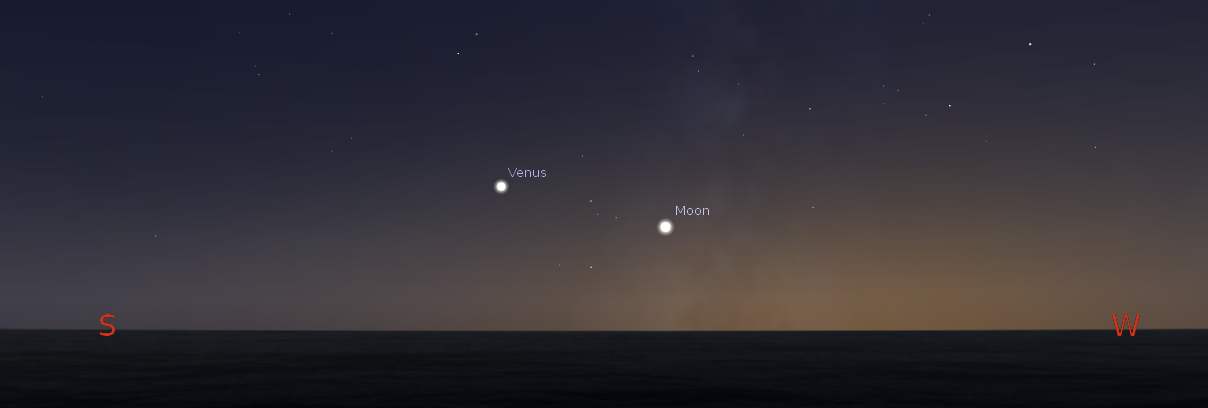
Venus and the Moon in the southwest at 6 p.m. on December 4, 2013. Created using Stellarium.
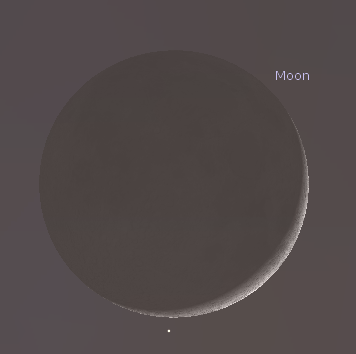
The Moon magnified at 6 p.m. on December 4, 2013. Created using Stellarium.
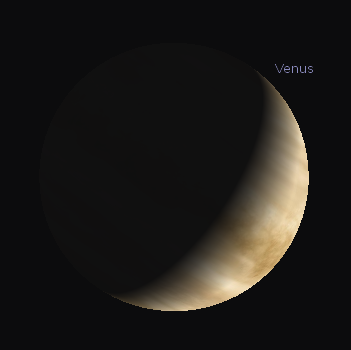
Venus as seen in a telescope at 6 p.m. December 4, 2013. The crescent will be blindingly bright with no detail. Created using Stellarium.
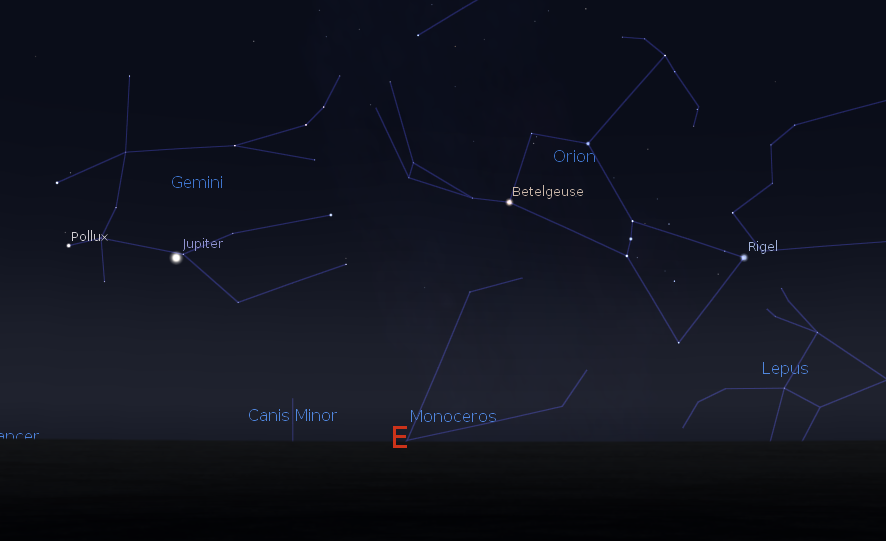
Jupiter and some winter constellations at 9 p.m. on December 4, 2013. Created using Stellarium.
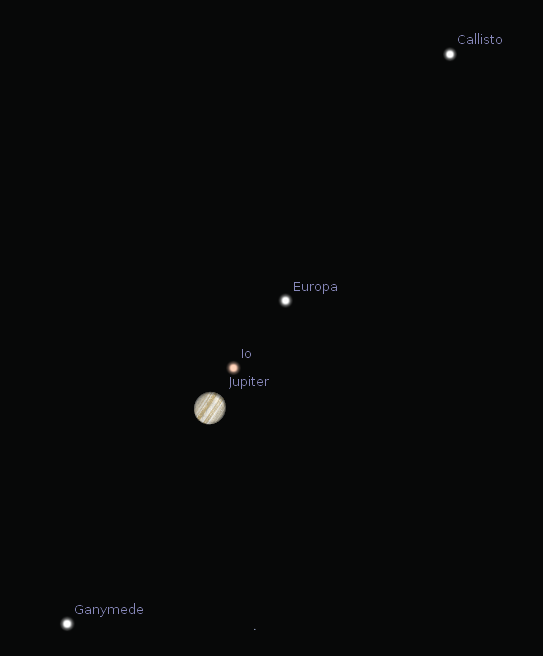
Jupiter and its moons as seen in a telescope at 9 p.m. December 4, 2013. The orientation may be rotated or even mirror image. Created using Stellarium.
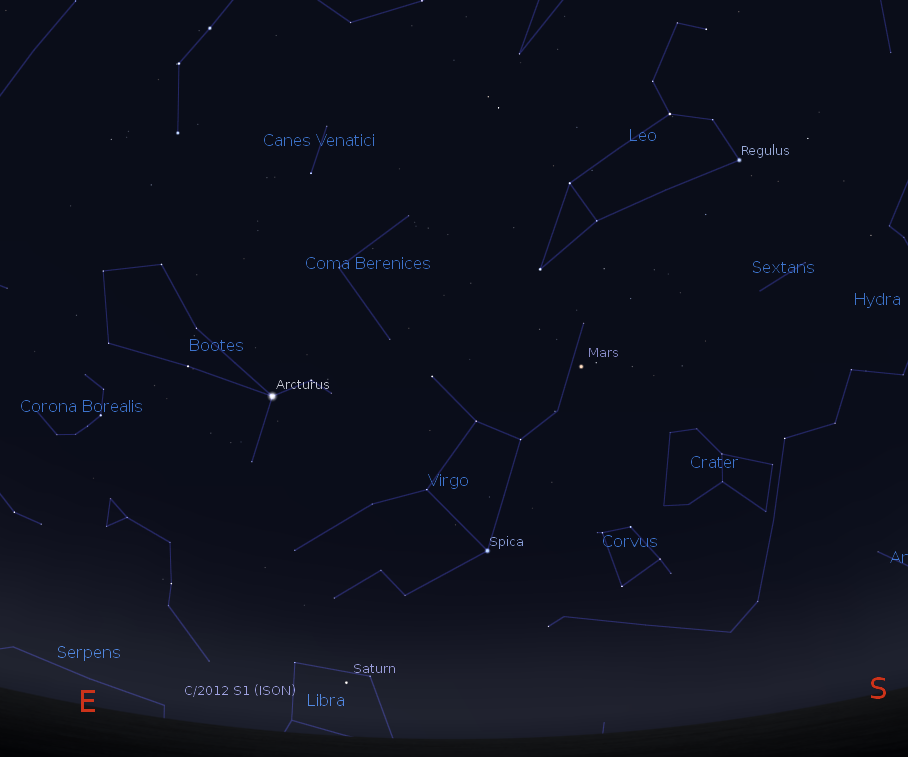
Mars, Saturn and the ghost of Comet ISON at 6:30 a.m. on December 5, 2013. Created using Stellarium.

