Archive

Posts Tagged ‘Jupiter’

Ephemeris: 01/15/2025 – Our weekly look at the whereabouts of the naked-eye planets

January 15, 2025 Comments off

This is Ephemeris for Wednesday, January 15th. Today the Sun will be up for 9 hours and 12 minutes, setting at 5:28, and it will rise tomorrow at 8:15. The Moon, 2 days past full, will rise at 7:27 this evening.

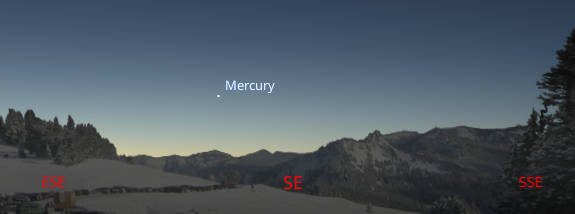
Let’s take our weekly look at the whereabouts of the naked-eye planets. At 8 PM this evening four of the five naked eye planets will be out. Starting from the West we have Venus the brightest of all low in the west southwest. Left and a bit above it is Saturn. They will appear at their closest Friday and Saturday nights. Jupiter, the second-brightest planet will be high in the southeast. The 4th planet out is Mars, which is at opposition from the Sun tonight. Mars will not get this close to the Earth again until 2031. It shines with its reddish hue a third as bright as Jupiter in the eastern sky. On unusually close approaches, Mars can actually outshine Jupiter. The fifth naked eye planet, Mercury, is too close to the Sun on the morning side to be visible.

The astronomical event times given are for the Traverse City/Interlochen area of Michigan (EST, UT – 5 hours). Times will be different for other locations.

Addendum
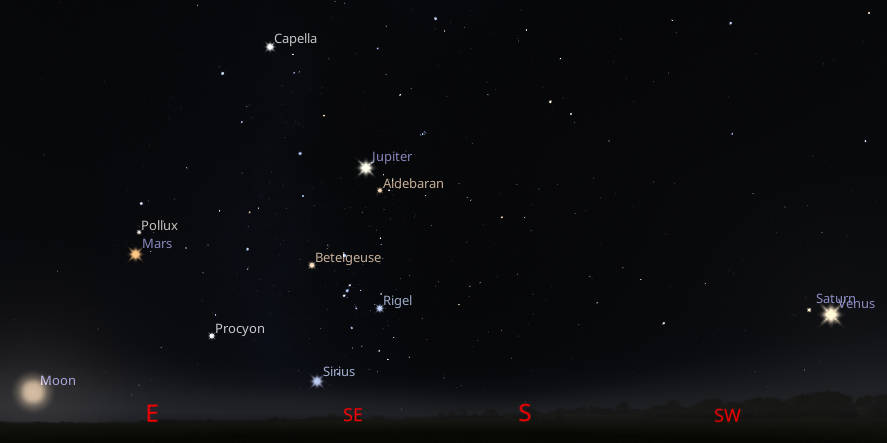
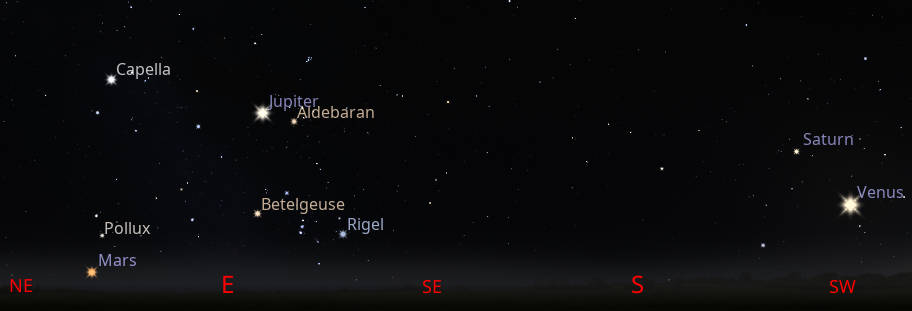
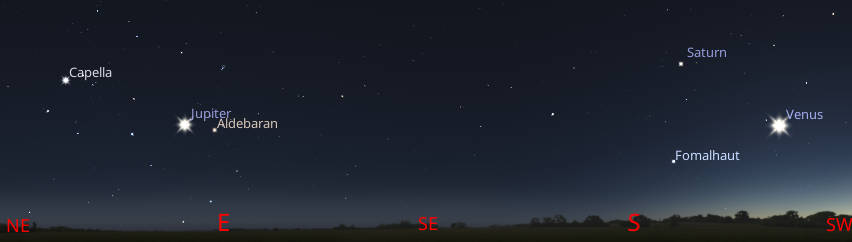
A 8 PM January 15, 2025 planet panorama
A 8 PM January 15, 2025 planet panorama. Venus and Saturn are in the west-southwest, and Jupiter is in the southeast. Mars is in the east-northeast. The waning gibbous Moon is rising in the east-northeast. The first magnitude stars are also named. Click or tap on the image to enlarge it. Created using Stellarium.
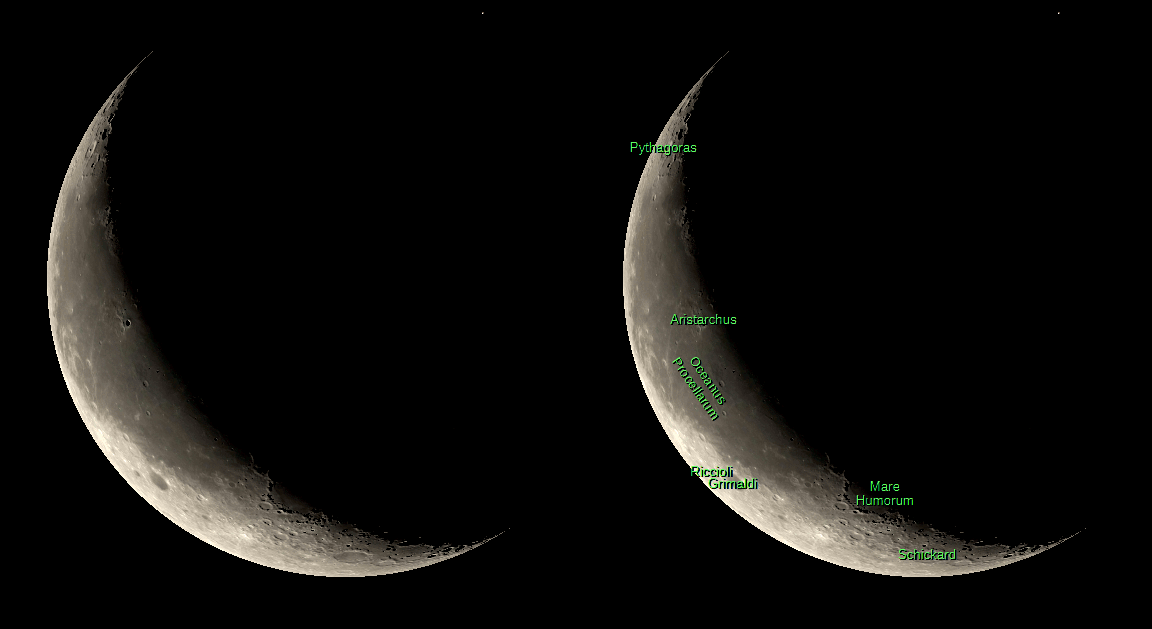
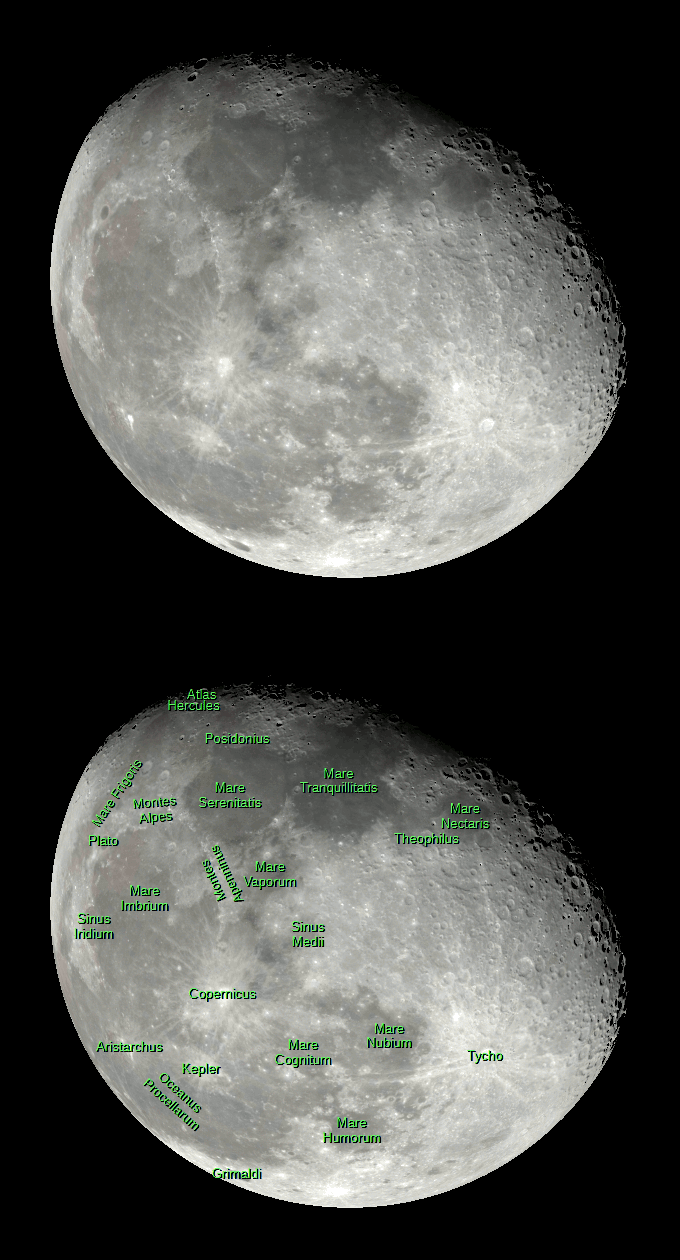
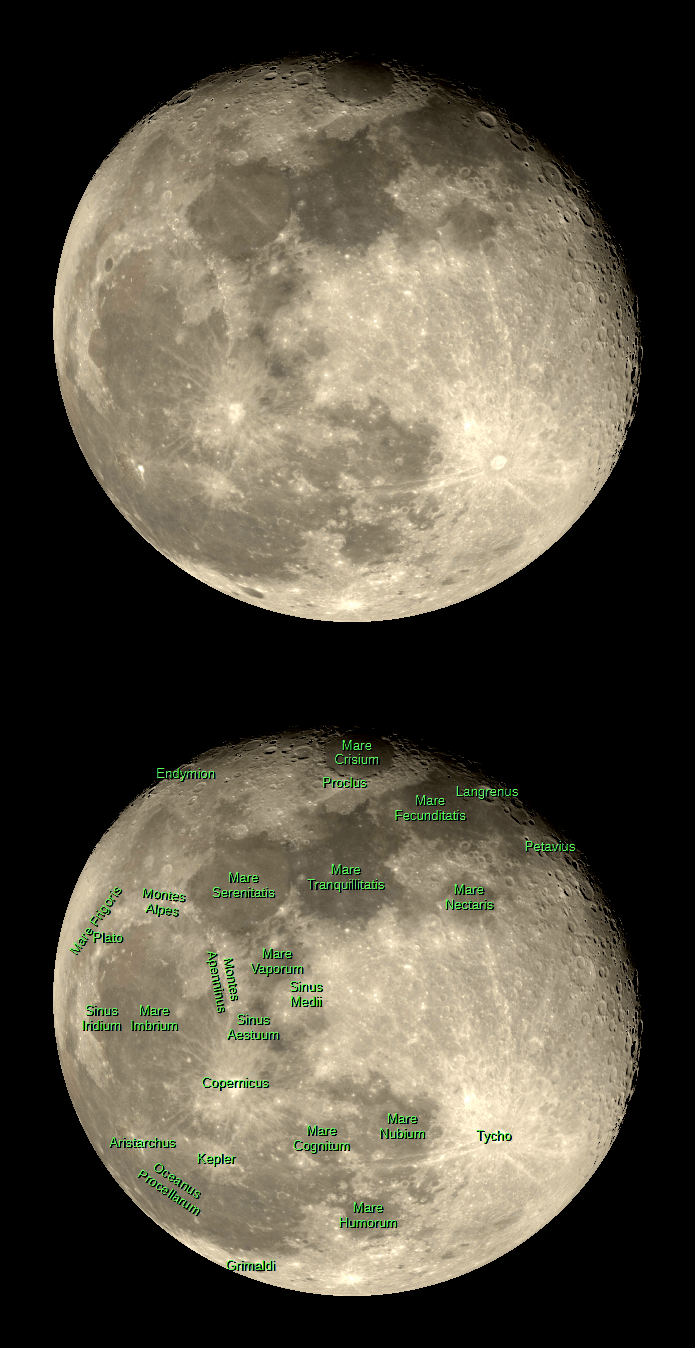
The Moon tonight at 9 PM, January 15, 2025, as it might appear in a small telescope
The Moon tonight at 9 PM, January 15, 2025, as it might appear in a small telescope. Selected features are labeled. Created using Stellarium, LibreOffice Draw, and GIMP.

Translations of some lunar feature names according to Virtual Moon Atlas

Mare Cognitum – Sea of Knowledge
Mare Crisium – Sea of Crises
Mare Fecunditatis – Sea of Fruitfulness
Mare Frigoris – Sea of Cold
Mare Humorum – Sea of Moisture
Mare Imbrium – Sea of Showers
Mare Nectaris – Sea of Nectar
Mare Nubium – Sea of Clouds
Mare Serenitatis – Sea of Serenity
Mare Tranquillitatis – Sea of Tranquility
Mare Vaporum – Sea of Vapors
Montes Alpes – Alps Mountains
Montes Apenninus – Apennines Mountains
Oceanus Procellarum – Ocean of Storms
Sinus Iridium – Bay of Rainbows
Sinus Medii – Central Bay

Mare is pronounced Mar-e. Craters are named for persons, real or otherwise.

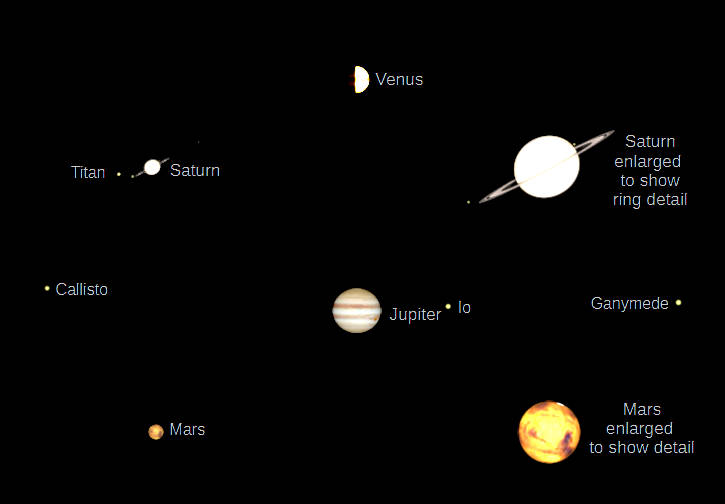
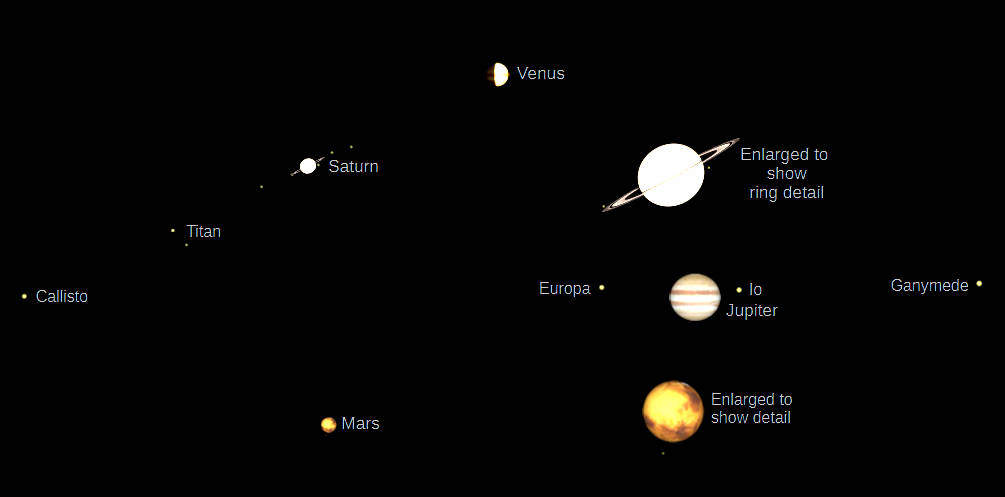
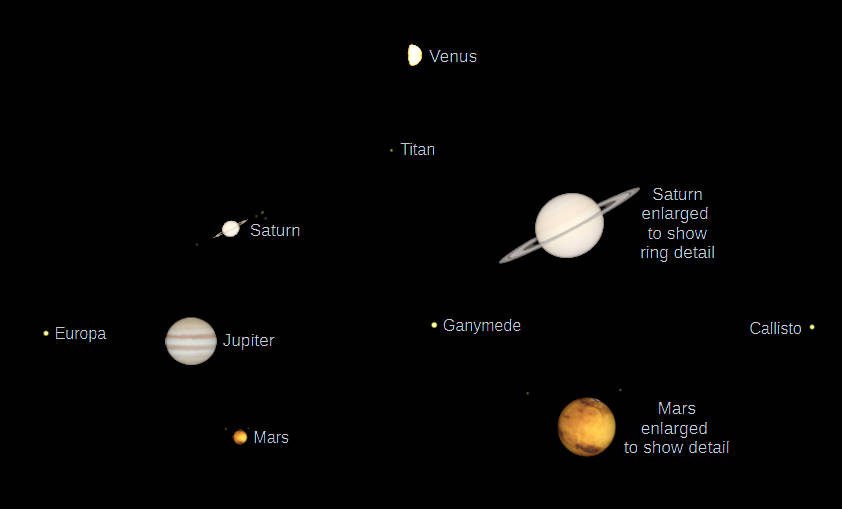
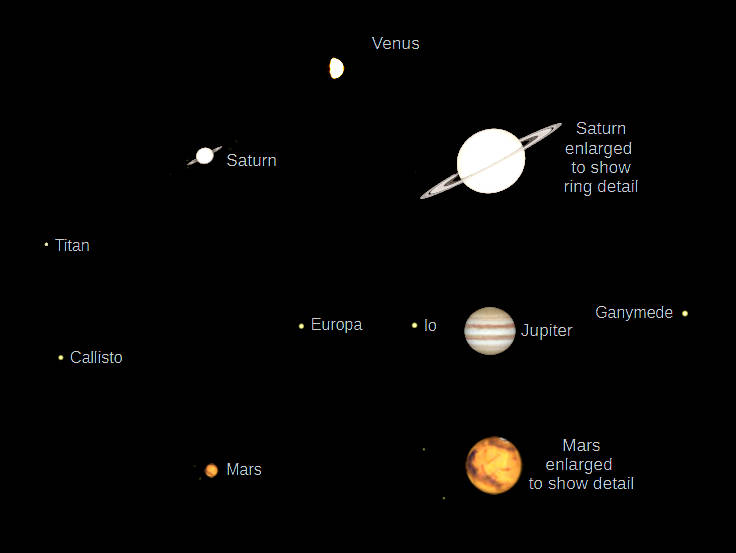
Telescopic Venus, Saturn, Jupiter and Mars
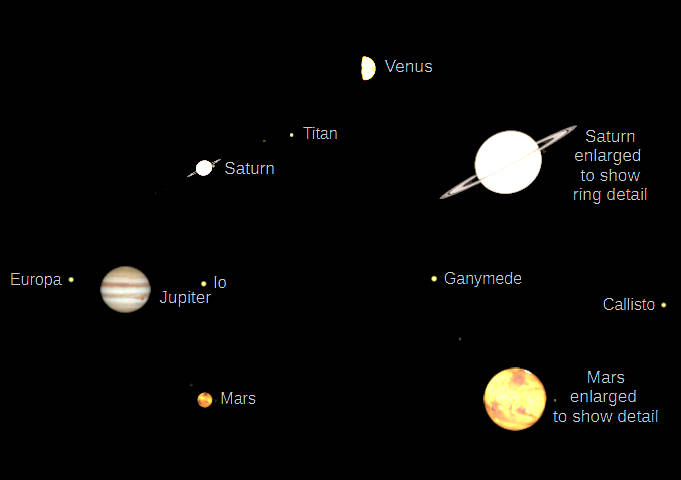
Telescopic Venus, Saturn, Jupiter and Mars (north up) as they would be seen in a small telescope with the same magnification. All the planets are shown for tonight, 8 PM, January 15, 2025. Apparent diameters: Venus 26.1″, 47.8% illuminated; Saturn 16.2″, its rings 37.8″, 3.7 degrees from edge on (closing); Jupiter 45.5″; Mars, 14.6″. Planetary surface detail is more subtle than shown here. Jupiter’s moon Europa is behind the planet and will reappear on Callisto’s side of the planet at 9:22 PM (2:22 UT). The ” means seconds of arc, or 1/3600th of a degree. Click or tap on the image to enlarge it. Created using Cartes du Ciel (Sky Charts).
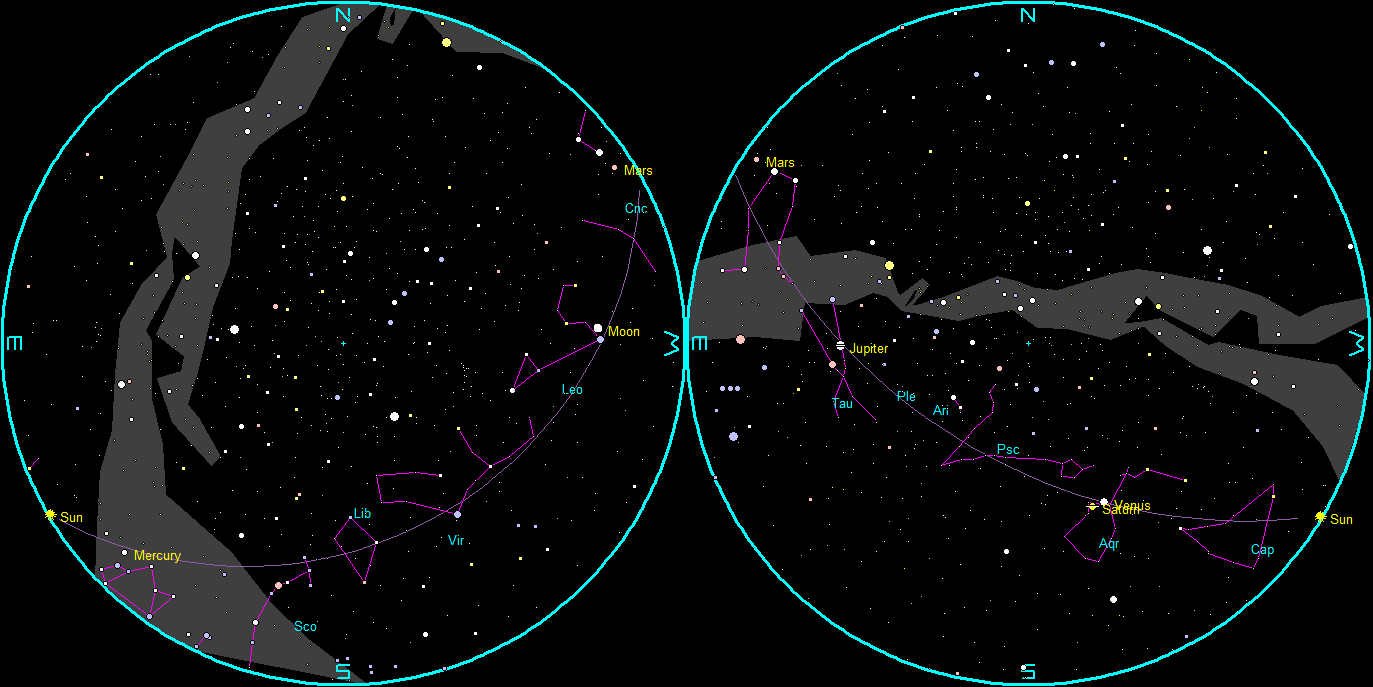
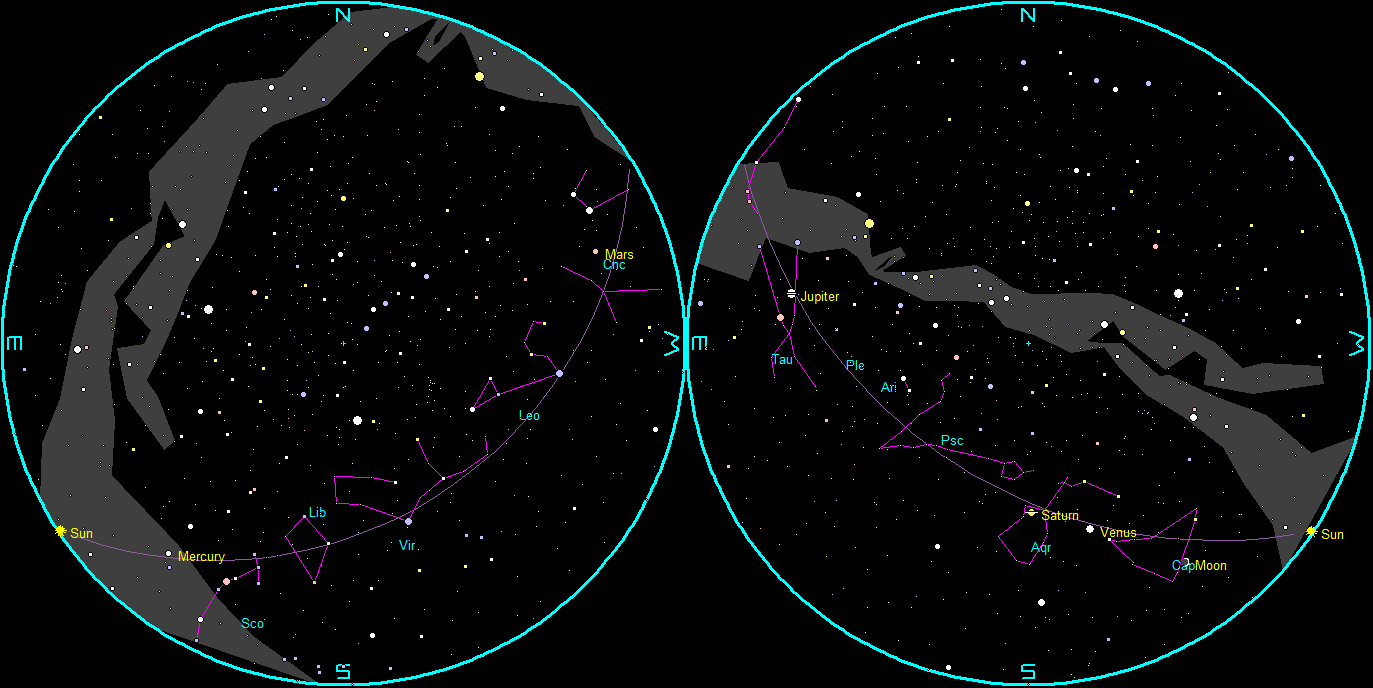
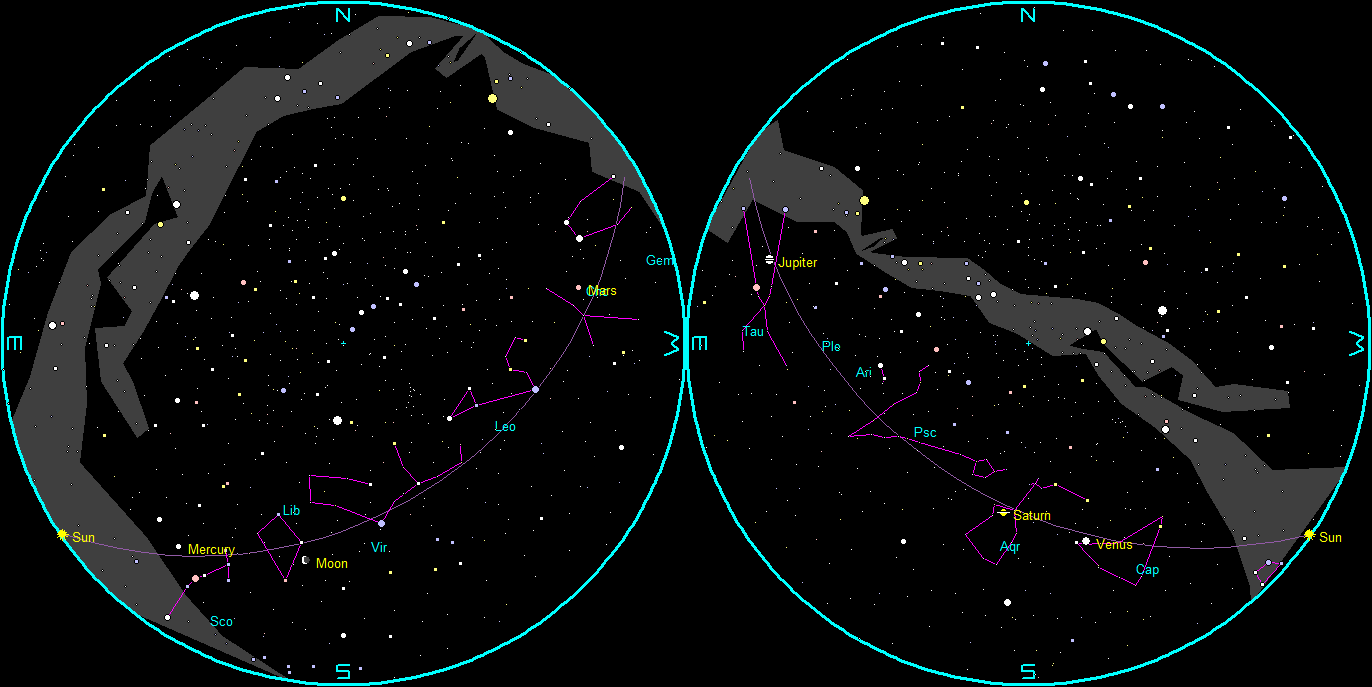
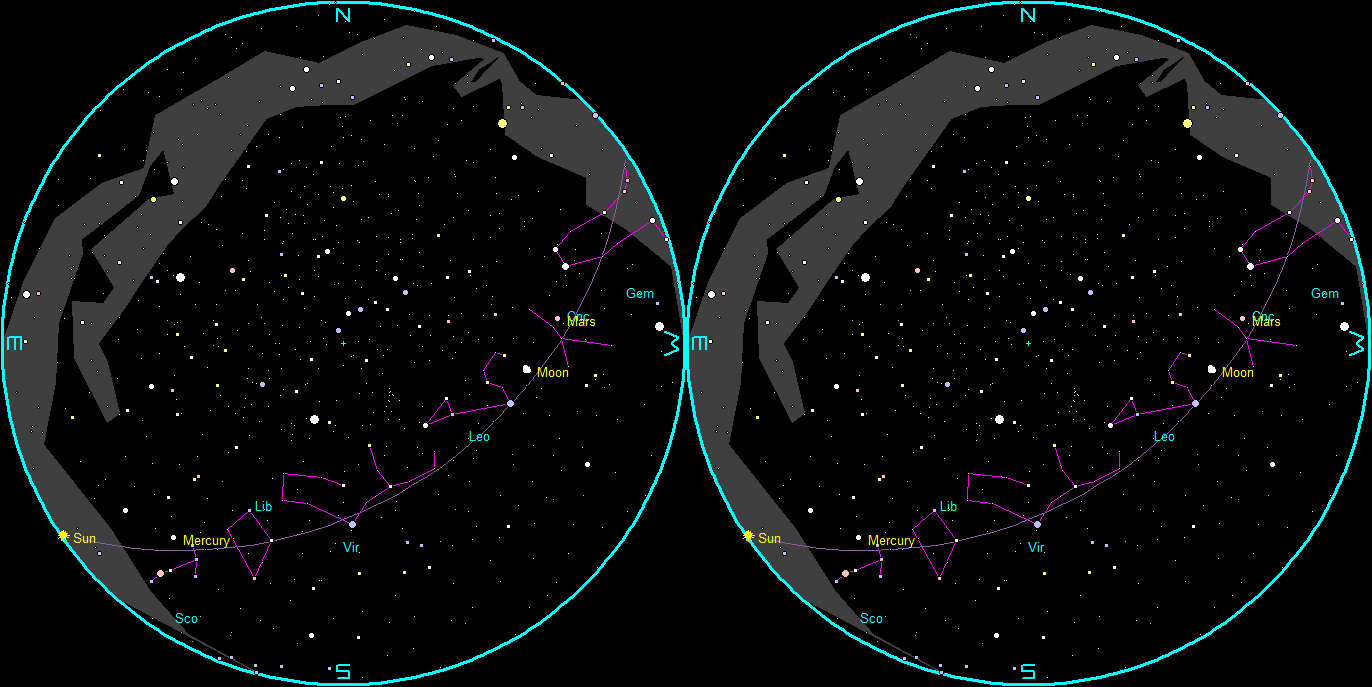
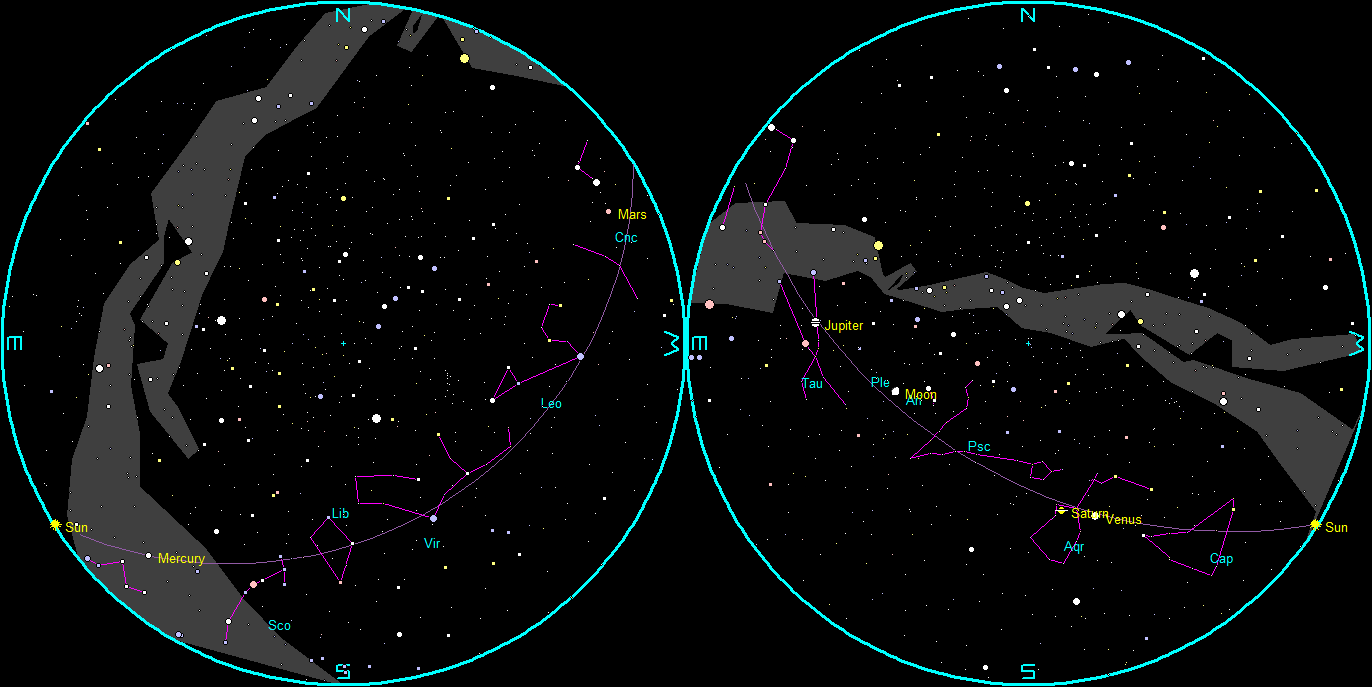
The naked-eye planets and the Moon at sunset and sunrise on a single night, starting with sunset on the right on January 15, 2025. The night ends on the left with sunrise on the 16th. Click or tap on the image to enlarge it. Created using my LookingUp app and GIMP.
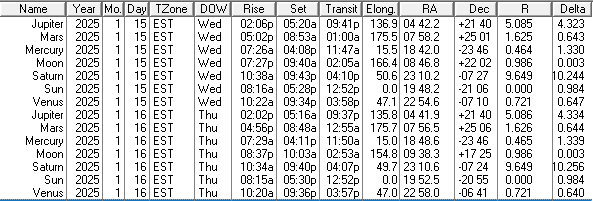
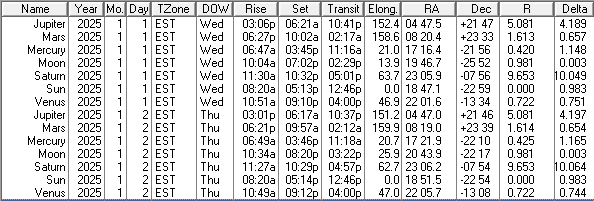
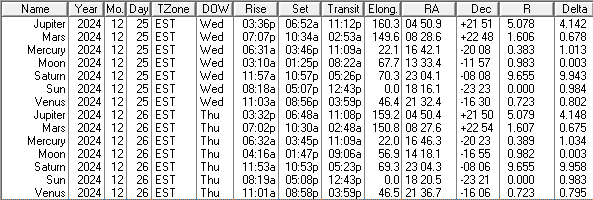
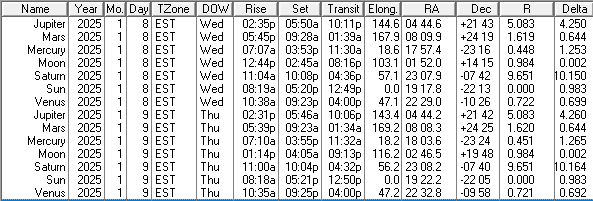
This is a low precision ephemeris of the Sun Moon and naked eye planet positions for today and tomorrow, January 15 and 16, 2025. Some of the columns are self-explanatory, others not. The transit column is the time that the body crosses the meridian and is due south. Elong, for elongation, is the angle between the Sun and that body. RA is right ascension, which is the object’s east-west position on the celestial sphere in hours and minutes. Dec is declination which is the north-south position of the object on the celestial sphere in degrees and minutes. R is the distance of that object from the Sun in astronomical units. An astronomical unit is about 93 million miles or 150 million kilometers. And Delta is the distance of that object from the Earth, also in astronomical units. I omit the ‘m’ in am and pm for compactness. The data was generated using my LookingUp for DOS app and displayed as a table by my Ephemeris Helper app.

Ephemeris: 01/08/2025 – A weekly look at the whereabouts of the naked-eye planets

January 8, 2025 Comments off

This is Ephemeris for Wednesday, January 8th. Today the Sun will be up for 9 hours and 1 minute, setting at 5:20, and it will rise tomorrow at 8:18. The Moon, 2 days past first quarter, will set at 4:05 tomorrow morning.

Let’s take our weekly look at the whereabouts of the naked-eye planets. At 8:00 PM this evening four of the five naked eye planets will be out. Starting from the West we have Venus the brightest of all low in the west southwest. Above and left of that is Saturn. The waxing gibbous moon is high in the South at that time. Jupiter, the second-brightest planet will be high in the southeast. The 4th planet out is Mars which is low in the east northeast with its reddish hue giving it away. Next Monday the Moon will pass directly over the planet Mars in our evening sky. The fifth naked eye planet, Mercury, is too close to the Sun on it morning side to be visible.

The astronomical event times given are for the Traverse City/Interlochen area of Michigan (EST, UT – 5 hours). Times will be different for other locations.

Addendum
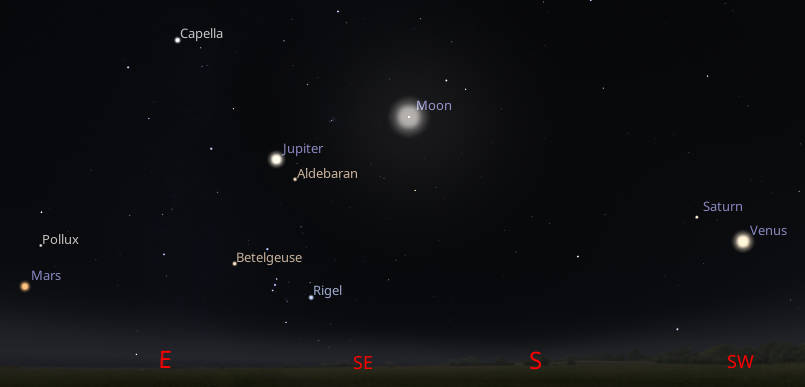
A 7 PM January 8, 2025, planet panorama
A 7 PM January 8, 2025 planet panorama. Venus and Saturn are in the southwest, and Jupiter is in the east. Mars is just rising in the east-northeast. Click or tap on the image to enlarge it. Created using Stellarium.
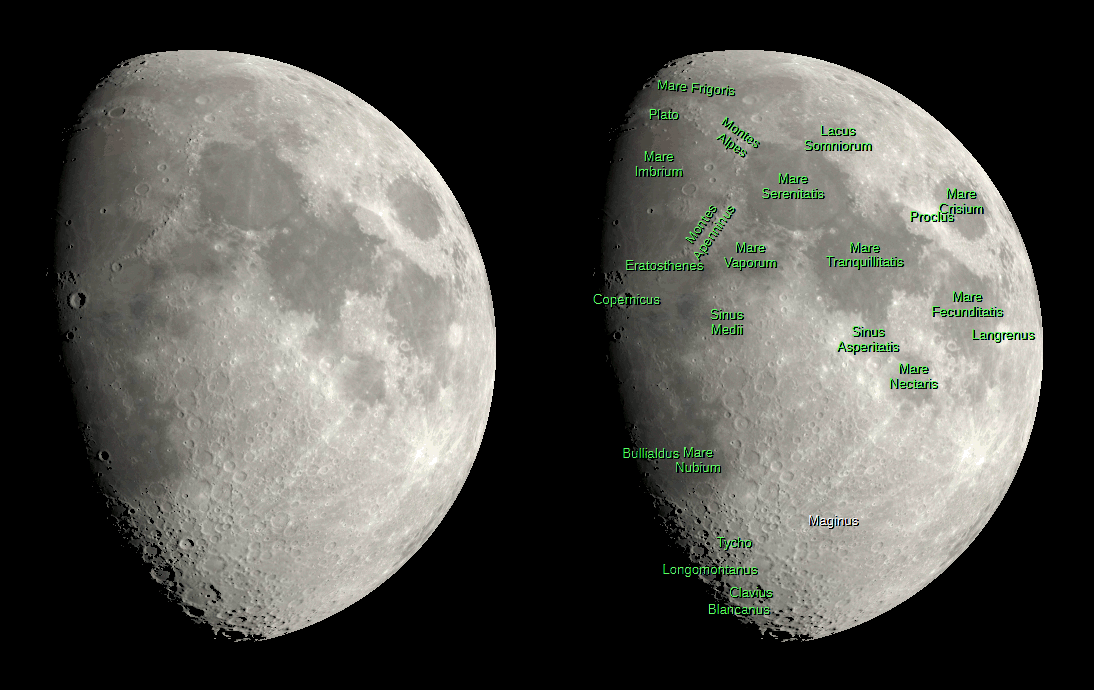
The Moon tonight, January 8, 2025, as it might appear in a small telescope
The Moon tonight, January 8, 2025, as it might appear in a small telescope. Selected features are labeled. Created using Stellarium, LibreOffice Draw, and GIMP.
Telescopic Venus, Saturn, Jupiter and Mars
Telescopic Venus, Saturn, Jupiter and Mars (north up) as they would be seen in a small telescope with the same magnification. All the planets are shown for tonight, 7 PM, January 8, 2025. Apparent diameters: Venus 24.1″, 51.6% illuminated; Saturn 16.4″, its rings 38.2″, 4.0 degrees from edge on (closing); Jupiter 46.3″; Mars, 14.5″. Planetary surface detail is more subtle than shown here. Jupiter’s moon Io will disappear behind the planet later in the evening and reappear on the other side after midnight. The ” means seconds of arc, or 1/3600th of a degree. Click or tap on the image to enlarge it. Created using Cartes du Ciel (Sky Charts).
The naked-eye planets and the Moon at sunset and sunrise on a single night
The naked-eye planets and the Moon at sunset and sunrise on a single night, starting with sunset on the right on January 8, 2025. The night ends on the left with sunrise on the 9th. Click or tap on the image to enlarge it. Created using my LookingUp app and GIMP.
A low precision ephemeris of the Sun Moon and naked eye planet positions for today and tomorrow
This is a low precision ephemeris of the Sun Moon and naked eye planet positions for today and tomorrow, January 8 and 9, 2025. Some of the columns are self-explanatory, others not. The transit column is the time that the body crosses the meridian and is due south. Elong, for elongation, is the angle between the Sun and that body. RA is right ascension, which is the object’s east-west position on the celestial sphere in hours and minutes. Dec is declination which is the north-south position of the object on the celestial sphere in degrees and minutes. R is the distance of that object from the Sun in astronomical units. An astronomical unit is about 93 million miles or 150 million kilometers. And Delta is the distance of that object from the Earth, also in astronomical units. I omit the ‘m’ in am and pm for compactness. The data was generated using my LookingUp for DOS app and displayed as a table by my Ephemeris Helper app.

Ephemeris: 01/01/2025 – A New Year’s Day look at the naked-eye planets

January 1, 2025 Comments off

This is Ephemeris for New Year’s Day, Wednesday, January 1st, 2025. The Sun will rise at 8:20. It’ll be up for 8 hours and 53 minutes, setting at 5:13. The Moon, 2 days past new, will set at 7:02 this evening.

Let’s take our weekly look at the whereabouts of the naked-eye planets. Venus can be spotted in the south-southwestern sky by 5:45 PM, about 30 minutes after sunset, and will also be above and left of the thin crescent Moon. Venus will set at 9:10 PM. Saturn will be in the south-southwestern sky at 6 PM, above and left of Venus, which will be seen to cross paths with it on the 18th of this month. Jupiter is low in the east, about the same time Venus is first spotted. It will be a good object for the small telescope. Mars, rises tonight at 6:31. Mars is still considered a morning planet since it is still up at sunrise. But that will end on the 15th of this month, when Mars reaches opposition from the Sun.

The astronomical event times given are for the Traverse City/Interlochen area of Michigan (EST, UT – 5 hours). Times will be different for other locations.

Happy New Year! I do really hope it will be happy…

Addendum

This is a 7 PM planet panorama. Venus and Saturn are in the southwest, and Jupiter is in the east. Mars is just rising in the east-northeast
This is a 7 PM planet panorama. Venus and Saturn are in the southwest, and Jupiter is in the east. Mars is just rising in the east-northeast. Click or tap on the image to enlarge it. Created using Stellarium.
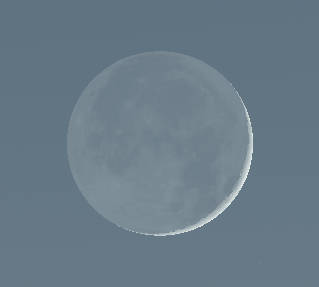
The waxing two day old Moon with earthshine on its night side
The waxing two day old Moon with earthshine on its night side. Created using Stellarium.
Telescopic Venus, Saturn, Jupiter and Mars (north up) as they would be seen in a small telescope with the same magnification
Telescopic Venus, Saturn, Jupiter and Mars (north up) as they would be seen in a small telescope with the same magnification. All the planets are shown for tonight, Jupiter specifically for 7 PM, January 1, 2025. Apparent diameters: Venus 22.4″, 55% illuminated; Saturn 16.6″, its rings 38.6″, 4.3 degrees from edge on (closing); Jupiter 47.0″; Mars, 14.3″. Planetary surface detail is more subtle than shown here. The ” means seconds of arc, or 1/3600th of a degree. Click or tap on the image to enlarge it. Created using Cartes du Ciel (Sky Charts).
The naked-eye planets and the Moon at sunset and sunrise on a single night, starting with sunset on the right on January 1, 2025. The night ends on the left with sunrise on the 2nd
The naked-eye planets and the Moon at sunset and sunrise on a single night, starting with sunset on the right on January 1, 2025. The night ends on the left with sunrise on the 2nd. Click or tap on the image to enlarge it. Created using my LookingUp app and GIMP.
This is a low precision ephemeris of the Sun Moon and naked eye planet positions for today and tomorrow
This is a low precision ephemeris of the Sun Moon and naked eye planet positions for today and tomorrow, January 1 and 2, 2025. Some of the columns are self-explanatory, others not. The transit column is the time that the body crosses the meridian and is due south. Elong, for elongation, is the angle between the Sun and that body. RA is right ascension, which is the object’s east-west position on the celestial sphere in hours and minutes. Dec is declination which is the north-south position of the object on the celestial sphere in degrees and minutes. R is the distance of that object from the Sun in astronomical units. An astronomical unit is about 93 million miles or 150 million kilometers. And Delta is the distance of that object from the Earth, also in astronomical units. I omit the ‘m’ in am and pm for compactness. The data was generated using my LookingUp for DOS app and displayed as a table by my Ephemeris Helper app.

Ephemeris: 12/25/2024 – A Christmas week look at the naked-eye planets

December 25, 2024 1 comment

This is Ephemeris for Christmas Day, Wednesday, December 25th. Today the Sun will be up for 8 hours and 48 minutes, setting at 5:07, and it will rise tomorrow at 8:19. The Moon, 3 days past last quarter, will rise at 4:16 tomorrow morning.

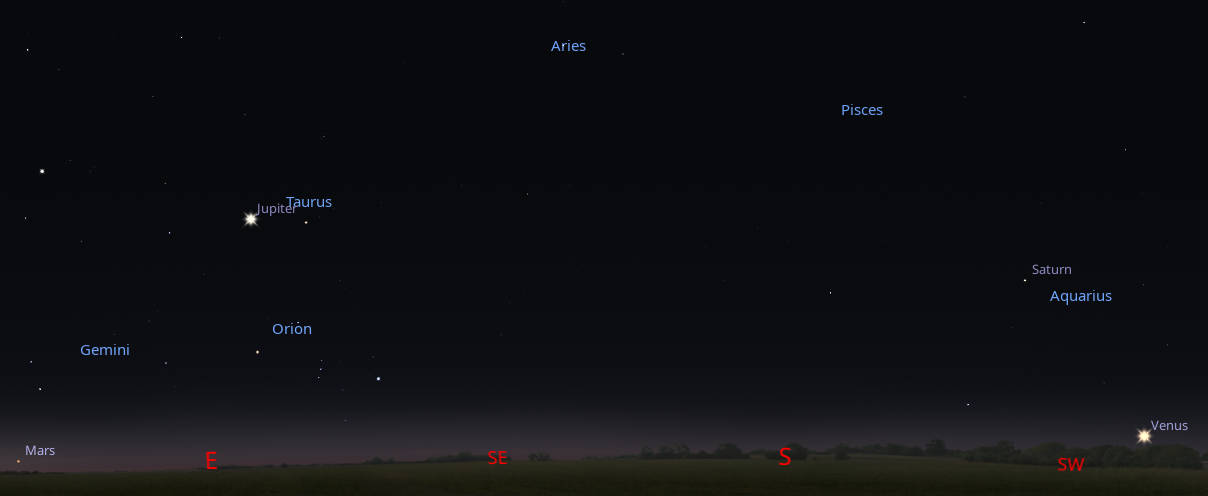
Let’s take our weekly look at the whereabouts of the naked-eye planets. Venus can be spotted in the south-southwestern sky by 5:30 PM, about 30 minutes after sunset. It will set at 8:41 PM. Saturn will be in the south at 6 PM, way above the bright star Fomalhaut. Jupiter is low in the east-northeast, about the same time Venus is first spotted. It will be a good object for the small telescope about an hour later. Mars, rises tonight at 7:44, It will appear above the Moon in the evening. Mars is still considered a morning planet since it is still up at sunrise. By 6:00 AM tomorrow Jupiter will be low in the west-northwest, to the right of the setting Orion, while reddish Mars will be high in the west-southwest.

The astronomical event times given are for the Traverse City/Interlochen area of Michigan (EST, UT – 5 hours). Times will be different for other locations.

Addendum
This is a 6 PM planet panorama
This is a 6 PM planet panorama. Venus is in the southwest, Saturn is in the south, and Jupiter is rising in the east. Mars will rise shortly. Click or tap on the image to enlarge it. Created using Stellarium.
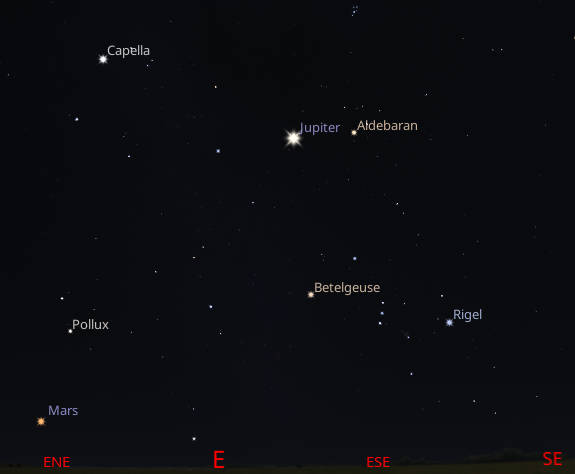
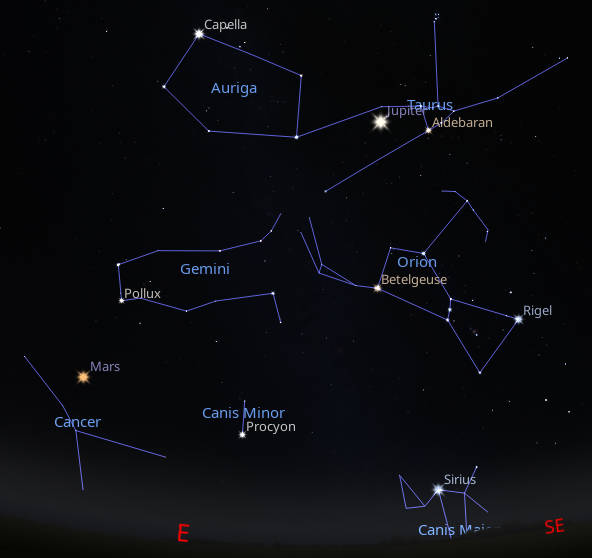
Looking eastward at 9:00 PM at Jupiter and Mars among the rising winter constellations
Looking eastward at 9:00 PM at Jupiter and Mars among the rising winter constellations. Created using Stellarium.
The Moon as it might appear through a small telescope tomorrow morning
The Moon as it might appear through a small telescope tomorrow morning, December 26, 2024. Selected features are labeled. Created using Stellarium, LibreOffice draw, and GIMP.
Telescopic Venus, Saturn, Jupiter and Mars (north up) as they would be seen in a small telescope with the same magnification
Telescopic Venus, Saturn, Jupiter and Mars (north up) as they would be seen in a small telescope with the same magnification. All the planets are shown for tonight, Jupiter specifically for 8 PM, December 25, 2024. Apparent diameters: Venus 21.0″, 58.1% illuminated; Saturn 16.7″, its rings 39.0″, 4.5 degrees from edge on (closing); Jupiter 47.5″; Mars, 13.9″. Saturn’s rings are actually much brighter than depicted here. Planetary surface detail is more subtle than shown here. The ” means seconds of arc, or 1/3600th of a degree. Click or tap on the image to enlarge it. Created using Cartes du Ciel (Sky Charts).
The naked-eye planets and the Moon at sunset and sunrise on a single night
The naked-eye planets and the Moon at sunset and sunrise on a single night, starting with sunset on the right on December 25, 2024. The night ends on the left with sunrise on the 26th. Click or tap on the image to enlarge it. Created using my LookingUp app and GIMP.
This is a low precision ephemeris of the Sun Moon and naked eye planet positions for today and tomorrow
This is a low precision ephemeris of the Sun Moon and naked eye planet positions for today and tomorrow, December 25 and 26, 2024. Some of the columns are self-explanatory, others not. The transit column is the time that the body crosses the meridian and is due south. Elong, for elongation, is the angle between the Sun and that body. RA is right ascension, which is the object’s east-west position on the celestial sphere in hours and minutes. Dec is declination which is the north-south position of the object on the celestial sphere in degrees and minutes. R is the distance of that object from the Sun in astronomical units. An astronomical unit is about 93 million miles or 150 million kilometers. And Delta is the distance of that object from the Earth, also in astronomical units. I omit the ‘m’ in am and pm for compactness. The data was generated using my LookingUp for DOS app and displayed as a table by my Ephemeris Helper app.

Ephemeris: 12/24/2024 – Looking at another possibility for the Star of Bethlehem

December 24, 2024 Comments off

This is Ephemeris for Christmas Eve, Tuesday, December 24th. Today the Sun will be up for 8 hours and 48 minutes, setting at 5:07, and it will rise tomorrow at 8:18. The Moon, 2 days past last quarter, will rise at 3:10 tomorrow morning.

Many writers of the 2nd and 3rd centuries CE place Jesus’ birth, via Roman events, around 2 BCE. So the Star of Bethlehem could appear several years later than the triple conjunction of Jupiter and Saturn in 7 BCE that’s been popular. In 3 and again in 2 BCE there were star-like conjunctions or apparent joining of the planets Jupiter and Venus against the backdrop of the constellation of Leo the Lion. A lion is related to Judah, son of Jacob, by a blessing the latter gave his 12 sons in Genesis. The first conjunction occurred in August in the morning sky. On June 16th of the next year the two planets got together again, this time in the evening sky, a month or more after Jesus would have been born in the vulnerable spring lambing season when shepherds would most likely be out at night guarding the flocks, not December 25th.

The astronomical event times given are for the Traverse City/Interlochen area of Michigan (EST, UT – 5 hours). Times will be different for other locations.

Addendum
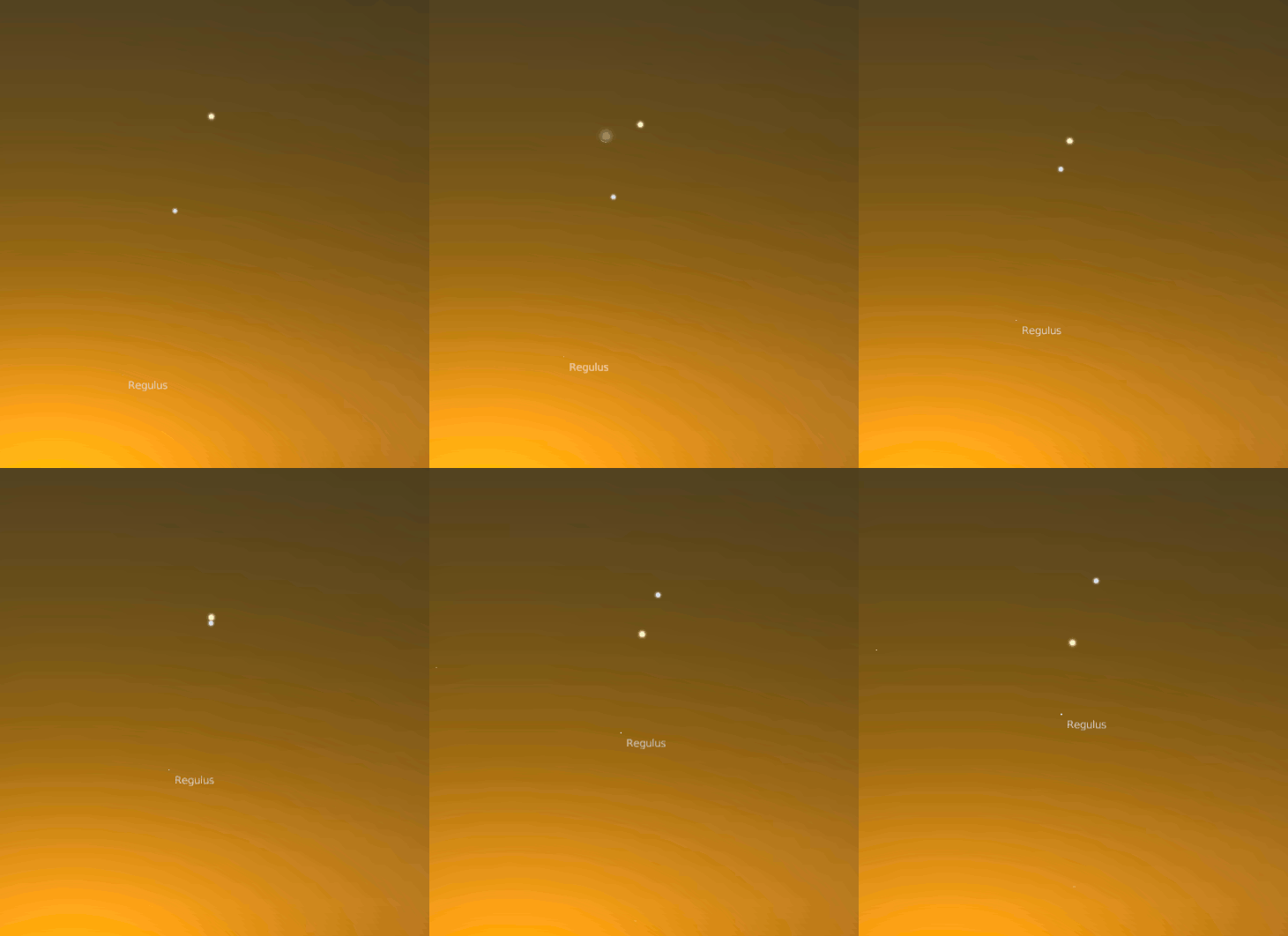
August 12, 3 BC conjunction
Here is an animation created using Stellarium of Jupiter and Venus, the brighter of the two seeming to coalesce on August 12, 3 BCE in the early morning twilight.
The second appearance of the "Star"
On June 16th 2 BCE, this time in the evening, Venus and Jupiter seem to coalesce as one, at least to the naked eye.

An edited excerpt from this year’s Star of Bethlehem presentation I gave to the Grand Traverse Astronomical Society on December 6th.

The triple conjunction of Jupiter and Saturn in 7 BCE is the generally accepted Star of Bethlehem, with Jesus being born in 6 or 5 BCE and Herod’s death being in 4 BCE after a lunar eclipse. What if the lunar eclipse in question was in 1 BCE? If so, there is that other possibility. It involves the constellation Leo, which is a lion. There is a passage in Genesis in which Jacob, who, by this time, is called Israel, is blessing his sons, each the heads of the twelve tribes of Israel. In Genesis 49 9-10 He compares him to a lion cub, the king of beasts, from whom the leaders of Israel will come. We can make a connection between Judah and the celestial lion, Leo. Let’s take a look at the celestial happenings against the constellation of Leo with Jupiter and Venus in 3 and 2 BCE.

On August 12th of 3 BCE Jupiter and Venus appeared to come together so close as to be separable only in telescopes. This may have been the Star at its rising mentioned to Herod. Could this predawn celestial mating of Jupiter, who the Babylonians saw as the god Marduk and Venus as Ishtar, the goddess of fertility, to bring forth a powerful king? The Magi, I’m pretty sure, would have known that 10 months later, a little longer than the human gestation period, by the way, that the two planets would again come together.

Ten months after the first conjunction of Jupiter and Venus, perhaps as the Magi neared Jerusalem, they saw Jupiter and Venus approaching each other again. Later as they left Herod’s palace on the evening of June 16th, 2 BCE the conjunction was at its tightest. They saw the “Star” again, as Matthew relates. Telescopes, which wouldn’t be invented for another sixteen hundred years, could have seen this extremely close conjunction of Jupiter and Venus. Venus, near its greatest eastern elongation from the Sun, would appear half illuminated. But even to the best naked eye observer, Jupiter and Venus would merge into a single star. Venus was much brighter than Jupiter than it appears here. In fact, it was nearly twelve times brighter, so Jupiter’s added brightness wouldn’t contribute much to the combined brightness. Jupiter would seem to disappear at their closest.

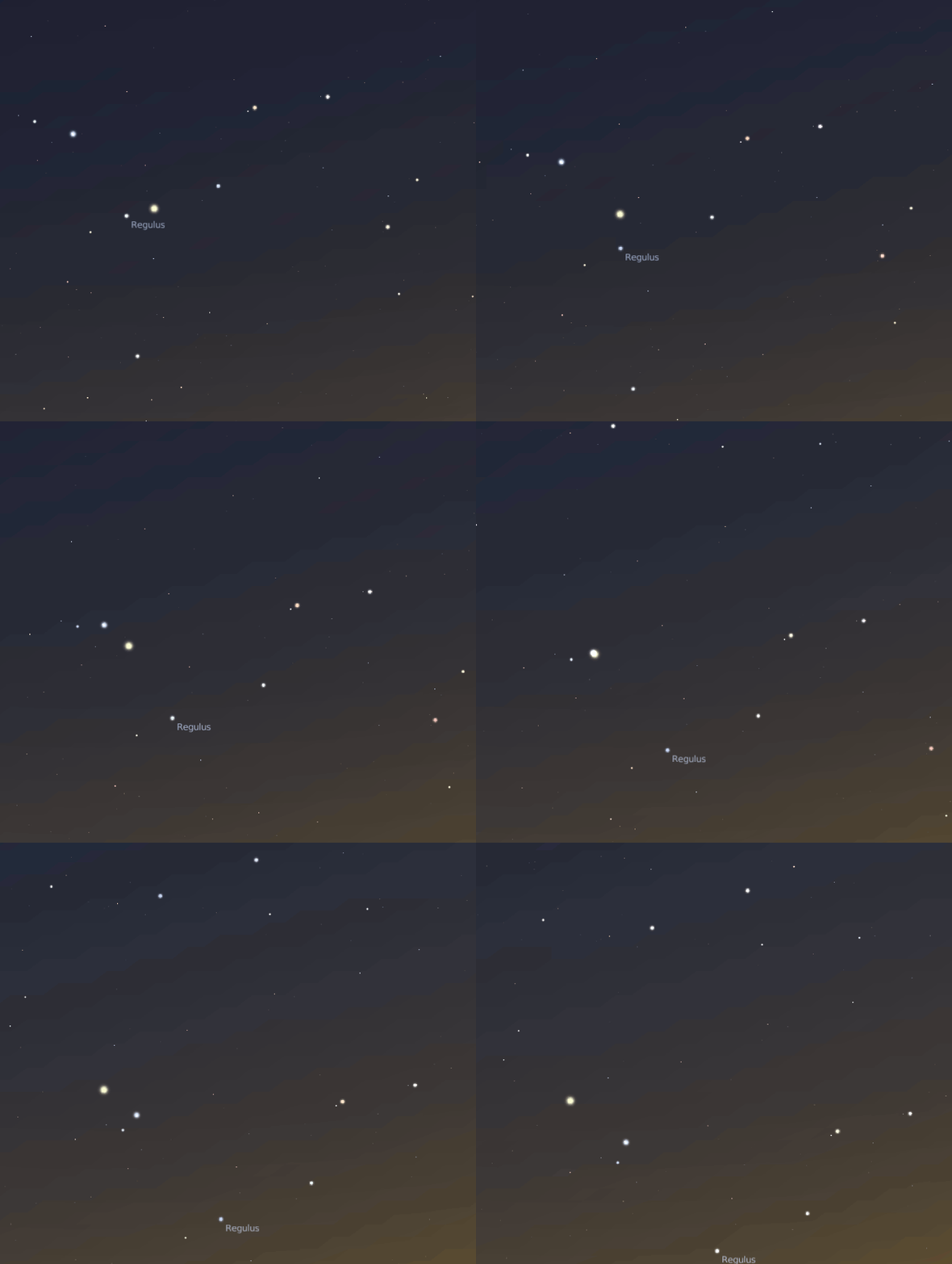
Also, there was a conjunction of Jupiter with the “Little King” star Regulus on September 14th 3 BCE, one or two days after the beginning of the Jewish New Year. Was this another sign that a new King of the Jews would be born? It is actually the first of three conjunctions Jupiter has with Regulus in the next 9 months. Yes, another triple conjunction. Jupiter passed Regulus the second time on February 17, of 2 BCE and for a final time on May 9th. During this time Venus had moved back toward the Sun and entered the evening sky where Jupiter met it once again.

Ephemeris: 12/23/2024 – What was the Star of Bethlehem? Part 1

December 23, 2024 Comments off

This is Ephemeris for Monday, December 23rd. Today the Sun will be up for 8 hours and 48 minutes, setting at 5:06, and it will rise tomorrow at 8:18. The Moon, 1 day past last quarter, will rise at 2:05 tomorrow morning.

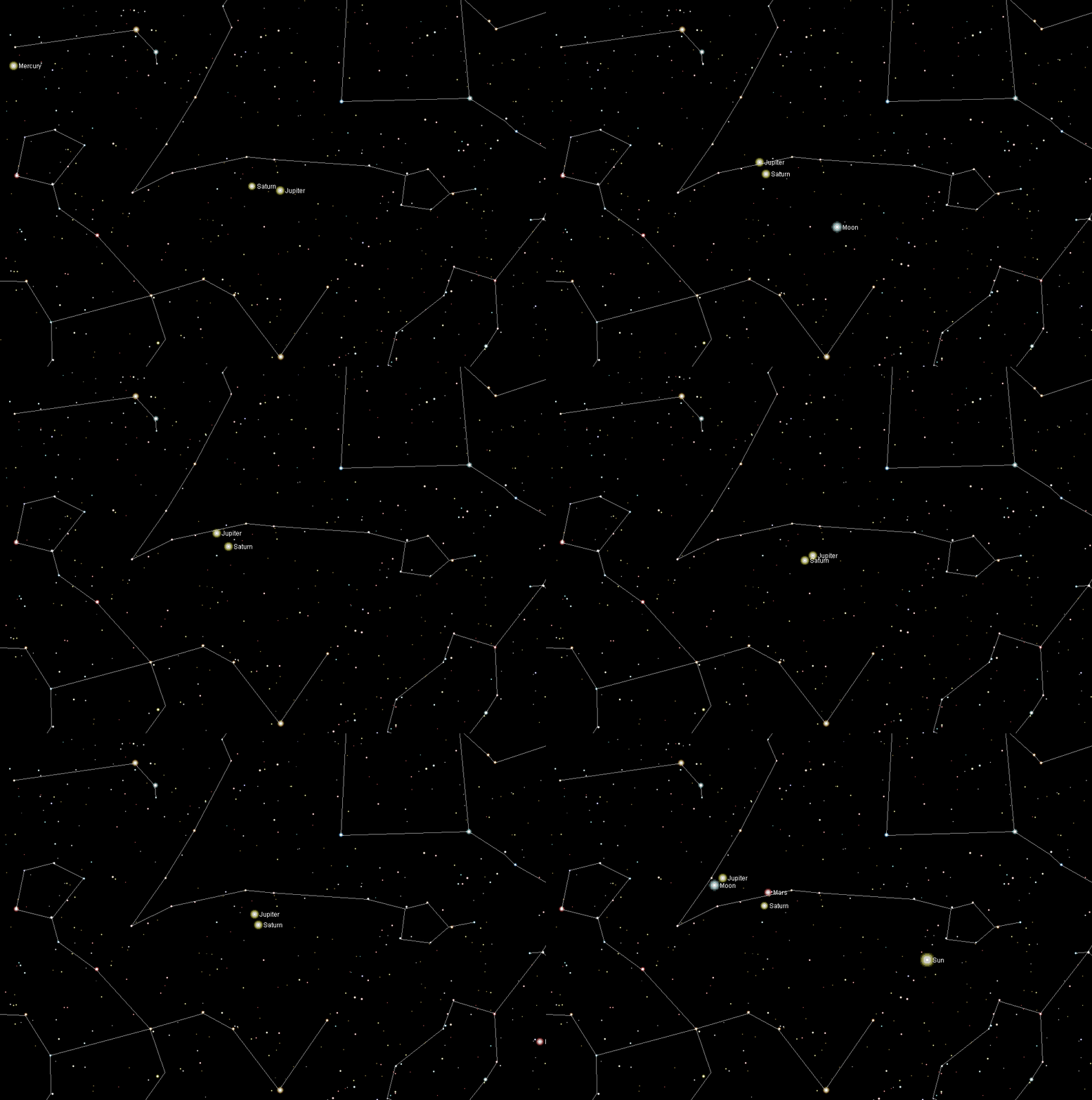
The most popular solution to what the Star of Bethlehem may have been, is a triple conjunction of Jupiter and Saturn that occurred in 7 BCE, where Jupiter passed Saturn three times in a few months time. So the event should more probably be called a celestial sign, rather than a star. The conjunction occurred against the constellation of Pisces the fish which was thought to represent the Jews or whoever lived in that area. Such a series of conjunctions against a particular zodiacal constellation would occur only about once every 800 to 900 years. Triple conjunctions aren’t super rare, if you don’t care which constellation it’s happening in front of. We had one in 1981, but it was against the constellation of Virgo.

The astronomical event times given are for the Traverse City/Interlochen area of Michigan (EST, UT – 5 hours). Times will be different for other locations.

Addendum
Triple conjunction
The Jupiter-Saturn triple conjunction of 7 BC. Click on the image to enlarge and animate. This animation is at 5 day intervals. The Moon will be popping in and out of the view. It ends in February of 6 BC when Mars and the Sun enter the picture. Created using Cartes du Ciel and GIMP.

Ephemeris: 12/18/2024 – Taking our weekly look at the whereabouts of the naked-eye planets

December 18, 2024 Comments off

This is Ephemeris for Wednesday, December 18th. Today the Sun will be up for 8 hours and 48 minutes, setting at 5:03, and it will rise tomorrow at 8:16. The Moon, 3 days past full, will rise at 8:36 this evening.

Let’s take our weekly look at the whereabouts of the naked-eye planets. Venus can be spotted in the south-southwestern sky by 5:30 PM, about 30 minutes after sunset. It will set at 8:41 PM. Saturn will be in the south at 6 PM, way above the bright star Fomalhaut. Jupiter is low in the east-northeast, about the same time Venus is first spotted. It will be a good object for the small telescope about an hour later. Mars, rises tonight at 7:44, It will appear above the Moon in the evening. Mars is still considered a morning planet since it is still up at sunrise. By 6:00 AM tomorrow Jupiter will be low in the west-northwest, to the right of the setting Orion, while reddish Mars will be high in the west-southwest.

The astronomical event times given are for the Traverse City/Interlochen area of Michigan (EST, UT – 5 hours). Times will be different for other locations.

Addendum
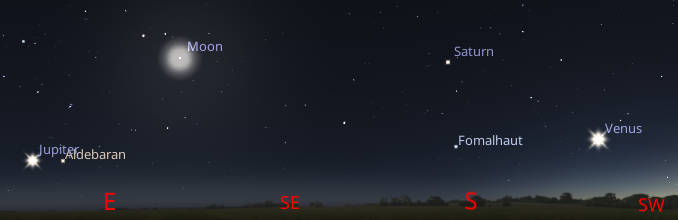
This is what I call my 8:00 PM planet panorama. Venus is setting the southwest Saturn heading downwards in the southwest, Jupiter high in the east and Mars just rising in the east northeast. The waning gibbous Moon will rise shortly, trailing Mars. The only thing we’re really missing is Mercury which is close to the Sun in the morning sky. Click or tap on the image to enlarge it. Created using Stellarium.
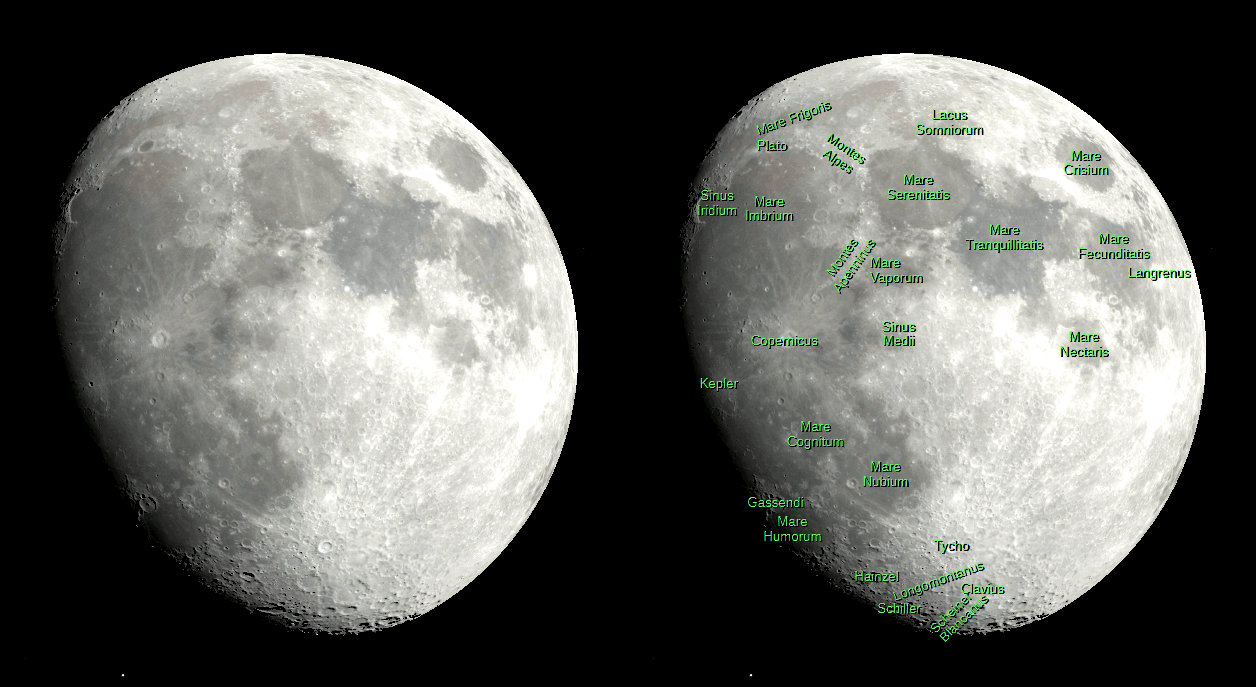
The Moon as it might appear through a small telescope 10 PM tonight, December 18, 2024. Selected features are labeled. Created using Stellarium, LibreOffice draw, and GIMP.
The planet Mercury should be seen low in the southeast by 7:30 AM, tomorrow morning December 19, 2024. Created using Stellarium.
Telescopic Venus, Saturn, Jupiter and Mars (north up) as they would be seen in a small telescope with the same magnification. All the planets are shown for tonight, Jupiter specifically for 9 PM, December 18, 2024. Apparent diameters: Venus 19.7″, 61.1% illuminated; Saturn 16.9″, its rings 39.4″, 4.7 degrees from edge on (closing); Jupiter 47.9″; Mars, 13.3″, 96.3% illuminated. Saturn’s rings are actually much brighter than depicted here. Planetary surface detail is more subtle than shown here. The ” means seconds of arc, or 1/3600th of a degree. Click or tap on the image to enlarge it. Created using Cartes du Ciel (Sky Charts).

The naked-eye planets and the Moon at sunset and sunrise on a single night, starting with sunset on the right on December 18, 2024. The night ends on the left with sunrise on the 19th. Click or tap on the image to enlarge it. Created using my LookingUp app and GIMP.
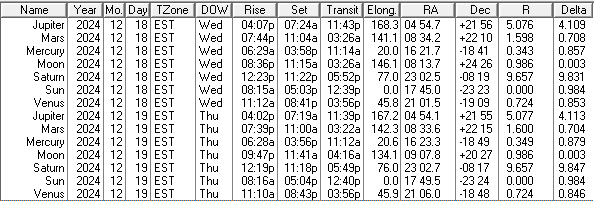
This is a low precision ephemeris of the Sun Moon and naked eye planet positions for today and tomorrow, December 18 and 19, 2024. Some of the columns are self-explanatory, others not. The transit column is the time that the body crosses the meridian and is due south. Elong, for elongation, is the angle between the Sun and that body. RA is right ascension, which is the object’s east-west position on the celestial sphere in hours and minutes. Dec is declination which is the north-south position of the object on the celestial sphere in degrees and minutes. R is the distance of that object from the Sun in astronomical units. An astronomical unit is about 93 million miles or 150 million kilometers. And Delta is the distance of that object from the Earth, also in astronomical units. I omit the ‘m’ in am and pm for compactness. The data was generated using my LookingUp for DOS app and displayed as a table by my Ephemeris Helper app.

Ephemeris: 12/17/2024 – A closeup look at Ganymede

December 17, 2024 Comments off

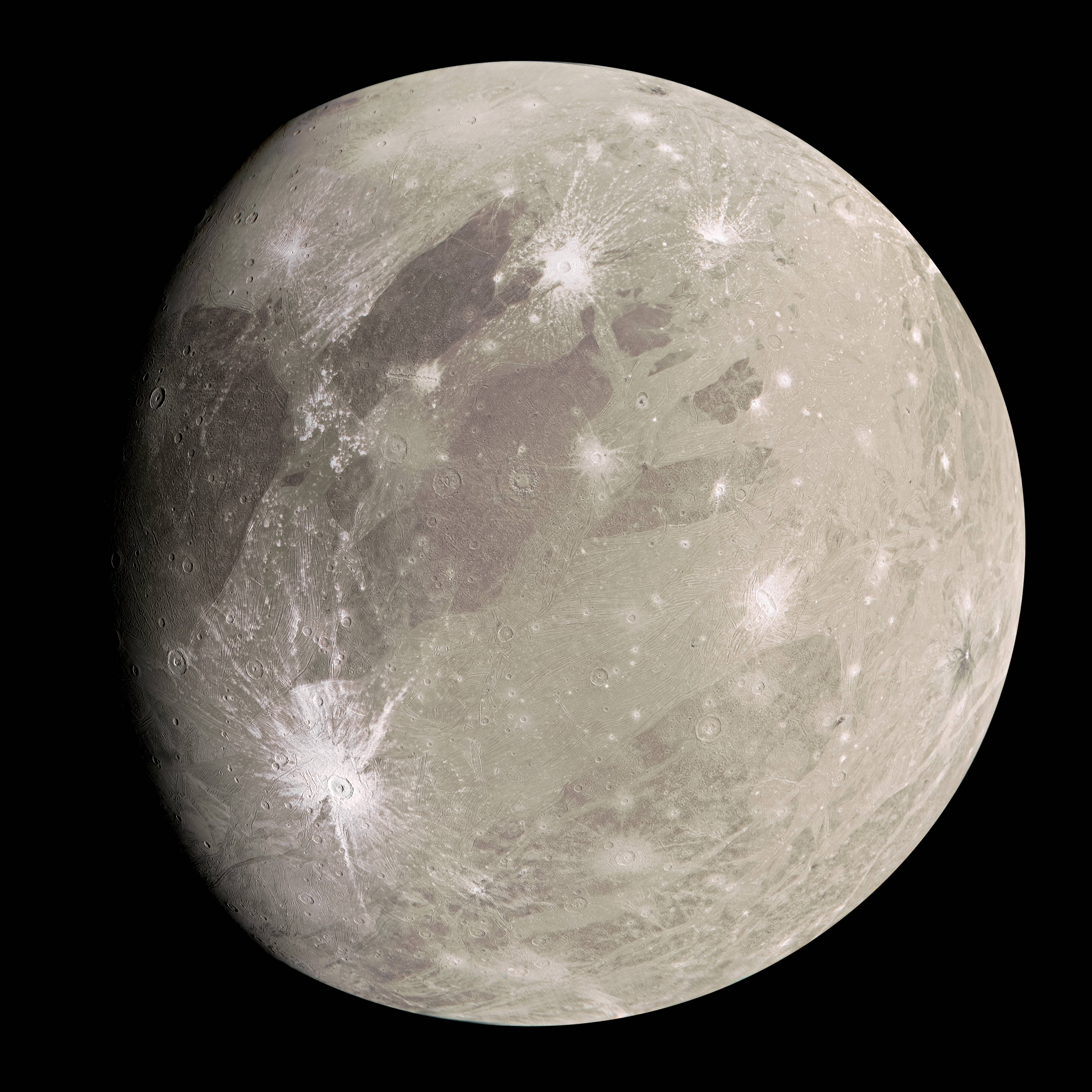
This is Bob Moler with Ephemeris for Tuesday, December 17th. Today the Sun will be up for 8 hours and 48 minutes, setting at 5:03, and it will rise tomorrow at 8:15. The Moon, 2 days past full, will rise at 7:23 this evening. | Ganymede is the largest satellite in the solar system orbiting the largest planet in the solar system, Jupiter. It is 1 1/2 times the diameter of our Moon, and slightly larger than the planet Mercury. It is an icy moon, being about half made-up of water ice and silica. Ganymede appears to have a below surface ocean of water like Europa. And its surface appears to be quite smooth, not as smooth as Europa’s but parts of it are literally devoid of craters for the most part, and many of the craters it does appear to have inner craters in the center which looks quite weird. The Juno spacecraft, still orbiting Jupiter, took some very close images of Ganymede back in 2021 using its relatively simple camera. These were some of the best images of it.

The astronomical event times given are for the Traverse City/Interlochen area of Michigan (EST, UT – 5 hours). Times will be different for other locations.

Addendum
A composite picture of Jupiter's largest moon, Ganymede
A composite picture of Jupiter’s largest moon, Ganymede, taken by the Juno spacecraft in 2021. Click or tap on the image to enlarge it. Note that many craters have central craters in them, not just the splashiest. Credit: NASA.

Ephemeris: 12/11/2024 – Where are the naked-eye planets this week?

December 11, 2024 Comments off

This is Ephemeris for Wednesday, December 11th. Today the Sun will be up for 8 hours and 51 minutes, setting at 5:02, and it will rise tomorrow at 8:11. The Moon, 3 days past first quarter, will set at 5:00 tomorrow morning.

Let’s take our weekly look at the whereabouts of the naked-eye planets. Venus can be spotted in the south-southwestern sky by 5:30 PM, about 30 minutes after sunset. It will set at 8:25 PM. Saturn will be in the south at 6 PM, way above the bright star Fomalhaut. Jupiter is low in the east-northeast, about the same time as when Venus is first spotted. It will be a good object for the small telescope about an hour later. Mars, rises tonight at 8:17, Mars is still considered a morning planet since it is still up at sunrise. By 6:00 AM tomorrow Jupiter will be low in the west-northwest, to the right of the setting Orion, while reddish Mars will be high in the west-southwest.

The astronomical event times given are for the Traverse City/Interlochen area of Michigan (EST, UT – 5 hours). Times will be different for other locations.

Addendum
Venus, Saturn, Jupiter, and the Moon as they would appear about 6 this evening in this panorama view fron east-northeast to southwest
Venus, Saturn, Jupiter, and the Moon as they would appear about 6 this evening in this panorama view fron east-northeast to southwest. Created using Stellarium.
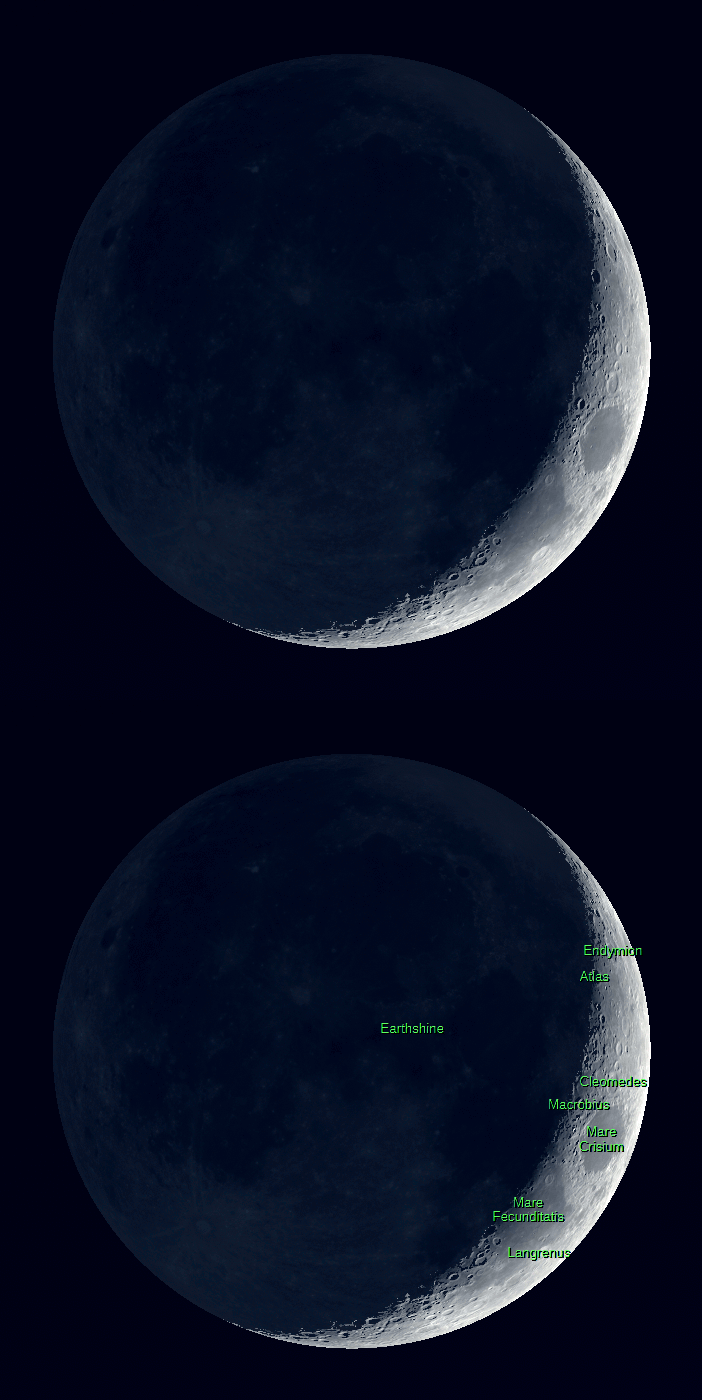
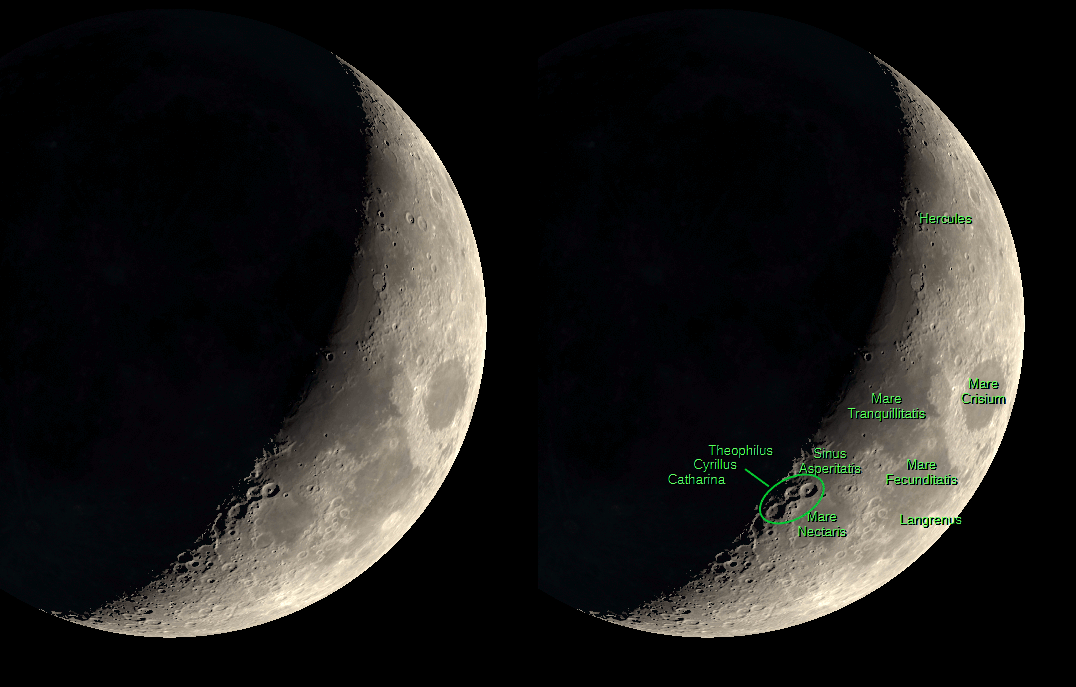
The Moon tonight as it might appear in a small telescope
The Moon tonight as it might appear in a small telescope. Selected features ae labeled. Created using Stellarium, LibreOffice Draw, and GIMP.
Jupiter with Mars rising in the east-noprtheast at 9:00 PM with Orion also rising
Jupiter with Mars rising in the east-noprtheast at 9:00 PM with Orion also rising. Created using Stellarium.
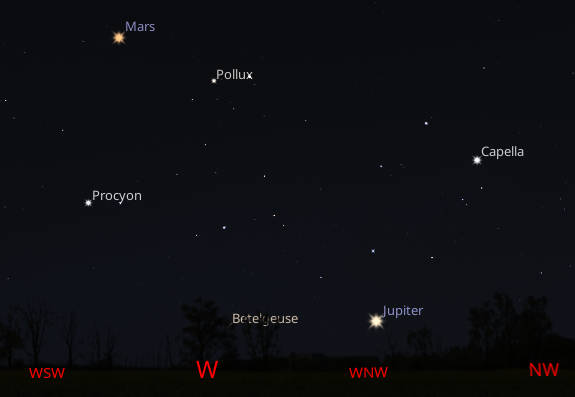
Jupiter with Mars rising in the east-noprtheast at 9:00 PM with Orion also rising
By 7:00 AM the winter stars and Jupiter have moved into the west with Orion almost completely set. Jupiter is seen about to set in the west-northwest. Mars in the west-southwest. Created using Stellarium.
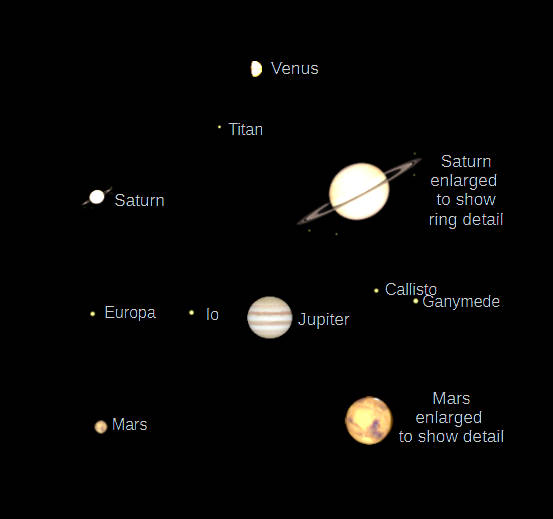
Telescopic Venus, Saturn, Jupiter and Mars (north up) as they would be seen in a small telescope with the same magnification
Telescopic Venus, Saturn, Jupiter and Mars (north up) as they would be seen in a small telescope with the same magnification. All the planets are shown for tonight, Jupiter specifically for 8 PM, December 11, 2024. Apparent diameters: Venus 18.6″, 63.8% illuminated; Saturn 17.1″, its rings 39.9″, 5.0 degrees from edge on (closing again); Jupiter 48.1″; Mars, 12.7″, 94.8% illuminated. Saturn’s rings are actually much brighter than depicted here. Planetary surface detail is more subtle than shown here. The ” means seconds of arc, or 1/3600th of a degree. Click or tap on the image to enlarge it. Created using Cartes du Ciel (Sky Charts).
Telescopic Venus, Saturn, Jupiter and Mars (north up) as they would be seen in a small telescope with the same magnification
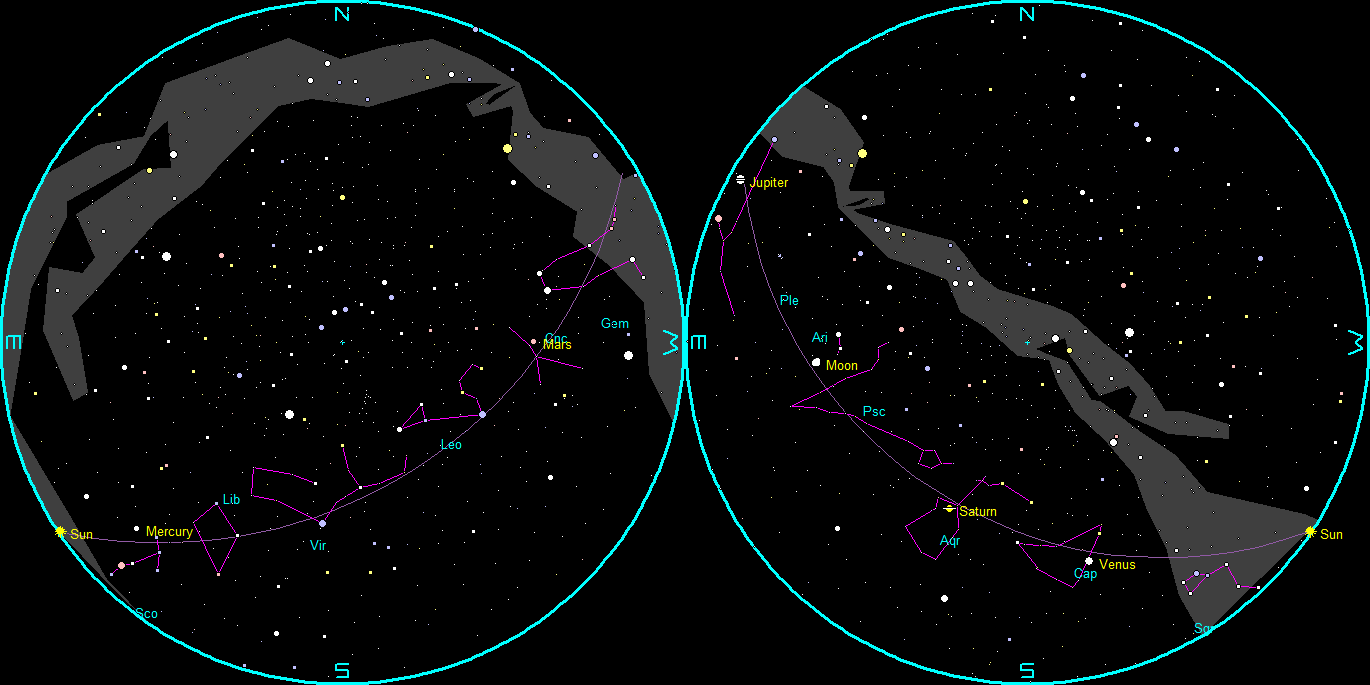
The naked-eye planets and the Moon at sunset and sunrise on a single night, starting with sunset on the right on December 11, 2024. The night ends on the left with sunrise on the 12th. Click or tap on the image to enlarge it. Created using my LookingUp app and GIMP.
This is a low precision ephemeris of the Sun Moon and naked eye planet positions for today and tomorrow
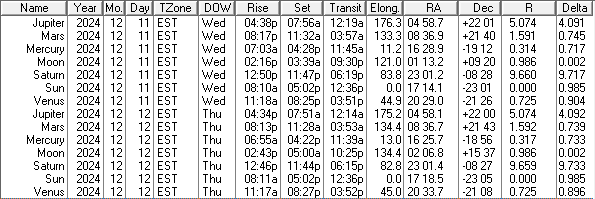
This is a low precision ephemeris of the Sun Moon and naked eye planet positions for today and tomorrow, December 11 and 12, 2024. Some of the columns are self-explanatory, others not. The transit column is the time that the body crosses the meridian and is due south. Elong, for elongation, is the angle between the Sun and that body. RA is right ascension, which is the object’s east-west position on the celestial sphere in hours and minutes. Dec is declination which is the north-south position of the object on the celestial sphere in degrees and minutes. R is the distance of that object from the Sun in astronomical units. An astronomical unit is about 93 million miles or 150 million kilometers. And Delta is the distance of that object from the Earth, also in astronomical units. I omit the ‘m’ in am and pm for compactness. The data was generated using my LookingUp for DOS app and displayed as a table by my Ephemeris Helper app.

Ephemeris: 12/10/2024 – Jupiter’s four bright moons

December 10, 2024 Comments off

This is Ephemeris for Tuesday, December 10th. Today the Sun will be up for 8 hours and 52 minutes, setting at 5:02, and it will rise tomorrow at 8:10. The Moon, 2 days past first quarter, will set at 3:39 tomorrow morning.

The bright star like object in the east in the evenings is the planet Jupiter. If one were to look at Jupiter through binoculars it would appear somewhat larger than a star would look. It has several dimmer stars from one side to the other of it, and if one looked the next night those little stars would have moved. Those are not stars at all, but the four largest moons of Jupiter. This would be easily apparent in the telescope. These are the four Galilean moons. They were observed by Galileo in either late 1609 or early 1610. Another astronomer, Simon Marius discovered these moons at about the same time, but Galileo was first to publish. So he gets the honor. However, Simon Marius is the one who gave them the names we know them by today. Their names, in order of their distance from Jupiter, are: Io, Europa, Ganymede, and Callisto. Each is a fascinating world in its own right.

The astronomical event times given are for the Traverse City/Interlochen area of Michigan (EST, UT – 5 hours). Times will be different for other locations.

Addendum
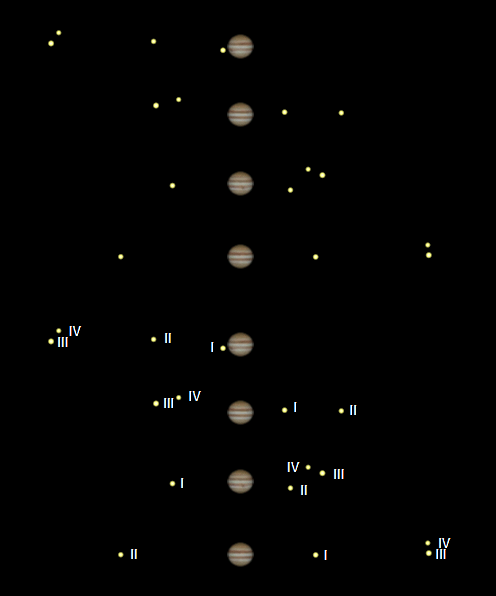
Jupiter and its four Galilean moons on 4 consecutive nights from top to bottom: tonight December 10th through the 13th 2024 at 8 PM EST (01:00 UT the next day). The moons are denoted by the Roman numeral shorthand for them: Io, I; Europa, II ; Ganymede, III; and Callisto, IV. Created using Cartes du Ciel (Sky Charts), LibreOffice Draw, and GIMP.

The periods of these satellites is interesting. Io orbits Jupiter in 1.8 days. Europa orbits in 3.6 days twice as long as Io. Ganymede orbits Jupiter in 7.2 days which is twice as long as Europa. Callisto takes 16.7 days to orbit Jupiter, and that is longer than twice Ganymede’s orbital period, and so is not in resonance with Ganymede. So the first three are in a 2:1orbital resonance with each other.