Archive

Posts Tagged ‘Jupiter’

Ephemeris: 12/05/2024 – More about Jupiter: it’s very gassy

December 5, 2024 Comments off

This is Bob Moler with Ephemeris for Thursday, December 5th. Today the Sun will be up for 8 hours and 57 minutes, setting at 5:02, and it will rise tomorrow at 8:05. The Moon, 3 days before first quarter, will set at 9:14 this evening.

The planet Jupiter rules over the night sky with the Moon after Venus sets. Jupiter, 11 times the diameter of the Earth, has the volume of 1300 earths, however it is only 318 times the mass of the Earth. It is made-up mostly of hydrogen and helium, so it is called a gas giant planet, rather than a terrestrial or rocky planet like the Earth. Jupiter is the best viewable of the planets in a small telescope. It has 2 dark bands across it called belts of darker appearing clouds. The famed Great Red Spot is an anticyclone embedded in the southern of those belts. The spot is not as red anymore. I remember it being brick-red back in the late 1950s and early 60s. Jupiter spins very rapidly, its day lasts only 10 hours.

The astronomical event times given are for the Traverse City/Interlochen area of Michigan (EST, UT – 5 hours). Times will be different for other locations.

Addendum
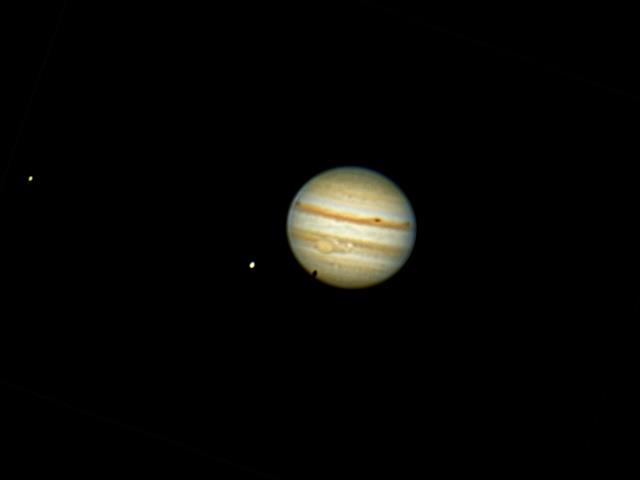
Jupiter by Scott Anttila November 14, 2011
Jupiter by Scott Anttila November 14, 2011. With shadow on the planet and the Great Red Spot.
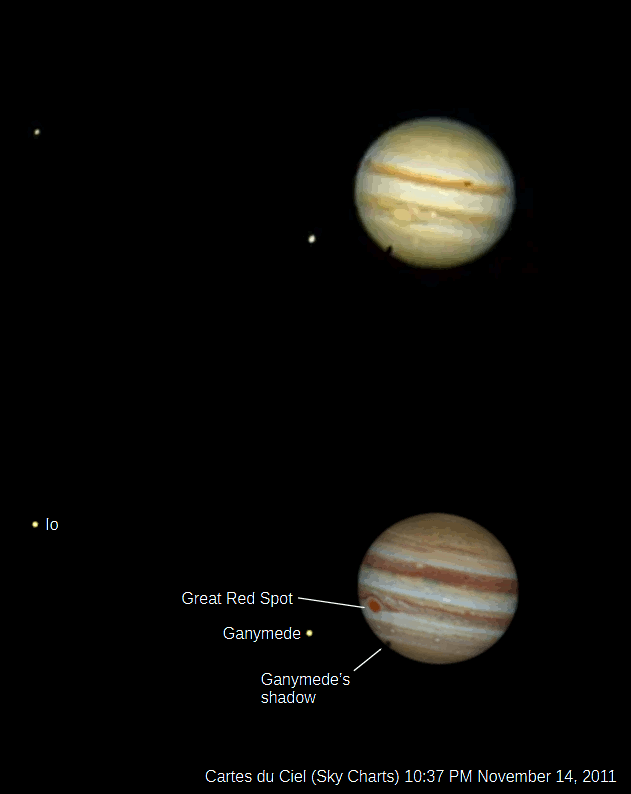
Matching Scott Anttila's Jupiter image from above with a Cartes du Ciel (sky charts) simulation taken back to that date
Matching Scott Anttila’s Jupiter image from above with a Cartes du Ciel (sky charts) simulation taken back to that date. I did it mainly to identify the moons. It also simulated the shadow of Ganymede on the planet. The red spot has moved in longitude since it was portrayed in the simulation. The Red Spot slowly moves in longitude. The Great Red Spot in Anttila’s image is just above the shadow, and isn’t as great and red as the simulated image, which I suspect is a product of one of the Voyager spacecraft’s time lapse movie on approach to Jupiter in the late 1970s, in which the feature contrast and color were enhanced.
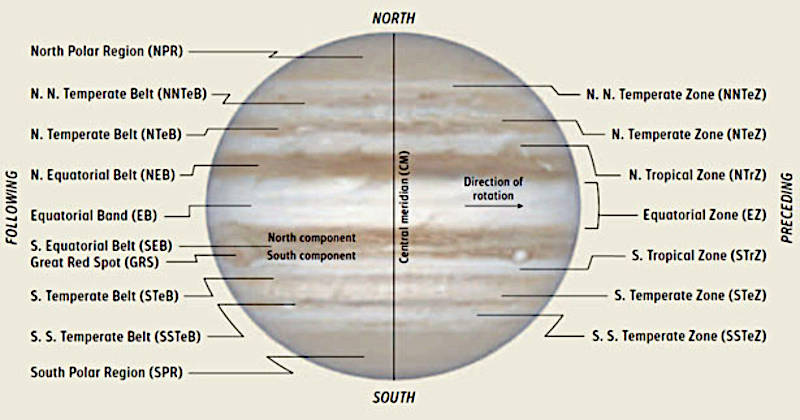
The nomenclature of Jupiter's cloud features
The nomenclature of Jupiter’s cloud features. Click or tap on the image to enlarge it. Credit: The Planetary Society.

Ephemeris: 12/04/2024 – Checking where the naked-eye planets are now

December 4, 2024 Comments off

This is Ephemeris for Wednesday, December 4th. Today the Sun will be up for 8 hours and 58 minutes, setting at 5:02, and it will rise tomorrow at 8:04. The Moon, 3 days past new, will set at 7:59 this evening.

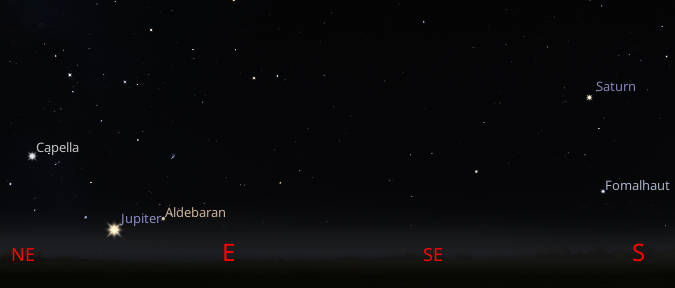
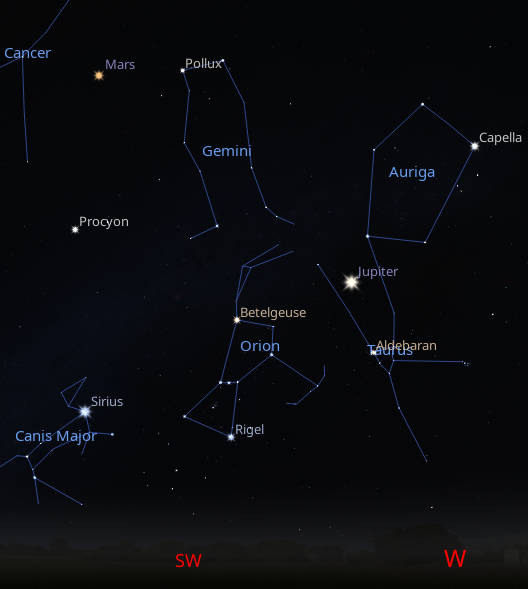
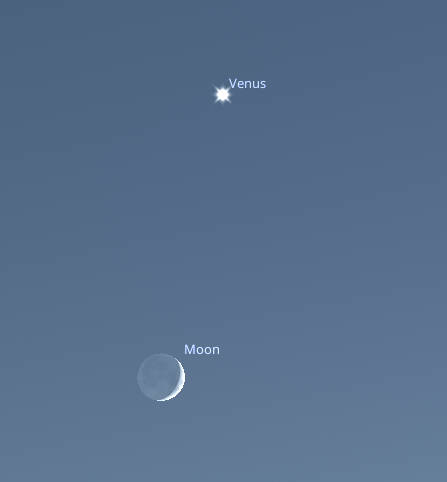
Let’s take our weekly look at the whereabouts of the naked-eye planets. Venus can be spotted low in the south-southwestern sky by 5:30 PM, about 30 minutes after sunset. It appears above the Moon tonight, and will set at 8:09 PM. Saturn will be in the south-southeast at 6 PM. Jupiter will rise at 5:09 PM in the east-northeast, and be a good object for the small telescope about an hour later. Mars, rises tonight at 8:47, Both Mars and Jupiter are considered morning planets, since they are still up at sunrise, though Jupiter will be an evening planet after Saturday. By 6:00 AM tomorrow Jupiter will be in the west, above and right of Orion, while reddish Mars will be high in the southwest. Jupiter and Saturn are great planets to view with a small telescope.

The astronomical event times given are for the Traverse City/Interlochen area of Michigan (EST, UT – 5 hours). Times will be different for other locations.

Addendum
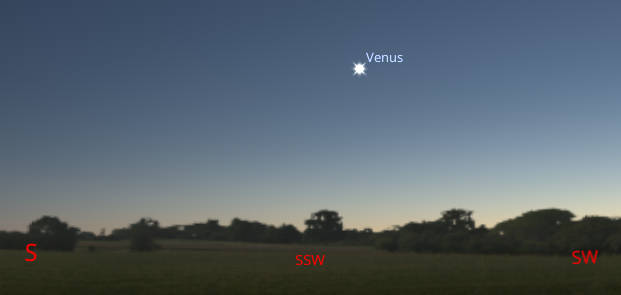
Venus will appear above the waxing crescent moon this evening. This is their separation at 5:30 PM from Northern Michigan. The Moon will be moving to the upper left compared to Venus. Created using Stellarium.
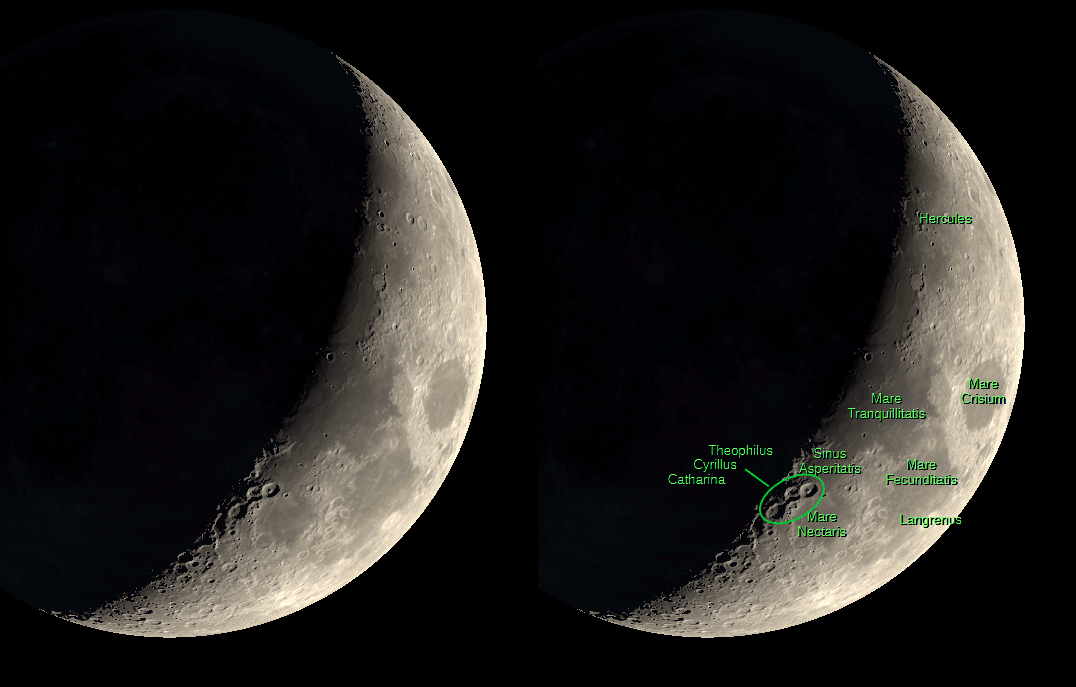
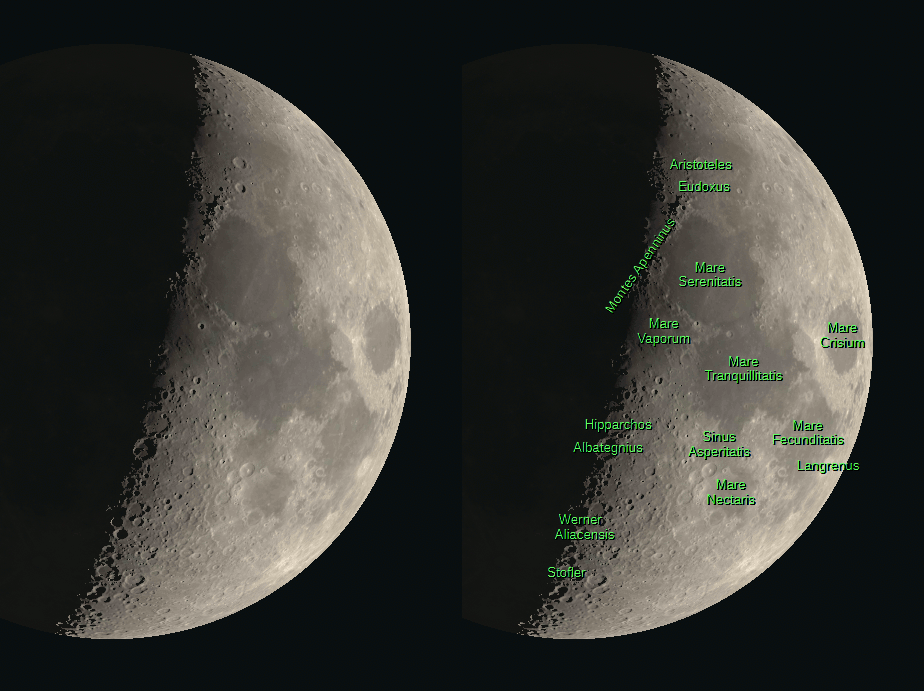
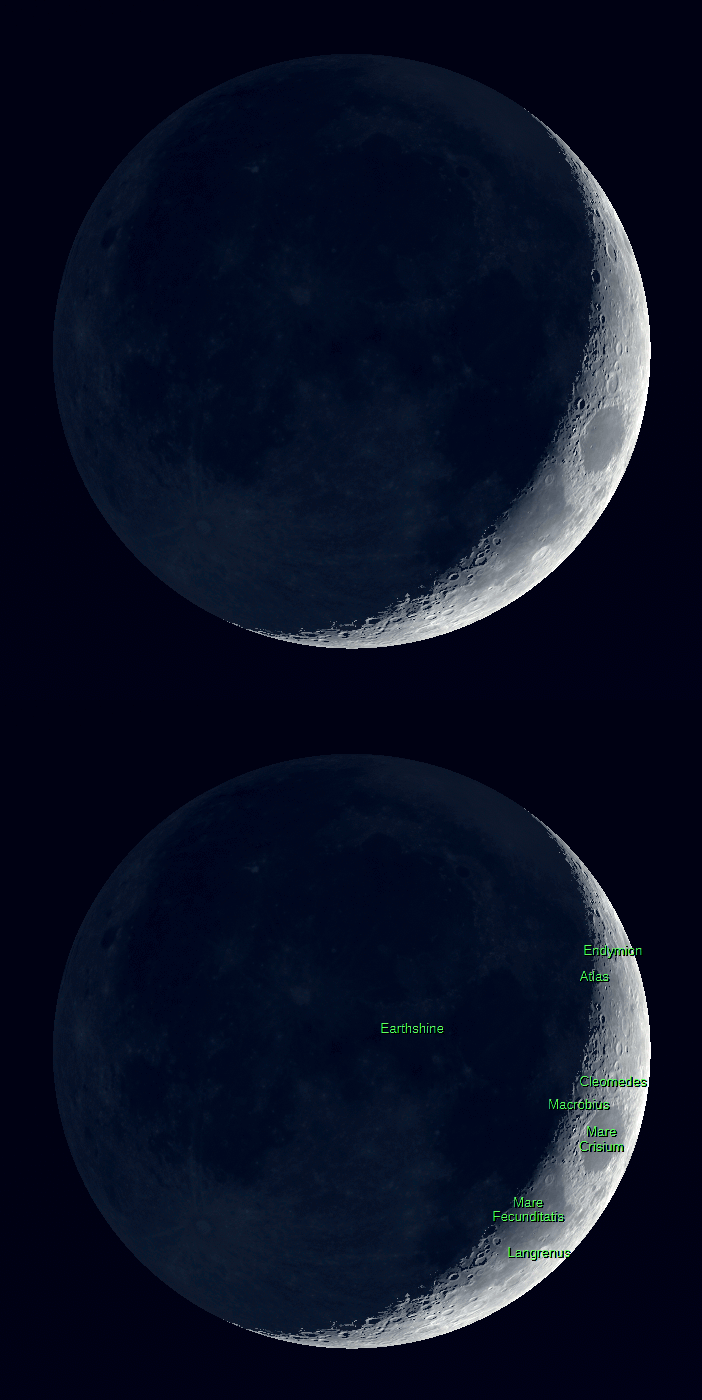
The Moon tonight as it might appear in a small telescope. Selected features ae labeled. Created using Stellarium, LibreOffice Draw, and GIMP.
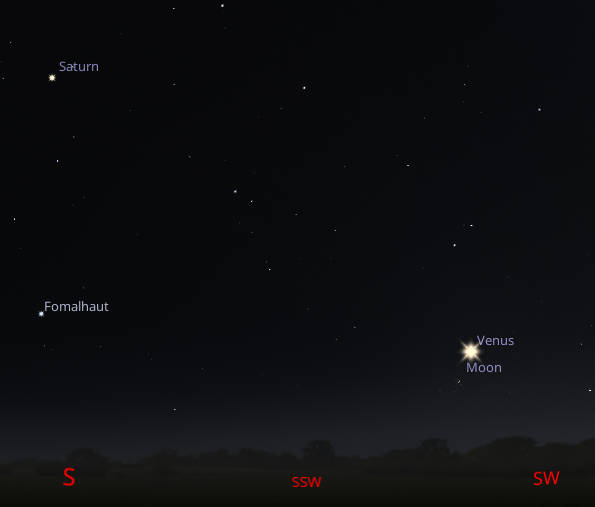
Venus and Saturn as they would appear about 6:30 this evening. The Moon is lost in the bloated image of Venus. Created using Stellarium.
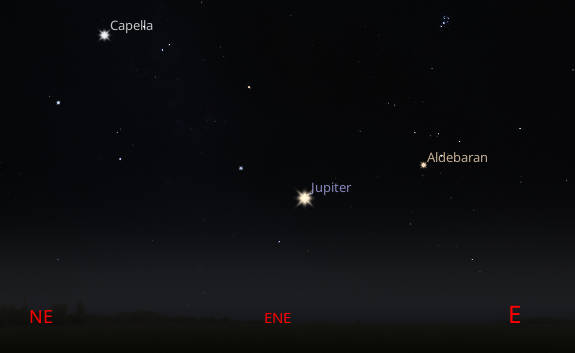
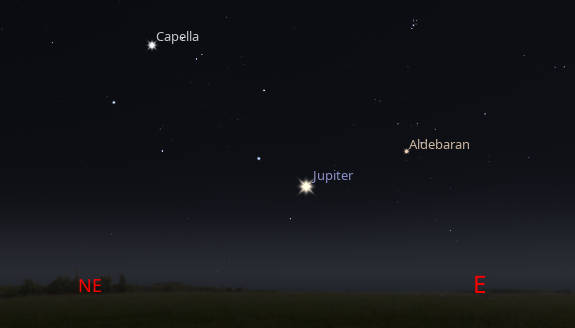
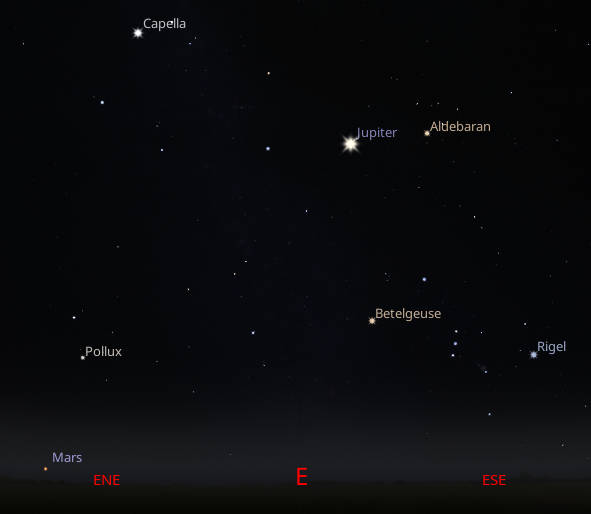
Jupiter with Mars rising in the east at 9:00 PM with Orion also rising. Created using Stellarium.
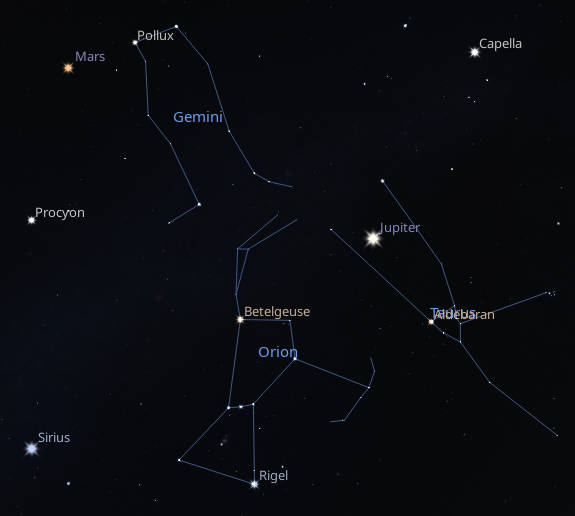
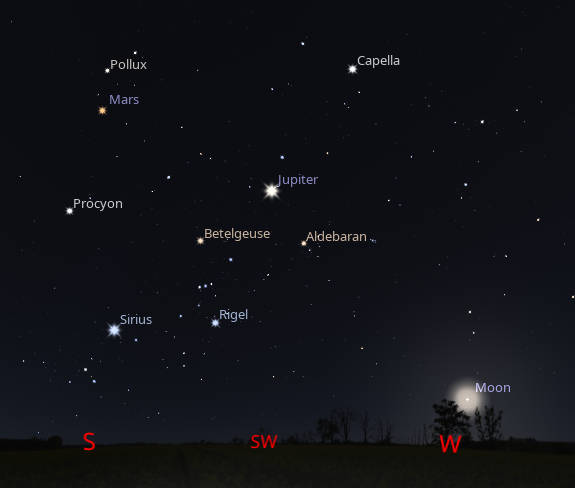
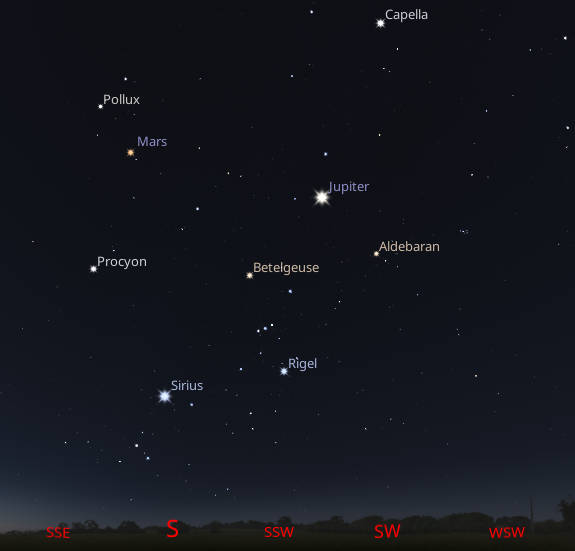
By 6:00 AM the winter stars and Jupiter have moved into the west with Orion about to set. Jupiter is seen in the West with Mars high up in the southwest. Created using Stellarium.
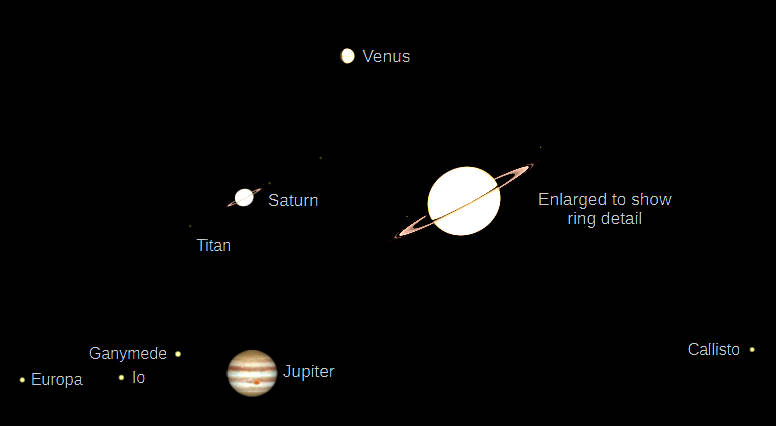
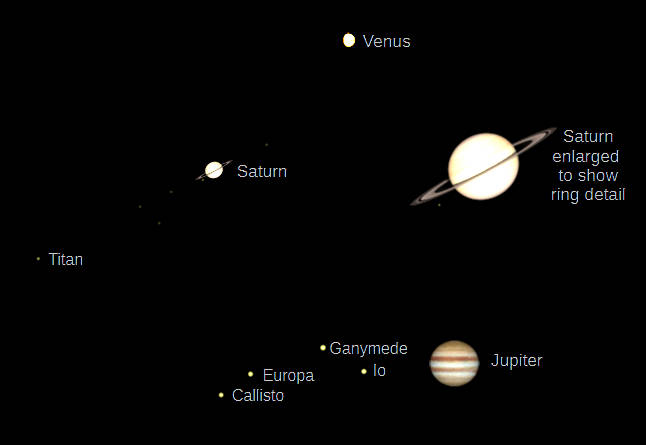
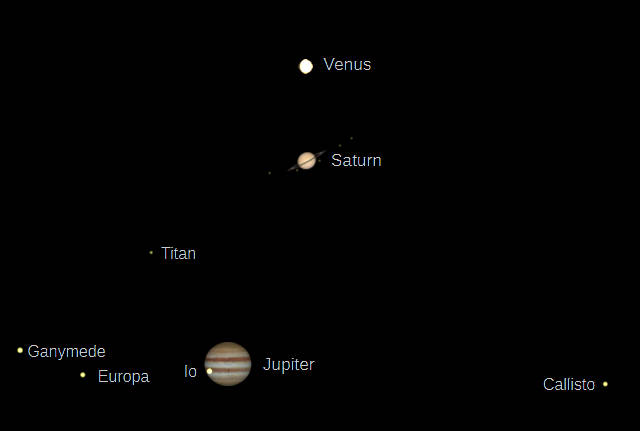
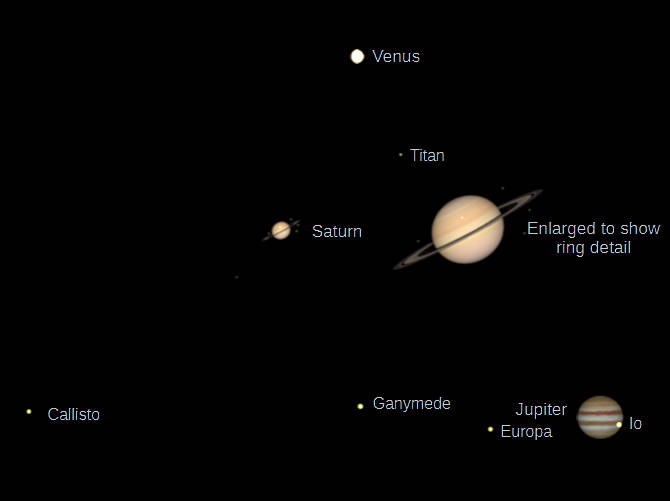
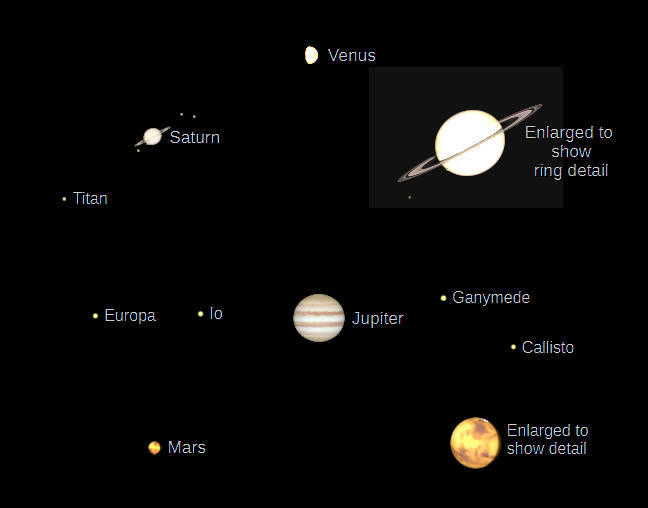
Telescopic Venus, Saturn, Jupiter and Mars (north up) as they would be seen in a small telescope with the same magnification. All the planets are shown for tonight, Jupiter specifically for 8 PM, December 4, 2024. Apparent diameters: Venus 17.6″, 66.4% illuminated; Saturn 17.3″, its rings 40.3″, 5.1 degrees from edge on (closing again); Jupiter 48.2″; Mars, 12.0″, 93.5% illuminated. Saturn’s rings are actually much brighter than depicted here. Planetary surface detail is more subtle than shown here. The ” means seconds of arc, or 1/3600th of a degree. Click or tap on the image to enlarge it. Created using Cartes du Ciel (Sky Charts).
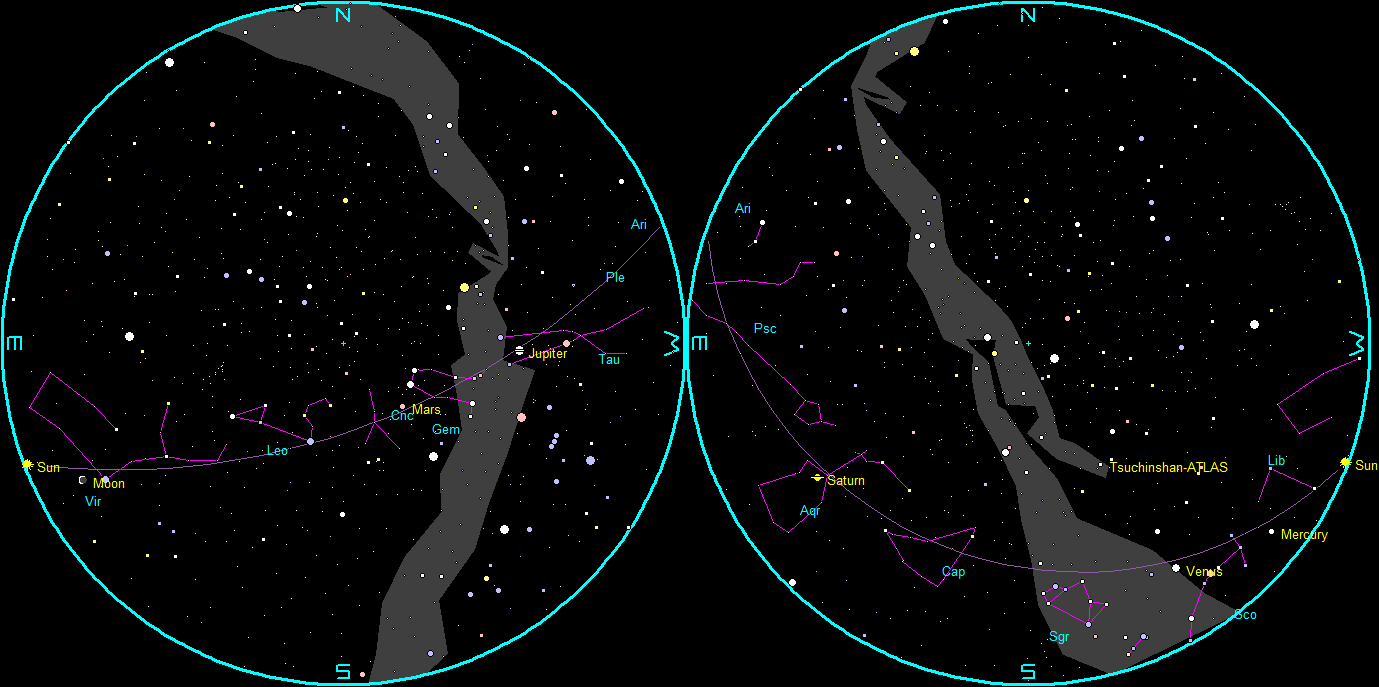
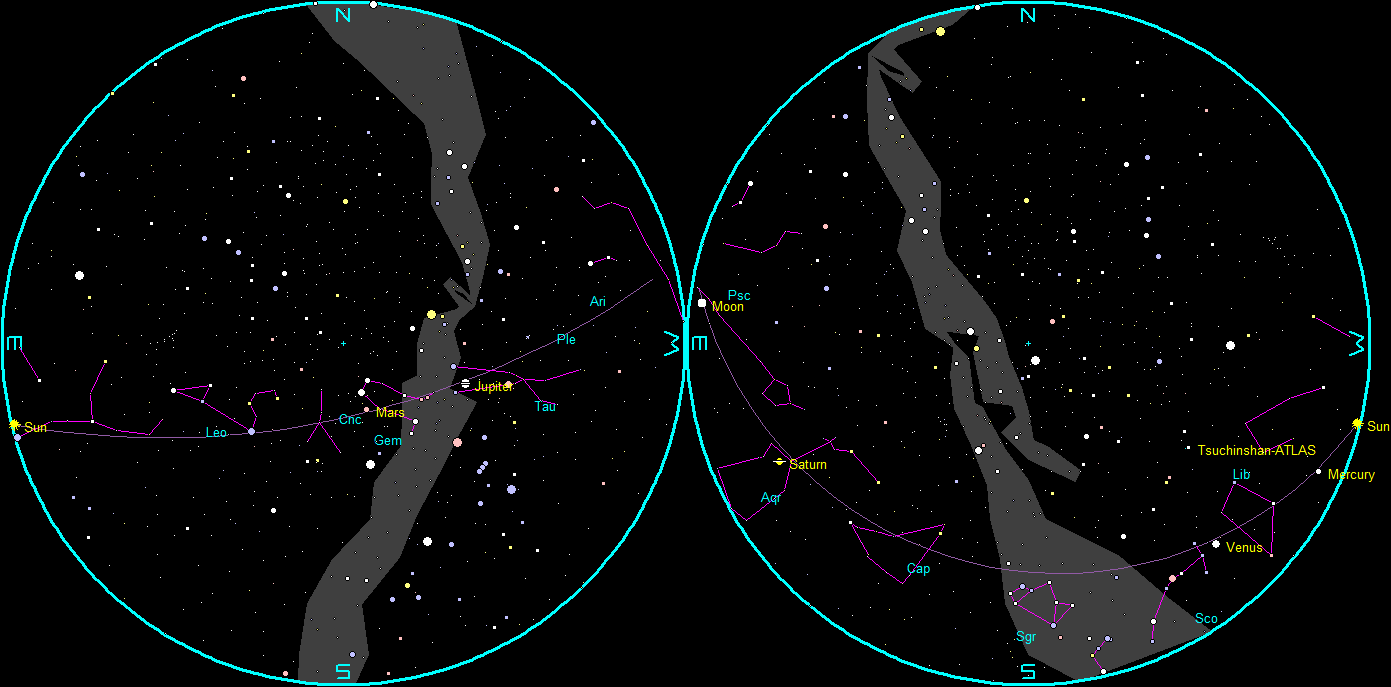
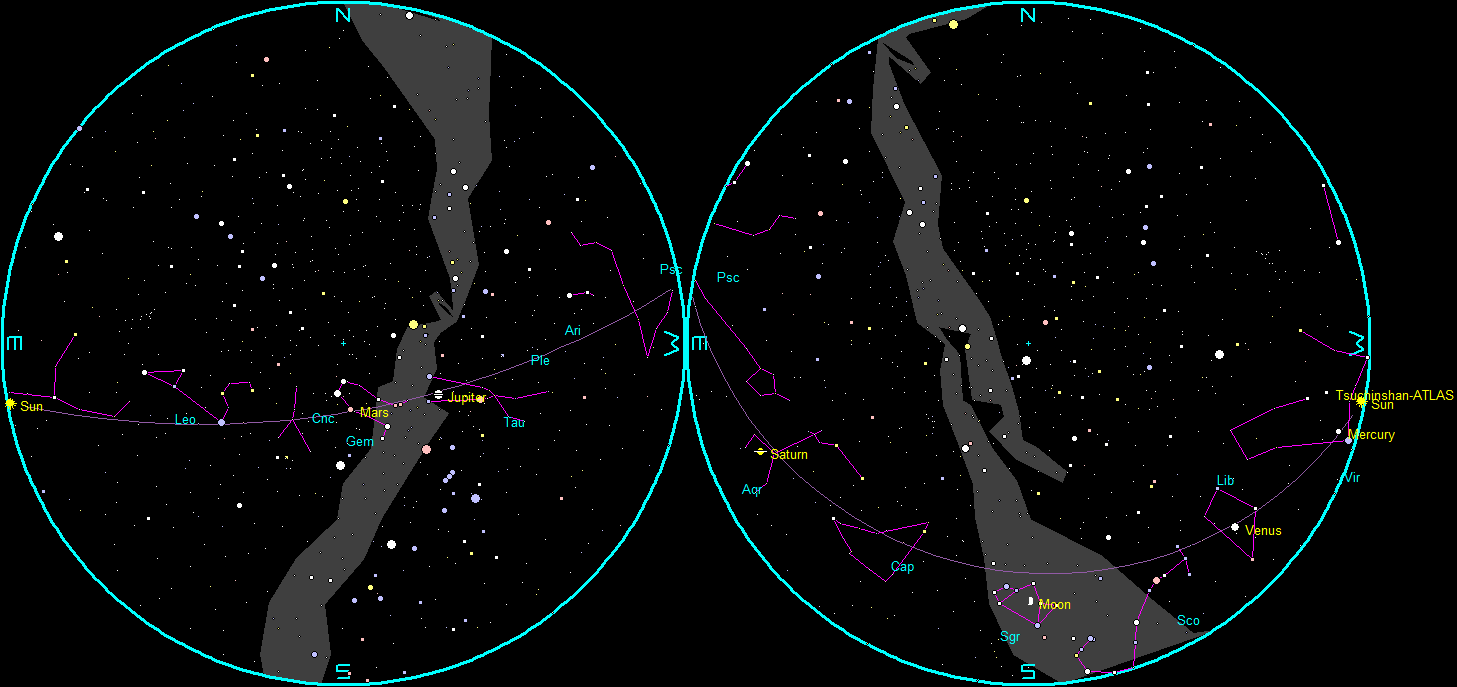
The naked-eye planets and the Moon at sunset and sunrise on a single night, starting with sunset on the right on December 4, 2024. The night ends on the left with sunrise on the 5th. Click or tap on the image to enlarge it. Created using my LookingUp app and GIMP.
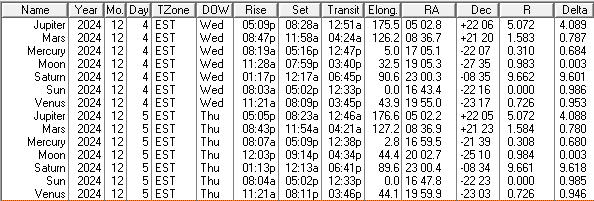
This is a low precision ephemeris of the Sun Moon and naked eye planet positions for today and tomorrow, December 4 and 5, 2024. Some of the columns are self-explanatory, others not. The transit column is the time that the body crosses the meridian and is due south. Elong, for elongation, is the angle between the Sun and that body. RA is right ascension, which is the object’s east-west position on the celestial sphere in hours and minutes. Dec is declination which is the north-south position of the object on the celestial sphere in degrees and minutes. R is the distance of that object from the Sun in astronomical units. An astronomical unit is about 93 million miles or 150 million kilometers. And Delta is the distance of that object from the Earth, also in astronomical units. I omit the ‘m’ in am and pm for compactness. The data was generated using my LookingUp for DOS app and displayed as a table by my Ephemeris Helper app.

Ephemeris: 12/03/2024 – Jupiter begins to dominate the evening sky

December 3, 2024 Comments off

This is Ephemeris for Tuesday, December 3rd. Today the Sun will be up for 9 hours even, setting at 5:02, and it will rise tomorrow at 8:03. The Moon, 2 days past new, will set at 6:48 this evening.

The bright star that’s in the east early in the evenings isn’t a star at all, but the planet Jupiter. This giant planet is moving to be in opposition to the Sun this Saturday, which means that the Earth is directly between Jupiter and the Sun, so it’s the time that it’s closest to us. And so it’s at its largest appearing and brightest. Jupiter is the largest of the planets being about 11 times the Earth’s diameter, its volume would be 11 cubed or about 1,300 times the Earth’s volume. It is the second-brightest planet after Venus. It is also the largest appearing planet in telescopes except for a couple of months around the time when Venus is closest to the Earth. Binoculars will show that Jupiter is not quite star-like, and some of its large satellites can be also seen.

The astronomical event times given are for the Traverse City/Interlochen area of Michigan (EST, UT – 5 hours). Times will be different for other locations.

Addendum
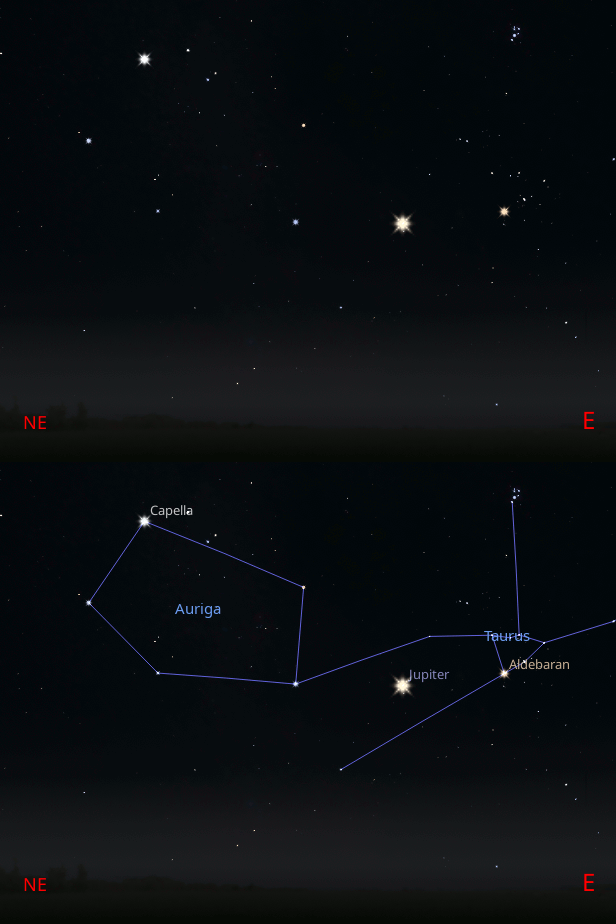
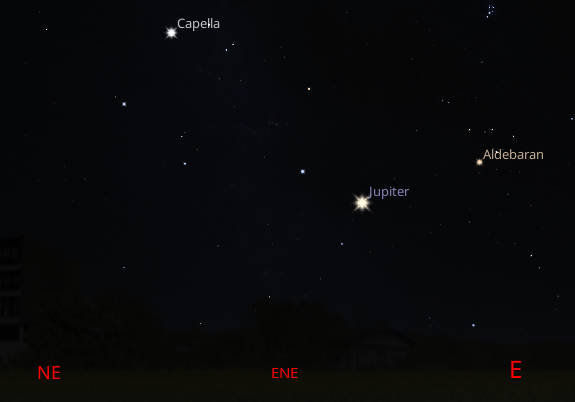
Jupiter is now seen low in the east in the early evening.
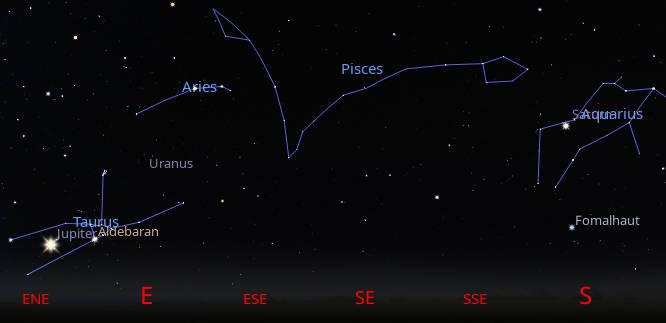
Jupiter is now seen low in the east in the early evening. It is currently located between the horns of Taurus the bull and it will stay wandering in there through the rest of its appearance until spring when it moves towards the horn tips as it sets in the west in the evening twilight. The next time we’ll see it late next year it will be in the constellation of Gemini. Created using Stellarium and GIMP.
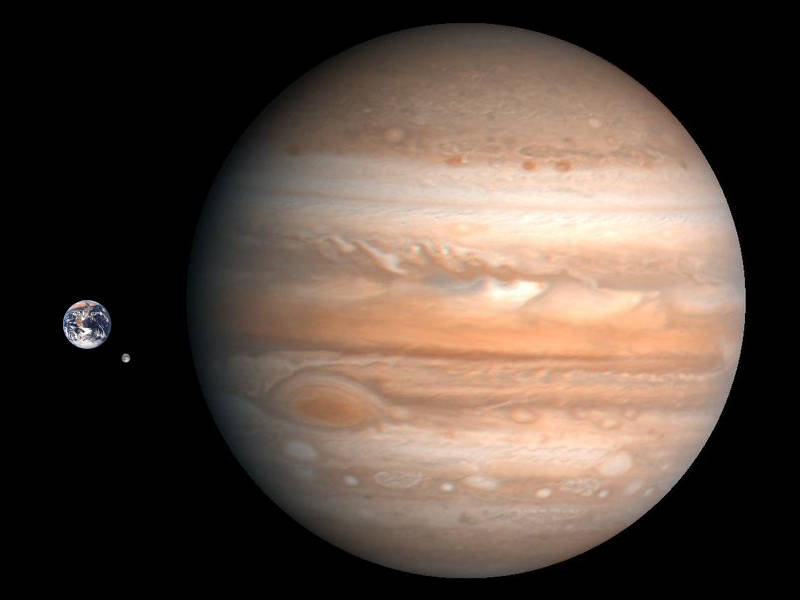
A size comparison between Jupiter, the Earth and Moon
A size comparison between Jupiter the Earth and Moon. Feel insignificant yet? Credit: NASA.

Ephemeris: 11/27/2024 – Checking up on the naked-eye planets this week

November 27, 2024 Comments off

This is Ephemeris for Wednesday, November 27th. Today the Sun will be up for 9 hours and 9 minutes, setting at 5:05, and it will rise tomorrow at 7:57. The Moon, 4 days before new, will rise at 5:23 tomorrow morning.

Let’s take our weekly look at the whereabouts of the naked-eye planets. Venus can be spotted low in the south-southwestern sky by 5:30 PM, about 25 minutes after sunset. It will set at 7:52. Saturn will be in the south-southeast at 6 PM. Jupiter will rise at 5:45 PM in the east northeast, and be a good object for the small telescope about an hour later. Mars, rises tonight near 9:16, Both Mars and Jupiter are considered morning planets, since they are still up at sunrise. By 6 AM tomorrow Jupiter will be in the west, above and right of Orion, while reddish Mars will be high in the southwest. Jupiter and Saturn are good planets to view with a small telescope, Mars will appear only a quarter the diameter of Jupiter.

The astronomical event times given are for the Traverse City/Interlochen area of Michigan (EST, UT – 5 hours). Times will be different for other locations.

Addendum
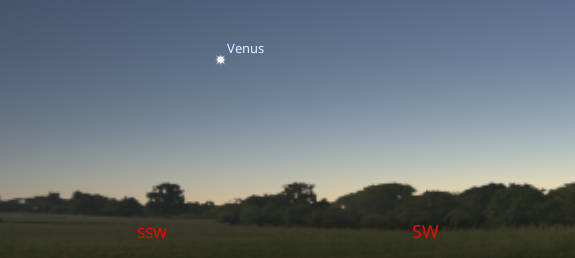
This is where Venus will appear in the south-southwest at about 5:30 PM or about 25 minutes after sunset
This is where Venus will appear in the south-southwest at about 5:30 PM or about 25 minutes after sunset. Venus is now in the part of the ecliptic where the planets travel northward as it moves eastward. So It will be seeing it higher in the sky when it’s first spotted in the evening. Created using Stellarium.
Saturn and Jupiter at 8 PM tonight, November 27, 2024. Off to the right beyond the image, Venus setting in the southwest. Click or tap on the image to enlarge it. Created using Stellarium.
Telescopic Venus, Saturn, Jupiter and Mars (north up) as they would be seen in a small telescope with the same magnification
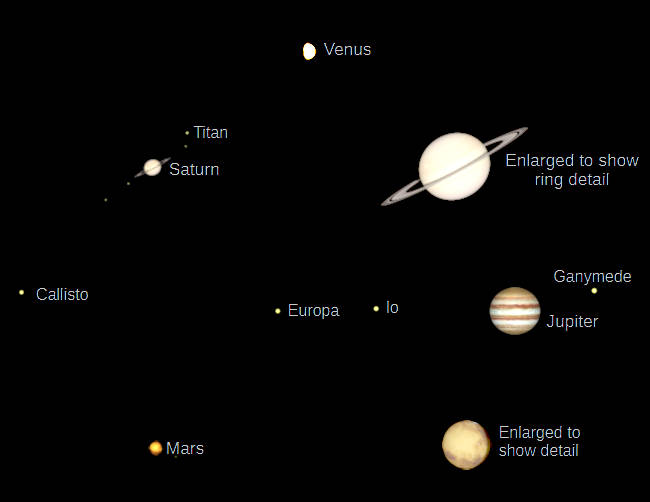
Telescopic Venus, Saturn, Jupiter and Mars (north up) as they would be seen in a small telescope with the same magnification. All the planets are shown for tonight, Jupiter specifically for 8 PM, November 27, 2024. Apparent diameters: Venus 16.8″, 68.8% illuminated; Saturn 17.5″, its rings 40.9″, 5.2 degrees from edge on (closing again); Jupiter 48.1″; Mars, 11.4″, 92.1% illuminated. Saturn’s rings are actually much brighter than depicted here. Planetary surface detail is more subtle than shown here. The ” means seconds of arc, or 1/3600th of a degree. Click or tap on the image to enlarge it. Created using Cartes du Ciel (Sky Charts).
The naked-eye planets and the Moon at sunset and sunrise on a single night
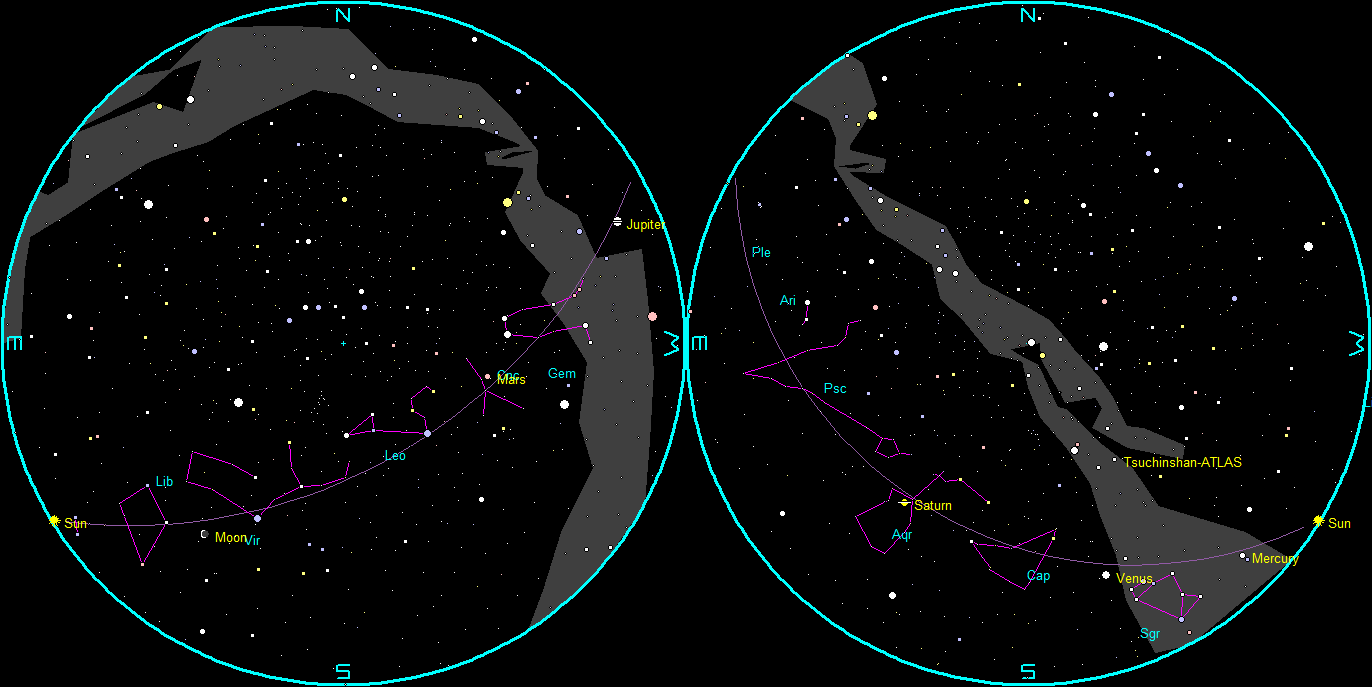
The naked-eye planets and the Moon at sunset and sunrise on a single night, starting with sunset on the right on November 27, 2024. The night ends on the left with sunrise on the 28th. Click or tap on the image to enlarge it. Created using my LookingUp app and GIMP.
Low precision ephemeris of the Sun Moon and naked eye planet positions
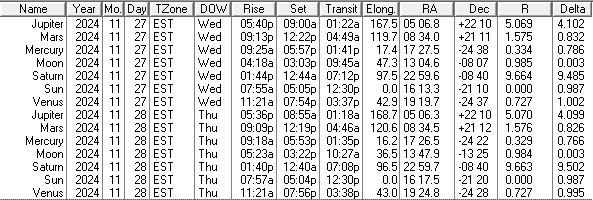
This is a low precision ephemeris of the Sun Moon and naked eye planet positions for today and tomorrow, November 27 and 28, 2024. Some of the columns are self-explanatory, others not. The transit column is the time that the body crosses the meridian and is due south. Elong, for elongation, is the angle between the Sun and that body. RA is right ascension, which is the object’s east-west position on the celestial sphere in hours and minutes. Dec is declination which is the north-south position of the object on the celestial sphere in degrees and minutes. R is the distance of that object from the Sun in astronomical units. An astronomical unit is about 93 million miles or 150 million kilometers. And Delta is the distance of that object from the Earth, also in astronomical units. I omit the ‘m’ in am and pm for compactness. The data was generated using my LookingUp for DOS app and displayed as a table by my Ephemeris Helper app.

Ephemeris: 11/20/2024 – Our weekly look at the naked-eye planets

November 20, 2024 Comments off

This is Ephemeris for Wednesday, November 20th. Today the Sun will be up for 9 hours and 22 minutes, setting at 5:09, and it will rise tomorrow at 7:48. The Moon, 2 days before last quarter, will rise at 9:45 this evening.

Let’s take our weekly look at the whereabouts of the naked-eye planets. Venus can be spotted low in the southwestern sky by 5:30 PM, about 20 minutes after sunset. It will set at 7:41. Saturn will be in the south-southeast at 6 PM. Jupiter will rise at 6:11 PM in the east northeast, and be a good object for the small telescope about an hour later. Mars, rises tonight near 9:36, just ahead of the Moon and will be leading it through the night skies tonight. By 6:00 AM tomorrow Jupiter will be in the west, above and right of Orion, while reddish Mars will be high in the southwest to the right of the waning gibbous Moon. Jupiter and Saturn are good planets to view with a small telescope, Mars will appear only a quarter the diameter of Jupiter.

The astronomical event times given are for the Traverse City/Interlochen area of Michigan (EST, UT – 5 hours). Times will be different for other locations.

Addendum
Venus will appear in the south-southwest at about 5:30 PM or about 20 minutes after sunset
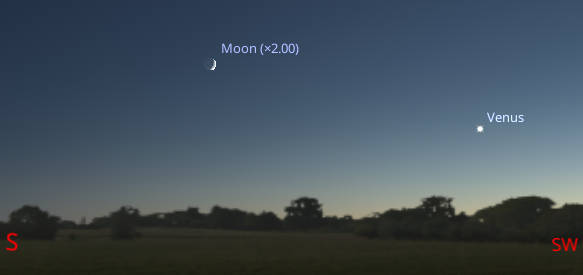
This is where Venus will appear in the south-southwest at about 5:30 PM or about 20 minutes after sunset. Venus is now in the part of the ecliptic where the planets travel northward as it moves eastward. So It will be seeing it higher in the sky when it’s first spotted in the evening. Created using Stellarium.
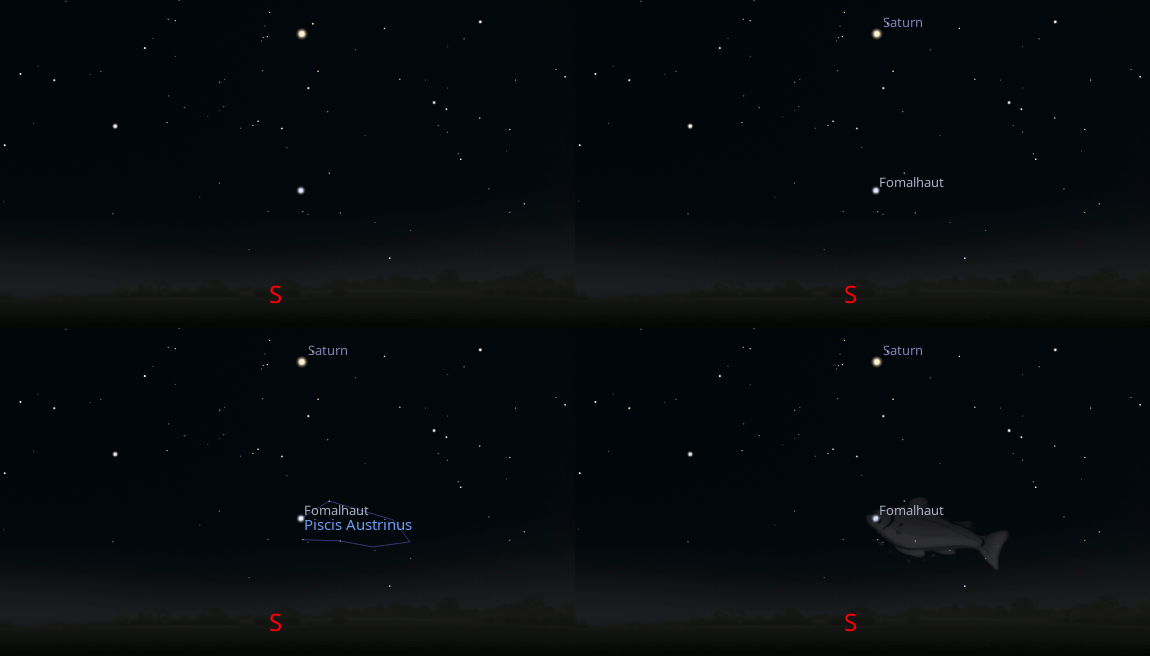
Saturn finder animation
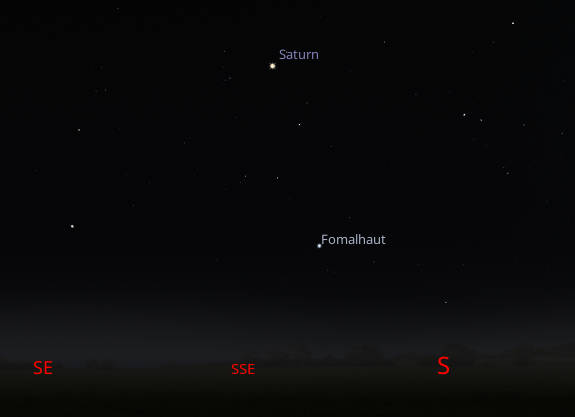
Saturn and the star Fomalhaut as they would appear at 8 PM this evening in the south. This is a chart from yesterday’s post. There is no real change from then. Created using Stellarium and GIMP.
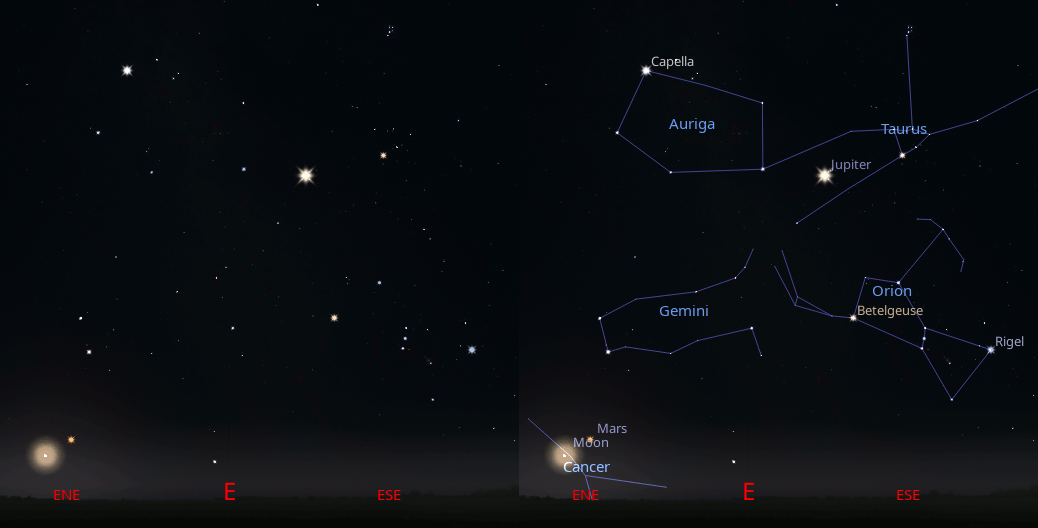
A finder animation for Jupiter, Mars and the Moon
A finder animation for Jupiter, Mars and the Moon for 10:30 PM this evening, November 20, 2024. They’re located among the winter constellations that are rising in the late evening. We are a month and a day from the beginning of winter. Created using Stellarium and GIMP.
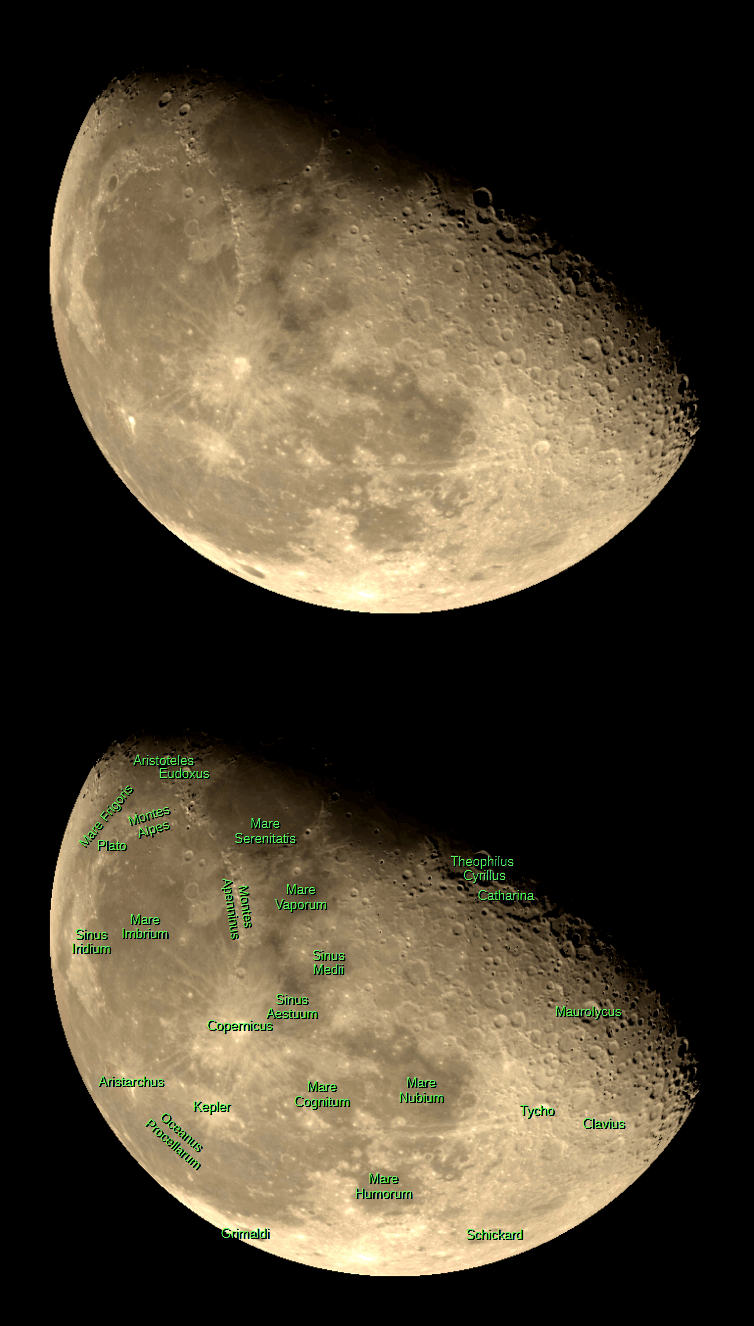
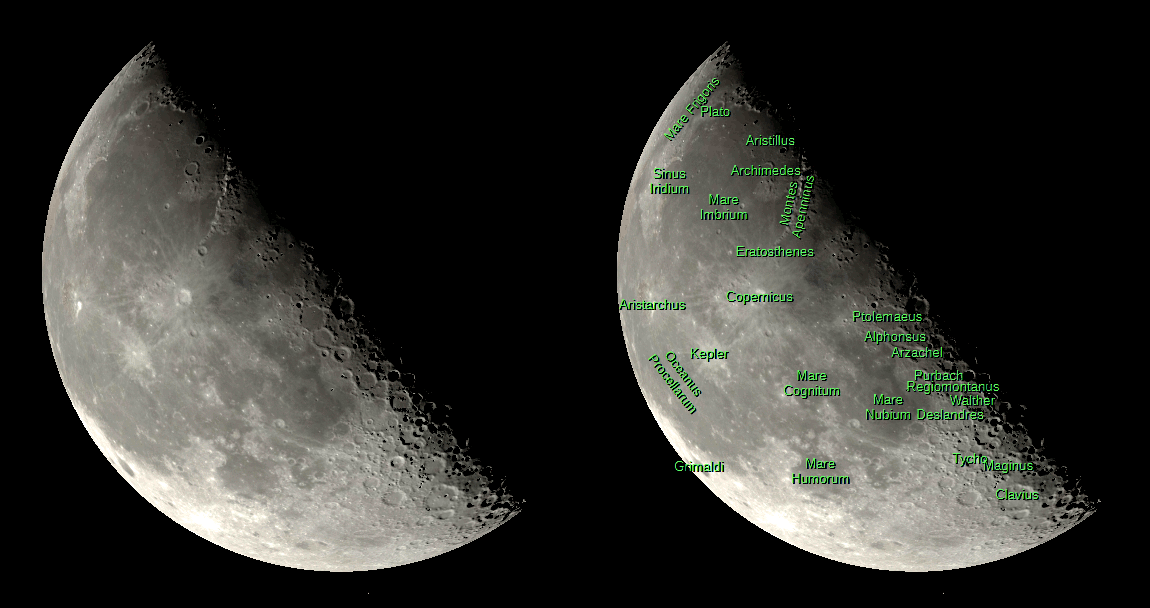
The Moon as it might appear through a small telescope tonight
The Moon as it might appear through a small telescope tonight, November 20, 2024. Selected features are labeled. Created using Stellarium, LibreOffice draw, and GIMP.
Telescopic Venus, Saturn, Jupiter and Mars
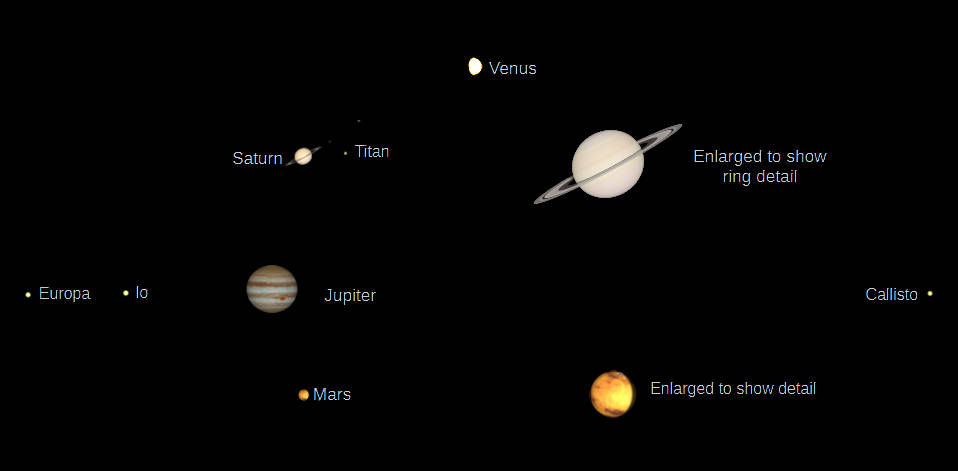
Telescopic Venus, Saturn, Jupiter and Mars (north up) as they would be seen in a small telescope with the same magnification. All the planets are shown for tonight, November 20, 2024 at 11 PM EST. Apparent diameters: Venus 16.0″, 71.1% illuminated; Saturn 17.8″, its rings 41.3″, 5.2 degrees from edge on (starting to close again); Jupiter 47.8″; Mars, 10.7″, 91.0% illuminated. Saturn’s rings are actually much brighter than depicted here. Planetary surface detail is more subtle than shown here. Jupiter’s moon Ganymede is behind the planet, but will appear on the Io and Eurolpa side of the planet at 11:16 PM. The ” symbol means seconds of arc, or 1/3600th of a degree. Click or tap on the image to enlarge it. Created using Cartes du Ciel (Sky Charts).
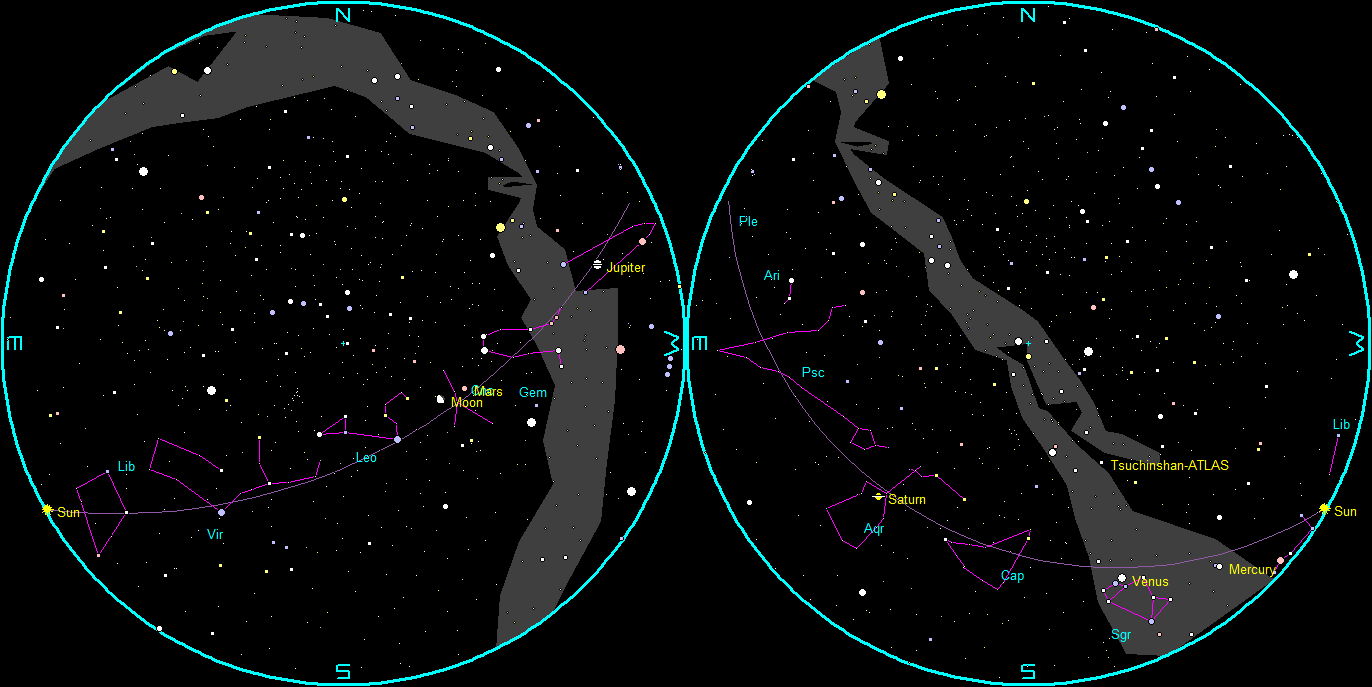
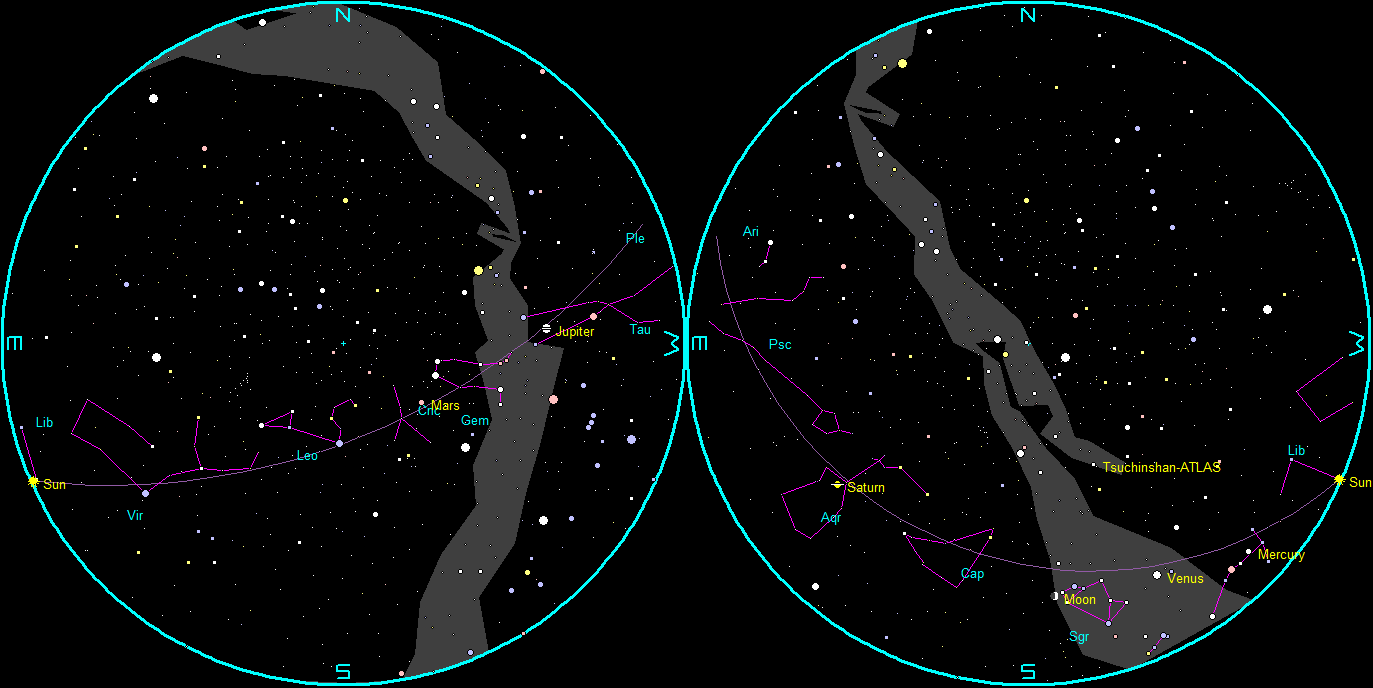
The naked-eye planets and the Moon at sunset and sunrise on a single night, starting with sunset on the right on November 20, 2024. The night ends on the left with sunrise on the 21st. Click or tap on the image to enlarge it. Created using my LookingUp app and GIMP.
Low precision ephemeris of the Sun Moon and naked eye planet positions for today and tomorrow
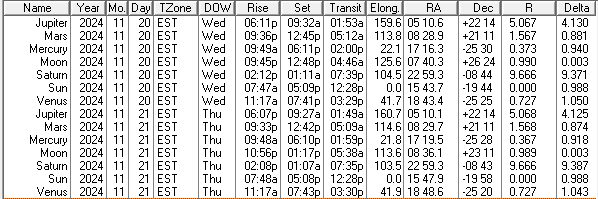
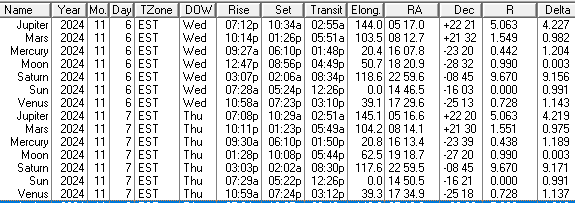
This is a low precision ephemeris of the Sun Moon and naked eye planet positions for today and tomorrow, November 20 and 21, 2024. Some of the columns are self-explanatory, others not. The transit column is the time that the body crosses the meridian and is due south. Elong, for elongation, is the angle between the Sun and that body. RA is right ascension, which is the object’s east-west position on the celestial sphere in hours and minutes. Dec is declination which is the north-south position of the object on the celestial sphere in degrees and minutes. R is the distance of that object from the Sun in astronomical units. An astronomical unit is about 93 million miles or 150 million kilometers. And Delta is the distance of that object from the Earth, also in astronomical units. I omit the ‘m’ in am and pm for compactness. The data was generated using my LookingUp for DOS app and displayed as a table by my Ephemeris Helper app.

Ephemeris: 11/06/2024 – Where are the naked eye planets this week?

November 6, 2024 Comments off

This is Ephemeris for Wednesday, November 6th. Today the Sun will be up for 9 hours and 55 minutes, setting at 5:24, and it will rise tomorrow at 7:29. The Moon, 3 days before first quarter, will set at 8:56 this evening.

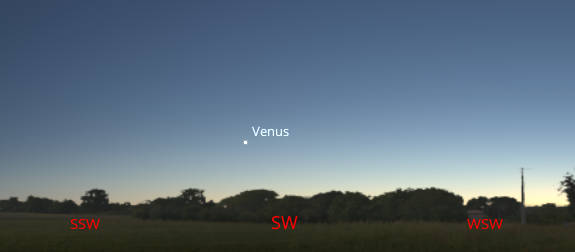
Let’s take our weekly look at the whereabouts of the naked-eye planets. Venus can be spotted low in the southwestern sky by 6 PM, about half an hour after sunset. It will set at 7:22. Saturn will be in the southeast at 7 PM. Jupiter will rise at 7:17 PM in the east northeast, and be a good object for the small telescope about an hour later. By 6:00 AM tomorrow Jupiter will be high in the west southwest, among the winter stars, while reddish Mars, which rises tonight near 10:16, will be high in the south. Jupiter and Saturn are good planets to view with a small telescope, while Venus and Mars will appear very small and featureless. These last two will improve next year when they move closer to us.

The astronomical event times given are for the Traverse City/Interlochen area of Michigan (EST, UT – 5 hours). Times will be different for other locations.

Addendum
Venus and the Moon in evening twilight, approximately half an hour after sunset
Venus and the Moon in evening twilight, approximately half an hour after sunset. For the Grand Traverse area of Michigan that would be about 6 PM, November 6, 2024. Created using Stellarium.
The Moon tonight as it might appear in a small telescope
The Moon tonight as it might appear in a small telescope. Selected features ae labeled. Created using Stellarium, LibreOffice Draw, and GIMP.
Jupiter and Saturn in this panorama from northeast to south at 8 pm or about 2 1/2 hours aftet sunset
Jupiter and Saturn in this panorama from northeast to south at 8 pm or about 2 1/2 hours aftet sunset. Created using Stellarium.
Jupiter and Mars among the stars of winter seen in the southwestern sky at 6 AM, or about an hour and a half before sunrise, tomorrow morning November 7, 2024. Created using Stellarium.
Telescopic Venus, Saturn and Jupiter
Telescopic Venus, Saturn and Jupiter (north up) as they would be seen in a small telescope with the same magnification. All the planets shown are for tonight, the evening of November 6, 2024. Apparent diameters: Venus 14.7″, 77.4% illuminated; Saturn 18.5″, its rings 42.3″, 5.3 degrees from edge on (opening up a bit); Jupiter 46.7″; Mars, too small to be represented here, is 9.6″. Saturn’s rings are actually much brighter than depicted here. The ” means seconds of arc, or 1/3600th of a degree. Created using Cartes du Ciel (Sky Charts).
The naked-eye planets and the Moon at sunset and sunrise on a single night, starting with sunset on the right on November 6, 2024. The night ends on the left with sunrise on the 7th. Click or tap on the image to enlarge it. Created using my LookingUp app and GIMP.
A low precision ephemeris of the Sun Moon and naked eye planet positions for today and tomorrow
This is a low precision ephemeris of the Sun Moon and naked eye planet positions for today and tomorrow, November 6 and 7, 2024. Some of the columns are self-explanatory, others not. The transit column is the time that the body crosses the meridian and is due south. Elong, for elongation, is the angle between the Sun and that body. RA is right ascension, which is the object’s east-west position on the celestial sphere in hours and minutes. Dec is declination which is the north-south position of the object on the celestial sphere in degrees and minutes. R is the distance of that object from the Sun in astronomical units. An astronomical unit is about 93 million miles or 150 million kilometers. And Delta is the distance of that object from the Earth, also in astronomical units. I omit the ‘m’ in am and pm for compactness. The data was generated using my LookingUp for DOS app and displayed as a table by my Ephemeris Helper app.

Ephemeris: 10/30/2024 – Our weekly look at the whereabouts of the naked-eye planets

October 30, 2024 Comments off

This is Ephemeris for Wednesday, October 30th. Today the Sun will be up for 10 hours and 14 minutes, setting at 6:33, and it will rise tomorrow at 8:20. The Moon, 2 days before new, will rise at 7:28 tomorrow morning.

Let’s take our weekly look at the whereabouts of the naked-eye planets. Venus can be spotted low in the southwestern sky by 7 PM, about half an hour after sunset. It will set at 8:18. Comet Tsuchinshan-ATLAS is definitely a binocular object and will be a third of the way up to the zenith in the southwest around 8 PM. It will set at 11:17 PM. Saturn will be in the southeast at 8 PM. Jupiter will rise at 8:42 PM in the east northeast, and be a good object for the small telescope about an hour later. By 7:00 AM tomorrow Jupiter will be high in the west southwest, among the winter stars, while Mars, which rises tonight near 11:30, will be high in the south.

The astronomical event times given are for the Traverse City/Interlochen area of Michigan (EDT, UT – 4 hours). Times will be different for other locations.

Addendum
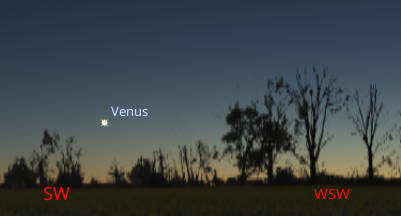
Venus in evening twilight
Venus in evening twilight, approximately half an hour after sunset. For the Grand Traverse area of Michigan that would be about 7 PM, October 30, 2024. Created using Stellarium.
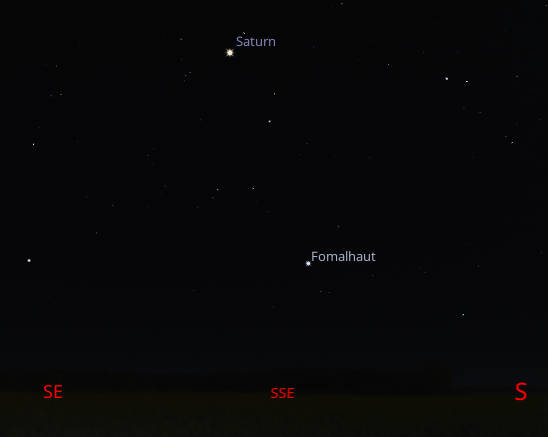
Saturn, keeping company with Fomalhaut
Saturn, keeping company with Fomalhaut, the loneliest star in the sky in the south-southeastern sky at 8 PM. Created using Stellarium
Jupiter low in the east-northeast at 11 PM
Jupiter low in the east-northeast at 11 PM. Created using Stellarium.
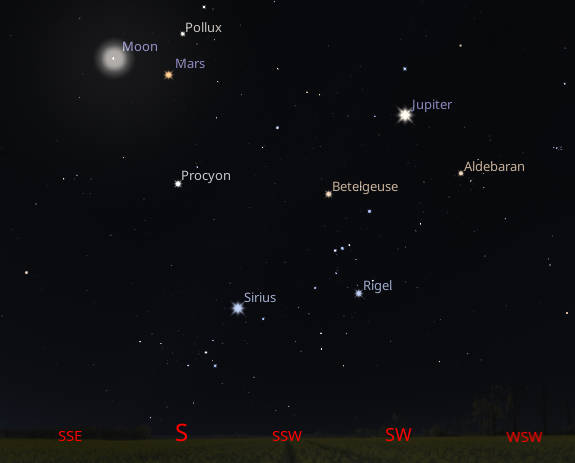
Jupiter and Mars among the stars of winter seen at 7 AM tomorrow morning October 31, 2024. Created using Stellarium.
Telescopic Venus, Saturn and Jupiter
Telescopic Venus, Saturn and Jupiter (north up) as they would be seen in a small telescope with the same magnification. All the planets shown are for tonight, the evening of October 30, 2024. Apparent diameters: Venus 14.1″, 77.4% illuminated; Saturn 18.4″, its rings 42.8″, 5.2 degrees from edge on (opening up a bit); Jupiter 46.0″; Mars, too small to be represented here, is 9.2″. Saturn’s rings are actually much brighter than depicted here. The ” means seconds of arc, or 1/3600th of a degree. Created using Cartes du Ciel (Sky Charts).
The naked-eye planets and the Moon at sunset and sunrise on a single night, starting with sunset on the right on October30, 2024. The night ends on the left with sunrise on the 31st. Click or tap on the image to enlarge it. Created using my LookingUp app and GIMP.
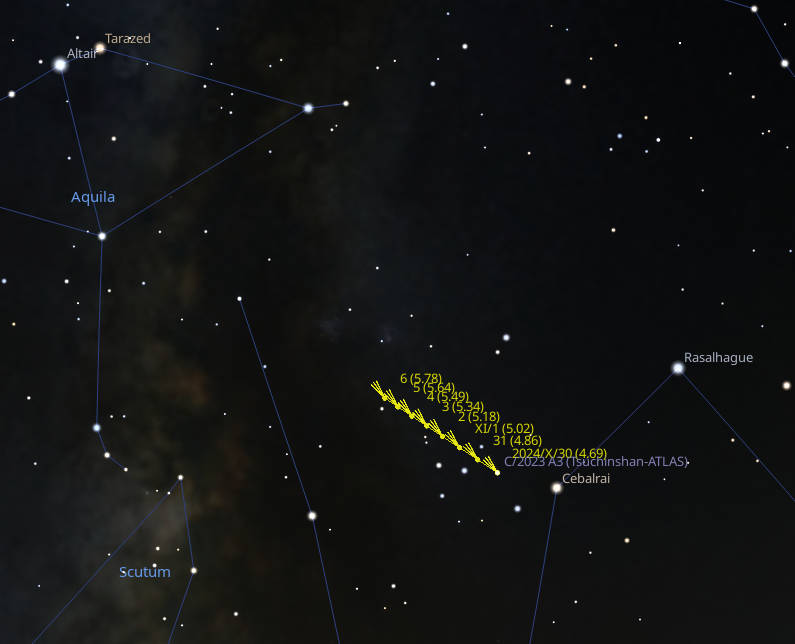
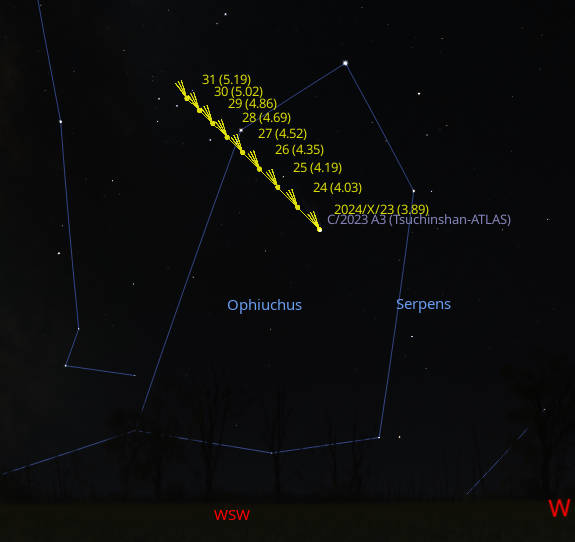
A finder chart for Comet Tsuchinshan-ATLAS
A finder chart for Comet Tsuchinshan-ATLAS for tonight and for the next 7 days as it drops from 5th to 6th magnitude. Click or tap on the image to enlarge it. Created using Stellarium.
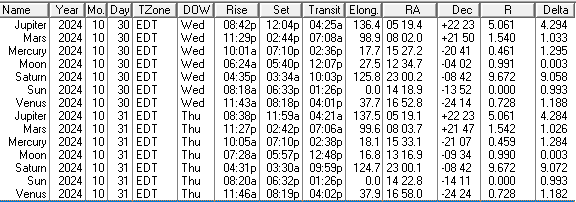
A low precision ephemeris of the Sun Moon and naked eye planet positions for today and tomorrow
This is a low precision ephemeris of the Sun Moon and naked eye planet positions for today and tomorrow, October 30 and 31, 2024. Some of the columns are self-explanatory, others not. The transit column is the time that the body crosses the meridian and is due south. Elong, for elongation, is the angle between the Sun and that body. RA is right ascension, which is the object’s east-west position on the celestial sphere in hours and minutes. Dec is declination which is the north-south position of the object on the celestial sphere in degrees and minutes. R is the distance of that object from the Sun in astronomical units. An astronomical unit is about 93 million miles or 150 million kilometers. And Delta is the distance of that object from the Earth, also in astronomical units. I omit the ‘m’ in am and pm for compactness. The data was generated using my LookingUp for DOS app and displayed as a table by my Ephemeris Helper app.

Ephemeris: 10/23/2024 – Taking a look at this week’s brighter solar system bodies

October 23, 2024 Comments off

This is Ephemeris for Wednesday, October 23rd. Today the Sun will be up for 10 hours and 34 minutes, setting at 6:44, and it will rise tomorrow at 8:10. The Moon, 1 day before last quarter, will rise at 11:50 this evening.

Let’s take our weekly look at the whereabouts of the naked-eye planets. Venus might be spotted in the West southwest low on the horizon at 7:15 PM, 29 minutes after sunset. It will set at 8:17. Comet Tsuchinshan-ATLAS will be west after 8:30 PM the end of astronomical twilight. It will set at 10:55 PM. Saturn will be in the southeast at 8 PM. Jupiter will rise at 9:11 PM this evening in the east northeast, and be a good object for the small telescope about an hour later. By 7:00 AM tomorrow Jupiter will be high in the southwest while Mars will be high in the s­outh to the right of the Moon.

The astronomical event times given are for the Traverse City/Interlochen area of Michigan (EDT, UT – 4 hours). Times will be different for other locations.

Addendum
Venus in evening twilight, approximately three quarters of an hour after sunset
Venus in evening twilight, approximately three quarters of an hour after sunset. For the Grand Traverse area of Michigan that would be about 7:30 PM tonight, October 23, 2024. Created using Stellarium.
Saturn, keeping company with Fomalhaut, the loneliest star in the sky
Saturn, keeping company with Fomalhaut, the loneliest star in the sky in the siuth-southeastern sky at 9 PM. Created using Stellarium
Jupiter low in the east-northeast at 11 PM this evening
Jupiter low in the east-northeast at 11 PM this evening. Created using Stellarium.
A finder chart for Comet Tsuchinshan-ATLAS for tonight and for the next 7 days
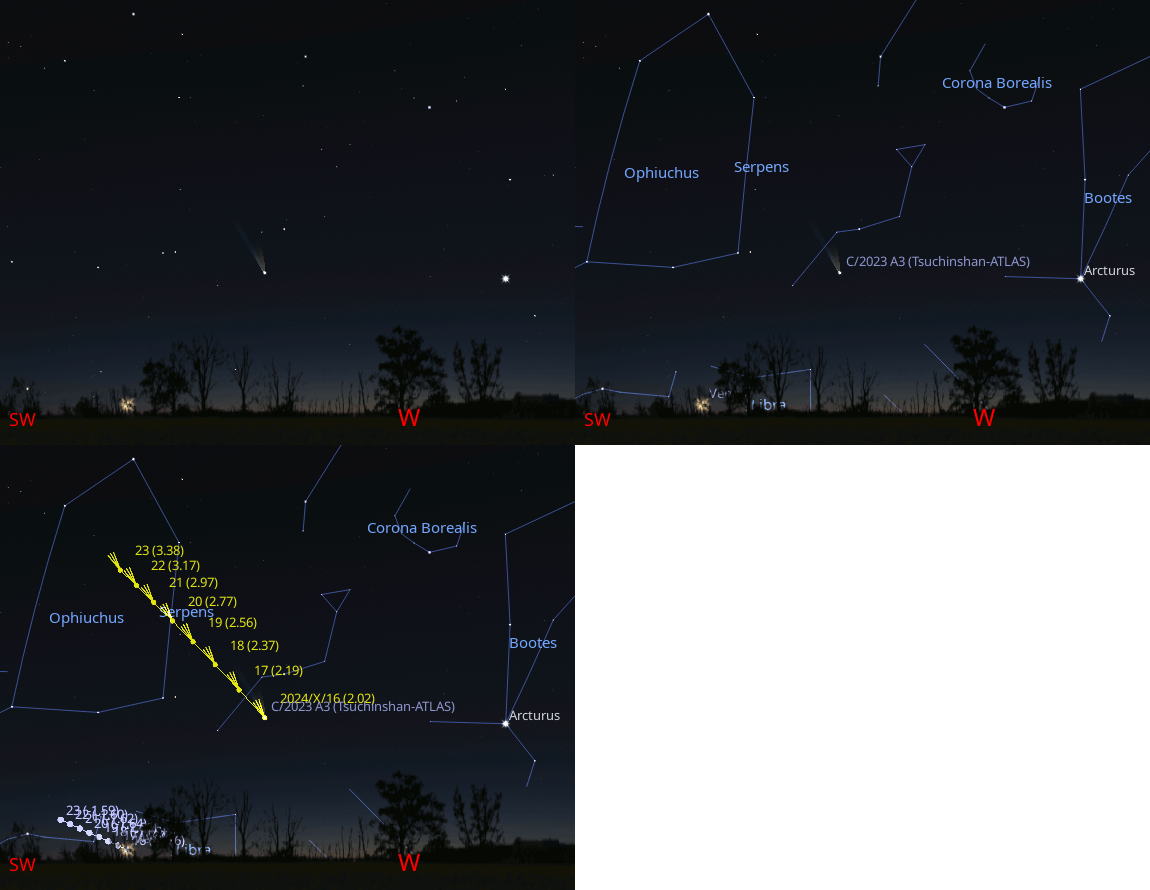
A finder chart for Comet Tsuchinshan-ATLAS for tonight and for the next 7 days. Created using Stellarium.
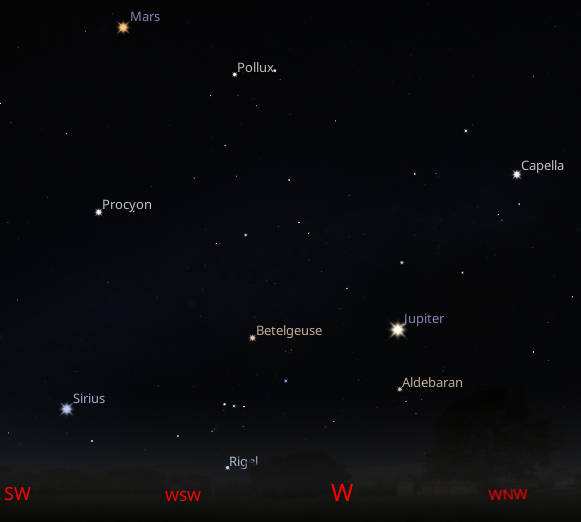
Jupiter, Mars and the Moon among the stars of winter seen at 7 AM tomorrow morning
Jupiter, Mars and the Moon among the stars of winter seen at 7 AM tomorrow morning October 24, 2024. Created using Stellarium.
The Moon three hours past last quarter at 7 AM tomorrow morning
The Moon three hours past last quarter at 7 AM tomorrow morning, October 24, 2024. Selected features are labeled. Created using Stellarium, LibreOffice Draw, and GIMP.
Telescopic Venus, Saturn and Jupiter
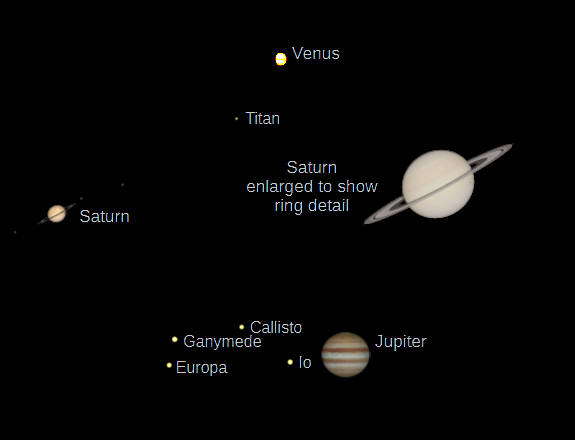
Telescopic Venus, Saturn and Jupiter (north up) as they would be seen in a small telescope with the same magnification. All the planets shown are for tonight, the evening of October 23, 2024. Venus and Saturn are from the evening of the 25th 2024, Apparent diameters: Venus 13.6″, 79.2% illuminated; Saturn 18.6″, its rings 43.2″, 5.1 degrees from edge on (opening up a bit); Jupiter 45.2″; Mars, too small to be represented here, is 8.7″. Saturn’s rings are actually much brighter than depicted here. The ” means seconds of arc, or 1/3600th of a degree. Created using Cartes du Ciel (Sky Charts).
A low precision ephemeris of the Sun Moon and naked eye planet positions
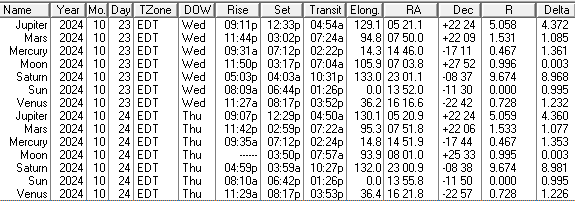
This is a low precision ephemeris of the Sun Moon and naked eye planet positions for today and tomorrow, October 23 and 24, 2024. Some of the columns are self-explanatory, others not. The transit column is the time that the body crosses the meridian and is due south. Elong, for elongation, is the angle between the Sun and that body. RA is right ascension, which is the object’s east-west position on the celestial sphere in hours and minutes. Dec is declination which is the north-south position of the object on the celestial sphere in degrees and minutes. R is the distance of that object from the Sun in astronomical units. An astronomical unit is about 93 million miles or 150 million kilometers. And Delta is the distance of that object from the Earth, also in astronomical units. I omit the ‘m’ in am and pm for compactness. The data was generated using my LookingUp for DOS app and displayed as a table by my Ephemeris Helper app.

Ephemeris: 10/16/2024 – Where are the naked-eye planets and the comet?

October 16, 2024 Comments off

This is Bob Moler with Ephemeris for Wednesday, October 16th. Today the Sun will be up for 10 hours and 55 minutes, setting at 6:55, and it will rise tomorrow at 8:01. The Moon, 1 day before full, will set at 8:11 tomorrow morning.

Let’s take our weekly look at the whereabouts of the naked-eye planets. Venus might be spotted in the West southwest low on the horizon at 7:30 PM, 35 minutes after sunset. It will set at 8:19. Comet Tsuchinshan-ATLAS will be west southwest way above and to the right of Venus. It will set at 9:46 PM. Saturn will be in the southeast at 8 PM. Jupiter will rise at 9:40 PM this evening and be a good object for the small telescope about an hour later. Jupiter and Mars are both mourning planets so they can be seen early in the morning before sunrise. By 7:00 AM tomorrow Jupiter will be high in the southwest while Mars will be high in the South.

The astronomical event times given are for the Traverse City/Interlochen area of Michigan (EDT, UT – 4 hours). Times will be different for other locations.

Addendum
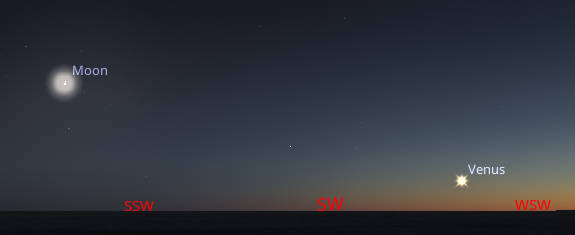
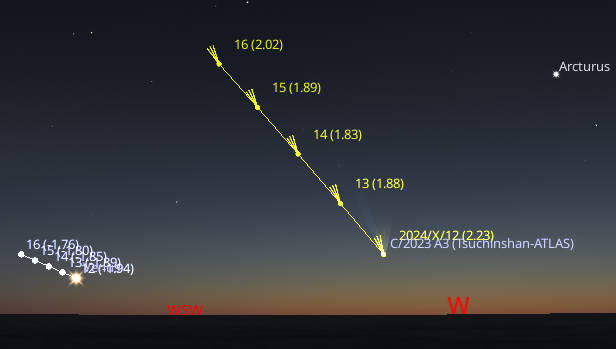
An animated finder for Comet Tsuchinshan-ATLAS and Venus for tonight and for the next 7 days. Venus is in the lower left on the horizon for tonight. The image contains 3 frames the first is tonight at 8 PM without any annotations. The second adds names and constellation outlines. The third is the comet’s position for tonight in the next 7 days. Created using Stellarium and GIMP.
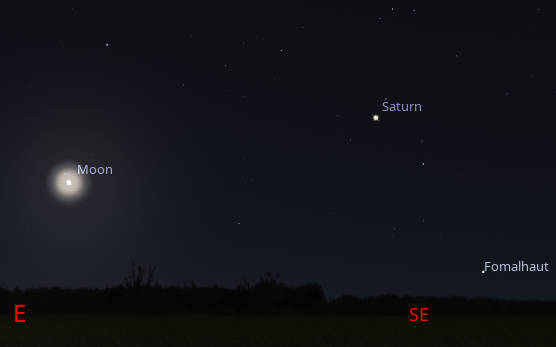
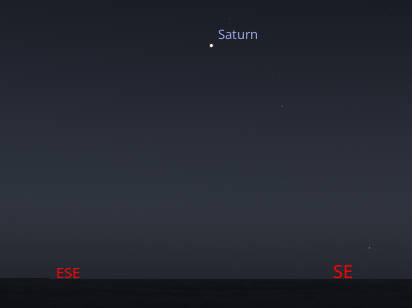
Saturn and the Moon tonight at 8:00 PM along with the star Fomalhaut just rising . Created using Stellarium
Jupiter low in the east northeast at 11 PM this evening. Created using Stellarium.
Jupiter and Mars among the stars of winter seen at 7 AM tomorrow morning. Created using Stellarium.
Telescopic Venus, Saturn and Jupiter (north up) as they would be seen in a small telescope with the same magnification. Venus and Saturn are from 8 pm, and Jupiter for 11 pm tonight, October 16, 2024. Apparent diameters: Venus 13.2″, 81.0% illuminated; Saturn 18.7″, its rings 43.6″, 5.0 degrees from edge on (opening up a bit); Jupiter 44.4″; Mars, too small to be represented here, is 8.3″. The ” means seconds of arc, or 1/3600th of a degree. Click or tap on the image to enlarge it. Created using Cartes du Ciel (Sky Charts).
The naked-eye planets and the Moon at sunset and sunrise on a single night, starting with sunset on the right on October16, 2024. The night ends on the left with sunrise on the 17th. Click or tap on the image to enlarge it. Created using my LookingUp app and GIMP.
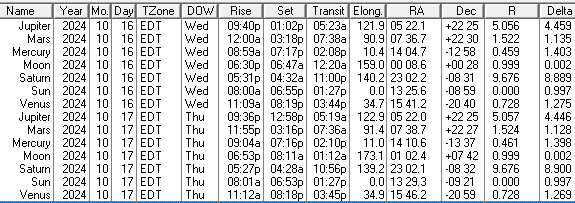
This is a low precision ephemeris of the Sun Moon and naked eye planet positions for today and tomorrow, October 16 and 17, 2024. Some of the columns are self-explanatory, others not. The transit column is the time that the body crosses the meridian and is due south. Elong, for elongation, is the angle between the Sun and that body. RA is right ascension, which is the object’s east-west position on the celestial sphere in hours and minutes. Dec is declination which is the north-south position of the object on the celestial sphere in degrees and minutes. R is the distance of that object from the Sun in astronomical units. An astronomical unit is about 93 million miles or 150 million kilometers. And Delta is the distance of that object from the Earth, also in astronomical units. I omit the ‘m’ in am and pm for compactness. The data was generated using my LookingUp for DOS app and displayed as a table by my Ephemeris Helper app.

Ephemeris: 10/09/2024 – Where are the naked-eye planets this week?

October 9, 2024 Comments off

This is Ephemeris for Wednesday, October 9th. Today the Sun will be up for 11 hours and 16 minutes, setting at 7:07, and it will rise tomorrow at 7:52. The Moon, 1 day before first quarter, will set at 10:57 this evening.

Let’s take our weekly look at the whereabouts of the naked-eye planets. Venus might be spotted in the West southwest only 7° above the horizon at 8 PM, 55 minutes after sunset. It will set at 8:23. Saturn will be in the southeast at that time. Saturn may look disappointing in telescopes this year since its rings are nearly edge on and appearing as a line through the planet like it’s stapled onto the sky. Jupiter and Mars will be up in the morning sky, with Jupiter rising about 10:08 PM in the east-northeast. By 7 AM tomorrow, Jupiter will be brighter than any of the winter stars high in the south. Mars, with its reddish hue, will be to the left of Jupiter. Comet Tsuchinshan-ATLAS will be in the western evening sky starting this weekend. It is expected to be quite bright, I’m betting with a broad tail.

The astronomical event times given are for the Traverse City/Interlochen area of Michigan (EDT, UT – 4 hours). Times will be different for other locations.

Addendum
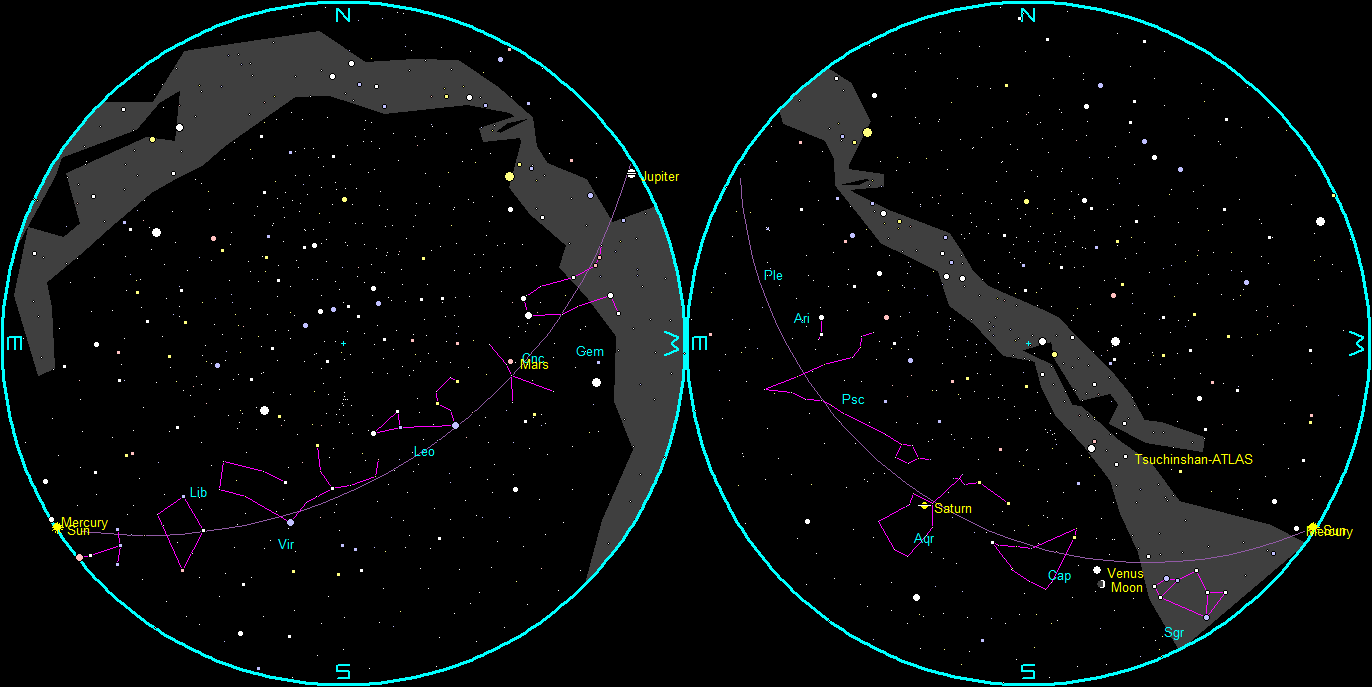
Venus and the Moon in evening twilight, approximately an hour after sunset. For the Grand Traverse area of Michigan that would be about 8 PM tonight, October 9, 2024, where Venus, is only 7 degrees above the horizon at sunset. It would be higher from the south of us, below 45° N latitude, and lower for those north of us. Created using Stellarium.
Saturn as it would appear at 8 PM tonight, October 9, 2024, low in east southeast to southeast. With the naked eye it would seem to be pretty much alone in that sector of the sky of dim stars. Created using Stellarium.
Though not visible tonight, the comet will be making an evening appearance at the end of the week. The track of comet C/2023 A3 (Tsuchinshan-ATLAS) for five nights at 8 pm starting with Saturday the 12th. It might be visible on the 11th but the sky might be too bright. On that date we might be able to see the tail without seeing the head of the comet in the twilight. It should be interesting. The bright track on the lower left is Venus. Each label is the date and estimated magnitude. The comet is expected to be brighter that those estimates, especially during the first week of its appearance. Created using Stellarium.
The Moon as it might appear through a small telescope tonight, October 9, 2024. Selected features are labeled. Created using stellarium, LibreOffice draw, and GIMP.
Mars and Jupiter among the bright winter stars, and above the constellation of Orion with its bright stars Betelgeuse and Rigel 7:00 AM tomorrow morning, October 10, 2024. Created using Stellarium.
Telescopic Venus, Saturn and Jupiter (north up) as they would be seen in a small telescope with the same magnification. Venus and Saturn are from 8 pm, and Jupiter for 11 pm tonight, October 9, 2024. Apparent diameters: Venus 12.7″, 82.5% illuminated; Saturn 18.9″, its rings 44.0″, 4.8 degrees from edge on (opening up a bit); Jupiter 43.5″; Mars, too small to be represented here, is 8.0″. The ” means seconds of arc, or 1/3600th of a degree. Click or tap on the image to enlarge it. Created using Cartes du Ciel (Sky Charts).
The naked-eye planets and the Moon at sunset and sunrise on a single night, starting with sunset on the right on October 9, 2024. The night ends on the left with sunrise on the 10th. Click or tap on the image to enlarge it. Created using my LookingUp app and GIMP.
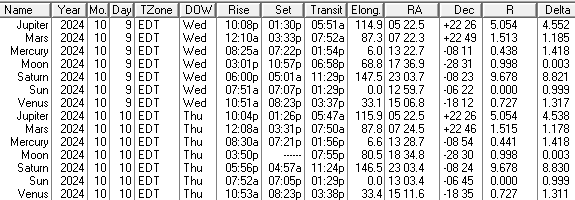
This is a low precision ephemeris of the Sun Moon and naked eye planet positions for today and tomorrow, October 9 and 10, 2024. Some of the columns are self-explanatory, others not. The transit column is the time that the body crosses the meridian and is due south. Elong, for elongation, is the angle between the Sun and that body. RA is right ascension, which is the object’s east-west position on the celestial sphere in hours and minutes. Dec is declination which is the north-south position of the object on the celestial sphere in degrees and minutes. R is the distance of that object from the Sun in astronomical units. An astronomical unit is about 93 million miles or 150 million kilometers. And Delta is the distance of that object from the Earth, also in astronomical units. I omit the ‘m’ in am and pm for compactness. The data was generated using my LookingUp for DOS app and displayed as a table by my Ephemeris Helper app.