Archive
Ephemeris: 03/21/2024 – Three lunar craters named for heliocentrists by a geocentrist
This is Ephemeris for Thursday, March 21st. Today the Sun will be up for 12 hours and 14 minutes, setting at 7:57, and it will rise tomorrow at 7:41. The Moon, halfway from first quarter to full, will set at 6:59 tomorrow morning.
The gibbous moon tonight is exhibiting, over the last three days, three craters named for those who promoted the heliocentric or Sun centered solar system. The largest crater of the three, Copernicus, can be seen to the lower left of the center of the Moon. The asteroid that hit it made a big splash, which can be seen in its rays of ejecta being round and full. Then about halfway between it and the terminator is a small crater named for Johannes Kepler, and then nearby and on the terminator tonight is the crater named for the Greek philosopher who first proposed the Sun centered solar system, or in his case the universe, Aristarchus. He was a contemporary of and overshadowed by Aristotle, so his ideas were never adopted.
The astronomical event times given are for the Traverse City/Interlochen area of Michigan (EDT, UT–4 hours). They may be different for your location.
Addendum
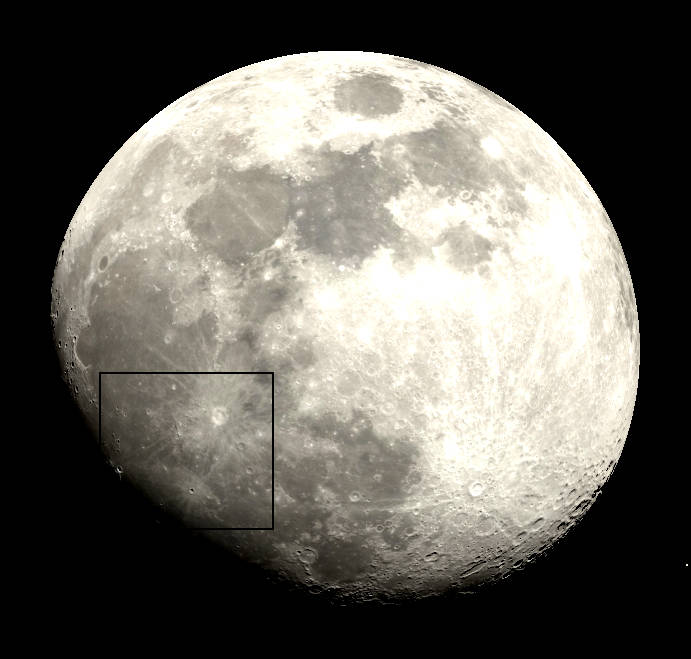
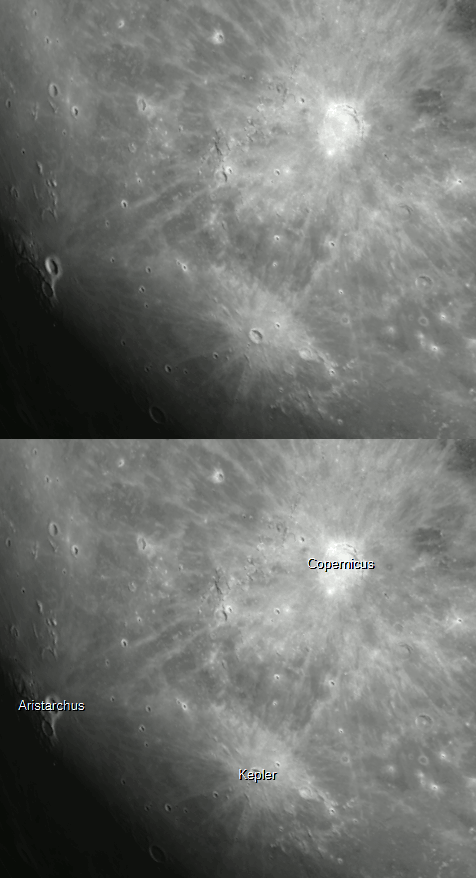
These craters were named by Giovanni Battista Riccioli, an astronomer and Jesuit priest. He established the lunar nomenclature we have today and named many of the largest craters. Being a 17th century Catholic, he bought the Roman Catholic line that the universe was geocentric, that is earth centered, yet he honored these heliocentrists with their own craters. He tended to group crater names by their relationship in life or their ideas, so the three proponents of the Sun centered solar system were given craters near each other in one section of the Moon.

Aristarchus of Samos was a Greek philosopher who lived between 310 and 230 BCE. He proposed a heliocentric solar system or universe, where Earth and all the planets revolved about the Sun. However, the work that he proposed it in has been lost. We know of his idea only referenced in the writings of others who attempted to debunk it.
Copernicus (Mikola Kopernik 1473-1543), was a Polish Catholic Canon, who was a mathematician, astronomer and translator, among other talents. He came up with the theory of the Sun centered or heliocentric solar system or in his day, universe.
Johannes Kepler (1571–1630) was an astronomer, astrologer and mathematician who discovered the laws of planetary motion. While Copernicus kept the circular orbits of the planets, they still didn’t match the motions of the planets in the sky. So he had to add some epicycles to make it all work. He actually had more epicycles than Ptolemy had. Kepler was able to figure out that he didn’t need epicycles if he assumed that the orbits were elliptical. He developed his Three Laws of Planetary Motion.
Galileo also has a crater there (Galilaei). It’s a tiny crater right on the terminator, below Kepler in the images above, and not visible. The Virtual Moon Atlas does not give an origin of the naming of the crater. Back in 1651, when Riccioli was giving craters names, Galileo was still on the outs with the Vatican, and the church.
12/19/2022 – Ephemeris – Hunting for the Star of Bethlehem: What it wasn’t
This is Ephemeris for Monday, December 19th. Today the Sun will be up for 8 hours and 48 minutes, setting at 5:04, and it will rise tomorrow at 8:16. The Moon, 3 days past last quarter, will rise at 4:59 tomorrow morning.
In these last days before Christmas, I’d like to explore what in the sky could have been the Star of Bethlehem from an astronomical point of view. If it had to do with the arrangement of planets, tracing back two thousand years would be simple. If it was some sudden appearance of an actual star or comet, we would have to rely on contemporary accounts. Those would have to come from the Chinese and Koreans. The state of astronomy around the Mediterranean and the Middle East was pretty stagnant due to the fact that they thought that the heavens were perfect and changeless, so things like comets and novae or “New Stars” meant change, so were not really part of the heavens. So we must look for something more mundane.
The astronomical event times given are for the Traverse City/Interlochen area of Michigan (EST, UT –5 hours). They may be different for your location.
Addendum
Probably the first person to kick off the search for the Star of Bethlehem was Johannes Kepler. (These are slides from this year’s Searching for the Star of Bethlehem presentation I gave to the Grand Traverse Astronomical Society. The captions are from the text of the presentation)
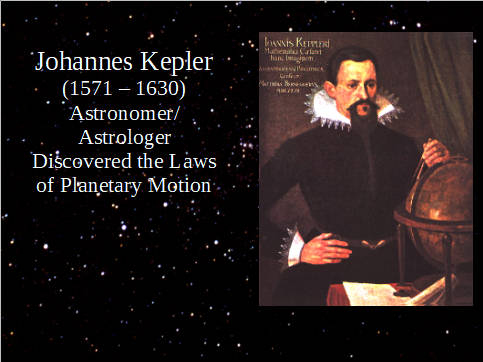
The search for the Star really started with Johannes Kepler, who lived from 1571 to 1630. He was an astronomer, although he cast horoscopes for the odd prince or duke, which is how he made a living. His mother was even charged for being a witch, but nothing came of it. And after much trial and error discovered his Three Laws of Planetary Motion. His story is a fascinating one.
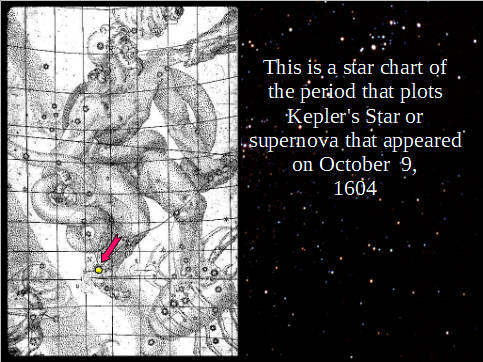
Kepler also discovered a supernova, the last one seen in the Milky Way. This is an old star chart that records Kepler’s Star,
a supernova, or super bright new star, he discovered on October 9, 1604. I colored it yellow and have an arrow pointed to it, in Ophiuchus’ right ankle.
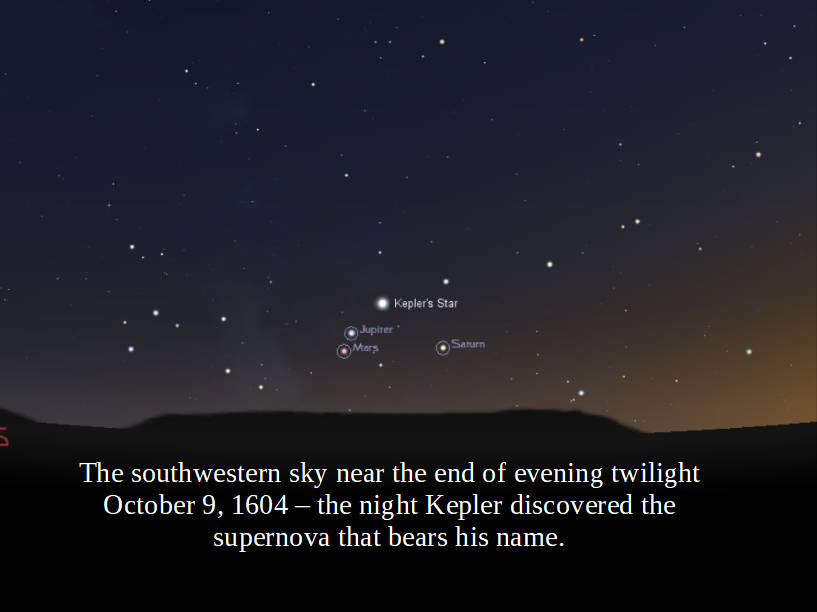
Here is a Stellarium recreation of the sky the night of his discovery. It’s the southwestern sky near the end of evening twilight, October 9, 1604, the night Kepler discovered the supernova that bears his name. It got him to thinking, could a similar grouping of a nova and planets be the Star of Bethlehem?
He knew of no nova being reported back then, though no one in the western world probably would have. That would be a change in the officially changeless heavens, so it couldn’t possibly have been a real heavenly object. And being the mathematical genius he was, (he did discover the Three Laws of Planetary Motion), found a very interesting conjunction of Jupiter and Saturn, with Mars piling on later, that occurred in 7 BCE. (Click on the image to enlarge it.)
07/23/2018 – Ephemeris – The importance of Mars in determining the nature of the solar system
Monday, July 23rd. The Sun rises at 6:19. It’ll be up for 14 hours and 59 minutes, setting at 9:18. The Moon, half way from first quarter to full, will set at 3:41 tomorrow morning.
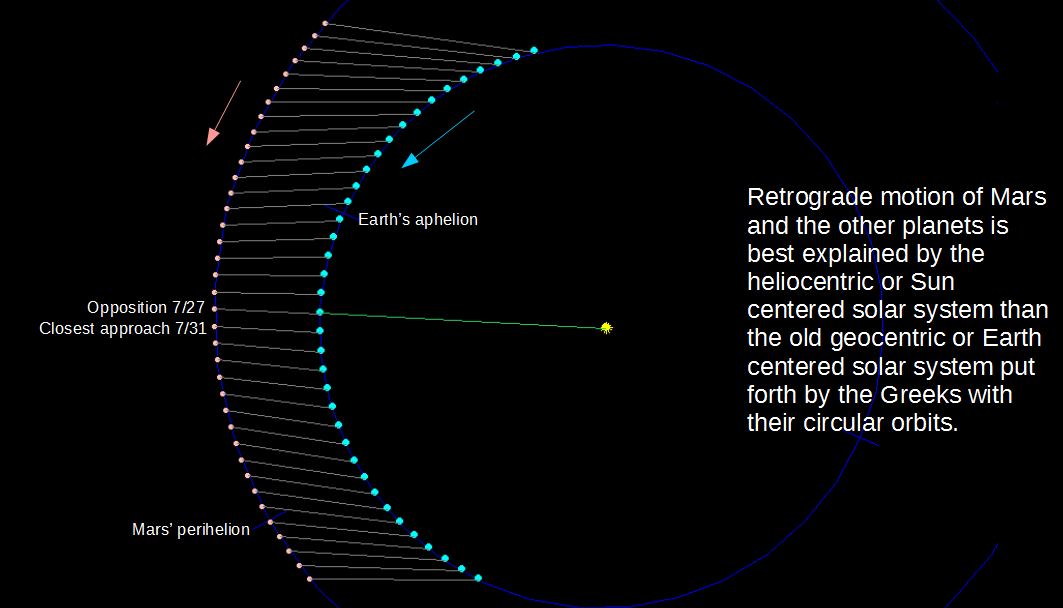
The accurate observational positions of Mars by Tycho Brahe allowed Johannes Kepler in the early 17th century to discover his three laws of planetary motion. Tycho was the last and greatest of the naked eye astronomers. Kepler befriended Tycho who jealously guarded his observations. It was only after his death in 1601 that Kepler took possession of Tycho’s data. Until then it was believed that planets moved with uniform circular motion, even though they didn’t look like it. Astronomers added circle after circle, called epicycles, to attempt to make their system work. Mars was the worst case. Kepler finally determined that Mars, and indeed all the planets, orbited the Sun in elliptical orbits. That was his first law of planetary motion.
The times given are for the Traverse City/Interlochen area of Michigan. They may be different for your location.
Addendum
The source if the images below is the talk “Mars 2018” I gave at the Betsie Valley District Library, July, 20, 2018.
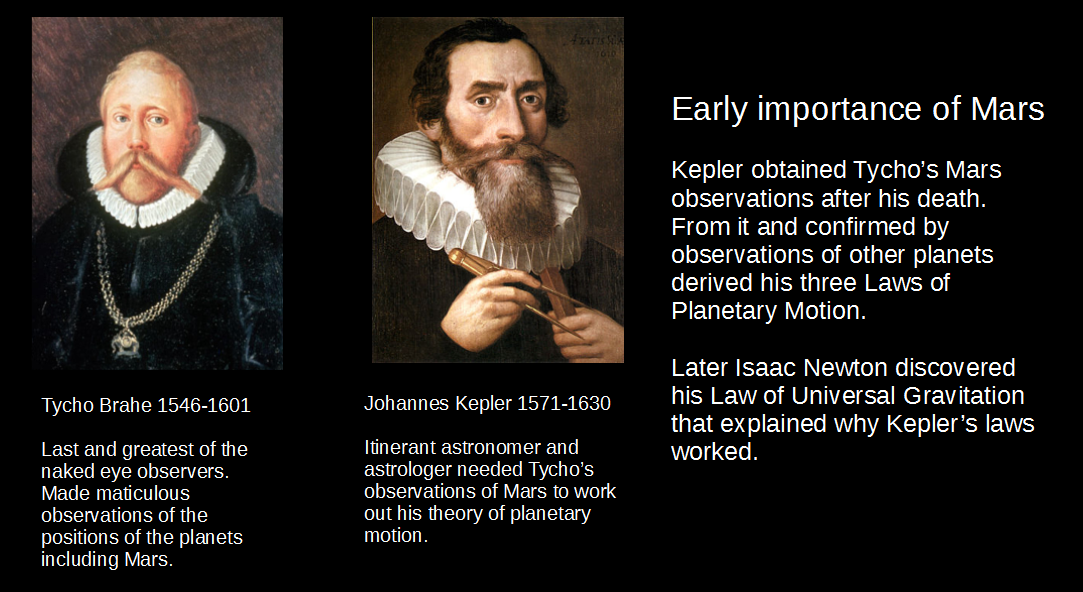
Tycho and Kepler. Artist for Tycho: Eduard Ender (1822-1883). Artist for Kepler, unknown. Source: Wikipedia.
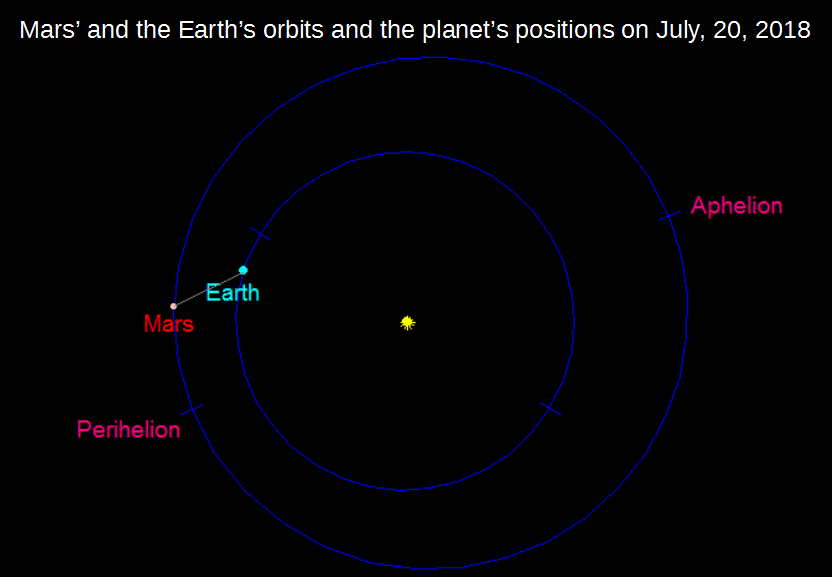
Mars’ and Earth’s orbits to scale and positions of the Earth and Mars July 20, 2018, one week before opposition. Note that Mars’ orbit is decidedly not circular. Credit my LookingUp program.
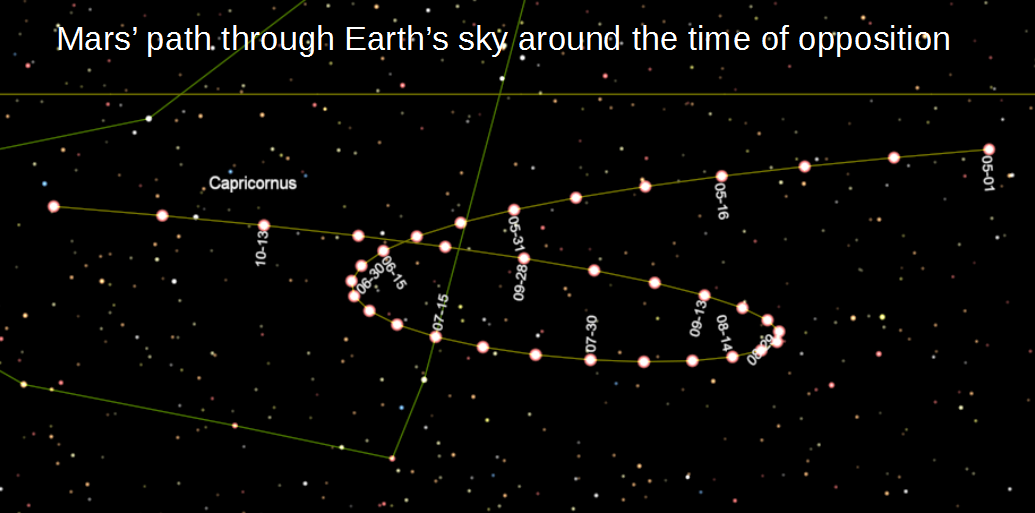
Created using Cartes du Ciel (Sky Charts).
Created using Cartes du Ciel (Sky Charts).
05/17/2016 – Ephemeris – Three heliocentrists memorialized on the Moon tonight
Ephemeris for Tuesday, May 17th. Today the Sun will be up for 14 hours and 55 minutes, setting at 9:07. The Moon, half way from first quarter to full, will set at 4:50 tomorrow morning. Tomorrow the Sun will rise at 6:10.
Tonight the gibbous Moon boasts the uncovering of three craters from lunar night whose namesakes were pioneers in putting forth the heliocentric theory. That is that the Earth and the other planets revolved about the Sun. Out the longest, and making the biggest splash is the crater Copernicus, named for the Polish cleric whose book On the Revolution of the Heavenly Spheres gave a new meaning to the word revolution, that is upheaval. The crater Kepler is about two-thirds the way from Copernicus and the terminator, named after the astronomer who discovered that the plants orbit the Sun in elliptical paths. Finally just catching sunlight is Aristarchus who in the 4th century BC first proposed a heliocentric solar system.
Times are for the Traverse City/Interlochen area of Michigan. They may be different for your location.
Addendum
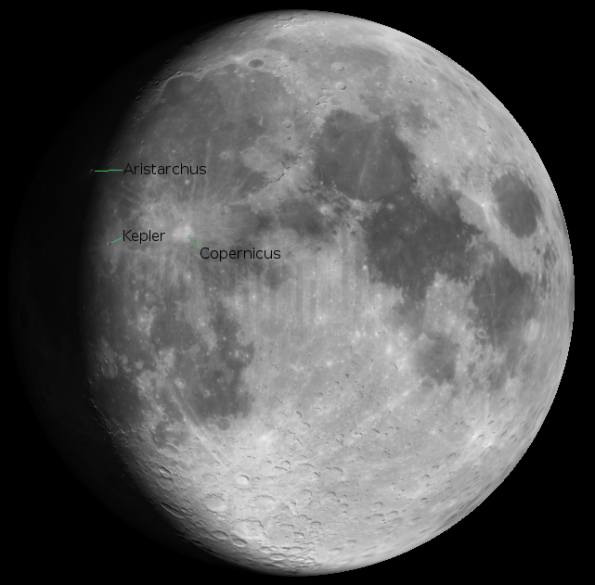
Three heliocentrists on the Moon at 10 p.m., May 17, 2016. Created using Virtual Moon Atlas.
11/23/2012 – Emphemeris – Think Tatooine is special? How about a planet in a 4 star system.
Ephemeris for Friday, November 23rd. The sun will rise at 7:50. It’ll be up for 9 hours and 17 minutes, setting at 5:07. The moon, 3 days past first quarter, will set at 3:59 tomorrow morning.
The satellite named Kepler, which is attempting to detect planets around other stars has been up there for over 3 years and has received a mission extension. It is looking at a single patch of the sky in the constellation Cygnus. The count of confirmed and unconfirmed planets has risen to 23 hundred. Confirmations have to be done by ground based telescopes, so it will take a while to investigate all the finds for planets. The public can help sift through the Kepler data at www.planethunters.org. In fact the first planet hunters discovery was announced last month: A planet orbiting a pair of stars in the 4 star system. That’s a real feat considering they all look like a single point of light to Kepler.
Times are for the Traverse City/Interlochen area of Michigan. They may be different for your location.
Addendum
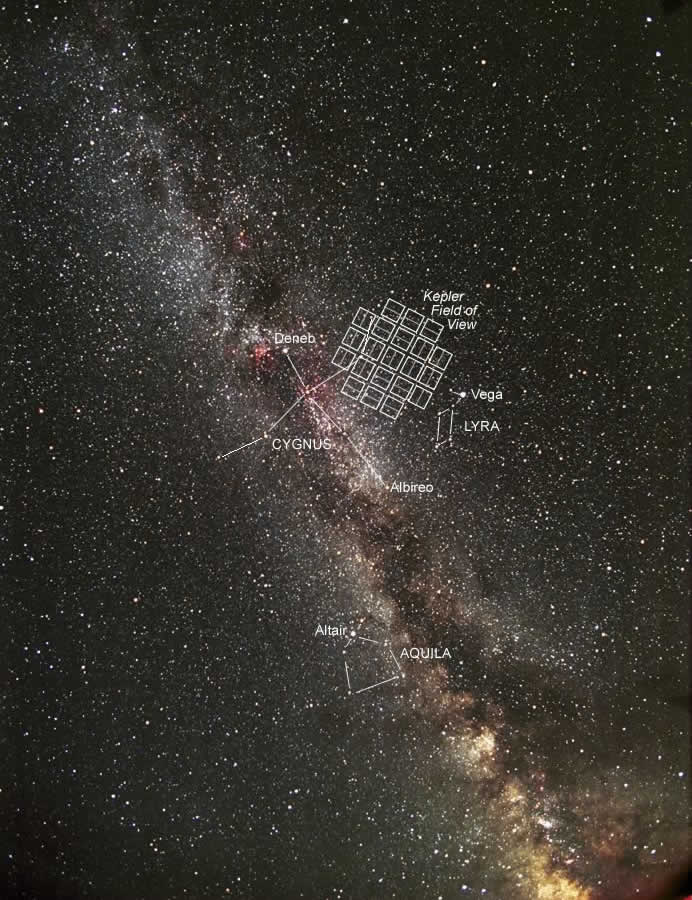
Kepler field of view. Credit C. Roberts, NASA.
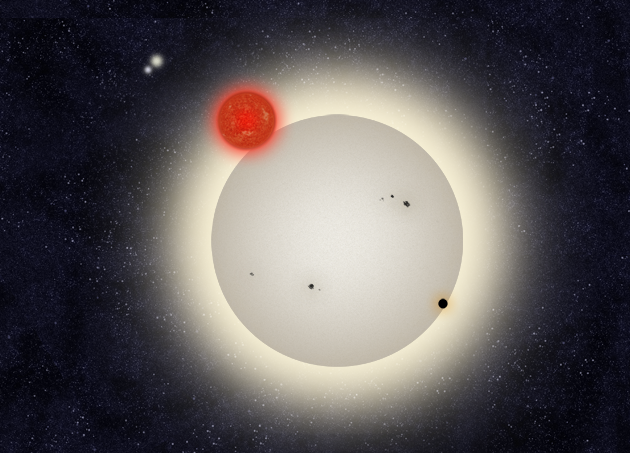
Artist’s rendition of PH1 (Planet Hunters 1) a planet in a 4 star system. Image credit: Haven Giguere/Yale.
Here’s the post from the Planet Hunters blog.
10/25/2012 – Ephemeris – Exploring the bright gibbous moon
Ephemeris for Thursday, October 25th. The sun will rise at 8:11. It’ll be up for 10 hours and 29 minutes, setting at 6:40. The moon, half way from first quarter to full, will set at 5:02 tomorrow morning.
The moon tonight is very bright, so looking at it with a telescope can be almost painful. There are moon filters sold at telescope stores for standard sized eyepieces that will alleviate that problem. Remember it’s daytime on the moon and the sunlight is as strong on the moon as it is on the earth. Concentrate the telescope on the left edge of the moon, the sunrise line where the shadows are. The small crater Kepler, named for the astronomer who gave us the laws the govern the motion of the planets is located near the terminator near the moon’s equator. The Crater Gassendi, to the lower left, is a ringed plain with low walls and a flat floor that has a rille or crack in it. Another distinctive crater is Schiller lower to the south and very elongated.
Times are for the Traverse City/Interlochen area of Michigan. They may be different for your location.
Addendum
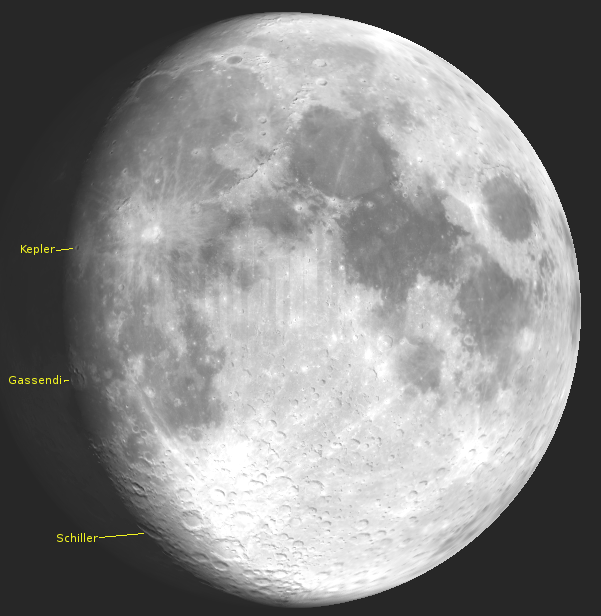
The bright gibbous moon highlighting three craters, Kepler, Gassendi, and Schiller. Created using the Virtual Moon Atlas.
Gassendi is named for Pierre Gassend, 17th French astronomer and pioneer in the use of a refractor telescope. Schiller is named for Julius Schiller a 17th century monk who came out with a Christian themed star atlas. These and other crater facts were obtained for the open source lunar program Virtual Moon Atlas.
 Bob Moler's Ephemeris Blog