Archive
Ephemeris: 03/31/2025 – Finding Leo, the celestial lion
This is Ephemeris for Monday, March 31st. Today the Sun will be up for 12 hours and 44 minutes, setting at 8:09, and it will rise tomorrow at 7:23. The Moon, 2 days past new, will set at 11:39 this evening.
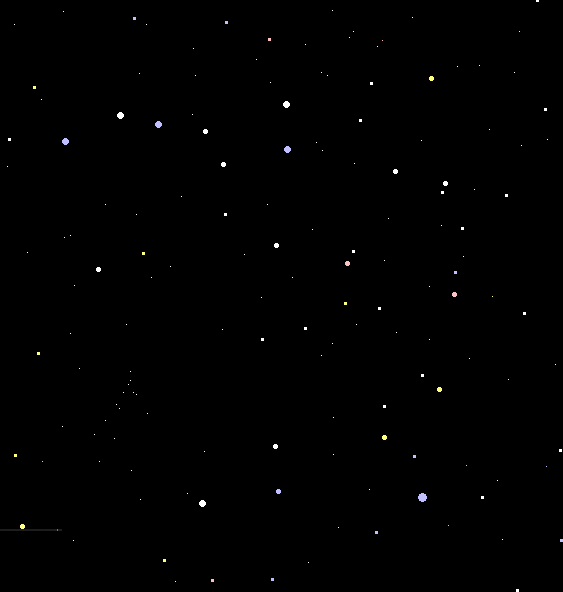
At 10 p.m. the spring constellation of Leo the lion will be high in the south-southeast. It can be found by locating the Big Dipper high in the northeast and imagining that a hole were drilled in the bowl to let the water leak out. It would drip on the back of this giant cat. The Lion is standing or lying facing westward. His head and mane are seen in the stars as a backwards question mark. This group of stars is also called the sickle. The bright star Regulus is at the bottom, the dot at the bottom of the question mark. A triangle of stars, to the left of Regulus, is the lion’s haunches. Leo contains some nice galaxies visible in moderate sized telescopes. The stars in Leo’s part of the sky are fewer than those in the winter sky.
The astronomical event times given are for the Traverse City/Interlochen area of Michigan (EDT, UT – 4 hours). Times will be different for other locations.
Addendum
Ephemeris: 12/24/2024 – Looking at another possibility for the Star of Bethlehem
This is Ephemeris for Christmas Eve, Tuesday, December 24th. Today the Sun will be up for 8 hours and 48 minutes, setting at 5:07, and it will rise tomorrow at 8:18. The Moon, 2 days past last quarter, will rise at 3:10 tomorrow morning.
Many writers of the 2nd and 3rd centuries CE place Jesus’ birth, via Roman events, around 2 BCE. So the Star of Bethlehem could appear several years later than the triple conjunction of Jupiter and Saturn in 7 BCE that’s been popular. In 3 and again in 2 BCE there were star-like conjunctions or apparent joining of the planets Jupiter and Venus against the backdrop of the constellation of Leo the Lion. A lion is related to Judah, son of Jacob, by a blessing the latter gave his 12 sons in Genesis. The first conjunction occurred in August in the morning sky. On June 16th of the next year the two planets got together again, this time in the evening sky, a month or more after Jesus would have been born in the vulnerable spring lambing season when shepherds would most likely be out at night guarding the flocks, not December 25th.
The astronomical event times given are for the Traverse City/Interlochen area of Michigan (EST, UT – 5 hours). Times will be different for other locations.
Addendum
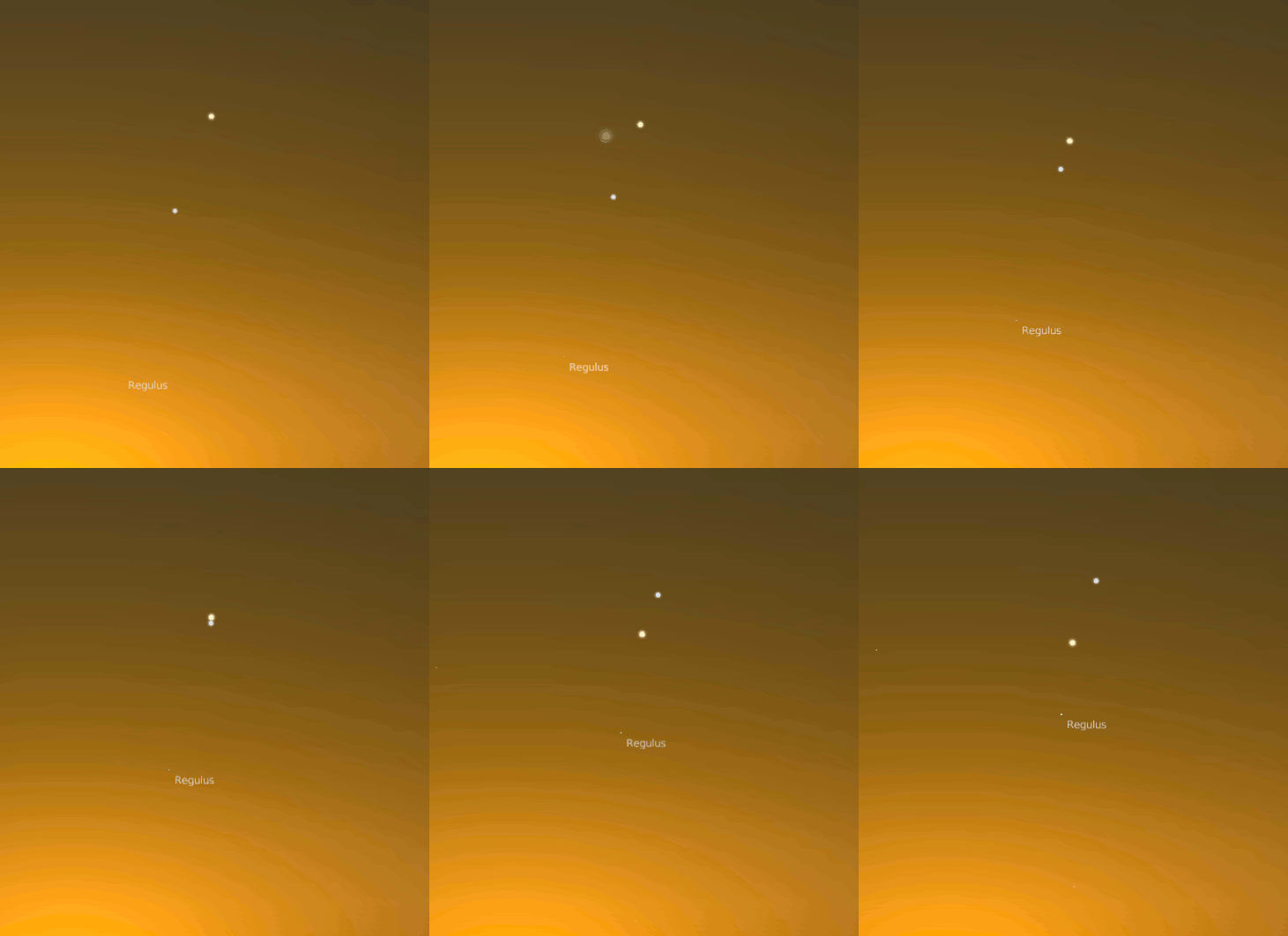
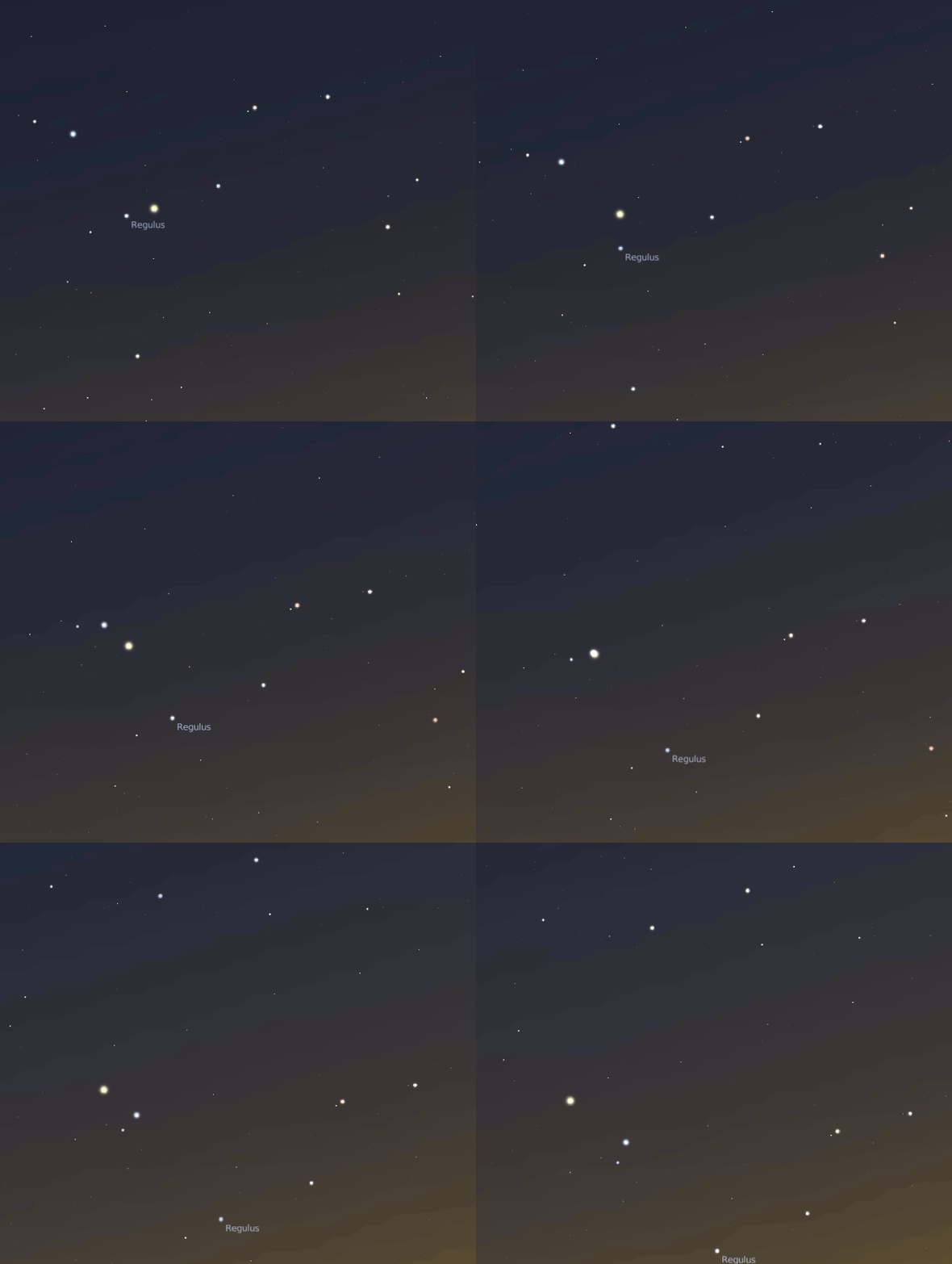
An edited excerpt from this year’s Star of Bethlehem presentation I gave to the Grand Traverse Astronomical Society on December 6th.
The triple conjunction of Jupiter and Saturn in 7 BCE is the generally accepted Star of Bethlehem, with Jesus being born in 6 or 5 BCE and Herod’s death being in 4 BCE after a lunar eclipse. What if the lunar eclipse in question was in 1 BCE? If so, there is that other possibility. It involves the constellation Leo, which is a lion. There is a passage in Genesis in which Jacob, who, by this time, is called Israel, is blessing his sons, each the heads of the twelve tribes of Israel. In Genesis 49 9-10 He compares him to a lion cub, the king of beasts, from whom the leaders of Israel will come. We can make a connection between Judah and the celestial lion, Leo. Let’s take a look at the celestial happenings against the constellation of Leo with Jupiter and Venus in 3 and 2 BCE.
On August 12th of 3 BCE Jupiter and Venus appeared to come together so close as to be separable only in telescopes. This may have been the Star at its rising mentioned to Herod. Could this predawn celestial mating of Jupiter, who the Babylonians saw as the god Marduk and Venus as Ishtar, the goddess of fertility, to bring forth a powerful king? The Magi, I’m pretty sure, would have known that 10 months later, a little longer than the human gestation period, by the way, that the two planets would again come together.
Ten months after the first conjunction of Jupiter and Venus, perhaps as the Magi neared Jerusalem, they saw Jupiter and Venus approaching each other again. Later as they left Herod’s palace on the evening of June 16th, 2 BCE the conjunction was at its tightest. They saw the “Star” again, as Matthew relates. Telescopes, which wouldn’t be invented for another sixteen hundred years, could have seen this extremely close conjunction of Jupiter and Venus. Venus, near its greatest eastern elongation from the Sun, would appear half illuminated. But even to the best naked eye observer, Jupiter and Venus would merge into a single star. Venus was much brighter than Jupiter than it appears here. In fact, it was nearly twelve times brighter, so Jupiter’s added brightness wouldn’t contribute much to the combined brightness. Jupiter would seem to disappear at their closest.
Also, there was a conjunction of Jupiter with the “Little King” star Regulus on September 14th 3 BCE, one or two days after the beginning of the Jewish New Year. Was this another sign that a new King of the Jews would be born? It is actually the first of three conjunctions Jupiter has with Regulus in the next 9 months. Yes, another triple conjunction. Jupiter passed Regulus the second time on February 17, of 2 BCE and for a final time on May 9th. During this time Venus had moved back toward the Sun and entered the evening sky where Jupiter met it once again.
05/03/2022 – Ephemeris – Regulus, the “Little King Star”
This is Bob Moler with Ephemeris for Tuesday, May 3rd. Today the Sun will be up for 14 hours and 20 minutes, setting at 8:50, and it will rise tomorrow at 6:28. The Moon, 3 days past new, will set at 12:05 tomorrow morning.
Fairly high in the south-southwest at 10 p.m. is a pattern of stars that’s in the shape of a backward question mark. This informal star group or asterism is also called the sickle. It is the head and mane of the official zodiacal constellation of Leo the lion. To the left is a triangle of stars is his hind end. The bright star at the bottom of the question mark, or end of the sickle’s handle is Regulus, the “Little King Star”, alluding to the lion’s status as the king of the jungle. Regulus is about 79 light years away and is a 4 star system that exists as two star pairs. The bright star Regulus itself and a companion too close to be imaged directly in telescopes, and a nearby pair of dim stars make up the system. The Moon often passes in front of Regulus, since it’s close to the ecliptic. These occultations, as they are called, will occur monthly for a year and a half starting July
The astronomical event times given are for the Traverse City/Interlochen area of Michigan (EDT, UT – 4 hours). They may be different for your location.
Addendum

Animated finder chart for Leo and Regulus for early May at 10 pm or an hour after sunset. The orange line that appears is the ecliptic, the path of the Sun in the sky. The path of the Moon is tilted by about 5 degrees to that path. The paths cross at points called nodes. The nodes move slowly westward in an 18.6-year cycle called the regression of the nodes. Occultations of Regulus by the Moon occur during two periods in that cycle. The next period where occultations of Regulus will occur monthly from July 2025 to January 2027. Created using Stellarium and GIMP.
Occultations are like solar eclipses in that they can only be seen from a limited area. That area will shift southward during that period. Of the 21 occultations in that period, only 2 will be visible from the United States: February 3rd, and April 26th 2026.
03/21/2022 – Ephemeris – Finding the celestial lion
This is Ephemeris for Monday, March 21st. Today the Sun will be up for 12 hours and 12 minutes, setting at 7:56, and it will rise tomorrow at 7:42. The Moon, 3 days past full, will rise at 12:15 tomorrow morning.
At 10 p.m. the spring constellation of Leo the lion will be fairly high in the southeast. It can be found by locating the Big Dipper high in the northeast and imagining that a hole were drilled in the bowl to let the water leak out. It would drip on the back of this giant cat. The Lion is standing or lying facing westward. His head and mane are seen in the stars as a backwards question mark. This group of stars is also called the Sickle. The bright star Regulus is at the bottom, the dot at the bottom of the question mark. A triangle of stars, to the left of Regulus, is the lion’s haunches. Leo contains some nice galaxies visible in moderate sized telescopes. The stars in Leo’s part of the sky are fewer than those in the winter sky.
The astronomical event times given are for the Traverse City/Interlochen area of Michigan (EDT, UT – 4 hours). They may be different for your location.
Addendum
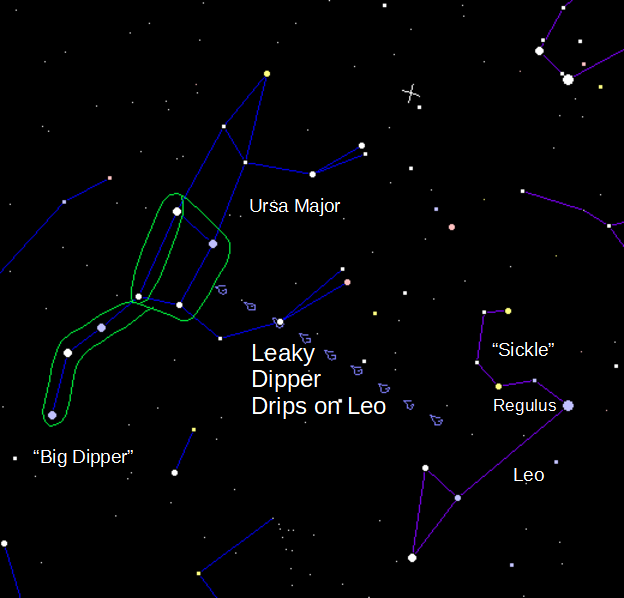
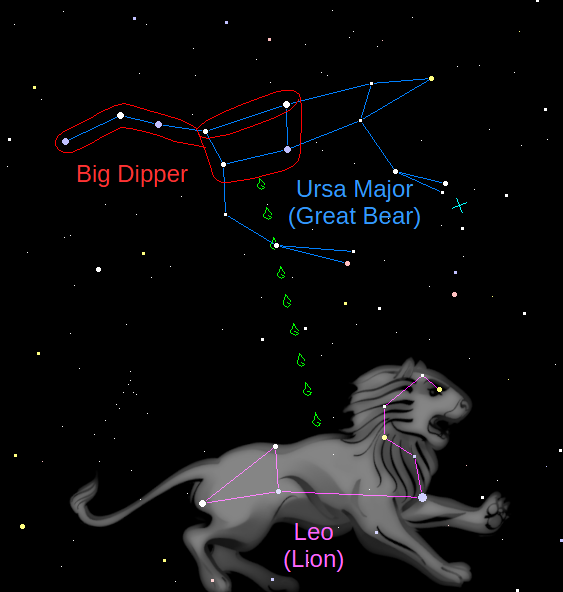
Leaky Big Dipper drips on Leo. The positions in the sky are for 10 pm local time, or about 2 hours after sunset. The little distorted cross at the top of the image marks the zenith. Look high in the east and southeast to see these stars. Created using my LookingUp program, GIMP and LibreOffice.
04/20/2020 – Ephemeris – The Little King Star
This is Ephemeris for Monday, April 20th. Today the Sun will be up for 13 hours and 45 minutes, setting at 8:34, and it will rise tomorrow at 6:47. The Moon, 2 days before new, will rise at 6:37 tomorrow morning.
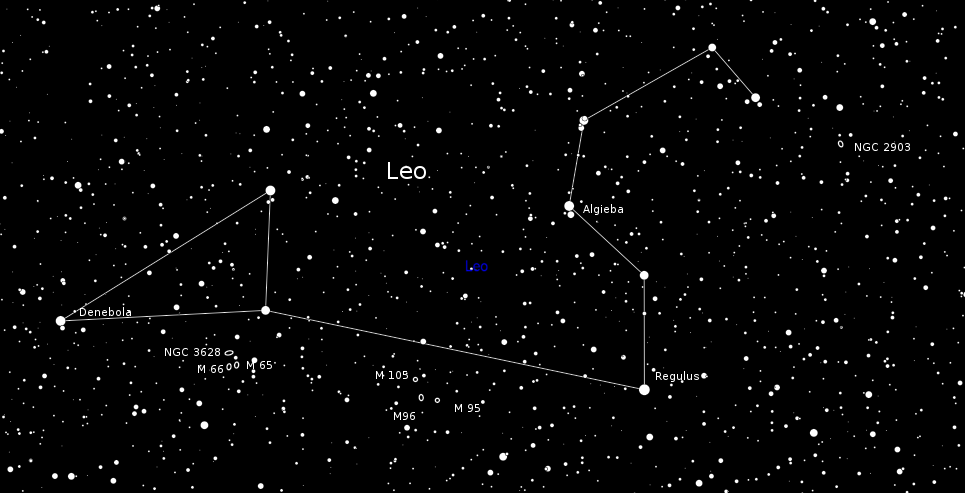
The brightest star in the constellation Leo, which is high in the south these evenings is Regulus, whose name means “Little King”. It is appropriate due to its position in the heart of the king of beasts Leo the lion. Regulus is dead last in brightness of the 21 first magnitude stars, the brightest night-time stars. Even so, it is much brighter than the Sun. It is 79 light years away. The Sun would require a telescope to be spotted at that distance. Regulus appears to be a quadruple star system. The bright star itself is really two stars with a bright star orbited by a much dimmer star every 40 days. There are two dimmer stars much further out that share Regulus’ motion through space. There are an infinite variety of star system arrangements in the galaxy and beyond.
The event times given are for the Traverse City/Interlochen area of Michigan. They may be different for your location.
Addendum
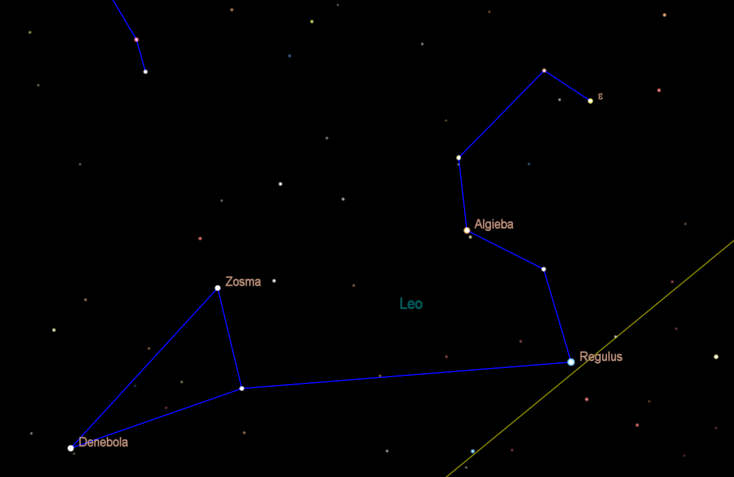
The naked eye stars of Leo, including Regulus at 9:30 p.m. April 20, 2020. Note that Algieba is a binary star that can be seen in small telescopes. The yellow line that passes Regulus is the ecliptic the apparent path of the Sun. The Moon and planets also hang out near that line. Created using Cartes du Ciel (Sky Charts).
04/09/2020 – Ephemeris – How to find the constellation of Leo the lion
This is Ephemeris for Thursday, April 9th. Today the Sun will be up for 13 hours and 12 minutes, setting at 8:21, and it will rise tomorrow at 7:06. The Moon, 2 days past full, will rise at 10:36 this evening.
At 10 p.m. the spring constellation of Leo the lion will be high in the south-southeast. It can be found by locating the Big Dipper high in the northeast and imagining that a hole were drilled in the bowl to let the water leak out. It would drip on the back of this giant cat. The Lion is standing or lying facing westward. His head and mane are seen in the stars as a backwards question mark. This group of stars is also called the sickle. The bright star Regulus is at the bottom, the dot at the bottom of the question mark. A triangle of stars, to the left of Regulus, is the lion’s haunches. Leo contains some nice galaxies visible in moderate sized telescopes. The stars in Leo’s part of the sky are fewer than those in the winter sky.
The event times given are for the Traverse City/Interlochen area of Michigan. They may be different for your location.
Addendum
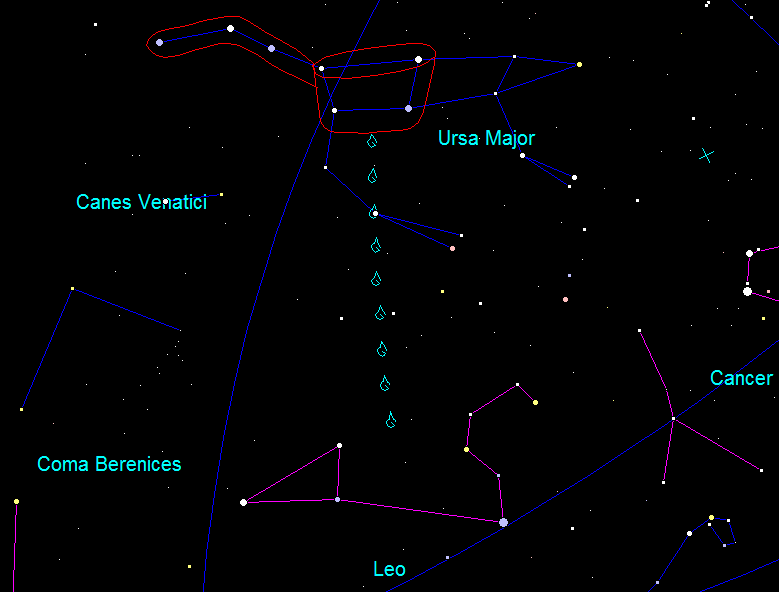
Leaky Big Dipper drips on Leo. Created using my LookingUp program.
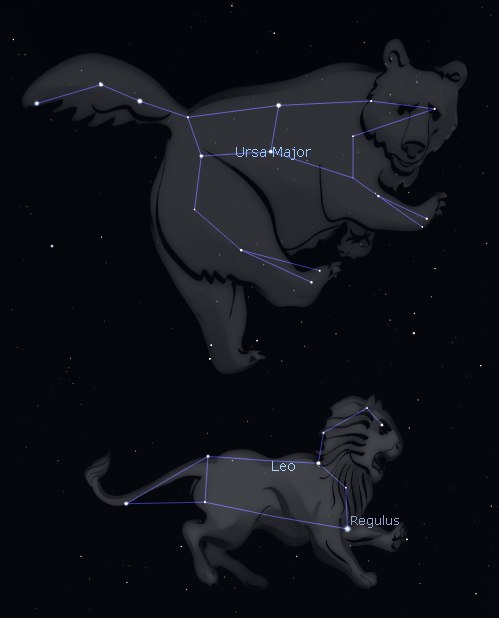
Ursa Major with the Big Dipper in her hind end and Leo. Created using Stellarium and GIMP.
03/13/2015 – Ephemeris – Leo rising
Ephemeris for Friday, March 13th. The Sun will rise at 7:59. It’ll be up for 11 hours and 46 minutes, setting at 7:46. The Moon, at last quarter today, will rise at 3:35 tomorrow morning.
The constellation Leo the lion is now rising in the east at 9 pm. It’s below and left of the Big Dipper higher up in the east-northeast. Leo is marked by two sets of easily recognizable stars. The front of him is a backward question mark of stars, also known as the Sickle that mark his head and mane, along with the front part of his body. Regulus is the star at the bottom of that backwards question mark. It’s the Little King Star. Jupiter this year is above right if it. The hind end of him is a triangle of stars ending with another bright star, but not as bright as Regulus. It’s Denebola which means Lion’s tail. It is thought when the sun was in this constellation long ago that the lions were driven by the heat to quench their thirst in the Nile river. Ancients physicians thought medicines were poison when the sun was here too.
Times are for the Traverse City/Interlochen area of Michigan. They may be different for your location.
Addendum
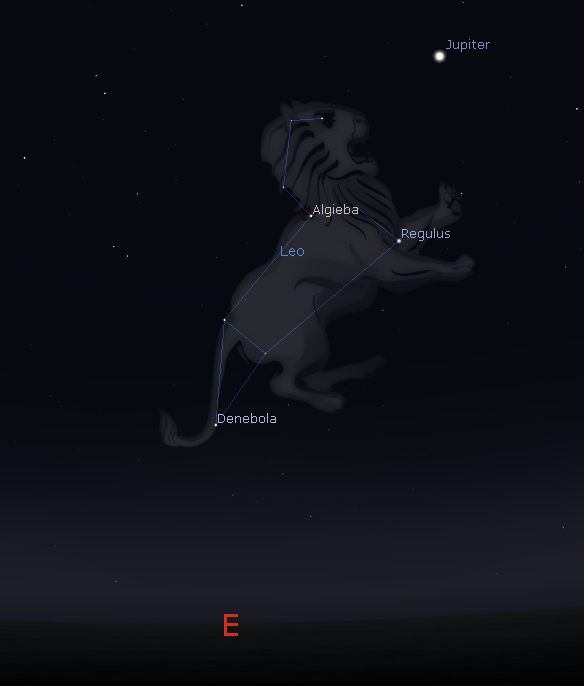
Leo rising in the east behind Jupiter at 9 p.m. on March 13, 2015. Created using Stellarium.
05/06/2013 – Ephemeris – The Constellation Leo the Lion and its meaning to the ancients
Ephemeris for Monday, May 6th. The sun rises at 6:25. It’ll be up for 14 hours and 28 minutes, setting at 8:53. The moon, 3 days before new, will rise at 5:03 tomorrow morning.
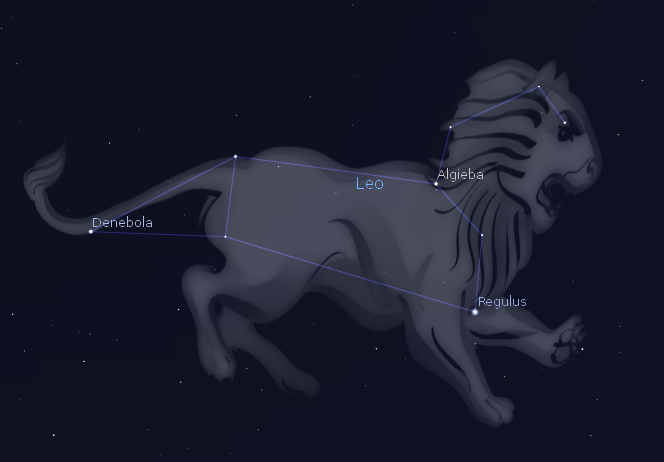
Leo the lion’s image as displayed by Stellarium for May 6, at 10 p.m. due south.
The constellation of Leo the lion is seen in the south at 10:30 p.m. Regulus lies at the bottom of a backwards question mark of stars that are his head and mane. This backwards question mark is also known as the asterism or informal constellation of the Sickle. To the left of the Sickle is a triangle of stars that are his haunches. As the lion is the king of beasts it is fitting that its brightest star Regulus means “Little King Star”. It was thought in ancient Egypt that the heat of summer, when the sun was in Leo drove the lions to drink the waters of the Nile. The lion was also the symbol of the Israelite tribe of Judah, from Jacob’s prophesy in Genesis, and as such may have played a part in the origin of the Star of Bethlehem.
Times are for the Traverse City/Interlochen area of Michigan. They may be different for your location.
04/08/2013 – Ephemeris – The constellation Leo the lion
Ephemeris for Monday, April 8th. The sun will rise at 7:10. It’ll be up for 13 hours and 8 minutes, setting at 8:18. The moon, 2 days before new, will rise at 6:32 tomorrow morning.
Besides the advancing sunset times and warming temperatures, there’s another sign that spring is here. That’s the appearance of the constellation Leo the lion high in the southeast in the evening. The front of this beast is a backward question mark of stars with the bright star Regulus as the dot at the bottom. That’s his head, mane and chest. His haunches are a triangle of stars to the left, This year the planet Saturn is to the left of the Regulus. A way to find Leo is to remember that cat’s aren’t supposed to like water. Find the Big Dipper high in the northeast and imagine drilling a hole in the bottom of the bowl. The water will fall on Leo’s back. Also you’ll notice the stars of spring to the east are more sparse than those of winter to the west.
Times are for the Traverse City/Interlochen area of Michigan. They may be different for your location.
Addendum
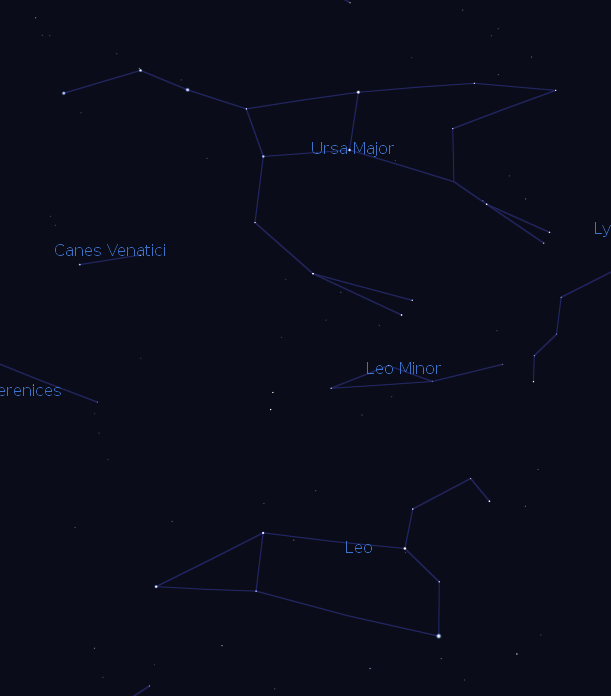
Leo and Ursa Major (Big Dipper) for 10 pm on April 8, 2013. Created using Stellarium.
 Bob Moler's Ephemeris Blog