Archive
08/28/2014 – Ephemeris – The evening Moon will stay low in the sky for the next couple of weeks.
Ephemeris for Thursday, August 28th. The sun will rise at 7:00. It’ll be up for 13 hours and 25 minutes, setting at 8:26. The moon, 3 days past new, will set at 9:40 this evening.
Since we’re within a month of the autumnal equinox, coming up on September 22nd, something funny is happening with the Moon rise and set times near both new and full moon. That is they aren’t changing very much. Here we are with the Moon three days old, and it still sets before the end of astronomical twilight. You may notice that for the next two weeks, that the Moon doesn’t get very high in the sky in the early evening. It’s path stays close to the horizon. Around first quarter next Tuesday the Moon will get to be just a little higher in the sky than the sun does on the first day of winter. The next full moon is the Harvest Moon, being the full moon closest to the first day of autumn. Then the day-to-day succession of rise times again will slow.
Times are for the Traverse City/Interlochen area of Michigan. They may be different for your location.
Addendum
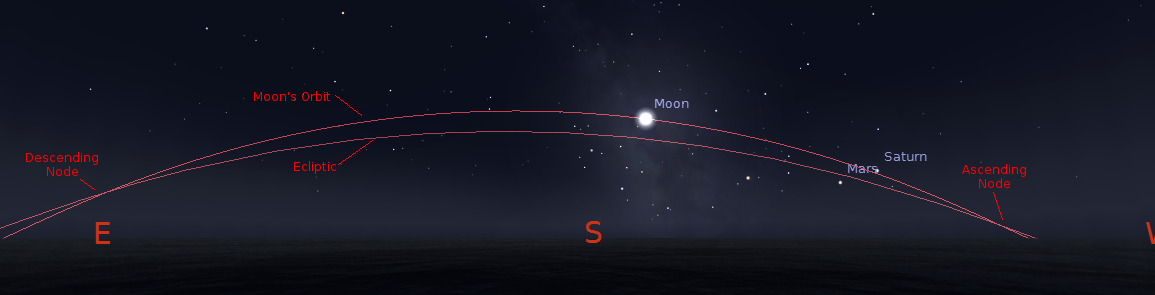
The Moon on September 3, 2014 a day after first quarter. It will rise higher after that if one stays up long enough. Created using Stellarium. Click on image to enlarge.
In the image above the Moon’s orbit is compared to the ecliptic, the plane of the Earth’s orbit to which it’s inclined by about 5º. Note the two points where these lines cross. The point where the Moon’s orbit crosses the ecliptic heading northward is called the ascending node. The crossing point heading southward is the descending node. The important thing about that is the when the moon passes a node while at new or full, an eclipse will occur, which they will do in October. There will be a total lunar eclipse on the morning of October 8th, then a partial solar eclipse on October 23rd as the sun is setting here in northern Michigan. I’ll have more information as the events gets closer.
04/14/2014 – Ephemeris – The total lunar eclipse is tonight after midnight.
Updated 4 p.m. EDT: See bottom of the post.
Ephemeris for Monday, April 14th. The sun will rise at 7:00. It’ll be up for 13 hours and 26 minutes, setting at 8:26. The Moon, 1 day before full, will set at 7:05 tomorrow morning.
We’re hoping for clear skies for tonight’s total lunar eclipse. Actually it’s in the wee hours of tomorrow morning. So if you’re a night owl, stay up tonight or otherwise catch all or part of it by setting your alarm clock. Here’s the timings: The partial phase begins as the Moon enters the earth’s inner shadow at 1:58 a.m. Totality starts at 3:06 a.m. Totality will last until 4:24,when the upper left edge of the moon again peeks into sunlight. The ending partial phase will end at 5:33 a.m. If it’s clear or at least partly cloudy there are two locations in the Grand Traverse area to view the eclipse, other than your own back yard, which is perfectly acceptable. The first is the NMC Rogers Observatory, and the other is the Dune Climb parking lot at Sleeping Bear Dunes.
Times are for the Traverse City/Interlochen area of Michigan. They may be different for your location.
Addendum
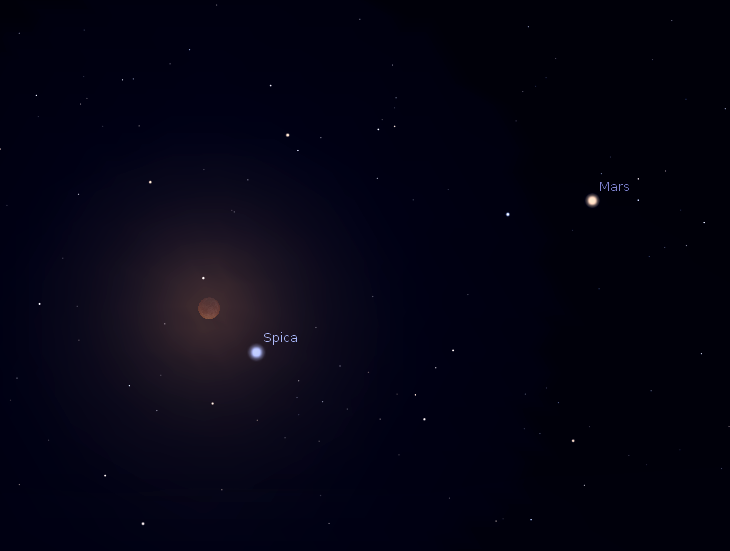
The April 15, 2014 lunar eclipse simulated by Stellarium. Note that Mars and the star Spica will be nearby.
As of 24 hours before the eclipse the weather prospects don’t look good for northwestern lower Michigan or all the east coast for that matter. We’re on the edge of the clouds. The western shore Lake Michigan and parts of the U.P. may be clear. But things could change.
There will be a live webcast from University of Georgia at http://www.ccssc.org/webcast.html, who may be stuck with the same overcast we may have. Hat Tip to Spaceweather.com
There is also another live stream of the eclipse from Griffith Observatory in Los Angeles. Or go to http://www.griffithobservatory.org and click on the Griffith TV button. Coverage starts at 9:45 PDT or 12:45 a.m. EDT which is a bit more than an hour before the partial phase of the eclipse starts. Hat Tip to Carla Johns of the NASA Museum Alliance for the links.
Here’s a link to the official NASA eclipse website for this eclipse.
Here’s a link to my in-depth discussion of the April 15, 2014 eclipse.
Update
Here’s another link to a live feed of the eclipse: Virtual Telescope Project.
Universe Today has more links.
The Sleeping Bear eclipse viewing has been canceled.
04/11/2014 – Ephemeris – Get ready for Tuesday’s total lunar eclipse
Ephemeris for Friday, April 11th. The sun will rise at 7:05. It’ll be up for 13 hours and 17 minutes, setting at 8:22. The Moon, half way from first quarter to full, will set at 5:36 tomorrow morning.
Next Tuesday morning’s total eclipse of the moon is the first we’ve seen for several years. The partial phase begins as the Moon enters the earth’s inner shadow at 1:58 a.m. Totality starts at 3:06 a.m. The entire Moon should be a red or orange color. The depth of color will slowly change during totality until 4:24, when totality ends and the upper left edge of the moon again peeks into sunlight. The ending partial eclipse will end at 5:33 a.m. If it’s clear or at least partly cloudy there are two locations in the Grand Traverse area to view the eclipse, other than your own back yard, which is perfectly acceptable. The first is the NMC Rogers Observatory, and the other is the Dune Climb parking lot at Sleeping Bear Dunes.
Times are for the Traverse City/Interlochen area of Michigan. They may be different for your location.
Addendum

Something like what Tuesday’s eclipse will look like from the eastern US. Total lunar eclipse in Egypt. Photo credit: Sean Bagshaw from sservi.nasa.gov.
In a composite photo like this the Earth’s rotation is carrying the moon westward (right) toward setting, while the Moon’s orbital motion is carrying it toward the east (left) more slowly through the Earth’s shadow. This appears to be a real composite. Morning twilight would approach from the opposite side of the sky.
04/10/2014 – Ephemeris – Get ready for the April 15, 2014 total lunar eclipse
Ephemeris for Thursday, April 10th. The sun will rise at 7:07. It’ll be up for 13 hours and 14 minutes, setting at 8:21. The Moon, 3 days past first quarter, will set at 5:09 tomorrow morning.
Next Tuesday morning we’re in for a treat as the Moon enters the Earth’s shadow producing a total lunar eclipse. The eclipse will be a challenge especially if you wait for April 15th to do your taxes. Next Tuesday is tax deadline day, and the eclipse will happen is the wee hours of that morning. You don’t have to watch the whole thing, but I will if it’s clear. The partial phase begins as the Moon enters the earth’s inner shadow at 1:58 a.m. Totality starts at 3:06 a.m. The entire Moon should be a red or orange color. The depth of color will slowly change during totality until 4:24, when totality ends and the upper left edge of the moon again peeks into sunlight. The ending partial eclipse will end at 5:33 a.m.
Times are for the Traverse City/Interlochen area of Michigan. They may be different for your location.
Addendum

How a lunar eclipse happens. Credit spaceplace.nasa.gov
The outer shadow is the Earth’s penumbra which gradually darkens from the outside edge to the umbra, the Earth’s inner shadow. It’s been my experience that it isn’t noticeable until about a half hour before the partial phase starts, when the Moon starts to dip into the umbra.
Here’s a link to the official NASA eclipse website for this eclipse.Here’s a link to my in-depth discussion of the April 15, 2014 eclipse.
Tax Day Eclipse – April 15, 2014
From the April 2014 Stellar Sentinel, the newsletter of the Grand Traverse Astronomical Society
If you stay up April 14th or get up early on April 15th to watch the total lunar eclipse that morning, make sure your taxes are done, because you might not be good for much of anything during the day on the 15th.
That being said, let’s take a look at the what and where of the eclipse. Lunar eclipses only occur at full moon. The Sun, Earth and Moon have to line up so the the Earth casts its shadow on the Moon. This occurs in about one in six full moons. Below is the Moon and the earth’s shadow at the March full moon.
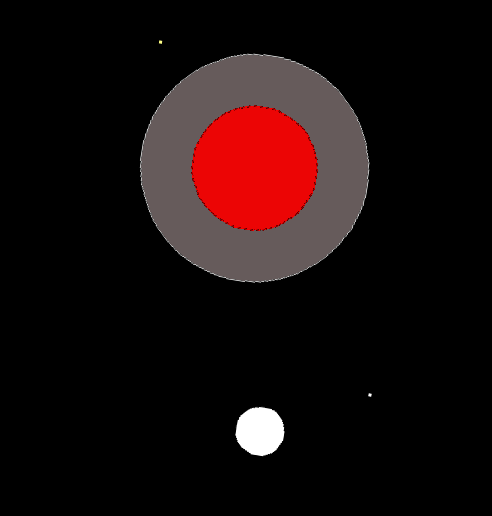
On March 16, 2014 the full Moon missed the Earth’s shadow, so no eclipse was seen. Created using Cartes duCiel.
In the illustration above the “bulls-eye” is the Earth’s shadow as it would appear at the Moon’s distance. The outer gray circle represents the Earth’s penumbra, where the sun’s light is increasingly blocked by the earth. The umbra (in red for emailed PDF versions of this newsletter) is the Earth’s inner shadow where no direct sunlight enters. When the Moon enters the umbra the partial phase of the eclipse begins. When the Moon is entirely within the umbra the Moon will be totally eclipsed. The Moon back on March 16th missed the earth’s shadow by passing several degrees south of it. When the moon is in the umbra it is still dimly lit indirectly to some degree by the combined rays of the sun that are refracted through Earth’s from all the accumulated sunrises and sunsets occurring around the Earth at that time. Back in 1967 the robotic lunar soft lander Surveyor 3 was able to take some images of the earth during a lunar eclipse. For Surveyor this was a solar eclipse and illustrated the light being refracted around the earth.
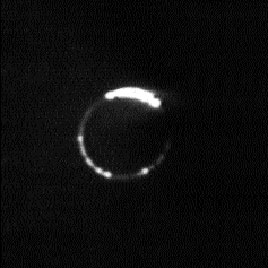
Solar eclipse by the Earth as viewed by Surveyor 3, April 24, 1967. Credit: NASA
The current Chinese Chang’e 3, should it survive one more lunar night, has a chance to take a better quality photograph of the eclipsed Sun this April 15th if its camera can tilt far up enough.
The light that illuminates the Moon in the Earth’s umbra is generally red in color, though the edge of the umbra generally has a gray cast to it. The light level is so low in the umbra, that, to the naked eye, it appears that the Moon is indeed being eaten by something invisible as the ingress partial phase progresses. About three quarters the way in the color of the umbra can be perceived even to the naked eye.
There are exceptions. Two notable lunar eclipse of this person’s memory occurred in 1982. On July 6, 1982 the early morning eclipse when the Moon passed centrally through the umbra the Moon was unevenly lit. The top or northern half was much darker than the southern half. In late March and early April that year the El Chichón volcano erupted in southern Mexico sending 20 million metric tons of ash high into the stratosphere. Apparently it masked the light from the northern hemisphere making it into the earth’s shadow. That year’s December 30th lunar eclipse was exceptionally dark. In fact during totality one had to hunt to find the Moon at all with the naked eye.
The events of the April 15th eclipse
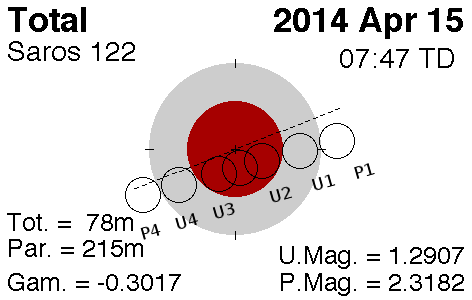
The Moon travels through the Earth’s shadow from right to left. What are seen are points of contact with the shadow and mid-eclipse. From Five Millennium Canon of Lunar Eclipses (Espenak & Meeus) NASA.
Contact times are labeled P1, U1, U2, U3, U4, and P4. P2 and P3 are omitted because they are synonymous with U2 and U3 respectively:
P1 – 12:53:37 a.m. Enter the penumbra (unseen). By about 1:30 the duskiness on the left edge of the Moon will start to be pronounced.
U1 – 1:58:19 a.m. Enter the umbra (partial eclipse begins).
U2 – 3:06:47 a.m. Totality begins.
Mid eclipse 3:49:40 a.m.
U3 – 4:24:35 a.m. Totality ends, egress partial phase begins.
U4 – 5:33:04 a.m. Partial phase ends. The Moon’s upper right edge should appear dusky for the next half hour or so.
P4 – 6:37:37 a.m. Penumbral phase ends (unseen).
Note: The duskiness of the penumbral phase of the eclipse can be enhanced by viewing through sunglasses.
Weather permitting there will be two Grand Traverse Astronomical Society venues to view this eclipse. The first will be the NMC Rogers Observatory. The second will be at the Sleeping Bear Dunes National Lakeshore in the Dune Climb parking lot on M109. Both start at 1:30 a.m. if it’s clear.
Note: All times are Eastern Daylight Time. For locations other than Northwestern Lower Michigan, check with your local astronomy club. However this is a perfect event to be viewed from one’s back yard. No optical aid is required.
Correction: The U2 timing was incorrectly stated in the original post.
03/31/2014 – Ephemeris – Previewing April skies
Ephemeris for Monday, March 31st. The sun will rise at 7:25. It’ll be up for 12 hours and 43 minutes, setting at 8:08. The moon, 1 day past new, will set at 9:30 this evening.
The 4th month of the year begins tomorrow. Daylight hours in the Interlochen/Traverse City area and will increase from 12 hours and 46 minutes tomorrow to 14 hours 11 minutes on April 30th. The altitude, or angle, of the sun above the southern horizon at local noon will be 50 degrees tomorrow and will ascend to 60 degrees on April 30th. The altitude of the sun in the Straits area will be a degree lower. The actual time of local apparent noon this month for the Interlochen/Traverse City area, when the sun passes due south, will be about 1:43 p.m. The big event for this month will be a total lunar eclipse visible from our area in the wee hours of the morning on April 15th. It’s the first or two lunar eclipses visible from here this year. The other is in October.
Times are for the Traverse City/Interlochen area of Michigan. They may be different for your location.
Addendum
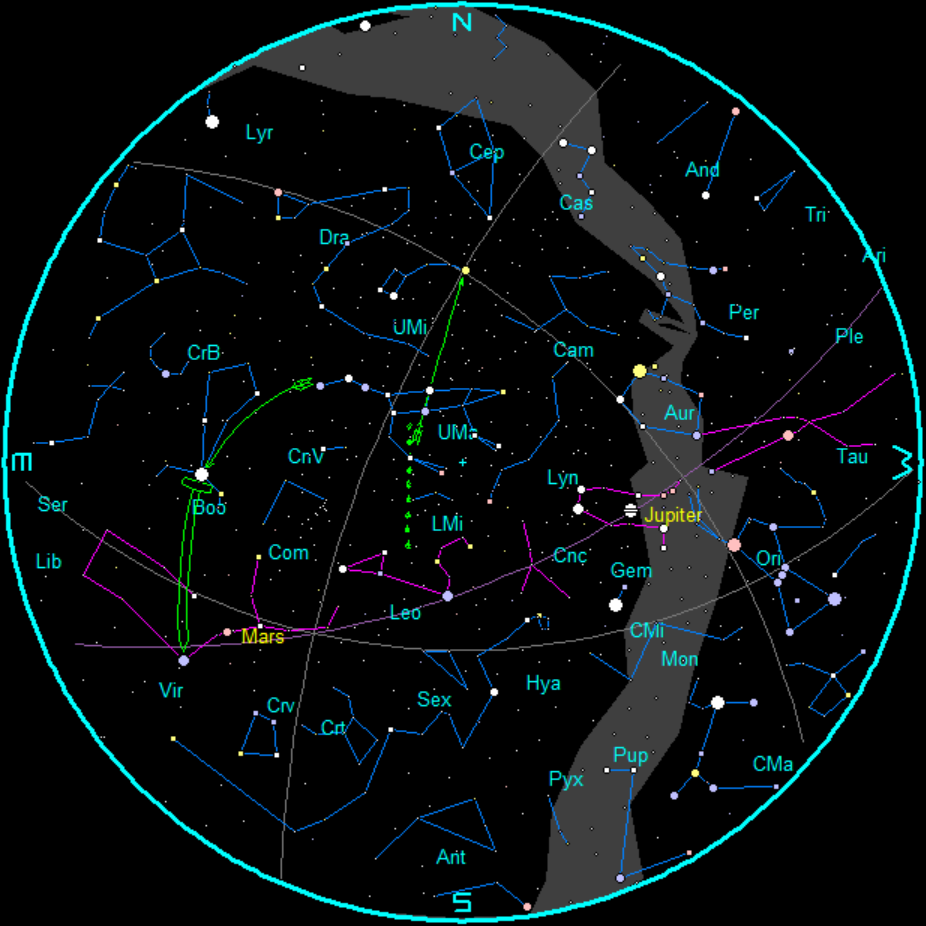
Star Chart for mid-month for April 2014 at 10 p.m. Credit: Bob Moler.
Add a half hour to every week before the 15th and subtract and hour for every week after the 15th.
For a list of constellation names to go with the abbreviations click here.
01/06/2014 – Ephemeris – It will be a year of eclipses for northern Michigan!
Ephemeris for Monday, January 6th. The sun will rise at 8:19. It’ll be up for 8 hours and 58 minutes, setting at 5:18. The moon, 1 day before first quarter, will set at 12:07 tomorrow morning.
The year 2014 will be a year of eclipses. World wide it will have the minimal number of eclipses possible, four. However, lucky us, we will see three of them if it’s clear, that is. The first is a total eclipse of the moon in the wee morning of Tax Day, April 15th. It will be the best of the three because we will see it from beginning to end. On October 8th we will have another lunar eclipse is the morning. This one will start closer to dawn, so the kids can see this one by getting up early. The total phase will be visible, but the moon will set as the moon is leaving the earth’s shadow. The last will be a partial solar eclipse on October 23rd. when the eclipse will be interrupted by sunset.
Times are for the Traverse City/Interlochen area of Michigan. They may be different for your location.
Addendum
My Article in January’s Stellar Sentinel, the newsletter of the Grand Traverse Astronomical Society.
After a drought in visible eclipses seen from our part of the planet last year and a single partial solar eclipse the year before, we have a chance, weather permitting, to view two total lunar eclipses and the first half of a partial solar eclipse this year. OK, we did have a penumbral lunar eclipse last year, but I usually don’t count penumbral eclipses, since the casual observer may look at the moon and not know they are occurring. They’re what I call a 5 o’clock shadow eclipse, where parts of the moon are illuminated by a partially blocked sun. There is no obvious dragon or Cookie Monster nibbling at the moon.
Eclipse Seasons
In 2014 the two eclipse seasons are in April and again in October. These are about six months apart centered around the moon’s ascending and descending nodes, where the plane of the Moon’s orbit crosses the Earth’s orbital plane when the new moon’s shadow can fall upon the earth and the earth’s shadow can fall on the full moon.
The line of nodes regresses westward or clockwise slowly in an 18.6 year period. That means that the eclipse seasons slowly move backward through the calendar. Every time the sun passes a node there are either two or rarely, three eclipses. Either one each of lunar and solar separated by two weeks from the other. Or, rarely, a central eclipse with 2 weeks before and two weeks later a very partial eclipse near the poles in the case of solar eclipses or penumbral eclipses in the case of lunar eclipses. 2014 is a year of two total lunar eclipses and two partial solar eclipses near the poles.
Saros
A means of predicting eclipses was developed by the Chaldeans in what is now Iraq some centuries before the common era (BC or BCE). The Greeks learned of it. Hipparchus and Ptolemy knew of it. Solar and lunar eclipses repeat every 18 years 11 1/3 days. This cycle was called the Saros by Sir Edmund Halley of Halley’s Comet fame, then Astronomer Royal in England.
The saros is the near coincidence of 3 lunar “months”: the Synodic Month, or lunation the period between new moons; the Draconic Month, the period between the moon’s passage of the ascending node of its orbit as explained above; and the Anomalistic Month, the period between passages of the moon through perigee, the closest point in its orbit to the earth.
The synodic month is on average 29.530589 days, and the basis for the Jewish and Islamic lunar calendars.
The draconic month is 27.212220 days long on average. The ascending node regresses westward, so meets the moon, traveling eastward than the synodic month, where it has to catch up with the eastward moving sun. Remember the dragon eating the sun image from above. The ancients thought a dragon lived at the nodes to devour the Sun or Moon in eclipses. The symbol for the ascending node: is called the Dragon’s Head. For the descending node the symbol is inverted and called the Dragon’s Tail. These symbols may be seen on orbital diagrams.
The anomalistic month is 27.554551 days. In celestial mechanics an anomaly doesn’t means anything is wrong, it’s the angle between, in the case of the moon, the perigee of its orbit and the position of the moon as seen from the earth. It has to do with the perigee and that’s why it’s used.
It turns out that:
223 Synodic Months = 6585.322 days
242 Draconic Months = 6585.8 days
239 Anomalistic months = 6585.5 days
Thus the Saros cycle is 6585.322 days long, or 18 years 11 1/3 days, meaning that the next eclipse of that Saros occurs a third of the earth in longitude west of the previous eclipse. It takes three saros cycles for an eclipse to repeat near the same longitude. For instance, my first total solar eclipse was viewed from Quebec on July 20, 1963. The third Saros of that eclipse will occur on August 21, 2017. I expect to be around to see that, my 5th total solar eclipse. The path will shift southward and be seen across the continental United States.
There are something like 40 Saros cycles active at one time. Eclipses at the descending node head southward each eclipse, while those at the ascending node move northward.
The Eclipses of 2014
Here are the dates of the eclipses:
Total Lunar Eclipse April 15, 2014
Total Lunar Eclipse October 8, 2014
Partial Solar Eclipse October 23, 2014
Interestingly, all these eclipses will occur in the western part of the sky for us in northern Michigan. Both October eclipses will end with the eclipsed body setting before the official end of the eclipse. This means that both lunar eclipses are early morning eclipses and the solar eclipse will be a late afternoon eclipse.
Lunar eclipses start and end with the moon traveling through the earth’s penumbral shadow. It’s been my experience that this shadow only becomes visible in the half hour before and after the partial phases of the eclipse. The partial phase of the Tuesday April 15th lunar eclipse will start at 1:58 a.m., totality starts at 3:06 and ends at 4:24; with the partial phase ending at 5:33 as twilight begins to brighten.
The Wednesday October 8th lunar eclipse will start later in the morning. The partial phase will start at 5:14 a.m. Totality will run from 6:25 to 7:24 a.m. all in the growing morning twilight. Sunrise and moonset will interrupt the eclipse by 7:57.
The partial solar eclipse is on Thursday October 23. The eclipse will begin around 5:33 p.m. for Traverse City with sunset at 6:44. Times and whether the eclipse is visible at all depend on the location of the observer.
NASA diagrams, maps, and more information on these eclipses can be found here.
The Death of Herod the Great – Dating of the Star of Bethlehem
Note: This is from an article I wrote for the Grand Traverse Astronomical Society’s December 2012 newsletter The Stellar Sentinel.
I’m preparing for my biennial talk In Search of the Star of Bethlehem. In recent years I’ve been intrigued with the date of King Herod the Great’s death. Because it constrains the time of Christ’s birth since he was born near the end of King Herod’s reign according to the Gospel of Luke.
Late first century Jewish historian Flavius is the only source we have for the date of Herod’s death. Josephus was an interesting fellow. He was born Yosef ben Matityahu, a Jew. He fought against the Romans in A.D. 67, and was captured. He served as an interpreter for the Romans and was given Roman Citizenship.
In the 17th volume of his Antiquities of the Jews Josephus relates the events between a lunar eclipse and Passover the period in which Herod the Great died.
The favorite lunar eclipse over the years for this was a slight partial eclipse in March 13th of 4 B.C. The reason for this date is probably the possible discrepancy in the start of our current calendar numbering A.D. or C.E. This calendar numbering was promulgated by Dennis the Short in what would become the 6th century. There was a common thought that old Dennis was 8 years off, and that A.D. 1 was 8 years earlier than he thought. The hard thing about calculating the chronological eras was that there wasn’t just one. There were many. Trying to synchronize these is a daunting task.
The problem with the 4 B.C. eclipse is that there was only one lunar month between that eclipse and Passover which begins on the day of the full moon. And Josephus records many events between that eclipse and Passover.
If we believe many ancient sources writing close to the to the time of Christ’s birth, his date of birth would have been around 3 or 2 BC., which puts the 4 B.C. Death of Herod too soon. I was never wild about the 4 B.C. Eclipse for another reason, the eclipse was a slight partial eclipse occurring in the morning. Eclipse calculations were capable of predicting that eclipse, but it would have not have been very noticeable to the population.
The next lunar eclipse occurred on January 10 of 1 B.C. It was a total lunar eclipse that was seen most of the night. There were 3 lunar months between that eclipse and Passover that year. Plenty of time for all of Herod’s final activities.
According to Josephus the Eclipse was mentioned in connection with the burning alive of a fellow named Matthias and his companions for sedition.
Herod became very ill, as described in rather excessive detail by Josephus. His doctors suggested that he go to the baths at Callirrhoe. He took their advise and crossed the Jordan river. Note at this tome Herod resided in Jericho. As of this writing, I have not been able to find the location of Callirrhoe. It’s in present day Jordan near the Dead Sea. It could have been 20 or so miles from Jericho. There is a current day hot springs at Hammamat Ma’een which is a tourist attraction, but I so far haven’t found Callirrhoe whose waters run into the Dead Sea or Lake Asphaltites. The trips to and from Callirrhoe would have been slow carrying the sick King.
Knowing he was close to death he decreed a bonus of 50 Drachmas to his soldiers and another bonus to his commanders and friends. He then returned to Jericho. He had his minions draft and send letters to all the important Jewish men to come to Jericho under pain of death. He calculated, perhaps rightly that they would not mourn him when he died, so he would keep them at the hippodrome (racetrack) and when word of his passing be made known, have his archers slay all that were gathered there.
Herod then received a message from Caesar as to the verdict on son Antipater’s trial for plotting to kill Herod. It was left to Herod to decide what was to be done with him, until then Herod had him under arrest. Herod was feeling very ill and while paring an apple for himself, which he normally did, decided to commit suicide but was prevented at the last instant by his cousin who let out a loud scream. Those outside thought that Herod had died. Antipater heard and tried to convince his jailer to let him out to claim the throne. The jailer refused and told Herod. Upon the news Herod had Antipater executed immediately.
Herod then changed his will, giving his kingdom to his son Archclaus and died five days after having Antipater executed. Herod’s sister Salome and her husband Alexas allowed those kept at the Hippodrome to be released to return to their own lands before the news of Herod’s death became known. Herod was prepared for burial and a large funeral procession of soldiers, followed by 500 domestics carrying spices moved out two miles to Herodium, where he was buried.
Archclaus, though greeted with great acclaim at first angered the people. Archclaus then wanted to plead his case before Caesar and have himself made king. Sometime after this Josephus mentions the feast of Passover.
In my perusals of sources mentioning the people in the above recounting, 4 B.C. appears to be the generally accepted year of Herod and Antipater’s deaths. This gives only 29 days for the drama above to take place. The better eclipse of 1 B.C. Has nearly 90 days for it to take place.
This is why I have come to accept the January 10, 1 B.C. lunar eclipse mentioned by Josephus, and that the two conjunctions of Venus and Jupiter in 3 and 2 B.C. were the Star of Bethlehem that the Magi saw.
12/09/11 – Ephemeris – Glimpse a piece of a lunar eclipse tomorrow morning
Friday, December 9th. The sun will rise at 8:07. It’ll be up for 8 hours and 55 minutes, setting at 5:02, the earliest sunset of the year. The moon, 1 day before full, will set at 8:08 tomorrow morning.
There will be an eclipse of the moon tomorrow, however we will get a chance to spot the very beginning of the partial phase. The eclipse will be best seen in the western United States, Australia and most of Asia. The partial phase starts at 7:46 a.m. with the moon low in the west northwest. The sun will rise about the time the moon will set. That will occur at 8:09 a.m., give or take a few minutes depending where you are in northern Michigan. It will have to be really crystal clear to see this at all. Next year we’ll see the tail end of an eclipse of the sun as it sets on May 20th. And we’ll see partial eclipse of the moon on June 4th. The next evening we’ll have the rare transit of Venus which won’t reoccur for over 100 years.
* Times, as always are for the Traverse City/Interlochen area of Michigan.
Addendum
More Information here: http://eclipse.gsfc.nasa.gov/OH/OHfigures/OH2011-Fig06.pdf
Update
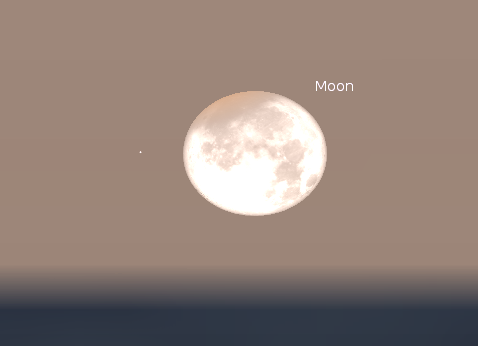
Lunar Eclipse at 8 a.m. December 10, 2011. Created using Stellarium.
06/15/11 – Ephemeris – The bright planets for this week and a Lunar Eclipse
Wednesday, June 15th. Today the sun will be up for 15 hours and 32 minutes, setting at 9:29. The moon, at full today, will rise at 9:35 this evening. Tomorrow the sun will rise at 5:56.
It’s Wednesday and time again to take a look at the whereabouts of the bright planets. The ringed planet Saturn will be visible in the south southwest as it gets dark. It’s near the bright star Spica to its lower left. Spica has a blue tinge, while Saturn is yellowish. It will set at 2:44 a.m. Saturn is a wonderful sight is a telescope with its rings. Jupiter will rise at 3:19 a.m. in the east. Mars will rise at 4:19. Venus now rises too close to sunrise to be seen in the twilight as is Mercury. There will be a total lunar eclipse this afternoon our time, making it completely invisible from here. However it will be perfectly visible from Asia where among others my grandson Chris is serving as a Marine. I’ve emailed him the times which are also available on the Ephemeris Blog.
* Times are for the Traverse City/Interlochen area of Michigan. They may be different for your location.
Addendum
Here’s the poop on the Total Lunar Eclipse on the night of the 15th-16th.
I’m giving the timings in both Universal Time (UT), also known as Greenwich Mean Time (GMT) or Zulu and Afghanistan Standard Time (AST) (UT+4.5 hours).
Event                             UT            AST
Partial Eclipse Starts        15th 18:22     15th 22:52
Total Phase Starts            15th 19:22     15th 23:52
Total Phase Ends              15th 21:03     16th 01:33
Partial Eclipse Ends          15th 02:02     16th 02:32
The moon will enter the earth’s shadow from right to left.
During the total phase of the eclipse (we call it totality), the moon will probably appear red in color with gray near the edge of the earth’s shadow.
If you were on the moon, looking back at the earth at maximum eclipse the earth will appear as a red ring, the total of all the sunrises and sunsets around the earth.
 Bob Moler's Ephemeris Blog