Archive
Ephemeris: 04/18/2024 – Looking at the gibbous Moon tonight
This is Ephemeris for Thursday, April 18th. Today the Sun will be up for 13 hours and 39 minutes, setting at 8:32, and it will rise tomorrow at 6:50. The Moon, 3 days past first quarter, will set at 5:23 tomorrow morning.
At 10 tonight the gibbous moon will be bright. At the moon’s left edge, just coming into sunlight will be what looks like a large half crater at the edge of the lunar sea called Mare Imbrium, the Sea of Showers. That feature is Sinus Iridium, or Bay of Rainbows. The arc of its mountainous edge is rainbow shaped, but it is as colorless as the rest of the Moon. The crater Copernicus, left of the Moon’s center sports few shadows and appears mostly as a bright spot surrounded by its ray system of ejecta craters that appear bright when the sun is high in their sky. At the south end of the Moon are the lunar highlands, bright, rugged and covered by large, mostly very old craters. The largest of these craters is Clavius, named for Christophorus Clavius who helped establish our Gregorian Calendar.
The astronomical event times given are for the Traverse City/Interlochen area of Michigan (EDT, UT–4 hours). They may be different for your location.
Addendum
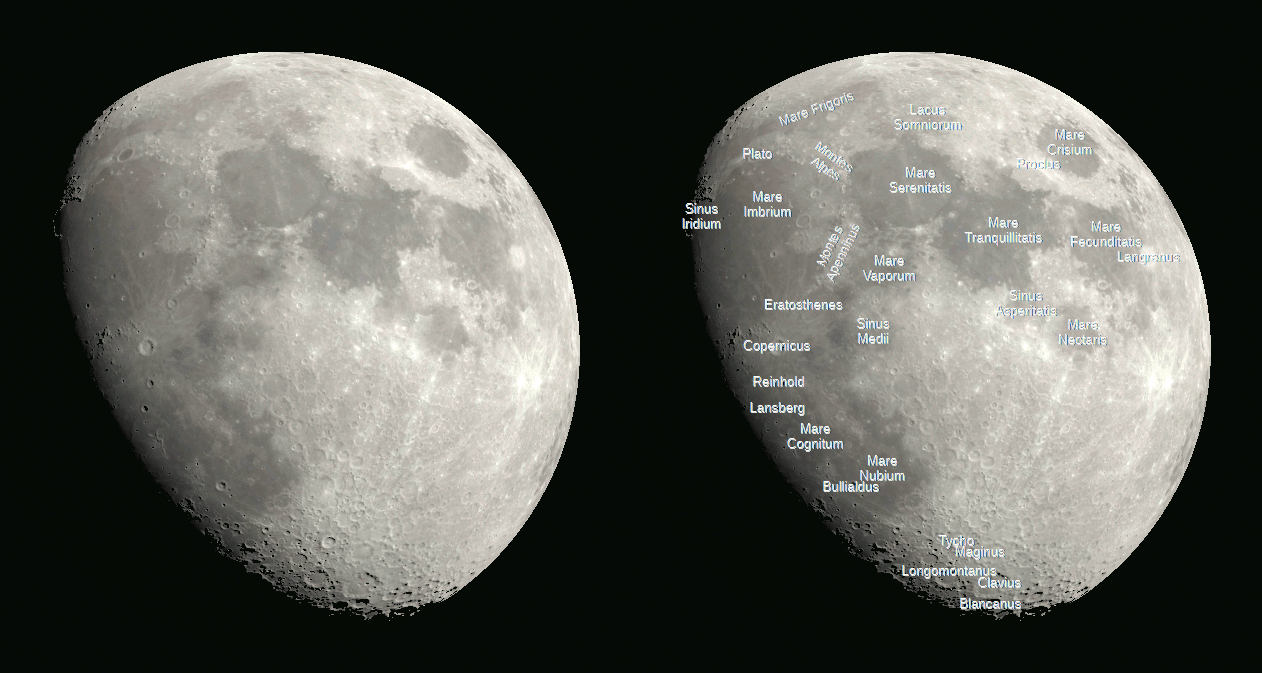
Translations of some lunar feature names according to Virtual Moon Atlas
Lacus Somniorum – Lake of Dreams
Mare Crisium – Sea of Crises
Mare Fecunditatis – Sea of Fertility
Mare Frigoris – Sea of Cold
Mare Imbrium – Sea of Showers
Mare Nectaris – Sea of Nectar
Mare Nubium – Sea of Clouds
Mare Serenitatis – Sea of Serenity
Mare Tranquillitatis – Sea of Tranquility
Mare Vaporum – Sea of Vapors
Montes Alpes – Alps Mountains
Montes Apenninus – Apennines Mountains
Sinus Asperitatis – Bay of Roughness
Sinus Iridium – Bay of Rainbows
Sinus Medii – Bay of the Center
Craters are generally named after astronomers, people of science, or explorers and are often Latinized.
Note that Mare is pronounced Mar-é.
Ephemeris: 02/15/2024 – Viewing the Moon tonight
This is Ephemeris for Thursday, February 15th. Today the Sun will be up for 10 hours and 26 minutes, setting at 6:10, and it will rise tomorrow at 7:42. The Moon, 1 day before first quarter, will set at 1:48 tomorrow morning.
Let’s look at the Moon again this evening. The moving terminator or sunrise line on the Moon has moved westward, though it looks like eastward to us. It shows Mare Crisium, or Sea of Crises, near the Moon’s edge, which is surrounded by the bright highlands, and to the left and below is the Sea of Fertility. Above that is Mare Tranquillitatis, where the Apollo 11 spacecraft Eagle landed, and below Tranquility are two small dark areas that look like seas, but only the bottom one is, it’s the Sea of Nectar, Mare Nectaris. Between it and Tranquility is the Bay of Roughness or Sinus Asperitatis, which sounds better in the original Latin.
The astronomical event times given are for the Traverse City/Interlochen area of Michigan (EST, UT –5 hours). They may be different for your location.
Addendum
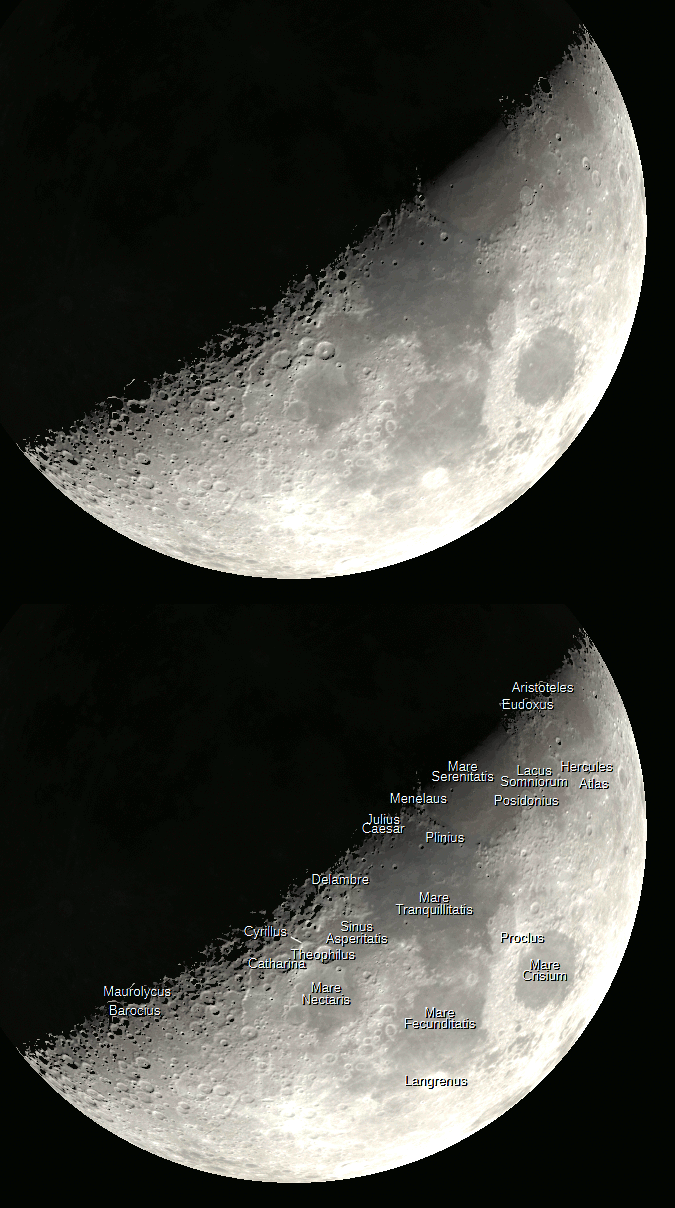
Translations of some lunar feature names according to Virtual Moon Atlas
Lacus Somniorum – Lake of Dreams
Mare Crisium – Sea of Crises
Mare Fecunditatis – Sea of Fertility
Mare Nectaris – Sea of Nectar
Mare Serenitatis – Sea of Serenity
Mare Tranquillitatis – Sea of Tranquility
Sinus Asperitatis – Bay of Roughness
Ephemeris: 12/18/2023 – The Moon tonight
This is Bob Moler with Ephemeris for Monday, December 18th. Today the Sun will be up for 8 hours and 48 minutes, setting at 5:03, and it will rise tomorrow at 8:15. The Moon, 1 day before first quarter, will set at 11:50 this evening.
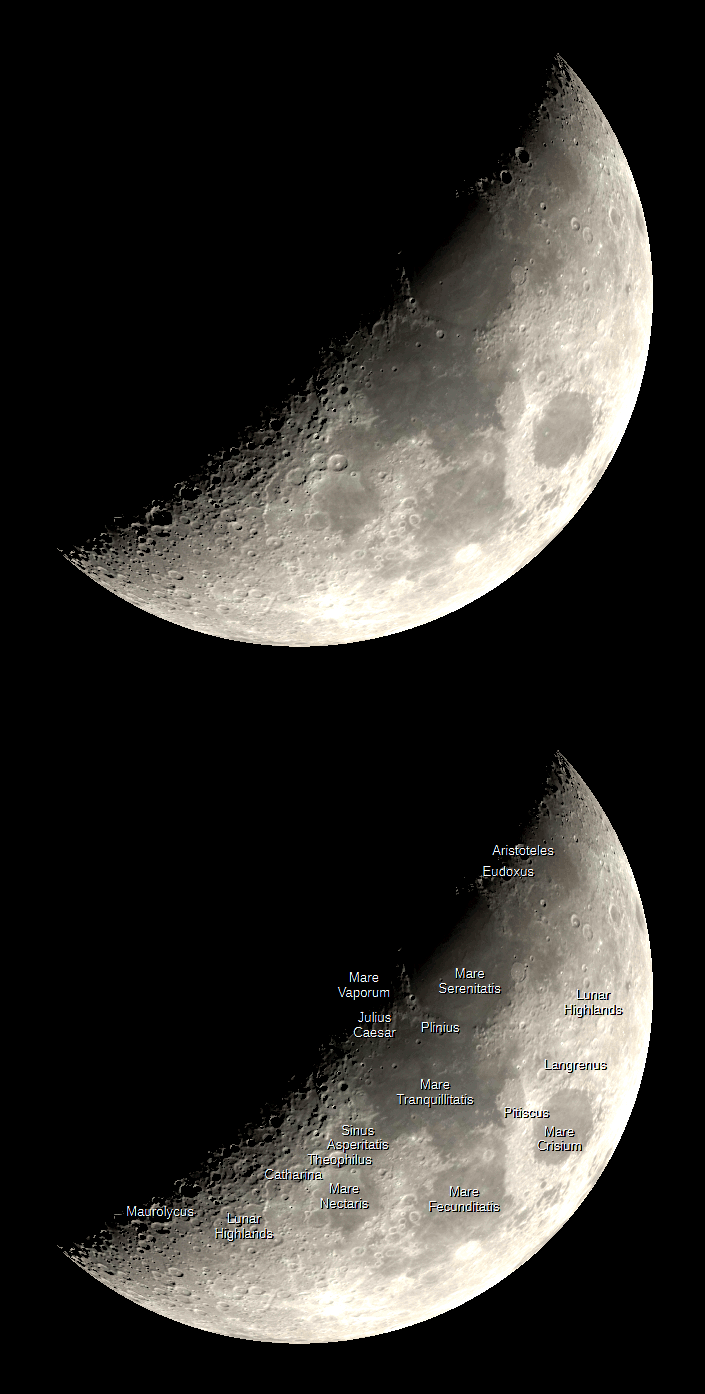
Tonight’s Moon is just about exactly one day before first quarter it’s a six-day-old Moon. Each quarter of the revolution of the moon is just about one week. A lunar month comes out to 29 1/2 days which is a little bit more than 28 days which should be four weeks. That’s pretty close. The illuminated part of the moon that we’re looking at first quarter I consider the most interesting half of the Moon with a good mixture of lowlands which are the seas which are the dark grayer parts of the Moon and the highlands which are very roughly cratered, and are actually higher than the lowlands, or the seas. So if you could put water on the Moon without evaporating it, this is where the water would be. Early telescopic astronomers did think that’s where the water was. Of course the Moon has no atmosphere and the water would just evaporate.
The astronomical event times given are for the Traverse City/Interlochen area of Michigan (EST, UT –5 hours). They may be different for your location.
Addendum
06/22/2023 – Ephemeris – The lunar seas on tonight’s Moon
This is Ephemeris for Thursday, June 22nd. Today the Sun will be up for 15 hours and 34 minutes, setting at 9:32, and it will rise tomorrow at 5:57. The Moon, halfway from new to first quarter, will set at 12:51 tomorrow morning.
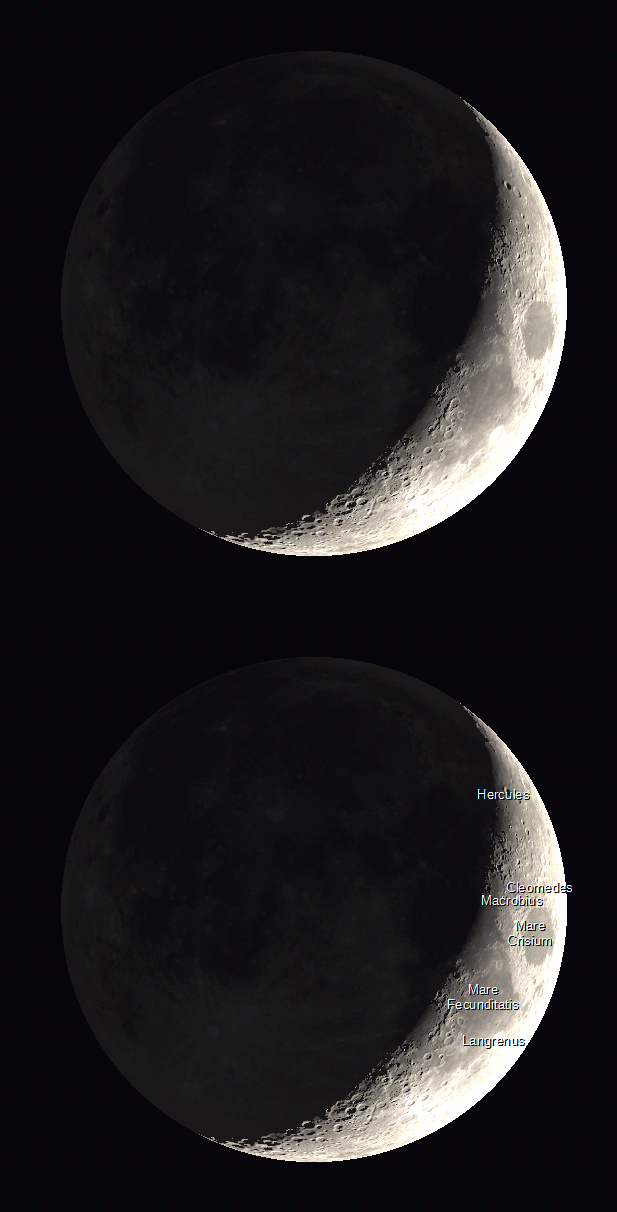
The crescent Moon tonight reveals two large seas. Astronomers using the first telescopes thought the darker flat areas on the moon may actually be filled with water. It turns out that they are flat lava plains, and since most of them are roughly circular, may be gigantic craters from impacts of asteroids. Examination of rocks brought back by the Apollo astronauts over 50 years ago suggest the age of the seas at around 4 billion years. This suggests some kind of disruption in the solar system, called the Late Heavy Bombardment. The reason the Earth does not have these scars is due to plate tectonics and the weathering of wind and water. The Moon has none of these, so it preserves the damage done to it.
The astronomical event times given are for the Traverse City/Interlochen area of Michigan (EDT, UT –4 hours). They may be different for your location.
Addendum
Late Heavy Bombardment (Based on my August 4, 2022 post)
There are even more and larger seas on the east half of the Moon, as we see it. Most were created about 3.9 billion years ago by asteroid strikes. The same thing happened to the Earth, but plate tectonics destroyed the evidence. Not so on the Moon. The result, many planetary scientists think, was the Late Heavy Bombardment, caused by the shifting orbits of mainly Saturn, Uranus and Neptune that disrupted the smaller asteroids, and sending them careening through the solar system.
08/04/2022 – Ephemeris – The Late Heavy Bombardment
This is Bob Moler with Ephemeris for Thursday, August 4th. Today the Sun will be up for 14 hours and 32 minutes, setting at 9:04, and it will rise tomorrow at 6:33. The Moon, 1 day before first quarter, will set at 12:19 tomorrow morning.
The face of the Moon is nearly half uncovered from our point of view, with first quarter occurring at 7:06 tomorrow morning. It shows the string of lunar seas, those gray areas on the moon which lead to the terminator, the Moon’s sunrise line. There are even more and larger seas on the east half of the Moon, as we see it. Most were created about 3.9 billion years ago by asteroid strikes. The same thing happened to the Earth, but plate tectonics destroyed the evidence. Not so on the Moon. The result, many planetary scientists think, was the Late Heavy Bombardment, caused by the changing orbits of mainly Saturn, Uranus and Neptune disrupting the smaller asteroids, and sending them careening through the solar system.
The astronomical event times given are for the Traverse City/Interlochen area of Michigan (EDT, UT – 4 hours). They may be different for your location.
Addendum
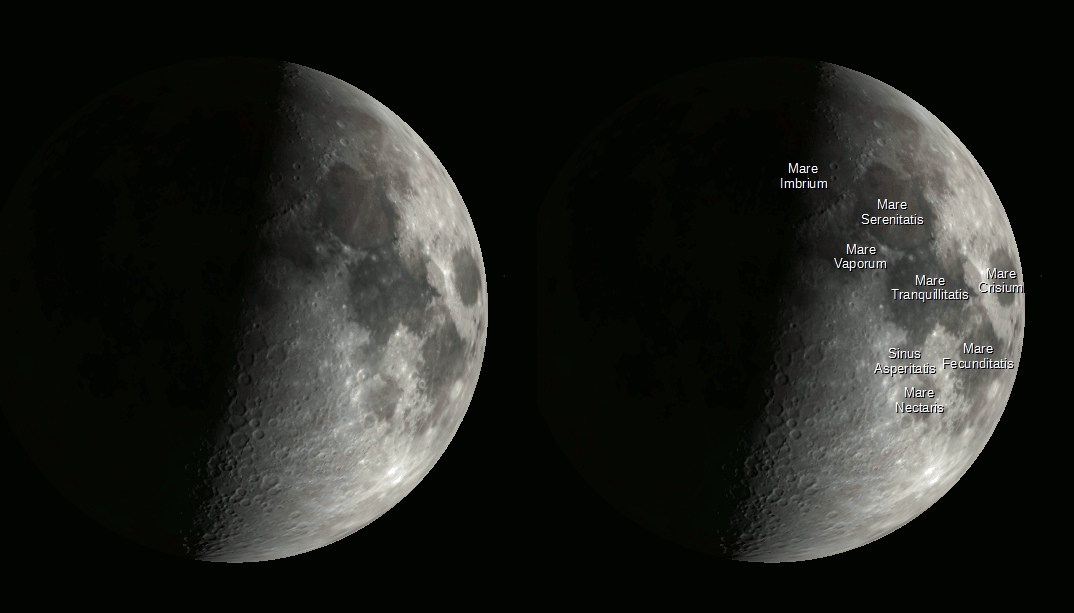
First quarter Moon with prominent seas labeled. Created using Stellarium, GIMP and LibreOffice.
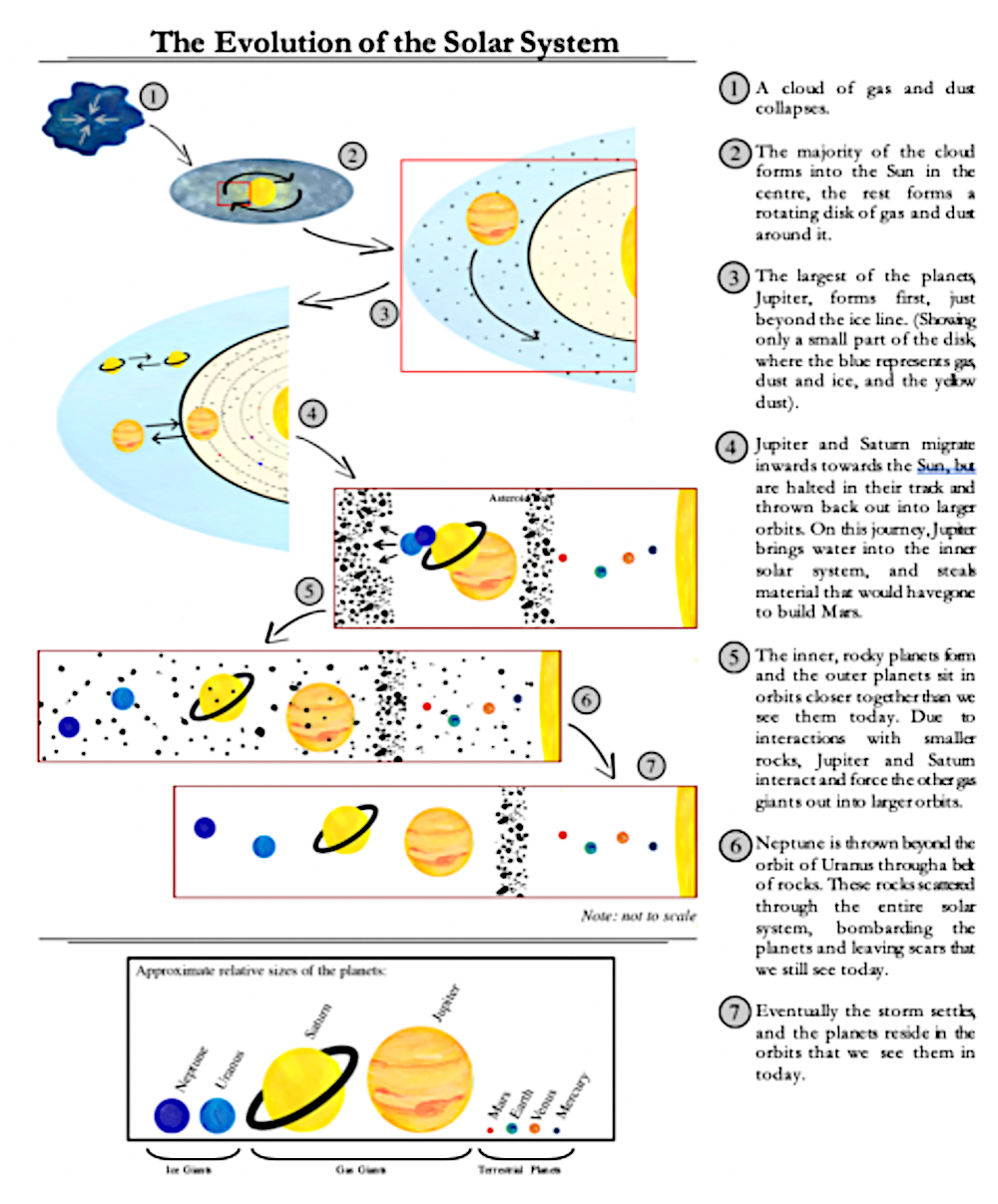
Nice model infographic: Evolution of the solar system. Step 6, with the exchange of Neptune’s and Uranus’ orbits, cause the Late Heavy Bombardment. The Nice model isn’t that nice. It’s named for Nice, France, the city where the model was first developed. The original on the web page was smaller. I enlarged it and sharpened it a bit, so it’s more readable. Credit: Nora Eisner.
The above infographic is from the blog post at https://blog.planethunters.org/2019/04/29/formation-of-our-solar-system/ by Nora Eisner.
08/02/2022 – Ephemeris – Where did the Moon’s “seas” come from?
This is Ephemeris for Tuesday, August 2nd. Today the Sun will be up for 14 hours and 37 minutes, setting at 9:07, and it will rise tomorrow at 6:31. The Moon, 3 days before first quarter, will set at 11:37 this evening.
As the days progress to full moon on the 13th, the Moon will reveal its many maria or seas, as the first telescopic astronomers called these blemishes. Many have roughly circular outlines bounded by mountains. They have flat floors that are darker than the heavily cratered parts of the moon, and have very few craters on them. That means they were created after the major craters were made, and obliterated the craters beneath. The majority of the cratering came very early, as the Moon accreted from the material the was produced when a Mars sized protoplanet hit the early Earth about 4.51 billion years ago. That’s according to most planetary scientists. The maria are actually huge craters produced by large asteroids later, about 3.9 billion years ago.
The astronomical event times given are for the Traverse City/Interlochen area of Michigan (EDT, UT – 4 hours). They may be different for your location.
Addendum
Lunar “seas” seen on a first quarter moon. Mare is Latin for sea. Sinus means bay. Created using Stellarium, GIMP and LibreOffice.
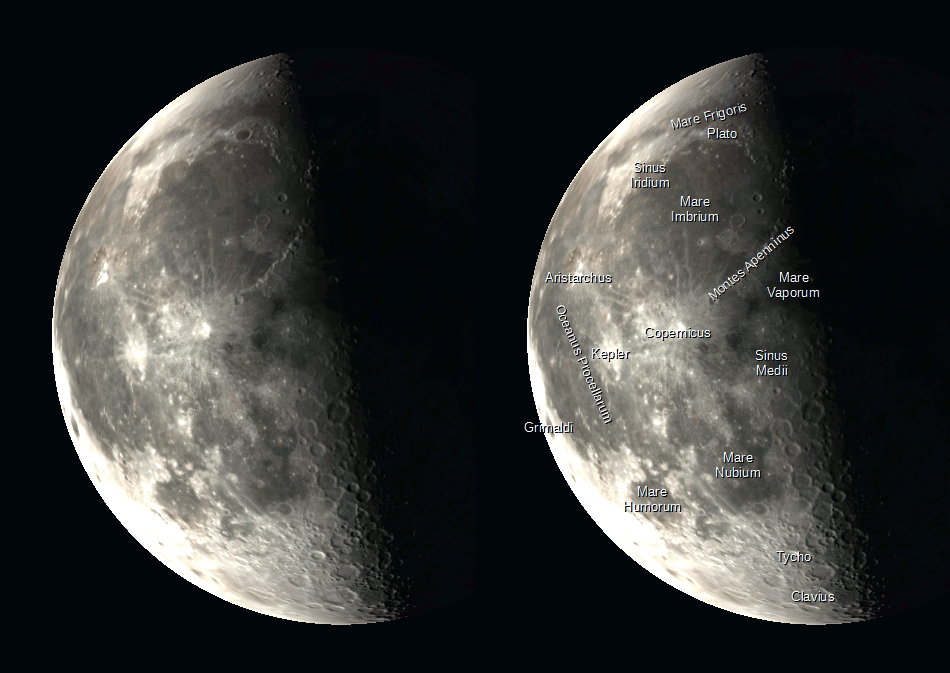
Lunar “seas” and some other prominent features labeled on the last quarter moon.
02/10/2022 – Ephemeris – The waxing gibbous Moon is revealing more seas and craters
This is Ephemeris for Thursday, February 10th. Today the Sun will be up for 10 hours and 14 minutes, setting at 6:04, and it will rise tomorrow at 7:48. The Moon, 2 days past first quarter, will set at 4:38 tomorrow morning.
The Moon tonight is a waxing gibbous phase. More gray lunar seas are appearing near the terminator, the sunrise line. From north to south these seas, most only partially in sunlight, are: At the far north, the Cold Sea, Sea of Showers, The sea where the famous crater Copernicus is, the Sea of Islands. The southernmost sea at the terminator is the Sea of Clouds. Some large and prominent craters can be seen with binoculars or a small telescope can be seen in the south, the striking and relatively fresh Tycho, with its Moon girdling ejecta rays, though the rays are best seen at full moon. And the huge crater Clavius, with an arc of 5 smaller craters, one on its wall and the others on its floor, in ever diminishing sizes.
The astronomical event times given are for the Traverse City/Interlochen area of Michigan (EST, UT – 5 hours). They may be different for your location.
Addendum
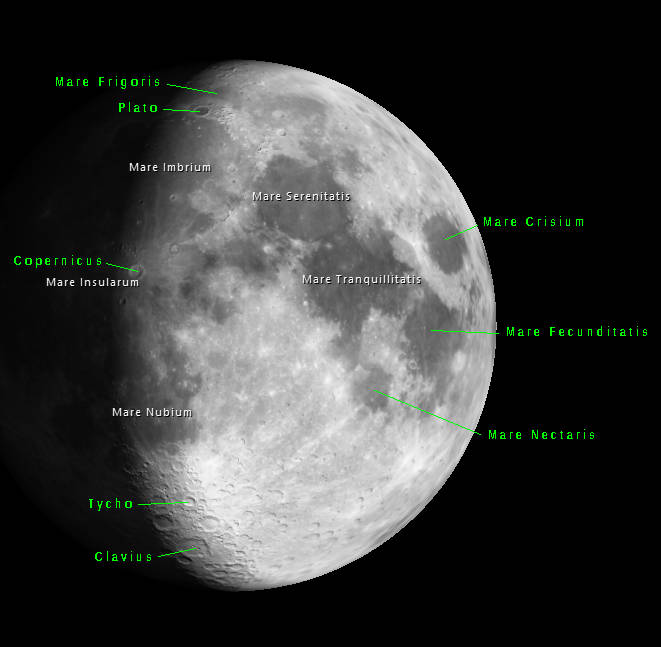
2 days past first quarter Moon as it would be seen in a small telescope or even binoculars, annotated. For this evening, February 10, 2022. Click on the image to enlarge it. Created using Virtual Moon Atlas. Annotations in white are from the app, mine are in green. Translations of the sea names are below.
Translations
Mare Crisium – Sea of Crises
Mare Fecunditatis – Sea of Fertility
Mare Frigoris – Sea of Cold
Mare Imbrium – Sea of Showers
Mare Insularum – Sea of Islands
Mare Nectaris – Sea of Nectar
Mare Nubium – Sea of Clouds
Mare Serenitatis – Sea of Serenity
Mare Tranquilitatis – Sea of Tranquility
A closer look
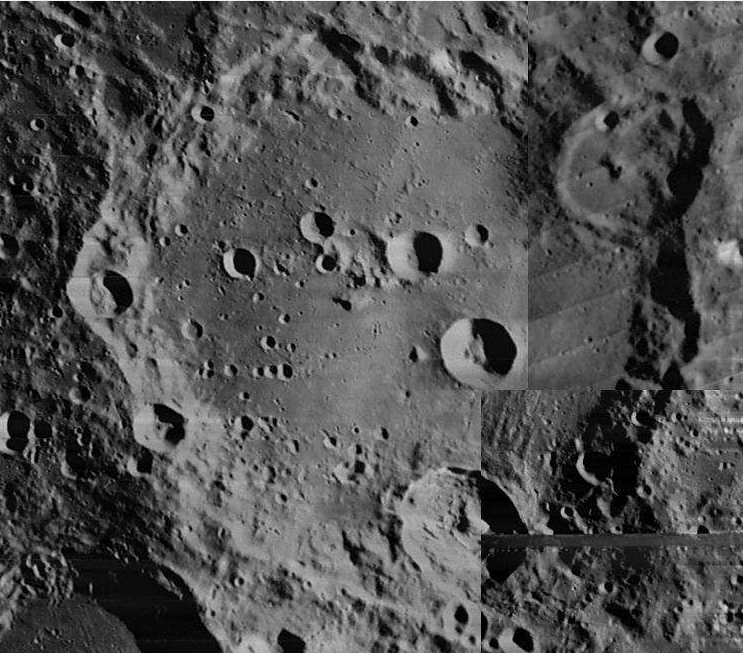
A montage of Clavius as photographed by one of the Lunar Orbiter spacecraft in the 1960s From Digital Lunar Orbital Photographic Atlas. Credit Jeff Gillis, Lunar and Planetary Institute.
02/07/2022 – Ephemeris – The Moon tonight
This is Ephemeris for Monday, February 7th. Today the Sun will be up for 10 hours and 5 minutes, setting at 6:00, and it will rise tomorrow at 7:53. The Moon, 1 day before first quarter, will set at 1:29 tomorrow morning.
Tonight, let’s take a look at the nearly first quarter Moon. The small, nearly circular gray spot is the sea of Crises. A diagonal chain of larger seas run from the terminator, the sunrise line, to below the Sea of Crises. They are, from the terminator, the seas of Serenity, Tranquility and Fertility. NASA is hoping to launch its uncrewed mission to the Moon, Artemis-1, next month with a large block of launch dates. The launch window begins on March 12th and ends on the 27th, with two blackout dates. Two lengths of missions are possible, a long 38 to 42 day mission is possible in the first part of the launch window, and a shorter 26 to 28 day mission is possible in the latter part of the window.
The astronomical event times given are for the Traverse City/Interlochen area of Michigan (EST, UT – 5 hours). They may be different for your location.
Addendum
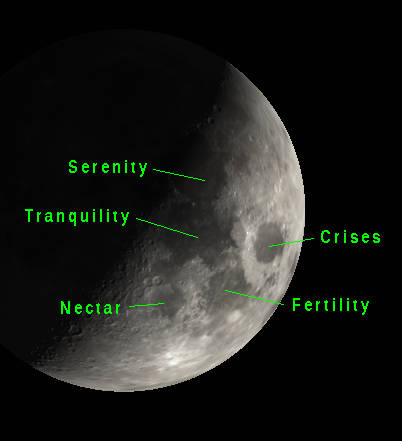
The Moon as it might appear tonight in binoculars or a small telescope at 7 pm tonight, February 7, 2022. I labeled the lunar seas with their English names, translated from the Latin. Also labeled is the Sea of Nectar, which wasn’t mentioned in the program. Moon image created using Stellarium.
05/17/2021 – Ephemeris – The Moon tonight
This is Ephemeris for Monday, May 17th. Today the Sun will be up for 14 hours and 54 minutes, setting at 9:06, and it will rise tomorrow at 6:11. The Moon, 2 days before first quarter, will set at 2:25 tomorrow morning.
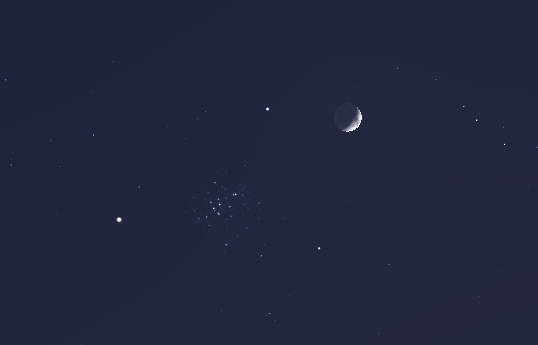
The Moon tonight reveals a bit more territory than it did last night, and will every night until full moon. The Moon’s solar day equals a lunar month of about 29 and a half of our days. As seen in binoculars, below and left of The distinctly oval Sea of Crises, or Mare Crisium, is the Sea of Fertility, or Mare Fecunditatis. To the left of the Sea of Crises, the Sea of Tranquility (Tranquilitatis) where the Apollo 11 crew landed. Above that half of Sea of Serenity has come into daylight. Tonight the Beehive star cluster will be visible below and left of the Moon. It should be easily visible in binoculars and has a vaguely triangular shape. It was known to the ancients as Praesepe, the manger, who saw it as a glowing spot on moonless nights.
The astronomical event times given are for the Traverse City/Interlochen area of Michigan. They may be different for your location.
Addendum
05/28/2020 – Ephemeris – The Moon tonight and the origin of the lunar seas
This is Ephemeris for Thursday, May 28th. Today the Sun will be up for 15 hours and 15 minutes, setting at 9:18, and it will rise tomorrow at 6:01. The Moon, 1 day before first quarter, will set at 2:25 tomorrow morning.
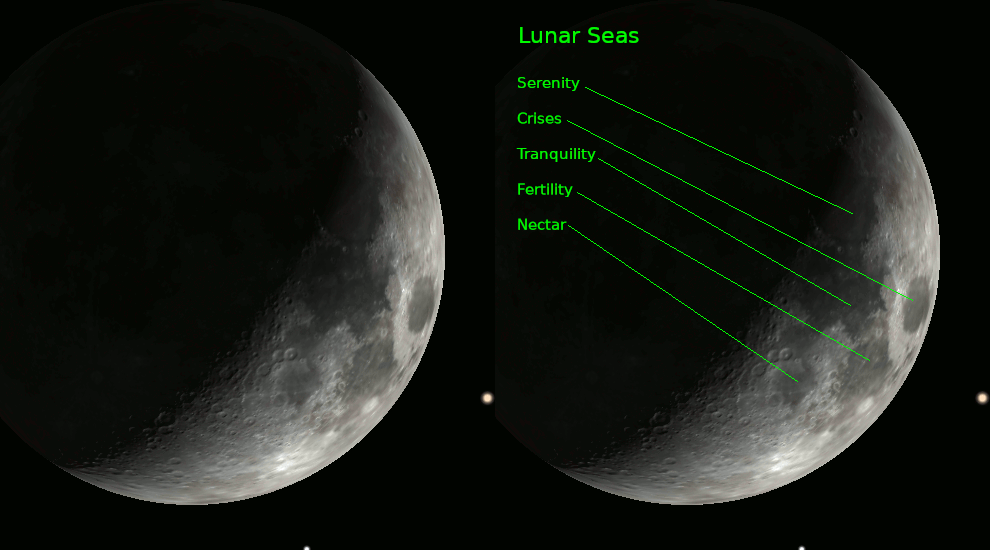
Tonight’s Moon is a fat crescent. The lower or southern part of the Moon are brighter. These are the lunar highlands, the more rugged crater filled part of the Moon. The darker areas are the so-called lunar seas, huge lava filled craters. Note that they appear to be roughly circular. They are thought to be the result of large asteroid impacts that occurred four billion years ago during what is known as the late heavy bombardment. The late heavy bombardment is still controversial. One theory has that the outer planets changed their orbits in time disrupting the two areas of small bodies, the asteroid belt inside Jupiter’s orbit and the Kuiper belt beyond Neptune, sending some of them into the inner solar system.
The event times given are for the Traverse City/Interlochen area of Michigan. They may be different for your location.
Addendum
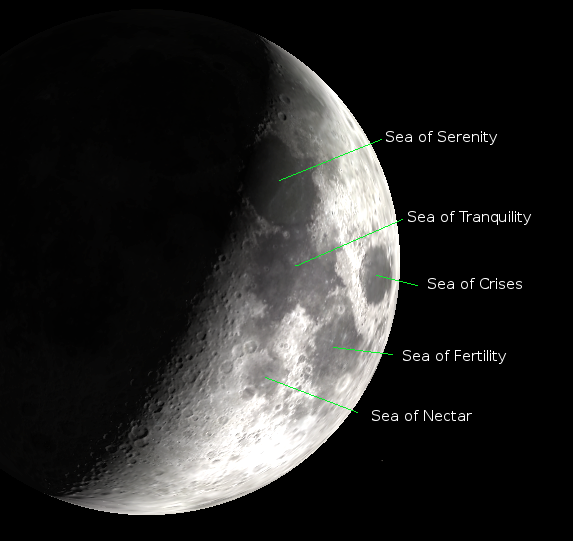
The Moon at low magnification this evening, May 28, 2020 with the English names for the visible lunar seas. Created using Stellarium.
 Bob Moler's Ephemeris Blog