Archive
Ephemeris: 07/30/2024 – The heavenly harp
This is Ephemeris for Tuesday, July 30th. Today the Sun will be up for 14 hours and 42 minutes, setting at 9:10, and it will rise tomorrow at 6:28. The Moon, 3 days past last quarter, will rise at 2:08 tomorrow morning.
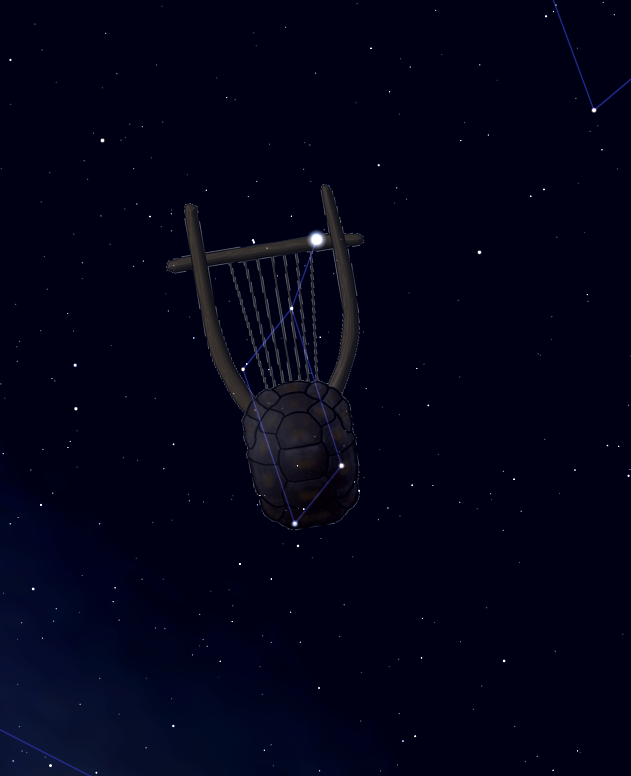
After it gets dark, nearly overhead, appears the bright star Vega, the brightest of the stars of the Summer Triangle. It is part of the constellation called Lyra the harp. The form of the harp is a lyre, which has a U-shaped frame with a bar across the top, the strings are strung from the bar down to the base of the U. According to Greek myth it was invented by the god Hermes who used a tortoise shell as the base of the U. He gave it to Apollo, who in turn gave it to Orpheus. Orpheus had the greatest musical talent. His singing and lyre playing would make animals and even inanimate objects dance. The constellation itself consists of Vega and a parallelogram of four stars which are seen below it.
The astronomical event times given are for the Traverse City/Interlochen area of Michigan (EDT, UT–4 hours). They may be different for your location.
Addendum
07/02/2013 – Ephemeris – Lyra the harp in Greek mythology
Ephemeris for Tuesday, July 2nd. Today the sun will be up for 15 hours and 29 minutes, setting at 9:31. The moon, 2 days past last quarter, will rise at 2:45 tomorrow morning. Tomorrow the sun will rise at 6:02.
High in the east at 11 p.m. can be found a bright star just above a small, narrow, but very distinctive parallelogram of stars. They are the stars of the constellation Lyra the harp. The bright star is Vega the 5th brightest night-time star. To the Romans the star Vega represented a falling eagle or vulture. Apparently they never made the distinction between the two. It is a pure white star and serves as a calibration star for color and brightness. The harp, according to Greek mythology, was invented by the god Hermes. The form of the harp in the sky, is as he had invented it: by stretching strings across a tortoise-shell. Hermes gave it to his half-brother Apollo, who in turn gave it to the great musician Orpheus.
Times are for the Traverse City/Interlochen area of Michigan. They may be different for your location.
Addendum
Lyra as a tortoise-shell harp. Created using Stellarium and free clip art.
Annotated Lyra:
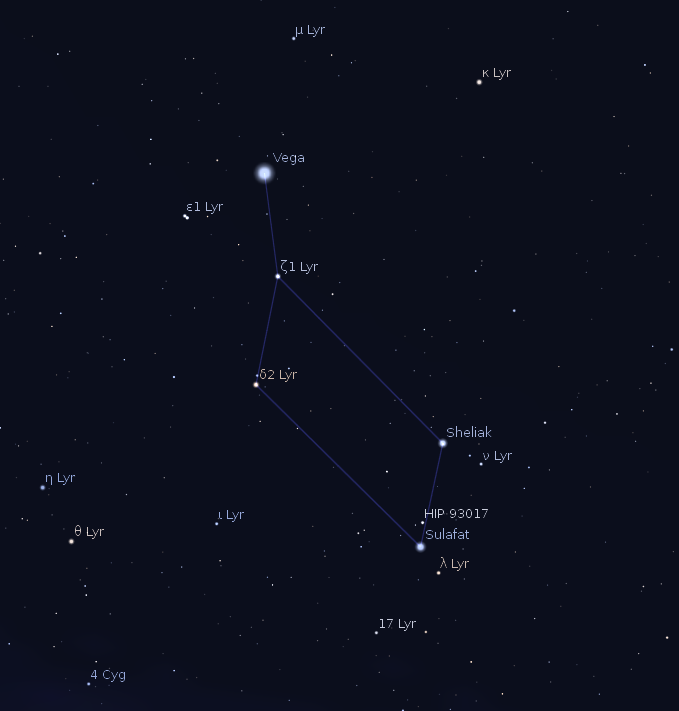
Magnified view of Lyra. Created using Stellarium.
 Bob Moler's Ephemeris Blog