Archive
01/27/2021 – Ephemeris – Let’s have a lookout for the naked-eye planets for this week
This is Ephemeris for Wednesday, January 27th. Today the Sun will be up for 9 hours and 37 minutes, setting at 5:44, and it will rise tomorrow at 8:05. The Moon, 1 day before full, will set at 8:23 tomorrow morning.
Let’s have a lookout for the naked-eye planets for this week. Mercury will be low in the west-southwestern sky around 6:15 pm or about a half hour after sunset. It will set at 7:18 pm. Saturn and Jupiter are too close to the direction of the Sun to be seen. Saturn has passed into the morning sky, while Jupiter will pass behind the Sun tomorrow. Neither of these planets are visible. It will be a month or more before even Saturn will be visible in the morning twilight. Mars can be found quite high in the south at 7 pm. It will actually be due south at 6:43 tonight. Mars is increasing its speed eastward through the constellation of Aries the ram and will set at 1:52 am. Venus will be hard to spot in the morning twilight after it rises at 7:26 am tomorrow.
The event times given are for the Traverse City/Interlochen area of Michigan. They may be different for your location.
Addendum
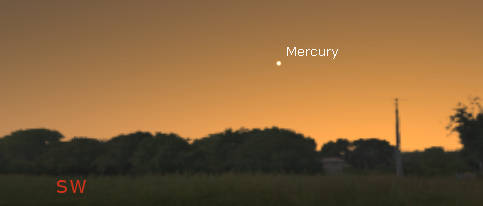
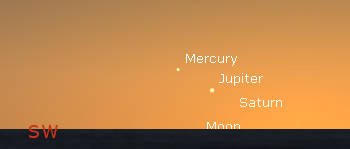
Mercury in evening twilight at 6:15 pm tonight January 27, 2021. Created using Stellarium.
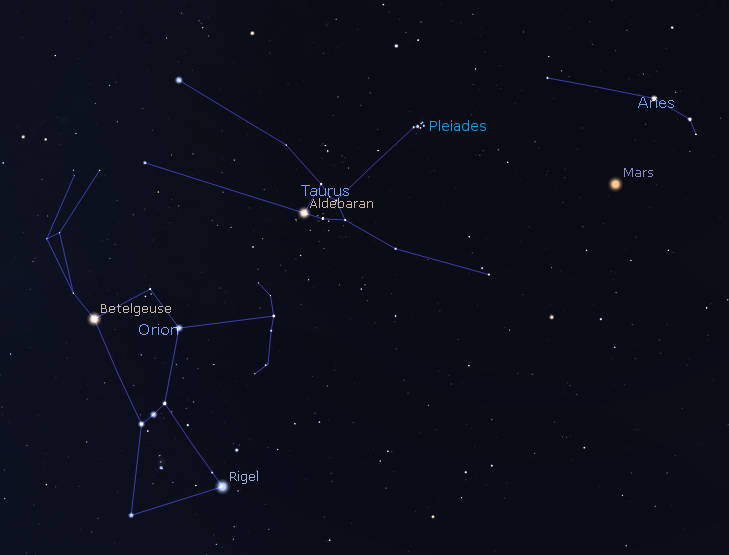
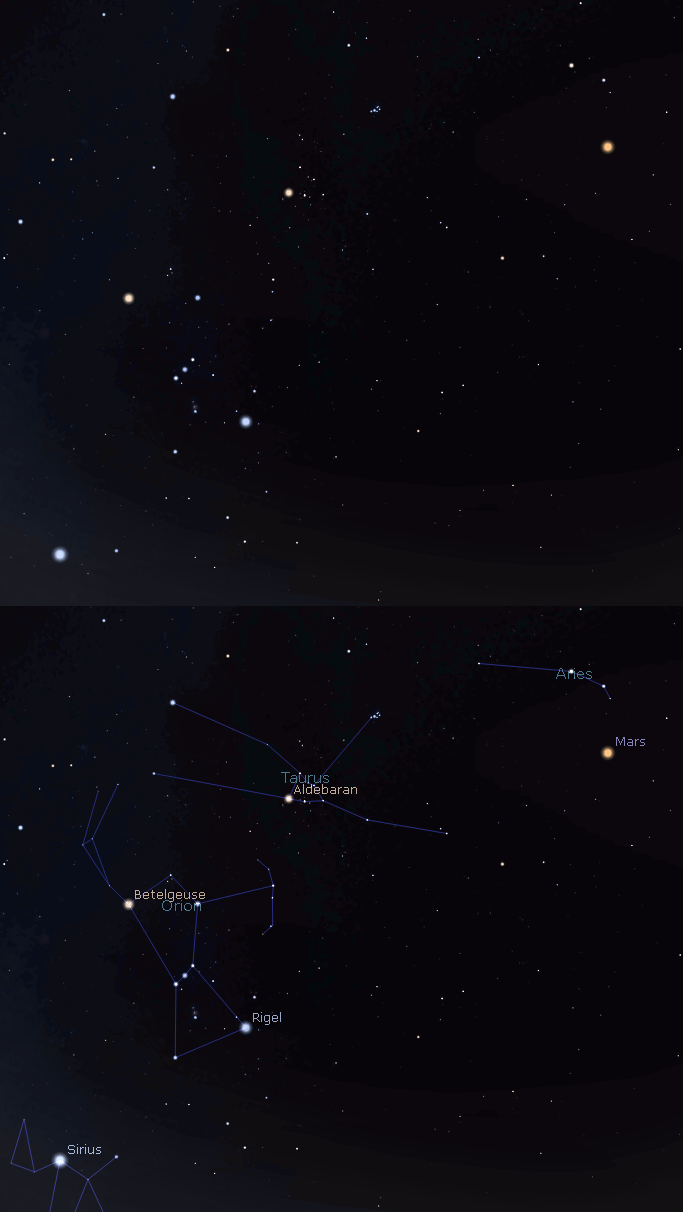
Mars and neighboring constellations for 7 pm tonight, January 27, 2021. Created using Stellarium.

The Moon as it might be seen in binoculars or low power telescope tonight at 7 pm, January 27, 2021. Created using Stellarium.
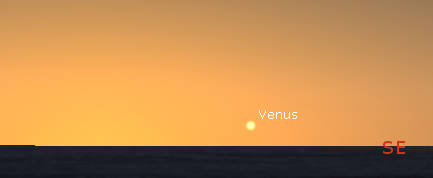
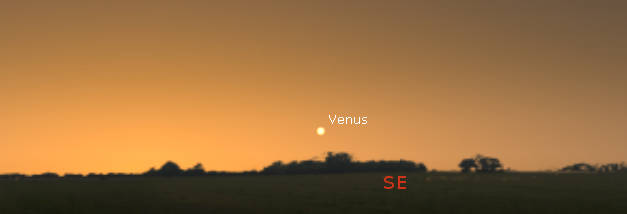
Venus in morning twilight over a water horizon. Around here that would be Lake Huron shortly after 7:30 am tomorrow January 28, 2021. Created using Stellarium.
The graphic illustrating the planets as seen in a telescope is on hiatus until Jupiter and Saturn clear the Sun in the morning sky in a couple of months. Mars appears too small to show any detail in a small telescope.
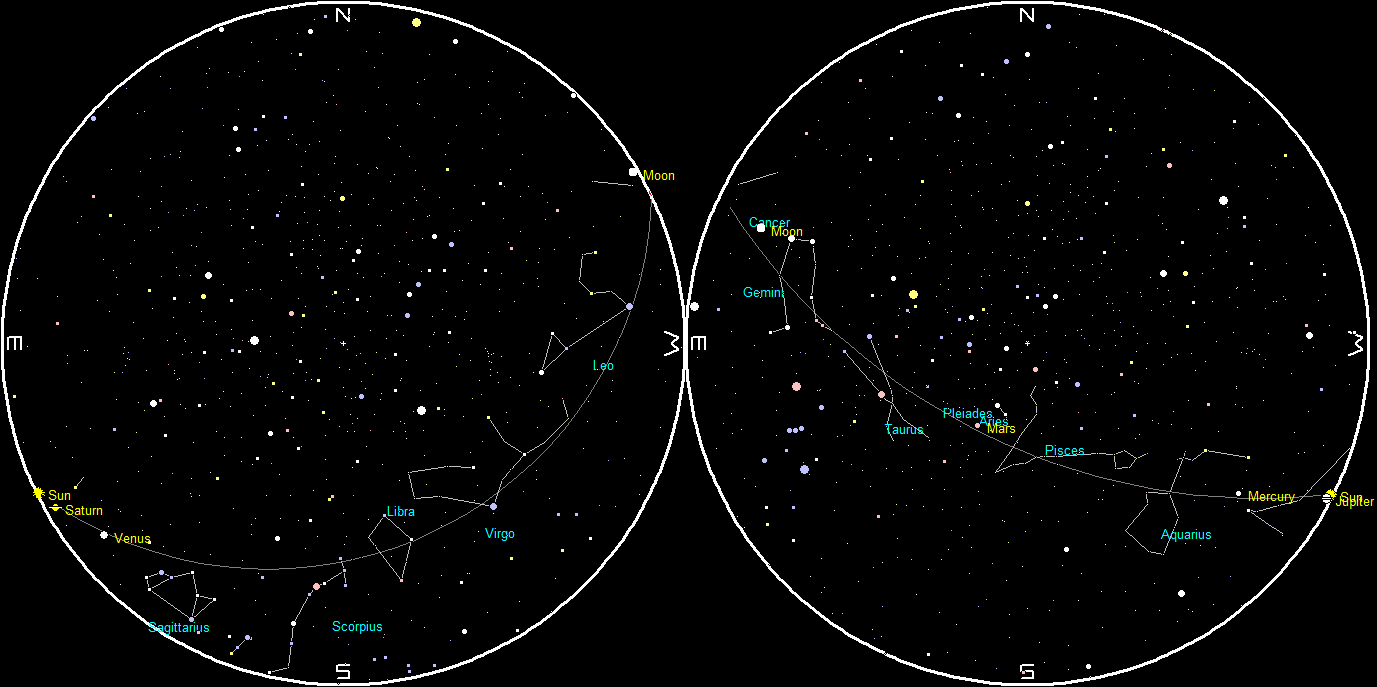
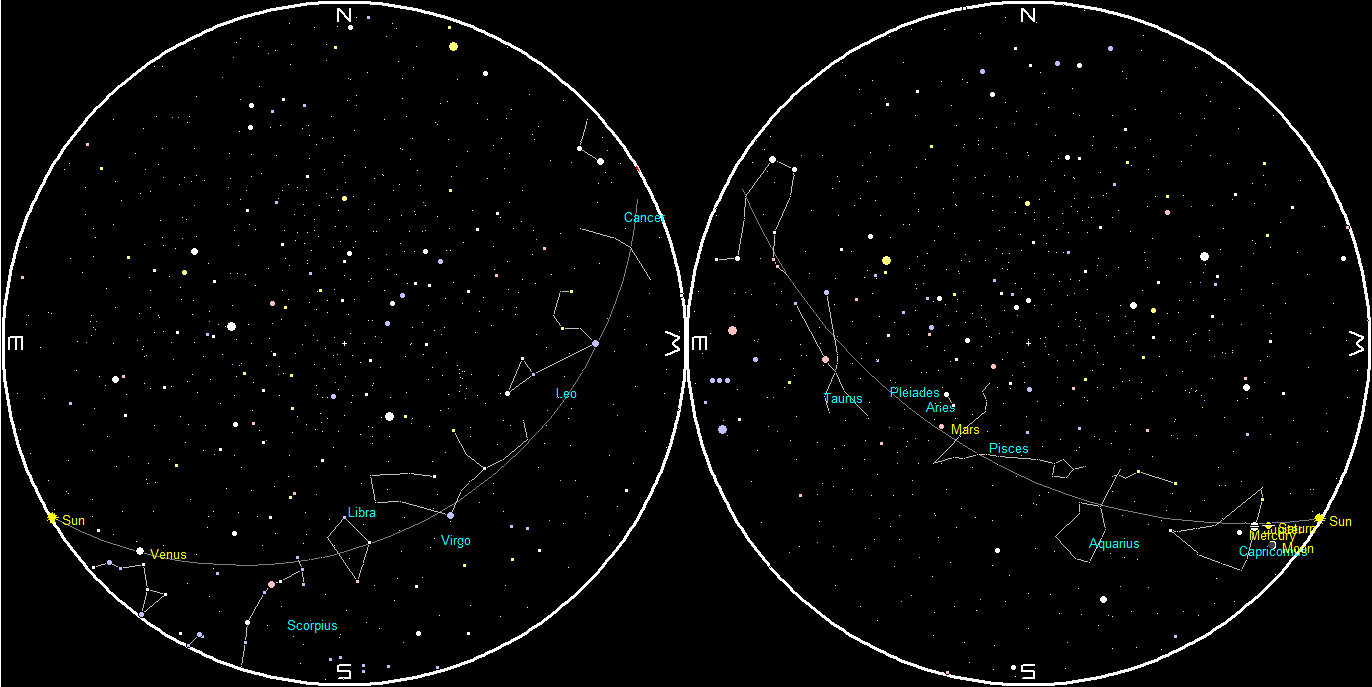
Planets and the Moon at sunset and sunrise of a single night starting with sunset on the right on January 27, 2021. The night ends on the left with sunrise on the 28th. I’m afraid that the labels for Jupiter and the Sun overlap, since the planets and Sun are very close. Click on the image to enlarge. Created using my LookingUp program.
01/13/2021 – Ephemeris – Let’s take a look for the naked-eye planets for this week
This is Bob Moler with Ephemeris for Wednesday, January 13th. Today the Sun will be up for 9 hours and 8 minutes, setting at 5:26, and it will rise tomorrow at 8:16. The Moon is new today, and won’t be visible.
Let’s take a look for the naked-eye planets for this week. Mercury has joined Jupiter and Saturn extremely low in the southwestern sky. I’m afraid Saturn will be lost in the twilight, but Jupiter, with Mercury above it might be visible. They are both extremely low in the southwestern sky around 6 pm. Jupiter will set at 6:20 pm with Mercury following 20 minutes later. Quite high in the south at 7 pm Mars can be found. It will be actually due south on the meridian at 7:10 pm tonight. The meridian is an imaginary line that runs from the north compass point on one’s horizon, through the zenith to the south compass point. Mars is beginning to increase its speed eastward and will set at 2:09 am. Venus, our brilliant morning star will rise at 7:15 am in the east-southeast.
Addendum
Jupiter and Mercury in evening twilight st 6 pm, about a half hour after sunset over the Lake Michigan horizon. Saturn, though present can’t compete with the bright twilight. The less than one day old moon is setting. Created using Stellarium.
Mars finder animation for 8 pm tonight, January 13, 2021 (about 2 1/2 hours after sunset. Looking southward. Created using Stellarium and GIMP.
Venus in the morning twilight at 7:45 am tomorrow morning January 14, 2021 (about 1/2 hour before sunrise). Created using Stellarium.
The graphic that shows the planets as seen in small telescopes has been discontinued because Jupiter and Saturn are too close to the horizon and Venus and Mars are too small (less than 10 seconds of arc in diameter). It will be resumed in a couple of months when Jupiter and Saturn become visible in the morning sky.
Planets and the Moon at sunset and sunrise of a single night starting with sunset on the right on January 13, 2021. The night ends on the left with sunrise on the 14th. I’m afraid that the labels for Jupiter and Saturn will overlap, since the planets are very close. Click on the image to enlarge. Created using my LookingUp program.
01/06/2021 – Ephemeris – Let’s take our first look at the naked-eye planets for 2021
This is Bob Moler with Ephemeris for Wednesday, January 6th. Today the Sun will be up for 8 hours and 58 minutes, setting at 5:18, and it will rise tomorrow at 8:19. The Moon, at last quarter today, will rise at 1:57 tomorrow morning.
Let’s take our first look at the naked-eye planets for 2021. Jupiter and Saturn are both extremely low in the southwestern sky around 6 pm. Jupiter is the very bright one. Below and right of it is the dimmer Saturn it by two degrees or four moon widths. They crossed paths for us 16 nights ago. They can still be seen in the same binocular field. Saturn will set first tonight at 6:33 pm with Jupiter following nine minutes later. Quite high in the southeast at that hour will be Mars, still in Pisces. It will pass due south at 7:25 tonight. Mars’ distance is increasing to 88 million miles (141 million km) away. It will set at 2:19 tomorrow morning. Venus, our brilliant morning star will rise at 7:03 am in the east-southeast as it seems to retreat slowly toward the Sun, but actually it’s heading way around behind the Sun.
The event times given are for the Traverse City/Interlochen area of Michigan. They may be different for your location.
Addendum
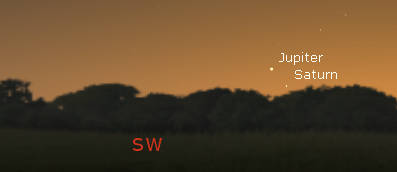
Jupiter and Saturn just above the distant trees at 6 pm January 6, 2021. We might lose them in twilight next week. We’ll have to move to a Lake Michigan horizon to try to spot them. Created using Stellarium.
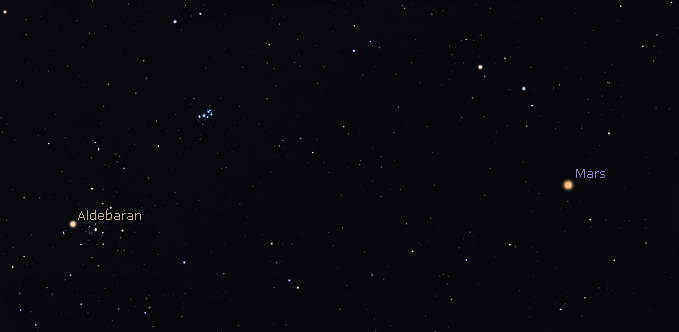
Mars in the evening sky at 8 pm January 6, 2021 looking southward. Mars is on the boarder between Pisces on the right and Aries above and left. Also seen on the left is the tiny dipper shape of the Pleiades or Seven Sisters star cluster and farther to the left the letter V of stars that is the face of Taurus the bull with the bright star Aldebaran. Created using Stellarium.
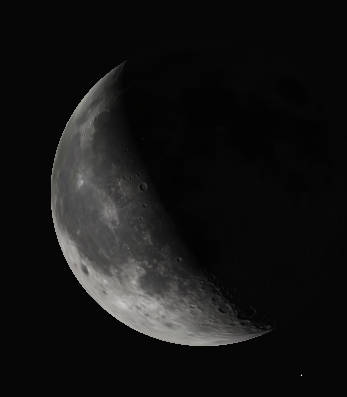
The waning crescent Moon at around 7 am January 7, 2021 as it might be seen in binoculars or a small telescope. Created using Stellarium.
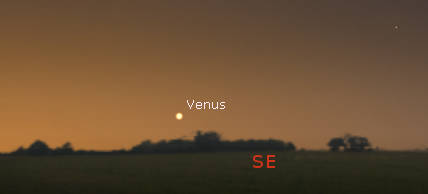
Venus seen low on the southeastern horizon at 7:30 in the morning on January 7, 2021. Created using Stellarium.
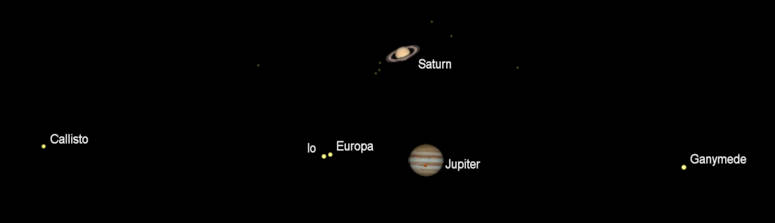
The planets Jupiter and Saturn as they might be seen in a small telescope at 6 pm, January 6, 2021. These planets are seen in twilight so Saturn’s moons will be invisible, and Jupiter’s moons nearly so. Mars is not shown because its apparent size is less than 10″ (seconds of arc in diameter), and Venus, nearly so. Apparent diameters: Jupiter, 32.73″; Saturn, 15.20″, rings, 35.42″; Mars, 9.82″, and Venus, 10.55″ 95% full.
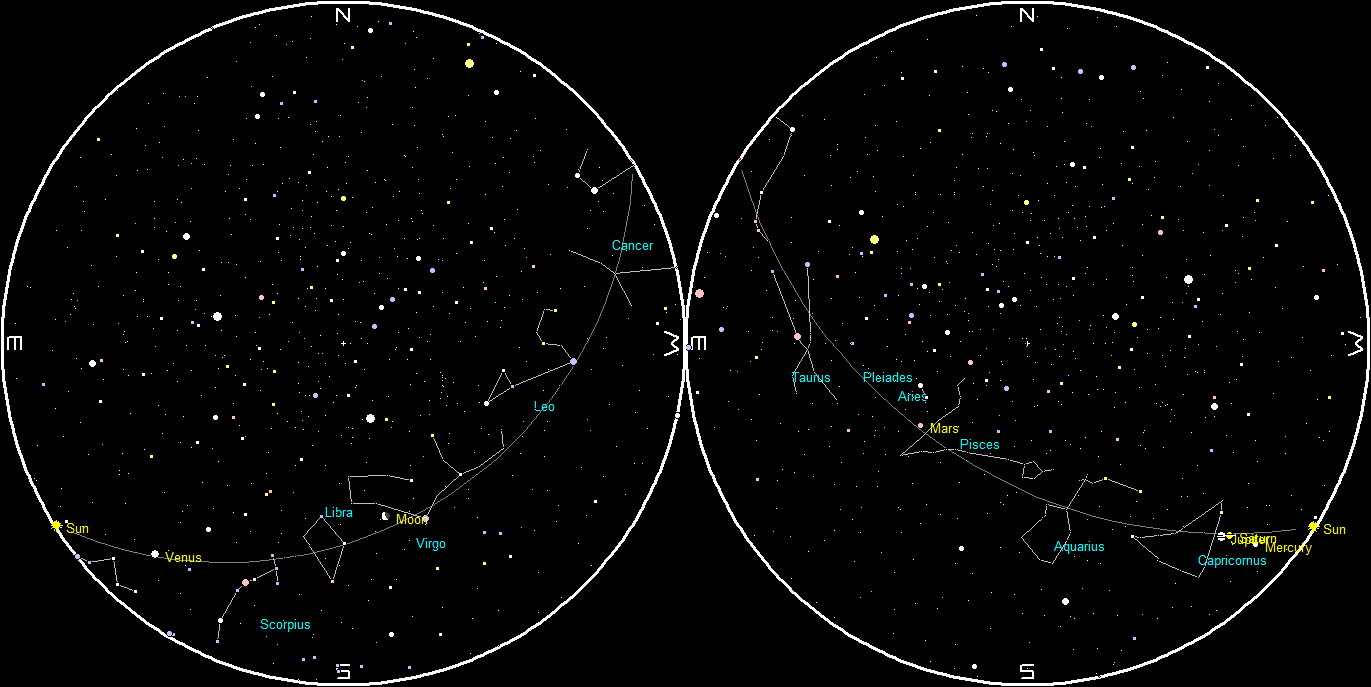
Planets and the Moon at sunset and sunrise of a single night starting with sunset on the right on January 6, 2021. The night ends on the left with sunrise on the 7th. I’m afraid that the labels for Jupiter and Saturn overlap, since the planets are very close. Click on the image to enlarge. Created using my LookingUp program.
12/30/2020 – Ephemeris – Let’s take our last look at the naked-eye planets for this year
This is Bob Moler with Ephemeris for Wednesday, December 30th. Today the Sun will be up for 8 hours and 51 minutes, setting at 5:11, and it will rise tomorrow at 8:20. The Moon, 1 day past full, will rise at 5:40 this evening.
Let’s take our last look at the naked-eye planets for this year. Jupiter and Saturn are both low in the southwestern sky around 6 pm. Jupiter is the very bright one. Below and right of it is the dimmer Saturn it by a degree or two moon widths. They crossed paths for us nine nights ago. They can still be seen in the same binocular field. Saturn will set first tonight at 6:57 pm with Jupiter following four minutes later. Quite high in the southeast will be Mars, still in Pisces. Mars’ distance is increasing to 82 million miles (132 million km) away. It will set at 2:29 tomorrow morning. Brilliant Venus will rise at 6:49 am in the east-southeast as it seems to retreat slowly toward the Sun, but actually it’s heading way around behind the Sun.
The event times given are for the Traverse City/Interlochen area of Michigan. They may be different for your location.
Addendum

Jupiter and Saturn low on the southwestern horizon at 6 pm. Created using Stellarium.
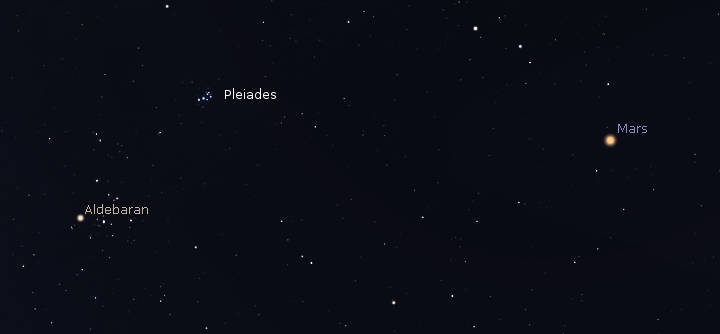
Mars with the stars of Taurus the Bull including Aldebaran with the “V” of stars that are the Hyades that mark the bull’s face and the Pleiades. Seen at 8 pm, December 30, 2020. Created using Stellarium.
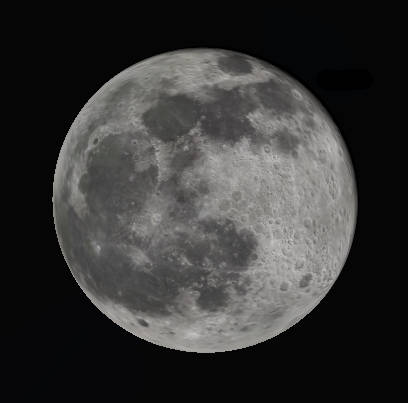
The Moon as it might be seen tonight at 8 pm, December 30, 2020. Created using Stellarium.
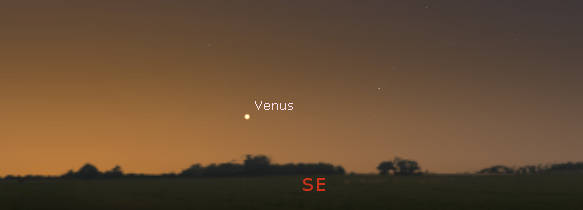
Venus in the southeast at 7:30 am. Created using Stellarium.
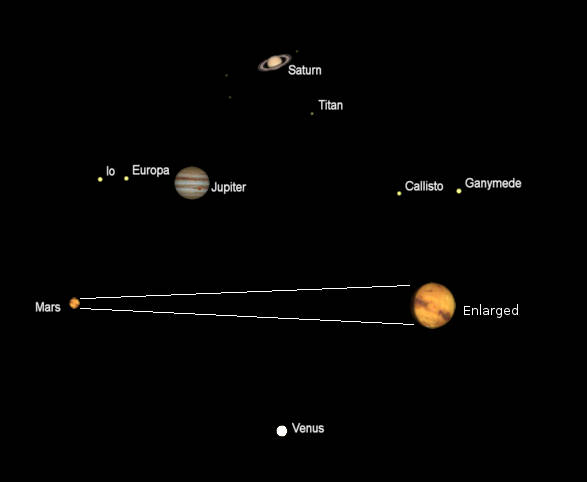
The planets as seen in a telescope (north up) with the same magnification for the night of December 30/31, 2020. Times of the display are: Jupiter and Saturn, 6 pm; Mars, 8 pm; Venus, 7:30 am. Apparent diameters: Jupiter, 32.92″; Saturn, 15.26″, rings, 35.54″; Mars, 10.52″, and Venus 10.71″. Mars also displays an enlargement showing surface detail. Mars was closest to the Earth this go-a-round on October 6. The ” symbol means seconds of arc (1/3600th of a degree.) Planets whose diameters drop below 10″, or are too close to the direction of the Sun to observe will not be shown. Created using Cartes du Ciel (Sky Charts).
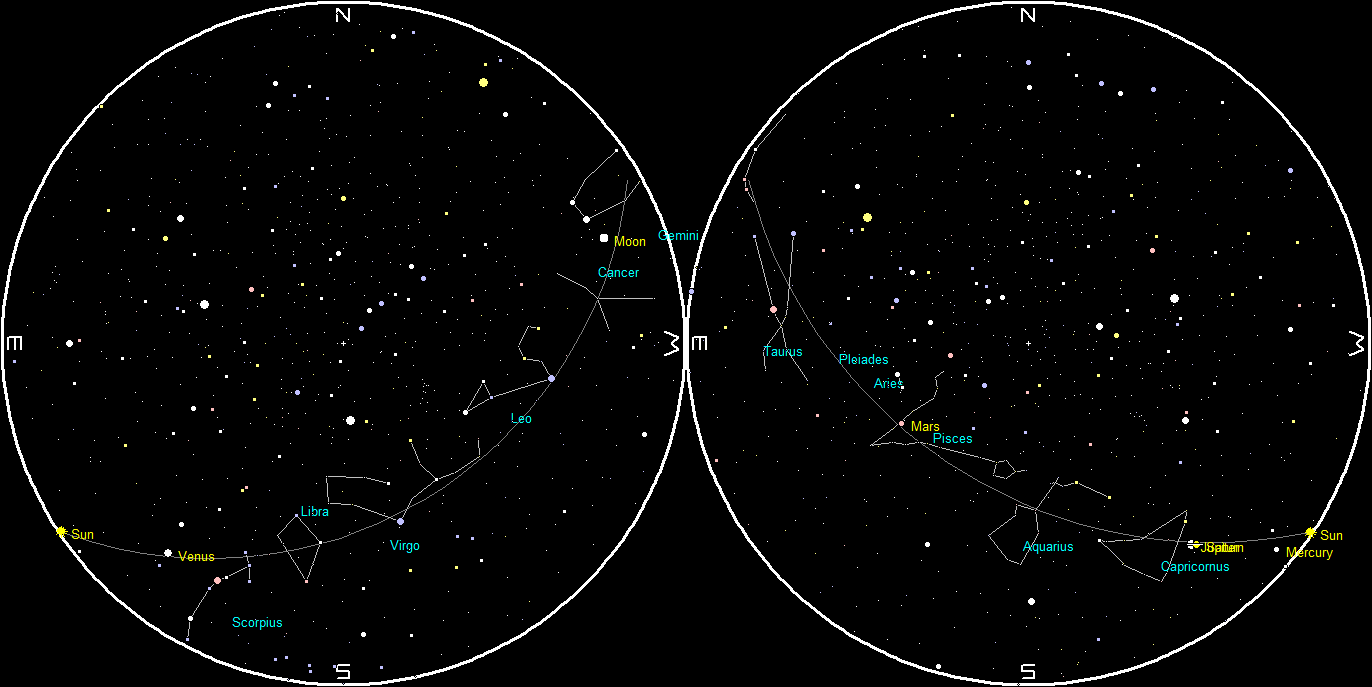
Planets and the Moon at sunset and sunrise of a single night starting with sunset on the right on December 30, 2020. The night ends on the left with sunrise on the 31st. I’m afraid that the labels for Jupiter and Saturn will overlap, since the planets are very close. Click on the image to enlarge. Created using my LookingUp program.
12/23/2020 – Ephemeris – Let’s look for the naked-eye planets for this Christmas week
This is Ephemeris for Wednesday, December 23rd. Today the Sun will be up for 8 hours and 48 minutes, setting at 5:06, and it will rise tomorrow at 8:18. The Moon, 2 days past first quarter, will set at 2:49 tomorrow morning.
Let’s look for the naked-eye planets for this week. Jupiter and Saturn are both low in the southwestern sky around 6 pm. Jupiter is the very bright one. Below and right of it is the dimmer Saturn it by a quarter of a degree or half a moon width. They crossed paths for us two nights ago, in 20 years, though not as close. They can still be seen in the same low power telescope field. Saturn will now set first tonight at 7:20 pm with Jupiter following a minute later. Quite high in the southeast and above the 9 day old Moon at that hour will be Mars, still in Pisces. Mars’ distance is increasing to 76 million miles (123 million km) away. It will set at 2:41 tomorrow morning. Brilliant Venus will rise at 6:33 am in the east-southeast as it seems to retreat slowly toward the Sun, but actually it’s heading way around behind the Sun.
The event times given are for the Traverse City/Interlochen area of Michigan. They may be different for your location.
Addendum
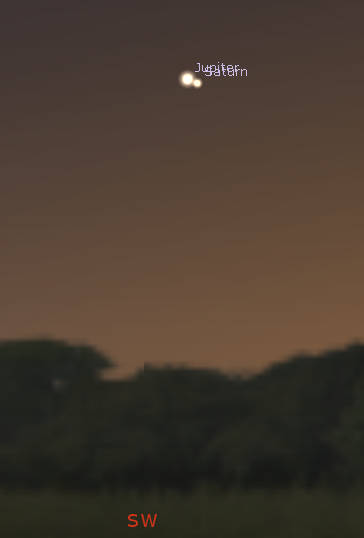
Jupiter and Saturn in twilight at 6 pm or a bit less than an hour after sunset tonight December 23, 2020. Created using Stellarium.
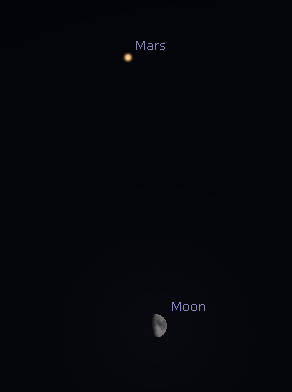
Mars will be seen above the Moon tonight. This is the appearance of both at 6 pm, tonight, December 23, 2020. Created using Stellarium.
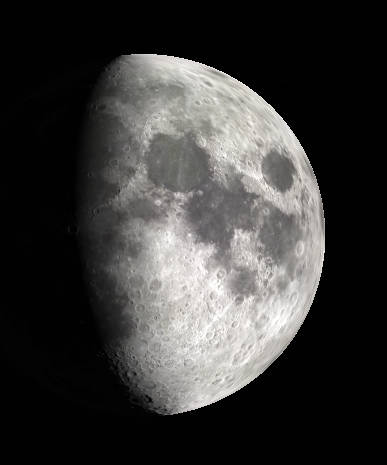
The gibbous Moon as it might be seen in binoculars this evening at 6 pm December 23, 2020. Created using Stellarium.
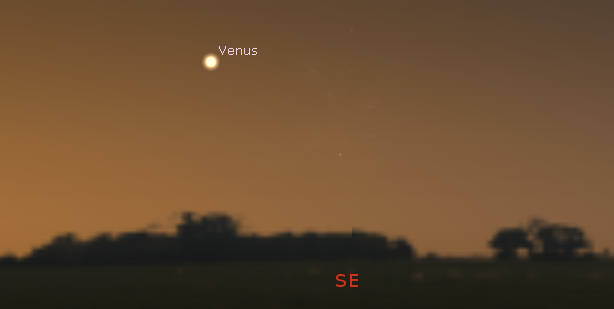
Venus low in the southeast at 7:30 am December 24, 2020. The morning sky is not as friendly to morning planets as it was earlier in autumn. Created using Stellarium.
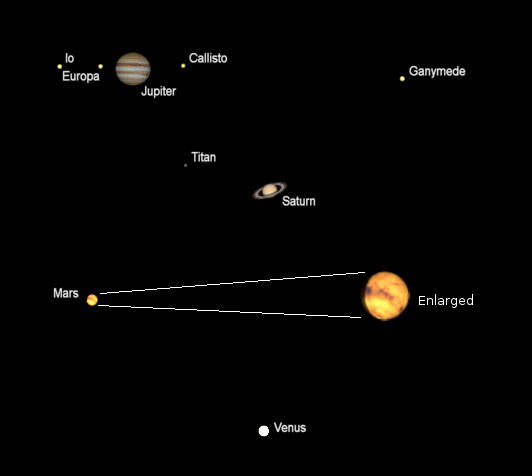
The planets as seen in a telescope (north up) with the same magnification for the night of December 23/24, 2020. Times of the display are: Jupiter, Saturn, and Mars, 6 pm; Venus, 7:30 am. Apparent diameters: Jupiter, 33.18″; Saturn, 15.32″, rings, 35.70″; Mars, 11.32″, and Venus 10.89″. Mars also displays an enlargement showing surface detail. Mars was closest to the Earth this go-a-round on October 6. The ” symbol means seconds of arc (1/3600th of a degree.) I will no longer show planets whose diameters drop below 10″, or are too close to the direction of the Sun to observe. Created using Cartes du Ciel (Sky Charts).
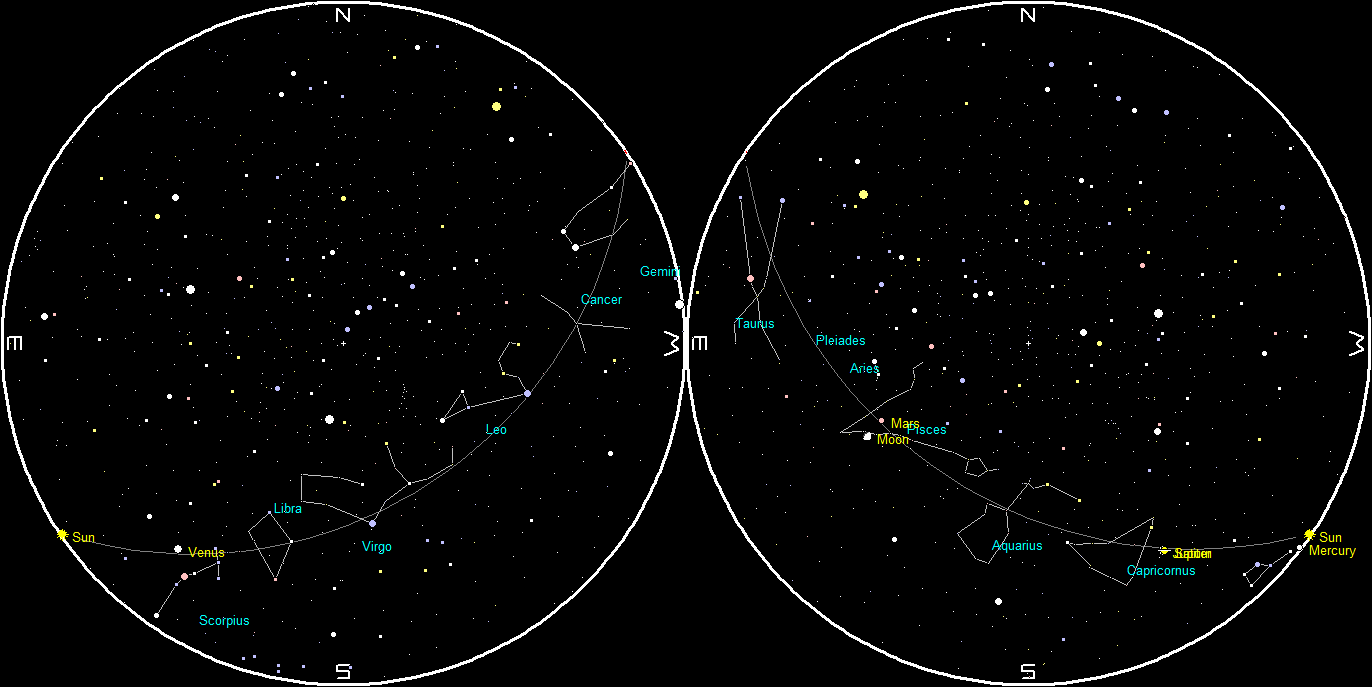
Planets and the Moon at sunset and sunrise of a single night starting with sunset on the right on December 23, 2020. The night ends on the left with sunrise on the 24th. I’m afraid that the labels for Jupiter and Saturn will overlap, since the planets are very close. Click on the image to enlarge. Created using my LookingUp program.
12/16/2020 – Ephemeris – Let’s look for the naked-eye planets for this week
This is Bob Moler with Ephemeris for Wednesday, December 16th. Today the Sun will be up for 8 hours and 48 minutes, setting at 5:03, and it will rise tomorrow at 8:14. The Moon, 2 days past new, will set at 7:09 this evening.
Let’s look for the naked-eye planets for this week. Jupiter and Saturn are both low in the southwestern sky from 6 to 7 pm. Jupiter is the very bright one. Above and left it by half a degree or one moon width will be dimmer Saturn. Below them tonight will be the thin crescent Moon. They will cross paths for us on the evening of December 21st and be seen in the same low power telescope field that evening. Jupiter will set first tonight at 7:40 pm with Saturn following four minutes later. Quite high in the southeast at that hour will be Mars, still in Pisces. Mars’ distance is increasing to 71 million miles (114 million kilometers) away. It will set at 2:55 tomorrow morning. Brilliant Venus will rise at 6:16 am in the east-southeast as it seems to retreat slowly toward the Sun, but actually it’s heading way around behind the Sun.
The event times given are for the Traverse City/Interlochen area of Michigan. They may be different for your location.
Addendum
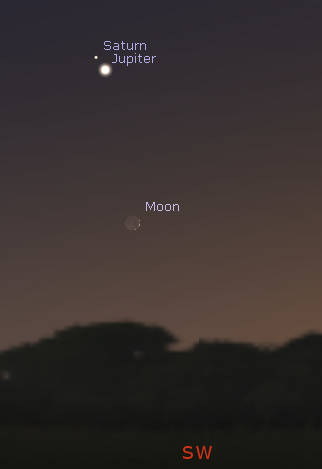
Jupiter and Saturn with Moon at 6 pm tonight December 16, 2020. Created using Stellarium.
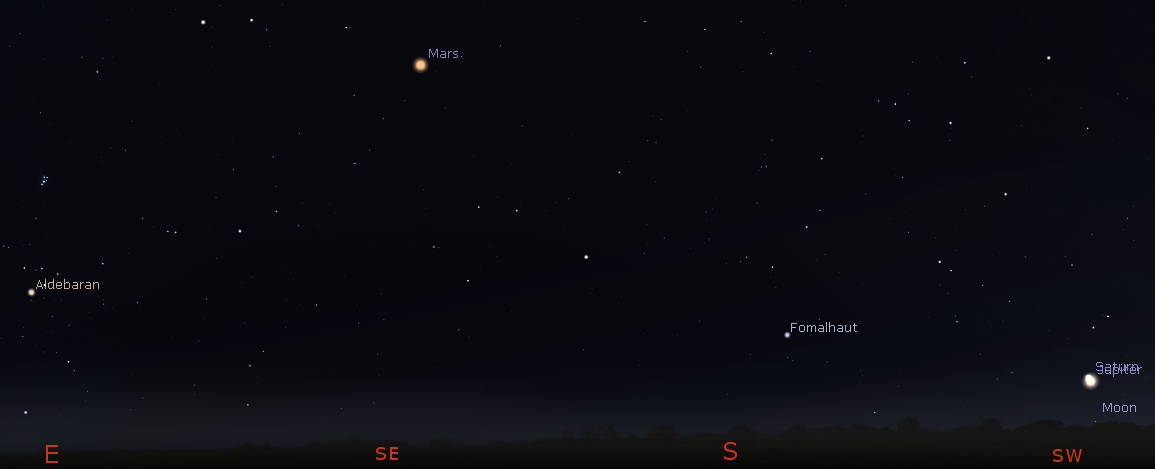
Evening planet panorama showing Mars, Jupiter, Saturn and the Moon setting at 6:30 pm December 16, 2020. Click on the image to enlarge. Created using Stellarium.
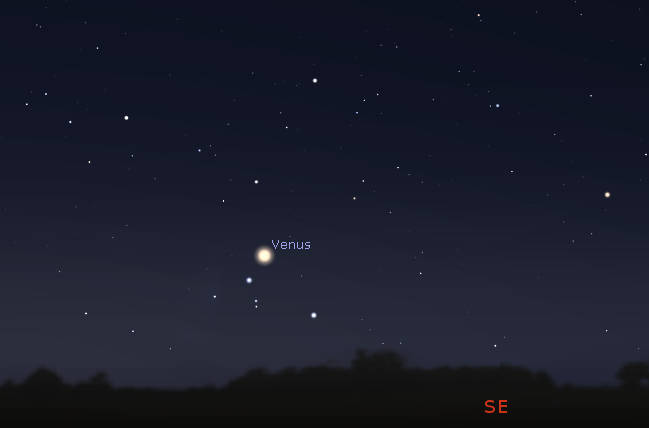
Venus low in the southeast at 7 am December17, 2020. Venus is all by its lonesome in the morning sky. No need for a panorama, so we’re zoomed in a bit. The morning sky has is not as friendly to morning planets as it was earlier in autumn season as we embark into winter next week. Created using Stellarium.
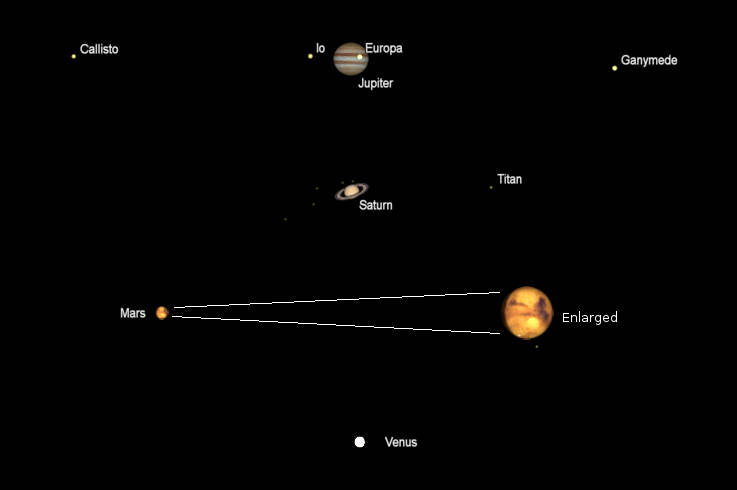
The planets as seen in a telescope (north up) with the same magnification for the night of December 16/17, 2020. Times of the display are: Jupiter and Saturn, 6 pm and Mars, 8 pm; Venus, 7 am. Apparent diameters: Jupiter, 33.49″; Saturn, 15.41″, rings, 35.90″; Mars, 12.20″, and Venus, 11.10″. Europa is transiting Jupiter and will be generally invisible. Mars also displays an enlargement showing surface detail. Mars was closest to the Earth this go-a-round on October 6. The ” symbol means seconds of arc (1/3600th of a degree.) Created using Cartes du Ciel (Sky Charts).
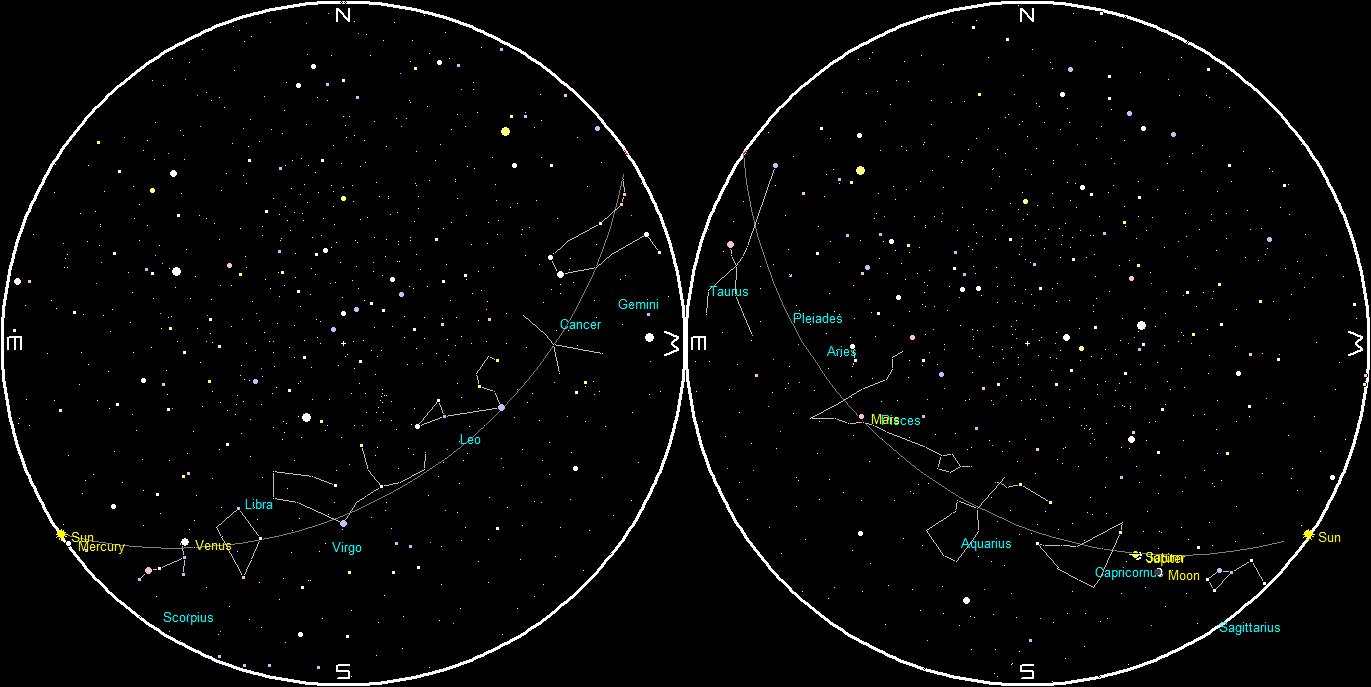
Planets and the Moon at sunset and sunrise of a single night starting with sunset on the right on December 16, 2020. The night ends on the left with sunrise on the 17th. I’m afraid that the labels for Jupiter and Saturn will overlap, since the planets are getting very close. Click on the image to enlarge. Created using my LookingUp program.
12/09/2020 – Ephemeris – A look at the naked-eye planets for this week
This is Ephemeris for Wednesday, December 9th. Today the Sun will be up for 8 hours and 53 minutes, setting at 5:02, the earliest sunset, and it will rise tomorrow at 8:09. The Moon, 2 days past last quarter, will rise at 2:55 tomorrow morning.
Let’s look for the naked-eye planets for this week. Jupiter and Saturn are both low in the southwestern sky from 6 to 7 pm. Jupiter is the very bright one. Above and left it by one and a half degrees or three moon widths will be dimmer Saturn. They are slowly closing, so they will cross paths for us on the evening of December 21st and be seen in the same low power telescope field that evening. Jupiter will set first tonight at 8 pm with Saturn following at 8:08. Quite high in the southeast at that hour will be Mars, still in Pisces. Mars’ distance is increasing to 65.3 million miles (105.2 million km) away. It will set at 3:10 tomorrow morning. Brilliant Venus will rise at 5:58 am in the east-southeast as it retreats slowly towards the Sun, but actually it’s heading around behind the Sun.
The event times given are for the Traverse City/Interlochen area of Michigan. They may be different for your location.
Addendum
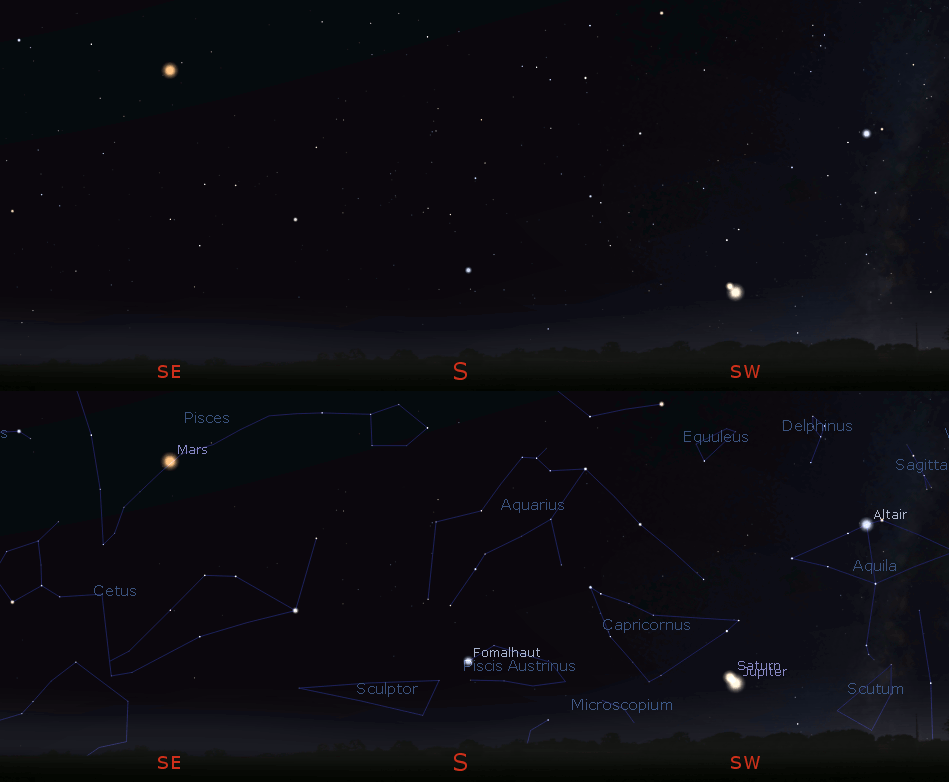
The evening planets seen at 6:30 pm or about an hour and a half after sunset December 9, 2020. Animation showing non-annotated sky and then with annotations. Click on the image to enlarge. Created using Stellarium and GIMP.
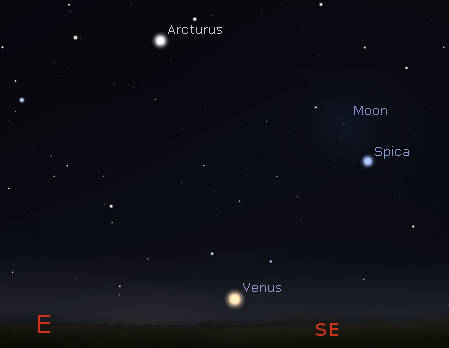
Venus and the waning crescent Moon at 6:30 am on December 10, 2020. Created using Stellarium.
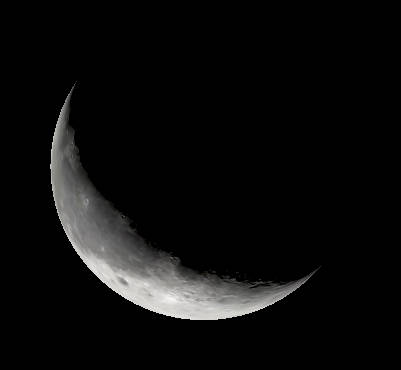
The waning crescent Moon as it might appear in binoculars or a small telescope at 6:30 am December 10, 2020. Created using Stellarium.
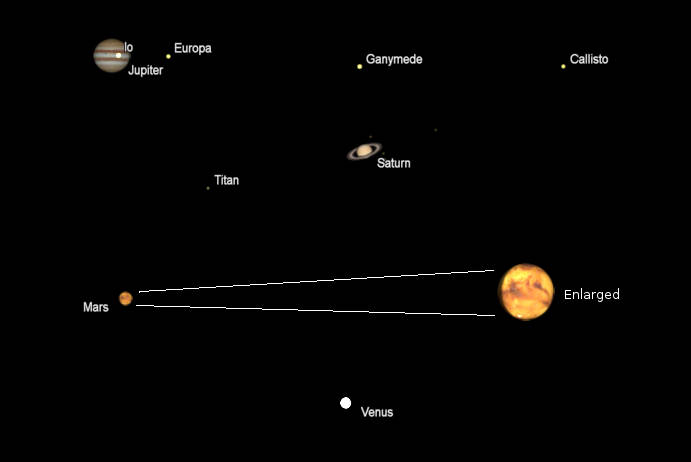
The planets as seen in a telescope (north up) with the same magnification for the night of December 9/10, 2020. Times of the display are: Jupiter, Saturn and Mars, 6:30 pm; Venus, 6:30 am. Apparent diameters: Jupiter, 33.85″; Saturn, 15.51″, rings, 36.13″; Mars, 13.18″, and Venus 11.32″. Io is transiting Jupiter and will be generally invisible. Mars also displays an enlargement showing surface detail. Mars was closest to the Earth this go-a-round on October 6. The ” symbol means seconds of arc (1/3600th of a degree). Created using Cartes du Ciel (Sky Charts).
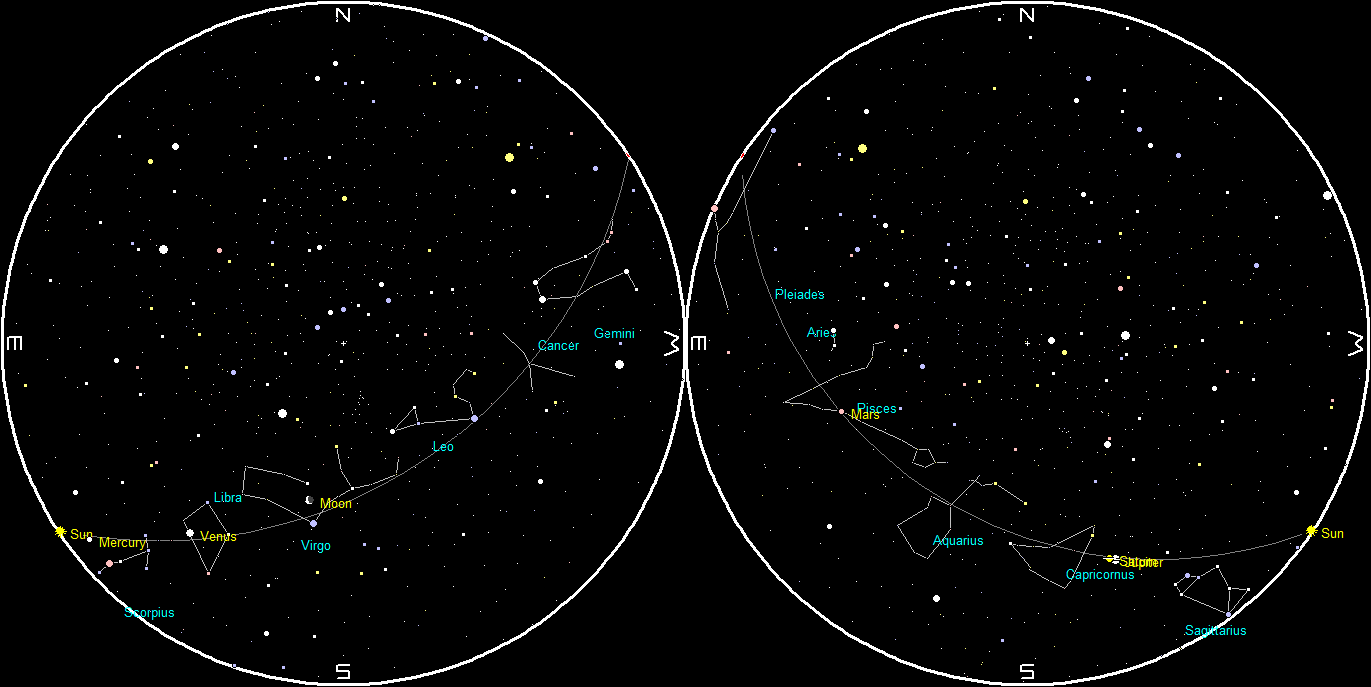
Planets and the Moon at sunset and sunrise of a single night starting with sunset on the right on December 9, 2020. The night ends on the left with sunrise on the 10th. I’m afraid that the labels for Jupiter and Saturn will overlap, since the planets are getting very close. Click on the image to enlarge. Created using my LookingUp program.
12/02/2020 – Ephemeris – A look at the naked-eye planets for this week
This is Ephemeris for Wednesday, December 2nd. Today the Sun will be up for 9 hours and 1 minute, setting at 5:03, and it will rise tomorrow at 8:02. The Moon, 2 days past full, will rise at 6:51 this evening.
Let’s look for the naked-eye planets for this week. Jupiter and Saturn are both low in the southwestern sky from 7 to 8 pm. Jupiter is the very bright one. Above and left it by 2 degrees or 4 moon widths will be dimmer Saturn. They are slowly closing, so they will cross paths on the evening of December 21st and be seen in the same telescope field that evening. Jupiter will set first tonight at 8:20 with Saturn following at 8:32. Quite high in the southeast at that hour will be Mars, still in Pisces. Mars’ distance is increasing to 60.2 million miles (97.0 million km) away. Mars will set at 3:27 tomorrow morning. Brilliant Venus will rise at 5:40 am in the east-southeast as it retreats slowly towards the Sun, but actually it’s heading around behind the Sun.
The event times given are for the Traverse City/Interlochen area of Michigan. They may be different for your location.
Addendum
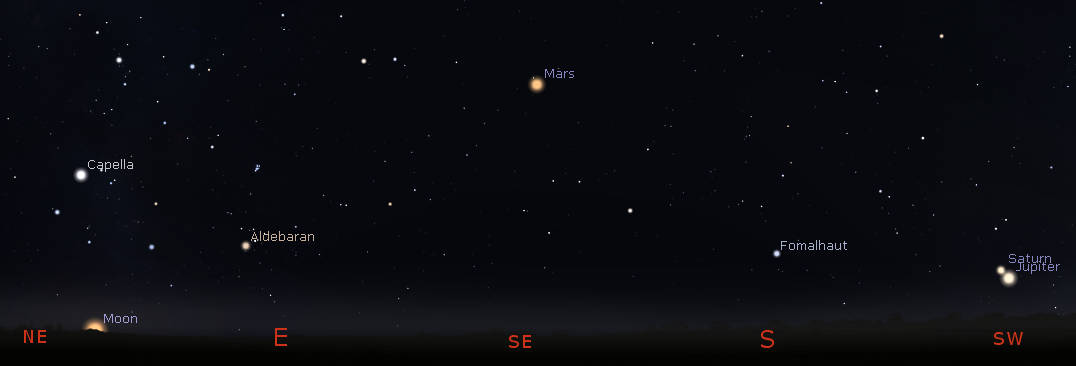
The evening planets with the Mon rising at 7 pm tonight December 2, 2020. Click on the image to enlarge. Created using Stellarium.
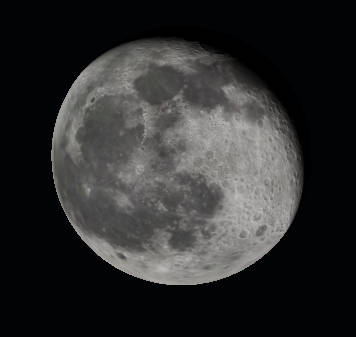
The Moon as it might be seen tonight at 9 pm, December 2, 2020. Created using Stellarium.
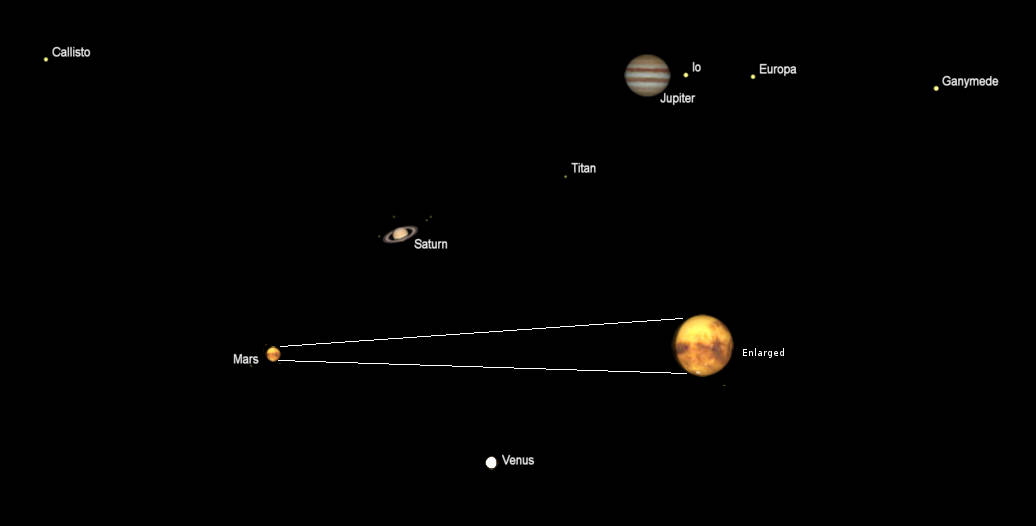
The planets as seen in a telescope (north up) with the same magnification for the night of November 25/26, 2020. Times of the display are: Jupiter, Saturn and Mars, 7 pm; Venus, 6:30 am. Apparent diameters: Jupiter, 34.28″; Saturn, 15.63″, rings, 36.41″; Mars, 14.27″; and Venus, 11.57″. Mars also displays an enlargement showing surface detail. Mars was closest to the Earth this go-a-round on October 6. The ” symbol means seconds of arc (1/3600th of a degree.) Click on the image to enlarge. Created using Cartes du Ciel (Sky Charts).
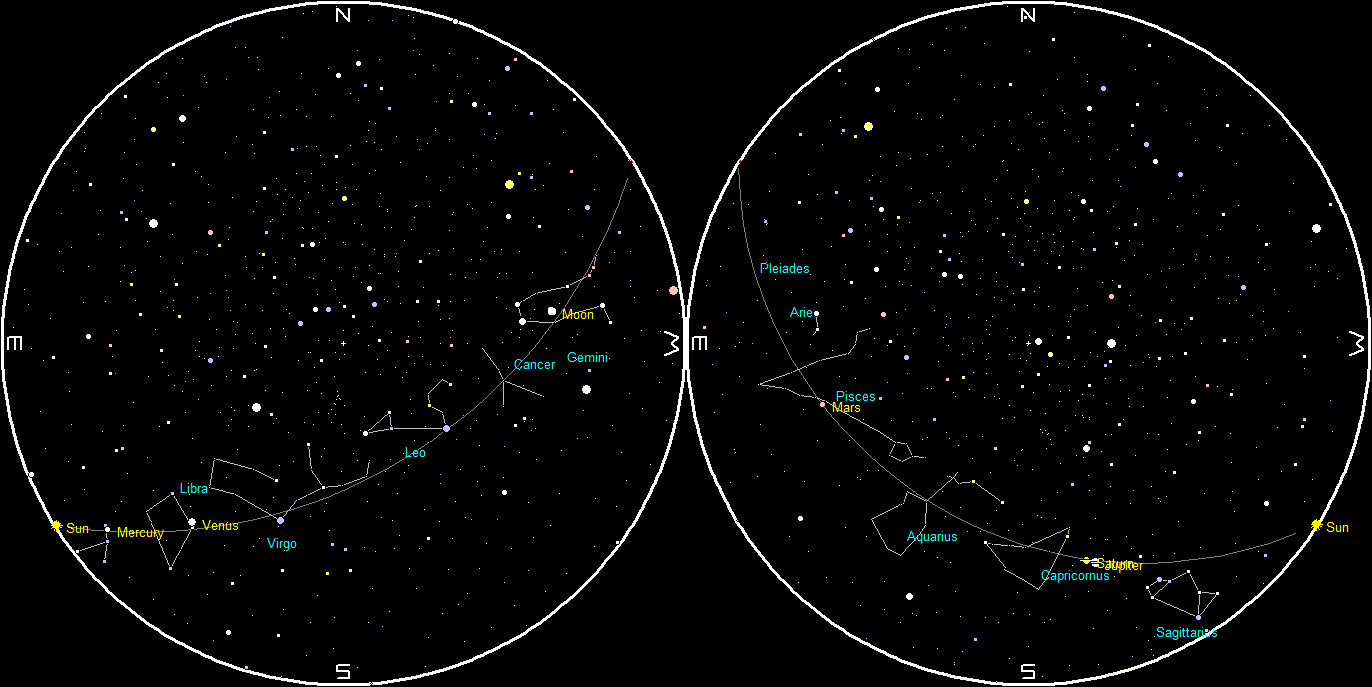
Planets and the Moon at sunset and sunrise of a single night starting with sunset on the right on December 2, 2020. The night ends on the left with sunrise on the 3rd. I’m afraid that the labels for Jupiter and Saturn will overlap, since the planets are getting very close. Click on the image to enlarge. Created using my LookingUp program.
11/25/2020 – Ephemeris – Let’s look for the naked-eye planets for this week
This is Ephemeris for Wednesday, November 25th. Today the Sun will be up for 9 hours and 12 minutes, setting at 5:06, and it will rise tomorrow at 7:54. The Moon, 4 days past first quarter, will set at 3:58 tomorrow morning.
Let’s look for the naked-eye planets for this week. Jupiter and Saturn are both low in the southwestern sky from 7 to 8 pm. Jupiter is the very bright one. Above and left will be dimmer Saturn. They are slowly closing, so they will cross paths on the evening of December 21st and be seen in the same telescope field that evening. Jupiter will set first tonight at 8:41 with Saturn following at 8:56. Off in the southeast at that hour will be Mars above the bright gibbous Moon tonight. Mars’ distance is increasing to 55.6 million miles (89.6 million kilometers) away. Mars will set at 3:47 tomorrow morning. Brilliant Venus will rise at 5:21 am in the east-southeast as it retreats slowly toward, but actually around the back of the Sun.
The event times given are for the Traverse City/Interlochen area of Michigan. They may be different for your location.
Addendum
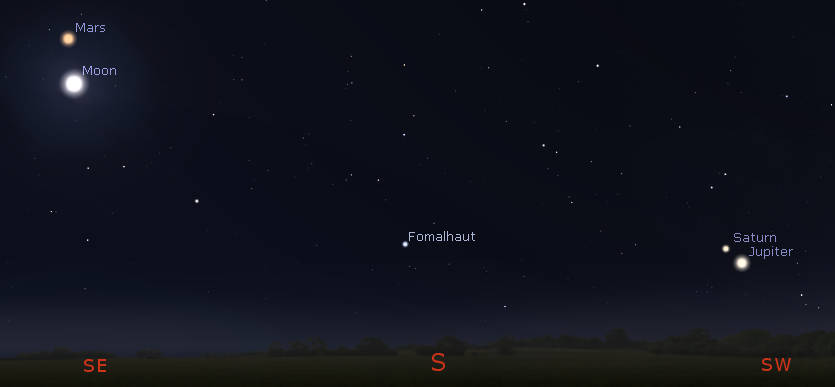
Evening planets and the Moon for 7 pm tonight November 25, 2020. Click on the image to enlarge. Created using Stellarium.
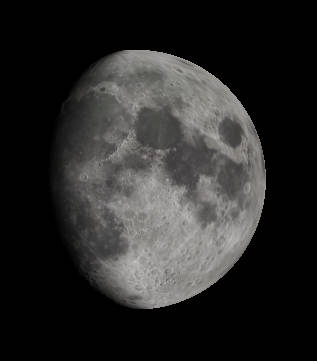
The gibbous Moon as it might be seen in binoculars this evening at 7 pm November 25, 2020. Created using Stellarium.
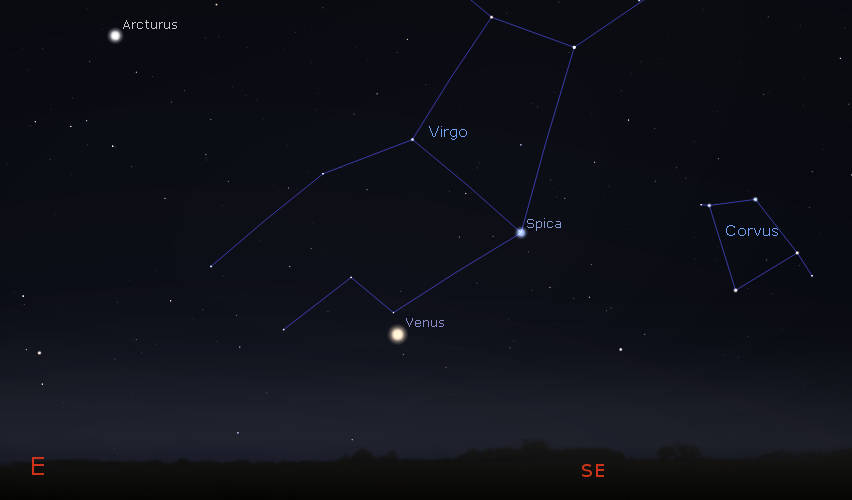
Venus and the morning constellations at 6:30 am tomorrow November 26, 2020. Created using Stellarium.
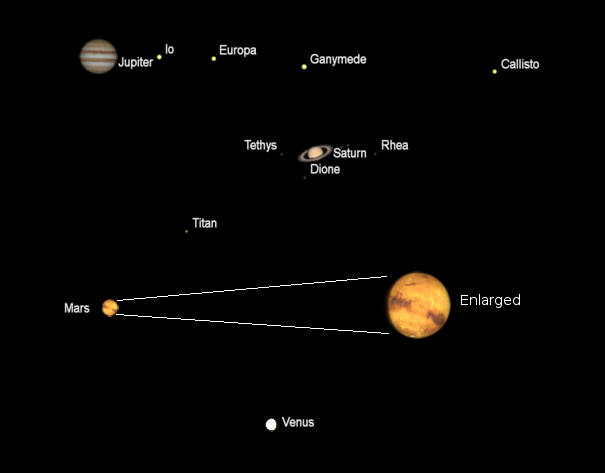
The planets as seen in a telescope (north up) with the same magnification for the night of November 25/26, 2020. Times of the display are: Jupiter and Saturn, 7 pm; Mars, 10 pm; Venus, 6:30 am. Apparent diameters: Jupiter, 34.76″; Saturn, 15.76″, rings, 36.72″; Mars, 15.45″, and Venus 11.85″. Mars also displays an enlargement showing surface detail. Mars was closest to the Earth this go-a-round on October 6. The ” symbol means seconds of arc (1/3600th of a degree.) Created using Cartes du Ciel (Sky Charts).
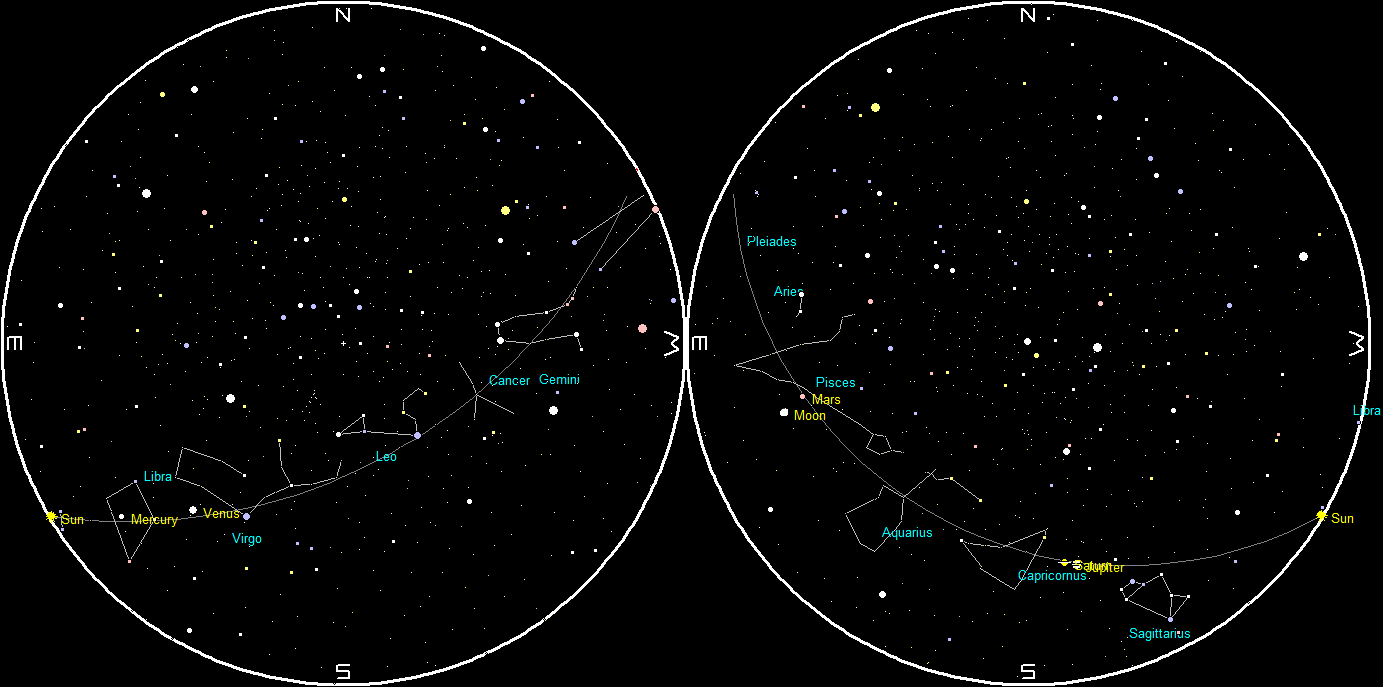
Planets and the Moon at sunset and sunrise of a single night starting with sunset on the right on November 25, 2020. The night ends on the left with sunrise on the 26th. I’m afraid that the labels for Jupiter and Saturn will overlap, since the planets are getting very close. Click on the image to enlarge. Created using my LookingUp program.
11/17/2020 – Ephemeris – Let’s look for the naked-eye planets for this week
This is Bob Moler with Ephemeris for Wednesday, November 18th. Today the Sun will be up for 9 hours and 26 minutes, setting at 5:11, and it will rise tomorrow at 7:45. The Moon, halfway from new to first quarter, will set at 8:24 this evening.
Let’s look for the naked-eye planets for this week. Jupiter and Saturn are both low in the southwestern sky 7 to 8 pm. Jupiter is the very bright one. Above and left it will be the somewhat dimmer Saturn. They are near the Moon tonight. They are slowly closing, so they will cross paths on December 21st and be seen in the same telescope field that evening. Jupiter will set first tonight at 9:02 with Saturn following at 9:21. Off in the southeast at that hour will be Mars. Its distance is increasing to 51.5 million miles (82.9 million kilometers) away. Mars will set at 4:10 tomorrow morning. Brilliant Venus will rise at 5:03 am in the east-southeast as it retreats slowly toward the Sun. Close to ending its morning appearance now is Mercury which will rise at 6:15 am in the east.
The event times given are for the Traverse City/Interlochen area of Michigan. They may be different for your location.
Addendum
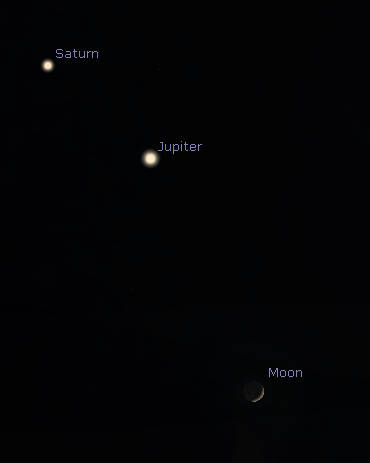
Jupiter, Saturn and Moon low in the southwest at 7:30 pm tonight, November 18, 2020. Created using Stellarium.
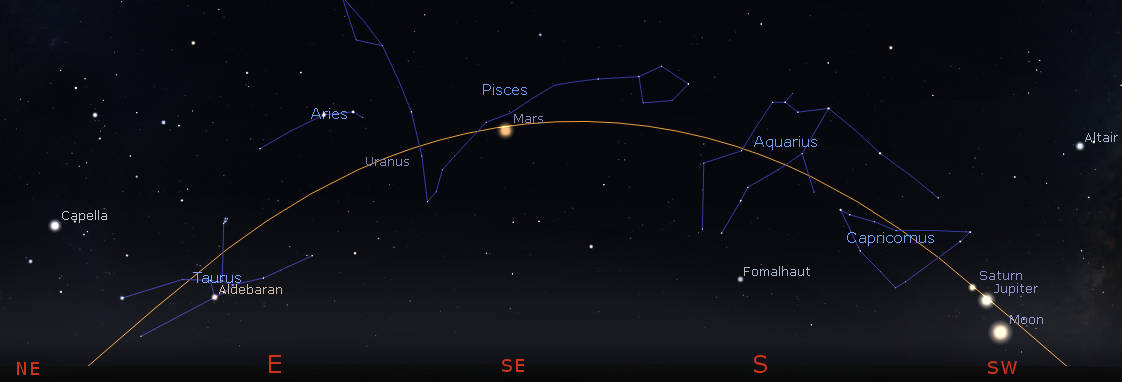
Evening planets, Moon, ecliptic and zodiac at 7:30 pm tonight November 18, 2020. Click on the image to enlarge. Created using Stellarium.
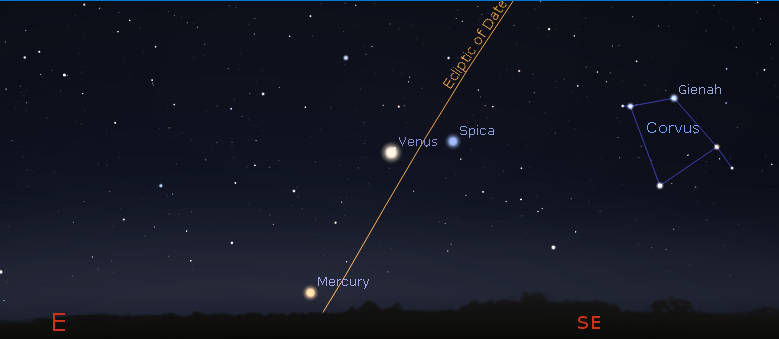
Venus and Mercury with the star Spica, the ecliptic (path of the Sun) and the constellation Corvus at 6:30 tomorrow morning November 19, 2020. Created using Stellarium.
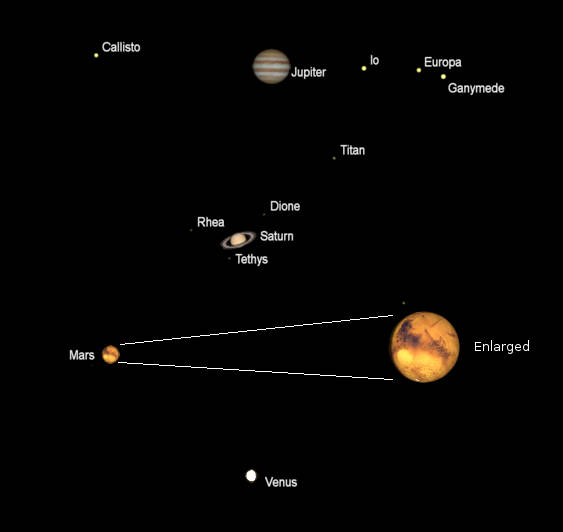
The planets as seen in a telescope (north up) with the same magnification for the night of November 18/19, 2020. Times of the display are: Jupiter and Saturn, 7:30 pm; Mars, 10 pm; Venus, 6:30 am. Apparent diameters: Jupiter, 35.30″; Saturn, 15.91″, rings, 37.06″; Mars, 16.72″, and Venus 12.15″. Mars also displays an enlargement showing surface detail. Mars was closest to the Earth this go-a-round on October 6. The ” symbol means seconds of arc (1/3600th of a degree.) Created using Cartes du Ciel (Sky Charts).
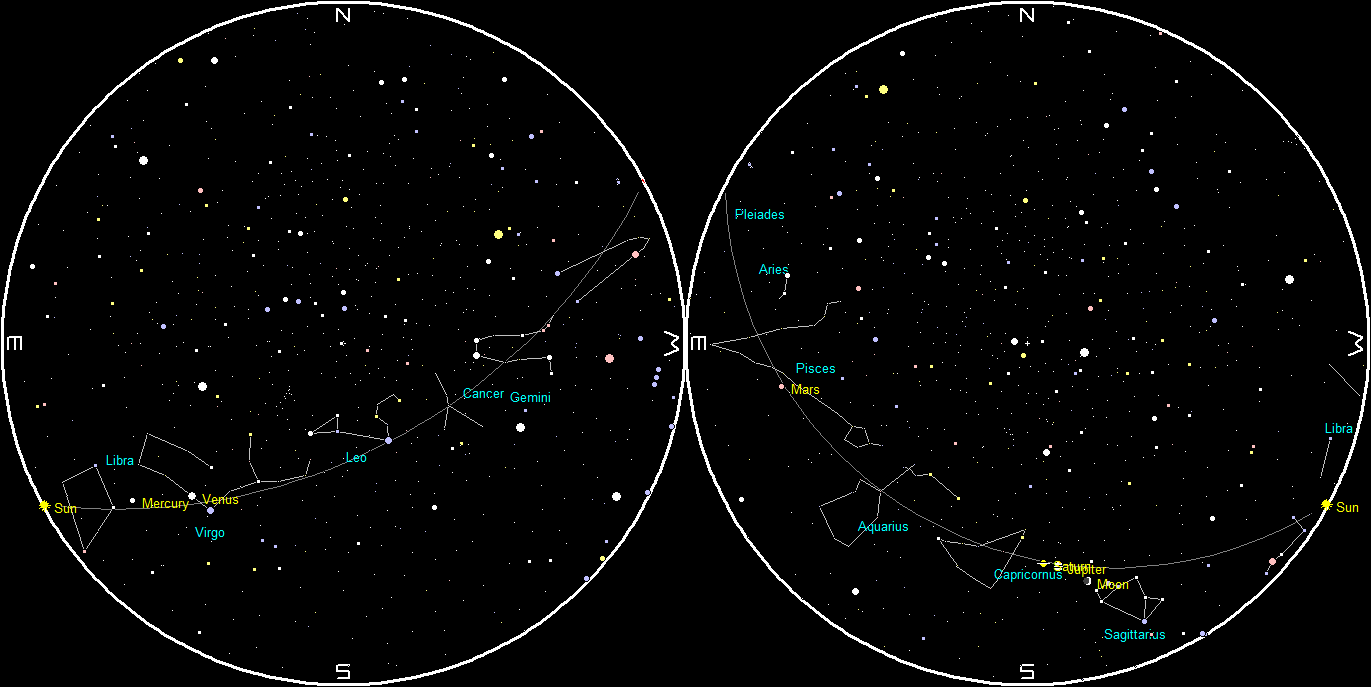
Planets and the Moon at sunset and sunrise of a single night starting with sunset on the right on November 18, 2020. The night ends on the left with sunrise on the 19th. I’m afraid that the labels for Jupiter and Saturn will overlap, since the planets are getting very close. Click on the image to enlarge. Created using my LookingUp program.
 Bob Moler's Ephemeris Blog