Archive
11/02/2022 – Ephemeris – Let’s see where the naked-eye planets have wandered off to this week
This is Bob Moler with Ephemeris for Wednesday, November 2nd. The Sun will rise at 8:22. It’ll be up for 10 hours and 7 minutes, setting at 6:29. The Moon, 1 day past first quarter, will set at 2:38 tomorrow morning.
Let’s see where the naked-eye planets have wandered off to this week. Jupiter and Saturn will be visible this evening, in the southeastern sky with the bright moon between them, as soon after sunset as it will be dark enough to see them, which would be by 7:45 pm. Jupiter is the brighter of the two to the left of the Moon, while dimmer Saturn is closer to the Moon on the right. The red planet Mars, though a morning planet, will rise tonight at 8:46 pm in the northeast. It’s located between the tips of the long horns of Taurus the bull, slowly moving northward between those horn tip stars in its big torn to the west among the stars. By seven tomorrow morning, the red planet Mars will be fairly high in the southwestern sky, above and right of the winter constellation of Orion.
The astronomical event times given are for the Traverse City/Interlochen area of Michigan (EDT, UT – 4 hours). They may be different for your location.
Addendum
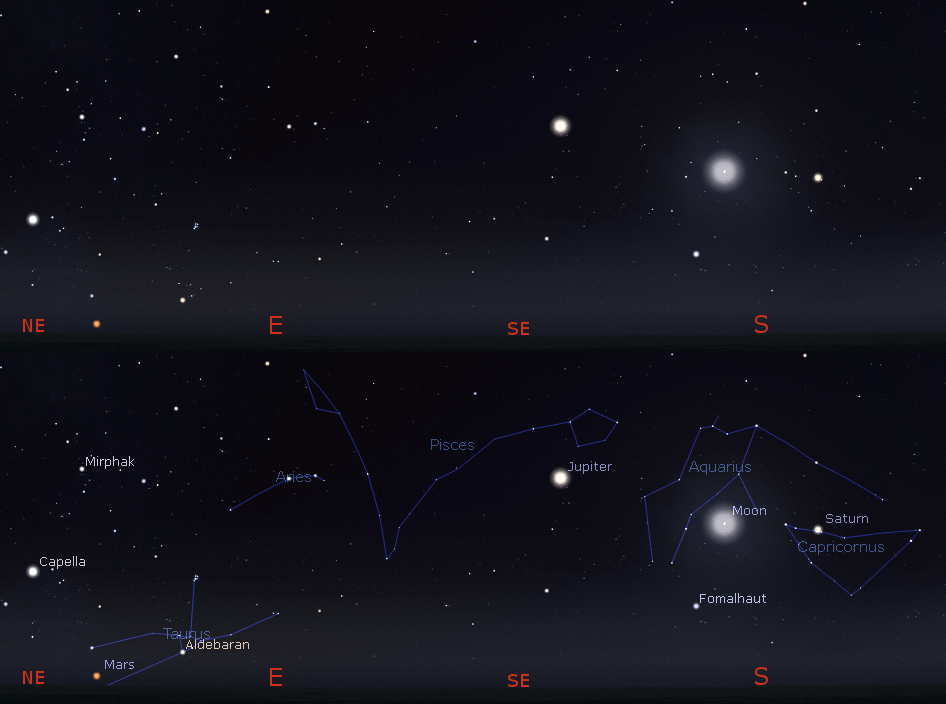
Planets and the Moon visible in the evening. Jupiter and Saturn in the south with Mars, rising in the northeast. Mars is not yet an evening planet. It’s still more than a month away from rising before sunset and becoming one. Click on the image to enlarge it. Created using Stellarium and GIMP.
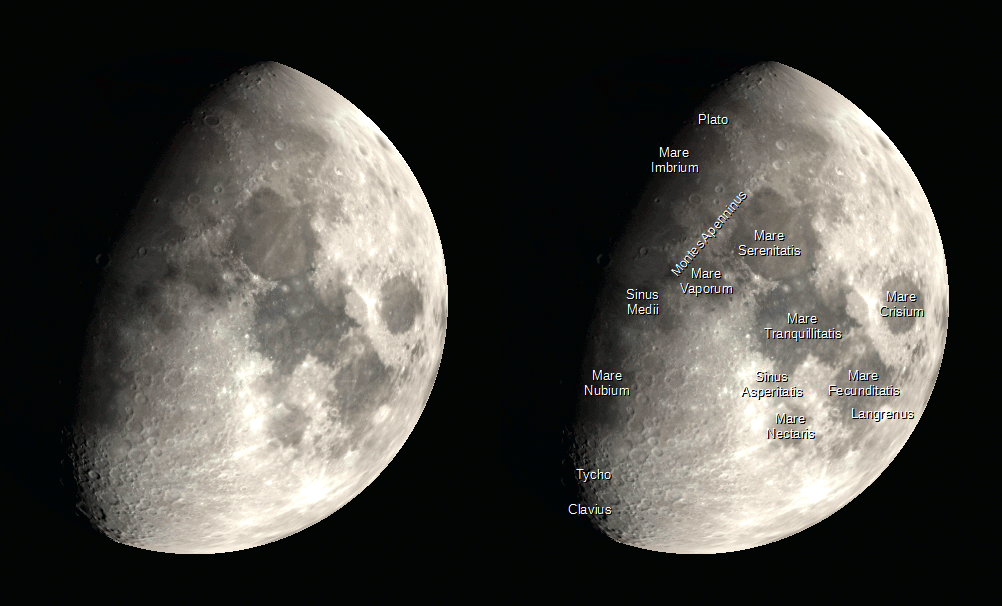
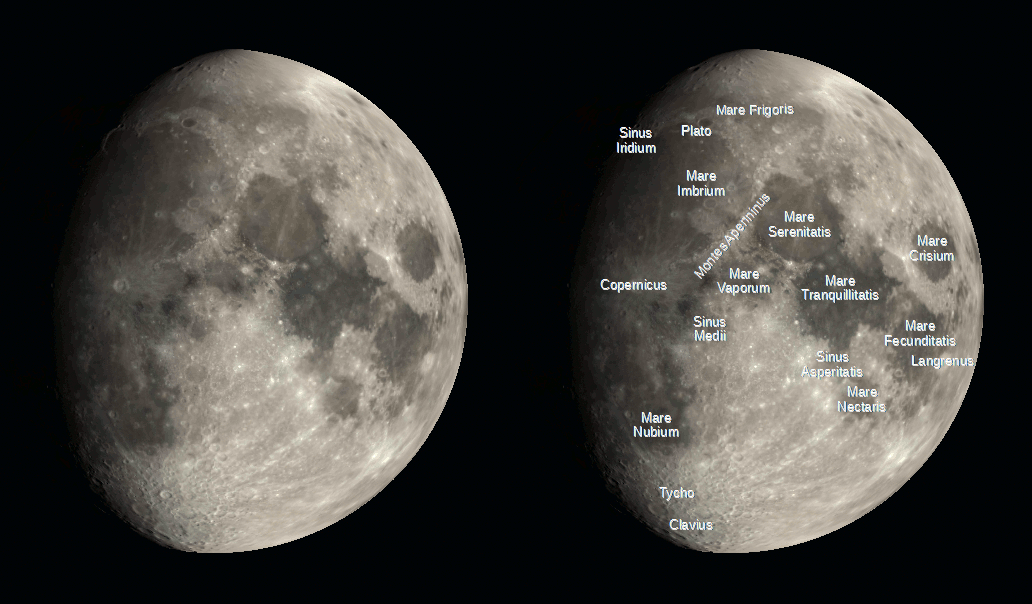
The Moon as it might be seen in binoculars or small telescope tonight, November 2, 2022 with labels of prominent features. Created using Stellarium, LibreOffice Draw and GIMP.
Translations of some lunar feature names according to Virtual Moon Atlas
Mare Crisium – Sea of Crises
Mare Fecunditatis – Sea of Fertility
Mare Imbrium – Sea of Showers
Mare Nubium – Sea of Clouds
Mare Serenitatis – Sea of Serenity
Mare Tranquillitatis – Sea of Tranquility
Mare Vaporum – Sea of Vapors
Montes Apenninus – Apennines Mountains
Sinus Asperitatis – Golfe des Asperites
Sinus Medii – Bay of the Center
Craters are generally named after astronomers, people of science, or explorers
Note that Mare is pronounced Mar-é
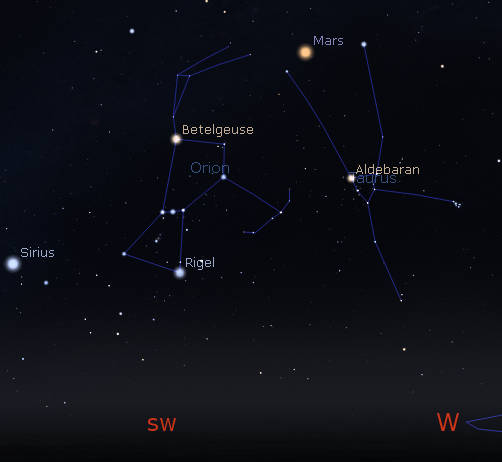
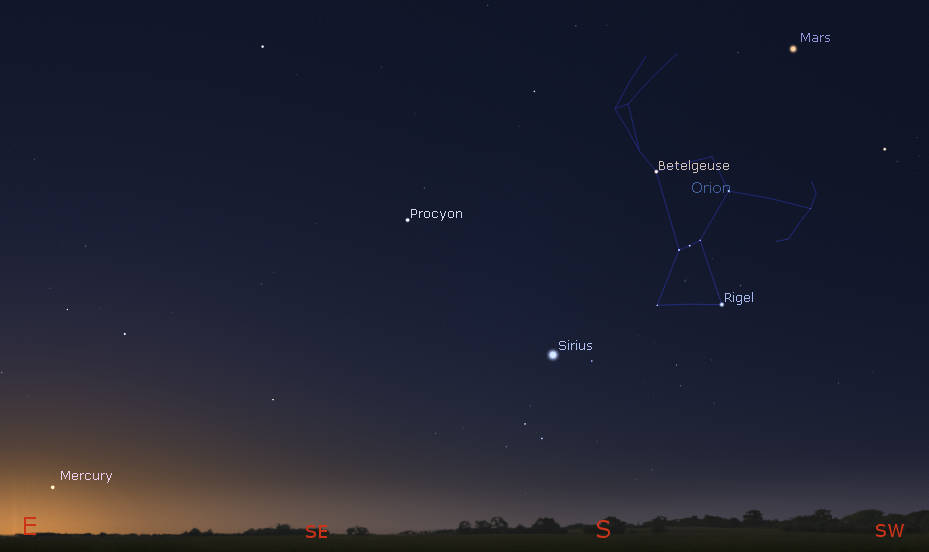
Mars in the at 7 am tomorrow morning, November 3, 2022. Created using Stellarium.
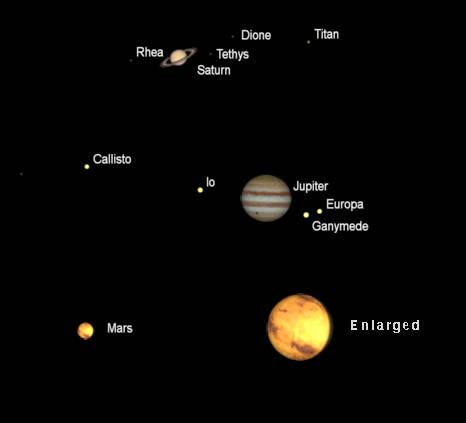
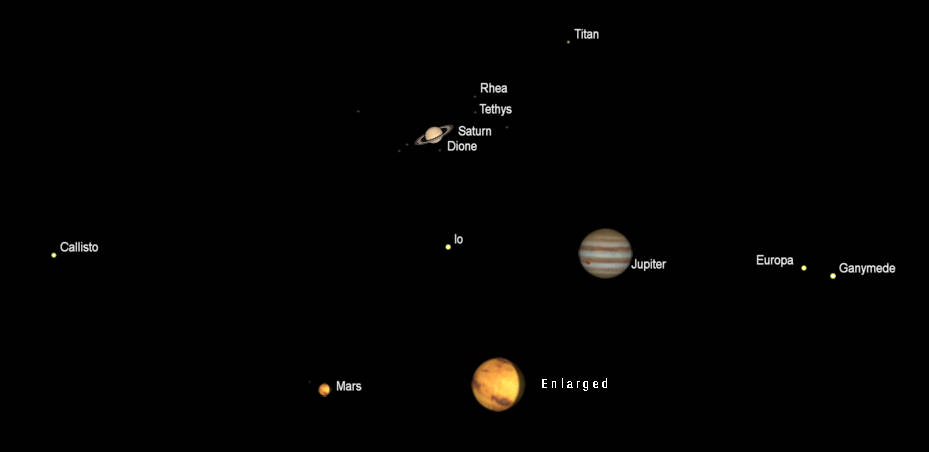
Telescopic views of Saturn Jupiter and Mars (north up) as they would be seen in a small telescope, with the same magnification. The image of Mars doesn’t show it, but the white north polar cap will appear at the top or north limb of Mars. Saturn and Jupiter are shown at 9 pm, Mars at 11 pm. Apparent diameters: Saturn 17.20″, its rings 40.07″; Jupiter 47.37″. Mars 15.34″. Mars’ distance is 56.7 million miles (91.4 million kilometers). The ” symbol means seconds of arc (1/3600th of a degree.) Click on the image to enlarge it. Created using Cartes du Ciel (Sky Charts).
A note on Jupiter and its moons: Before 7:56 pm, Io will be in Jupiter’s shadow. At 8:22 pm, Ganymede’s shadow will begin to cross the face of Jupiter. In the image above, the shadow, a small dot, is seen on the lower left of the disk. Europa’s shadow was on the disk prior to 9 pm. Ganymede’s shadow will leave the disk at 11:08 pm. Shadows cross Jupiter’s disk from east to west (right to left) in this view.
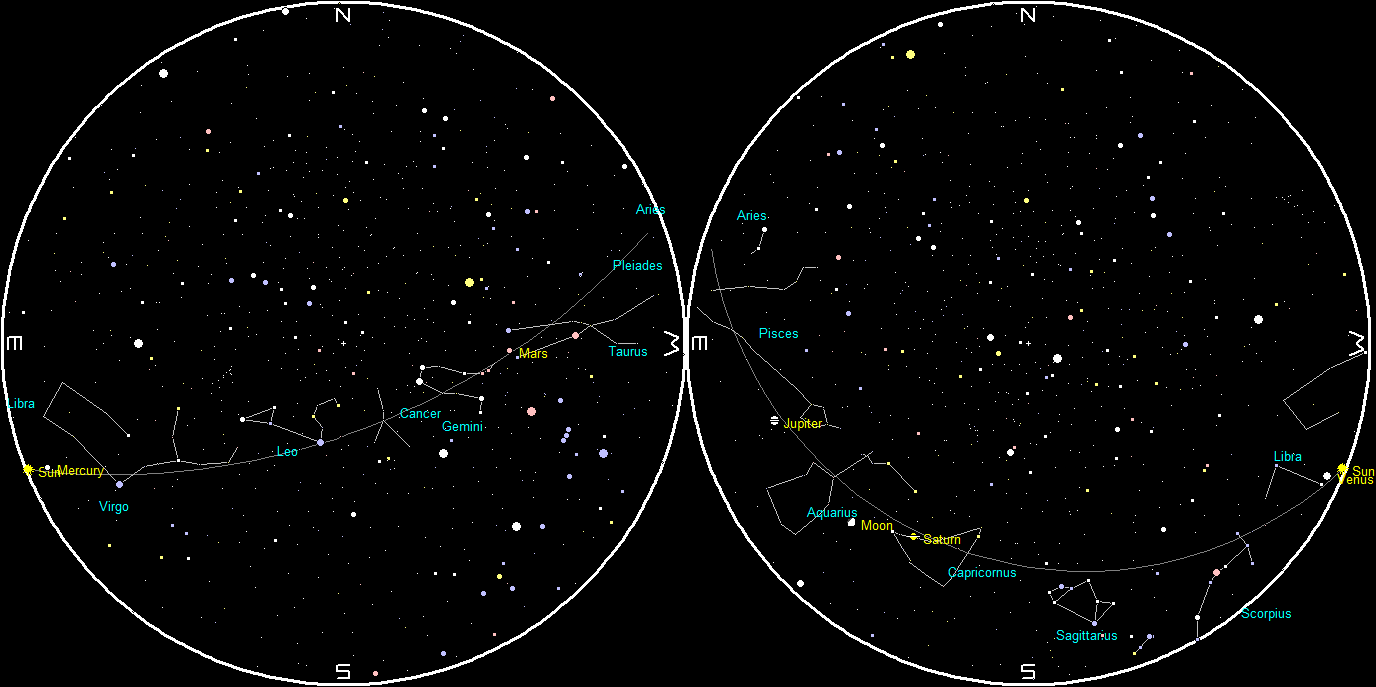
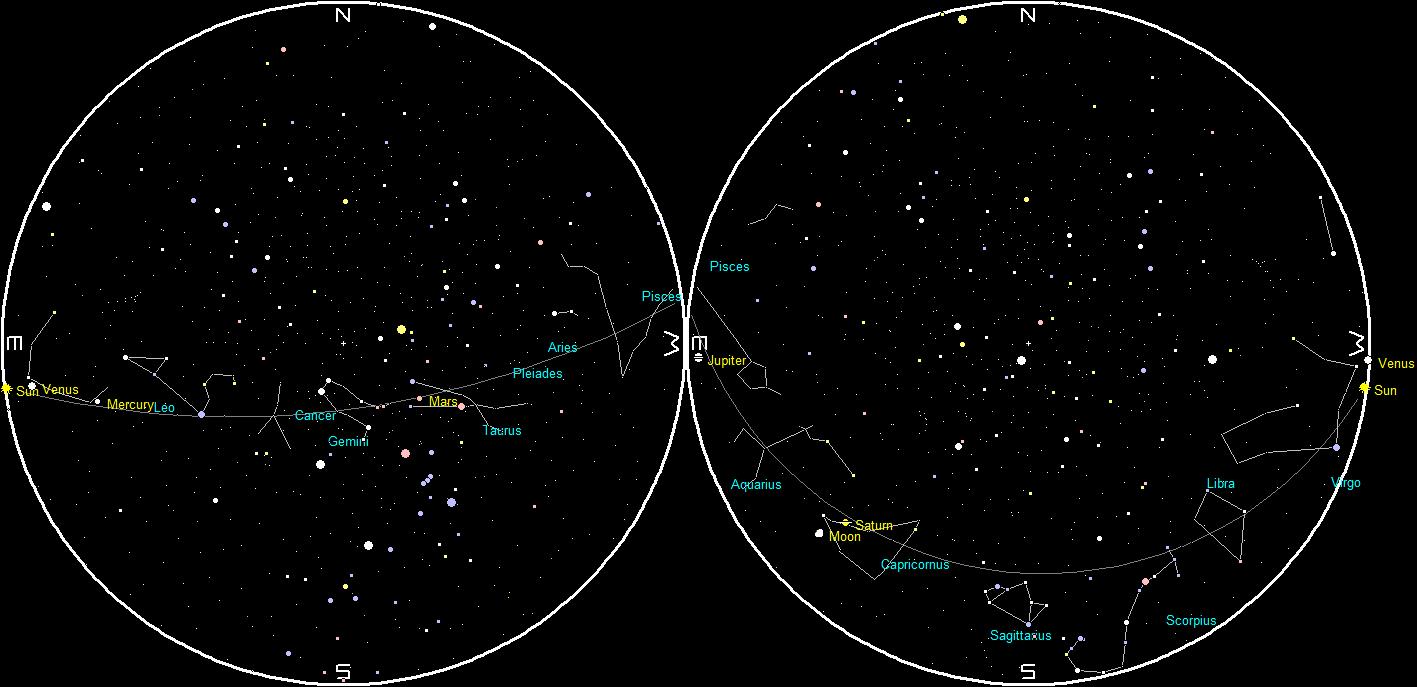
The naked-eye planets and the Moon at sunset and sunrise on a single night, starting with sunset on the right on November 2, 2022. The night ends on the left with sunrise on the 3rd. Click on the image to enlarge it. Created using my LookingUp app and GIMP.
10/26/2022 – Ephemeris – Let’s see where the naked-eye planets have wandered off to this week
This is Bob Moler with Ephemeris for Wednesday, October 26th. Today the Sun will be up for 10 hours and 27 minutes, setting at 6:40, and it will rise tomorrow at 8:14. The Moon, 1 day past new, will set at 7:21 this evening.
Let’s see where the naked-eye planets have wandered off to this week. Jupiter and Saturn will be visible this evening, in the east-southeast and south-southeast respectively, as soon after sunset as it will be dark enough to see them, which would be by 7:45 pm. Jupiter is seen against the stars of Pisces the fish, while Saturn is spotted in the eastern end of Capricornus the sea goat. The red planet Mars, though a morning planet, will rise tonight at 9:15 pm in the northeast. It’s located between the tips of the long horns of Taurus the bull. By seven tomorrow morning, the red planet Mars will be high in the southwestern sky, above the winter constellation of Orion. Mars has traveled about as far east as it will get for a while. It will head back westward after Sunday.
The astronomical event times given are for the Traverse City/Interlochen area of Michigan (EDT, UT – 4 hours). They may be different for your location.
Addendum
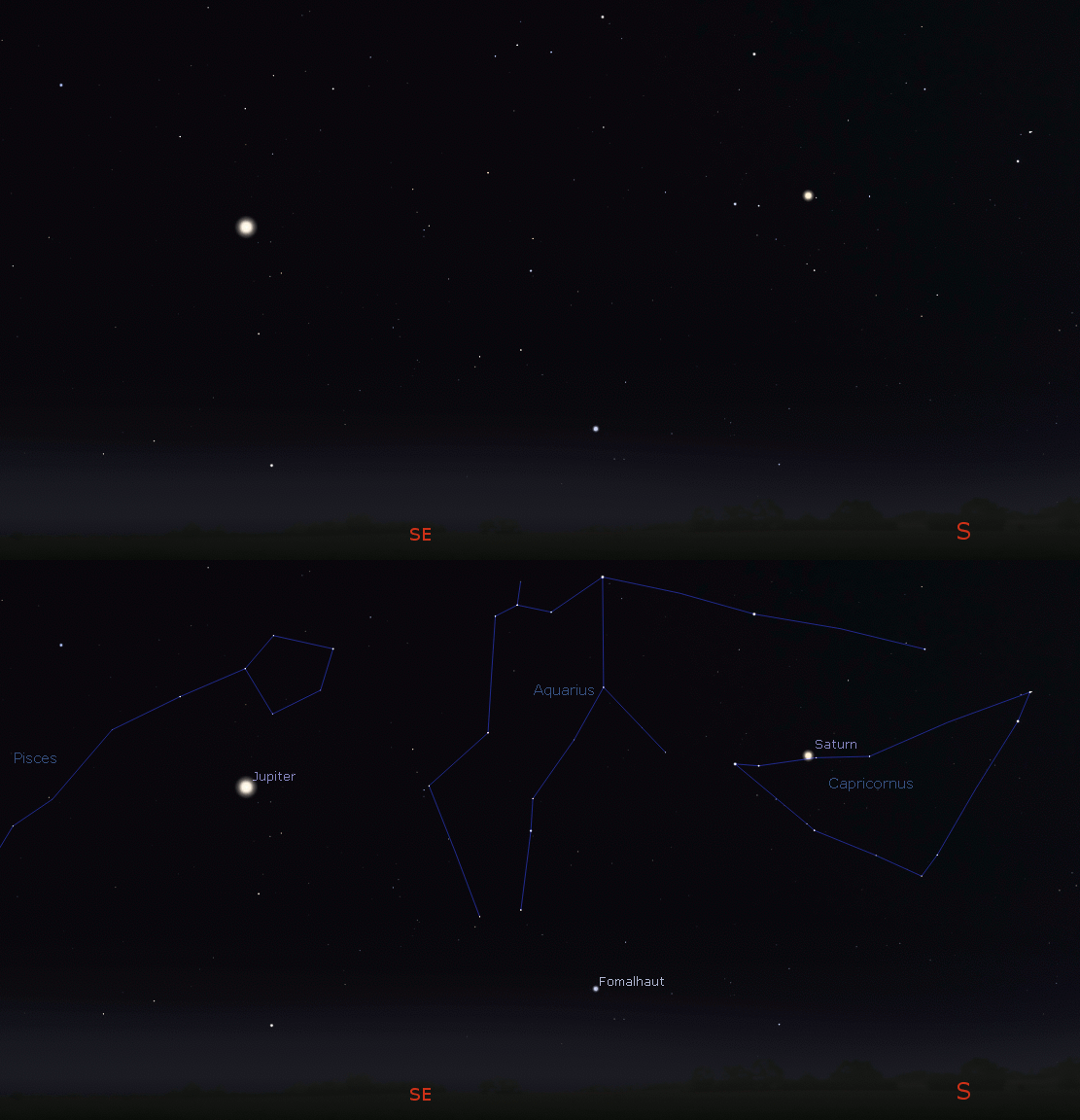
Jupiter and Saturn with label animation for 8 pm tonight, October 26, 2022. Click on the image to enlarge it. Created using Stellarium and GIMP.
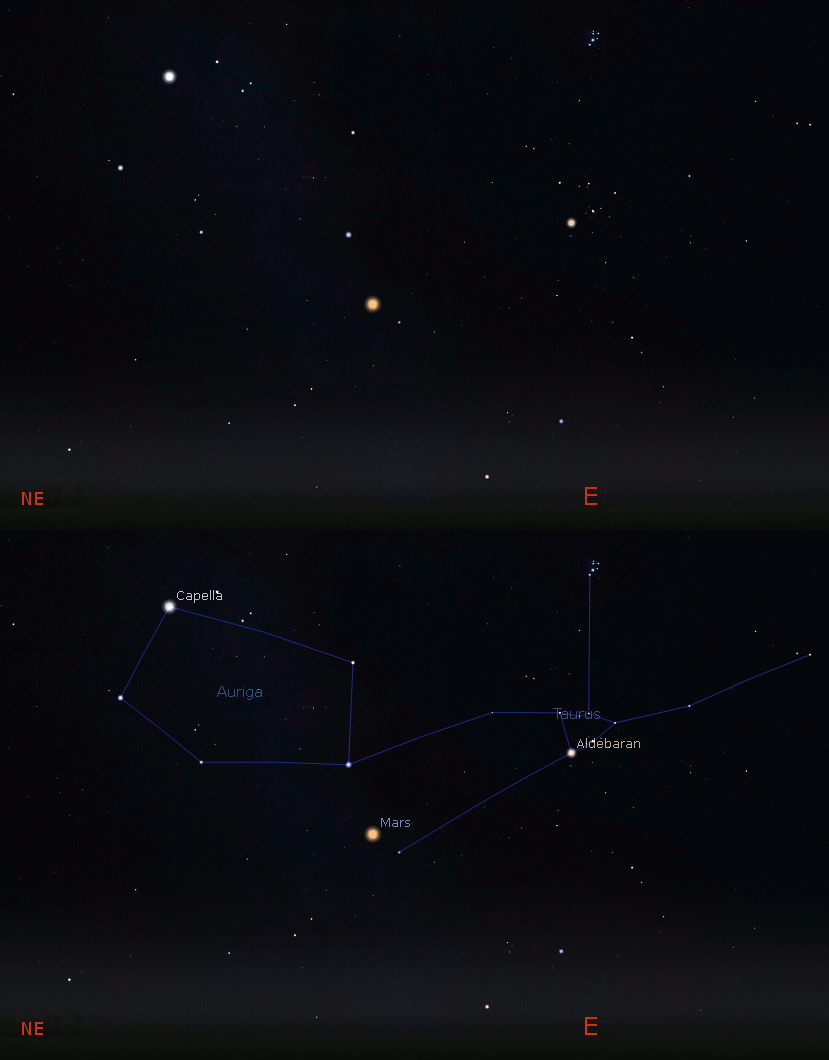
Though Mars is a morning planet, since it is in the sky at sunrise, perhaps the best time to vies it is in the evening after it rises in the east-northeast at 9:15 pm. By 11 pm, as seen here, Mars should be high enough to present a decent image in a telescope. Click on the image to enlarge it. Created using Stellarium.
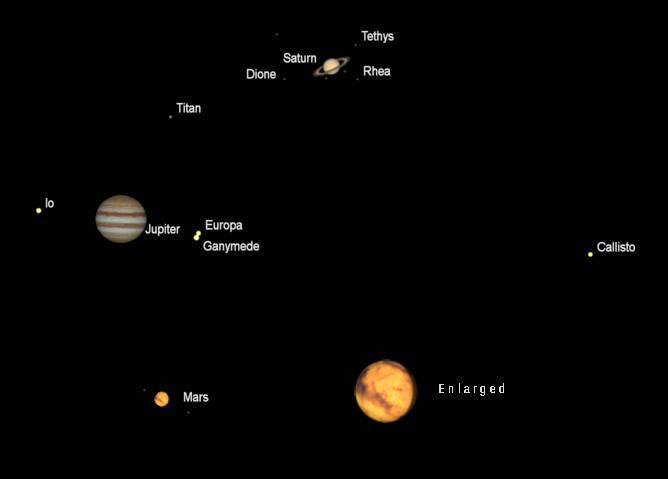
Telescopic views of Saturn Jupiter and Mars (north up) as they would be seen in a small telescope, with the same magnification. The image of Mars doesn’t show it, but the white north polar cap will appear at the top or north limb of Mars. Saturn and Jupiter are shown at 8 pm, Mars at 11 pm. Apparent diameters: Saturn 17.41″, its rings 40.55″; Jupiter 48.16″. Mars 14.58″. Mars’ distance is 59.7 million miles (96.2 million kilometers). The ” symbol means seconds of arc (1/3600th of a degree.) Click on the image to enlarge it. Created using Cartes du Ciel (Sky Charts).
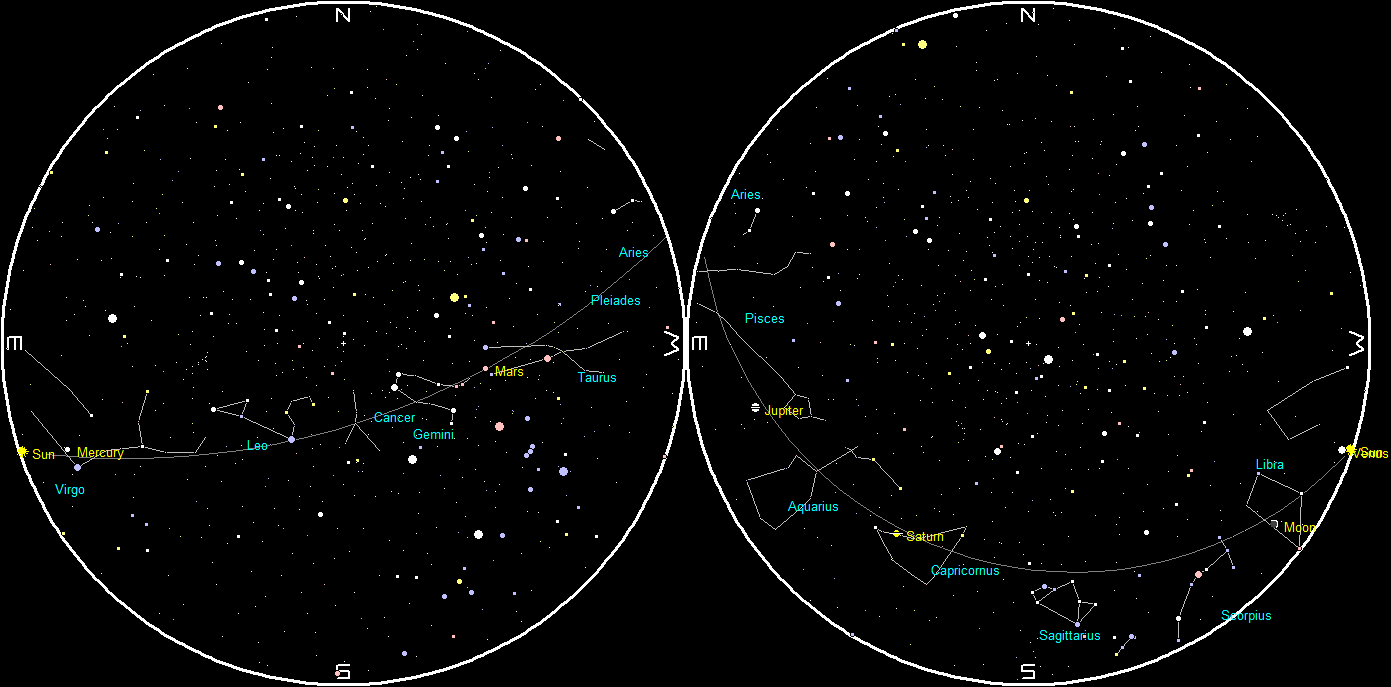
The naked-eye planets and the Moon at sunset and sunrise on a single night, starting with sunset on the right on October 26, 2022. The night ends on the left with sunrise on the 27th. Click on the image to enlarge it. Created using my LookingUp program and GIMP.
10/19/2022 – Ephemeris – Let’s search for the naked-eye planets for this week
This is Bob Moler with Ephemeris for Wednesday, October 19th. Today the Sun will be up for 10 hours and 47 minutes, setting at 6:51, and it will rise tomorrow at 8:04. The Moon, 2 days past last quarter, will rise at 2:29 tomorrow morning.
Let’s search for the naked-eye planets for this week. Jupiter and Saturn will be visible this evening, in the east-southeast and south-southeast respectively, as soon after sunset as it will be dark enough to see them, which would be by 7:45 pm. Jupiter is seen against the stars of Pisces the fish, while Saturn is spotted in the eastern end of Capricornus the sea goat. The red planet Mars, though a morning planet, will rise tonight at 9:41 pm in the northeast. It’s located between the tips of the long horns of Taurus the bull. By seven tomorrow morning, the red planet Mars will be high in the southwestern sky, above the winter constellation of Orion. Tiny Mercury might be spotted very low in the east around 7:30 am for the next few days.
The astronomical event times given are for the Traverse City/Interlochen area of Michigan (EDT, UT – 4 hours). They may be different for your location.
Addendum
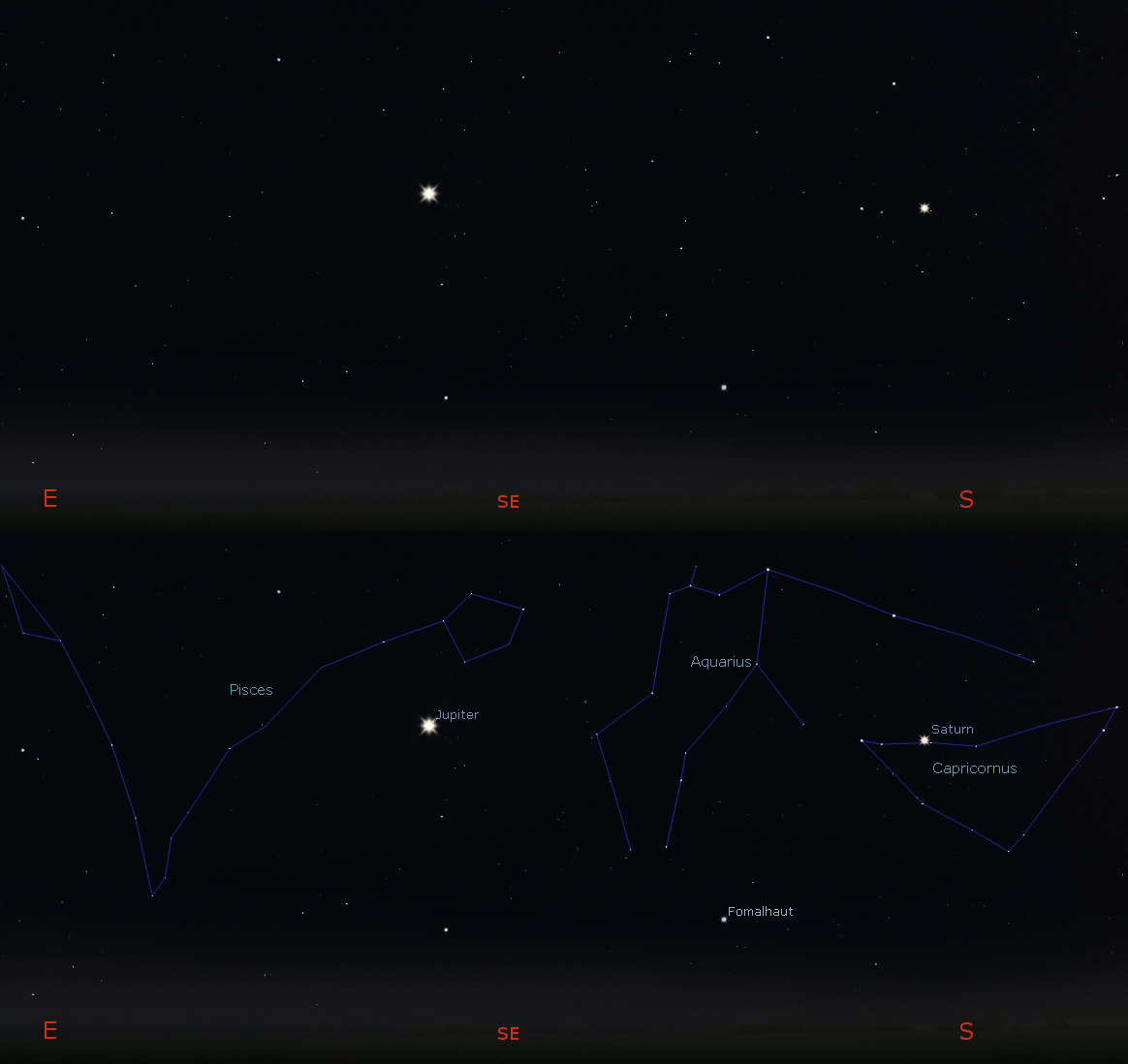
Jupiter and Saturn in the evening finder animation for 9 pm tonight, October 19, 2022. Click on the image to enlarge. Created using Stellarium and GIMP.
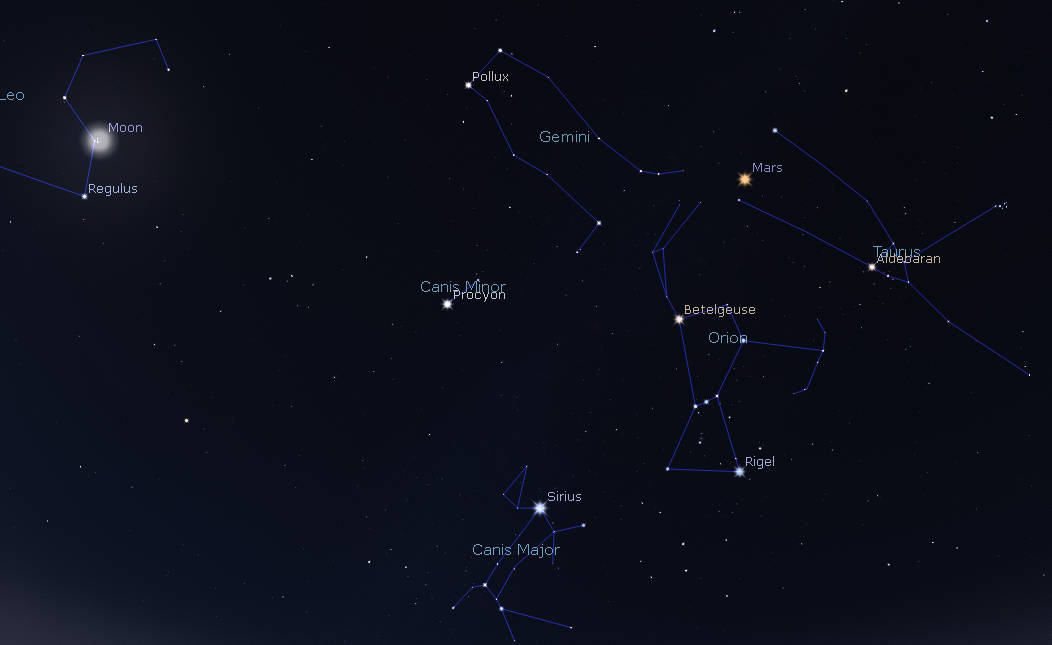
Mars among the winter stars at 7 tomorrow morning, October 20, 2022. Click on the image to enlarge it. Created using Stellarium.
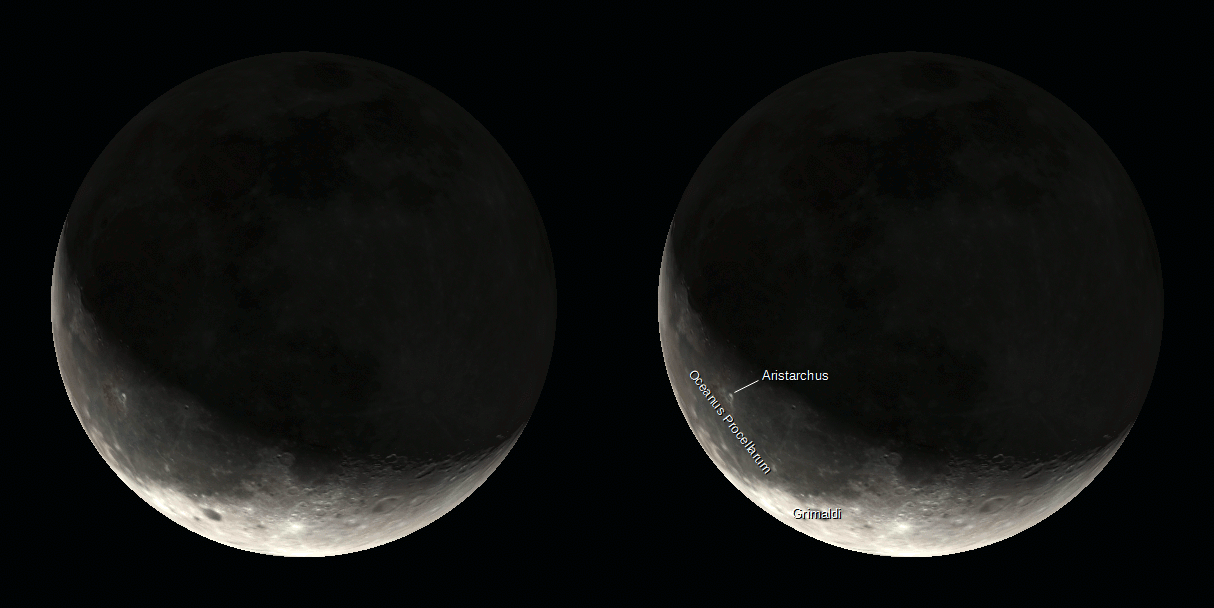
Waning crescent Moon labeled/unlabeled animation for 7 tomorrow morning, October 20, 2022. Created using Stellarium, LibreOffice Draw, and GIMP.
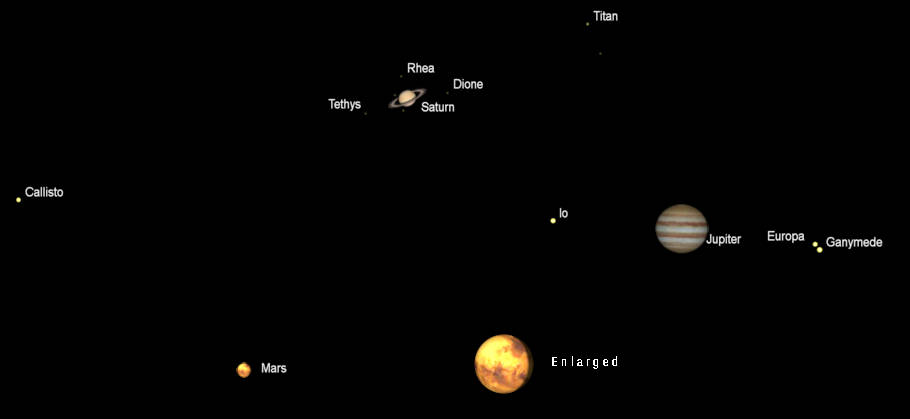
Telescopic views of Saturn Jupiter and Mars (north up) as they would be seen in a small telescope, with the same magnification. The image of Mars doesn’t show it, but the white north polar cap will appear at the top or north limb of Mars. Saturn and Jupiter are shown at 9 pm, Mars at 7 am. I do not show planets less than 10 seconds of arc in diameter, so Mercury is not shown. Apparent diameters: Saturn 17.61″, its rings 41.02″; Jupiter 48.82″. Mars 13.86″. Mars’ distance is 63.0 million miles (101.4 million kilometers). The ” symbol means seconds of arc (1/3600th of a degree.) Click on the image to enlarge it. Created using Cartes du Ciel (Sky Charts).
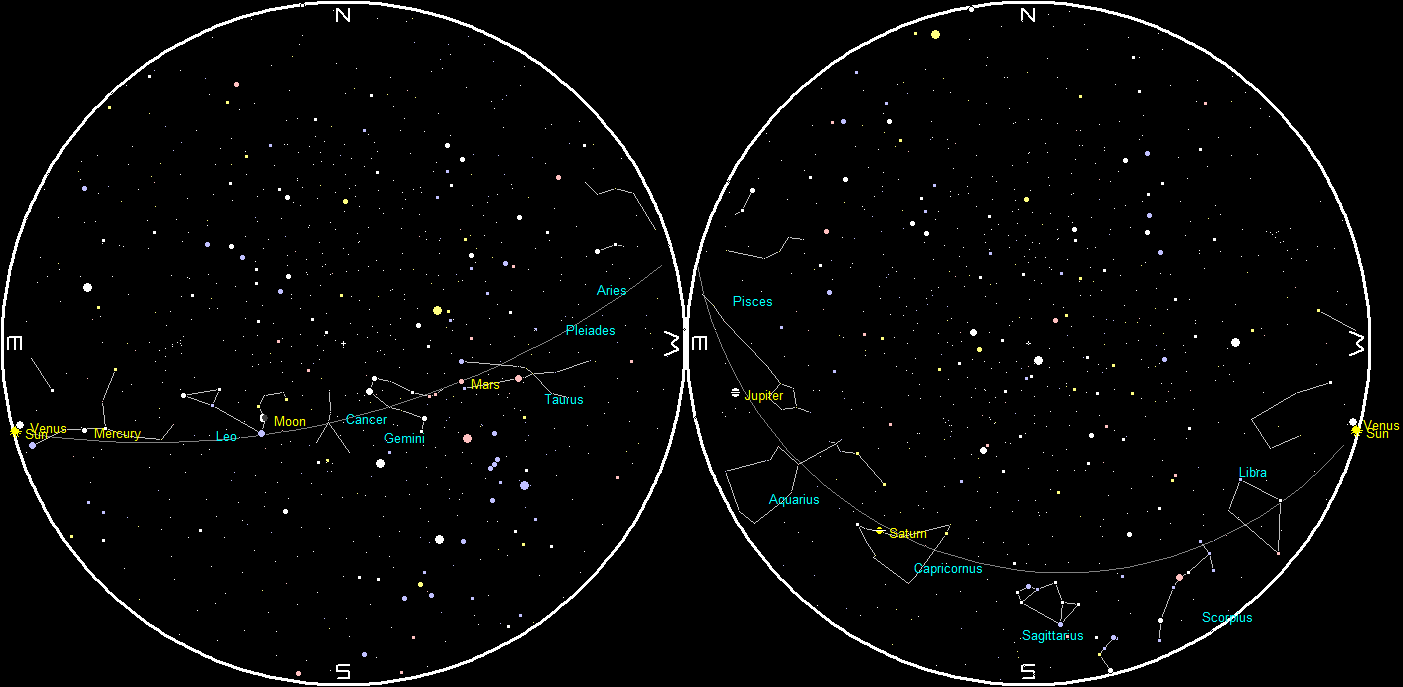
The naked-eye planets and the Moon at sunset and sunrise on a single night, starting with sunset on the right on October 19, 2022. The night ends on the left with sunrise on the 20th. Click on the image to enlarge it. Created using my LookingUp program and GIMP.
10/12/2022 – Ephemeris – Let’s search for the naked-eye planets for this week
This is Bob Moler with Ephemeris for Wednesday, October 12th. Today the Sun will be up for 11 hours and 8 minutes, setting at 7:03, and it will rise tomorrow at 7:55. The Moon, 3 days past full, will rise at 8:28 this evening.
Let’s search for the naked-eye planets for this week. Jupiter and Saturn will be visible this evening, in the east-southeast and south-southeast respectively, as soon after sunset as it will be dark enough to see them, which would be by 7:45 pm. Jupiter is seen against the stars of Pisces the fish, while Saturn is spotted in the eastern end of Capricornus the sea goat. The red planet Mars, though a morning planet, will rise tonight at 10:04 pm in the northeast. It’s located between the long horns of Taurus the bull. By seven tomorrow morning, the red planet Mars will be high in the southwestern sky, above the winter constellation of Orion. Tiny Mercury can be spotted at that hour very low in the east and by 7:30 for the next week or so.
The astronomical event times given are for the Traverse City/Interlochen area of Michigan (EDT, UT – 4 hours). They may be different for your location.
Addendum
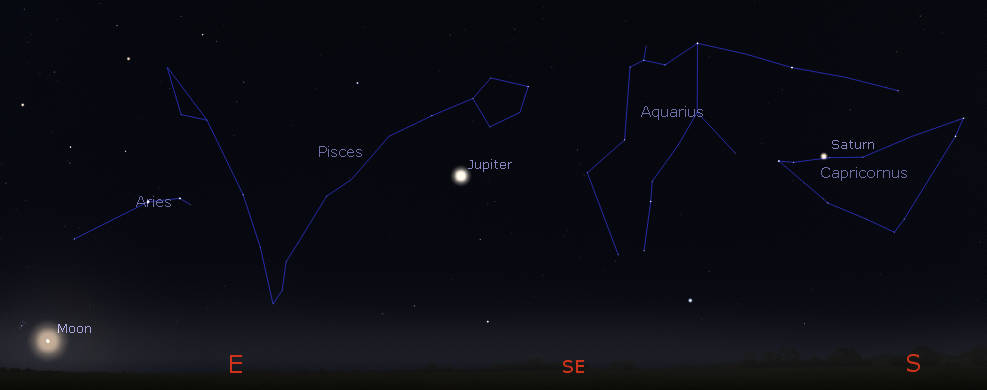
Evening planets and the Moon at 9 pm tonight, October 12, 2022, with the line figures of the zodiacal constellations in their part of the sky. Click on the image to enlarge it. Created using Stellarium.
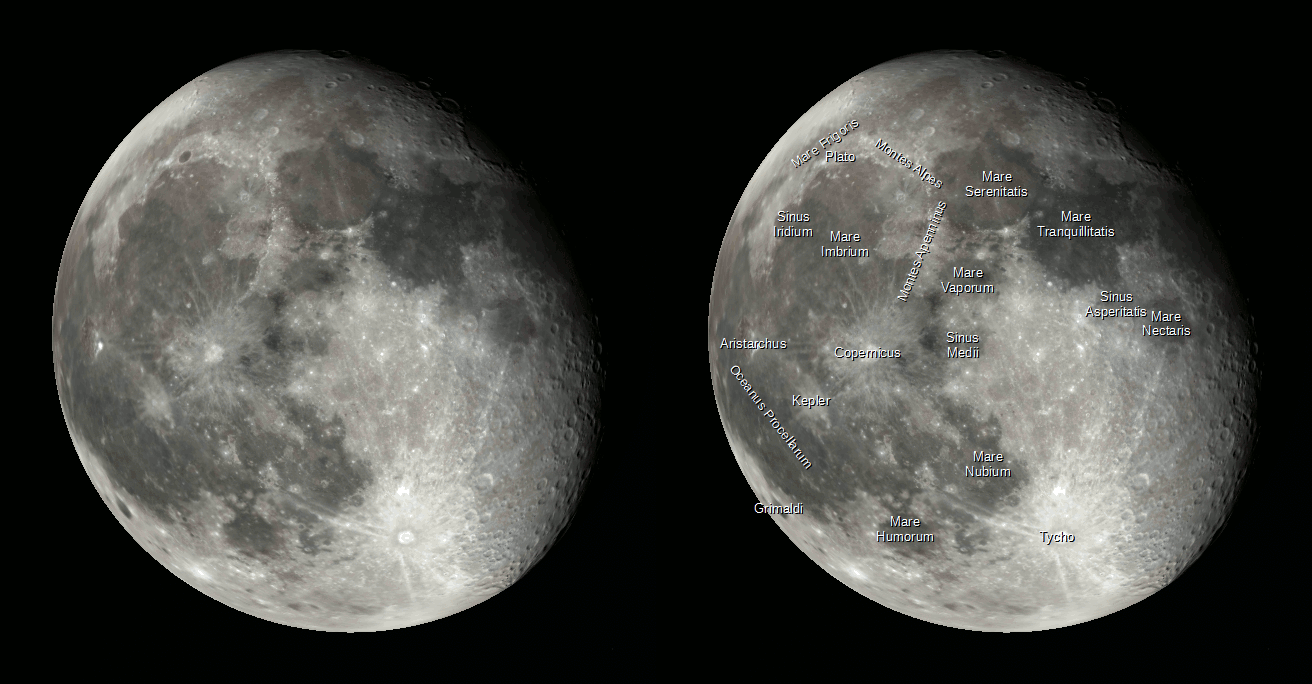
Annotated waning Gibbous Moon Animation for tonight, October 12, 2022, as it might look like in binoculars or a small telescope. Created using Stellarium, LibreOffice Draw and GIMP.
Translations of some lunar feature names according to Virtual Moon Atlas
Mare Frigoris – Sea of Cold
Mare Humorum – Sea of Moisture
Mare Imbrium – Sea of Showers
Mare Nubium – Sea of Clouds
Mare Serenitatis – Sea of Serenity
Mare Tranquillitatis – Sea of Tranquility
Mare Vaporum – Sea of Vapors
Montes Alpes – Alps Mountains
Montes Apenninus – Apennines Mountains
Oceanus Procellarum – Ocean of Storms
Sinus Asperitatis – Golfe des Asperites
Sinus Iridium – Bay of Rainbows
Sinus Medii – Central Bay
Craters are generally named after astronomers, people of science, or explorers
Note that Mare is pronounced Mar-é
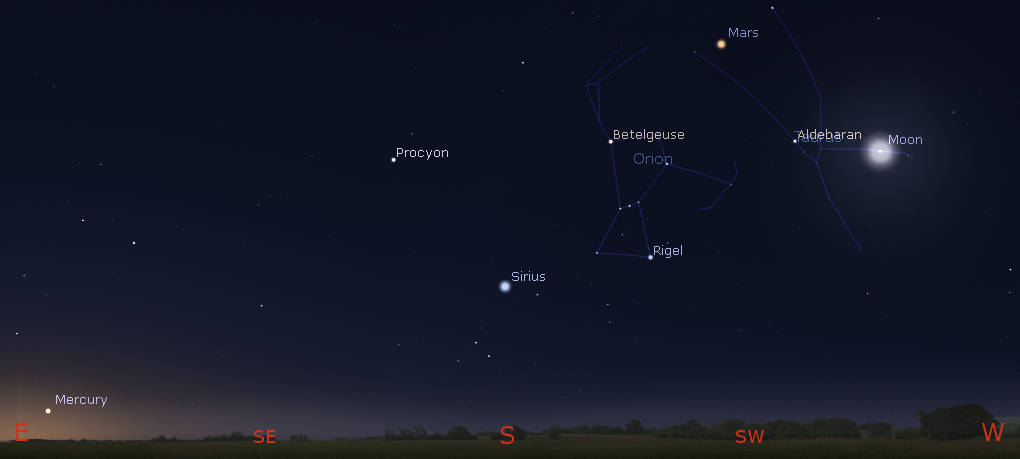
Morning planets Mars, Mercury and the Moon at 7 am tomorrow morning, October 13, 2022. Click on the image to enlarge it. Created using Stellarium.
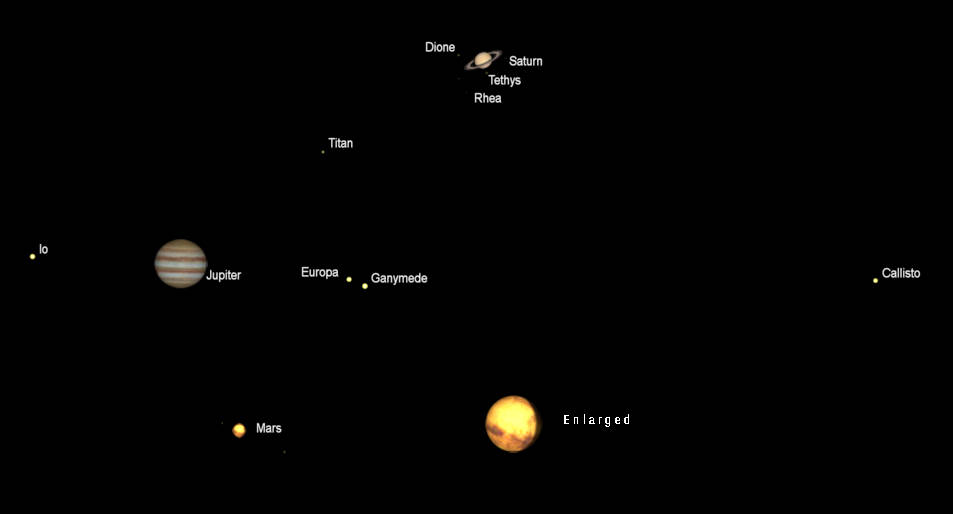
Telescopic views of Saturn Jupiter and Mars (north up) as they would be seen in a small telescope, with the same magnification. The image of Mars doesn’t show it, but the white north polar cap will appear at the top or north limb of Mars. Saturn and Jupiter are shown at 9 pm, Mars at 6 am. I do not show planets less than 10 seconds of arc in diameter, so Mercury is not shown. Apparent diameters: Saturn 17.81″, its rings 41.48″; Jupiter 49.34″. Mars 13.13″. Mars’ distance is 66.5 million miles (107.1 million kilometers). Mercury, which isn’t shown, is 6.17″ in diameter and 71.1% illuminated. The ” symbol means seconds of arc (1/3600th of a degree.) Click on the image to enlarge it. Created using Cartes du Ciel (Sky Charts).
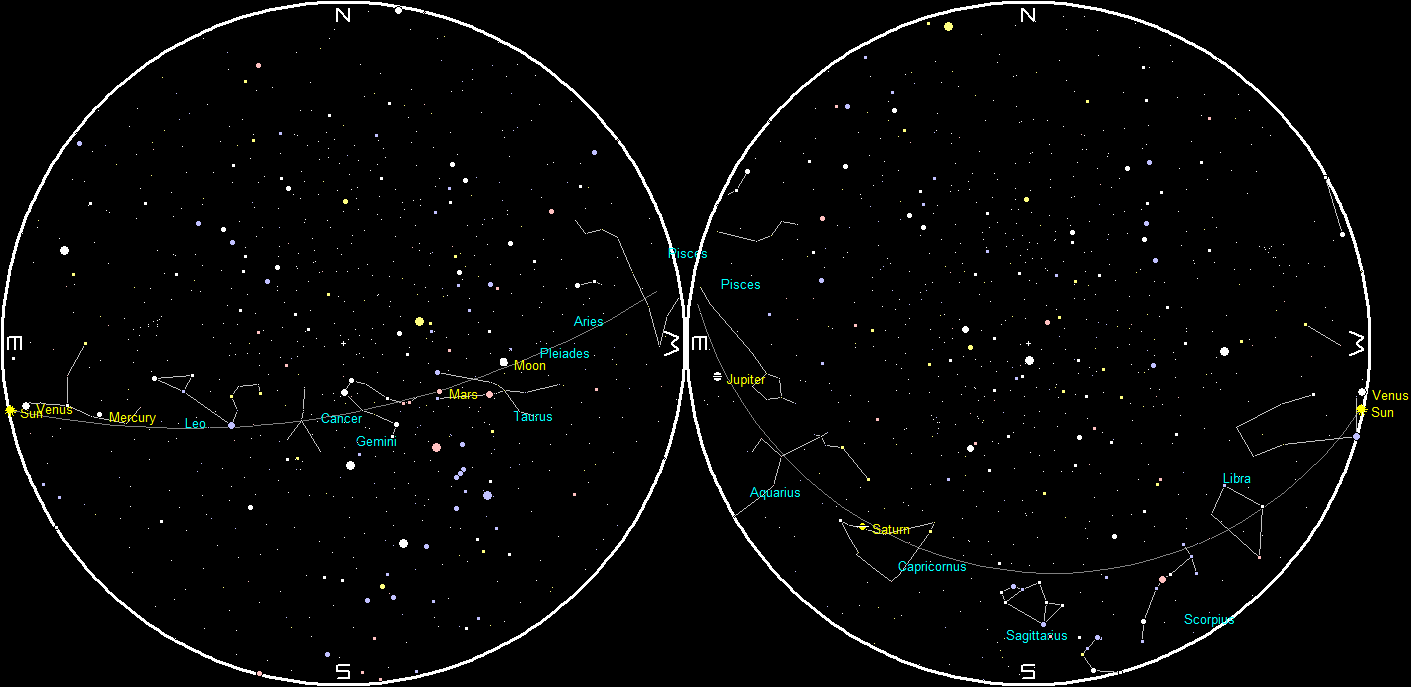
The naked-eye planets and the Moon at sunset and sunrise on a single night, starting with sunset on the right on October 12, 2022. The night ends on the left with sunrise on the 13th. Click on the image to enlarge it. Created using my LookingUp program and GIMP.
10/05/2022 – Ephemeris – Let’s search for the naked-eye planets for this week
This is Ephemeris for Wednesday, October 5th. Today the Sun will be up for 11 hours and 30 minutes, setting at 7:15, and it will rise tomorrow at 7:46. The Moon, 3 days past first quarter, will set at 3:33 tomorrow morning.
Let’s search for the naked-eye planets for this week. The waxing gibbous Moon will be visible near Saturn tonight, with the ringed planet right and above our Moon. Super bright Jupiter is to the far right of the Moon at 9 pm in the east southeast, the brightest star-like object in the sky. Jupiter is seen against the stars of Pisces the fish, while Saturn is spotted in the eastern end of Capricornus the sea goat. I don’t think the stars will be visible with the bright Moon. One star in their direction may be visible and low on the horizon and in line tonight with Saturn and the Moon. It’s Fomalhaut, normally the loneliest star in the sky. Before seven tomorrow morning, the red planet Mars will be high in the south, above the winter constellation of Orion. At that hour, Mercury can also be spotted low in the east.cc
The astronomical event times given are for the Traverse City/Interlochen area of Michigan (EDT, UT – 4 hours). They may be different for your location.
Addendum
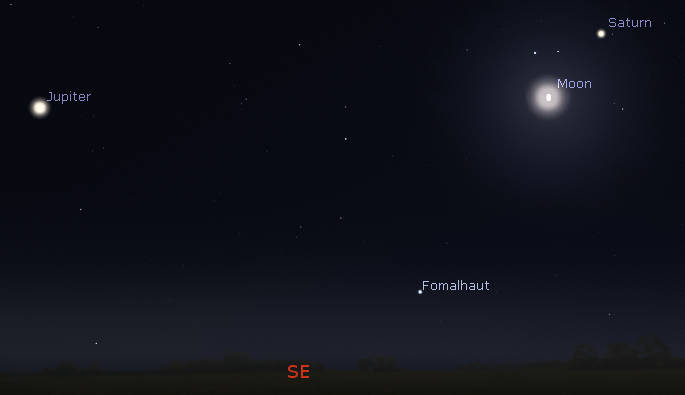
Evening planets and the Moon tonight, October 5, 2022, at 9 pm. Click on the image to enlarge it. Created using Stellarium.
Annotated Gibbous Moon Animation for tonight, October 5, 2022, as it might in binoculars or a small telescope. Created using Stellarium, LibreOffice Draw and GIMP.
Translations of some lunar feature names according to Virtual Moon Atlas
Mare Crisium – Sea of Crises
Mare Fecunditatis – Sea of Fertility
Mare Frigoris – Sea of Cold
Mare Imbrium – Sea of Showers
Mare Nectaris – Sea of Nectar
Mare Nubium – Sea of Clouds
Mare Serenitatis – Sea of Serenity
Mare Tranquillitatis – Sea of Tranquility
Mare Vaporum – Sea of Vapors
Montes Apenninus – Apennines Mountains
Sinus Asperitatis – Golfe des Asperites
Sinus Iridium – Bay of Rainbows
Sinus Medii – Bay of the Center
Craters are generally named after astronomers, people of science, or explorers
Note that Mare is pronounced Mar-é
Morning planets, Mars and Mercury with the winter stars and Orion at 7 am tomorrow morning, October 6, 2022. Click on the image to enlarge it. Created using Stellarium.
Telescopic views of Saturn Jupiter and Mars (north up) as they would be seen in a small telescope, with the same magnification. The image doesn’t show it, but the white north polar cap will appear at the top or north limb of Mars. Saturn and Jupiter are shown at 9 pm, Mars at 6 am. I do not show planets less than 10 seconds of arc in diameter. Apparent diameters: Saturn 18.00″, its rings 41.91″; Jupiter 49.69″. Mars 12.44″. Mars’ distance is 69.7 million miles (112.2 million kilometers). Mercury, which isn’t shown, is 7.51″ in diameter and 40.8% illuminated. The ” symbol means seconds of arc (1/3600th of a degree.) Click on the image to enlarge it. Created using Cartes du Ciel (Sky Charts).
The naked-eye planets and the Moon at sunset and sunrise on a single night, starting with sunset on the right on October 5, 2022. The night ends on the left with sunrise on the 6th. Click on the image to enlarge it. Created using my LookingUp program and GIMP.
09/21/2022 – Ephemeris – Let’s search for the naked-eye planets for this week
This is Ephemeris for Wednesday, September 21st. Today the Sun will be up for 12 hours and 13 minutes, setting at 7:41, and it will rise tomorrow at 7:29. The Moon, halfway from last quarter to new, will rise at 3:38 tomorrow morning.
Let’s search for the naked-eye planets for this week. Only one of the naked-eye planets is in the evening sky. Mercury is south of the Sun and cannot be seen. It will pass between the Earth and Sun on Friday and enter the morning sky. As it gets darker, Saturn can be seen in the southeast. Jupiter, though not officially an evening planet, will rise in the east in twilight at 7:54 pm. It is seen against the stars of Pisces now, moving slowly retrograde or westward. At 6:30 am tomorrow, two of the three remaining morning planets will be Mars high in the south, above the winter constellation of Orion, and Jupiter very low in the west. The thin waning crescent Moon will be in the east then. Venus will rise at 6:47 into bright twilight.
The astronomical event times given are for the Traverse City/Interlochen area of Michigan (EDT, UT – 4 hours). They may be different for your location.
Addendum
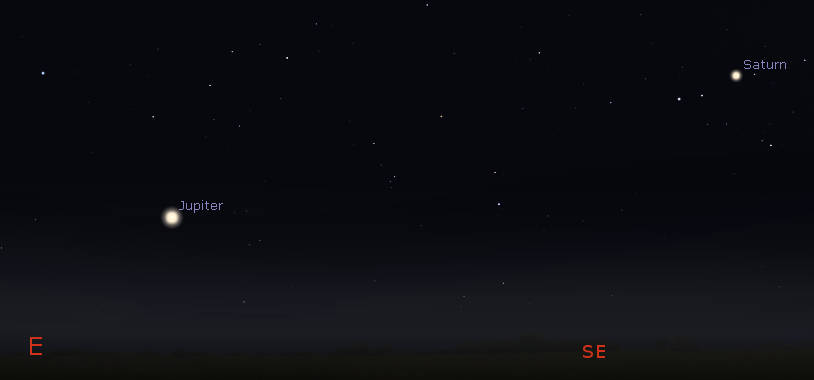
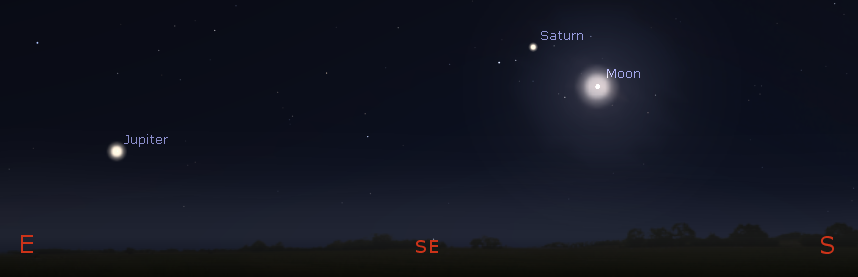
Jupiter and Saturn at 9 pm tonight, September 21, 2022. Created using Stellarium.
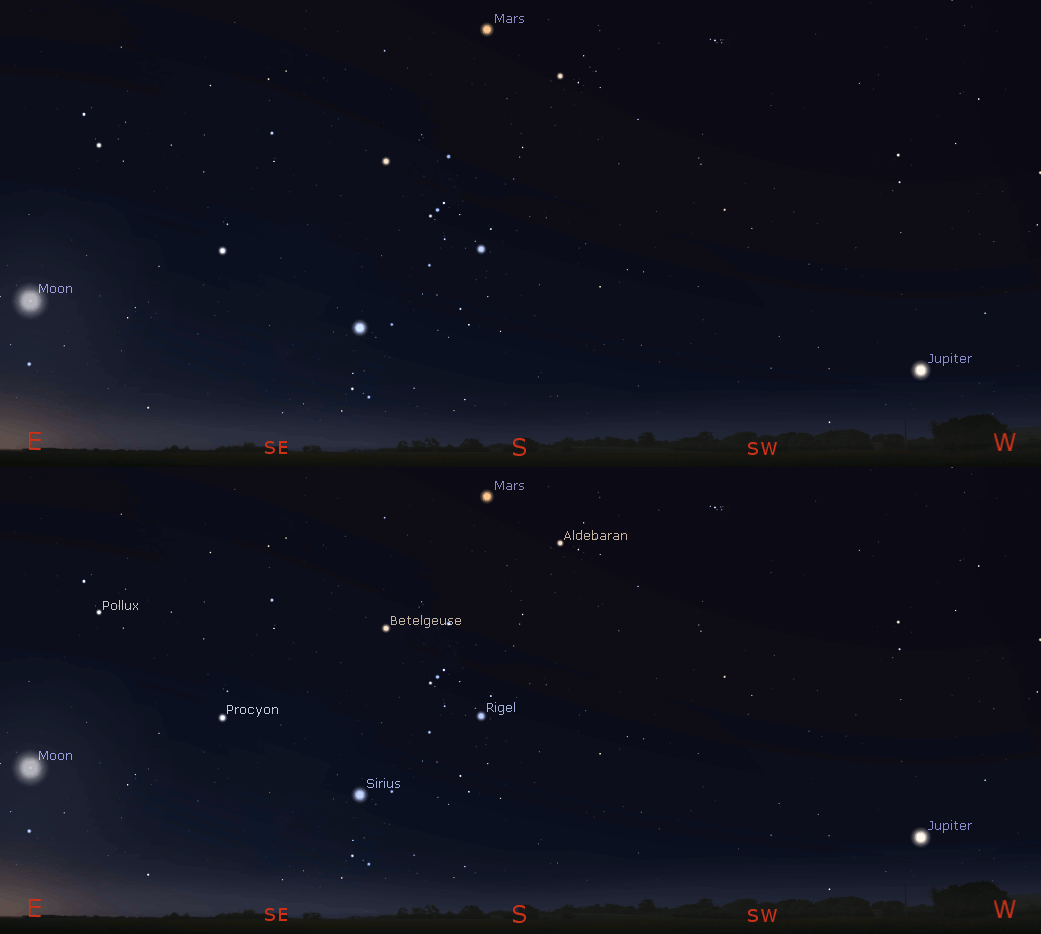
Animation of the morning planets and the waning crescent Moon at 6:30 am tomorrow, September 22, 2022. Star labels are shown alternately, since they clutter the image. Click on the image to enlarge it. Created using Stellarium and GIMP.
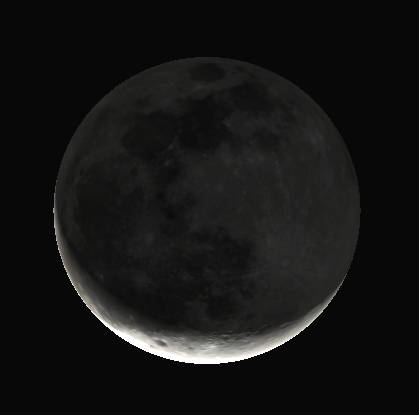
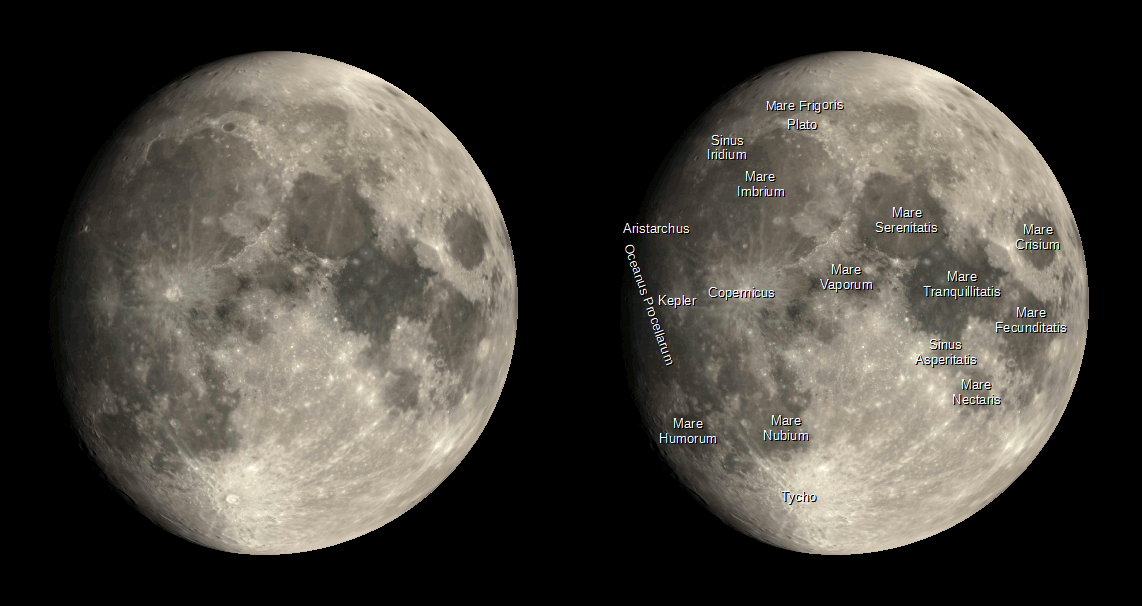
The waning crescent Moon as it might be seen in binoculars or a small telescope. The dark area on the left side of the Moon is Oceanus Procellarum (Ocean of Storms). The dark spot near the bottom of the Moon is the crater Grimaldi. Created using Stellarium.
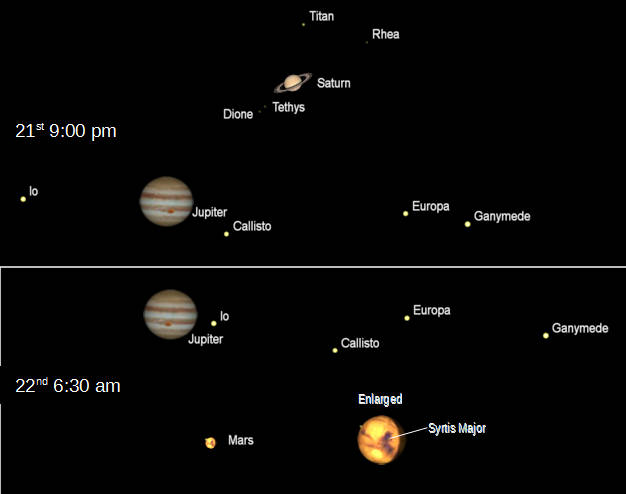
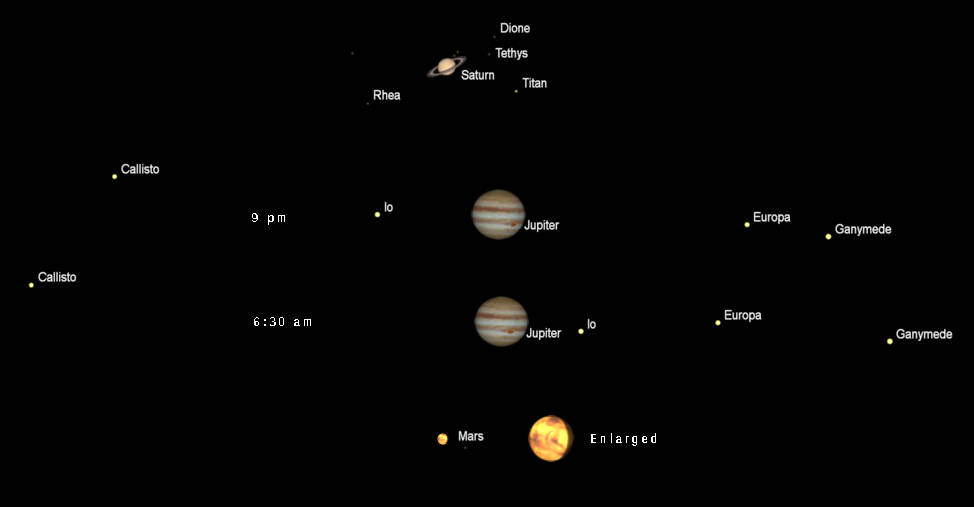
Telescopic views of Saturn Jupiter and Mars (north up) as they would be seen in a small telescope, with the same magnification. The times vary for each planet. Jupiter is shown twice, at 9 pm and 6:30 am, since its moons, especially Io and Europa, move rapidly. I do not show planets less than 10 seconds of arc in diameter. Apparent diameters: Saturn 18.33″, its rings 42.69″; Jupiter 49.85″. Mars 11.21″, 86.6% illuminated. Mars’ distance is 78 million miles (125 million kilometers). The ” symbol means seconds of arc (1/3600th of a degree.) Created using Cartes du Ciel (Sky Charts).
In the above chart, it may appear that Jupiter’s Great Red Spot didn’t move very much. However, the 9.5 hours between the images is a bit less than one Jovian day, so the spot actually made almost one complete rotation. In this view, features on the face of Jupiter rotate from left to right. Satellites behave similarly. They move left to right if in front of the planet, and right to left if behind.
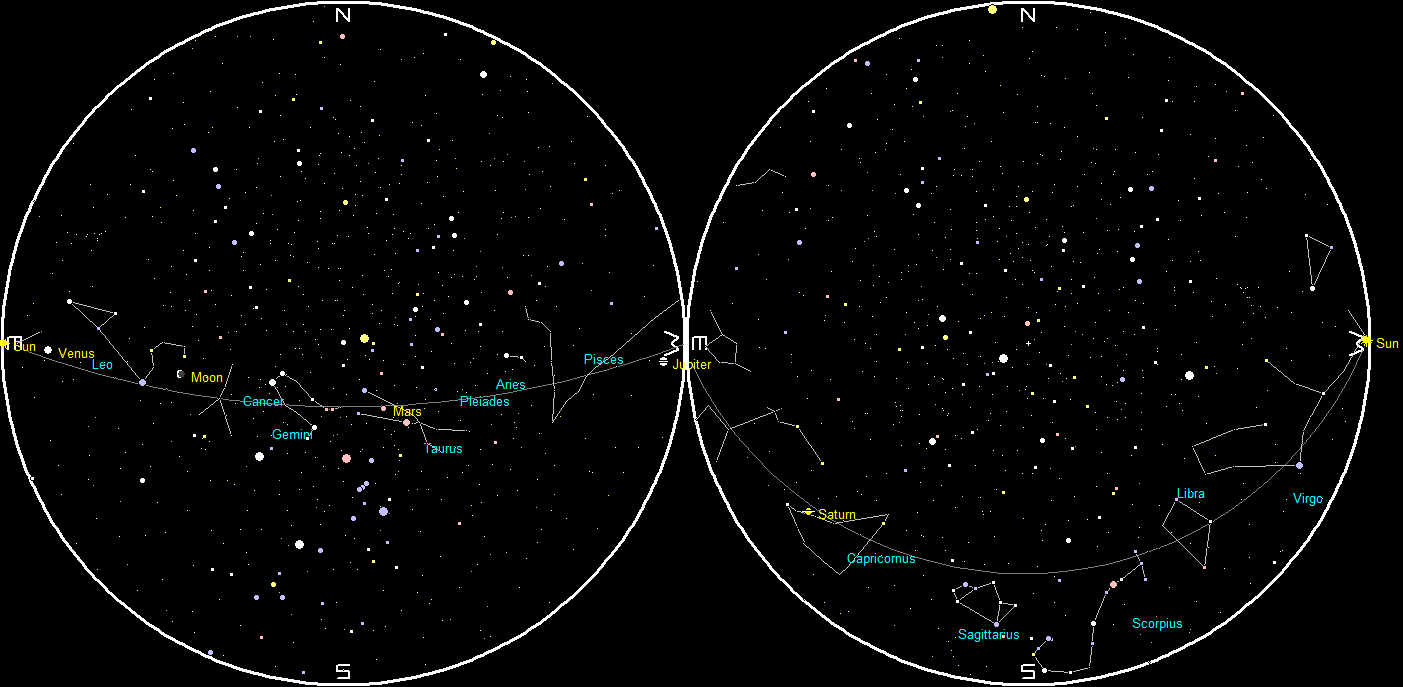
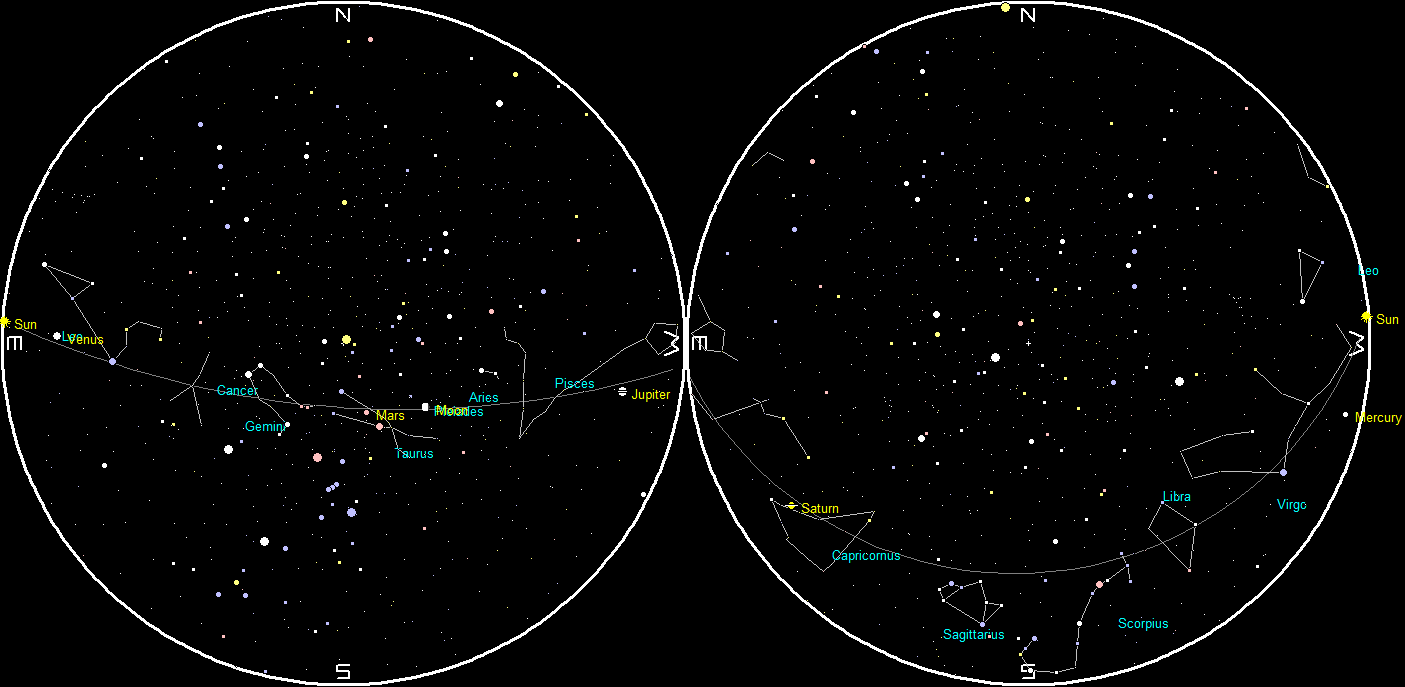
The naked-eye planets and the Moon at sunset and sunrise on a single night, starting with sunset on the right on September 21, 2022. The night ends on the left with sunrise on the 22nd. Click on the image to enlarge it. Created using my LookingUp program and GIMP.
09/14/2022 – Ephemeris – Let’s search for the naked-eye planets for this week
This is Ephemeris for Wednesday, September 14th. Today the Sun will be up for 12 hours and 34 minutes, setting at 7:55, and it will rise tomorrow at 7:21. The Moon, 3 days before last quarter, will rise at 10:02 this evening.
Let’s search for the naked-eye planets for this week. Two of the naked-eye planets are in the evening sky. Mercury sets too close to the Sun to be seen in the evening. But as it gets darker, Saturn can be seen in the southeast. Jupiter, still officially a morning planet, rises in the east around 8:23 pm. It is seen against the stars of Pisces now, moving slowly retrograde or westward. At 6:30 am tomorrow the three morning planets will be spread out from brilliant Venus on the horizon in the east-northeast, if you can see it at all, to Mars high in the south-southeast below the Moon and next to the bright reddish star Aldebaran to Jupiter in the west-southwest. Mars is among the stars seen rising on late autumn and early winter evenings.
The astronomical event times given are for the Traverse City/Interlochen area of Michigan (EDT, UT – 4 hours). They may be different for your location.
Addendum
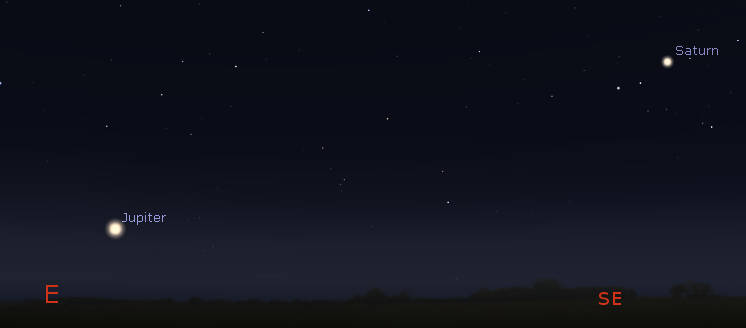
Jupiter and Saturn at 9 pm tonight, September 14, 2022. Created using Stellarium.
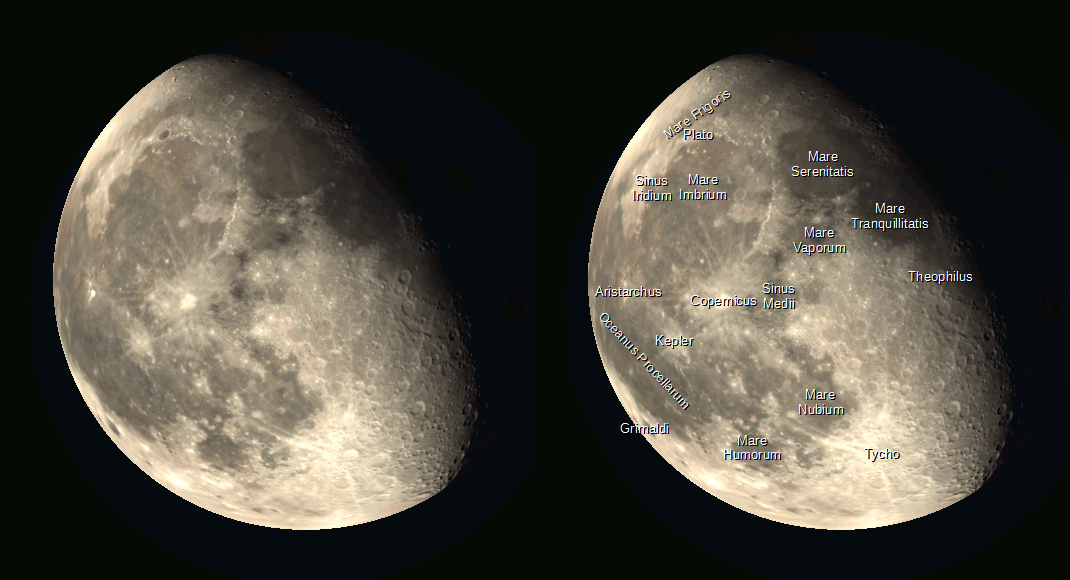
The waning gibbous moon as seen in binoculars or low power telescope at 10:30 tonight, September 14, 2022. Labels are centered on their feature. Created using Stellarium, labels using LibreOffice Draw, and GIMP for animation.
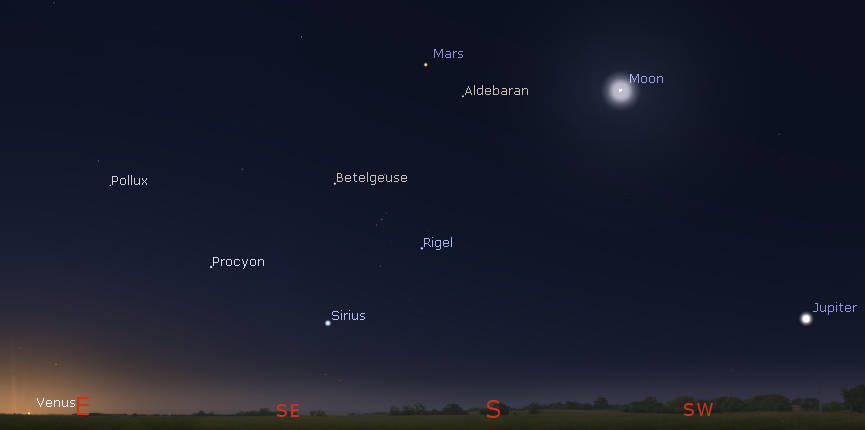
The morning planets with the Moon and the bright winter stars at 6:30 am tomorrow, September 15, 2022. Click on the image to enlarge it. Click on the image to enlarge it. Created using Stellarium.
Telescopic views of Saturn Jupiter and Mars (north up) as they would be seen in a small telescope, with the same magnification. The times vary for each planet. Saturn is shown at 9 pm. Jupiter is shown twice, at 9 pm and 6:30 am, since its moons, especially Io and Europa, move rapidly. Mars is shown at 6:30 am. I do not show planets less than 10 seconds of arc in diameter, so Venus isn’t shown. Apparent diameters: Saturn 18.47″, its rings 43.02″; Jupiter 49.66″. Mars 10.70″, 86.0% illuminated; Venus (not shown) 9.89″, 98.5% illuminated. The ” symbol means seconds of arc (1/3600th of a degree.) Click on the image to enlarge it. Created using Cartes du Ciel (Sky Charts) and GIMP.
The naked-eye planets and the Moon at sunset and sunrise on a single night, starting with sunset on the right on September 14, 2022. The night ends on the left with sunrise on the 15th. Click on the image to enlarge it. Created using my LookingUp program, and GIMP.
09/07/2022 – Ephemeris – Let’s search for the naked-eye planets for this week
This is Ephemeris for Wednesday, September 7th. Today the Sun will be up for 12 hours and 56 minutes, setting at 8:08, and it will rise tomorrow at 7:13. The Moon, 3 days before full, will set at 4:33 tomorrow morning.
Let’s search for the naked-eye planets for this week. Two of the naked-eye planets are in the evening sky. Mercury sets too close to the Sun to be seen in the evening. But as it gets darker, Saturn can be seen low in the southeast. Jupiter rises in the east around 8:52 pm. It is seen against the stars of Pisces now, moving slowly retrograde or westward. At 6:30 am tomorrow the three remaining morning planets will be spread out from brilliant Venus very low in the east-northeast to Mars high in the south-southeast above the bright reddish star Aldebaran to Jupiter in the west-southwest. Mars is among the stars seen rising on late autumn and winter evenings. Venus is actually all the way to the spring constellation of Leo the lion.
The astronomical event times given are for the Traverse City/Interlochen area of Michigan (EDT, UT – 4 hours). They may be different for your location.
Addendum
Evening planets and the Moon tonight at 10 pm, September 7, 2022. Click on the image to enlarge it. Created using Stellarium.
The Moon tonight as it might be seen in binoculars or low power telescopes. Labels of prominent features are alternately shown with the unlabeled chart. Created using Stellarium, LibreOffice Draw and GIMP.
Translations of some feature names
Mare Crisium – Sea of Crises
Mare Fecunditatis – Sea of Fertility
Mare Frigoris – Sea of Cold
Mare Humorum – Sea of Moisture
Mare Imbrium – Sea of Showers
Mare Nectaris – Sea of Nectar
Mare Nubium – Sea of Clouds
Mare Serenitatis – Sea of Serenity
Mare Tranquillitatis – Sea of Tranquility
Mare Vaporum – Sea of Vapors
Montes Apenninus – Apennines Mountains
Oceanus Procellarum – Ocean of Storms
Sinus Asperitatis – Golfe des Asperites
Sinus Iridium – Bay of Rainbows
Sinus Medii – Bay of the Center
Note that Mare is pronounced Mar-é
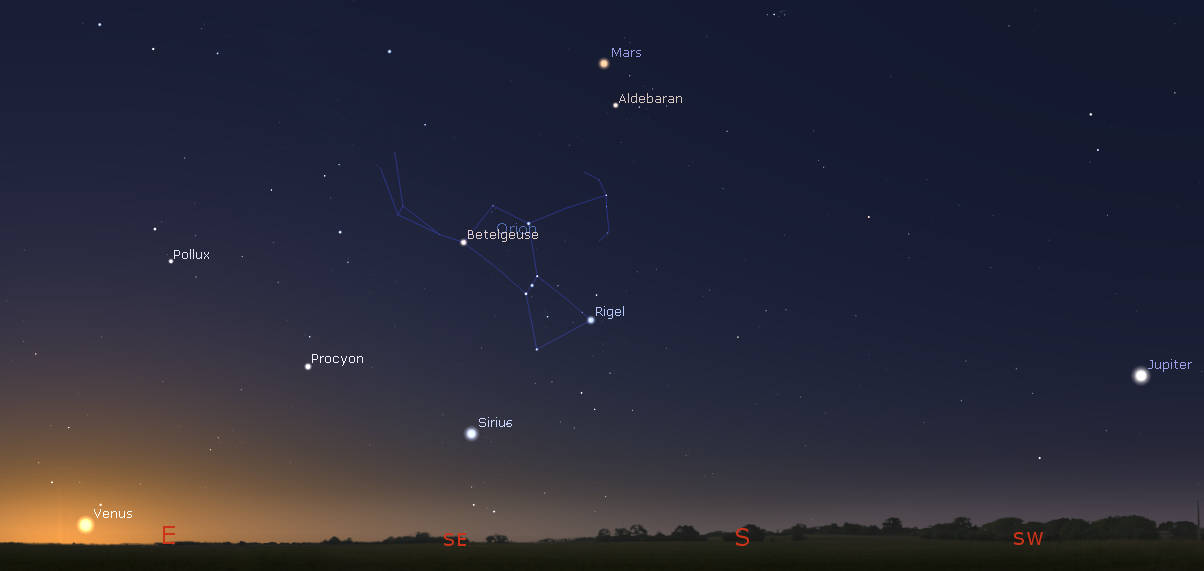
Morning planets with the bright winter stars at 6:30 am tomorrow, September 8, 2022. Click on the image to enlarge it. Created using Stellarium.
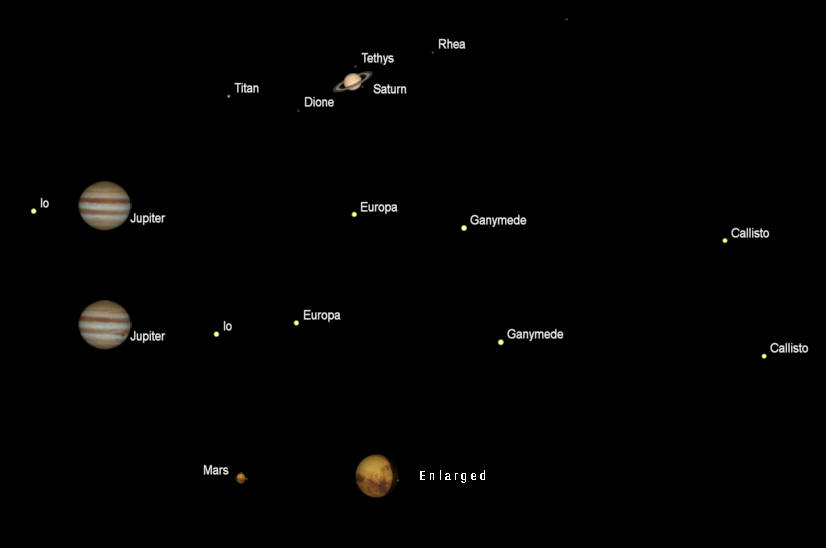
Telescopic views of Saturn Jupiter and Mars (north up) as they would be seen in a small telescope, with the same magnification. The times vary for each planet. Jupiter is shown twice, at 10 pm and 6:30 am, since its moons, especially Io and Europa, move rapidly. I do not show planets less than 10 seconds of arc in diameter, so Venus doesn’t show up yet. Coincidentally, Mars has reached that threshold. Apparent diameters: Saturn 18.58″, its rings 43.23″; Jupiter 49.27″. Mars 10.23″, 85.5% illuminated; Venus (not shown) 9.97″, 97.9% illuminated. The ” symbol means seconds of arc (1/3600th of a degree.) Click on the image to enlarge it. Created using Cartes du Ciel (Sky Charts).
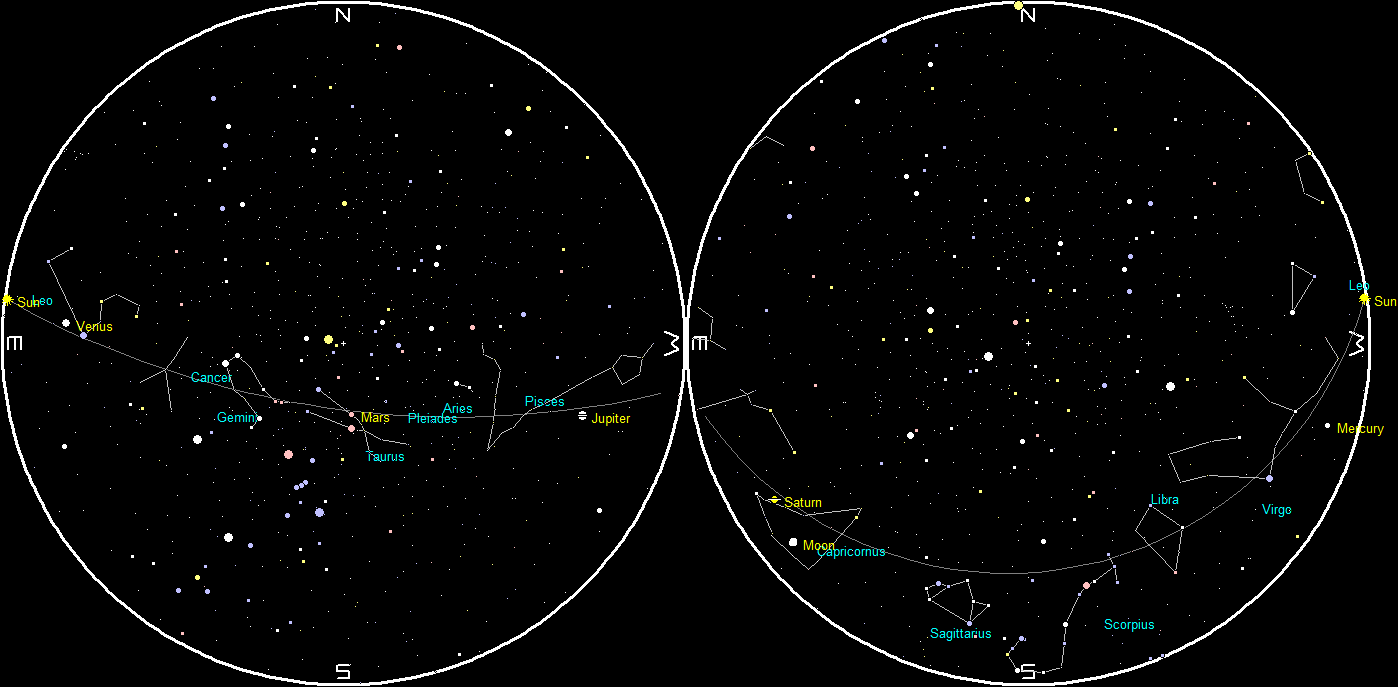
The naked-eye planets and the Moon at sunset and sunrise on a single night, starting with sunset on the right on September 7, 2022. The night ends on the left with sunrise on the 8th. Click on the image to enlarge it. Created using my LookingUp program.
08/31/2022 – Ephemeris – Let’s search for the naked-eye planets for this week
This is Ephemeris for Wednesday, August 31st. Today the Sun will be up for 13 hours and 17 minutes, setting at 8:21, and it will rise tomorrow at 7:05. The Moon, 3 days before first quarter, will set at 10:23 this evening.
Let’s search for the naked-eye planets for this week. Two of the naked-eye planets are in the evening sky. Mercury sets too close to the Sun to be seen in the evening. As it gets darker, Saturn can be seen low in the southeast. Jupiter rises in the east around 9:21 pm. It is seen against the stars of Pisces now, moving slowly retrograde or westward now. At 6:15 am tomorrow the three morning planets will be spread out from brilliant Venus very low in the east-northeast to Mars high in the southeast above the bright reddish star Aldebaran to Jupiter in the southwest. Mars is among the stars seen rising on late autumn and winter evenings, when observing them then, it will be a lot colder than it will be tomorrow morning.
The astronomical event times given are for the Traverse City/Interlochen area of Michigan (EDT, UT – 4 hours). They may be different for your location.
Addendum
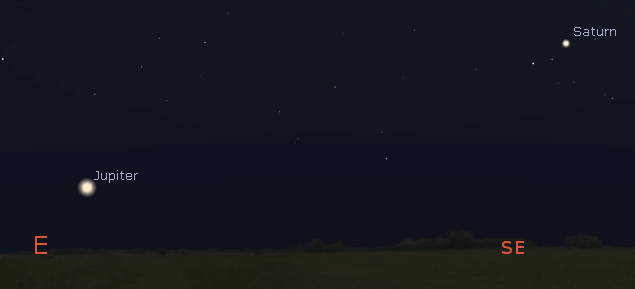
Jupiter and Saturn in the at 10 pm tonight, August 31, 2022.
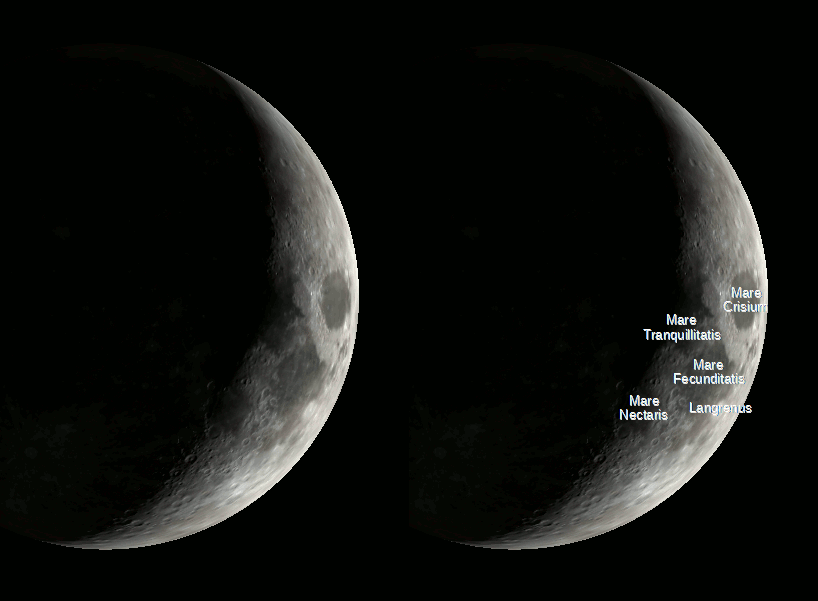
Annotated animation of the Moon tonight, August 31, 2022. Created using Stellarium, LibreOffice Draw and GIMP.
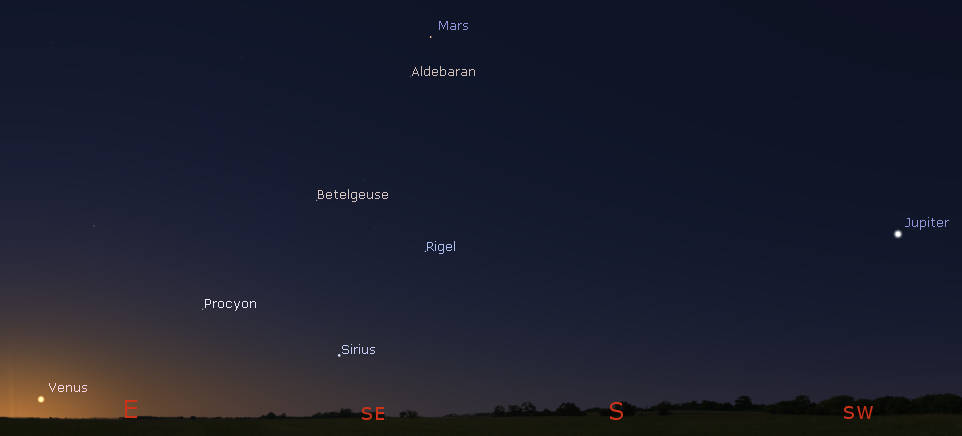
Morning planets with the bright winter stars at 6:15 am tomorrow, September 1, 2022. Click on the image to enlarge it. Created using Stellarium.
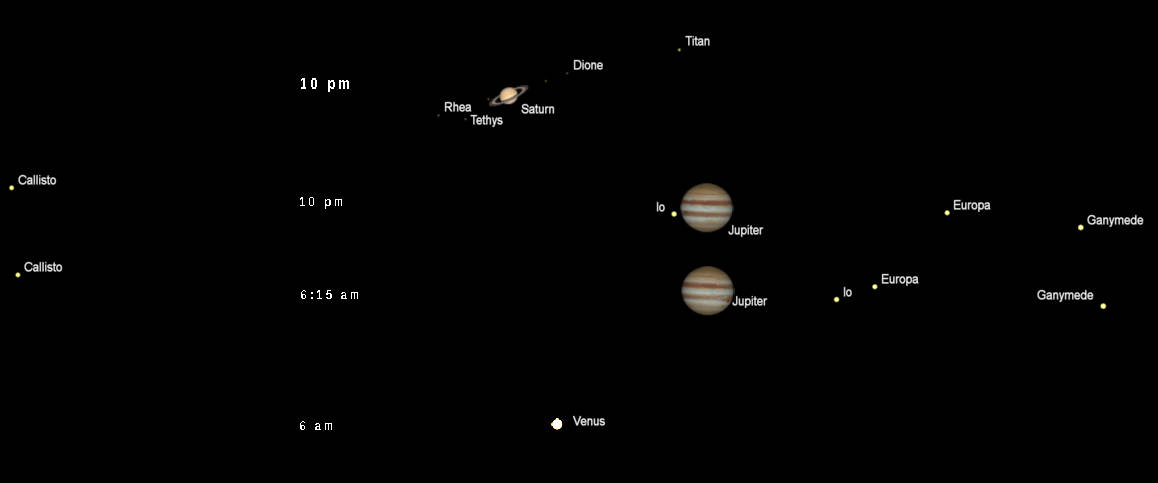
Views of Saturn, Jupiter, and Venus (north up) as they would be seen in a small telescope, with the same magnification. The times vary for each planet. Jupiter is shown twice, at 10 pm and 6:15 am, since its moons, especially Io and Europa, move rapidly. I do not show planets less than 10 seconds of arc in diameter, so Mars doesn’t show up yet. It will soon. Apparent diameters: Saturn 18.67″, its rings 43.50″; Jupiter 48.74″. Mars 9.79″, 84% illuminated; Venus 10.04″. The ” symbol means seconds of arc (1/3600th of a degree.) Click on the image to enlarge it. Created using Cartes du Ciel (Sky Charts).
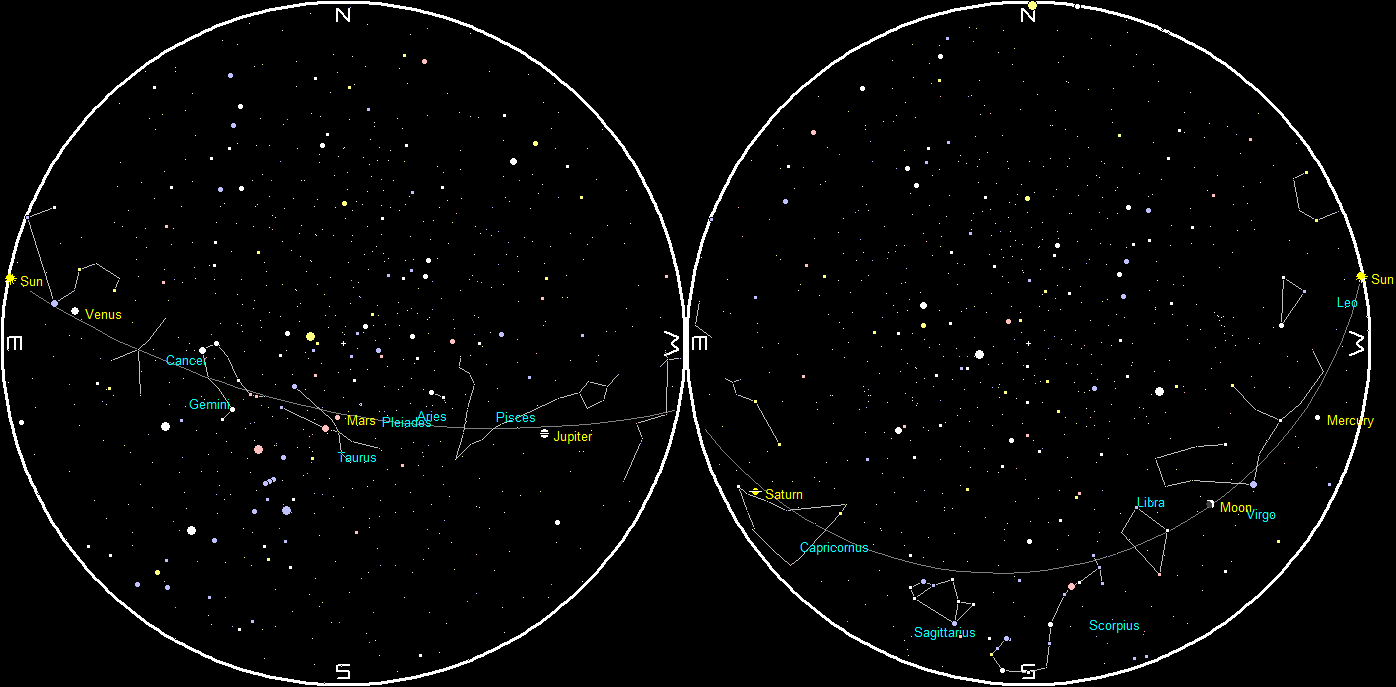
The naked-eye planets and the Moon at sunset and sunrise on a single night, starting with sunset on the right on August 31, 2022. The night ends on the left with sunrise on September 1st. Click on the image to enlarge it. Created using my LookingUp program.
Let’s search for the naked-eye planets for this week
This is Ephemeris for Wednesday, August 24th. Today the Sun will be up for 13 hours and 37 minutes, setting at 8:33, and it will rise tomorrow at 6:57. The Moon, 3 days before new, will rise at 4:46 tomorrow morning.
Let’s search for the naked-eye planets for this week. Two of the naked-eye planets are in the evening sky. Mercury probably sets too close to the Sun to be seen in the evening, but it might be spotted very low on a Lake Michigan horizon in the west at 9 pm. As it gets darker, Saturn can be seen low in the southeast. Jupiter rises in the east around 10 pm. At 6:15 am tomorrow, the morning planets will be spread out from brilliant Venus low in the east-northeast, and below the thin crescent Moon to Jupiter in the southwest. Mars, in the southeast, will be a lot higher than both Venus and Jupiter. Mars is among the rising stars seen in the late autumn and winter evening skies, when observing them then, it will be a lot colder than it will be tomorrow morning.
The astronomical event times given are for the Traverse City/Interlochen area of Michigan (EDT, UT – 4 hours). They may be different for your location.
Addendum
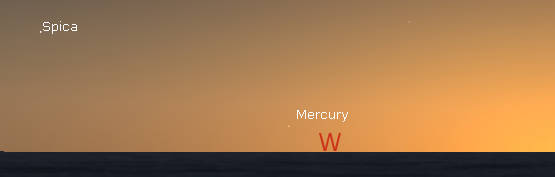
Mercury as it might appear at 9:05 pm tonight, August 24, 2024. I’ve included nearby Spica, which is easier to spot at that time. Actually, neither is likely to be visible. Mercury is only 2 1/2 degrees above a sea horizon. Created using Stellarium.
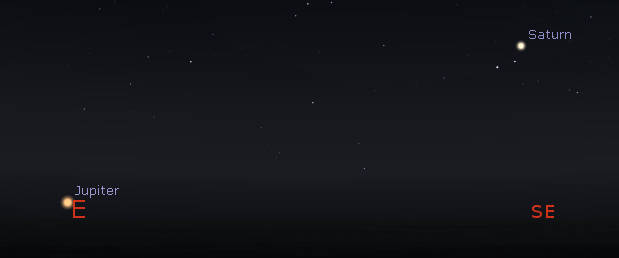
Jupiter rising, with Saturn in the southeast as it might be seen tonight, August 24, 2022. It reminds me of spotting Jupiter rising at our star party Monday night at the Sleeping Bear Dunes. Created using Stellarium.
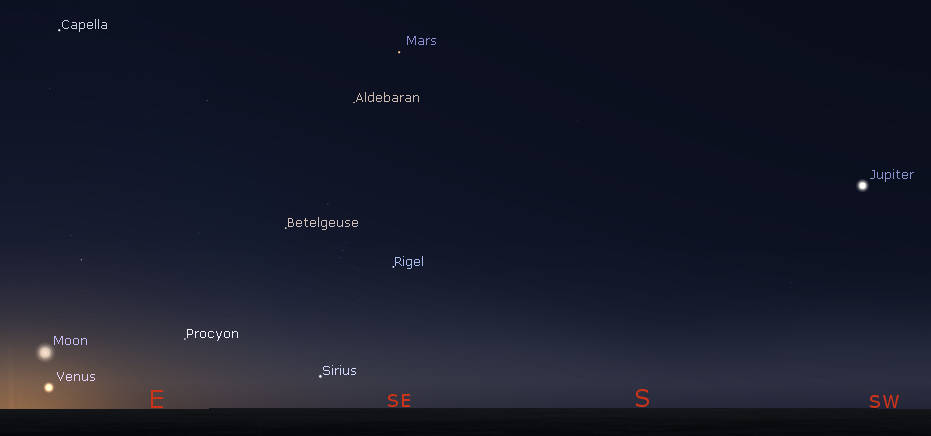
Morning planets and the Moon at 6 am tomorrow morning, August 25, 2022. The Moon will appear as a tiny sliver of a crescent. Created using Stellarium.
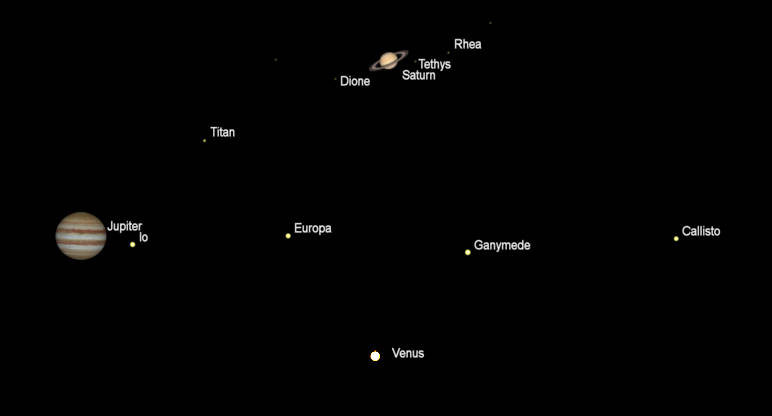
Views of Saturn, Jupiter, and Venus (north up) as they would be seen in a small telescope, with the same magnification. The times vary for each planet. Saturn is shown at 11 pm, Jupiter is shown at midnight. I do not show planets less than 10 seconds of arc in diameter, so Mars doesn’t show up yet. It will soon. Apparent diameters: Saturn 18.73″, its rings 43.63″; Jupiter 48.08″. Mars 9.40″, 84.9% illuminated; Venus 10.31″, 94.3% illuminated. The ” symbol means seconds of arc (1/3600th of a degree.) Click on the image to enlarge it. Created using Cartes du Ciel (Sky Charts).
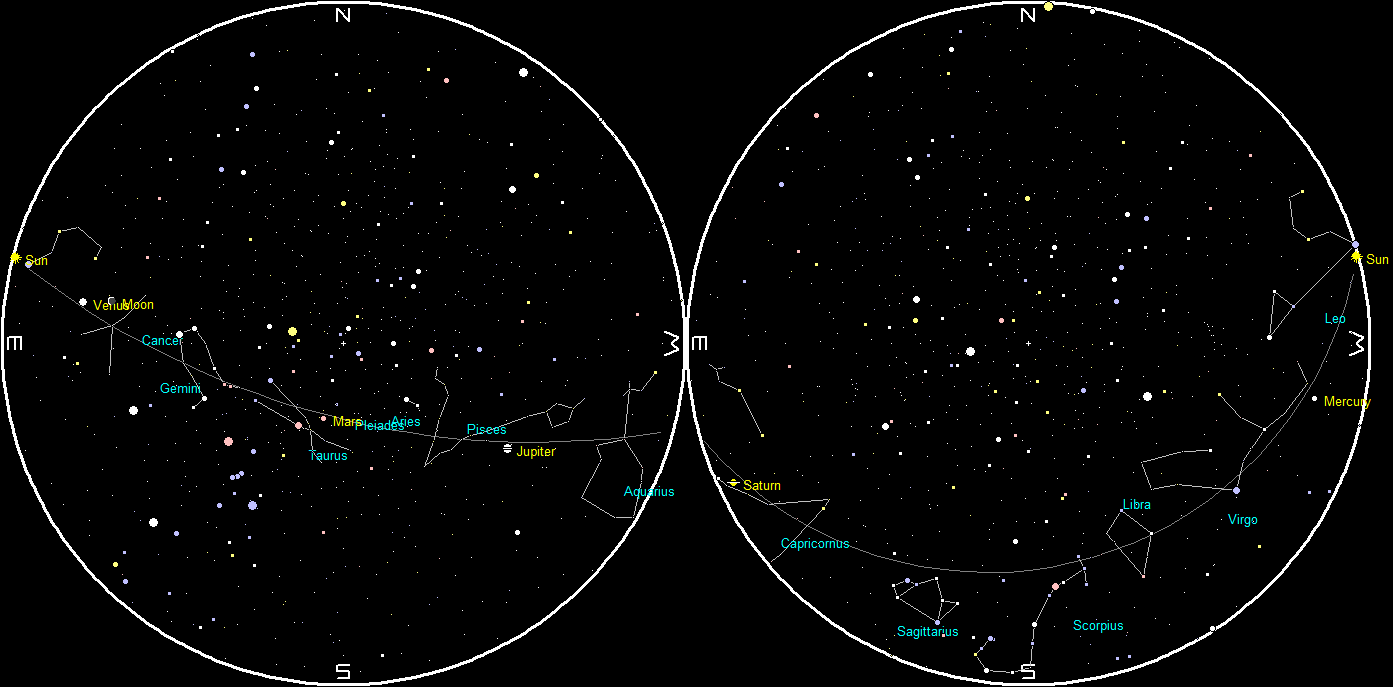
The naked-eye planets and the Moon at sunset and sunrise on a single night, starting with sunset on the right on August 24, 2022. The night ends on the left with sunrise on the 25th. Click on the image to enlarge it. Created using my LookingUp program.
 Bob Moler's Ephemeris Blog