Archive
07/13/2016 – Ephemeris – The evening planets continue to march westward
Ephemeris for Wednesday, July 13th. Today the Sun will be up for 15 hours and 16 minutes, setting at 9:26, and it will rise tomorrow at 6:11. The Moon, 2 days past first quarter, will set at 2:23 tomorrow morning.
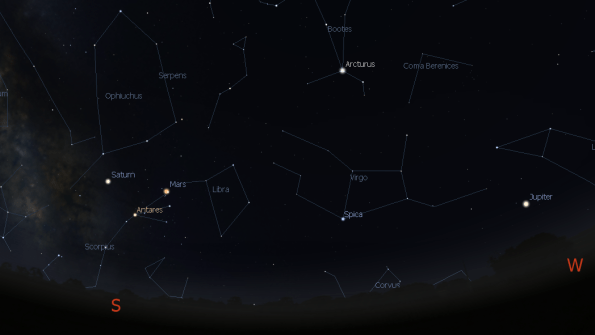
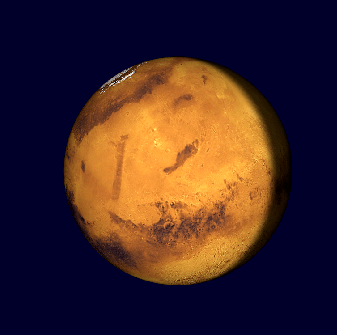
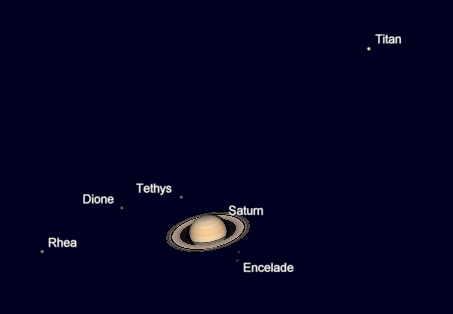
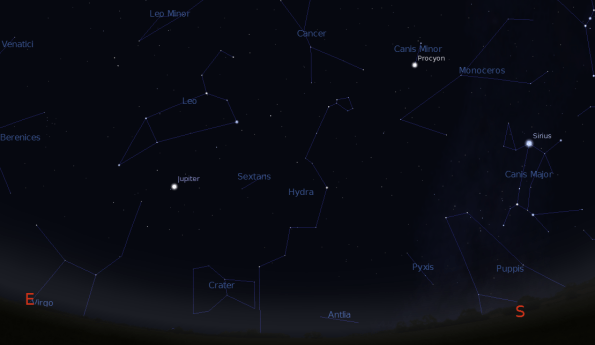
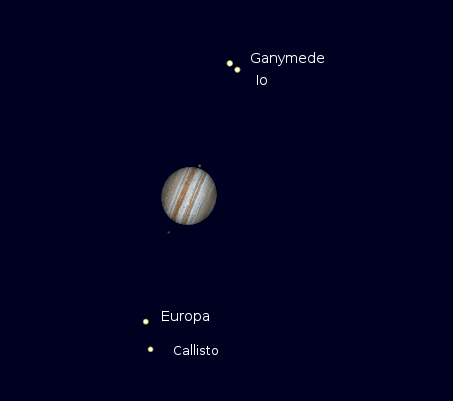
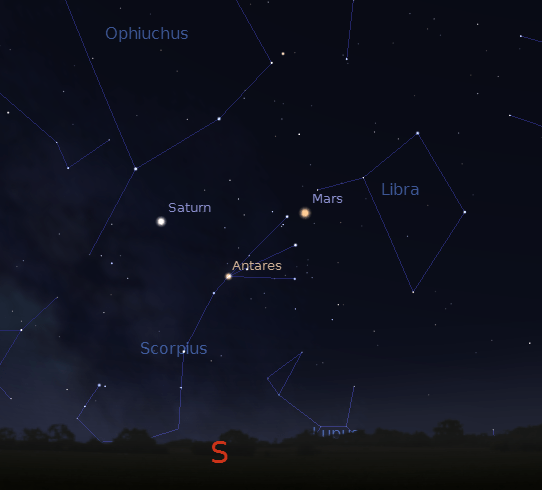
Let’s check out the bright naked eye planets tonight. Jupiter is in the west in the evening. It will set at 11:59 p.m. It’s below-left of the stars of Leo this year. Binoculars can make out some of Jupiter’s moons, but a telescope is required to see all four bright moons and Jupiter’s cloud features. Mars starts the evening in the southern sky. It’s above and right of its dimmer look-a-like star Antares, whose name means Rival of Mars. Mars will be due south at 9:30 p.m. and will set at 2:09 a.m. The Earth is pulling ahead of Mars so it’s now 58 million miles away and tiny in telescopes. Saturn is low in the south-southeast. It’s left of Mars. Saturn will pass due south at 10:50 p.m. and will set at 3:27 a.m. It’s a wonderful telescopic sight.
Times are for the Traverse City/Interlochen area of Michigan. They may be different for your location.
Addendum

Evening planets and the Moon at 10:30 p.m. July 13, 2016. Created using Stellarium.
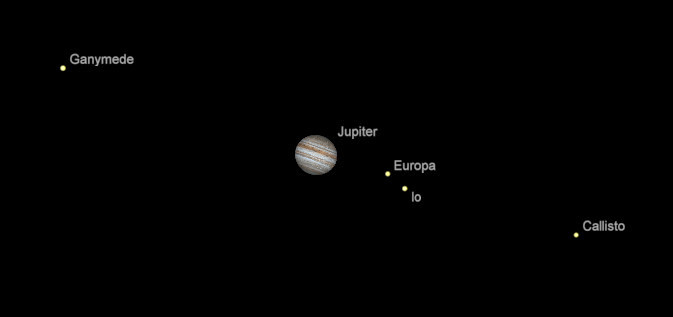
Jupiter and moons at 10:30 p.m. on July 13, 2016. Jupiter’s apparent diameter will be 33.2″. Created using Cartes du Ciel.

The Moon as seen in a pair of binoculars or small telescope with some prominent craters labeled at 10:30 p.m. on July 13, 2016. Created using Virtual Moon.Atlas.

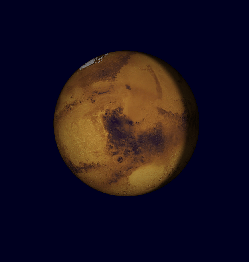
Mars as seen in a large telescope. Note the decidedly gibbous phase at 10:30 p.m. on July 13, 2016. Mars’ apparent diameter will be 14.8″. Created using Cartes du Ciel.

Saturn and its larger moonsat 10:30 p.m. on July 13, 2016. Saturn’s apparent diameter wil be 18.0″ and the rings 41.9″ Created using Cartes du Ciel.

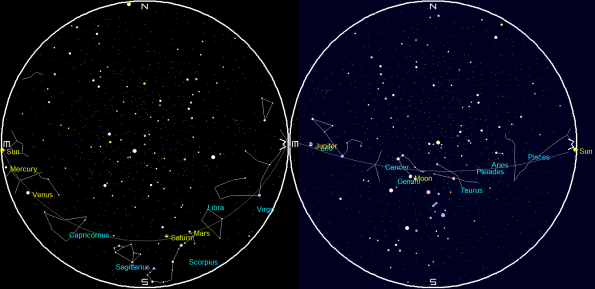
All the planets and the Moon from sunset July 13, 2016 to sunrise on the 14th. Created using my Looking up program.
Extra
I noticed Venus and Mercury near each other but very low in the sky, so I investigated. They are too low to be easily seen.

Venus and Mercury at 9:45 p.m., about 20 minutes after sunset tonight. Venus is 2.5 degrees above a flat horizon, and Mercury is 2 degrees.

Saturday night, same time, Venus will be 3 degrees up with Mercury above it in conjunction. Created using Stellarium. Give it a go. Good luck!
Note: The images and captions were uploaded via my phone after a storm too out the WiFi in the condo we’re staying in on vacation.
05/11/2016 – Ephemeris – Three of the bright planets are seen before midnight
Ephemeris for Wednesday, May 11th. Today the Sun will be up for 14 hours and 41 minutes, setting at 9:00. The Moon, 2 days before first quarter, will set at 1:48 tomorrow morning. Tomorrow the Sun will rise at 6:17.
Let’s see what the bright naked eye planets are up to. Mercury is now officially in the morning sky but too close to the Sun to be seen. Jupiter is in the south in the early evening, and will pass due south at 9:22 p.m., and will set at 3:55a.m. It’s below the stars of Leo this year. Binoculars can make out some of Jupiter’s moons, but a telescope is required to see all four bright moons and Jupiter’s cloud features. Mars will rise at 10:33 p.m. in the east-southeast. It’s still above its look-a-like star Antares, whose name means Rival of Mars. Mars is getting closer to the Earth now, only 50 million miles away It will be closest on the 30th. Saturn will rise at 10:41 p.m. in the east-southeast. It’s just left of Mars.
Times are for the Traverse City/Interlochen area of Michigan. They may be different for your location.
Addendum
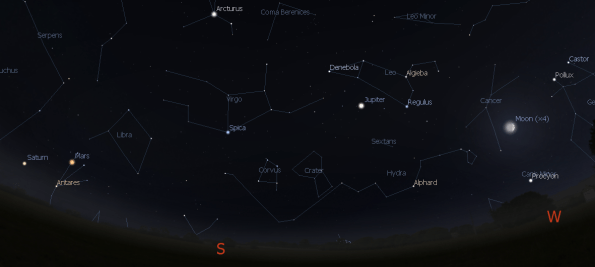
The evening sky tonight at 11:30 p.m. Created using Stellarium.
04/20/2016 – Ephemeris – Two bright planets in the evening, and two in the morning
Ephemeris for Wednesday, April 20th. The Sun rises at 6:49. It’ll be up for 13 hours and 45 minutes, setting at 8:34. The Moon, 2 days before full, will set at 6:47 tomorrow morning.
Let’s see what the bright naked eye planets are up to. Mercury is in the west-northwest, very low to the horizon, setting at 10:26 p.m. Mercury is fading now. Jupiter is in the southeast in the evening, and will pass due south at 10:46 p.m., and will set at 5:19 a.m. It’s below the stars of Leo this year. Binoculars can make out some of Jupiter’s moons, but a telescope is required to see all four bright moons and Jupiter’s cloud features. Mars will rise at 11:40 p.m. in the east-southeast. It’s above Scorpius but is actually in western Ophiuchus now. Saturn will rise at 12:09 a.m. in the east-southeast. It’s just left of Mars. Its rings are a telescopic treat. Venus will rise at 6:28 a.m. and not visible in the bright twilight.
Times are for the Traverse City/Interlochen area of Michigan. They may be different for your location.
Addendum
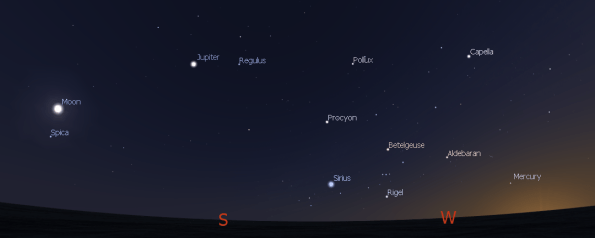
Mercury, Jupiter, the Moon and bright stars visible at 9:30 p.m. April 20, 2016.. Created using Stellarium.
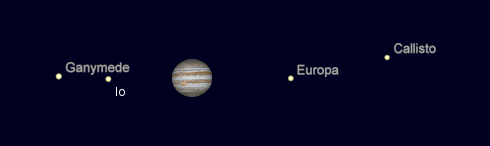
Jupiter and its moons as they might be seen through a telescope at 9:30 p.m. April 20, 2016. It’s 42.0″ in diameter. Created using Cartes du Ciel (Sky Charts).
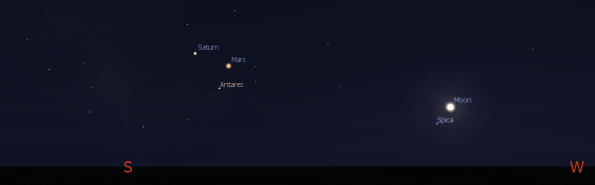
The Moon, Mars and Saturn and the bright stars at 5:30 a.m. April 21, 2016. Created using Stellarium.
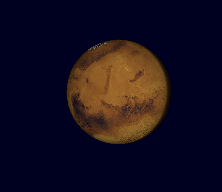
Mars as it might be seen in a large telescope with high power at 5:30 a.m., April 21 2016. Mars apparent diameter is 14.6″. The central meridian will be 233.11 degrees. Syrtis Major is at the extreme left of the planet. Created using Cartes du Ciel (Sky Charts).
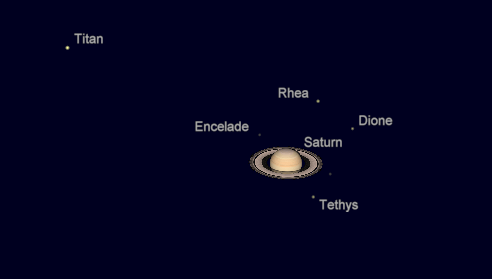
Saturn and its moons at 5:30 a.m., April 21, 2016. The apparent diameter of the planet is 17.9″. The rings span 41.7″, almost the apparent diameter of Jupiter. Created using Cartes du Ciel (Sky Charts).
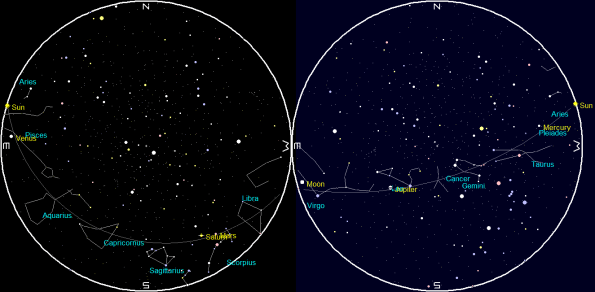
Planets at Sunrise and Sunset on April 20, 2016. If you are using Firefox right-click on the image and select View Image to enlarge the image.
04/13/2016 – Ephemeris – What’s up with the bright planets this week?
Ephemeris for Wednesday, April 13th. The Sun will rise at 7:01. It’ll be up for 13 hours and 24 minutes, setting at 8:26. The Moon, at first quarter today, will set at 3:09 tomorrow morning.
Let’s see what the bright naked eye planets are up to. Mercury is in the west-northwest, very low to the horizon, setting at 10:12 p.m. The next 7 days will be the best time to spot it. Jupiter is in the southeast in the evening, and will pass due south at 11:15 p.m., and will set at 5:48 a.m. It’s below the stars of Leo this year. Binoculars can make out some of Jupiter’s moons, but a telescope is required to see all four bright moons and Jupiter’s cloud features. Mars will rise at 12:08 a.m. in the east-southeast. It’s above Scorpius but is actually in western Ophiuchus now. Saturn will rise at 12:38 a.m. in the east-southeast. It’s just left of Mars. Its rings are a telescopic treat. Venus will rise at 6:37 a.m. and not really visible in the bright twilight.
Times are for the Traverse City/Interlochen area of Michigan. They may be different for your location.
Addendum
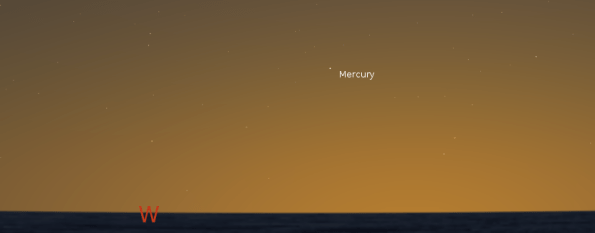
Mercury at 9 p.m. April 13, 2016. At this time Mercury will be located at 284° azimuth and 11.5° altitude. Created using Stellarium.
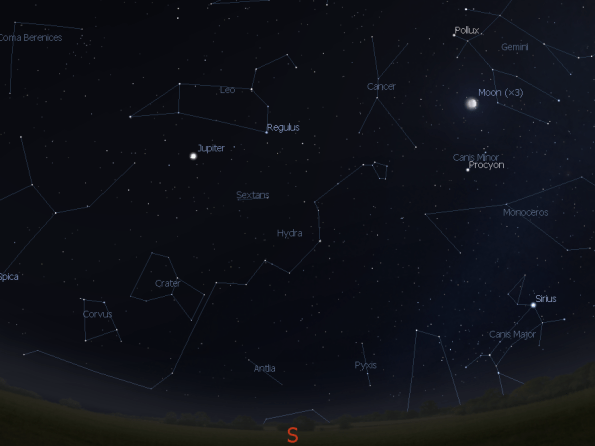
Jupiter, the Moon and the constellations visible at 10 p.m. April 13, 2016.. Created using Stellarium.
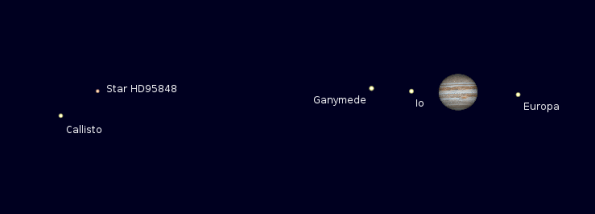
Jupiter and its moons at 10 p.m. April 13, 2016. Jupiter has an apparent diameter of 42.7″ Created using Cartes du Ciel (Sky Charts).
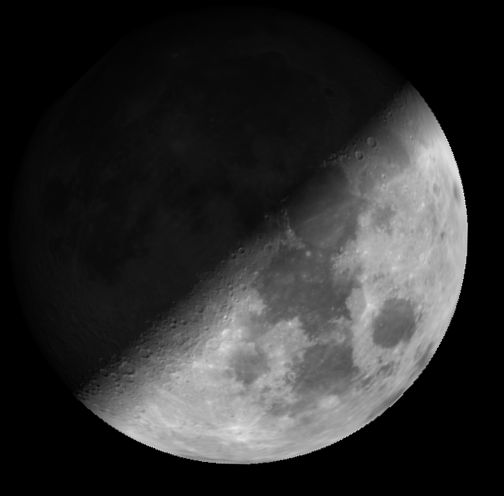
The Moon as it would appear tonight at 9 p.m. April 13, 2016. Created using Virtual Moon Atlas.
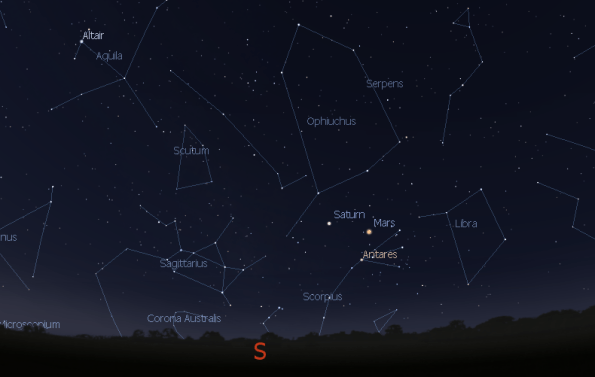
Mars and Saturn with a preview of the summer constellations at 6 a.m., April 14, 2016. Created using Stellarium.
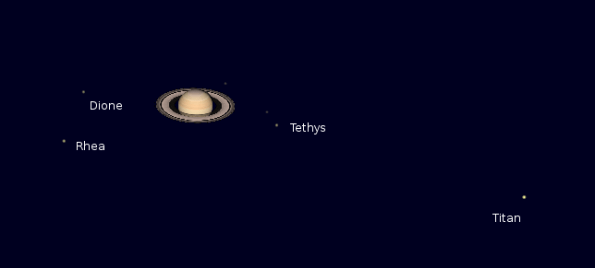
Saturn and its moons at 6 a.m., April 14, 2016. Saturn’s apparent diameter is 17.7″ and the rings span 41.3″ Created using Cartes du Ciel (Sky Charts).
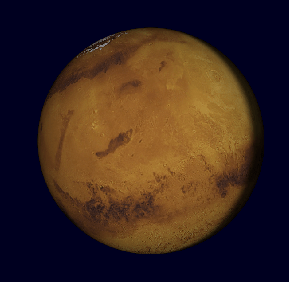
Mars as seen in a large telescope with high power at 6 a.m., April 14 2016. Mars apparent diameter 13.5″. The central meridian will be 202° Created using Cartes du Ciel (Sky Charts).
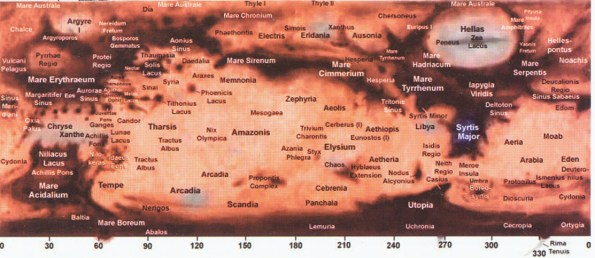
Mars map – North up.
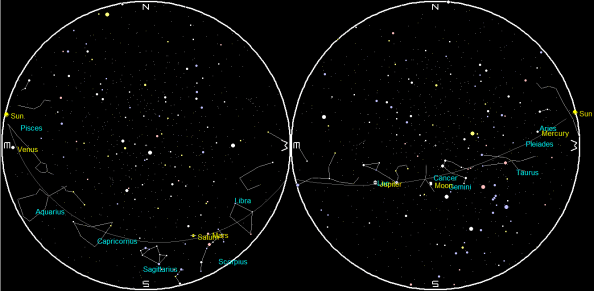
Planets at Sunrise and Sunset on April 13, 2016. If you are using Firefox right-click on the image and select View Image to enlarge the image.
04/06/2016 – Ephemeris – Mercury makes its spring appearance in the west – Plus Jovian moon hijinx
Ephemeris for Wednesday, April 6th. The Sun will rise at 7:13. It’ll be up for 13 hours and 3 minutes, setting at 8:17. The Moon, 1 day before new, will rise at 7:30 tomorrow morning.
Let’s check out the whereabouts of the bright naked eye planets. Mercury is in the west-northwest, very low to the horizon, setting at 9:35 p.m. Jupiter is in the southeast in the evening, and will pass due south, astronomers call it a transit, at 11:45 p.m., and will set at 6:16 a.m. It’s below the stars of Leo this year. Binoculars can make out some of Jupiter’s moons, but a telescope is required to see all four bright moons and Jupiter’s cloud formations. Mars will rise next at 12:31 a.m. in the east-southeast. It’s above Scorpius but moved into western Ophiuchus now. Saturn will rise at 1:06 a.m. in the east-southeast. It’s just left of Mars. Its rings are a telescopic treat. Venus will rise at 6:47 a.m. due east.
Times are for the Traverse City/Interlochen area of Michigan. They may be different for your location.
Addendum
Evening sky
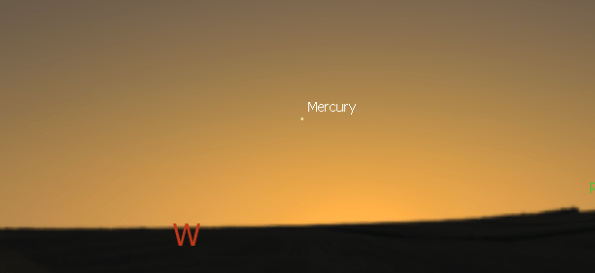
Mercury appears low in the sky in the west at 8:40 p.m. April 6, 2016. Created using Stellarium.
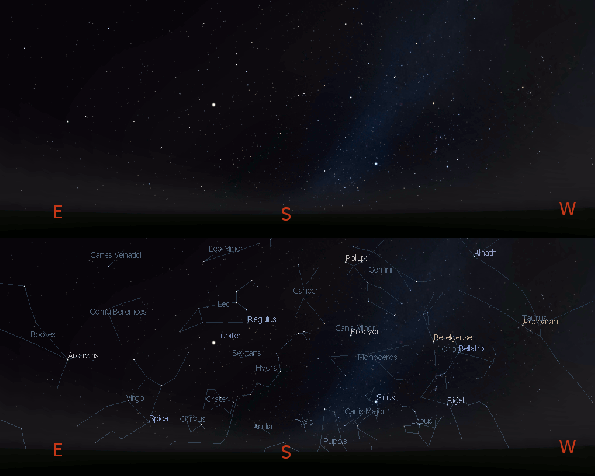
An animation of Jupiter in the night sky with and without lines and captions at 10 p.m., April 6, 2016. Created using Stellarium and GIMP.
If you are using Firefox right-click on the image and select View image to enlarge.
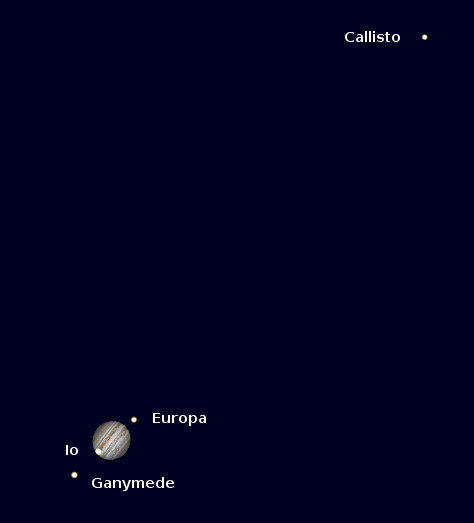
Jupiter and its moons at 10 p.m. April 6, 2016. It’s going to be busy night with the three closest moons playing tag with Jupiter. See the table of events below. Jupiter appears 43.2″ in diameter. Created with Cartes du Ciel (Sky Charts).
Jovian satellite events overnight
Io and Ganymede will pass in front (transit) the face of Jupiter, while Europa pass behind and be occulted by Jupiter.
| Event | Date/Time EDT | Date/Time UT | ||
| Io Transit Starts | 6 | 9:52 p.m. | 7 | 01:52 |
| Io Shadow Crossing Starts | 6 | 10:30 p.m. | 7 | 02:32 |
| Europa Occultation Starts | 6 | 10:48 p.m. | 7 | 02:48 |
| Io Transit Ends | 7 | 12:06 a.m. | 7 | 04:06 |
| Io Shadow Crossing Ends | 7 | 12:47 a.m. | 7 | 04:47 |
| Ganymede Transit Starts | 7 | 1:00 a.m. | 7 | 05:00 |
| Europa Eclipse Ends* | 7 | 2:53 a.m. | 7 | 06:53 |
| Ganymede Shadow Crossing Starts | 7 | 3:44 a.m. | 7 | 07:44 |
| Ganymede Transit Ends | 7 | 4:15 a.m. | 7 | 08:15 |
| Ganymede Shadow Crossing Ends | 7 | Not up | 7 | 11:00 |
| * When Europa’s occultation ends it will still be in Jupiter’s shadow and will enter sunlight a bit away from the planet. | ||||
Timings are from Project Pluto.
Morning sky
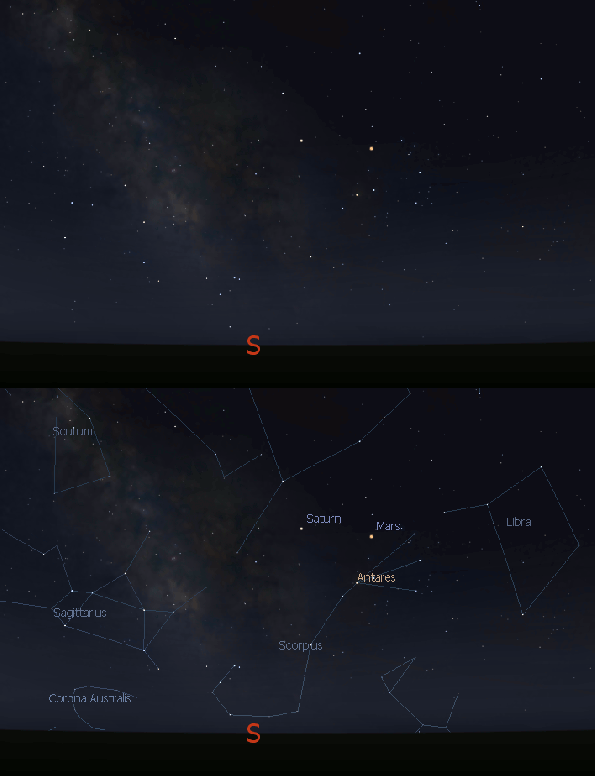
Looking south at 6 a.m. at Mars and Saturn in an animation with and without annotations. 6 a.m. April 7, 2017. Created using Stellarium and GIMP.
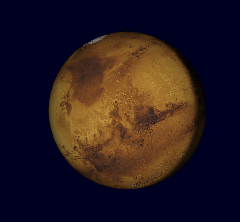
Mars as seen in a large telescope with high power at 6 a.m., April 7, 2016. Mars apparent diameter 12.7″. Created using Cartes du Ciel (Sky Charts).

Saturn with some of its satellites. Normally only Titan is visible. The disk of Saturn has the apparent diameter of 17.6″ while the rings span 40.9″. Created using Cartes du Ciel (Sky Charts).
The planets at sunrise and sunset
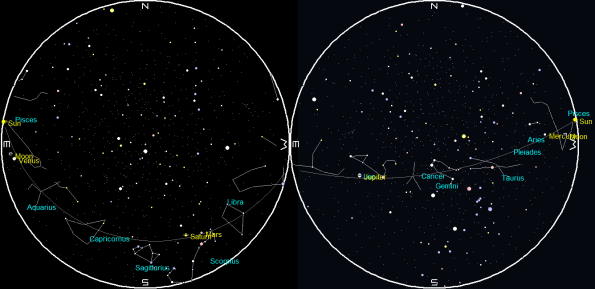
This is a chart showing the sunrise and sunset skies for April 6, 2016 showing the location of the planets and the Moon at that time. Created using my LookingUp program.
04/01/2016 – Ephemeris – Let’s preview April skies
Ephemeris for April Fools Day, Friday, April 1st. The Sun will rise at 7:22. It’ll be up for 12 hours and 48 minutes, setting at 8:11. The Moon, 1 day past last quarter, will rise at 4:23 tomorrow morning.
The 4th month of the year begins today. Daylight hours in the Interlochen/Traverse City area and will increase from 12 hours and 48 minutes today to 14 hours 13 minutes on the 30th. The altitude, or angle, of the sun above the southern horizon at local noon will be 50 degrees today and will ascend to 60 degrees on the 30th. The altitude of the sun in the Straits area will be a degree lower. The actual time of local apparent noon this month for the Interlochen/Traverse City area, when the sun passes due south, will be about 1:43 p.m. Jupiter and Mercury are the evening planets this month, with Mercury making its brief appearance away from the Sun’s sunset glow around mid-month.
Times are for the Traverse City/Interlochen area of Michigan. They may be different for your location.
Addendum
April Star Chart
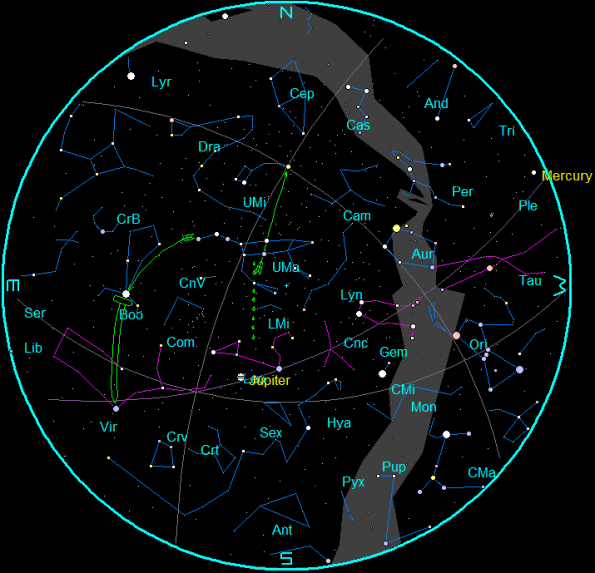
Star Chart for April 2016. Created using my LookingUp program. To enlarge in Firefox Right-click on image then click View image.
Star Chart for April 2016. Created using my LookingUp program. To enlarge in Firefox Right-click on image then click View image.
The planets and stars are plotted for the 15th at 10 p.m. EDT. That is chart time. Note, Traverse City is located approximately 45 minutes behind our time meridian. (An hour 45 minutes behind our daylight saving time meridian.) To duplicate the star positions on a planisphere you may have to set it to 1:45 earlier than the current time.
Evening nautical twilight ends at 9:15 p.m. EDT on the 1st, increasing to 9:59 p.m. EDT on the 30th.
Morning nautical twilight starts at 5:21 a.m. EDT on the 1st, and decreasing to 4:37 a.m. EDT on the 31st.
Add a half hour to the chart time every week before the 15th and subtract a half hour for every week after the 15th. Before the 13th also subtract an hour for Standard Time.
For a list of constellation names to go with the abbreviations click here.
- Pointer stars at the front of the bowl of the Big Dipper point to Polaris the North Star
- A leaky Big Dipper drips on Leo
- Follow the arc of the handle of the Big Dipper to the star Arcturus
- Extend the ac to a spike to point to Spica
Calendar of Planetary Events
Credit: Sky Events Calendar by Fred Espenak and Sumit Dutta (NASA’s GSFC)
To generate your own calendar go to http://eclipse.gsfc.nasa.gov/SKYCAL/SKYCAL.html
Times are Eastern Time. Some additions made to aid clarity.
    Date    Time(EDT) Event
Apr 01  Fr            Venus: 17.4° W
    05  Tu  1:27 p.m. Moon Descending Node
    06  We  4:30 a.m. Moon-Venus: 0.7° S
    07  Th  7:24 a.m. New Moon
    07  Th  1:36 p.m. Moon Perigee: 357200 km
    09  Sa  5:28 p.m. Uranus Conjunction
    10  Su  6:05 p.m. Moon-Aldebaran: 0.4° S Occultation*
    12  Tu  8:12 a.m. Moon North Dec.: 18.3° N
    13  We 11:59 p.m. First Quarter
    16  Sa  8:46 p.m. Moon-Regulus: 2.7° N
    18  Mo 12:42 a.m. Moon-Jupiter: 2.4° N
    18  Mo  9:59 a.m. Mercury Elongation: 19.9° E
    18  Mo  2:04 a.m. Moon Ascending Node
    21  Th 12:05 p.m. Moon Apogee: 406400 km
    22  Fr  1:24 a.m. Full Moon
    22  Fr  1:30 a.m. Lyrid Shower: ZHR = 20
    25  Mo  3:28 p.m. Moon-Saturn: 3.7° S
    27  We 12:44 a.m. Moon South Dec.: 18.4° S
    27  We 12:33 p.m. Mars-Antares: 4.9° N
    28  Th  4:32 a.m. Mercury-Pleiades: 6.5° S
    29  Fr 11:29 p.m. Last Quarter
May 01  Su            Venus: 9.8° W
* Occultation 6:29 - 7:38 p.m. In daylight - Grand Traverse Area
  See Friday April 9th post.
03/30/2016 – Ephemeris – The planets tonight – corrected to March 31-April 1
Note: I’ve been under the weather (bad cold) and have been sleeping a lot. The times for the planet phenomena in the second paragraph have been adjusted to the night of March 31st – April 1st.
Ephemeris for Wednesday, March 30th. The Sun will rise at 7:26. It’ll be up for 12 hours and 42 minutes, setting at 8:08. The Moon, 1 day before last quarter, will rise at 2:51 tomorrow morning.
Let’s check out the whereabouts of the bright naked eye planets for the nigh of March 31-April 1, 2016. Jupiter is up at sunset, and will pass due south, astronomers call it a transit, at 12:11 a.m., and will set at 6:41 a.m. It’s below the stars of Leo now. Binoculars can make out some of Jupiter’s moons, but a telescope is required to see Jupiter’s cloud formations. Mars will rise next at 12:49 a.m. in the east-southeast. It’s seen in western Scorpius now. Saturn will rise at 1:30 a.m. in the east-southeast. It’s above the stars of Scorpius, actually in Ophiuchus. Its rings are a telescopic treat. Venus will rise at 6:55 a.m. again in the east-southeast. Mercury is now in the evening sky but is too close to the Sun to be seen, it will be visible after sunset by mid-month.
Times are for the Traverse City/Interlochen area of Michigan. They may be different for your location.
Addendum
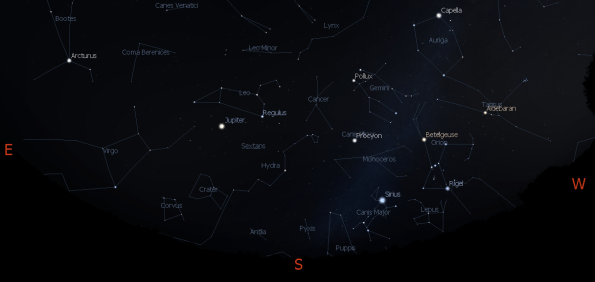
Jupiter and the evening constellations at 10 p.m. March 31, 2016. Created using Stellarium.
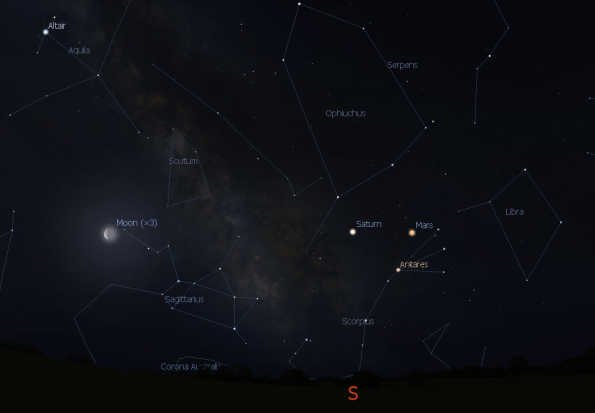
Mars, Saturn and the Moon with the summer constellations at 6 a.m., April 1, 2016. Created using Stellarium.
03/23/2016 – Ephemeris – Another planet defects from the morning sky
Ephemeris for Wednesday, March 23rd. The Sun will rise at 7:39. It’ll be up for 12 hours and 20 minutes, setting at 7:59. The Moon, at full today, will rise at 8:21 this evening.
Let’s check out the whereabouts of the bright naked eye planets. Jupiter is up at sunset, and will pass due south, astronomers call it a transit, at 12:45 a.m., and will set at 7:15 a.m. It’s below the stars of Leo now. Binoculars can make out some of Jupiter’s moons, but a telescope is required to see Jupiter’s cloud formations. Mars will rise next at 1:12 a.m. in the east-southeast. It’s seen in western Scorpius now. Saturn will rise at 2:02 a.m. in the east-southeast. It’s above the stars of Scorpius, actually in Ophiuchus. Its rings are a telescopic treat. Venus will rise at 7:05 a.m. again in the east-southeast. Mercury will pass in superior conjunction, that is behind the Sun, this afternoon and enter the evening sky.
Times are for the Traverse City/Interlochen area of Michigan. They may be different for your location.
Addendum
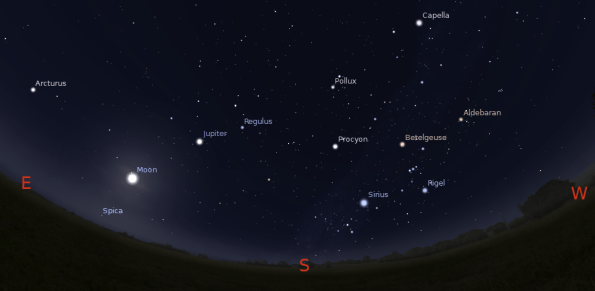
Jupiter with the moon and the bright stars of winter and spring at 10 p.m., March 23, 2016. Created using Stellarium.
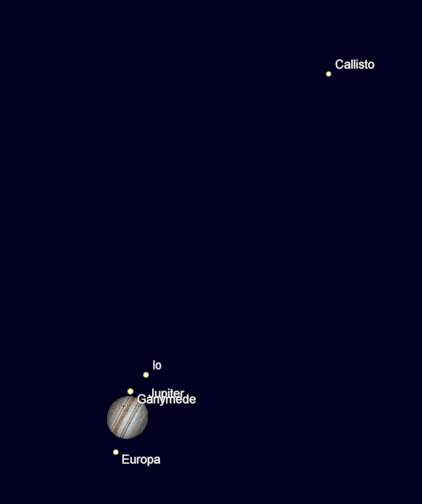
Jupiter and its moons on an active night as the would appear at 10 p.m. March 23, 2016. The equatorial diameter of Jupiter is 44.1″. Created using Cartes du Ciel (Sky Charts).
Tonight’s satellite events
| Event | Date/Time EDT | Date/Time UT | ||
| Europa Occultation Starts | 23 | — | 23 | 22:17 |
| Ganymede Transit Starts | 23 | — | 23 | 22:19 |
| Io Transit Starts | 23 | — | 23 | 22:22 |
| Io Shadow Crossing Starts | 23 | — | 23 | 22:24 |
| Ganymede Shadow Crossing Starts | 23 | — | 23 | 23:46 |
| Io Transit Ends | 23 | 08:36 PM | 24 | 00:36 |
| Io Shadow Crossing Ends | 23 | 08:58 PM | 24 | 00:58 |
| Ganymede Transit Ends | 23 | 09:31 PM | 24 | 01:31 |
| Europa Eclipse Ends* | 23 | 09:45 PM | 24 | 01:45 |
| Ganymede Shadow Crossing Ends | 23 | 11:04 PM | 24 | 03:04 |
| * When Europa’s occultation ends it will still in Jupiter’s shadow and will enter sunlight a bit away from the planet.
Timings are from Project Pluto. |
||||
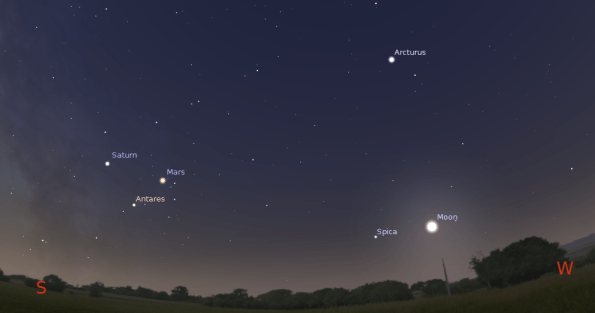
The Moon and the morning planets Mars and Saturn with the summer stars at 7 a.m. March 24, 2016. Created using Stellarium.
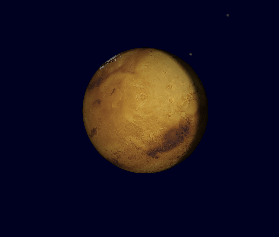
Mars as it would be seen in a large telescope at 6 a.m. March 24, 2016. Apparent diameter is 11.0″ One quarter of Jupiter’s apparent diameter. Created using Cartes du Ciel (Sky Charts).
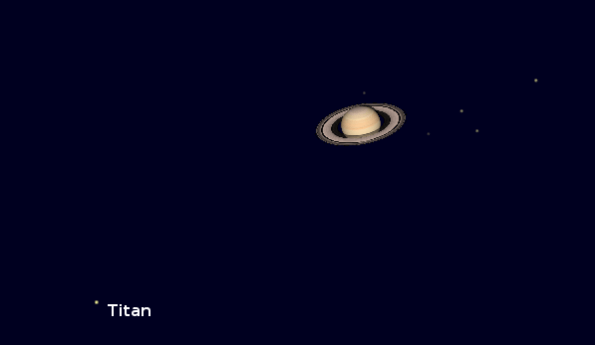
Saturn and Titan at 6 a.m. March 24, 2016. The planet’s apparent diameter is 17.2″ and the rings span 40.0″. Created using Cartes du Ciel (Sky Charts).
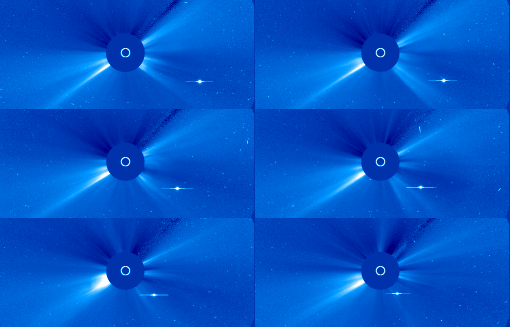
Mercury approaching the Sun from the right for the days March 19-22, 2016. Credit SOHO/NASA/ESA.
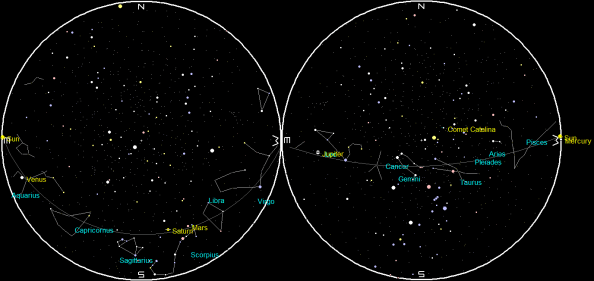
This is a chart showing the sunrise and sunset skies for March 23, 2016 showing the location of the planets and the Moon at that time. Created using my LookingUp program.
03/16/2016 – Ephemeris – Jupiter is in the evening, the other bright planets are in the morning
Ephemeris for Wednesday, March 16th. The Sun will rise at 7:52. It’ll be up for 11 hours and 58 minutes, setting at 7:50. The Moon, 1 day past first quarter, will set at 4:26 tomorrow morning.
Let’s check out the whereabouts of the bright naked eye planets. Jupiter is up at sunset, and will pass due south, astronomers call it a transit, at 1:13 a.m., and will set at 7:44 a.m. It’s below the stars of Leo now. Binoculars can make out some of Jupiter’s moons, but a telescope is required to see Jupiter’s cloud formations. Mars will rise next at 1:29 a.m. in the east-southeast. It’s seen in western Scorpius now. Saturn will rise at 2:29 a.m. in the east-southeast. It’s above the stars of Scorpius, actually in Ophiuchus. Its rings are a telescopic treat. Venus will rise at 7:13 a.m. again in the east-southeast. Mercury is lost in the bright morning twilight and will pass behind the Sun in superior conjunction a week from now.
Times are for the Traverse City/Interlochen area of Michigan. They may be different for your location.
Addendum
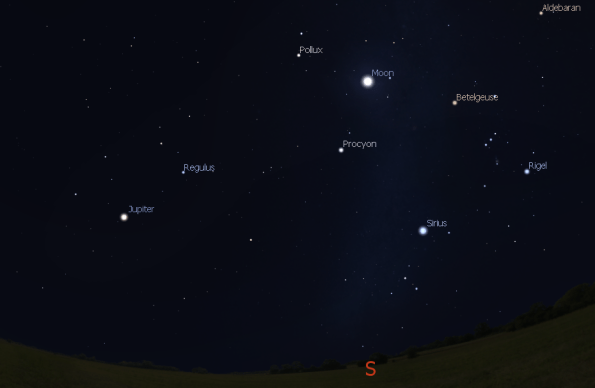
Jupiter and the Moon with the bright stars at 10 p.m. on March 16, 2016. Created using Stellarium.
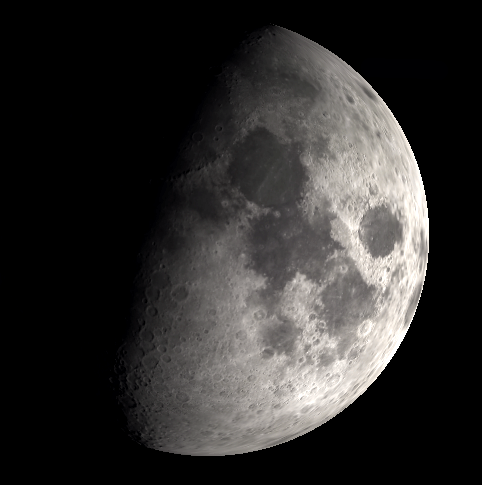
The Moon as it might appear in binoculars at 10 p.m. on March 16, 2016. Created using Stellarium.
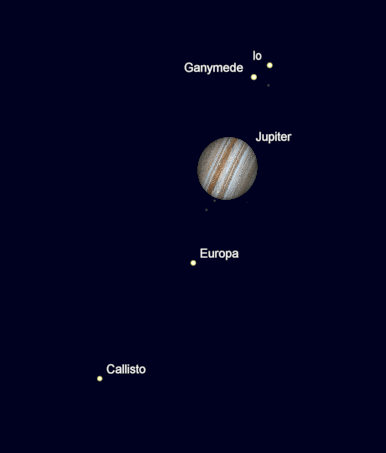
Jupiter and its moons as they would be seen in a telescope, at 10 p.m. March 16, 2016. Jupiter has an apparent diameter of 44.3″ Created using Stellarium.
The morning planets Mars, Saturn and Jupiter at 6:30 a.m. March 17, 2016. Created using Stellarium.
Mars as seen in a large telescope at high power. It’s only 10.0″ in diameter, about a quarter of Jupiter’s diameter. The long dark area near the bottom or south is Mare Cimmerium. The bright area above center is Elysium. Created using Cartes du Ciel (Sky Charts).
Saturn and its large satellite Titan and other moons as they should appear in a telescope in the morning of March 17, 2016. The planet is 17.0″ in diameter while the rings span 39.6″. Created using Stellarium.
This is a chart showing the sunrise and sunset skies for March 16, 2016 showing the location of the planets and the Moon at that time. Created using my LookingUp program.
Some of these images above are shown smaller than actual size. Image expansion lately hasn’t worked. If you are using Firefox, right-click on the image, and then click on View Image.
03/09/2016 – Ephemeris – With Venus and Mercury lost in twilight, Mars and Saturn are the only official morning planets easily seen now
Ephemeris for Wednesday, March 9th. The Sun will rise at 7:05. It’ll be up for 11 hours and 36 minutes, setting at 6:41. The Moon, 1 day past new, will set at 7:43 this evening.
Let’s check out the whereabouts of the bright naked eye planets. Jupiter is up at sunset, and will pass due south, astronomers call it a transit, at 12:47 a.m., and will set at 7:14 a.m. It’s below the stars of Leo now. Binoculars can make out some of Jupiter’s moons, but a telescope is required to see Jupiter’s cloud formations. Mars will rise next at 12:45 a.m. in the east-southeast. It’s seen in eastern Libra almost entering the territory of Scorpius. Saturn will rise at 1:56 a.m. in the east-southeast. It’s above the stars of Scorpius, actually in Ophiuchus. Its rings are a telescopic treat. Venus will rise at 6:20 a.m. again in the east-southeast. Mercury is lost in the bright morning twilight and will pass behind the Sun in superior conjunction on the 23rd.
Times are for the Traverse City/Interlochen area of Michigan. They may be different for your location.
Addendum
Sorry for the late post, but preparation for my visit to Mill Creek Elementary school in Williamsburg, MI took some extra preparation. Of course too I was watching the solar eclipse from Micronesia, both channels.
Jupiter appears with the coming spring stars and constellations at 9 p.m., March 9, 2016. Created using Stellarium.
Jupiter and its moons in a telescope at 9 p.m. March 9, 2016. It’s apparent diameter is 44.4″. Created using Cartes du Ciel (Sky Charts).
The morning planets Mars and Saturn are near each other in the south morning sky at 6 a.m. March 10, 2016. Created using Stellarium.
Mars as seen in a large telescope at high power. It’s only 9.5″ in diameter, about a quarter of Jupiter’s diameter. The large dark area in the center is Syrtis Major which sounds cooler than its English translation “Great Swamp”. South of it is the bright elliptical Hellas Basin. Created using Cartes du Ciel (Sky Charts).
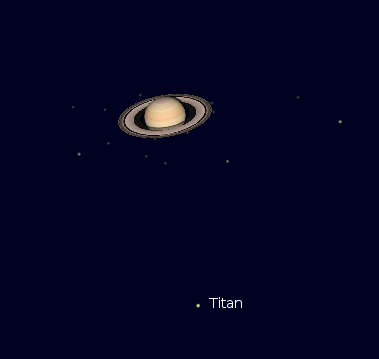
Saturn and its moon Titan as they might be seen through a telescope at 6 a.m. March 10, 2016. The planet diameter is 16.8″ while the rings span 38.1″. Created using Created using Cartes du Ciel (Sky Charts).
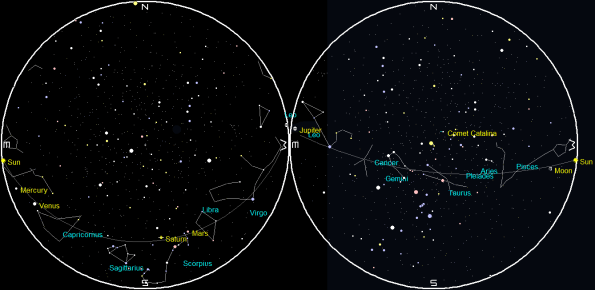
This is a chart showing the sunrise and sunset skies for March 9, 2016 showing the location of the planets and the Moon at that time. Created using my LookingUp program.

