Archive
03/14/11 – Ephemeris – The Lunar Jura Mountains
Ephemeris for Monday, March 14th. The sun will rise at 7:57. It’ll be up for 11 hours and 49 minutes, setting at 7:46. The moon, 3 days past first quarter, will set at 5:13 tomorrow morning.
On the moon tonight the gibbous phase and the terminator on the left side of the moon is revealing a large semi circular mountain range called the Jura Mountains that encloses a flat lava plain that looks like a bay in the margin of the Sea of Showers or Mare Imbrium. It is easily visible in binoculars this evening when the sunrise line is crossing the bay. The Jura Mountains will appear as a hook out of the upper left edge of the moon. That’s about the coolest sight that’s visible on the moon that can be seen with binoculars. It’s especially striking if seen in a small telescope. I’ve added these programs to my web log or blog and I can add images to illustrate what I’m talking about, as I did today. The blog’s address is bobmoler.wordpress.com.
* Times are for the Traverse City/Interlochen area of Michigan. They may be different for your location.
Addendum
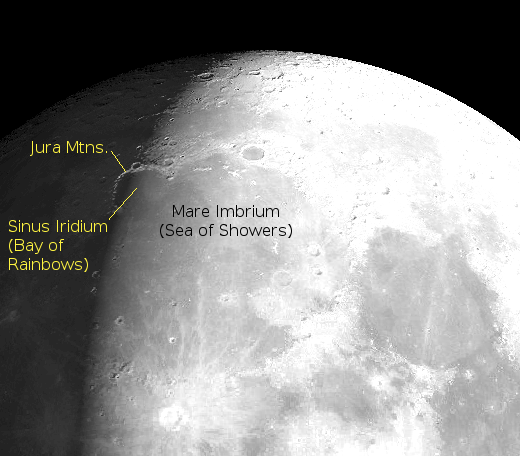
The Jura Mountains sticking up into morning daylight. Created from the Virtual Moon Atlas.
03/10/11 – Ephemeris – The moon will appear near the Pleiades tonight
Thursday, March 10th. The sun will rise at 7:04. It’ll be up for 11 hours and 37 minutes, setting at 6:41. The moon, 2 days before first quarter, will set at 12:54 tomorrow morning.
The fat crescent moon tonight will be near the Pleiades or Seven Sisters star cluster. The Pleiades can be seen above the moon. They will make a very beautiful sight in binoculars. They will be closest together near 2 in the morning. Some years the moon will even pass in front of the stars of the Pleiades. On the moon itself tonight, in binoculars, we can see the dark lunar seas of Crises, Fertility, Nectar, and Tranquility. With a telescope the crater Theophilus is visible near the terminator, the sunrise line a bit below center of the moon. It is a perfect circular crater with a central peak. The best crater visible now. That will change as the moons phase becomes fuller. It will appear washed out and indistinct. The moon needs shadows to delineate its features.
* Times are for the Traverse City/Interlochen area of Michigan. They may be different for your location.
Blog addendum:
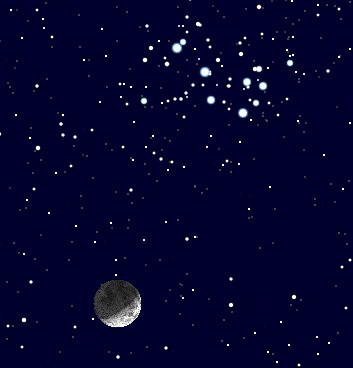
Pleiades and the moon 03/10/11, created using Cartes du Ciel.
Here’s a closer look at the moon courtesy of Virtual Moon Atlas.
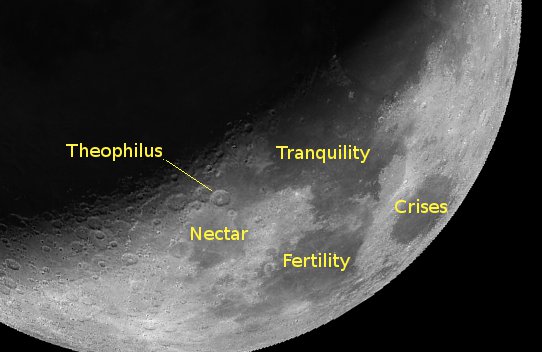
Young moon with the crater Theophilus and four seas. From Virtual Moon Atlas
03/08/11 – Ephemeris – The lunar sea of Crises
Fat Tuesday, March 8th. The sun will rise at 7:08. It’ll be up for 11 hours and 31 minutes, setting at 6:39. The moon, half way from new to first quarter, will set at 10:51 this evening.
The one feature that is prominent on the crescent moon tonight will be the dark sea Mare Crisium or sea of Crises. It appears easily in binoculars. It, as all the lunar seas, are really a large crater that was created about 3.85 billion years ago by an asteroid strike. It appears foreshortened because it’s near the moon’s limb. If you watched the proximity of Mare Crisium to the edge of the moon over time, you’d notice that sometimes it’s closer to the edge than at other times. The moon has a constant rotation, but its orbit isn’t circular, so the moon appears to rock back and forth slowly, and nods a bit too. The effect is called libration, and allows us to see 60% of the moon from earth.
* Times are for the Traverse City/Interlochen area of Michigan. They may be different for your location.
Blog Addendum:
Below is an image from Virtual Moon Atlas pointing out Mare Crisium, the Sea of Crises. VMA is a free program. See the links for free programs on this blog.
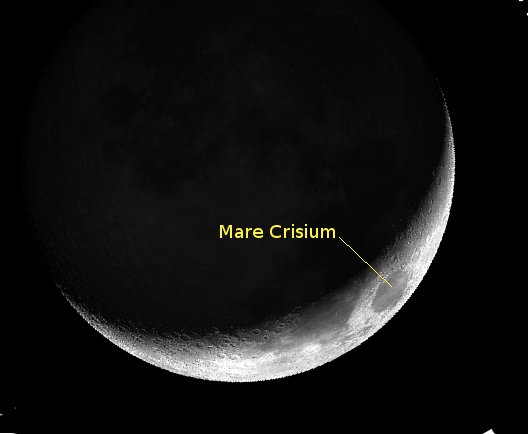
Mare Crisium via Virtual Moon Atlas
03/07/11 – Ephemeris – Earthshine
Monday, March 7th. The sun will rise at 7:09. It’ll be up for 11 hours and 28 minutes, setting at 6:37. The moon, 3 days past new, will set at 9:49 this evening.
The moon tonight will appear as a thin sliver, with not much visible on the thin illuminated portion. However if as you look at the moon tonight you have the funny feeling that the whole moon is visible, you are right. It’s easily confirmed with a pair of binoculars or a small telescope. What is illuminating the dark part of the moon is earthshine. The earth is big and bright in the moon’s sky, and nearly full from its vantage point. The effect used to be called by the term “Old moon in the new moon’s arms”. The effect was first explained by Leonardo DaVinci some 500 years ago. The effect will disappear in a few days as the moon gets brighter and the earth less so in the moon’s sky. Earthshine will appear again when the moon appears as a waning crescent in the morning.
* Times are for the Traverse City/Interlochen area of Michigan. They may be different for your location.
Update:
Earthshine is notoriously hard to photograph. Here’s one of mine from 1991. Part of a planetary conjunction picture with a short focal length telephoto lens. I’ve cropped out the planets. The sunlit side of the moon is vastly overexposed causing the blooming in the photograph.
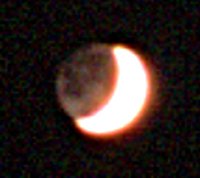
Earthshine on the crescent moon
 Bob Moler's Ephemeris Blog