Archive
08/08/11 – Ephemeris – The lunar seas and the possible second moon theory
Monday, August 8th. The sun rises at 6:36. It’ll be up for 14 hours and 22 minutes, setting at 8:58. The moon, 2 days past first quarter, will set at 2:17 tomorrow morning.
With the announcement last week that the earth may have had two moons, we’d kind of look at our surviving moon in a new light. Tonight the terminator, the line between light and dark on the moon, really the sunrise line crosses through the Sea of Clouds or Mare Imbrium. Telescope will reveal the crater Copernicus near the moon’s equator that will come into sunlight an hour from now as you listen to this. Two astronomers from the US and Switzerland propose that the collision of the earth that created the moon also created another moon. After a time this second, smaller moon crashed into our moon and created the dark seas on the side that faces the earth. The far side of the moon only has one small sea, the Sea of Moscow, discovered by the Russians in 1959 with their Lunik 3 spacecraft.
* Times are for the Traverse City/Interlochen area of Michigan. They may be different for your location.
07/11/11 – Ephemeris – The moon’s Oceanus Procellarum
Monday, July 11th. Today the sun will be up for 15 hours and 19 minutes, setting at 9:27. The moon, 3 days past first quarter, will set at 3:25 tomorrow morning. Tomorrow the sun will rise at 6:08.
The moon tonight is a big fat gibbous phase. The terminator, now before full moon is the sunrise line that creates tonight’s phase. It’s crossing the large sea called Oceanus Procellarum or the Ocean of Storms. It is the moon’s largest sea, though really a lava basin. This is easily seen with the unaided eye and binoculars. The moon has never had oceans or seas of water. That impression was in the eyes of early telescopic observers of the moon , who even thought there was life on the moon. Oceanus is huge, by lunar standards, 434 by 303 miles with indistinct walls. Lunar seas are actually huge craters with an age over 3 billion years.
* Times are for the Traverse City/Interlochen area of Michigan. They may be different for your location.
Addendum
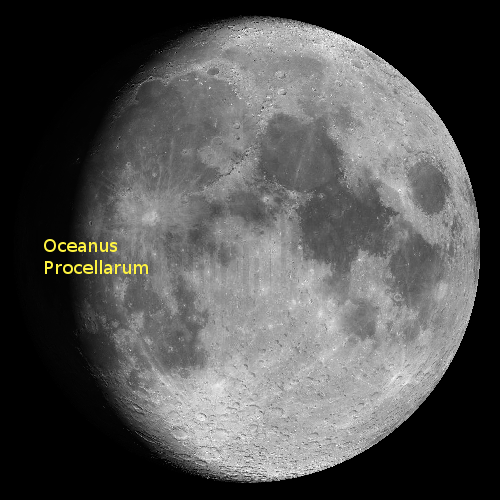
The moon's Oceanus Procellarum. Image from the Virtual Moon Atlas.
07/08/11 – Ephemeris – Viewing night Saturday at the Rogers Observatory
Friday, July 8th. Today the sun will be up for 15 hours and 23 minutes, setting at 9:29. The moon, at first quarter today, will set at 1:14 tomorrow morning. Tomorrow the sun will rise at 6:06.
Tomorrow evening there will be a viewing night at Northwestern Michigan College’s Joseph H. Rogers Observatory. On tap if it’s clear will be Saturn and the moon plus the brighter deep sky objects, that is telescopic objects that are beyond the solar system. Saturn is the planet to see in a telescope with it’s fantastic rings. The moon will reveal its wonders including the great Copernicus crater, 56 miles wide and two miles deep with a triple central peak and terraced walls. The observatory hill is also good vantage point to view the Cherry Festival fireworks where they’re not so loud. The observatory is located south of Traverse City on Birmley Road between Garfield and Keystone roads.
* Times are for the Traverse City/Interlochen area of Michigan. They may be different for your location.
07/05/11 – Ephemeris – The ancient’s perfect moon
Tuesday, July 5th. Today the sun will be up for 15 hours and 26 minutes, setting at 9:30. The moon, 3 days before first quarter, will set at 11:49 this evening. Tomorrow the sun will rise at 6:04.
As we look at the moon tonight we can see dark areas and bright areas. To western philosophers and astronomers from Aristotle to Copernicus objects in the heavens were thought to be perfect and changeless and moved in uniform circular motion around the earth. However the moon doesn’t appear perfect and spotless. It has light and dark areas on it. The supposed explanation for that was that it was a perfect mirror and reflected the earth. It might make sense if you didn’t think about it too much. For a very long time nobody did, at least nobody that made a difference until Copernicus came along. With Copernicus, Galileo and his telescope, Tycho Brahe’s observations, Kepler and Newton, the heavens were changed forever.
* Times are for the Traverse City/Interlochen area of Michigan. They may be different for your location.
06/10/11 – Ephemeris – The moon tonight
Friday, June 10th. Today the sun will be up for 15 hours and 29 minutes, setting at 9:26. The moon, 2 days past first quarter, will set at 2:40 tomorrow morning. Tomorrow the sun will rise at 5:57.
Tonight the moon is in its gibbous phase. Gibbous means hump backed. One crater that came into light in the last 24 hours is the crater Copernicus, named for the Polish astronomer and cleric who removed the earth from the center of the universe. The crater Copernicus is on the center left on the moon. Its halo of rays will show up better when the moon is full, but now the crater itself can be appreciated. In a telescope its is quite a sight. It has a complex triple central peak, and terraced walls. The small asteroid that hit it less than a billion years ago, struck the moon, gouging out the 56 mile diameter crater we see today. Rebound created the central peaks. An oblique image of it by a Lunar Orbiter in the late 60s was a famous picture of the time.
* Times are for the Traverse City/Interlochen area of Michigan. They may be different for your location.
06/09/11 – Ephemeris – The moon tonight
Thursday, June 9th. Today the sun will be up for 15 hours and 28 minutes, setting at 9:26. The moon, 1 day past first quarter, will set at 2:10 tomorrow morning. Tomorrow the sun will rise at 5:57.
Lets take a look at the moon tonight. It’ll be a day past first quarter and we see features at the terminator, the sunrise line which gives the moon a slightly gibbous shape. In small telescopes, at the north or top end of the moon, the wide flat crater Plato has just entered sunlight. Long shadows from its crater walls will retreat across its flat floor. If you look closely you’ll notice that the floor of Plato is slightly convex to conform with the curvature of the moon itself. South of Plato is a distinctive triangle of three craters on the flat floor of the Sea of Showers The largest is Archimedes, the northern of the other two is Aristellus, while the other is Autolycus. They are near the Apollo 15 landing site.
* Times are for the Traverse City/Interlochen area of Michigan. They may be different for your location.
05/10/11 – Ephemeris – The Ancient Greeks and measuring the distance to the sun
Tuesday, May 10th. The sun rises at 6:20. It’ll be up for 14 hours and 36 minutes, setting at 8:57. The moon, at first quarter today, will set at 2:46 tomorrow morning.
The ancient Greek astronomers had great success in actually calculating the distance to the moon. They came up with 60 earth radii. Yes, they knew the earth was round and even measured its circumference to great accuracy. The distance they got for the moon lies within the range of the actual moon’s distance. They next tried to measure the distance from the sun. To do this, they tried to observe the moon and the sun at the exact time the moon was at first quarter. At this time the earth, sun and moon make a right triangle. Theoretically the actual angle between the sun and the moon would give the distance to the sun. The answer they got was that the sun was 20 times the moon’s distance. That’s way short, the sun is 400 times the moon’s distance away.
* Times are for the Traverse City/Interlochen area of Michigan. They may be different for your location.
Addendum
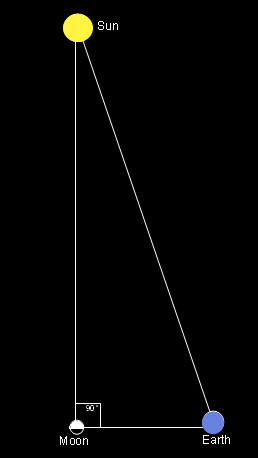
How the ancient Greeks tried to calculate the distance to the sun.
To the right is my take on the Greek sun measuring experiment. Using their guy Euclid and his geometry they knew that the sum of the angles of a triangle equal 180 degrees.
Having an exactly quarter moon, first or last, they knew the Sun-Moon-Earth angle was 90 degrees, so if they could measure the Sun-Earth-Moon angle from observation, they knew the other angle at the sun.
They had already calculated the moon’s distance, so they could calculate the other leg, the Sun-Moon distance using trigonometry. The first trig tables were invented by Greek astronomer Hipparchus.
Ah yes, Trig tables. I don’t suppose you kids use them anymore, with your electronic calculators. Back in my high school days my calculator was a slide rule. Sorry, old guy grousing.
04/15/11 – Ephemeris – Naming lunar features
Friday, April 15th. The sun rises at 6:58. It’ll be up for 13 hours and 28 minutes, setting at 8:27. The moon, 2 days before full, will set at 5:41 tomorrow morning.
If you’ve notices that the names we use for features on the moon sound familiar when used in other contexts, you’re right. Lunar craters are named for astronomers, scientists, philosophers and explorers. The mountains on the moon are named for earthly mountain ranges. The great lava plains, misnames seas are given fanciful names like the Sea of Tranquility, which I usually leave in the original Latin. In this case Mare Tranquilitatis. The naming convention for craters pretty much holds for the other bodies of the solar system. The next bodies to get crater names will be Mercury, which the MESSENGER spacecraft went into orbit of last month and the asteroid Vesta, which the Dawn spacecraft will reach in July.
* Times are for the Traverse City/Interlochen area of Michigan. They may be different for your location.
Addendum
See this Wikipedia article on planetary nomenclature.
04/11/11 – Ephemeris – First quarter moon
Monday, April 11th. The sun will rise at 7:05. It’ll be up for 13 hours and 16 minutes, setting at 8:22. The moon, at first quarter today, will set at 3:45 tomorrow morning.
Lets take a look at the moon tonight. It’ll be about 14 hours after first quarter and we see features at the terminator, the sunrise line that cuts the moon in half. In small telescopes, at the north or top end of the moon, the wide flat crater Plato has just entered sunlight. Long shadows from its crater walls will retreat across its flat floor. If you look closely you’ll notice that the floor of Plato is slightly convex to conform with the curvature of the moon itself. Nearby is the straight gash in the Alps Mountains, called the Alpine Valley. Supposedly the crater Plato formed shortly after Mare Imbrium formed throwing up the Alps and the Apennine mountains to the south. The Straight wall, another straight feature can be seen on the south end of the moon.
* Times are for the Traverse City/Interlochen area of Michigan. They may be different for your location.
Addendum
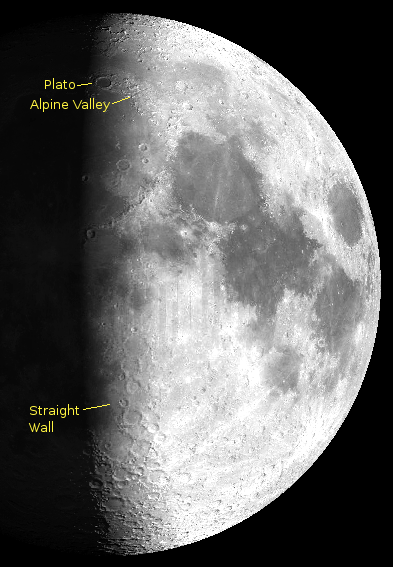
First quarter moon April 11, 2011 Created using Virtual Moon Atlas
03/15/11 – Ephemeris – The Lunar Highlands
Ephemeris for Tuesday, March 15th. The sun will rise at 7:55. It’ll be up for 11 hours and 52 minutes, setting at 7:48. The moon, half way from first quarter to full, will set at 5:48 tomorrow morning.
The south part of the moon that can be seen tonight appears brighter than the darker areas that we call seas, that make up the face of the man in the moon. These and other bright areas are called the lunar highlands, and are the most primitive surface of the moon. Here the landscape is saturated with craters. In binoculars the crater Tycho with its rays are just beginning to become prominent. These rays, are thought to be small craterlets caused by the ejecta from the creation of Tycho which occurred perhaps less than 1.1 billion years ago. This makes Tycho a relatively fresh crater in the moon’s nearly 4.5 billion year history. A telescope will reveal more, including the large crater Clavius with its arc of smaller craters within.
* Times are for the Traverse City/Interlochen area of Michigan. They may be different for your location.
 Bob Moler's Ephemeris Blog