Archive
12/26/2016 – Ephemeris – Orion takes its place as the central winter constellation
Ephemeris for Monday, December 26th. The Sun will rise at 8:19. It’ll be up for 8 hours and 49 minutes, setting at 5:08. The Moon, 3 days before new, will rise at 6:33 tomorrow morning.
The great constellation of Orion the hunter has claimed his rightful position as the central winter constellation. It’s the most famous constellation of all. Think the Big Dipper is a big deal? They can’t even see it from the large population centers of Australia. Parts of Orion can be seen from every part of the Earth from pole to pole. Orion’s distinctive feature is his belt of three bright stars in a row. This tilted belt is in the center of a large rectangle of bright stars. The upper left star is Betelgeuse a red giant star. The lower right star is Rigel a blue giant star. Orion was an unlucky fellow of Greek myth. One wonders why he gets this splashy constellation in Winter while Hercules gets a dim upside down constellation in the spring sky.
Times are for the Traverse City/Interlochen area of Michigan. They may be different for your location.
Addendum
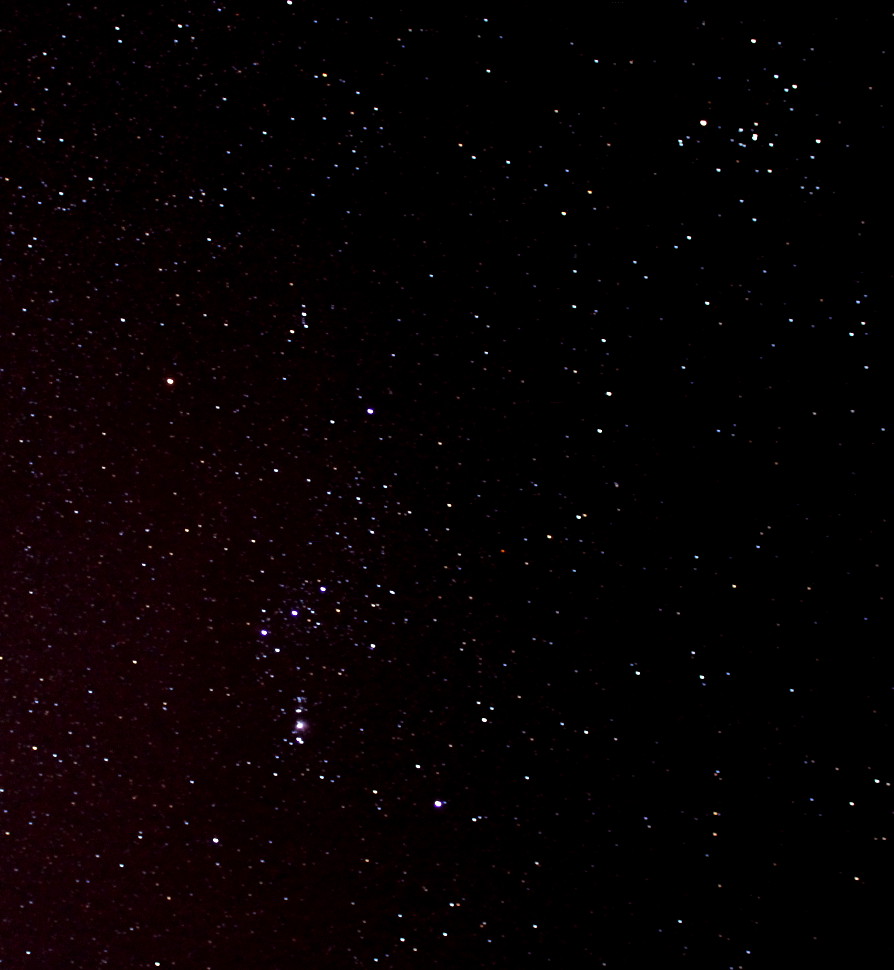
Orion and the head of Taurus photograph by myself January 4, 2016 at 11:30 p.m. It’s a stack of unguided 20 second exposures.
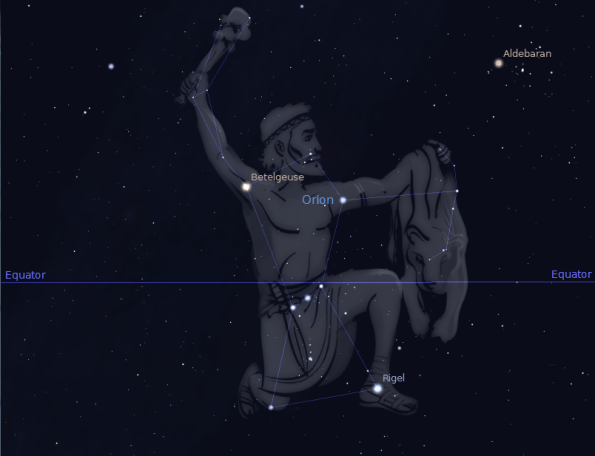
Orion from mid latitudes north of the equator. Orion would be upside down if viewed south of the equator. Created using Stellarium.
The Ephemeris radio programs are very short (59 seconds) so I will visit Orion several times during the winter to explore its mythology and deep sky wonders within, or search past posts for Orion.
12/06/2016 – Ephemeris – Capella the northernmost first magnitude star
Ephemeris for Tuesday, December 6th. The Sun will rise at 8:05. It’ll be up for 8 hours and 56 minutes, setting at 5:02. The Moon, 1 day before first quarter, will set at 12:08 tomorrow morning.
A bright star called Capella has slowly been rising in the northeastern sky in the evenings for the past few months. At 8 p.m. now it is low in the east-northeast to the upper left of Orion, rising in the east. This winter Capella will be overhead, the highest of winter’s seven brilliant first magnitude stars. Capella never quite sets for anyone north of Ludington. Due to its brightness, and being the closest first magnitude star to the pole, Capella appears to move slowly as the earth rotates, and spends summer and autumn evenings close to the horizon, and has, in years past, elicited a few phone calls and other queries about that ‘bright object in the northeast’. Capella belongs to the pentagonal constellation of Auriga the charioteer.
Times are for the Traverse City/Interlochen area of Michigan. They may be different for your location.
Addendum
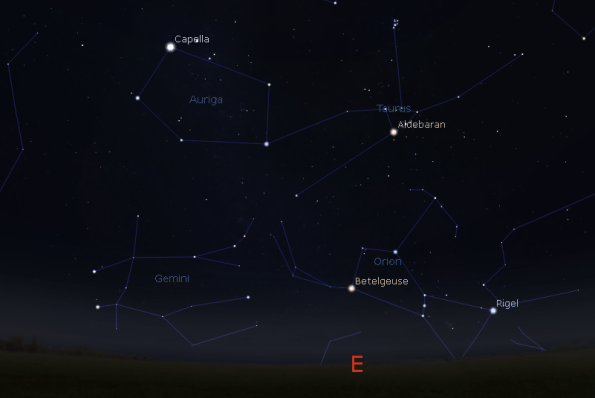
The star Capella with the other stars and constellations of Winter rising in the east. Created using Stellarium.
11/28/2016 – Ephemeris – The Hyades the star cluster in the face of Taurus the bull
Ephemeris for Monday, November 28th. The Sun will rise at 7:57. It’ll be up for 9 hours and 7 minutes, setting at 5:04. The Moon, 1 day before new, will rise at 7:45 tomorrow morning.
Rising in the east now is the bright star Aldebaran an orange star that’s at one end of the sideways letter V of stars that is the head of Taurus the bull. Above it is the jewel-like Pleiades or Seven Sisters star cluster. There’s more to Taurus, like it’s freakishly long horns and front part of its body. But you can say you’ve seem Taurus, if you can spot his face. That V of stars is actually a star cluster called the Hyades, and in Greek Myth were the half-sisters of the Pleiades, also fathered by the god Atlas. Both the Hyades and Pleiades are being pursued by Orion, which as Robert Frost put it is throwing a leg over the eastern horizon at 8 to 9 pm. He isn’t the only one following the Pleiades, the name Aldebaran means “The Follower”.
Times are for the Traverse City/Interlochen area of Michigan. They may be different for your location.
Addendum
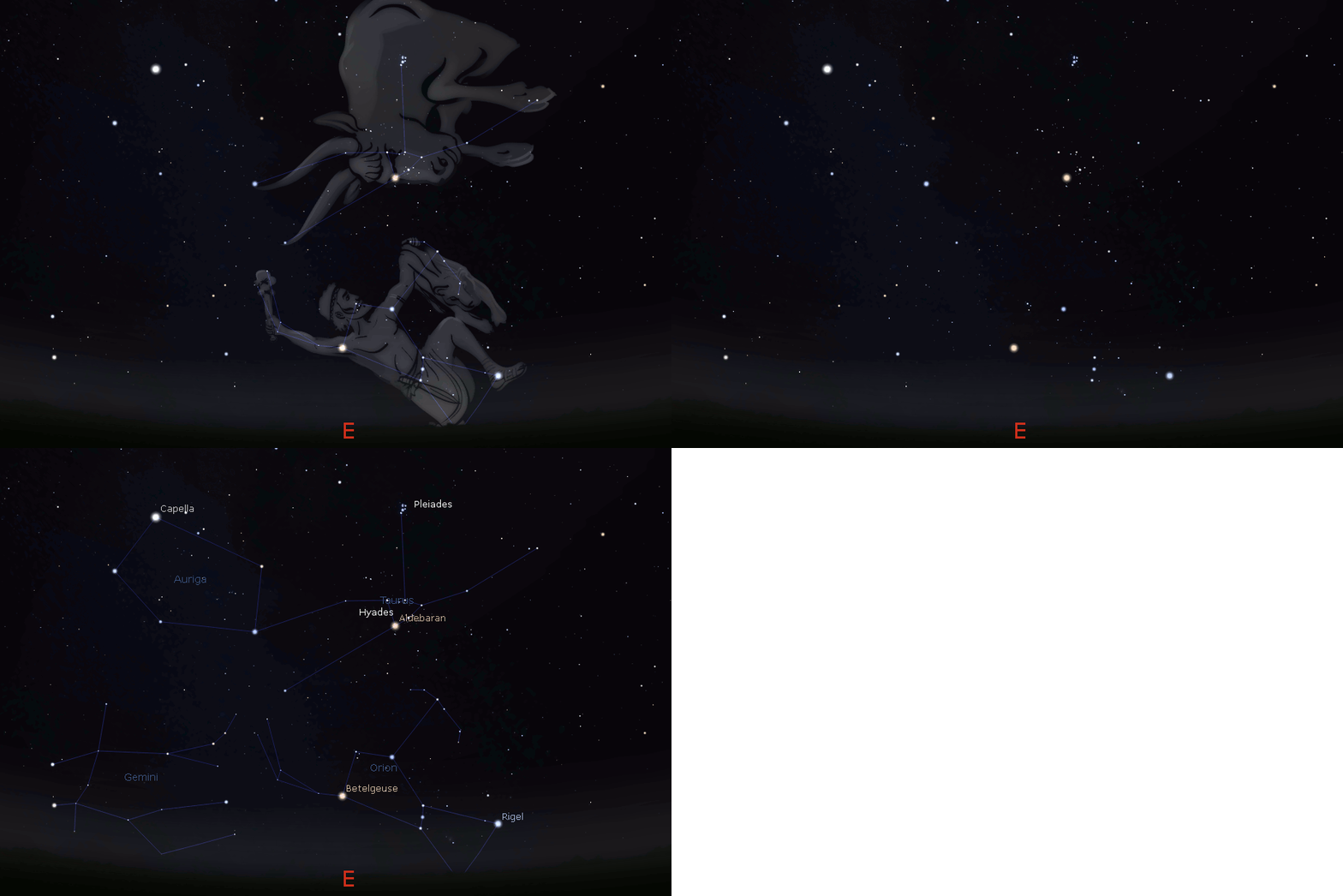
An animation showing the Hyades, Taurus, Orion and the Pleiades. Created using Stellarium and GIMP. Click on image to enlarge.
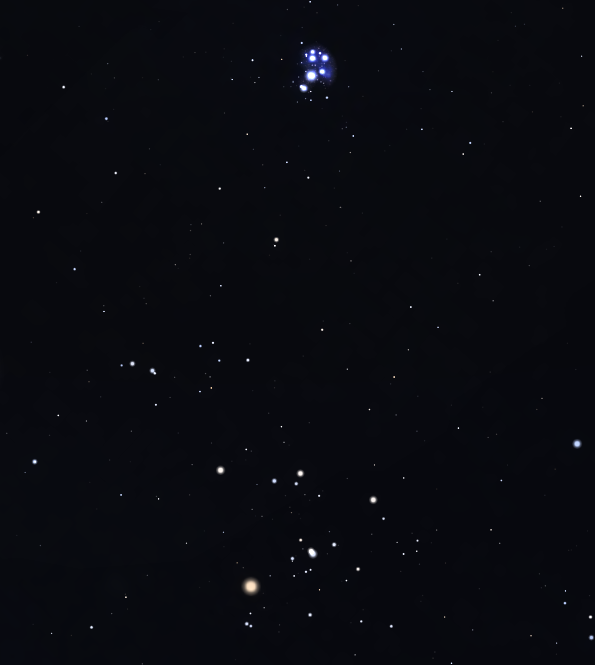
Closeup of the Hyades and the Pleiades. Created using Stellarium.
02/08/2016 – Ephemeris – The celestial unicorn
Ephemeris for Monday, February 8th. The Sun will rise at 7:53. It’ll be up for 10 hours and 6 minutes, setting at 6:00. The Moon is new today, and won’t be visible.
Among all the constellations in the sky of animals real and mythical, there is also a unicorn. It’s called Monoceros, and inhabits the southeastern sky at 9 p.m. bounded by Orion on the right, Canis Major, the great dog below and Canis Minor, the little dog to the left. Unfortunately for observers without optical aid Monoceros, though large, is devoid of bright stars. Maybe that’s why no one sees unicorns anymore. It has many faint stars because the Milky Way runs through it. To the telescope it is a feast of faint nebulae or clouds of gas and dust, the birth place of stars, including the red rose of the Rosette Nebula whose central star cluster can be seen in a telescope but the nebulosity requires a camera to capture and store its light.
Times are for the Traverse City/Interlochen area of Michigan. They may be different for your location.
Addendum
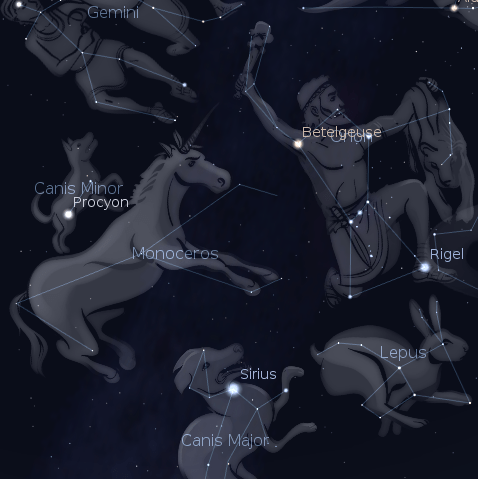
Monoceros the unicorn. Created using Stellarium.
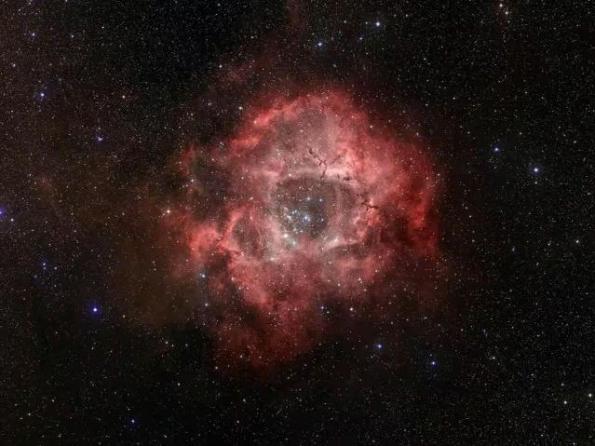
Rosette Nebula in the infrared from the Spitzer Space Telescope. Credit: NASA/JPL/Caltech
02/02/2016 – Ephemeris – Hard luck Orion
Ephemeris for Ground Hog Day, Tuesday, February 2nd. The Sun will rise at 8:01. It’ll be up for 9 hours and 50 minutes, setting at 5:52. The Moon, 2 days past last quarter, will rise at 3:31 tomorrow morning.
The large and bright constellation of Orion is now in the south at 9 p.m. It is seen as an upright rectangle of bright stars, with a belt of three stars in the center. Orion is a minor character in Greek mythology. Orion was the son of Neptune, and was a hunter. He had an ill-fated romance with Merope whose father King Oenopion had him blinded. After having his sight restored, Orion became a companion of Diana goddess of the hunt and they wanted to marry. In one story Apollo, Diana’s brother disapproved of Orion also and was able to trick Diana into accidentally killing Orion with her bow. The heart-broken Diana then placed Orion in the sky with his hunting dogs, were we see him to this day.
Times are for the Traverse City/Interlochen area of Michigan. They may be different for your location.
Addendum
Actually this isn’t the only story of Orion’s death. The other was that he was stung by a scorpion, also by the urging of Apollo. This is the explanation as to why Orion and Scorpius the scorpion are never in the sky at the same time. However south of the equator that is no longer true, but the Greeks and Romans never ventured that far south enough to see it.
Orion from mid latitudes north of the equator. Orion would be upside down if viewed south of the equator. Created using Stellarium.
01/29/2016 – Ephemeris – The rabbit that got away
Ephemeris for Friday, January 29th. The Sun will rise at 8:05. It’ll be up for 9 hours and 40 minutes, setting at 5:46. The Moon, 2 days before last quarter, will rise at 11:40 this evening.
Orion, the central winter constellation is seen in the south at 9 p.m. He is a hunter, but he’s preoccupied with the charge of Taurus the bull from the upper right. At Orion’s feet, and unnoticed by him is the small constellation of Lepus the hare. It’s very hard to see a rabbit in its eight dim stars: however, I do see a rabbit’s head ears and shoulders. A misshapen box is the head and face of this critter facing to the left. His ears extend upwards from the upper right star of the box, and the bend forward a bit. Two stars to the right of the box and a bit farther apart hint at the front part of the body. In Lepus telescopes can find M79, a distant globular star cluster, one of the few of these compact clusters visible in the winter sky.
Times are for the Traverse City/Interlochen area of Michigan. They may be different for your location.
Addendum
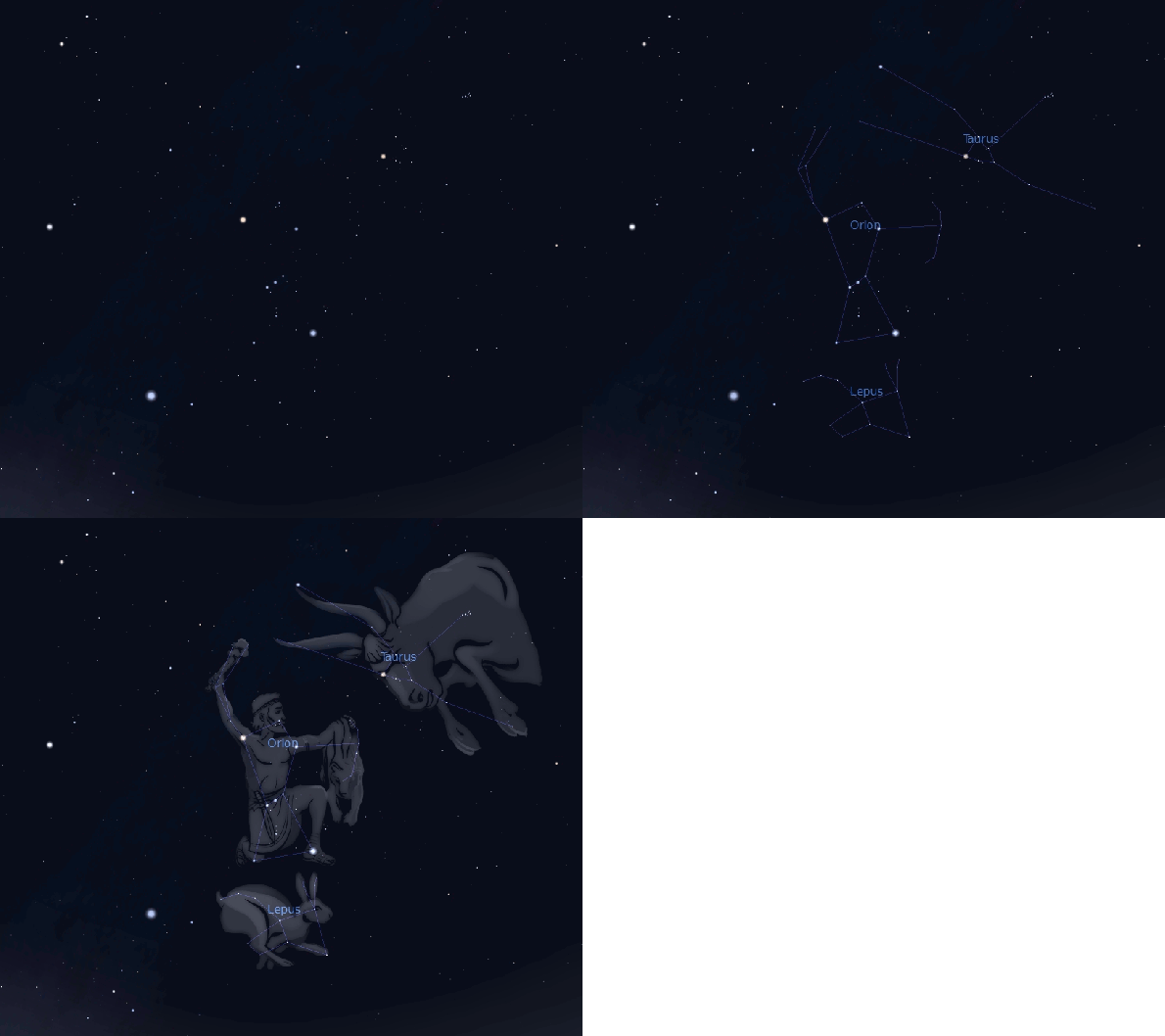
An animation showing the stars, constellations and artwork of Lepus, Orion and Taurus. Created using Stellarium and GIMP.
As you can see, the image above of Lepus isn’t how I imagine the hare as I mentioned in the text.
01/28/2016 – Ephemeris – This post has gone to the dogs
Ephemeris for Thursday, January 28th. The Sun will rise at 8:06. It’ll be up for 9 hours and 38 minutes, setting at 5:45. The Moon, 3 days before last quarter, will rise at 10:42 this evening.
The great winter constellation or star group Orion the Hunter, is located in the southern sky at 9:30 p.m. His elongated rectangle of a torso is vertical. In the center of the rectangle are three stars in a line that make his belt. As a hunter, especially one of old, he has two hunting dogs. The larger, Canis Major can be found by following the three belt stars of Orion down and to the left. There lies the brilliant star called Sirius, also known as the Dog Star. It’s in the heart of a stick figure dog facing Orion that appears to be begging. The smaller dog can be found by extending a line through Orion’s shoulder stars to the left. We find a bright star called Procyon. It and one other star make up the hot-dog shaped constellation of Canis Minor, the little dog.
Times are for the Traverse City/Interlochen area of Michigan. They may be different for your location.
Addendum
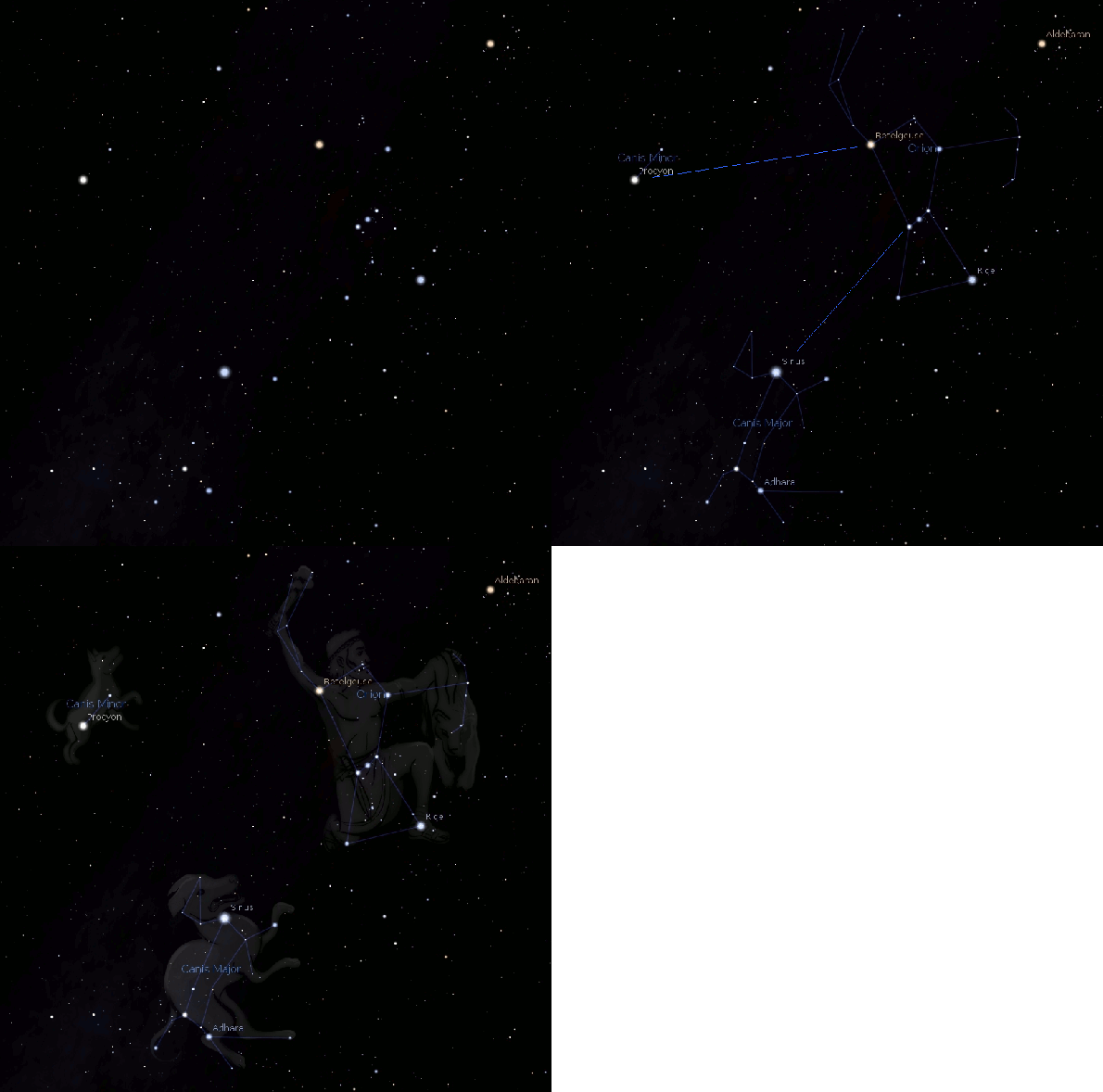
Orion and his hunting dogs revealed in animation. Created with Stellarium and GIMP.
01/25/2016 – Ephemeris – Sirius the Dog Star
Ephemeris for Monday, January 25th. The Sun will rise at 8:09. It’ll be up for 9 hours and 31 minutes, setting at 5:41. The Moon, 2 days past full, will rise at 7:43 this evening.
While we’re waiting for the bright Moon to leave the evening sky, let’s look at another bright star. This one is the brightest of all, Sirius the Dog Star. The Dog Star name comes from its position at the heart of the constellation Canis Major, the great dog of Orion the hunter. The three stars of Orion’s belt tilt to the southeast and point to Sirius. The name Sirius means ‘Dazzling One’, a reference to its great brilliance and twinkling. The Romans thought Sirius added its heat to that of the Sun in summer to bring on the scorching Dog Days of July and August. Its ancient Egyptian name was Sothis, and its first appearance in the morning twilight in late June signaled the flooding of the Nile, and the beginning of the Egyptian agricultural year.
Times are for the Traverse City/Interlochen area of Michigan. They may be different for your location.
Addendum
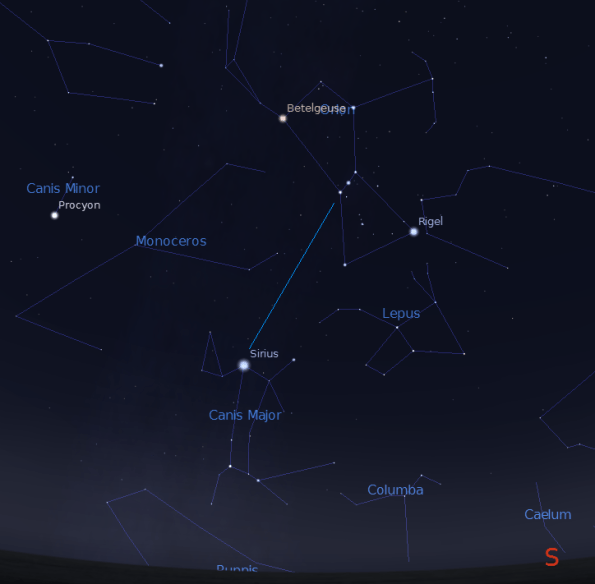
Orion’s Belt points to Sirius. Created using Stellarium.
01/07/2016 – Ephemeris – The Orion entourage
Ephemeris for Thursday, January 7th. The Sun will rise at 8:19. It’ll be up for 8 hours and 59 minutes, setting at 5:18. The Moon, 2 days before new, will rise at 6:42 tomorrow morning.
The whole Orion entourage is now visible in the southeast at 9 p.m. Orion the hunter with stars at his shoulders and knees and has a belt of three stars in a straight line. He has one arm upraised holding a club from the reddish star Betelgeuse and in the other arm he’s holding a lion skin shield fending off an attack from Taurus the bull above and right of him. Following the belt stars to the lower left we come to the brightest night-time star Sirius the Dog Star in the heart of Canis Major, his great hunting dog. Making a nearly equilateral triangle with Sirius and Betelgeuse is Procyon the little dog star in Canis Minor, Orion’s other small hunting dog. Hunched at the distracted Orion’s feet is the small constellation of Lepus the hare.
Times are for the Traverse City/Interlochen area of Michigan. They may be different for your location.
Addendum
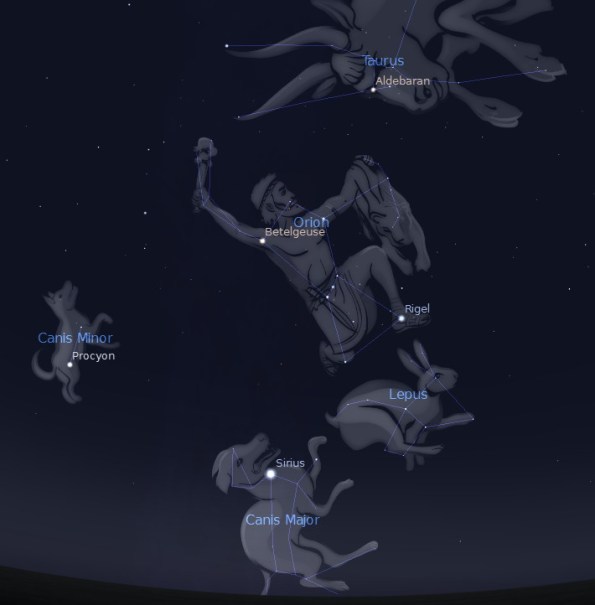
The Orion Entourage as seen at 9 p.m. January 7, 2016. Created using Stellarium
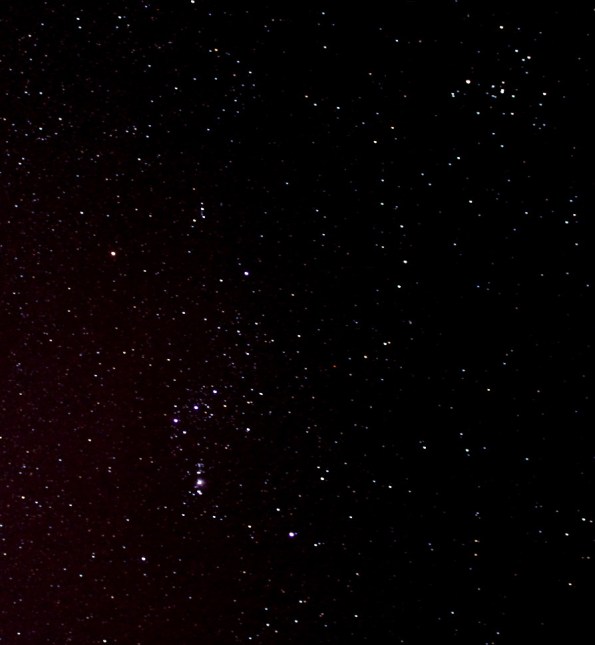
Orion and the head of Taurus photograph by myself January 4, 2016 at 11:30 p.m. It’s a stack of 5 untracked 20 second exposures.
Limiting magnitude is about 8, so you’re seeing stars you’d see with binoculars. The glow off to the left s from Traverse City, the center of which is 6 miles away to my northeast. I’m looking south here to get out of the glow, so Orion is more upright. I didn’t quite make it. My southwest through northwest is the darkest.
As you can probably guess I’ve got a new camera for my birthday/Christmas, a Canon EOS Rebel T5, and I’m investigating its astrophotographic capabilities. So expect some more “new” actual photographs on these posts.
01/04/2016 – Ephemeris – Some named stars in Orion and how to remember them
Ephemeris for Monday, January 4th. The Sun will rise at 8:20. It’ll be up for 8 hours and 55 minutes, setting at 5:15. The Moon, 2 days past last quarter, will rise at 3:49 tomorrow morning
Now that the Moon has fled let’s turn to the dark skies of winter and the magnificent constellation of Orion the hunter. At 9 p.m. he’s not yet completely upright in the southeast at 9 p.m. His seven bright stars make him easy to spot, starting with his belt of three stars in a straight line angling down to the left. It is inside a rectangle framing his shoulders and knees, leaning now to the left. The bright reddish star at the upper left corner is Betelgeuse, which according to a certain movie one shouldn’t say three-time in a row. The other shoulder star is a name familiar to Harry Potter fans, Bellatrix, though there’s nothing Lestrange about it. The lower right star is the bright blue-white Rigel. All in all a very impressive constellation.
Times are for the Traverse City/Interlochen area of Michigan. They may be different for your location.
Addendum
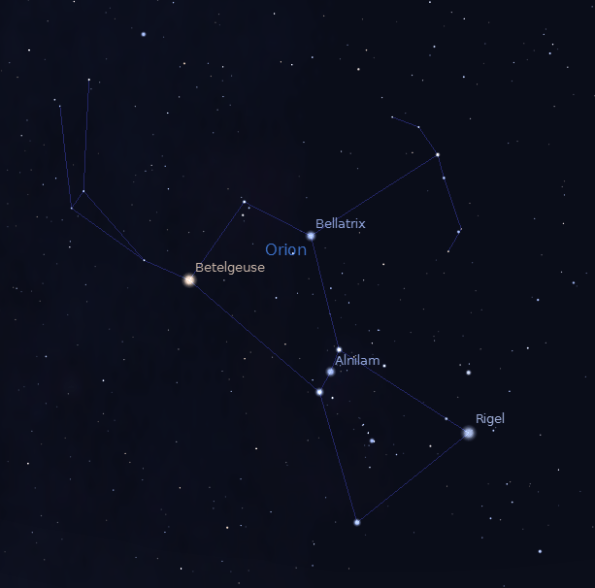
Some of Orion’s star names. Orion at 9 p.m. January 4, 2016. Created using Stellarium.
 Bob Moler's Ephemeris Blog