Archive
07/09/2013 – Ephemeris – Thank goodness this is as close as scorpions get to northern Michigan
Ephemeris for Tuesday, July 9th. Today the sun will be up for 15 hours and 21 minutes, setting at 9:28. The moon, 1 day past new, will set at 9:58 this evening. Tomorrow the sun will rise at 6:07.
Crawling just above the southern horizon at 11 p.m. is the zodiacal constellation of Scorpius the scorpion. His heart is the red giant star Antares. Its facing the west or right with a short arc of three stars as its head. His body and tail drop to the left and scrape the horizon before curving up to the critter’s poisonous stinger of two stars. It really makes a great scorpion. One story of the scorpion concerns Orion the hunter the great winter constellation. In that story Orion was killed by the sting of a scorpion. Therefore Orion and Scorpius are never seen in the sky at the same time. That is certainly true around here and for the Greeks, whose legend it is. However if one travels far enough south that is no longer true.
Times are for the Traverse City/Interlochen area of Michigan. They may be different for your location.
Addendum
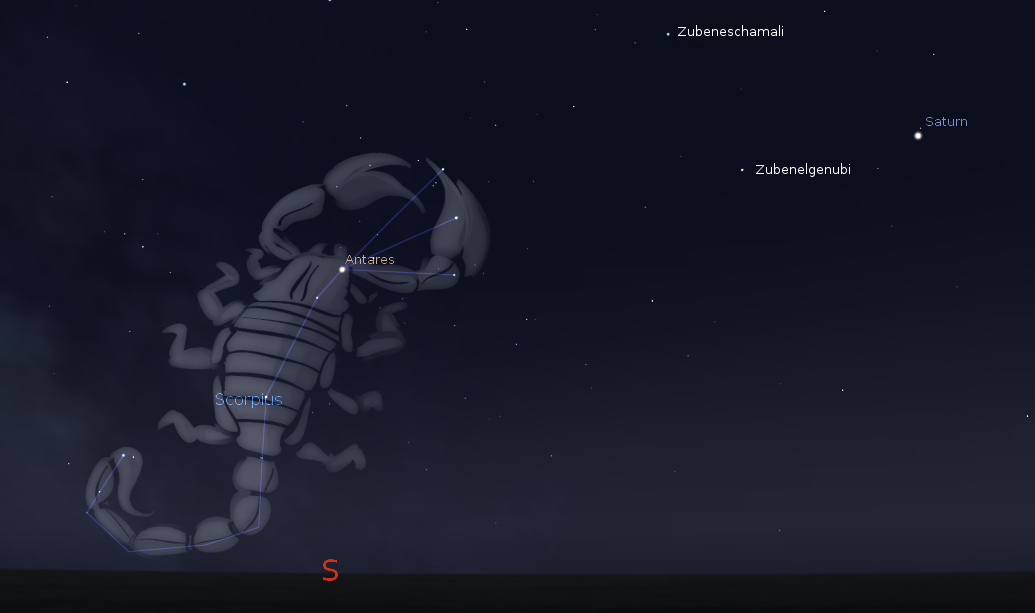
Scorpius at 11 p.m. on July 9, 2013. Credit Stellarium. I don’t agree with the artist’s drawing of the scorpion. To me it’s larger. The arc of three stars in the drawing’s right claw to me is its head and start of the claw appendages. I’ve added two star names from the constellation of Libra to the right. The Arabic translation of Zubeneschamali and Zubenelgenubi is North Claw and South Claw respectively. At one time Scorpius was larger than it is depicted today. Click on the image to enlarge.
04/01/2013 – Ephemeris – Orion the Fool
Ephemeris for April Fools Day, Monday, April 1st. The sun will rise at 7:22. It’ll be up for 12 hours and 47 minutes, setting at 8:10. The moon, 2 days before last quarter, will rise at 2:25 tomorrow morning.
Orion is one of the two constellations mentioned in the Bible, that have been deciphered. These are mentioned in the Book of Job. In the King James translation of the Bible the star Arcturus is mentioned. Modern scholars have changed that to the Bear, that is the Great Bear, Ursa Major, of which the Big Dipper is a part. The star cluster Pleiades, our Seven Sisters are also mentioned. There is no agreement of what Mazzeroth and the Mansions of the South are. The translation of Orion from the original Hebrew fits the day today. It’s Kesil, which means fool. Considering the mythology of Orion, a very minor character of Greek mythology, he was indeed, if not a fool, very unlucky in love.
Times are for the Traverse City/Interlochen area of Michigan. They may be different for your location.
Addendum
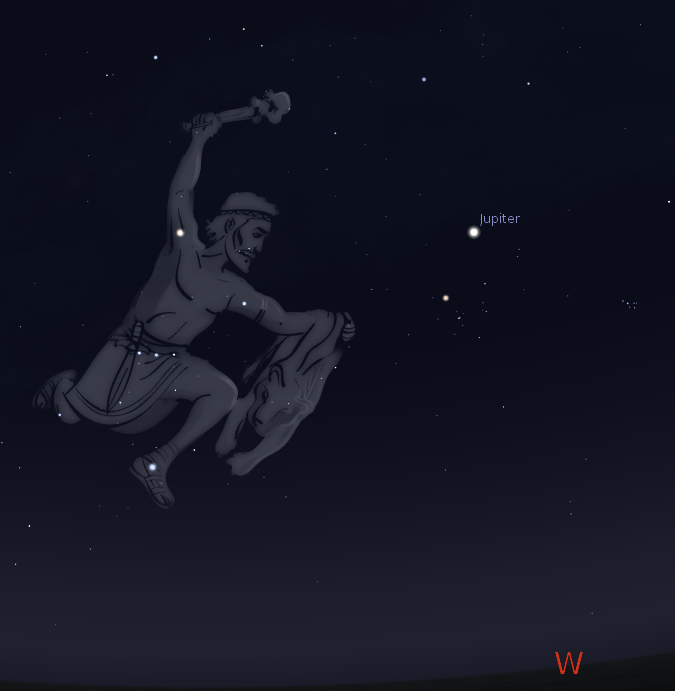
Orion the fool at 10 p.m. on April 3, 2013. Created using Stellarium. Note the Pleiades at the extreme right edge of the picture
02/04/2013 – Ephemeris – The celestial unicorn
Ephemeris for Monday, February 4th. The sun will rise at 7:57. It’ll be up for 9 hours and 58 minutes, setting at 5:56. The moon, 1 day past last quarter, will rise at 3:41 tomorrow morning.
Among all the constellations in the sky of animals real and mythical, there is also a unicorn. It’s called Monoceros, and inhabits the southeastern sky at 9 p.m. bounded by Orion on the right, Canis Major, the great dog below and Canis Minor, the little dog to the left. Unfortunately for observers without optical aid Monoceros, though large, is devoid of any but the faintest stars. Maybe that’s why no one sees unicorns anymore. It has many faint stars because the Milky Way runs through it. To the telescope it is a feast of faint nebulae or clouds of gas and dust, the birth place of stars, including the red rose of the Rosette Nebula, and the strange and tiny Hubble’s Variable Nebula. It has a wealth of wonders below the surface so to speak.
Times are for the Traverse City/Interlochen area of Michigan. They may be different for your location.
Addendum
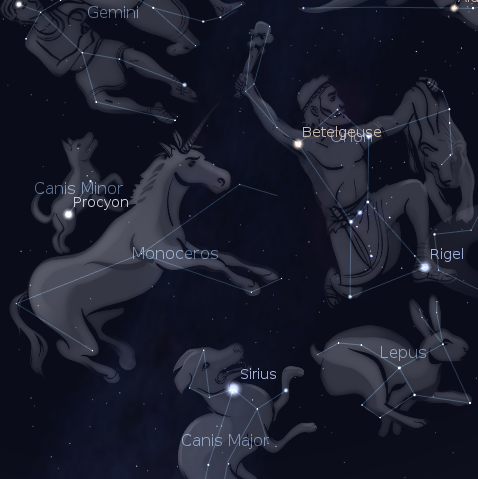
Moniceros the unicorn. Created using Stellarium.
01/25/2013 – Ephemeris – The star names of Orion
Ephemeris for Friday, January 25th. The sun will rise at 8:08. It’ll be up for 9 hours and 33 minutes, setting at 5:42. The moon, 1 day before full, will set at 7:23 tomorrow morning.
The constellation of Orion the hunter is visible in the south at 9 p.m. The stars of Orion are interesting in themselves. Starting at the top left of the seven bright stars of Orion’s torso is Betelgeuse the bright red star, whose name means something like “Armpit of the Giant”. The star in Orion’s other shoulder is Bellatrix the “Amazon Star”. Below are the three stars of Orion’s belt, from left to right; Alnitak, Alnilam and Mintaka. Their names mean “Girdle”, “Belt of Pearls”, and “Belt” respectively. Down to Orion’s knees we look on the left to the star Saiph which means “Sword”, though it is some ways from the stars of Orion’s sword. Finally there’s the bright blue-white star Rigel whose name means “left Leg of the Giant”.
Times are for the Traverse City/Interlochen area of Michigan. They may be different for your location.
Addendum
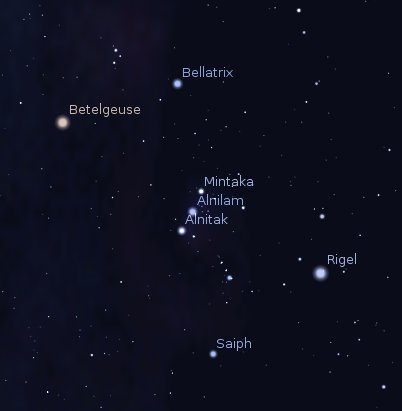
Orion with star names
01/22/2013 – Ephemeris – Sirius the Dog Star
Ephemeris for Tuesday, January 22nd. The sun will rise at 8:10. It’ll be up for 9 hours and 27 minutes, setting at 5:37. The moon, half way from first quarter to full, will set at 5:23 tomorrow morning.
The brightest star-like object in the evening sky is Jupiter high in the sky now. The second brightest star-like object is Sirius, also known as the Dog Star. It also is the brightest night-time star in our skies period. Tonight at 9 p.m. it’s located low in the southeastern sky. The Dog Star name comes from its position at the heart of the constellation Canis Major, the great dog of Orion the hunter. The three stars of Orion’s belt tilt to the southeast and point to Sirius. The name Sirius means ‘Dazzling One’ or ‘Scorcher’, a reference to its great brilliance and twinkling. Its Egyptian name was Sothis, and its appearance in the dawn skies in late June signaled the flooding of the Nile, and the beginning of the Egyptian agricultural year.
Times are for the Traverse City/Interlochen area of Michigan. They may be different for your location.
Addendum
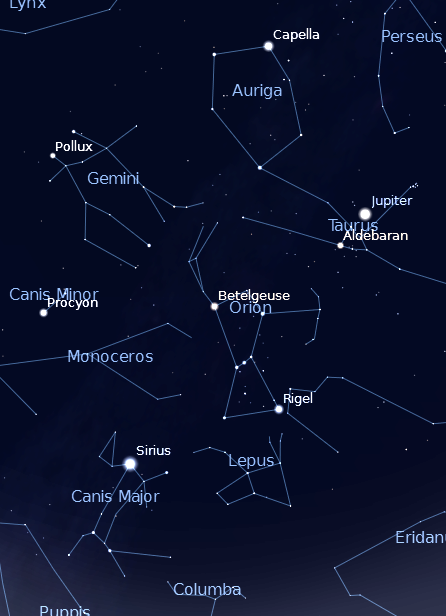
Winter Circle and Jupiter with Sirius at the bottom. Created using Stellarium.
01/17/2013 – Ephemeris – The blue super-giant star Rigel
Ephemeris for Thursday, January 17th. The sun will rise at 8:14. It’ll be up for 9 hours and 16 minutes, setting at 5:31. The moon, 1 day before first quarter, will set at 12:41 tomorrow morning.
Tuesday I talked about the star Betelgeuse the bright red star in the top left of Orion’s upright rectangle. Orion is seen in the south in the evening. The blue-white star in Orion’s opposite corner is usually brighter. It is Rigel whose longer Arabic name of which Rigel is the first part means Left Leg of the Giant. Rigel is a giant itself, actually a super giant star, which is more a measure of its mass than its size, that of 50 solar masses. Its surface temperature is more than twice as hot as the sun. It is 57 thousand times as bright as the sun and 50 times its diameter. Its distance is 860 light years. Those with telescopes might be able to spot a close companion star to Rigel, just at the edge of the bright arc light image of Rigel itself.
Addendum
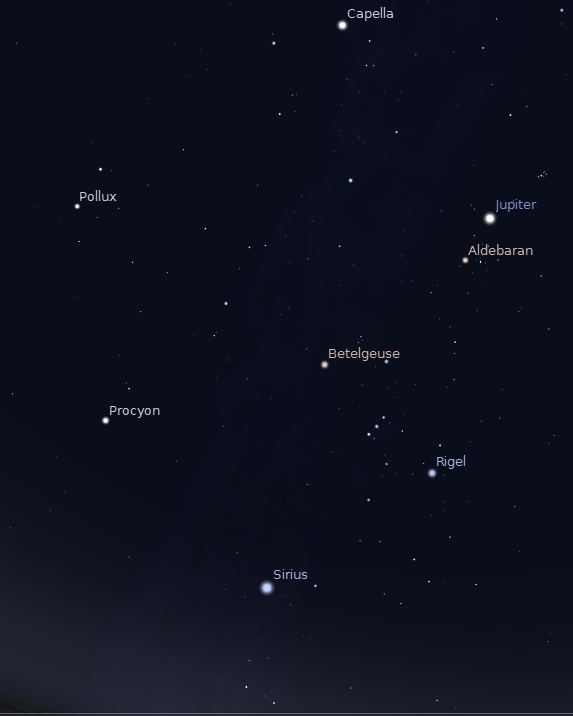
Rigel in the winter circle of bright winter stars plus Jupiter.this year. Created using Stellarium.
01/14/2013 – Ephemeris – Lepus the hare, overlooked by Orion
Ephemeris for Monday, January 14th. The sun will rise at 8:16. It’ll be up for 9 hours and 11 minutes, setting at 5:27. The moon, 3 days past new, will set at 9:23 this evening.
Orion, the central winter constellation is seen in the southern sky this evening. He is a hunter, as artists depict him, he is preoccupied with the charge of Taurus the bull from the upper right. At Orion’s feet, and unnoticed by him is the small constellation of Lepus the hare. It’s very hard to see a rabbit in its eight dim stars: however, I can see a rabbit’s head ears and shoulders. A misshapen box is the head and face of this critter facing to the left. His ears extend upwards from the upper right star of the box, and the bend forward a bit. Two stars to the right of the box and a bit fart
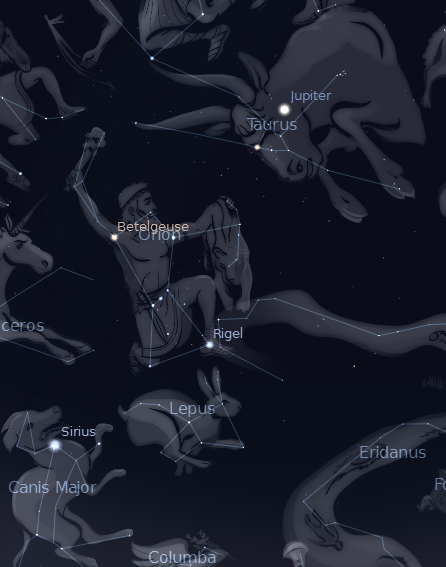
Orion facing Taurus letting Lepus escape with Jupiter in 2013. Created using Stellarium.
her apart hint at the front part of the body. In Lepus telescopes can find M79, a distant globular star cluster, one of the few visible in the winter sky.
Times are for the Traverse City/Interlochen area of Michigan. They may be different for your location.
Addendum
12/11/2012 – Ephemeris – The Pleiades and Hyades star clusters
Ephemeris for Tuesday, December 11th. The sun will rise at 8:09. It’ll be up for 8 hours and 52 minutes, setting at 5:02. The moon, 2 days before new, will rise at 7:13 tomorrow morning.
At 8 to 9 p.m. The constellation of Taurus the bull rises higher in the east to southeast. Taurus contains two bright clusters of stars. The most famous of these is the Pleiades, also known as the Seven Sisters. The other is a letter V shape that is the face of Taurus, the Hyades. In the Greek mythology they are half-sisters of each other, all fathered by the Titan Atlas. They are apparently fleeing from the giant Orion rising in the east. The Pleiades are the younger of the two star clusters, and there has been some problem in estimating their distance. They could be from 390 to 460 light years away. The distance to Hyades is much better known at 153 light years. It was the star cluster upon which greater distances could be measured.
Times are for the Traverse City/Interlochen area of Michigan. They may be different for your location.
Addendum
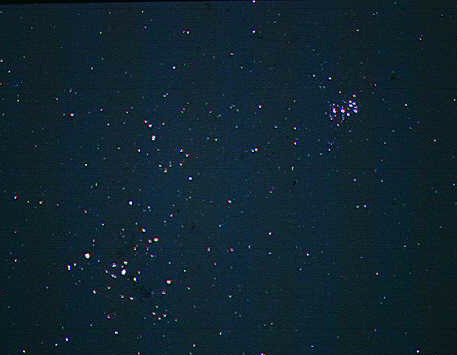
The Hyades (lower left) and the Pleiades (upper right). My photograph from many years ago.
12/06/2012 – Ephemeris – The constellation Taurus the bull
Ephemeris for Thursday, December 6th. The sun will rise at 8:05. It’ll be up for 8 hours and 57 minutes, setting at 5:02. The moon, at last quarter today, will rise at 1:10 tomorrow morning.
Low in the east southeast at 9 p.m. is the constellation of the giant hunter Orion. Above him is Taurus the bull. His face is a letter V shape of stars lying on its side, the star cluster Hyades, with the bright orange-red star Aldebaran at one tip of the V as its angry blood-shot eye, but actually about half way between us and the cluster. Jupiter is complicating this this year, appearing in Taurus. Orion is depicted in the sky facing, with club in one hand and a shield in the other, the approaching and in some depictions charging Taurus. The Pleiades star cluster is in his shoulder. Taurus in Greek mythology was the guise the god Zeus when he carried off the maiden Europa. Europa’s still with him as the intriguing satellite orbiting Zeus’ Roman equivalent the planet Jupiter.
Times are for the Traverse City/Interlochen area of Michigan. They may be different for your location.
Addendum
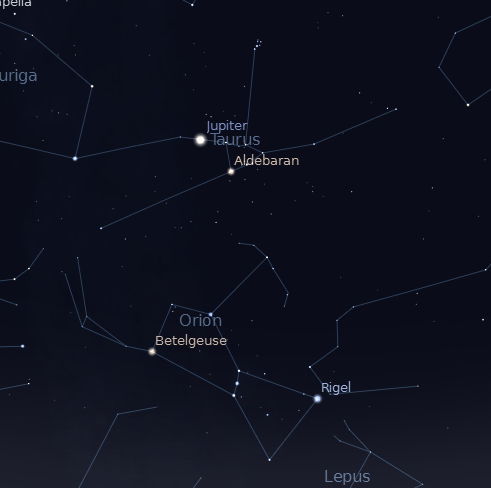
Taurus and Orion in the east at 9 p.m. December 6, 2012. Created using Stellarium.
12/03/2012 – Ephemeris – Orion rising
Ephemeris for Monday, December 3rd. The sun will rise at 8:01. It’ll be up for 9 hours and 1 minute, setting at 5:02. The moon, 3 days before last quarter, will rise at 9:56 this evening.
Off in the southeast at 9 in the evening the great constellation of Orion will be seen now. This is the most famous of all constellations world wide. We think the Big Dipper is a big deal. It’s not even a constellation, being the hind end of the great bear Ursa Major. However it’s invisible if one travels far enough south of the equator. Orion is now a rectangle of stars tilted to the left as he rises. With three stars in a straight line in the center. They are aligned nearly vertically. Orion is a giant hunter. The rectangle depict his shoulders and knees. Among its other bright stars Orion contains two of the brightest. The upper left star is the famous red giant star Betelgeuse. The lower left star is the blue=white super giant Rigel.
Times are for the Traverse City/Interlochen area of Michigan. They may be different for your location.
Addendum
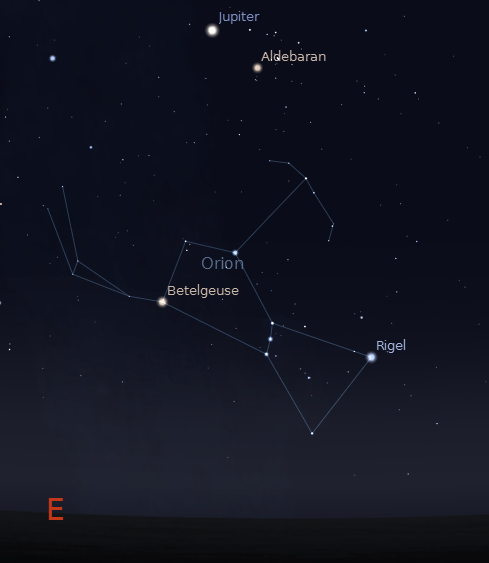
Orion rising at 9 p.m. December 3, 2012. Created using Stellarium.
 Bob Moler's Ephemeris Blog