Archive
11/18/11 – Ephemeris – Pleiades, Hyades and Orion
Friday, November 18th. The sun will rise at 7:42. It’ll be up for 9 hours and 29 minutes, setting at 5:12. The moon, at last quarter today, will rise at 12:48 tomorrow morning.
The Pleiades or Seven Sisters star cluster is now quite high in the east at 9 p.m. To the Greeks they were the daughters of the god Atlas. Their half sisters, the Hyades is seen below them as the letter V shape of stars that form the face of Taurus the bull, with the bright orange star Aldebaran at one corner. Both are being chased by the giant hunter Orion, now mostly risen in the east. His three belt stars in a row are now oriented vertically. The reddish star Betelgeuse is to their upper left, while blue-white Rigel to the lower right. Rigel may suffer some by being very close to the horizon at the time, but it will come into its own as it rises higher. [Here is our preview of the glories of the winter sky. There is more to come as the night wears on.]
* Times, as always are for the Traverse City/Interlochen area of Michigan. Bracketed passage was omitted from the audio program due to time constraints.
Addendum
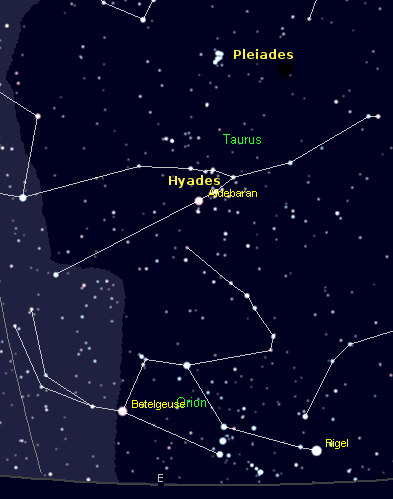
The eastern sky at 9 p.m.
04/26/11 – Ephemeris – Last chance to spot the winter constellations
Tuesday, April 26th. The sun rises at 6:40. It’ll be up for 13 hours and 59 minutes, setting at 8:40. The moon, 2 days past last quarter, will rise at 3:56 tomorrow morning
Lets face it we’re pretty sick of winter, what with all the relapses this month. But I’m never sick of the winter stars and constellations. With Leo and the other spring constellations taking over the skies from overhead to the south, the winter constellations are about to set in the west at 10 p.m. Orion’s rectangular torso is tipped to the right, his belt stars horizontal, 90 degrees from their rising orientation. The same is true of Castor and Pollux higher up which rose vertically and will set horizontally. The brightness and closeness of the stars here are a great contrast with the sparse numbers of stars visible overhead and to the south. That’s because the Milky Way runs through the winter stars and crosses to the north part of the sky.
* Times are for the Traverse City/Interlochen area of Michigan. They may be different for your location.
Addendum
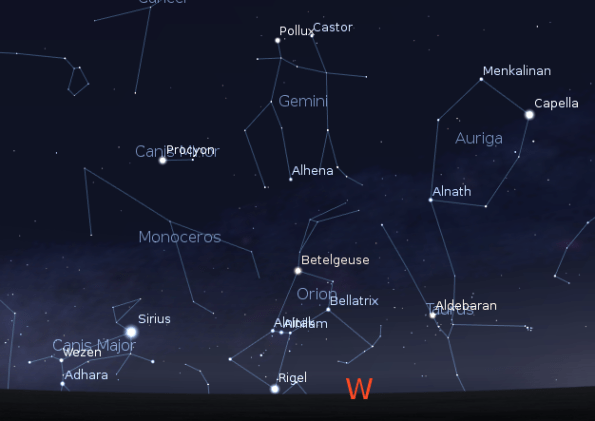
Winter Stars Setting in Late April. Created using Stellarium.

