Archive
12/17/2020 – Ephemeris – Betelgeuse, Betelgeuse… Nope not saying it again
This is Bob Moler with Ephemeris for Thursday, December 17th. Today the Sun will be up for 8 hours and 48 minutes, setting at 5:03, and it will rise tomorrow at 8:15. The Moon, 3 days past new, will set at 8:18 this evening.
The constellation Orion the hunter will have completely risen by 8 pm this evening. The leftmost bright red star in his shoulder is Betelgeuse. It’s phonetically spelled name (Beetle Juice) made the title of a movie in 1988. A year ago it’s dramatic dimming for a while caused some to wonder that it was about to explode in a supernova. Betelgeuse does normally vary a bit in brightness, but that was the most ever recorded. It’s a red giant star with a mass of 16 to 19 times the Sun’s. Its distance is thought to be about 550 light years away. It is difficult to measure the distance of single bright stars, even with satellites. Its age is maybe 8 to 8 ½ million years old out of a life expectancy of 10 million years, compared to the Sun’s 10 billion year life expectancy.
The event times given are for the Traverse City/Interlochen area of Michigan. They may be different for your location.
Addendum
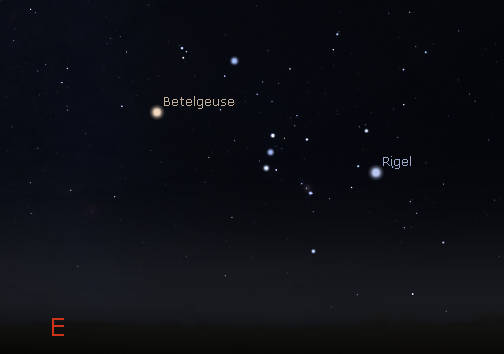
Orion at 8 pm or about 3 hours after sunset in mid December. Its seven brightest stars make an unmistakable pattern with only Betelgeuse and Rigel labeled. Created using Stellarium.

This comparison image shows the star Betelgeuse before and after its unprecedented dimming. The observations, taken with the SPHERE instrument on ESO’s Very Large Telescope in January and December 2019, show how much the star has faded and how its apparent shape has changed. Credit: ESO/M. Montargès et al.
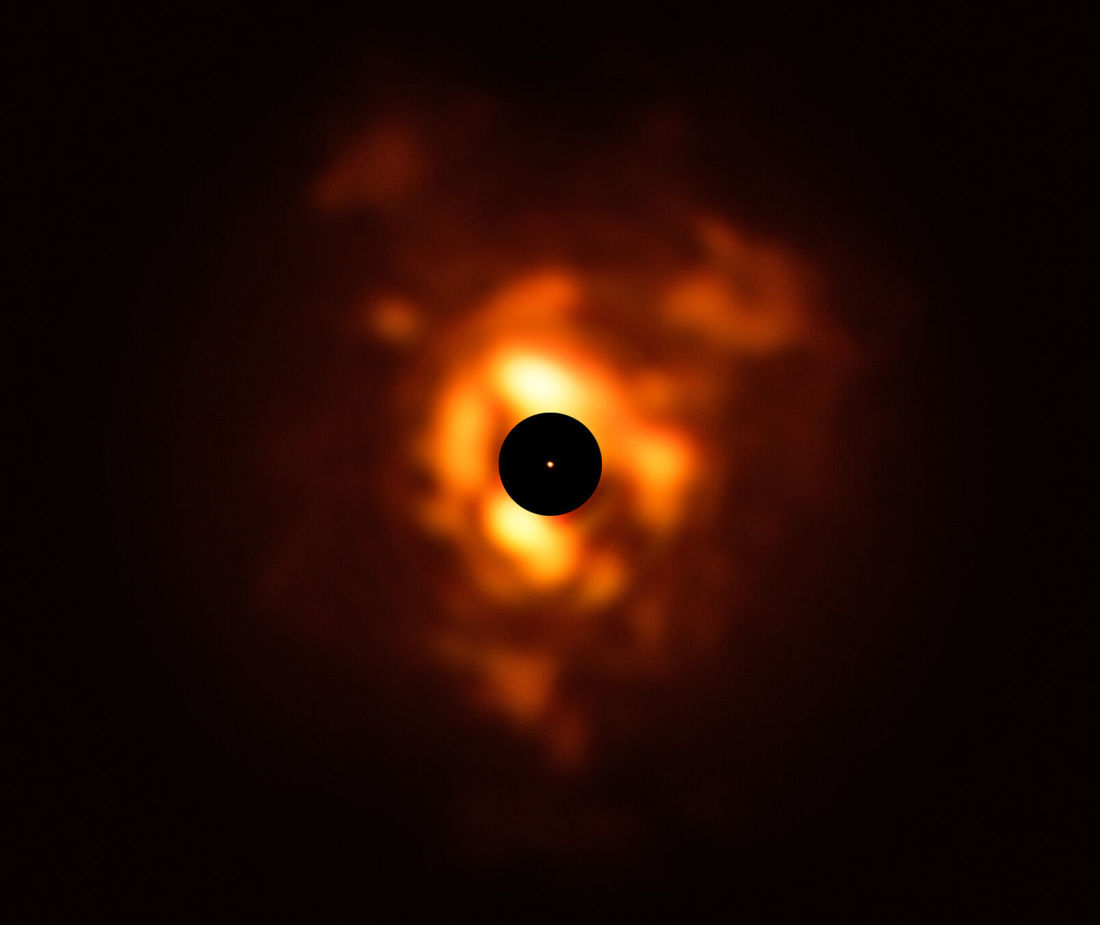
An image of the star Betelgeuse taken in infrared shows it’s surrounded by a vast cloud of dust that erupted from the surface (the bright star itself is masked out, though an image of it has been superposed there for scale — the star is about the size of the orbit of Jupiter, over a billion km wide). Credit: ESO/P. Kervella/M. Montargès et al., Acknowledgement: Eric Pantin via Phil Plait’s Bad Astronomy blog on syfy.com.
12/08/2020 – Ephemeris – Finding Taurus the bull
This is Ephemeris for Tuesday, December 8th. Today the Sun will be up for 8 hours and 54 minutes, setting at 5:02, and it will rise tomorrow at 8:08. The Moon, 1 day past last quarter, will rise at 1:39 tomorrow morning.
Orion is the big splashy constellation in the east southeast by 9 in the evening. Above it is another famous constellation Taurus the bull. Its face is a letter V shape of stars on its side with the open end of the V to the left. The bright star at the lower left end of the sideways V is the ruddy star Aldebaran, the Bull’s angry bloodshot eye. The bull is charging down at Orion. The Pleiades, also known as the seven sisters, is the cluster of stars in his shoulder, above the V. The stars in the face of Taurus, except for Aldebaran belong to a star cluster like the Pleiades, but closer and older, called the Hyades. In Greek mythology the Hyades are half sisters to the Pleiades, all fathered by the god Atlas.
The event times given are for the Traverse City/Interlochen area of Michigan. They may be different for your location.
Addendum

Three views of Taurus the bull and Orion the hunter for 9 p.m. on December 8th. Created using Stellarium and GIMP.
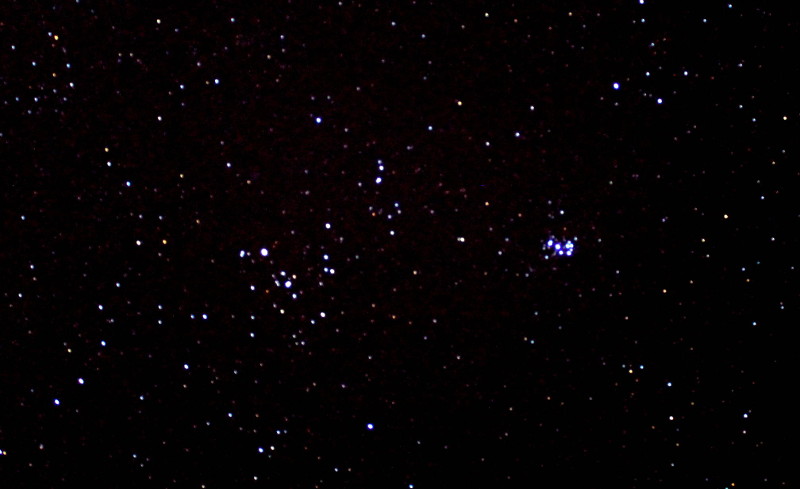
The Pleiades (right) and the Hyades (left) in this photograph I took January 4, 2016. The orientation is a bit different from how it appears in early December.
12/07/2020 – Ephemeris – Looking forward to the best of winter: Orion
This is Ephemeris for Monday, December 7th. Today the Sun will be up for 8 hours and 55 minutes, setting at 5:02, and it will rise tomorrow at 8:07. The Moon, at last quarter today, will rise at 12:25 tomorrow morning.
Orion, the central constellation of the winter evening sky will be completely risen by 9 this evening. Then it can be seen low in the east-southeast it’s upright rectangle of stars tilted to the left. The topmost star to the left in this rectangle is the famous red giant star Betelgeuse, which is reportedly dimming again. It’s in Orion’s shoulder. In his other shoulder is Bellatrix, a name known to Harry Potter fans. In his knees are Rigel, a blue-white giant star and Saiph. In the center of the rectangle are three stars in a straight line, now almost vertically arranged, Orion’s belt. And below his belt what seem to be three more stars, his sword. In the center of the sword stars can be found, with binoculars or telescope, Orion’s most famous feature, the Great Orion Nebula.
The event times given are for the Traverse City/Interlochen area of Michigan. They may be different for your location.
Addendum
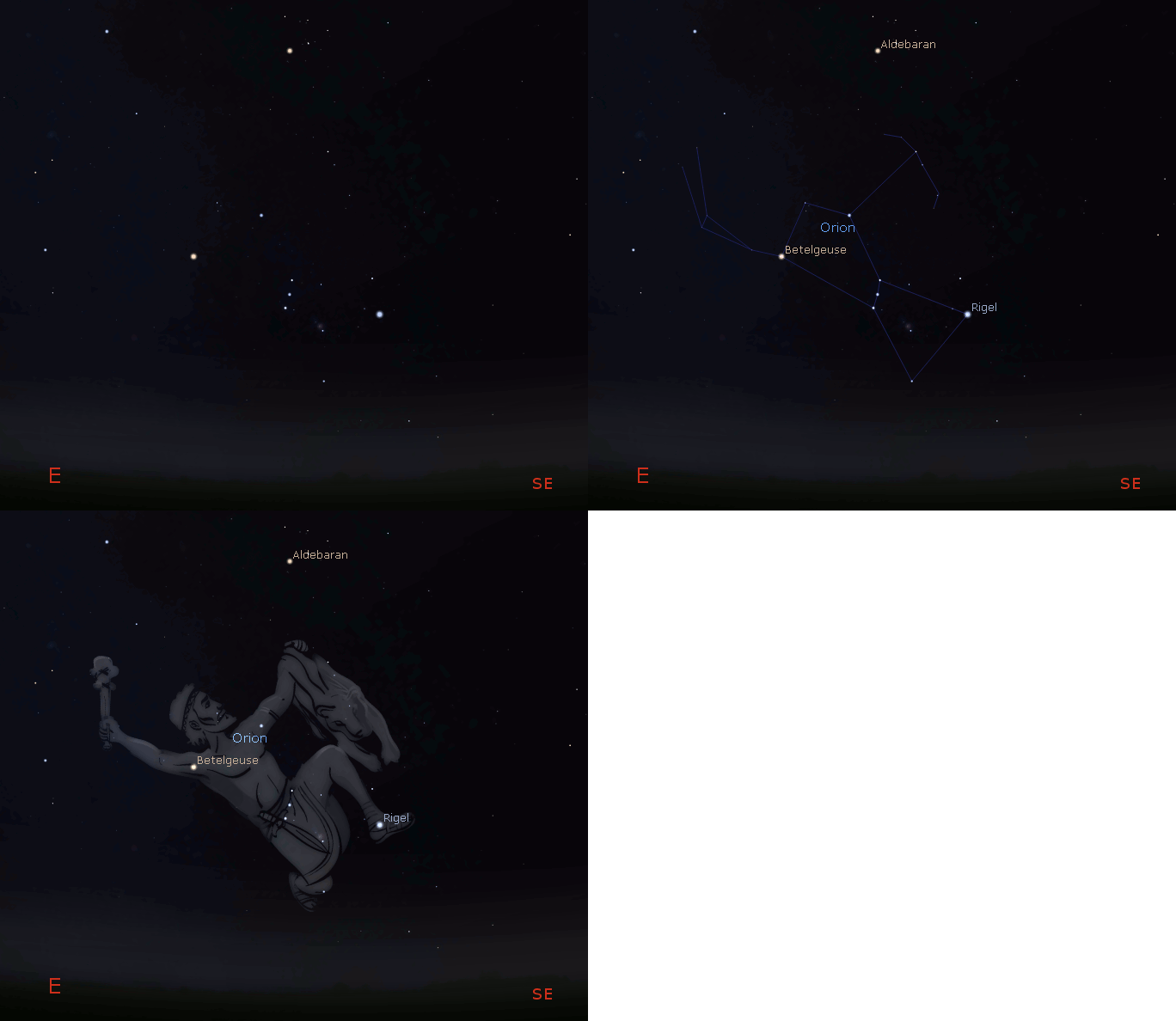
Orion early December finder animation for 9 pm December 7th. Created using Stellarium and GIMP.
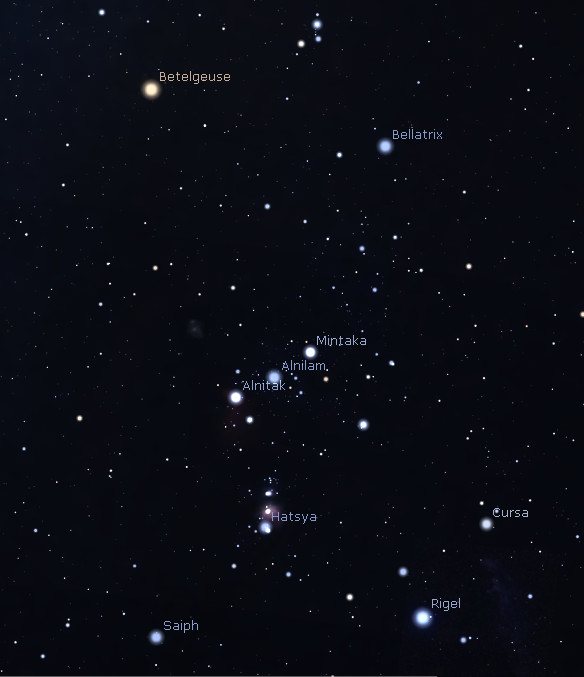
Orion’s named stars including the belt stars. Cursa, though named belongs to the neighboring constellation Eridanus the river. Created using Stellarium.
03/05/2020 – Ephemeris – Apparently Betelgeuse, though dimming wasn’t cooling as expected
Ephemeris for Thursday, March 5th. Today the Sun will be up for 11 hours and 24 minutes, setting at 6:36, and it will rise tomorrow at 7:10. The Moon, 3 days past first quarter, will set at 5:31 tomorrow morning.
Betelgeuse, the red star in the constellation Orion’s shoulder has apparently stopped dimming and has begun to brighten. The guesses as to the cause of the dimming are many. One suggested by a photograph taken of the star in December shows the southern half dimmed like it was covered by something. Betelgeuse out gasses lots of material, some of which condenses into dust. Could some of this dust mask the star and make it dimmer? I suspect that we’ll find out before too long. Many astronomers are wishing Betelgeuse would explode in a core collapse or type 2 supernova. At its approximate 700 light year distance we’d be safe, though a bazillion neutrinos would pass harmlessly through each one of us just before the light would get here.
The times given are for the Traverse City/Interlochen area of Michigan. They may be different for your location.
Addendum
An image of the star Betelgeuse taken in infrared shows it’s surrounded by a vast cloud of dust that erupted from the surface (the bright star itself is masked out, though an image of it has been superposed there for scale — it’s about the size of the orbit of Jupiter, over a billion km wide). Credit: ESO/P. Kervella/M. Montargès et al., Acknowledgement: Eric Pantin via Phil Plait’s Bad Astronomy blog on syfy.com.
This comparison image shows the star Betelgeuse before and after its unprecedented dimming. The observations, taken with the SPHERE instrument on ESO’s Very Large Telescope in January and December 2019, show how much the star has faded and how its apparent shape has changed. Credit: ESO/M. Montargès et al.
More on this from Dr. Phil Plait’s Bad Astronomy blog on syfy.com: https://www.syfy.com/syfywire/mea-culpa-betelgeuse-and-its-dusty-convective-pulsations
03/03/2020 – Ephemeris – Betelgeuse, apparently, has stopped dimming and may be brightening
Ephemeris for Tuesday, March 3rd. Today the Sun will be up for 11 hours and 18 minutes, setting at 6:33, and it will rise tomorrow at 7:14. The Moon, 1 day past first quarter, will set at 3:41 tomorrow morning.
Betelgeuse the red giant star in the constellation Orion’s shoulder has apparently stopped dimming and may be brightening again. The process of recovery is slow. It may recover its former brightness. We’ll know this later in summer when Betelgeuse and the rest of Orion moves from behind the Sun and enters the morning sky. Betelgeuse is known to be irregular in brightness, but has never been recorded as being this dim, dropping it from being a first magnitude star. Betelgeuse is no longer dimming. There is lots of speculation as to why it’s now brightening. One is the thought that there are several periodic cycles that govern Betelgeuse’s variability. That the troughs of these cycles happen to coincide is one explanation.
The times given are for the Traverse City/Interlochen area of Michigan. They may be different for your location.
Addendum
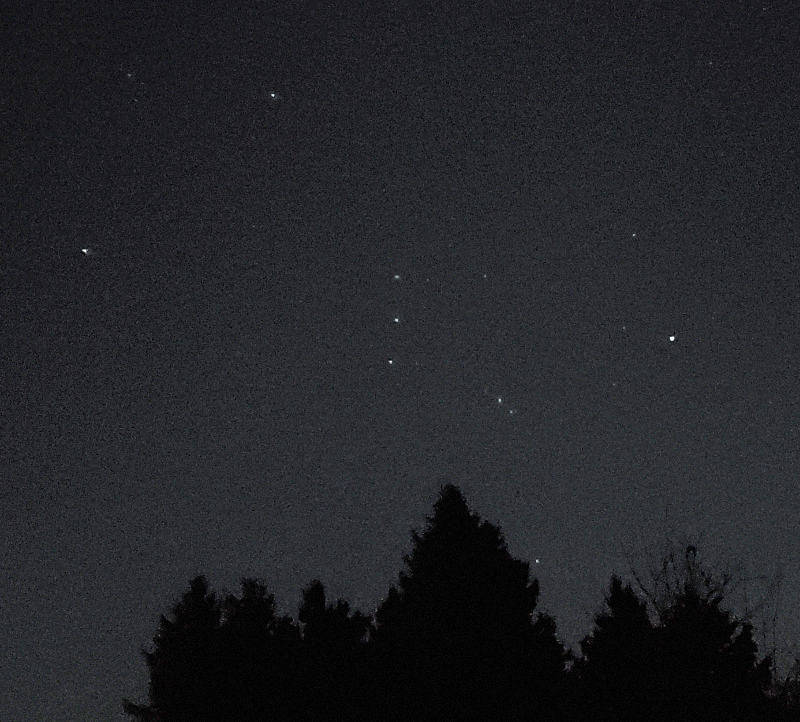
Betelgeuse in Orion (the bright star on the left) at 7:07 p.m. January 6, 2020. Taken with my Samsung Galaxy S10+ in the moonlight. Compare the brightness of Betelgeuse with Rigel, Bellatrix and the belt stars.
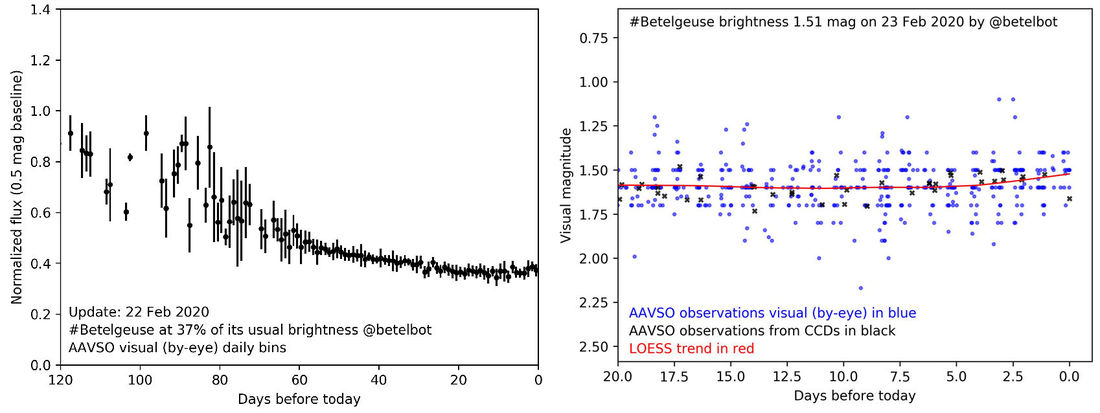
The brightness of Betelgeuse from late November 2019 to 23 Feb. 2020 shows it dimming dramatically (the y-axis is in magnitudes, where a bigger number is fainter). A close-up on just the past 20 days (right) shows it starting to rise again around 18 Feb. Blue dots are estimates by eye, black using digital cameras, and the red line is a smooth fit to the data. Credit: Betelbot on Twitter, run by Michael Hipke via Dr. Phil Plait’s Bad Astronomy post https://www.syfy.com/syfywire/no-supernova-for-you-betelgeuse-is-brightening-again-right-on-schedule
02/24/2020 – Ephemeris – Conflict in the skies: Orion vs. Taurus
Ephemeris for Monday, February 24th. Today the Sun will be up for 10 hours and 53 minutes, setting at 6:23, and it will rise tomorrow at 7:27. The Moon, 1 day past new, will set at 7:26 this evening.
The classical constellation figures of Orion the hunter and Taurus the bull appear to be interacting in the sky. Orion is in the south at 9 p.m. An angry Taurus, a bit above him in the southwest, appears to be charging at Orion who appears to be facing him with lion skin shield and an upraised club. Orion’s two hunting dogs, canes major and minor, appear to be unconcerned. The face of Taurus the bull is a letter V shape of faint stars with a bright reddish star at the upper left tip of the V called Aldebaran the bull’s angry bloodshot eye. There’s no mythological story that goes with this. Both Orion and Taurus have their own myths associated with them separate from their apparent clash in the heavens.
The times given are for the Traverse City/Interlochen area of Michigan. They may be different for your location.
Addendum
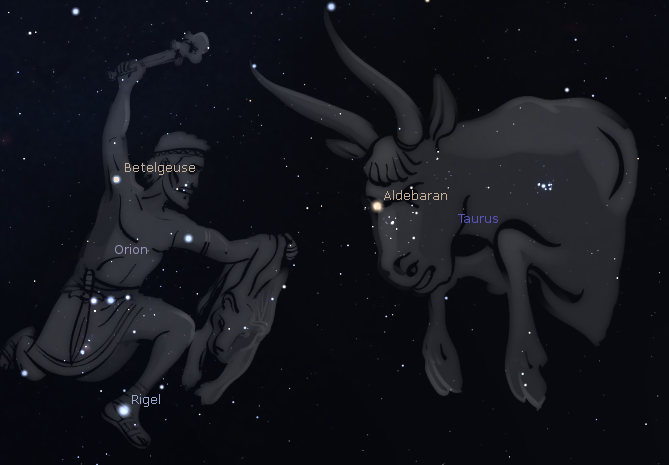
Conflict in the skis: Taurus is charging Orion. Seen at 9 p.m. in late February. Created using Stellarium and the dimming of Betelgeuse in GIMP.
02/20/2020 – Ephemeris – The Winter Triangle
Ephemeris for Thursday, February 20th. Today the Sun will be up for 10 hours and 41 minutes, setting at 6:17, and it will rise tomorrow at 7:34. The Moon, 3 days before new, will rise at 6:53 tomorrow morning.
I usually talk about the Winter Circle of bright stars, but some other astronomers talk about the Winter Triangle. The stars involved are Betelgeuse in the hunter Orion, Sirius in Canis Major, Orion’s large hunting dog, and Procyon in Canis Minor, his other small hunting dog. These three stars enclose a rather blank piece of sky with the faint Milky Way running through it and the equally invisible constellation of Monoceros the unicorn. The Summer Triangle has three bright stars with no other close competition. The Winter Triangle has 4 other bright stars near it. Any three of these would make a nice triangle. One of these stars, Betelgeuse has been the news recently because it is dimming to an unprecedented degree.
The times given are for the Traverse City/Interlochen area of Michigan. They may be different for your location.
Addendum
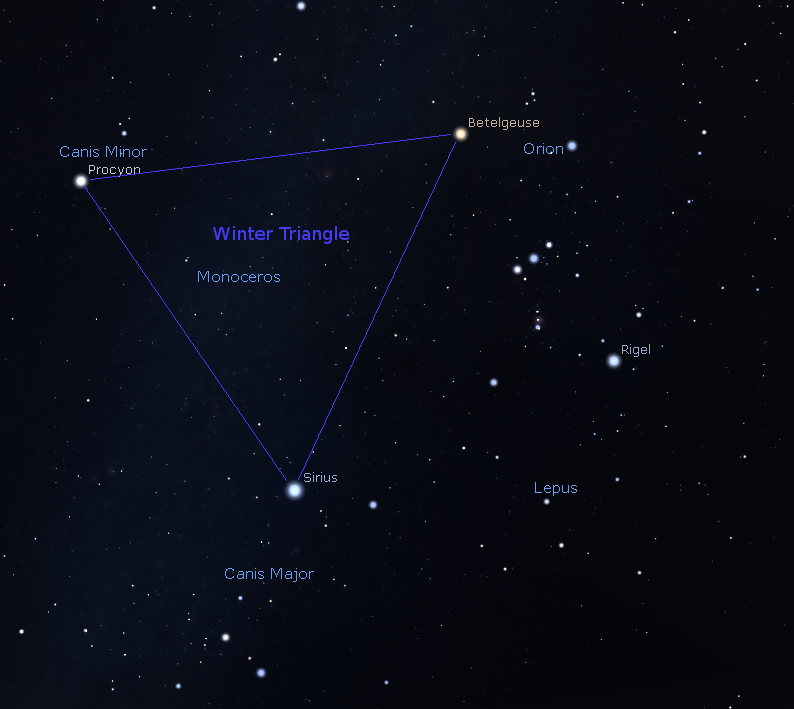
The Winter Triangle. It enclose a pretty blank space where Monoceros the unicorn lies. Created using Stellarium with my annotations for the Winter Triangle. By the way, Betelgeuse is currently only as bright as Bellatrix, the star next to the “n” in Orion.
02/18/2020 – Ephemeris – Orion in three cultures
Feb 18. This is Bob Moler with Ephemeris for Tuesday, February 18th. Today the Sun will be up for 10 hours and 35 minutes, setting at 6:14, and it will rise tomorrow at 7:37. The Moon, 3 days past last quarter, will rise at 5:24 tomorrow morning.
We observe the constellation of Orion in the south at 9 p.m. and think of the hapless Greek hero. To the Hebrews it was Kesil, the fool who built the tower of Babel hoping to reach heaven. To the Anishinaabe native peoples of this place it is the Wintermaker whose rising in the evening announces the coming of winter. Where Orion’s arms carry a lion skin shield and a club, the Wintermaker’s arms are exaggerated and extend from Aldebaran in Taurus to Procyon in Canis Minor, embracing just about all of the winter sky. Two other Anishinaabe constellations are entering the skies at this time in the east and northeast, to announce the coming of spring. One the pleasures and the other the dangers.
The times given are for the Traverse City/Interlochen area of Michigan. They may be different for your location.
Addendum
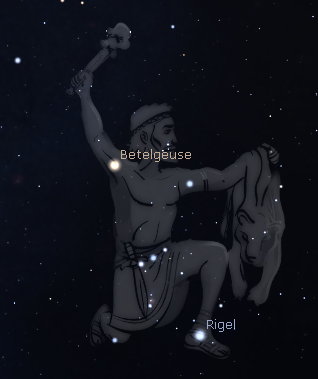
Orion as he is seen tonight at 9 p.m. Created using Stellarium.

The Wintermaker stretches his arms wide to embrace the winter stars. Created using Stellarium. Wintermaker figure from Ojibwe Sky Star Map by A. Lee, W. Wilson, C. Gawboy. Stellarium contains the constellation art from many cultures.
02/17/2020 – Ephemeris – A look at Orion and his hunting dogs
Ephemeris for President’s Day, Monday, February 17th. Today the Sun will be up for 10 hours and 32 minutes, setting at 6:13, and it will rise tomorrow at 7:39. The Moon, 2 days past last quarter, will rise at 4:27 tomorrow morning.
The great winter constellation or star group Orion the Hunter, is located in the southern sky at 9 p.m. His elongated rectangle of a torso is vertical. In the center of the rectangle are three stars in a line that make his belt. As a hunter, especially one of old, he has two hunting dogs. The larger, Canis Major can be found by following the three belt stars of Orion down and to the left. There lies the brilliant star called Sirius, also known as the Dog Star. It’s in the heart of a stick figure dog lower in the south facing Orion that appears to be begging. Canis Minor is just two stars found by extending Orion’s shoulder stars eastward where we find bright Procyon, the little dog star in the southeast.
The times given are for the Traverse City/Interlochen area of Michigan. They may be different for your location.
Addendum
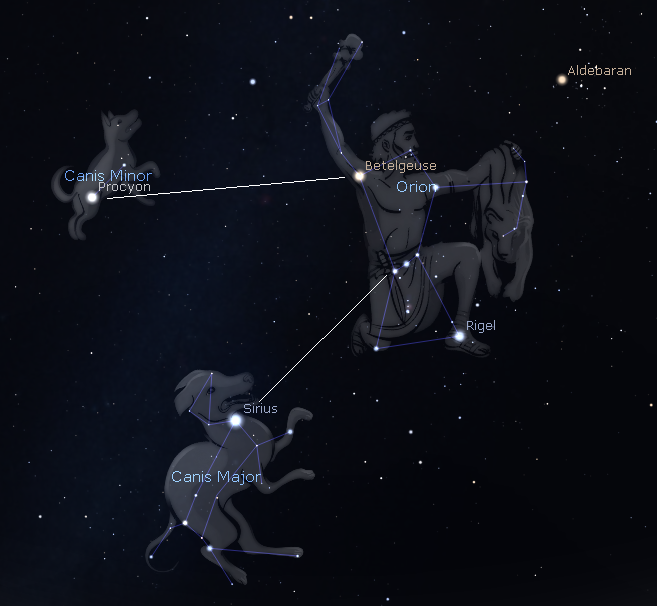
Orion and his hunting dogs with pointers as seen at 9 p.m. in mid February. Created using Stellarium.
02/13/2020 – Ephemeris – Orion’s Belt stars
This is Ephemeris for Thursday, February 13th. Today the Sun will be up for 10 hours and 21 minutes, setting at 6:07, and it will rise tomorrow at 7:45. The Moon, 2 days before last quarter, will rise at 11:48 this evening.
Orion’s belt of three stars is one of the most noticeable star groupings in the sky. There are no other group of three bright stars in a straight line visible anywhere else in the sky. The star’s names from left to right are Alnitak, Alnilam and Mintaka. They are actually a bit farther away than the other bright stars of Orion. Alnilam, the center star, is over three times the distance of red giant Betelgeuse above them and over twice as far as blue white giant star Rigel below them. Alnilam is 375 thousand times brighter than the Sun according to the SIMBAD Astronomical Database. These three stars were also known as Frigga’s Spindle by the Norsemen. Frigga also known as Freya is the goddess from which we get the name of the day of the week Friday.
The times given are for the Traverse City/Interlochen area of Michigan. They may be different for your location.
Addendum
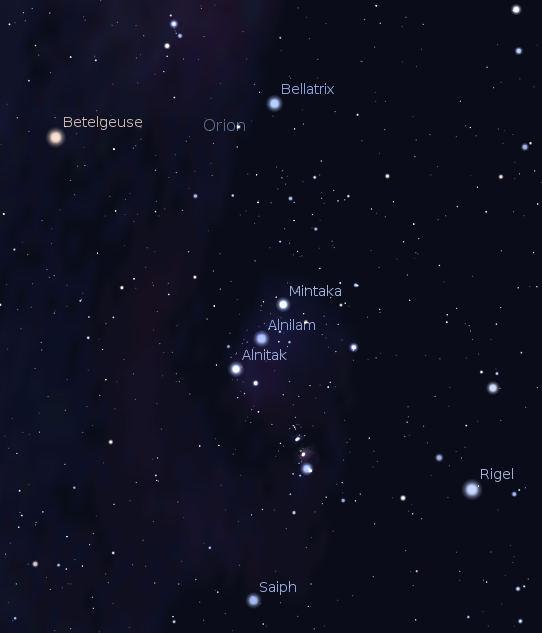
Torso of Orion centered on his belt. The torso of Orion is more upright this month. But I’m leaving it tilted so the star names don’t over print the stars. Created using Stellarium.
 Bob Moler's Ephemeris Blog