Archive
07/31/2015 – Ephemeris – Looking ahead at August in the skies
Ephemeris for Friday, July 31st. The Sun rises at 6:27. It’ll be up for 14 hours and 42 minutes, setting at 9:10. The Moon, at full today, will rise at 9:08 this evening.
Let’s look ahead at the month of August which starts tomorrow. Daylight hours will decrease from 14 hours and 40 minutes tomorrow to 13 hours 18 minutes on the 31st. The altitude of the sun at local noon, that is degrees of angle above the horizon will decrease from 63 degrees tomorrow to just over 53 degrees on the 31st. Straits area listeners can subtract one more degree from those angles. Local noon, when the sun is due south, is about 1:43 p.m. The Perseid meteor shower will reach its peak at about 2 a.m. on the morning of the 13th, and should be spectacular with a nearly new Moon. On the nights between now and then when the moon has set these meteor numbers will be building to the peak. Saturn will be our only easily visible evening planet.
Times are for the Traverse City/Interlochen area of Michigan. They may be different for your location.
Addendum
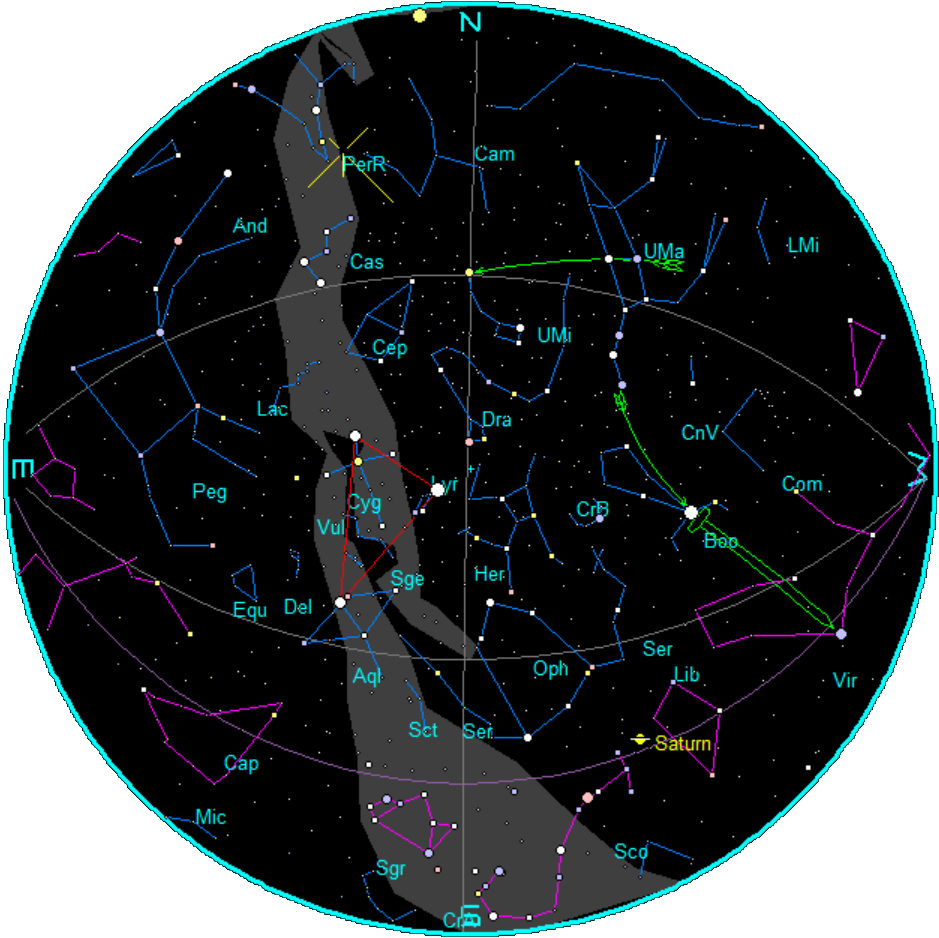
Star Chart for August 2015. Created using my LookingUp program. Click on image to enlarge.The Moon is not plotted.
The planets and stars are plotted for the 15th at 10 p.m. EDT. That is chart time. Note, Traverse City is located 1 hour 45 minutes behind our time meridian. To duplicate the star positions on a planisphere you may have to set it to 1 hour 45 minutes earlier than the current time.
Evening Astronomical twilight ends at 11:12 p.m. EDT on August 1st, decreasing to 10:06 p.m. EDT on the 31st.
Morning astronomical twilight starts at 4:24 a.m. EDT on August 1st, and increasing to 5:18 a.m. EDT on the 31st.
Add a half hour to the chart time every week before the 15th and subtract and hour for every week after the 15th.
For a list of constellation names to go with the abbreviations click here.
The green pointer from the Big Dipper is:
- Pointer stars at the front of the bowl of the Big Dipper point to Polaris the North Star.
- Drill a hole in the bowl of the Big Dipper and the water will drip on the back of Leo the Lion.
- Follow the arc of the Big Dipper’s handle to Arcturus
- Continue with a spike to Spica
- The Summer Triangle is shown in red
- PerR in yellow is the Perseid radiant
Calendar of Planetary Events
Credit: Sky Events Calendar by Fred Espenak and Sumit Dutta (NASA’s GSFC)
To generate your own calendar go to http://eclipse.gsfc.nasa.gov/SKYCAL/SKYCAL.html
Times are Eastern Daylight Time on a 24 hour clock. Some additions made to aid clarity.
Conjunctions like the Mercury-Regulus: 0.9° N means Regulus will appear 0.9° north of Mercury.
| Aug | 01 | Sa | Venus: 21.5° East of the Sun | |
| 02 | Su | 06:11 | Moon Perigee: 362,100 km | |
| 03 | Mo | 22:53 | Moon Descending Node | |
| 06 | Th | 22:03 | Last Quarter | |
| 07 | Fr | 13:25 | Mercury-Regulus: 0.9° N | |
| 08 | Sa | 19:22 | Moon-Aldebaran: 0.7° S | |
| 10 | Mo | 07:11 | Moon North Dec.: 18.3° N | |
| 13 | Th | 02:17 | Perseid Shower: ZHR* = 90 | |
| 14 | Fr | 10:54 | New Moon | |
| 15 | Sa | 15:19 | Venus Inferior Conjunction with the Sun | |
| 16 | Su | 10:34 | Moon-Mercury: 2.2° N | |
| 17 | Mo | 19:05 | Moon Ascending Node | |
| 17 | Mo | 22:33 | Moon Apogee: 405,900 km | |
| 19 | We | 23:35 | Mars-Beehive: 0.5° S | |
| 22 | Sa | 13:21 | Moon-Saturn: 2.8° S | |
| 22 | Sa | 15:31 | First Quarter | |
| 24 | Mo | 23:44 | Moon South Dec.: 18.2° S | |
| 26 | We | 17:04 | Jupiter Conjunction with the Sun | |
| 29 | Sa | 14:35 | Full Moon | |
| 30 | Su | 11:24 | Moon Perigee: 358,300 km | |
| 31 | Mo | 06:16 | Moon Descending Node | |
| 31 | Mo | 22:12 | Neptune Opposition from the Sun | |
| Sep | 01 | Tu | Venus: 25° West of the Sun |
*ZHR – Zenithal Hourly Rate: Approximate number of meteors per hour when the shower radiant is at the zenith. For more information on this and other meteor showers in 2015 see the International Meteor Organization website calendar section: http://www.imo.net/calendar.
08/12/2014 – Ephemeris – Comet Swift-Tuttle progenitor of the Perseid meteors
Ephemeris for Tuesday, August 12th. The sun rises at 6:41. It’ll be up for 14 hours and 11 minutes, setting at 8:52. The moon, 2 days past full, will rise at 9:50 this evening.
The Perseid meteor shower will reach its peak later this evening. The moon will still interfere with all but the brightest meteors. The meteors are caused by bits of sand grain to pea sized rubble given off by Comet Swift-Tuttle on past runs through the inner solar system. As comets go Comet Swift-Tuttle is large, with a nucleus of some 16 miles (26 km) in diameter. Comet Halley’s nucleus is half that and Churyumov–Gerasimenko’s nucleus that ESA’s Rosetta spacecraft is now orbiting is half Halley’s. Despite the wear and tear that a comet’s nucleus must endure when coming close to the Sun, the distribution of debris to give us a pretty even annual meteor shower means the comet has been near its present orbit for a very long time.
Times are for the Traverse City/Interlochen area of Michigan. They may be different for your location.
Addendum
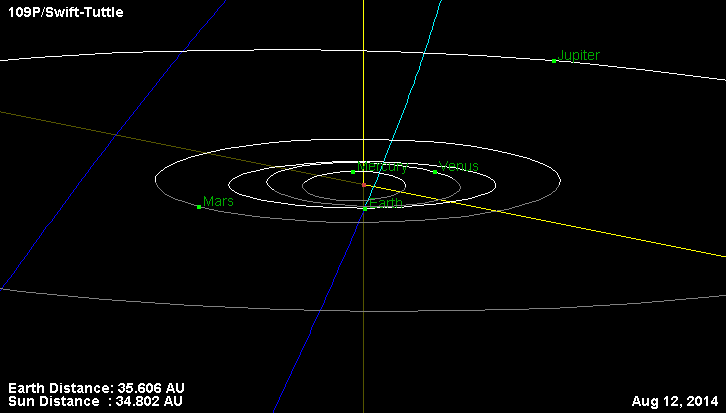
Orbit of Comet 109P/Swift-Tuttle. Blue line is the comet’s orbit, coming from above. Credit NASA / JPL / Applet by Osamu Ajiki (AstroArts), and further modified by Ron Baalke (JPL)
Link to the animation from which the above image was taken and other information on Comet Swift-Tuttle go to http://ssd.jpl.nasa.gov/sbdb.cgi?sstr=109P;cad=1
08/08/2014 – Ephemeris – Supermoon plus astronomical fun in the Grand Traverse Area
Ephemeris for Friday, August 8th. The sun rises at 6:36. It’ll be up for 14 hours and 21 minutes, setting at 8:58. The moon, 2 days before full, will set at 5:17 tomorrow morning.
In two days the Moon will reach perigee within a few hours of being a full moon. This has become known as a supermoon. Perigee is the point where an Earth orbiting object is closest to the Earth. The farthest point is called apogee. The coincidence of full moon and perigee was coined as the supermoon by astrologer Richard Knolle in 1979, but apparently didn’t catch on until he wrote a popular article in 2011. No wonder I hadn’t heard of it, this program had been on for 4 years before the term was even coined. The problem with appreciating the supermoon is the lack of a reference of nearly the same size. The moon always looks large when it’s near the horizon. It’s a well-known optical illusion, It’ll fool us every time.
Times are for the Traverse City/Interlochen area of Michigan. They may be different for your location.
Addendum
Saturday evening the 9th the Grand Traverse Astronomical Society (GTAS) will host a Sun and Star Party at Thoreson Farm at the Sleeping Bear Dunes National Lakeshore. It’s the concluding event at the Port Oneida Fair. Solar viewing will be from 4 to 6 p.m., and the evening event will run from 9 to 11 p.m. with the main attraction will be the nearly full Moon, the planet Saturn and colorful binary stars and bright star clusters. Thoreson Farm is located on South Thoreson Road. South Thoreson Road runs into M22, about a mile west of Port Oneida Road.
Sunday evening the 10th the GTAS will attend the Meteors and S’mores event at the Leelanau State Park at the tip of the Leelanau Peninsula. The event will run from 8:30 p.m. to 11:45 p.m. The Perseid meteor shower will reach peak a couple of days later, but there will still bright Perseids visible to the vigilant.
I’ll have more to say about the supermoon tomorrow in a non-Ephemeris post.
08/06/2014 – Ephemeris – Wednesday is bright planet day on Ephemeris
Ephemeris for Wednesday, August 6th. The sun rises at 6:34. It’ll be up for 14 hours and 26 minutes, setting at 9:01. The moon, 3 days past first quarter, will set at 3:03 tomorrow morning. | Wednesday is bright planet day on Ephemeris. Reddish Mars is in Virgo in the southwest as darkness falls. It’s 113 million miles (183 million km) away now, over twice as far as it was last April, and will set at 11:58 p.m. Saturn will be low in the south-southwest as darkness falls, in the faint constellation of Libra the scales. It will set at 12:43 a.m. Saturn’s great viewing with small or large telescopes to see those fabulous rings and its large moon Titan. Somewhat larger telescopes can spot some smaller moons closer in. Brilliant Venus will rise in the east northeast at 4:47 a.m. in morning twilight. Dark skies for the Perseid meteor shower will run from 3:03 a.m. to 4:34 a.m. Bright meteors will be visible all night.
Times are for the Traverse City/Interlochen area of Michigan. They may be different for your location.
Addendum
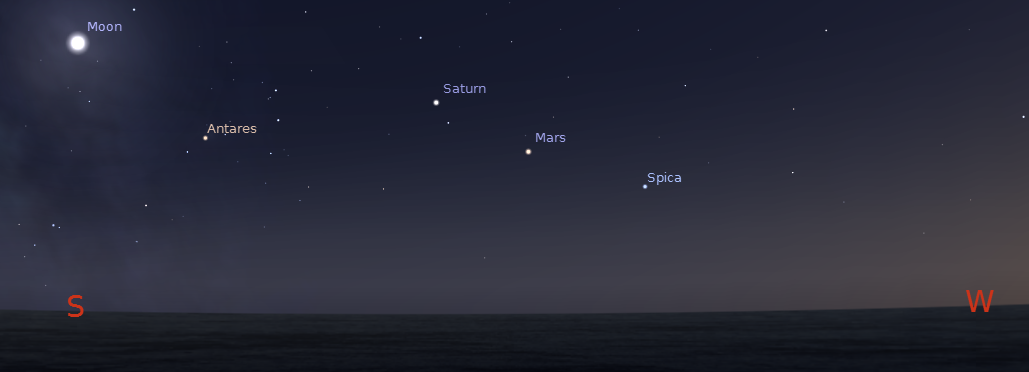
The planets Mars and Saturn with the bright stars and the Moon at 10 p.m., August 6, 2014. Created using Stellarium.
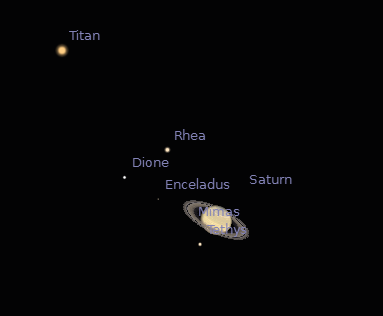
Saturn and its satellites through a telescope as seen on the evening of August 6, 2014. Created using Stellarium.
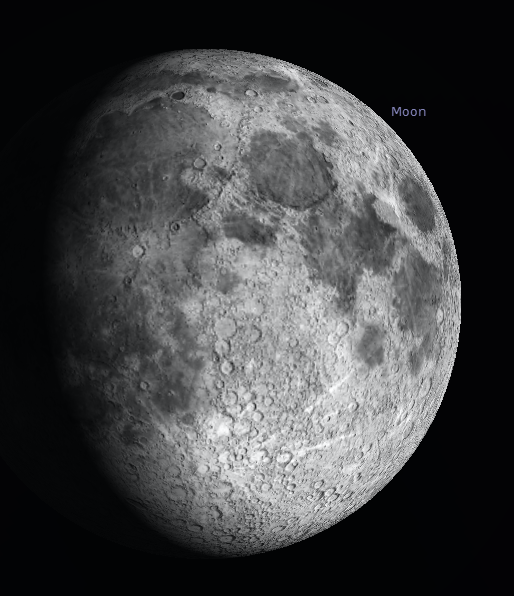
The Moon as it would be seen in binoculars at 10 p.m. , August 7, 2014. Created using Stellarium.
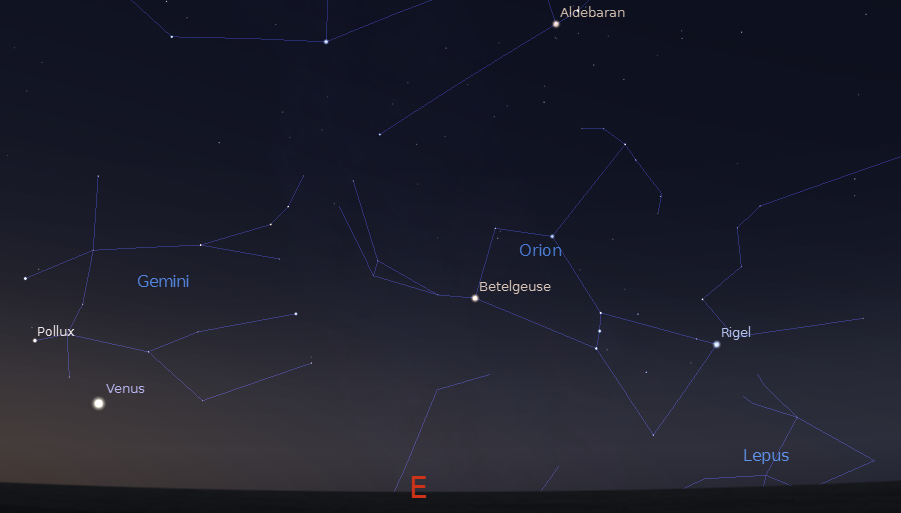
Venus and the constellations of winter rising in morning twilight at 5:30 a.m., August 7, 2014.
07/31/2014 – Ephemeris – Previewing August skies
Ephemeris for Thursday, July 31st. The sun rises at 6:27. It’ll be up for 14 hours and 41 minutes, setting at 9:09. The moon, 3 days before first quarter, will set at 11:07 this evening.
Let’s look ahead at the month of August in the skies. Daylight hours will decrease from 14 hours and 38 minutes tomorrow to 13 hours 16 minutes on the 31st. The altitude of the sun at local noon, that is degrees of angle above the horizon will decrease from 63 degrees tomorrow to just over 53 degrees on the 31st. Straits area listeners can subtract one more degree from those angles. Local noon, when the sun is due south, is about 1:43 p.m. The Perseid meteor shower will reach its peak on the morning of the 13th. All but the brightest meteors will be lost in the bright moonlight. Until then look for the meteors after the moon sets. That radiant point, where the meteors will seem to come from, will be in the northeastern sky.
Times are for the Traverse City/Interlochen area of Michigan. They may be different for your location.
Addendum
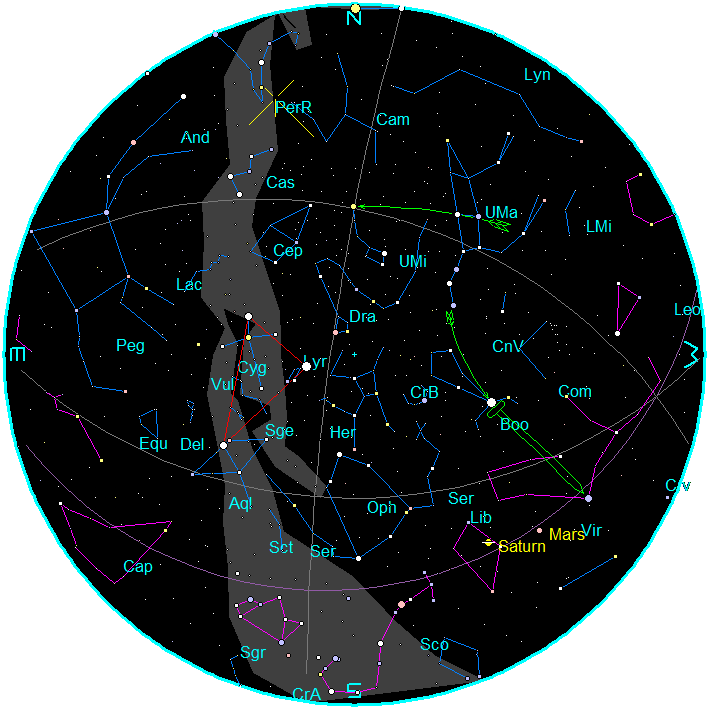
August star chart for 10 p.m. on August 15, 2014. Created by my LookingUp program.
The Moon is not plotted. The planets are plotted for the 15th. Mars will move eastward through the month and will approach Saturn.
Astronomical twilight ends at 11:11 p.m. on August 1st, decreasing to 10:05 on the 31st.
Add a half hour to every week before the 15th and subtract and hour for every week after the 15th.
For a list of constellation names to go with the abbreviations click here.
Also shown is the Summer Triangle in red. Clockwise from the top star is Deneb in Cygnus, Vega in Lyra and Altair in Aquila.
The yellow radiant marked PerR is the radiant for the Perseid meteor shower.
The green pointers from the Big Dipper are:
- Pointer stars at the front of the bowl of the Big Dipper point to Polaris the North Star.
- The arc of the dipper’s handle points to Arcturus.
- The straighten the ark to a spike to point to Spica.
07/28/2014 – Ephemeris – One meteor shower is at peak and another is ramping up.
Ephemeris for Monday, July 28th. The sun rises at 6:24. It’ll be up for 14 hours and 48 minutes, setting at 9:12. The moon, 2 days past new, will set at 9:46 this evening.
We have a couple of meteor showers of note coming up. The first is the Southern Delta Aquarids which will peak on the 30th. The radiant point for these meteors will rise around midnight in the southeast. Their numbers and their brightness are not very great. The Perseid meteor shower will have the misfortune to coincide with the full moon on August 12th and 13th, drowning out all but the brightest meteors. However the Perseids have a long run up to their peak, so their numbers will grow after the moon sets until the moon sets in morning twilight. The Perseid radiant is circumpolar for Northern Michigan, meaning it never sets, so some Perseid meteors can always be seen at night. Their radiant will be in the northeastern sky in the evening.
Times are for the Traverse City/Interlochen area of Michigan. They may be different for your location.
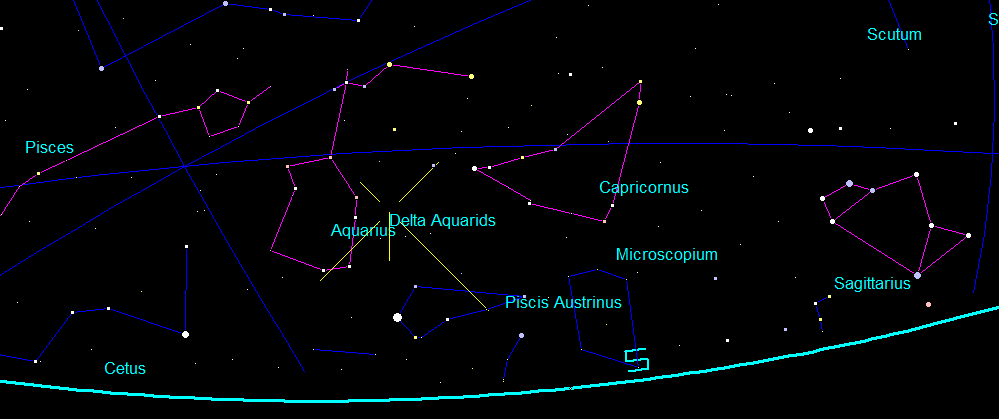
Approximate Radiant of the South Delta Aquarid meteor shower. The radiant does move over the several weeks of the shower to the east. Created using my LookinUp program.
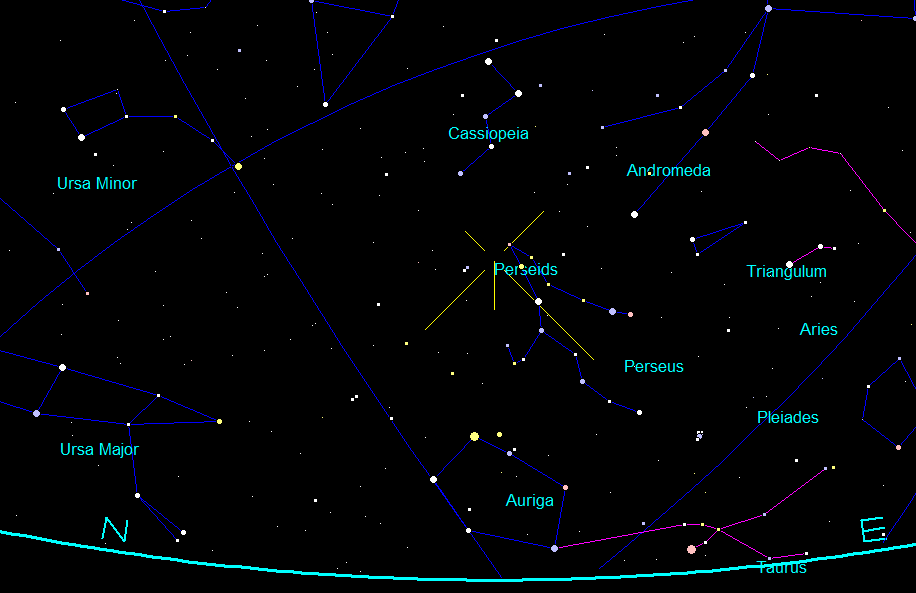
The Perseid meteor shower radiant a about 2 a,m, during the period of the shower. Created using my LookingUp program.
08/12/2013 – Ephemeris – The perseid meteors are not done yet
Ephemeris for Monday, August 12th. The sun rises at 6:41. It’ll be up for 14 hours and 10 minutes, setting at 8:52. The moon, 2 days before first quarter, will set at 11:26 this evening.
The Perseid meteor shower is still active. Their peak will be this afternoon. So starting at moon set at 11:26 or so it will be dark enough to see them. Meteor showers are caused when the earth crosses the path of a periodic comet and runs into the debris liberated by the comet’s past visits near the sun. Comet Swift-Tuttle is the comet responsible for the Perseids. It has an orbit of the sun of 130 years. Every time the comet comes close to the sun, it liberates a cloud of small gravel that’s too massive to be swept into the comet’s tail, however it is affected by the pressure of sunlight. These make the prediction of the time of the meteor shower interesting, or that a particular cloud may miss the earth this time to hit it some other passage.
Addendum
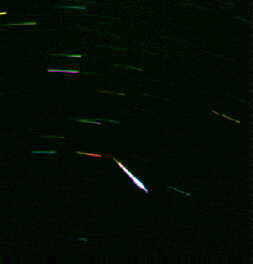
My best Perseid photo. From the 70’s.
08/09/2013 – Ephemeris – A weekend full of local astronomical events
Ephemeris for Friday, August 9th. The sun rises at 6:38. It’ll be up for 14 hours and 18 minutes, setting at 8:56. The moon, 3 days past new, will set at 9:55 this evening.
This weekend is packed with events by the Grand Traverse Astronomical Society starting tonight with Friday Night Live on Front Street in Traverse City. We’ll start by looking at the sun if it’s clear, and at Saturn as night falls. Tomorrow night its a Star Party and meteor watch at Thoreson Farm at Sleeping Bear Dunes National Lakeshore see the map at http://www.gtastro.org for location. Sunday night it’s Meteors and S’mores at Leelanau State Park. The Perseid meteor shower will reach its peak between 2 and 4 Monday afternoon, but we’re already seeing its meteors, which seem to come from the northeastern sky. The moon really won’t interfere until Monday night before midnight, so this is an excellent year for the Perseid meteor shower.
Times are for the Traverse City/Interlochen area of Michigan. They may be different for your location.
Addendum
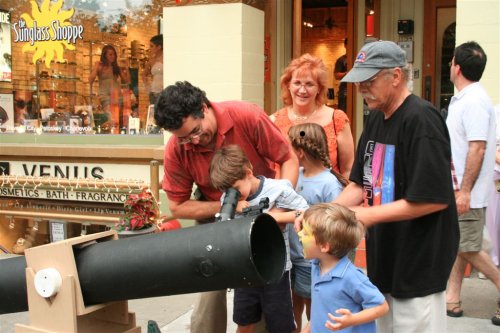
Friday Nite Live
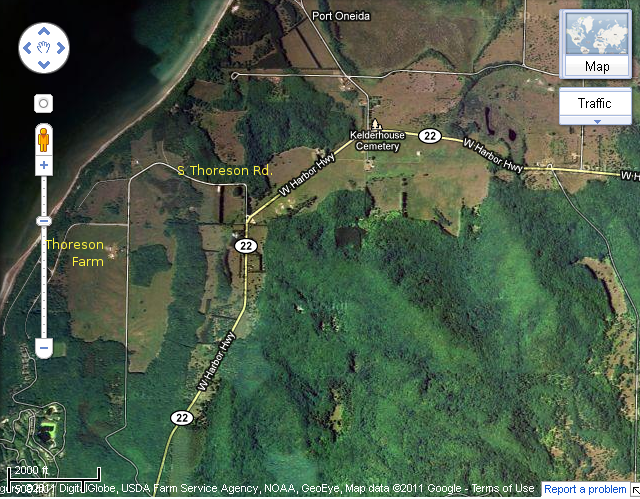
Map to Thoreson Farm, northeast of Glen Arbor.
08/01/2013 – Ephemeris – Previewing August skies
Ephemeris for Thursday, August 1st. The sun rises at 6:29. It’ll be up for 14 hours and 38 minutes, setting at 9:07. The moon, 3 days past last quarter, will rise at 2:49 tomorrow morning.
Let’s look ahead at the month of August in the skies. Daylight hours will decrease from 14 hours and 38 minutes today to 13 hours 16 minutes on the 31st. The altitude of the sun at local noon, that is degrees of angle above the horizon will decrease from 63 degrees today to just over 53 degrees on the 31st. Straits area listeners can subtract one more degree from those angles. Local noon, when the sun is due south, is about 1:43 p.m. The Perseid meteor shower will reach its peak at between 2 and 4 p.m. on the 12th. That means that more than likely the morning of the 12th and 13th will be equally good. I tend to prefer viewing before the peak, if given a choice. There are some observing events planned for that time.
Times are for the Traverse City/Interlochen area of Michigan. They may be different for your location.
Addendum
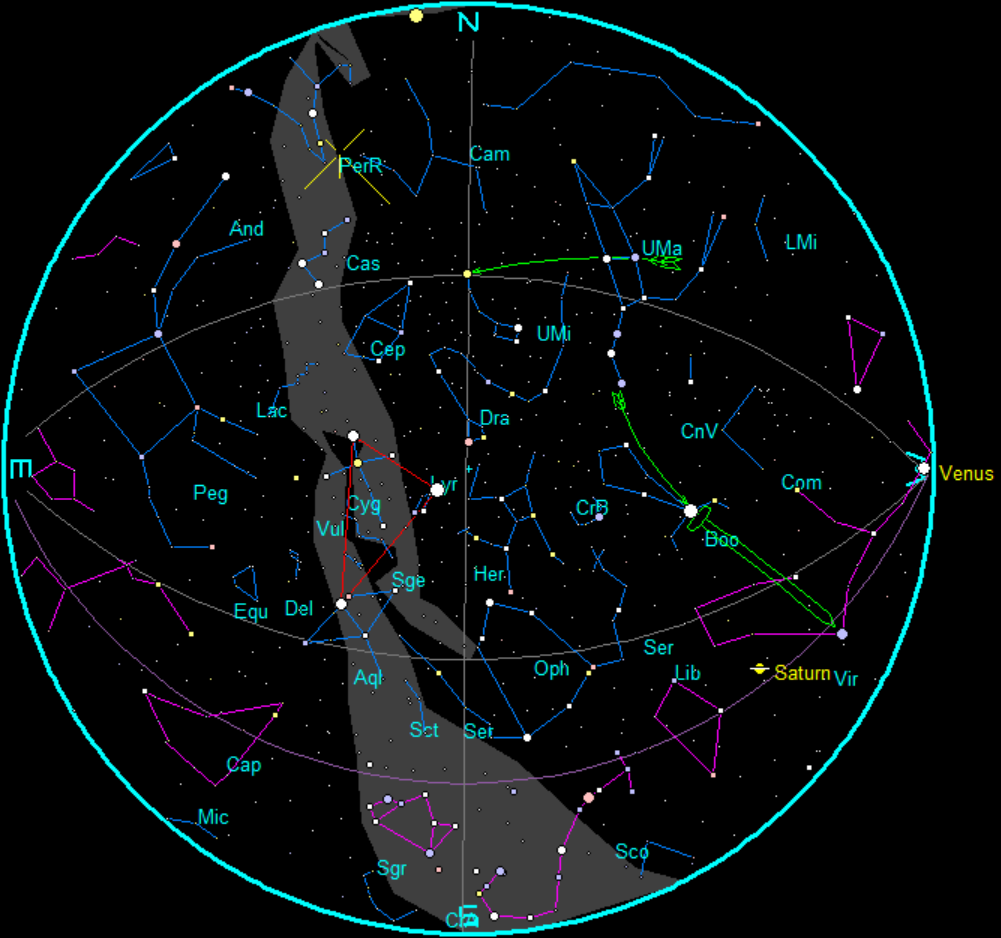
The sky as it would appear on August 15, 2013 at 10 p.m., without the moon.
The constellation abbreviations, names and bright star names are found here.
- The arrow from the pointer stars of the Big Dipper to Polaris the North Star, near the north celestial pole.
- Follow the arc of the handle of the Big Dipper to Arcturus.
- A Leaky Dipper drips on Leo
- Follow the spike to Spica.
- The Summer Triangle (in red)
- PerR is the Perseid meteor radiant
07/26/2013 – Ephemeris – South Delta Aquarid meteors at peak, but look for the Perseids
Ephemeris for Friday, July 26th. The sun rises at 6:22. It’ll be up for 14 hours and 51 minutes, setting at 9:14. The moon, 3 days before last quarter, will rise at 11:13 this evening.
We are now reaching the peak of the South Delta Aquarid meteor shower, which is hampered by the waning gibbous moon in the morning sky, where it’s visible. This is also the time to begin to look for the Perseid meteors that will reach peak next month on the morning of the 12th. The Perseids are an all night meteor shower because the radiant point, the point from which the meteors seem to come is far enough north so it never sets. The largest number of meteors appear when the radiant is highest in the sky, before dawn. However as soon as it gets dark the low position of the radiant in the northeast will result in fewer meteors but the streaks will be longer, as the meteoroids hit the atmosphere at a low angle.
Times are for the Traverse City/Interlochen area of Michigan. They may be different for your location.
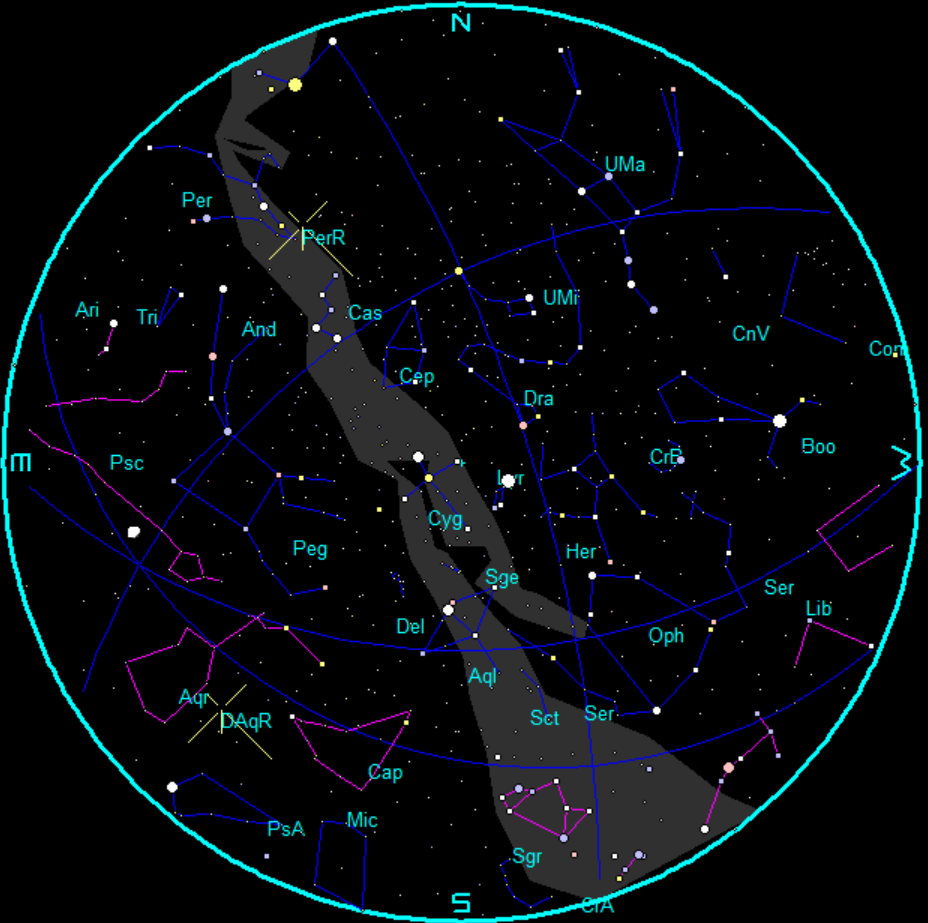
South Delta Aquarid meteor shower at peak and Persieds firing up at 1 a.m. July 27, 2013. PerR and DAqR are the radiants.
 Bob Moler's Ephemeris Blog