Archive
10/31/2012 – Epmeneris – The Ghoul Star
Ephemeris for Halloween, Wednesday, October 31st. The sun will rise at 8:19. It’ll be up for 10 hours and 12 minutes, setting at 6:32. The moon, 2 days past full, will rise at 7:37 this evening.
Not all the ghosts and goblins out tonight will be children. One will be out every night, because it’s a star. Its name is Algol, from the Arabic for Ghoul Star or Demon Star. The Chinese had a name for it that meant a mausoleum or more ominously ‘piled up corpses’. It’s the second brightest star in the constellation Perseus the hero, rising in the northeast this evening. The star is located where artists have drawn the severed head of Medusa, whom he had slain. Medusa was so ugly that she turned all who gazed upon her to stone. Algol is her still glittering eye. Astronomers finally found out what was wrong with Algol. It does a slow 6 hour wink every two days 21 hours, because it is two very close stars that eclipse each other in that period.
Times are for the Traverse City/Interlochen area of Michigan. They may be different for your location.
Addendum
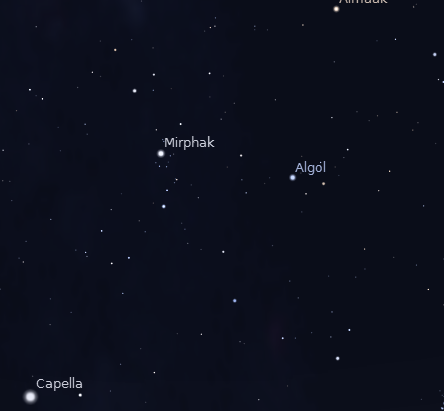
The constellation Perseus in the northeast at 9 p.m. on October 31, 2012. Created using Stellarium.
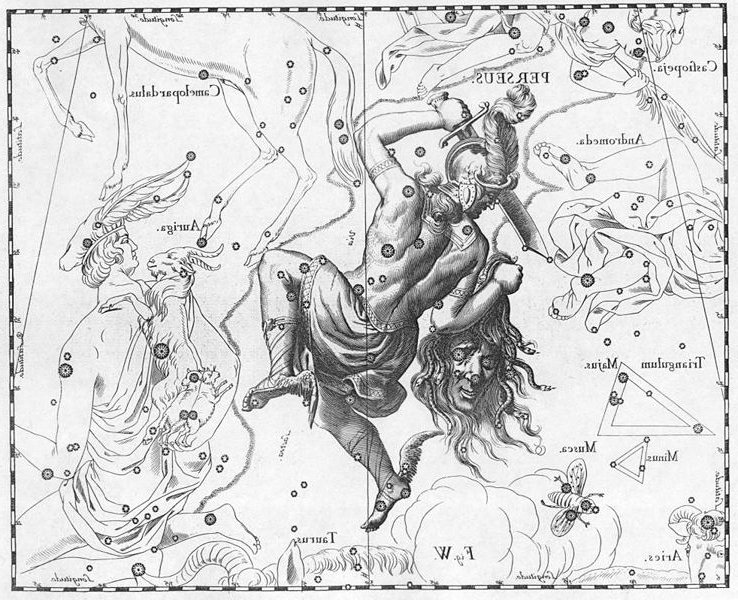
Perseus and the head of Medusa from the 1690 Uranographia by Johannes Hevelius. Image found with the article on Algol in Wikipedia.
Note that this is a mirror image. The star charts in the 17th century were based on celestial globes, which represented the constellations as seen from the outside of the celestial sphere instead of from the inside. I reversed the image to match Perseus as we see him.
10/18/2012 – Ephemeris – Autumn wonders for binoculars or small telescope: The Alpha Persei Association
Ephemeris for Thursday, October 18th. The sun will rise at 8:02. It’ll be up for 10 hours and 49 minutes, setting at 6:52. The moon, half way from new to first quarter, will set at 9:17 this evening.
When is a star cluster not a star cluster? When it’s an association. That is when it has begun to dissipate because the gravitational force of the group cannot hold it together. The central stars of the Big Dipper belong to The Ursa Major Association. Below the W shaped constellation of Cassiopeia in the northeast at 9 or 10 p.m. Is the constellation of Per-seus or Pers-e-us as it is usually pronounced. Its brightest star is Mirfak with a designation of Alpha Persei. There are some stars there to the naked eye, but with binoculars there are a great many stars just below naked eye visibility. This is called the Alpha Persei association. The star groups I’ve talked about this week are just some of the wonders visible in a simple pair of binoculars.
Times are for the Traverse City/Interlochen area of Michigan. They may be different for your location.
Addendum
The constellation Perseus. (Stellarium spells Alpha Persei Mirphak, not Mirfak. Star name spelling can be something variable.)
The constellation Perseus in the northeast at 10 p.m. on October 18, 2012. Created using Stellarium.
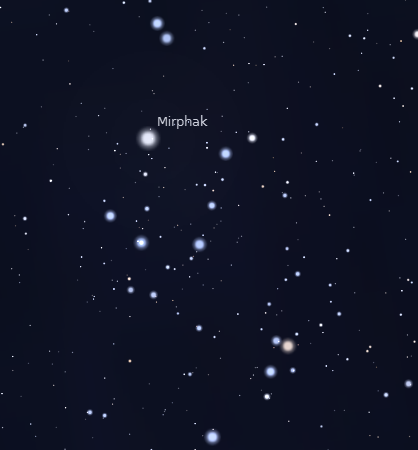
The Alpha Persei Association in a binocular view. Created using Stellarium.
11/21/11 – Ephemeris – The constellation Perseus the hero
Monday, November 21st. The sun will rise at 7:46. It’ll be up for 9 hours and 22 minutes, setting at 5:09. The moon, 3 days past last quarter, will rise at 4:32 tomorrow morning.
High in the east at 9 p.m. and below the letter W shaped constellation of Cassiopeia the queen is Perseus the hero. It’s kind of a odd shape for a hero, To me it looks like a chicken or the cartoon roadrunner. Perhaps its shape is like the Greek letter pi. It’s two brightest stars are Mirfak and Algol the demon star. Look at the area around Mirfak with binoculars and you will see a large group of stars just below unaided eye visibility. It’s called the Alpha Persei association. That because Mirfak is alpha Persei. The group is about 560 light years away, which means, though close, are farther away than the Pleiades, below right of them.
* Times, as always are for the Traverse City/Interlochen area of Michigan.
Addendum
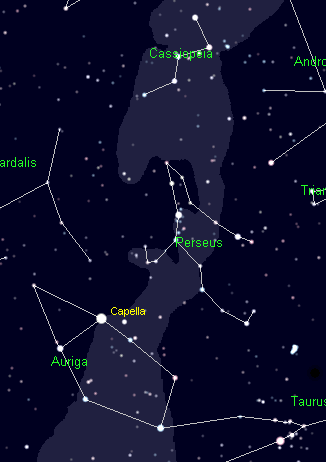
The Constellations Cassiopeia, Perseus and Auriga. Cartes du Ciel
10/17/11 – Ephemeris – The constellation of Cassiopeia
Monday, October 17th. The sun will rise at 7:59. It’ll be up for 10 hours and 55 minutes, setting at 6:55. The moon, 2 days before last quarter, will rise at 10:25 this evening. | The stars of the autumn skies are replacing the summer stars from the east. Look in the northeastern sky by 9 p.m. and you can find the W shaped constellation of Cassiopeia the queen. Cassiopeia is so far north that it never sets for us in Michigan. It is opposite the pole star Polaris from the Big Dipper. There’s a dim star that appears above the middle star of the W which turns the W into a very crooked backed chair. Above and left of Cassiopeia is a dim upside down church steeple shaped constellation of Cepheus the king. The Milky Way flows through a corner of Cepheus and Cassiopeia toward the northeastern horizon and through the constellation of Perseus the hero, which kind of looks, to me, like a chicken, but that’s another story.
* Times are for the Traverse City/Interlochen area of Michigan. They may be different for your location.
Addendum
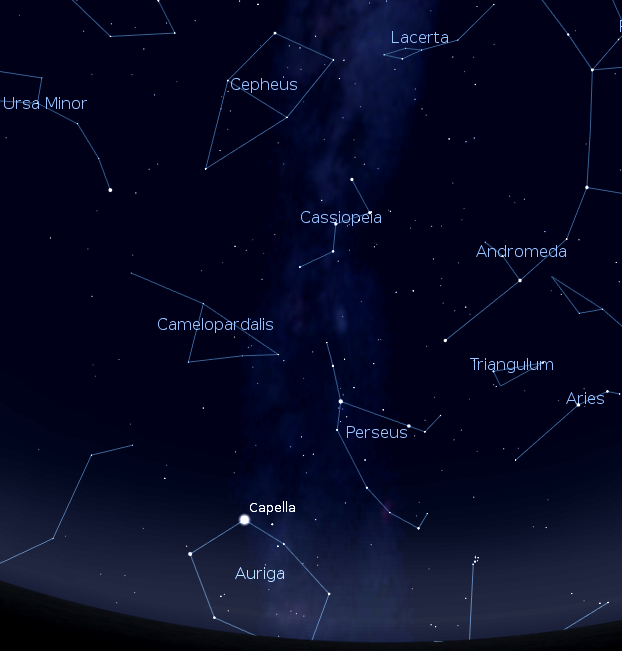
The constellation Cassiopeia and its neighbors. Created using Stellarium.
 Bob Moler's Ephemeris Blog