Archive
12/27/2016 – Ephemeris – The stars of Orion
Ephemeris for Tuesday, December 27th. The Sun will rise at 8:19. It’ll be up for 8 hours and 49 minutes, setting at 5:09. The Moon, 2 days before new, will rise at 7:26 tomorrow morning.
The large and bright constellation of Orion the hunter is in the southeast at 9 p.m., with the bright star Sirius below it near the horizon. The equally spaced line of three stars of Orion’s belt are nearly vertical and point down to Sirius, also known as the Dog Star in Canis Major, Orion’s greater dog. The whole of its constellation stars aren’t up at 9 p.m., but they will all clear the horizon by 10 p.m. Those three belt stars are in the center of an elongated rectangle of stars At the top left of Orion’s shoulder stars is the red giant star Betelgeuse. The right shoulder star is Bellatrix. Both Bellatrix and Sirius along with the names of other stars and constellations should be familiar to fans of the Harry Potter novels and movies, as members of the house of Black. The knee stars at the bottom of the rectangle are, from left to right Saiph and the brilliant blue giant star Rigel. Between his belt and knees are stars of his sword.
Times are for the Traverse City/Interlochen area of Michigan. They may be different for your location.
Addendum
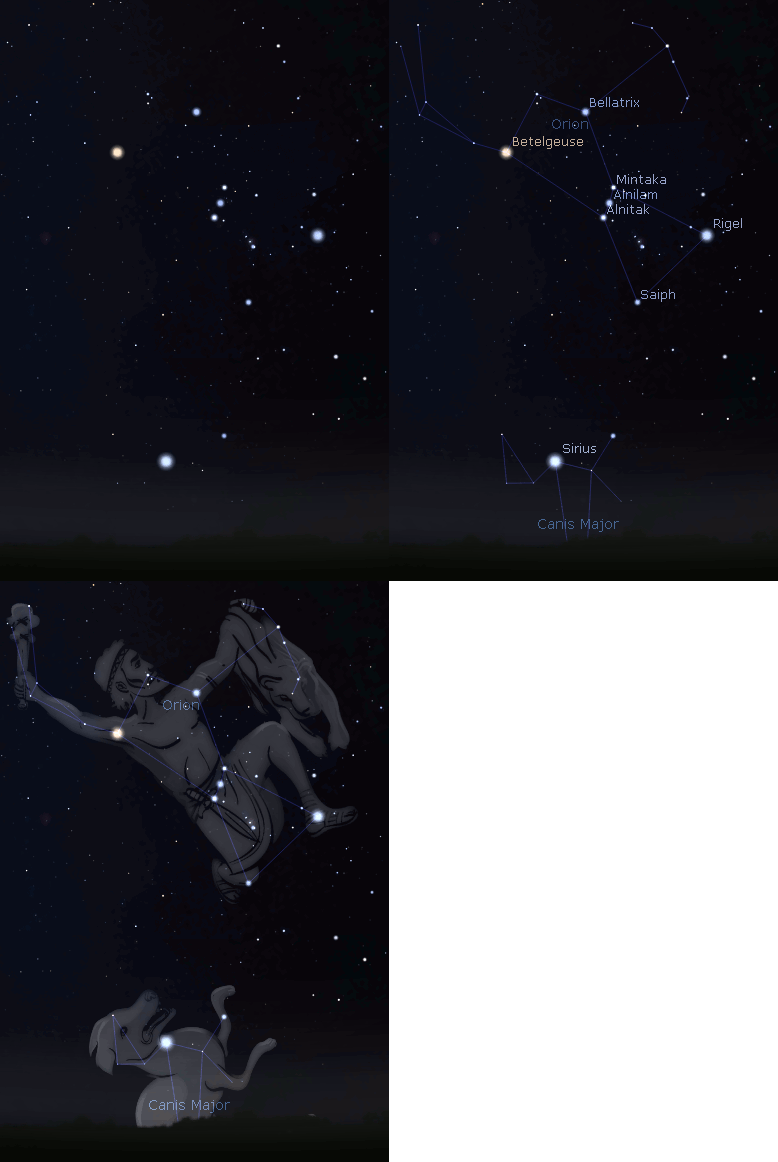
Orion, star names, and constellation art animation position for 9 p.m. December 27. Created using Stellarium and GIMP. Artist: Johan Meuris.
In the image above I’ve added the belt star names, though they are generally covered in a program of their own.
12/26/2016 – Ephemeris – Orion takes its place as the central winter constellation
Ephemeris for Monday, December 26th. The Sun will rise at 8:19. It’ll be up for 8 hours and 49 minutes, setting at 5:08. The Moon, 3 days before new, will rise at 6:33 tomorrow morning.
The great constellation of Orion the hunter has claimed his rightful position as the central winter constellation. It’s the most famous constellation of all. Think the Big Dipper is a big deal? They can’t even see it from the large population centers of Australia. Parts of Orion can be seen from every part of the Earth from pole to pole. Orion’s distinctive feature is his belt of three bright stars in a row. This tilted belt is in the center of a large rectangle of bright stars. The upper left star is Betelgeuse a red giant star. The lower right star is Rigel a blue giant star. Orion was an unlucky fellow of Greek myth. One wonders why he gets this splashy constellation in Winter while Hercules gets a dim upside down constellation in the spring sky.
Times are for the Traverse City/Interlochen area of Michigan. They may be different for your location.
Addendum
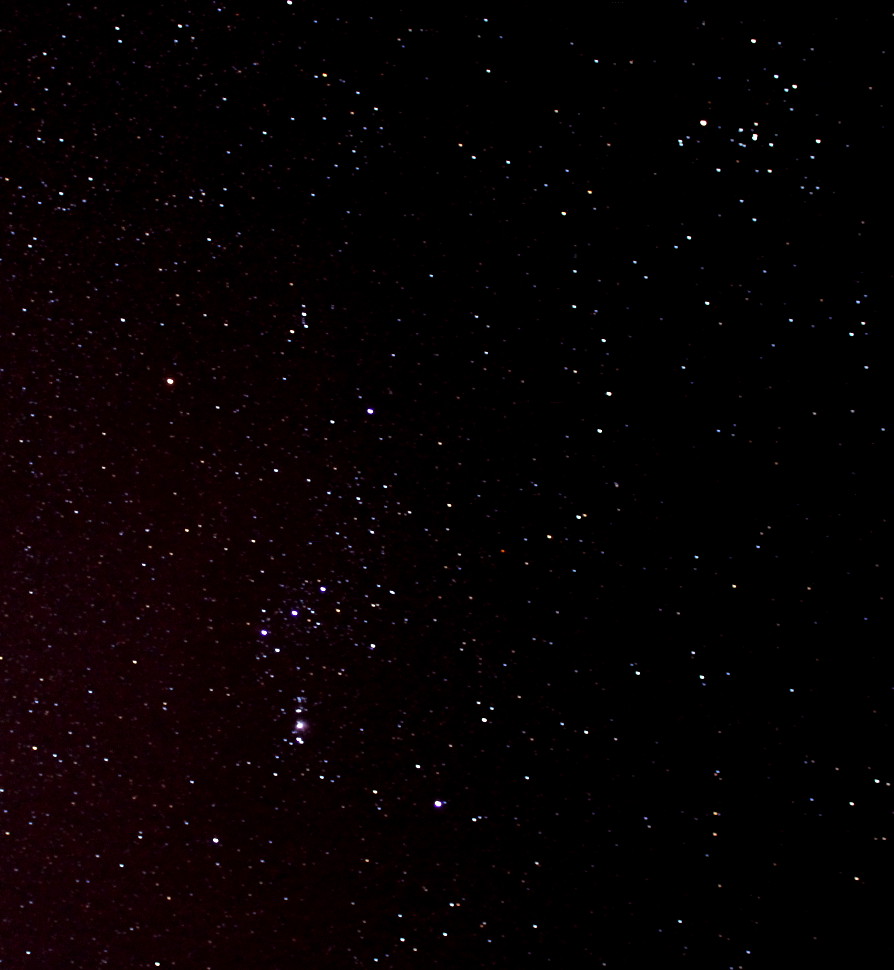
Orion and the head of Taurus photograph by myself January 4, 2016 at 11:30 p.m. It’s a stack of unguided 20 second exposures.
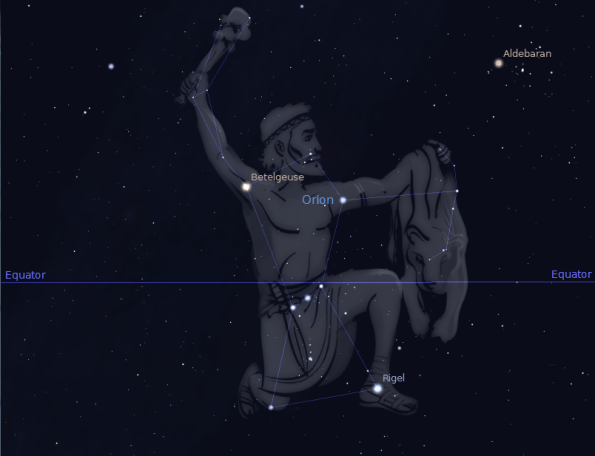
Orion from mid latitudes north of the equator. Orion would be upside down if viewed south of the equator. Created using Stellarium.
The Ephemeris radio programs are very short (59 seconds) so I will visit Orion several times during the winter to explore its mythology and deep sky wonders within, or search past posts for Orion.
02/12/2016 – Ephemeris – A circle of bright stars in winter
Ephemeris for Friday, February 12th. The Sun will rise at 7:48. It’ll be up for 10 hours and 18 minutes, setting at 6:06. The Moon, 3 days before first quarter, will set at 11:19 this evening.
The winter skies are blessed with more first magnitude stars than any other season. With the moon out these stars will stand out even more, as dimmer stars are suppressed. Six of these stars lie in a large circle centered on the seventh, the Winter Circle.
This circle is up at 9 p.m. Starting high nearly overhead is Capella in Auriga the charioteer. Moving clockwise down to the south, we come to Aldebaran in the face of Taurus the Bull. Then down to Orion’s knee we find Rigel. Down and left is the brightest star of all Sirius in Canis Major Orion’s large hunting dog, lowest of these stars in the southeast. Moving up and left there is Procyon in Canis Minor, Above is Pollux in Gemini the twins. All are centered on Betelgeuse the bright red star in Orion’s shoulder.
Times are for the Traverse City/Interlochen area of Michigan. They may be different for your location.
Addendum
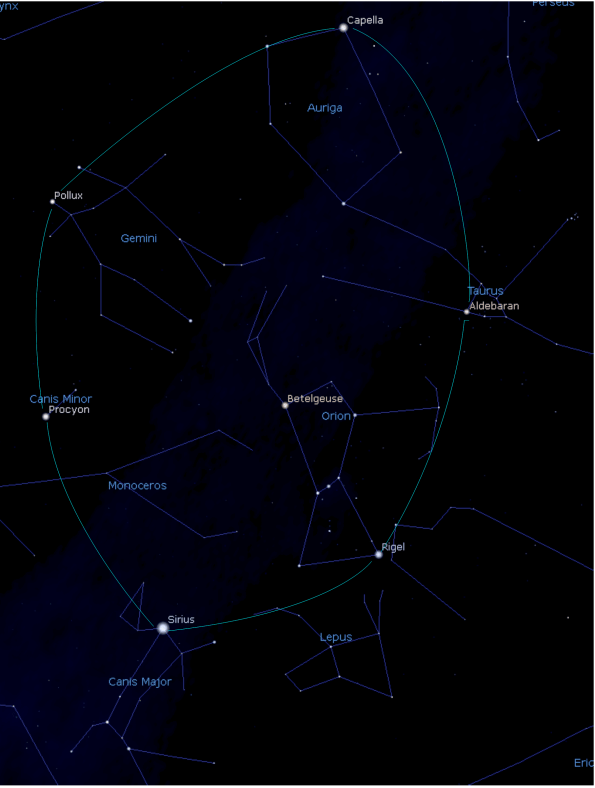
The bright stars of winter arrayed in a circle. Created using Stellarium.
Some also see a Winter Triangle consisting of the stars Betelgeuse, Sirius and Procyon.
01/21/2016 – Ephemeris – Rigel, Orion’s other bright star
Ephemeris for Thursday, January 21st. The Sun will rise at 8:12. It’ll be up for 9 hours and 22 minutes, setting at 5:35. The Moon, 2 days before full, will set at 6:44 tomorrow morning.
The bright star at the bottom right corner of the big upright rectangle that is the giant hunter Orion’s body in the south-southeast is Rigel. It is a white star with a bluish tinge. It compares in brightness with Betelgeuse at the opposite end of Orion’s rectangle, though it’s usually a bit brighter. The mismatch in color makes brightness comparisons difficult. Rigel is about 860 light years away, It’s 20 times the mass of the Sun, 120 thousand the times brighter than the Sun, and a diameter about the size of the orbit of Mercury. It’s age is thought to be about 8 million years. It has a visual companion star that can be seen in amateur telescopes. It’s not that dim, but suffers by being close to the arc light brightness of Rigel.
Times are for the Traverse City/Interlochen area of Michigan. They may be different for your location.
Addendum
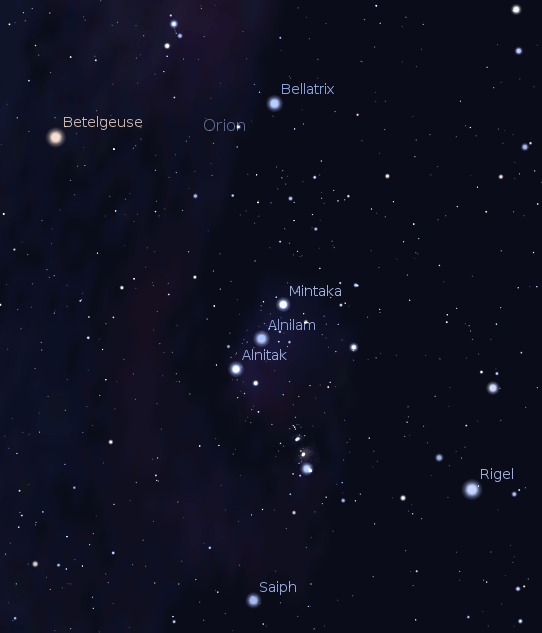
Torso of Orion centered on his belt. Created using Stellarium.
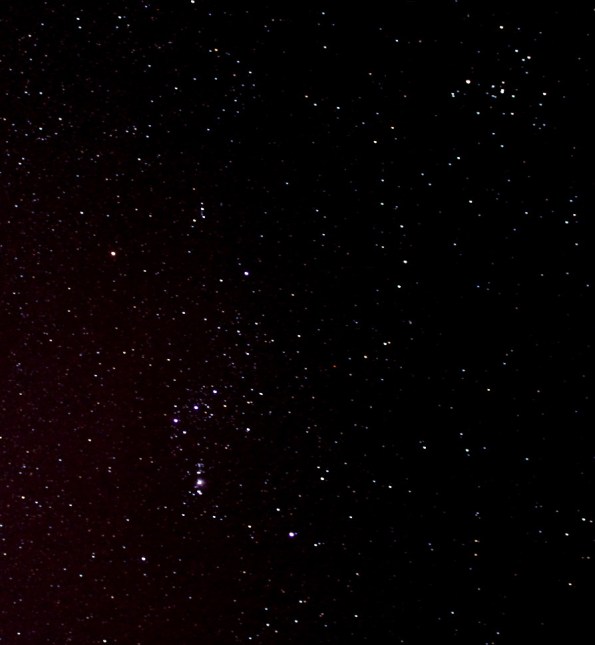
Orion and the head of Taurus photograph by myself January 4, 2016 at 11:30 p.m. It’s a stack of untracked 20 exposures.
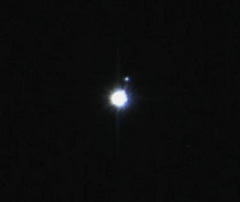
Rigel with its companion star as photographed through a telescope. No attribution. Source: http://washedoutastronomy.com/content/urban-orion?page=1
01/04/2016 – Ephemeris – Some named stars in Orion and how to remember them
Ephemeris for Monday, January 4th. The Sun will rise at 8:20. It’ll be up for 8 hours and 55 minutes, setting at 5:15. The Moon, 2 days past last quarter, will rise at 3:49 tomorrow morning
Now that the Moon has fled let’s turn to the dark skies of winter and the magnificent constellation of Orion the hunter. At 9 p.m. he’s not yet completely upright in the southeast at 9 p.m. His seven bright stars make him easy to spot, starting with his belt of three stars in a straight line angling down to the left. It is inside a rectangle framing his shoulders and knees, leaning now to the left. The bright reddish star at the upper left corner is Betelgeuse, which according to a certain movie one shouldn’t say three-time in a row. The other shoulder star is a name familiar to Harry Potter fans, Bellatrix, though there’s nothing Lestrange about it. The lower right star is the bright blue-white Rigel. All in all a very impressive constellation.
Times are for the Traverse City/Interlochen area of Michigan. They may be different for your location.
Addendum
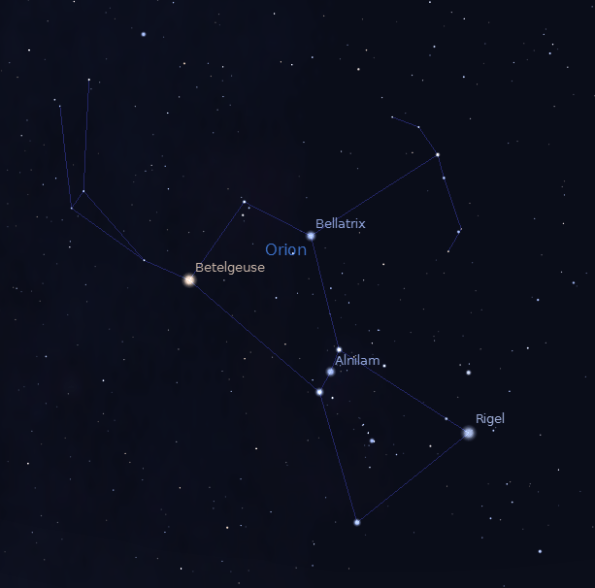
Some of Orion’s star names. Orion at 9 p.m. January 4, 2016. Created using Stellarium.
11/30/2015 – Ephemeris – Orion Rising
Ephemeris for Monday, November 30th. The Sun will rise at 7:58. It’ll be up for 9 hours and 5 minutes, setting at 5:04. The Moon, 3 days before last quarter, will rise at 10:12 this evening.
We have a few hours of darkness tonight before the Moon comes up. In the east the central winter constellation Orion the hunter throws a leg over the horizon between 8 and 9 p.m. as Robert Frost told in his poem Star-Splitter. The upright rectangle that is his body on January evenings is tilted to the left as he rises, with bright red star Betelgeuse at the top left of the rectangle, his shoulder. At the opposite corner is blue-white Rigel, a knee. In the center of the rectangle is a line of three stars nearly vertically aligned, which represents Orion’s belt. Above Orion is another bright orange star at one end of a letter V shape of stars. That’s Aldebaran the angry eye in the face if Taurus the bull who apparently is none to happy with Orion.
Times are for the Traverse City/Interlochen area of Michigan. They may be different for your location.
Addendum
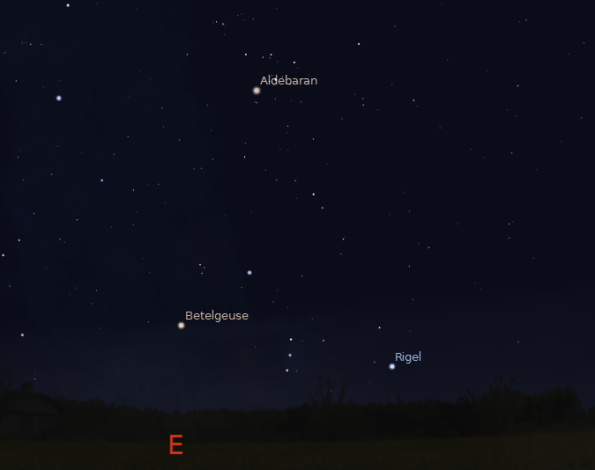
Orion Rising at 8:30 p.m. (3 1/2 hours after sunset) on November 30th. Created using Stellarium.
11/20/2015 – Ephemeris – Finding the bright stars of November
Ephemeris for Friday, November 20th. The Sun will rise at 7:46. It’ll be up for 9 hours and 24 minutes, setting at 5:10. The Moon, 1 day past first quarter, will set at 2:17 tomorrow morning.
The Moon is beginning to brighten up the sky making constellation spotting somewhat difficult, so I thought we’d look for the brightest stars. High in the west are the three stars of the Summer Triangle. At the bottom in the southwest is Altair, the first of these to set. A bit north of west the brightest, Vega. Highest in the west is Deneb, which won’t officially set for those Interlochen northward. Low in the south is the loneliest star Fomalhaut. In the northeast is the winter star Capella, which also doesn’t set for the IPR listener area, but spends summer nights hiding behind hills and trees in the north. Low in the east is the last of our bright stars, Aldebaran in Taurus the bull, which will be playing hide and seek with the Moon next week.
Times are for the Traverse City/Interlochen area of Michigan. They may be different for your location.
Addendum
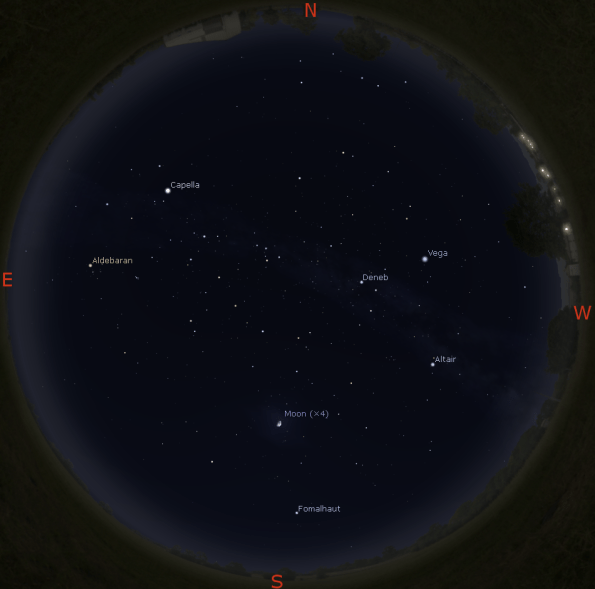
The bright first magnitude stars of autumn shown for 8 p.m. November 20, 2015. If you are closer to your time meridian, we’re 43 minutes behind ours, you will see two more bright stars in the east: Red Betelgeuse and blue-white Rigel. Created using Stellarium.
02/16/2015 – Ephemeris – The Winter Circle
Feb 16. This is Bob Moler with Ephemeris for President’s Day, Monday, February 16th. The sun will rise at 7:42. It’ll be up for 10 hours and 30 minutes, setting at 6:12. The moon, 2 days before new, will rise at 6:25 tomorrow morning.
The winter skies are blessed with more first magnitude stars than any other season. That’s a full one-third of the total are seen is a relatively small area. Six of these stars lie in a large circle centered on the seventh. This circle is up at 9 p.m. Starting high overhead is Capella in Auriga the charioteer. Moving down clockwise is Aldebaran in the face of Taurus the Bull. Then down to Orion’s knee we find Rigel. Down and left is the brightest star of all Sirius the Dog Star in Canis Major, lowest of these stars in the south-southeast. Moving up and left is Procyon in Canis Minor, Above Procyon is Pollux in Gemini the twins. All these are centered on Betelgeuse the bright red star in Orion’s shoulder.
Times are for the Traverse City/Interlochen area of Michigan. They may be different for your location.
Addendum
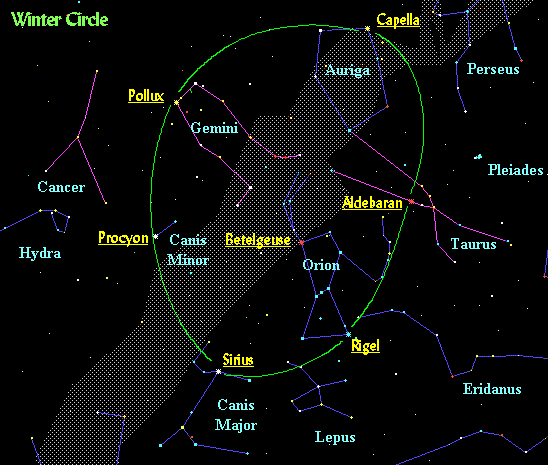
The Winter Circle of 1st magnitude stars
02/12/2015 – Ephemeris – The brilliant blue star in Orion: Rigel
Ephemeris for Thursday, February 12th. The sun will rise at 7:47. It’ll be up for 10 hours and 18 minutes, setting at 6:06. The moon, 1 day past last quarter, will rise at 2:52 tomorrow morning.
Two days ago I talked about the star Betelgeuse the bright red star in the top left of Orion’s upright rectangle. Orion is seen in the south at 9 in the evening. The blue-white star in Orion’s opposite corner is usually brighter. It is Rigel whose longer Arabic name of which Rigel is the first part means Left Leg of the Giant. Rigel is a giant itself, actually a super giant star, which is more a measure of its mass than its size, that of 21 solar masses. Its surface temperature is more than twice as hot as the sun. It is 120 thousand times as bright as the sun and 78 times its diameter. Its distance is around 860 light years. Those with telescopes might be able to spot a close companion star to Rigel, just at the edge of the bright arc light image of Rigel itself.
Times are for the Traverse City/Interlochen area of Michigan. They may be different for your location.
Addendum
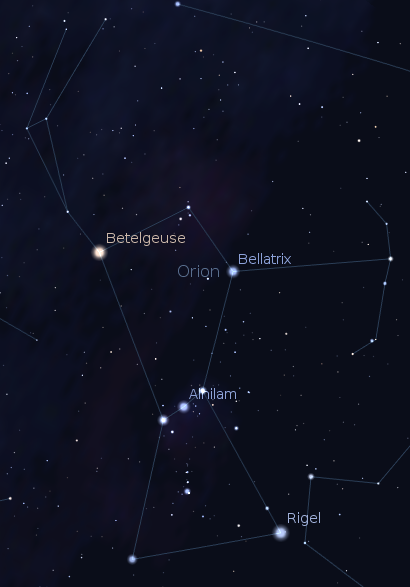
Orion upright and due south. Created using Stellarium.
Rigel with its companion star as photographed through a telescope. No attribution. Source: http://washedoutastronomy.com/content/urban-orion?page=1
12/15/2014 – Ephemeris – How to find Orion through the evening
Ephemeris for Monday, December 15th. The sun will rise at 8:12. It’ll be up for 8 hours and 50 minutes, setting at 5:02. The moon, 1 day past last quarter, will rise at 2:15 tomorrow morning.
At 7 p.m. tonight the great central constellation of winter Orion is struggling to rise, with the top half of him in the eastern sky. By 9 p.m. he’s whole and low in the east-southeast. By midnight he has taken his rightful place as the central winter constellation. In the evening now his distinctive belt of three stars in a straight line, by which most folks can find him, is more or less vertical in the sky. His brightest stars are Betelgeuse a red star to the left of the belt and blue-white Rigel to the right. When Orion’s the highest in the south we’ll explore the wonders within this constellation, the most famous constellation world over. Parts of it can be seen at the north and south poles of the Earth. The Big Dipper, which isn’t a real constellation, doesn’t hold a candle to it.
Times are for the Traverse City/Interlochen area of Michigan. They may be different for your location.
Addendum
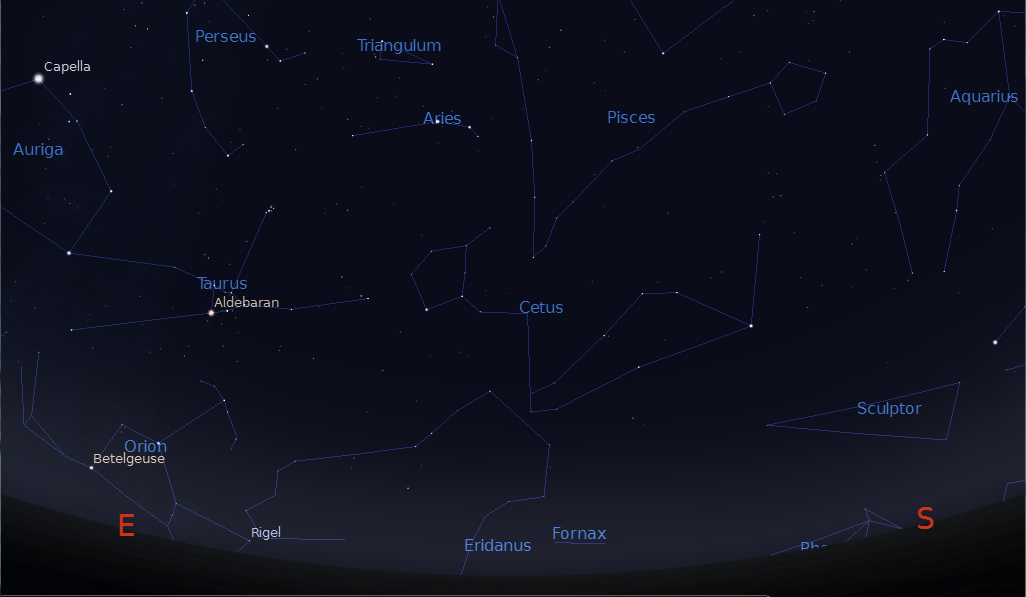
Orion rising at 7 p.m. December 15, 2014. Created using Stellarium.
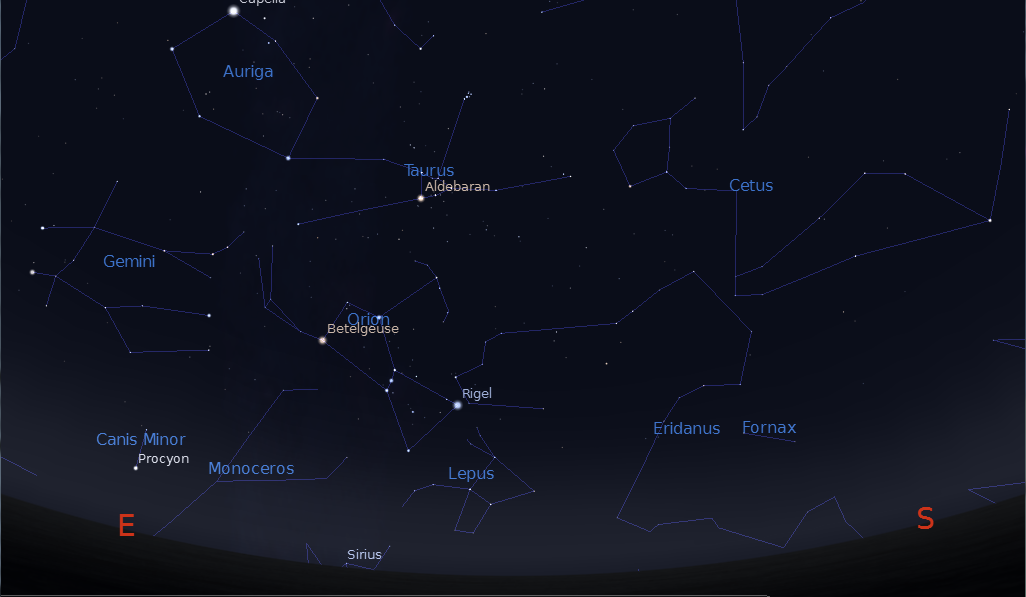
Orion rising higher at 9 p.m. December 15, 2014. Created using Stellarium.
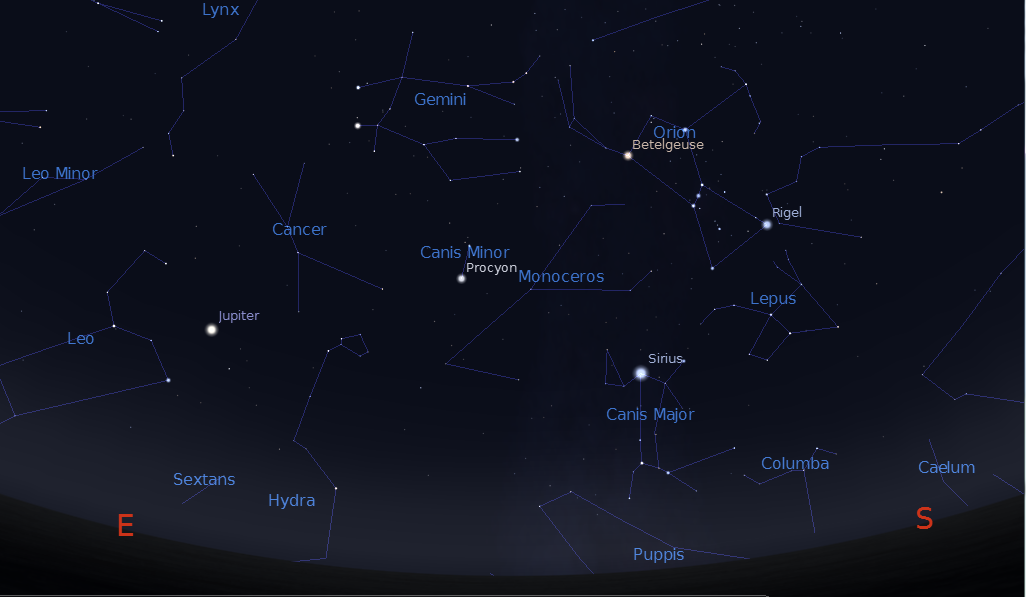
Orion close to the meridian at 12 midnight, December 16, 2014. There is distortion in this projection. Orion is standing straighter in the real sky than shown here. Created using Stellarium.
 Bob Moler's Ephemeris Blog