Archive
Ephemeris: 09/10/2024 – What last Saturday’s opposition from the Sun means
This is Ephemeris for Tuesday, September 10th. Today the Sun will be up for 12 hours and 45 minutes, setting at 8:01, and it will rise tomorrow at 7:17. The Moon, 1 day before first quarter, will set at 11:17 this evening.
Last Saturday the planet Saturn moved in opposition to the Sun. It’s not an insurrection or anything, but Saturn was opposite the Sun in the sky. At that time Saturn would be closest to the Earth of some 806 million miles (900 km). Saturn is 9 1/2 times the distance of the Earth to the Sun so over the year as Saturn moves from opposition through conjunction with the Sun to opposition again it does not vary in size very much, unlike Venus and Mars which are closer to us and vary a lot in size over their period around our sky. Saturn is now an evening planet and so will become a fixture in our evening skies for the next 4 or so months. It lies in a star poor part of the sky so it’s easy to find. Saturn’s rings are now nearly edge on to us so in a small telescope Saturn looks like a tiny disk stapled onto the sky with the staple being a bright line through the planet.
The astronomical event times given are for the Traverse City/Interlochen area of Michigan (EDT, UT – 4 hours). Times will be different for other locations.
Addendum
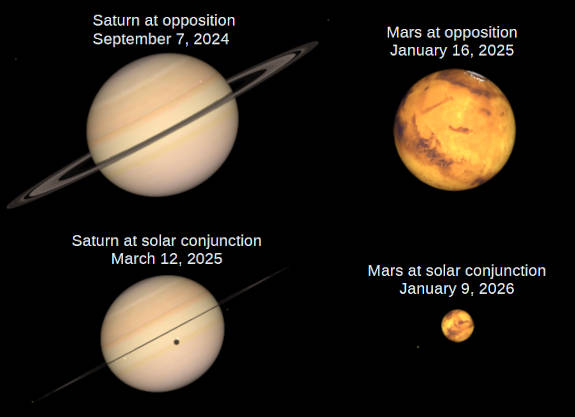
* Mars has a fairly elliptical orbit and next January’s opposition is almost at its farthest. In 2003 Mars was as close as that it has gotten in 50,000 years, or so they tell me. At that time Mars’ apparent size was 72% larger than it will be next January. Mars has its closest oppositions to the Earth every 15 or 17 years. The last time it occurred was in 2018, and the next time will be in 2035.
Ephemeris: 08/25/2023 – Saturn will reach opposition on Sunday
This is Ephemeris for Friday, August 25th. Today the Sun will be up for 13 hours and 35 minutes, setting at 8:32, and it will rise tomorrow at 6:57. The Moon, 1 day past first quarter, will set at 12:57 tomorrow morning.
The planet Saturn will reach opposition on Sunday. That means it will be opposite the Sun in the sky. It will be rising as the sun sets, and it will then officially become an evening planet. Opposition is the time when Saturn is the closest it gets to the Earth, in this case it’s 816 million miles (1 billion 314 million kilometers). In telescopes, we’ll see very little in the way of shadows of the planet on the rings and the rings on the planet, because we are almost directly in line with the Sun and Saturn. We’re actually a little north of the line, so Saturn will exhibit very thin shadows, however a pretty big telescope will be needed to see them. This is the time when Saturn appears largest in telescopes, and the rings are the brightest.
The astronomical event times given are for the Traverse City/Interlochen area of Michigan (EDT, UT –4 hours). They may be different for your location.
Addendum
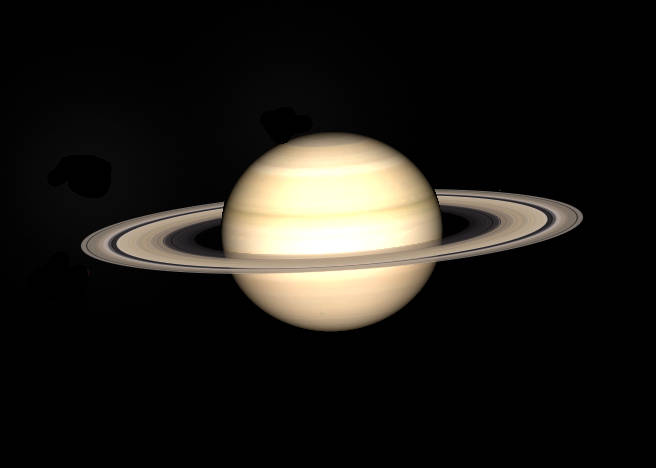
Saturn, as realized by the Stellarium planetarium app. It never appears this large in telescopes. The first time I saw Saturn in a telescope, and saw those rings, I was blown away. However, I was disappointed as to how small it was. Well, it is almost a billion miles (1.6 million kilometers) away, about twice as far as Jupiter. The extent of the rings are about as long as Jupiter’s apparent diameter, which averages about half of Saturn’s distance. Currently, the rings are getting more and more edge-on to us. The rings will be edge-on to us on March 23, 2025, nearly a year and a half from now, then begin to open up again. This is due to Saturn’s axial tilt of nearly 27 degrees, and the fact that the rings orbit the planet at its equator.
08/15/2022 – Ephemeris – Saturn moves into the evening sky
This is Ephemeris for Monday, August 15th. Today the Sun will be up for 14 hours and 3 minutes, setting at 8:48, and it will rise tomorrow at 6:46. The Moon, halfway from full to last quarter, will rise at 10:55 this evening.
Yesterday, Saturn was in opposition to the Sun. I’m not implying an argument here. Opposition is when a planet is opposite the Sun in the sky, so it rises around sunset and sets around sunrise. That means Saturn is the closest it can get to us this year. For the record, that’s 836 million miles (1,345 million kilometers). Saturn will first appear tonight in the southeast when it gets dark enough, say around 9:15 to 9:30 pm. It is in the constellation of Aquarius now. It is moving northeastward in our skies, or it would if it weren’t at opposition, and moving backward or retrograde as the Earth is, in effect, lapping Saturn in our eternal race around the Sun. Saturn’s rings appear to slowly get skinnier as the planet moves to an equinox, where its rings, which orbit its equator, will tilt edgewise to the Sun, and the Earth in 2025.
The astronomical event times given are for the Traverse City/Interlochen area of Michigan (EDT, UT – 4 hours). They may be different for your location.
Addendum
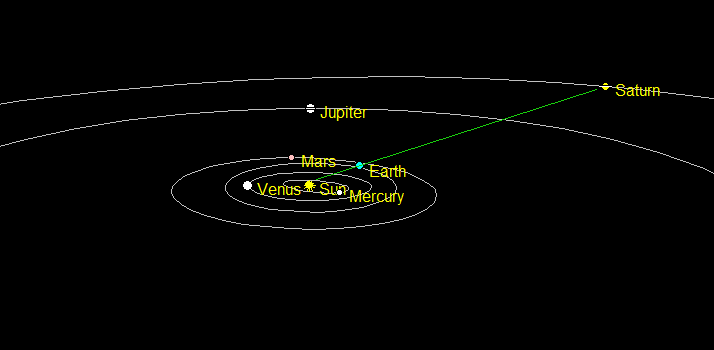
Display of the solar system out to Saturn, with added line showing Saturn’s location opposite the Sun from the Earth. This make the Earth nearly in line from the Sun to Saturn. This is the time that Saturn would be closest to the Earth. Credit: my LookingUp app. I wanted to use NASA’s Eyes, but there were too many interplanetary spacecraft near the Earth. The Earth was crowded out by spacecraft labels.
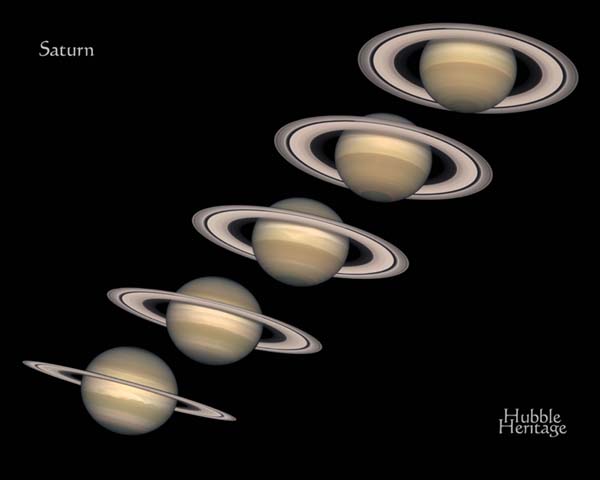
How the appearance of the rings change as Saturn orbits the Sun. Credit: NASA Hubble.
07/09/2019 – Ephemeris – Saturn is opposite the Sun in the sky today
Ephemeris for Tuesday, July 9th. Today the Sun will be up for 15 hours and 23 minutes, setting at 9:29, and it will rise tomorrow at 6:07. The Moon, at first quarter today, will set at 1:58 tomorrow morning.
Today Saturn will pass in opposition from the Sun at 12:12 p.m. It’s a time when Saturn will rise as the Sun sets, being opposite the Sun in the sky, and a time near its closest to the Earth at 841 million miles (1.354 billion km). Saturn orbits the Sun at a distance of 10 times the Earth’s distance, so Saturn’s distance from the Earth varies from 9 times to 11 times the Earth’s distance from the Sun. So it doesn’t change much in size in telescopes. This is unlike Mars which has a greater range of distances from the Earth. In telescopes the rings are the first one sees, with the planet nestled in the center. In small telescopes, it is a tiny but magnificent sight. It’s largest moon Titan is visible nearby.
The times given are for the Traverse City/Interlochen area of Michigan. They may be different for your location.
Addendum
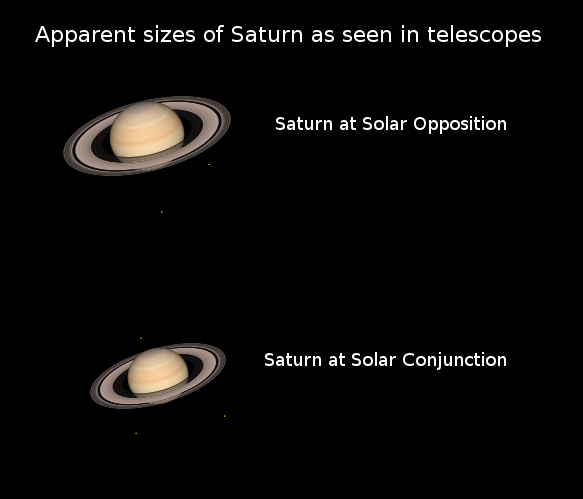
Here’s the extremes in the apparent size of Saturn from solar opposition to conjunction. Created using Cartes du Ciel.
06/28/2018 – Ephemeris – Saturn at opposition, what it means
Ephemeris for Thursday, June 28th. Today the Sun will be up for 15 hours and 32 minutes, setting at 9:32, and it will rise tomorrow at 6:00. The Moon, at full today, will rise at 9:54 this evening.
Just before midnight last night Saturn was in opposition to the Sun. We’re not talking about an argument here. To the astronomer opposition simply means that a planet, in this case Saturn, is 180 degrees from the Sun, or opposite the Sun in the sky. It is a time when the planet rises at sunset and sets at sunrise. It is also a time when the planet is around its closest to the Earth. It’s not a big deal for Saturn, which is almost 10 times farther from the Sun than we are. However it is a big deal for a nearby planet like Mars, which at the end of July will be closer to us than at any time since 2003, at 35.8 million miles. That’s a big deal since Mars is a small planet, a bit more than half the size of the Earth.
The times given are for the Traverse City/Interlochen area of Michigan. They may be different for your location.
Addendum
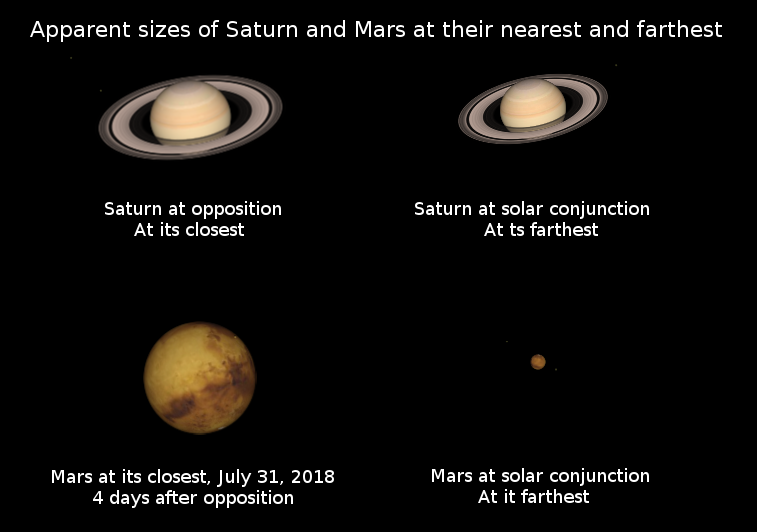
The apparent sizes of Saturn and Mars as seen from the Earth at opposition and solar conjunction. All at the same scale. Created using Cartes du Ciel (Sky Charts).
06/15/2017 – Ephemeris – Saturn is at opposition from the Sun today
Ephemeris for Thursday, June 15th. Today the Sun will be up for 15 hours and 32 minutes, setting at 9:29, and it will rise tomorrow at 5:56. The Moon, 2 days before last quarter, will rise at 1:28 tomorrow morning.
The Planet Saturn was in opposition with the Sun at 5:15 (09:15 UT) this morning. That means that it was 180 degrees from the Sun, well 178.6 degrees to be exact, because the Earth is a bit south of the Sun-Saturn line. This is a time when the shadows of the rings on the planet and planet on the rings almost disappear, due to our vantage point. Saturn is also closest now at 842 million miles (1.356 billion km). It average distance being about 940 million miles (1.5 billion km). In three months our emissary to Saturn, the Cassini spacecraft will dive beneath Saturn’s clouds to burn up after using up almost all its maneuvering fuel. Then we with our telescopes on and around Earth will remain the only link to the ringed planet.
The times given are for the Traverse City/Interlochen area of Michigan. They may be different for your location.
Addendum
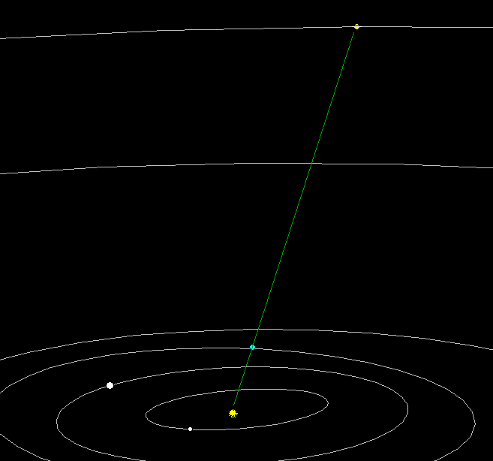
Saturn at opposition in a perspective view of the solar system which compresses the fact that Saturn is 10 times farther from the Sun as the Earth. Created using my LookingUp program.
06/02/2016 – Ephemeris – Saturn at opposition
Ephemeris for Thursday, June 2nd. Today the Sun will be up for 15 hours and 22 minutes, setting at 9:22, and it will rise tomorrow at 5:59. The Moon, 2 days before new, will rise at 5:11 tomorrow morning.
In the wee morning hours tomorrow Saturn will be in opposition from the Sun. It is a time Saturn will rise at sunset and set at sunrise. It is also a time that Saturn is closest to the Earth, so it will appear its largest in our telescopes. Saturn’s variance of apparent size over its appearance in our skies isn’t as dramatic as much closer and smaller Mars. For Saturn which orbits the Sun at nearly 10 times the Earth’s distance from the Sun varies in apparent size plus or minus 10% over it’s synodic period of 12½ months. The synodic period is the interval between oppositions or conjunctions of the Sun. One benefit of being in opposition is that Saturn and its glorious rings will be up all night.
Times are for the Traverse City/Interlochen area of Michigan. They may be different for your location.
Addendum
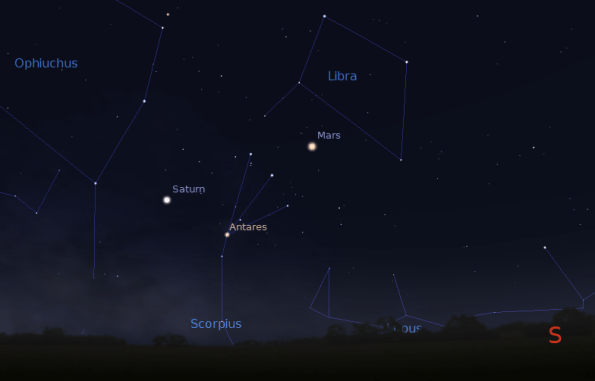
Saturn finder chart. Looking low in the south-southwest at 11 p.m., June 2, 2016. Created using Stellarium.
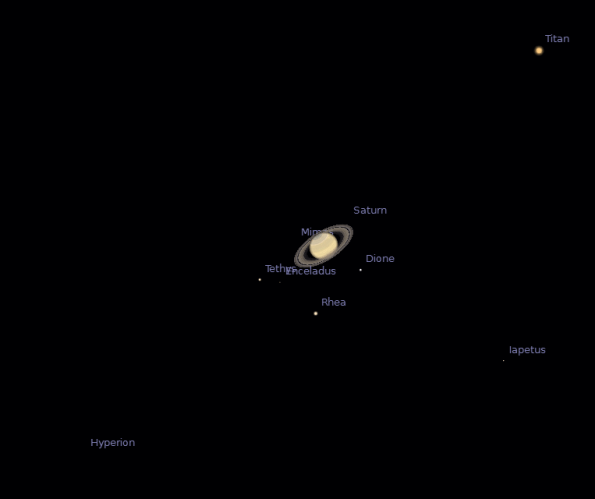
Saturn and some of its 63 moons at 11 p.m., June 2, 2016. Created using Stellarium.
05/21/2015 – Ephemeris – Saturn will reach opposition tomorrow
Ephemeris for Thursday, May 21st. Today the Sun will be up for 15 hours and 1 minute, setting at 9:10. The Moon, 3 days past new, will set at 12:21 tomorrow morning, and tomorrow the Sun will rise at 6:07.
The Planet Saturn will be at opposition from the Sun tomorrow, meaning that it is opposite the Sun in the sky, rising at sunset and setting at sunrise. It also means that Saturn is about it’s closest, brightest, and its largest appearing in telescopes. It will be 835 million miles (1,344 million km) away tomorrow. It’s rings should also be at their brightest. The rings are made of billions of particles, mostly ice. At opposition we are essentially viewing Saturn from the same direction as the Sun, and ring particle shadows on one another disappear, so the rings are brighter. Other defining shadows also disappear such as the planet’s shadow on the rings and the ring’s on Saturn, so the planet may appear kind of flat.
Times are for the Traverse City/Interlochen area of Michigan. They may be different for your location.
Addendum
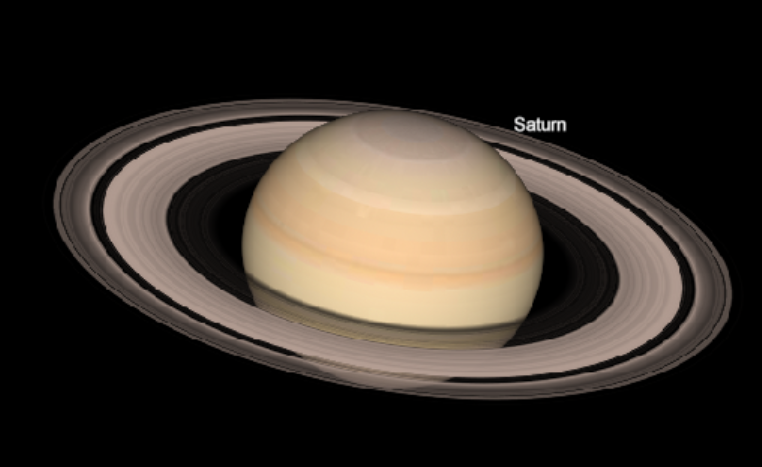
Saturn at opposition, May 22, 2015. Compare the shadow of the planet on the rings with the quadrature image below. Created using Cartes du Ceil (Sky Charts).
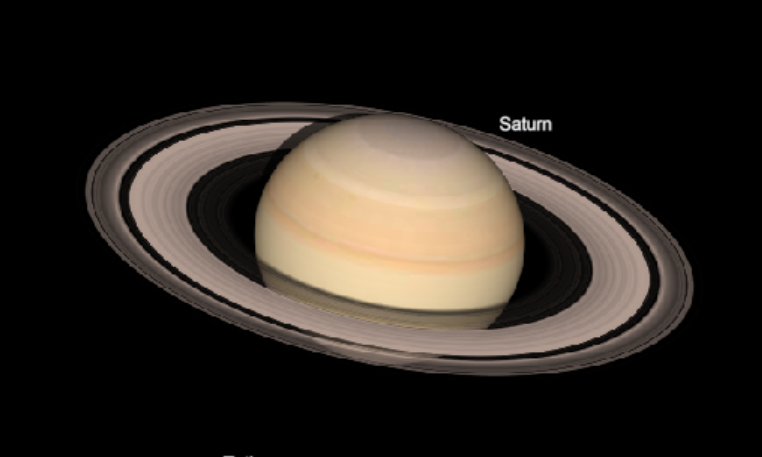
Saturn near quadrature, August 23, 2015. Compare the shadow of the planet on the rings with the opposition image above. Created using Cartes du Ceil (Sky Charts).
A superior planet’s quadrature position (90 degrees from the Sun) is the time we are the maximum amount out of line with the Sun from them. Any phase of shadows are the most pronounced. From the planet’s point of view the Earth is at greatest elongation from the Sun.
 Bob Moler's Ephemeris Blog