Archive
Ephemeris: 02/16/2026 – The Dog Star
This is Bob Moler with Ephemeris for President’s Day, Monday, February 16th. Today the Sun will be up for 10 hours and 31 minutes, setting at 6:12, and it will rise tomorrow at 7:39. The Moon, 1 day before new, will rise at 7:51 tomorrow morning.
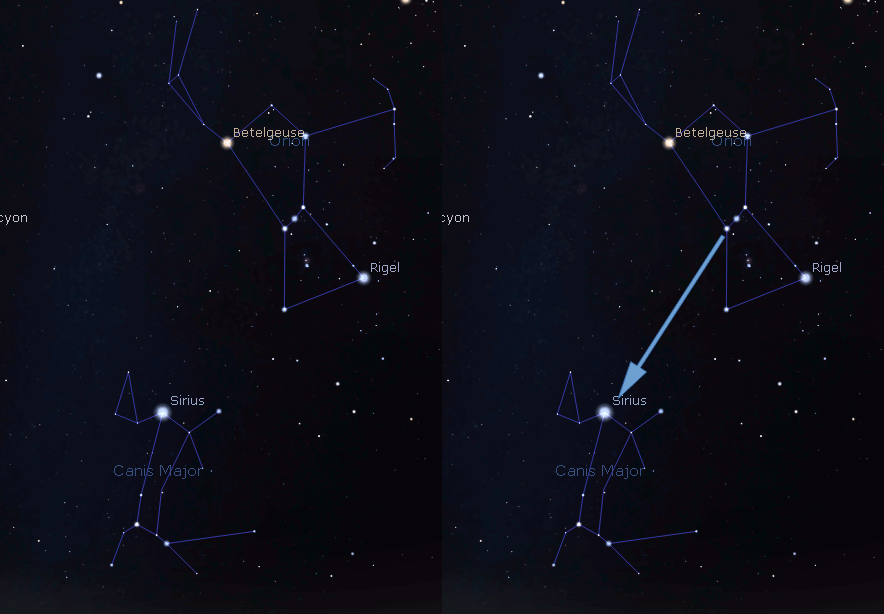
The second-brightest star-like object in the evening sky is Sirius, also known as the Dog Star. It also is the brightest nighttime star in our skies period. Tonight at 9 p.m. it’s located in the southern sky. The Dog Star name comes from its position at the heart of the constellation Canis Major, the great dog of Orion the hunter. The three stars of Orion’s belt tilt to the lower left to Sirius. Sirius means ‘Dazzling One’, because of its great brilliance and twinkling. Its Egyptian name was Sopdet, and its first appearance in the dawn skies around July 20th signaled the flooding of the Nile, and the beginning of the agricultural year. The relationship of the heliacal rising of Sirius and the seasonal or tropical year lasted from about 2900 BCE to the start of the Common Era. Sirius owes much of its brilliance to the fact that it lies close to us, only 8.6 light years away.
The astronomical event times given in this blog are for the Traverse City/Interlochen area of Michigan (Lat 44.7° N, Long 85.7° W; EST, UT – 5 hours) unless stated otherwise. Times will be different for other locations.
Addendum
Trivia Note
The Greeks invented the term “Dog days of summer” for the hottest days of July because they thought that Sirius added its intensity to the heat of the Sun to make it hotter out. So why doesn’t Sirius help warm our winter nights? Just asking.
02/28/2022 – Ephemeris – Ancient Egypt’s most important star
This is Ephemeris for Monday, February 28th. Today the Sun will be up for 11 hours and 7 minutes, setting at 6:29, and it will rise tomorrow at 7:20. The Moon, 2 days before new, will rise at 7:17 tomorrow morning.
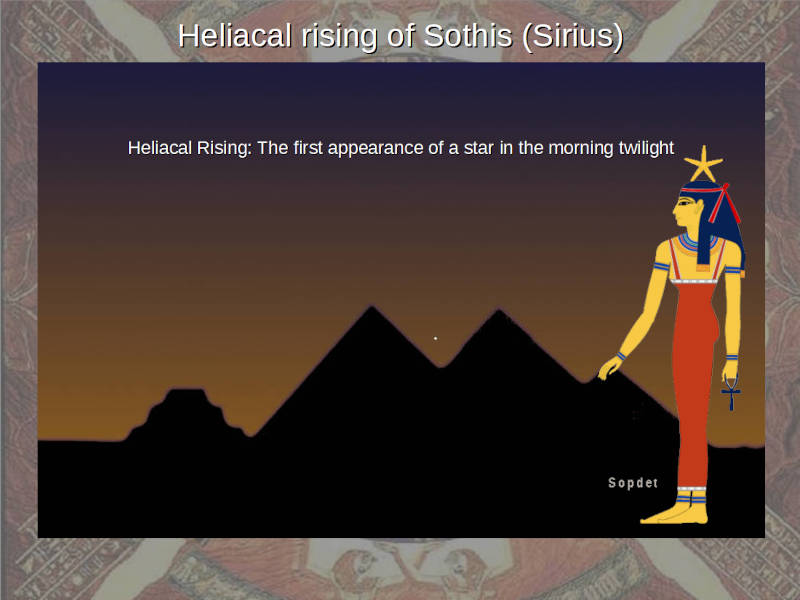
The Ancient Egyptian agricultural year began with the flooding of the Nile, which was announced by the heliacal rising of the brightest nighttime star, Sirius. A heliacal rising is the first appearance of a star in the morning twilight after disappearing in evening twilight some months before. The Greeks called the star Sothis, while the ancient Egyptians called the star Sopdet. The heliacal rising would occur on July 20th had our calendar been in use back then. The relationship between the summer solstice and the heliacal rising of Sothis, 29 days later, stayed the same for nearly three millennia, from at least 2900 BCE to 12 CE, despite precession* of the Earth’s axis moving the Sun from the middle of the constellation Leo at the summer solstice to the western edge of Cancer one and a half constellations west. Sopdet was personified by a goddess, who was the consort to Sah, who is what they called Orion.
———-
The astronomical event times given are for the Traverse City/Interlochen area of Michigan (EST, UT – 5 hours). They may be different for your location.
* Precession of the equinoxes. The slow, 26,000 year wobble of the Earth’s axis which causes the Earth, most of the time, to not have a pole star. We’re lucky to live at a time to have a bright star within a degree of the north celestial pole. That star is, of course, Polaris. Precession also changes the point in the sky, along the ecliptic and zodiac, where the Sun appears on the first day of spring, or any season. These points move westward along the ecliptic (the plane of the earth’s orbit of the Sun) one degree every 72 years.
Addendum
The Egyptian used the heliacal rising of Sirius as a signal that the flooding of the Nile was imminent, starting their agricultural year. The Greeks called the star Sothis, while the Egyptians themselves called it Sopdet, a goddess, and consort of the god Sah, our Orion.
Part of my presentation, December 2021 of Ancient Astronomy of the Egyptians and Babylonians.
 Bob Moler's Ephemeris Blog