Archive
Ephemeris: 03/20/2026 – Spring begins today!
This is Ephemeris for Friday, March 20th. Today the Sun will be up for 12 hours and 9 minutes, setting at 7:55, and it will rise tomorrow at 7:43. The Moon, 2 days past new, will set at 10:21 this evening.
At 10:46 AM today the season of spring will begin. It may or may not feel it in our neck of the woods, but astronomically at that time the Sun will appear to cross a point in the sky called the vernal equinox. Equinox means equal night, when the Sun is up for 12 hours, and set for 12 hours. It does, if you don’t look too closely, and in the old days clocks weren’t that accurate anyway. The vernal equinox is the point in the sky where the Sun crosses the celestial equator, which is above the Earth’s equator heading north. The North Pole will begin 6 months of daylight, while the rest of the Northern Hemisphere will bask in more than 12 hours of sunlight a day. The reverse is true in the Southern Hemisphere where autumn will start.
The astronomical event times given in this blog are for the Traverse City/Interlochen area of Michigan (Lat 44.7° N, Long 85.7° W; EST, UT – 5 hours) unless stated otherwise. Times will be different for other locations.
Addendum
Ephemeris: 03/06/2026 – The Fisher announces the coming of the maple sugaring season
This is Ephemeris for Friday, March 6th. Today the Sun will be up for 11 hours and 25 minutes, setting at 6:37, and it will rise tomorrow at 7:09. The Moon, 3 days past full, will rise at 10:30 this evening.
March is a month of transitions. The stars of the winter skies, that is Orion and his merry band of bright stars, move to the west as those of spring rise in the east. The Big Dipper is ascending in the northeastern sky, after lying low in the north during the long dark evenings in the heart of winter. The dipper is the hind end of the Great Bear, officially Ursa Major. The Anishinaabe peoples of the Great Lakes region saw the Big Dipper as the hind end and tail of a magical creature called Fisher, or in their language Ojiig, who brought summer to the Earth. Its position in the sky around the pole announces the seasons. The Fisher’s ascension high into the northeastern sky signals the start of the maple sugaring season later this month.
The astronomical event times given in this blog are for the Traverse City/Interlochen area of Michigan (Lat 44.7° N, Long 85.7° W; EST, UT – 5 hours) unless stated otherwise. Times will be different for other locations.
Addendum
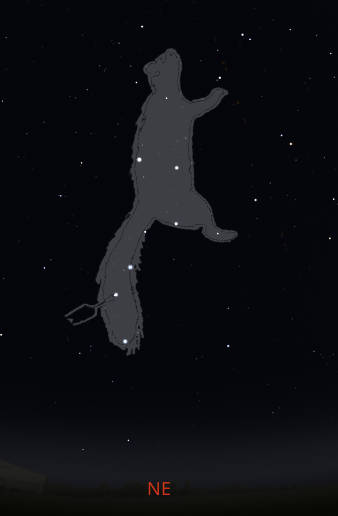
For the story of the Fisher, and how he got that arrow stuck in his tail, check out The story of the Fisher Star.
Ephemeris: 03/20/2025 – Spring has sprung!
This is Ephemeris for Thursday, March 20th. Today the Sun will be up for 12 hours and 10 minutes, setting at 7:55, and it will rise tomorrow at 7:43. The Moon, 2 days before last quarter, will rise at 2:57 tomorrow morning.
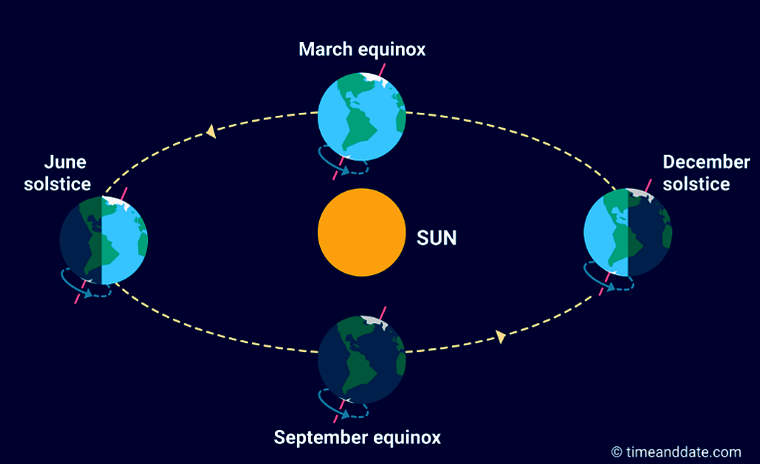
At 5:02 AM this morning the Sun passed overhead on the Earth’s equator heading northward beginning the season of spring. It is called the vernal or spring equinox also the March equinox if you didn’t care which hemisphere you lived in. Anyway, our daylight hours become longer and longer until June 21st the first day of summer. We have been seeing the effects of all this because all winter long the daylight hours have been getting longer and now in the last few weeks our temperatures have begun to rise, especially last Friday and Saturday. Along with the increased daylight hours the Sun is also getting higher in the sky giving us a more concentrated heating, it’s light and heat not being spread out as much as it was during the winter.
The astronomical event times given are for the Traverse City/Interlochen area of Michigan (EDT, UT – 4 hours). Times will be different for other locations.
Addendum
Ephemeris: 02/27/2025 – The spring constellations are rising
This is Ephemeris for Thursday, February 27th. Today the Sun will be up for 11 hours and 5 minutes, setting at 6:28, and it will rise tomorrow at 7:21. The Moon is new today, and won’t be visible.
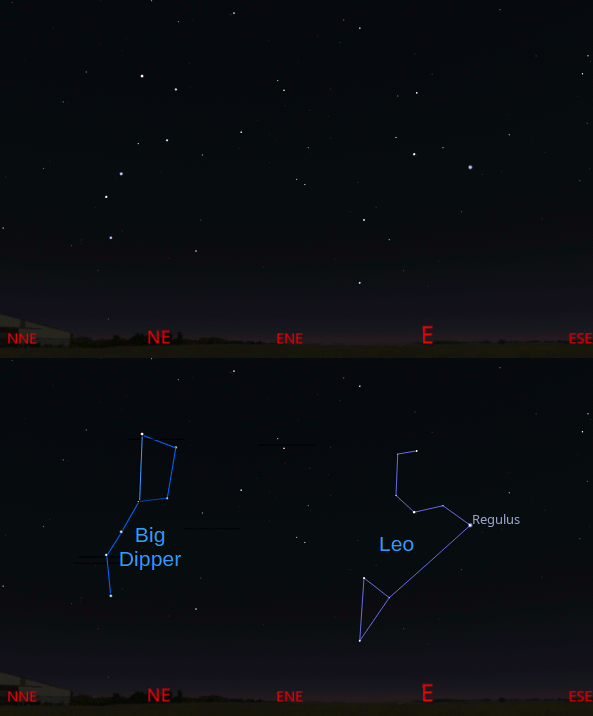
Today, we are exactly 3 weeks from the start of spring. The temperatures this week are rising. Even though at 8:00 PM Orion is high in the south, looking off to the east the spring constellation of Leo the lion has risen, and the Big Dipper is standing on its handle in the northeast. To the Anishinaabe native peoples of this area the Big Dipper is part of Ojiig, the Fisher, who brought summer to the Earth and when he’s in this position in the northeastern skies standing on his tail it is a sign of the spring to come and the start of the maple sugaring season. This next week or so is especially the best time, all year, to see the planet Mercury in the evening twilight due west, shortly after sunset. Its greatest separation from the Sun will come March 8th.
The astronomical event times given are for the Traverse City/Interlochen area of Michigan (EST, UT – 5 hours). Times will be different for other locations.
Addendum
Ephemeris: 03/29/2024 – Calculating the date of Easter
This is Ephemeris for Good Friday, March 29th. Today the Sun will be up for 12 hours and 39 minutes, setting at 8:07, and it will rise tomorrow at 7:26. The Moon, 3 days before last quarter, will rise at 1:09 tomorrow morning.
Easter will be celebrated by Western Christian churches this Sunday. Easter is a movable feast in that it falls on a different date each year following the first full moon of spring. It was an attempt to follow the Jewish Passover, which starts on the 15th of the month of Nisan. The Jewish calendar being a lunar calendar, the 15th is generally the night of the full moon, sometimes called the Paschal Full Moon. And since the Last Supper was a Seder, according to at least one Gospel, the Christian church wanted to link Easter with Passover as closely as possible using the Roman solar based (Julian) calendar. That’s not always the case, especially with our current Gregorian Calendar. Passover this year begins at sunset April 22nd because the Jewish lunar calendar is tied to the Julian Calendar.
The astronomical event times given are for the Traverse City/Interlochen area of Michigan (EDT, UT–4 hours). They may be different for your location.
Addendum
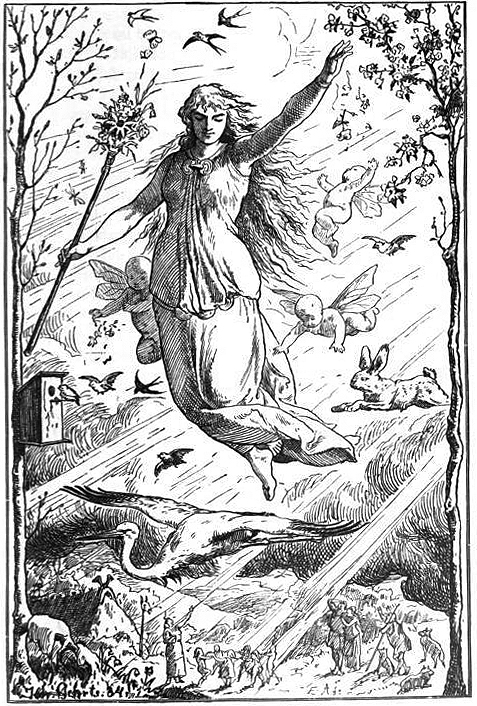
Ephemeris: 03/19/2024 – Today is the last day of winter and the first night of spring
This is Ephemeris for Tuesday, March 19th. Today the Sun will be up for 12 hours and 8 minutes, setting at 7:54, and it will rise tomorrow at 7:44. The Moon, 2 days past first quarter, will set at 6:13 tomorrow morning.
Today, at least in daylight, is the last day of winter. Tonight will be the first night of spring, since spring will arrive at 11:07 pm tonight. This is when the Sun crosses the celestial equator heading northward in the sky, which is actually the Sun moving so it passes overhead and moving north of the equator on the Earth. This gives us in the Northern Hemisphere longer days and warmer temperatures. We call it the vernal or spring equinox. However since some folks are living south of the equator, and are starting autumn at the same time. We sometimes call it the March equinox to recognize that fact. From now until June 20th the Sun will be moving higher in our sky and be staying out longer each day.
The astronomical event times given are for the Traverse City/Interlochen area of Michigan (EDT, UT–4 hours). They may be different for your location.
Addendum
03/21/2023 – Ephemeris Extra – Spring has sprung without me
Being in the hospital and now in inpatient rehab one loses a sense of time. So the vernal equinox snuck by me unnoticed. My view of the outside world is another part of the hospital, a part of the HVAC system, and a piece of sky.
Yesterday, the Sun passed over the Earth’s equator, heading northward. The Sun is gradually setting at the South Pole and rising at the North Pole. Folks like me who live in the Northern Hemisphere are experiencing longer daylight than those south of the equator, who are beginning autumn. The daylight hours will increase daily until June 21st, the summer solstice. In the Interlochen/Traverse City area, that will be 15 hours and 34 minutes.
The cause of the Earth’s seasons is not our varying distance from the Sun in our eliptical orbit of the Sun of 93 million plus or minus a million and a half miles.By the way, the Earth is currently moving away from the Sun. It will be farthest from the Sun around July 4th or 5th.
Our perception of the advance of spring, besides the gradully warming temperatures and increasing daylight hours, will be the height of the Sun’s path in the sky, and the position of the Sun’s rise and set points on the horizon. All these annual changes are angles having to do with one’s latitude (an angle), Earth’s position in orbit (an angle), and the tilt of the Earth’s axis to it’s orbit (more angles).
Bob
06/20/2022 – Ephemeris – Here we are at the last full day of spring
This is Ephemeris for Juneteenth, Observed, Monday, June 20th. Today the Sun will be up for 15 hours and 34 minutes, setting at 9:31, and it will rise tomorrow at 5:57. The Moon, at last quarter today, will rise at 2:09 tomorrow morning.
Here we are at the last full day of spring. Summer will begin at 5:14 EDT, or 9:14 UT tomorrow morning, when the Sun reaches its highest point on the celestial sphere, and directly over the northern latitude line called the Tropic of Cancer. At that time, folks at or north of the Arctic Circle at about 66 ½ degrees north latitude won’t see the Sun set. As it is, Interlochen is only about 4 degrees latitude south of the land of the all night twilight. It’s neat, around here in the western part of the Lower Michigan, to go out around midnight and see a bit of the last twilight glow near the north. Remember that around here, local or astronomical midnight occurs around 1:45 am. Ah politicians, aren’t they wonderful. And they’ve just made Daylight Saving Time permanent.
The astronomical event times given are for the Traverse City/Interlochen area of Michigan (EDT, UT – 4 hours). They may be different for your location.
Addendum
The event at 5:14 am EDT or 9:14 UT is called the summer solstice, or in deference to our Southern Hemisphere neighbors, the June solstice, because for them winter is starting. Solstice means “Sun stands still”. It doesn’t, of course. The sun is always moving eastward against the stars. However, if one checks the altitude of the Sun in the south at local noon each day, the Sun would move higher each day since the winter solstice until around June 21st, and go no further. It would slowly begin a retreat, day by day. That pause at the highest point is the solstice.
03/19/2021 – Ephemeris – Enjoy this last full day of winter!
This is Ephemeris for Friday, March 19th. Today the Sun will be up for 12 hours and 7 minutes, setting at 7:54, and it will rise tomorrow at 7:45. The Moon, 2 days before first quarter, will set at 2:23 tomorrow morning.
Spring is almost here. It will arrive at 5:37 tomorrow morning, so this is the last full day of winter, such as it was. That point in time and the point in the sky where the Sun crosses the celestial equator, the imaginary line in the sky above the Earth’s equator, heading northward is called the vernal equinox. Vernal means spring and equinox means equal night, meaning that day and night are equal, which they actually were last Tuesday. Since western civilization has spread south of the equator where the seasons are reversed, our Northern Hemisphere spring equinox is the Southern Hemisphere’s autumnal equinox, so to be understandable to both hemispheres we generally say March or September equinox instead.
Addendum
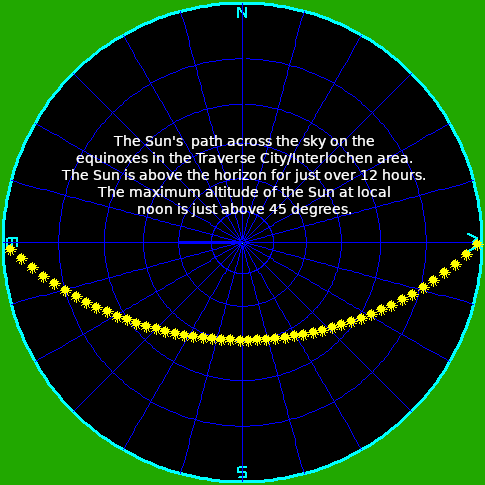
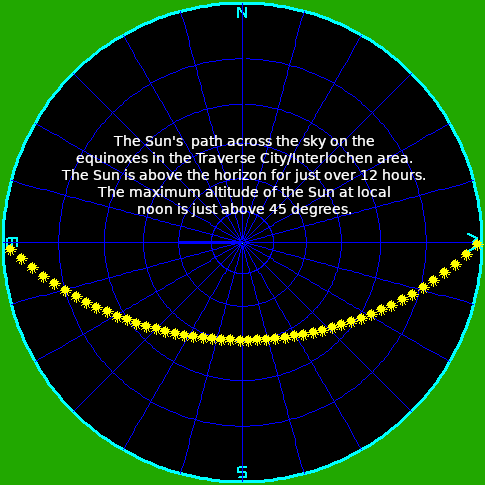
The Sun’s path through the sky on an equinox day from the Traverse City/Interlochen area in Michigan. The Sun is plotted every 15 minutes. This is a stereographic projection which compresses the sky near the zenith and enlarges the sky toward the horizon. Created using my LookingUp program.
03/20/2020 – Ephemeris – The first full day of spring
Ephemeris for Friday, March 20th. Today the Sun will be up for 12 hours and 11 minutes, setting at 7:55, and it will rise tomorrow at 7:43. The Moon, half way from last quarter to new, will rise at 7:00 tomorrow morning.
Spring snuck up on us at 11:50 p.m. last night, so this is the first full day of spring. That point in time and the point in the sky where the Sun crossed the celestial equator the imaginary line in the sky above the Earth’s equator heading northward is called the vernal equinox. Vernal means spring and equinox means equal night, meaning that day and night are equal. Since western civilization has spread south of the equator where seasons are reversed, our northern hemisphere spring equinox is the southern hemisphere’s autumnal equinox, so to be fair to both hemispheres we generally say March or September equinox instead. However the point in the sky the Sun crossed last night will always be known as the vernal equinox.
The event times given are for the Traverse City/Interlochen area of Michigan. They may be different for your location.
Addendum
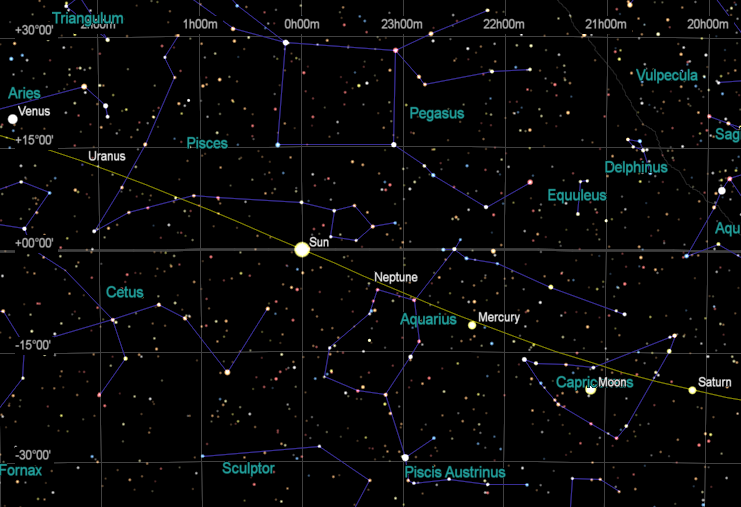
The Sun at the vernal equinox point on the celestial sphere at 11;50 p.m. EDT last night (March 19, 2020). The diagonal yellow line in the ecliptic, the Sun’s path in the sky. The vertical lines marked in hours at the top are lines of right ascension, the analog of earthly longitude. The horizontal lines are lines of declination, the same as latitude on the Earth. I referenced this point in yesterday’s program. Created using Cartes du Ciel *Sky Charts).
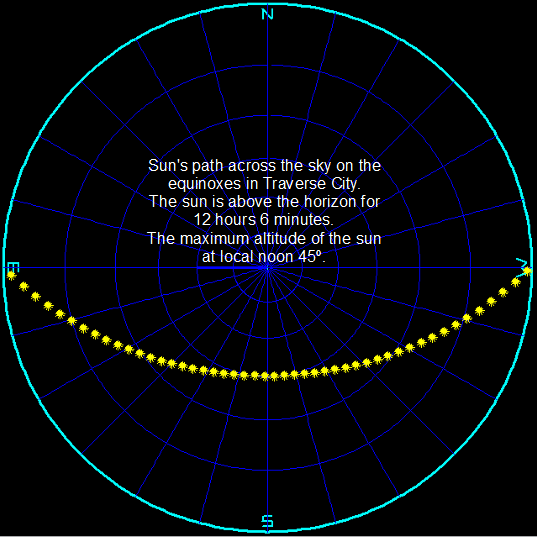
The Sun’s path through the sky on the equinox day from Traverse City, MI. Note that the Sun rises due east and sets due west. Created using my LookingUp program.
 Bob Moler's Ephemeris Blog