Archive
Ephemeris: 06/05/2025 – The free planetarium program I use
This is Ephemeris for Thursday, June 5th. Today the Sun will be up for 15 hours and 26 minutes, setting at 9:24, and it will rise tomorrow at 5:58. The Moon, 3 days past first quarter, will set at 3:14 tomorrow morning.
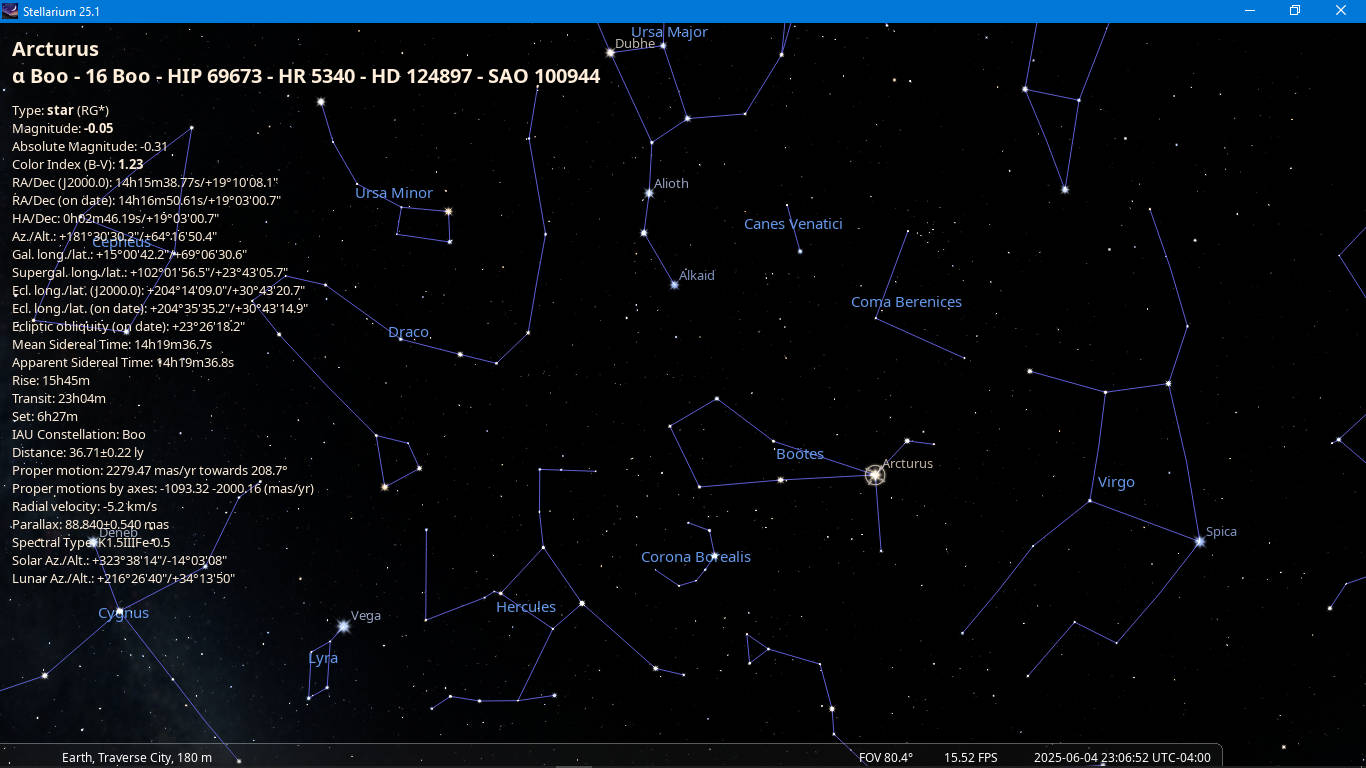
Due to my physical shortcomings, which started about five years ago, I’m not able to get out under the stars as much as I used to. My observing is basically confined to star parties that the Grand Traverse Astronomical Society hosts. Most of my “observing” is done using a planetarium program called Stellarium. It is, to my mind, the best and most accurate portrayal of the heavens of the planetarium programs that I’ve seen, and it’s free and open source! It can be downloaded from the Internet for computers: Windows, Macs, and Linux from stellarium.org. A web based version, which you don’t even have to download, is stellarium-web.org. There’s also versions for Android smartphones, iPhones and tablets.
Addendum
02/03/2016 – Ephemeris – Though a morning planet, Jupiter can be seen in the late evening
Ephemeris for Wednesday, February 3rd. The Sun will rise at 8:00. It’ll be up for 9 hours and 53 minutes, setting at 5:53. The Moon, 3 days past last quarter, will rise at 4:27 tomorrow morning.
Let’s check out the whereabouts of the bright naked eye planets. All the classical planets visible from antiquity are officially now in the morning sky. However Jupiter actually will rise at 9 p.m., in the east. Jupiter is still a morning planet since it’s not up at sunset. Mars will rise next at 1:45 a.m. in the east-southeast. It’s left of the bright star Spica. Saturn will rise at 4:05 a.m. in the east-southeast. The Moon will be below, left of it tomorrow morning. Venus will rise at 6:19 a.m. again in the east-southeast. Mercury will rise behind Venus at 6:36. Comet Catalina is up all night and is a binocular object in the dark expanse of the constellation Camelopardalis between the bowl of the Big Dipper and the W shape of Cassiopeia.
Times are for the Traverse City/Interlochen area of Michigan. They may be different for your location.
Addenda
Planets
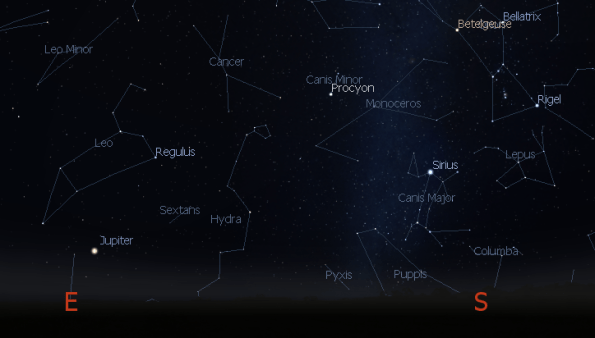
Jupiter low in the east at 10 p.m. on February 3rd, 2016. Created using Stellarium.
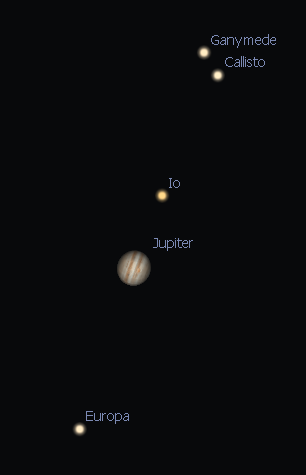
Jupiter and its moons as they would be seen in a telescope, at 10 p.m. February 3, 2016. I’d wait for an hour to let Jupiter rise above the thick atmosphere near the horizon for better clarity. Created using Stellarium.
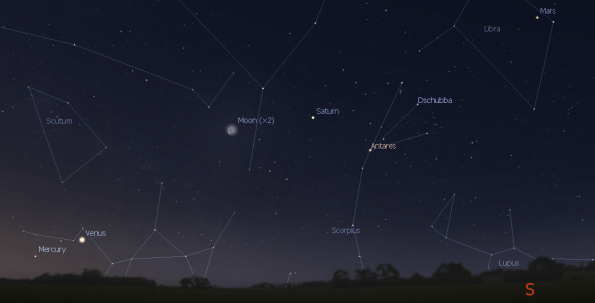
The planets in the morning sky at 7 a.m. on February 4, 2016. Jupiter is far to the west and out of this view. Created using Stellarium.
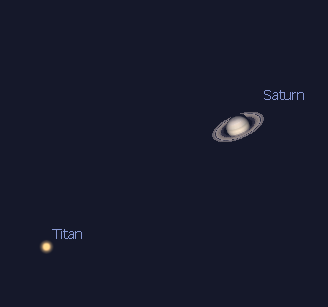
Saturn and its satellite Titan as they should appear in a telescope at 7 a.m. February 4, 2016
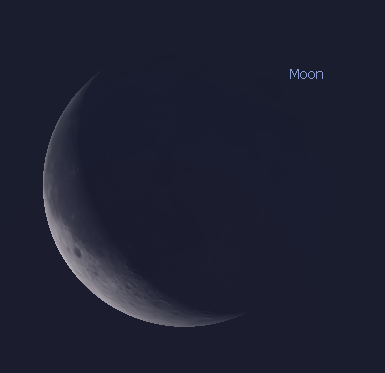
The Moon as it should appear in binoculars tomorrow morning at 7 a.m., February 4, 2016. Created using Stellarium.
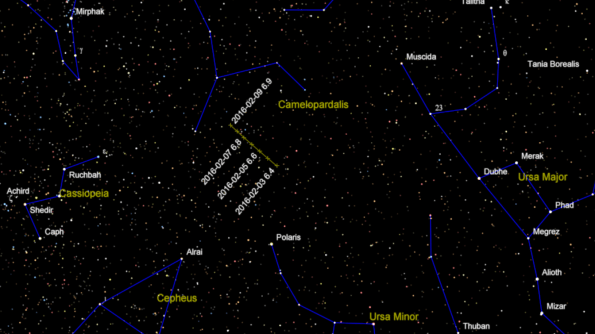
Comet Catalina’s path for the next week. Note that the magnitudes for the comet are about correct. It will take binoculars or a small telescope to spot the comet which will not show a tail visually. Created using Stellarium.
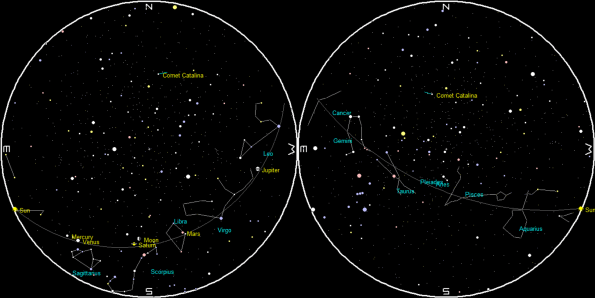
This is a chart showing the sunrise and sunset skies for February 3, 2016 showing the location of the planets, the Moon and Comet Catalina at that time. Created using my LookingUp program.
Off Topic
Stellarium
I’m now using Stellarium 0.14. It can detect older PCs and will not always crash, though I’m not thrilled with how it operates and some screen faults. The Portable Apps version has a patch that can be added to the application. The instructions for the patch are in the download page. Simply search “portable apps” to get started. The portable apps version worked better than the installed version, so I use the portable apps version. It turns out that my laptop can run 0.14, while my desktop cannot. The legacy version of Stellarium is 0.12.5.
It finally cleared up. For a while.
I bought myself a DSLR camera for my birthday/Christmas present a month and a half ago. I used to do a fair amount of astrophotography back before CCDs took over. I had some point and shoot digital cameras, which were not suitable for astrophotography. My last big spurge with film was for Comet Hale-Bopp in 1997.
But with the solar eclipse coming up next year the bug is biting again. I hate to brag but I’ve seen 4 total solar eclipses (1963, 1970, 1972, and 1979), plus 2 annular eclipses. I will recount my experiences with those eclipses in the year leading up to August 21, 2017.
In my film days I had developed a system for setting exposures for the Moon, planets, solar and lunar eclipses, and other possibly faint objects. It took a search to locate the data and used it when it finally cleared up on Ground Hog day. Below is one of the photos.
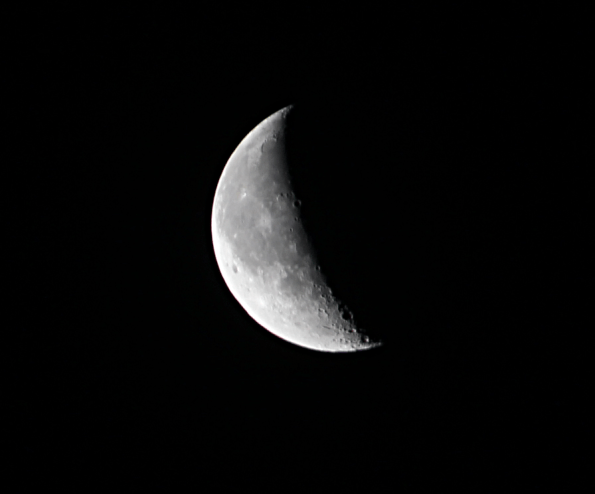
The fat crescent Moon at 7:02 a.m. February 2, 2016. ISO 100, 300mm focal length, f/11, 1/15 second.
 Bob Moler's Ephemeris Blog